
Judge, 1923-07-21 · page 8 of 36
Judge — July 21, 1923 — page 8: what you’re looking at
What you’re looking at
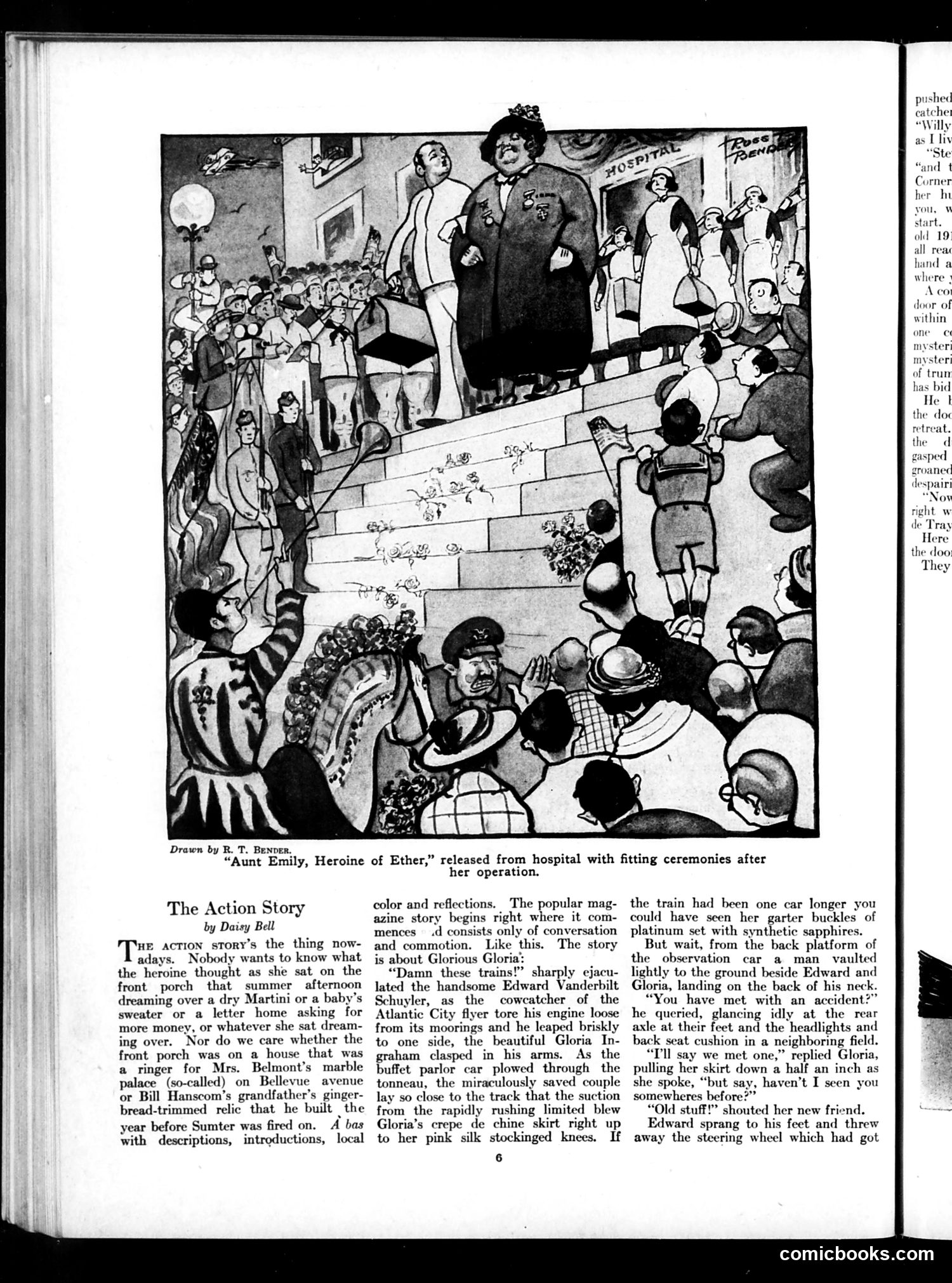
This page satirizes the formulaic "action story" genre popular in early 20th-century magazines. The author Daisy Bell mockingly critiques how modern stories have abandoned psychological depth—what characters think or feel, descriptions of settings—in favor of pure sensationalism and rapid-fire dialogue. The accompanying illustration by R.T. Bender depicts the absurd climax: a train accident where the beautiful Gloria is miraculously rescued by handsome Edward Vanderbilt Schuyler, observed by crowds. The satire intensifies with the sample story text, which piles on melodramatic clichés: aristocratic names, implausibly timed rescues, and oddly specific details (platinum garters with "synthetic sapphires") designed to titillate rather than inform. The joke is that in pursuing pure action and novelty, such stories become ridiculous—prioritizing brief skirt-lifting moments and convenient coincidences over narrative coherence or character development. It's a critique of sensationalism masquerading as modern storytelling.
📄 Transcribed text from this page (OCR, searchable)
Machine-transcribed from the original scan — historical spelling and the odd misread are preserved.
Drawn by R. T. BENDER, “Aunt Emily, Heroine The Action Story by Daisy Bell T= ACTION sTory’s the thing now- adays. Nobody wants to know what the heroine thought as she sat on the front porch that summer afternoon dreaming over a dry Martini or a baby’s sweater or a letter home asking for more money, or whatever she sat dream- ing over. Nor do we care whether the front porch was on a house that was a ringer for Mrs. Belmont’s marble palace (so-called) on Bellevue avenue or Bill Hanscom’s grandfather’s ginger- bread-trimmed relic that he built the year before Sumter was fired on. A bas with descriptions, introductions, local of Ether,” released from hospital with fitting ceremonies after her operation. color and reflections. The popular mag- azine story begins right where it com- mences _.d consists only of conversation and commotion. Like this. The story is about Glorious Gloria: “Damn these trains!” sharply ejacu- lated the handsome Edward Vanderbilt Schuyler, as the cowcatcher of the Atlantic City flyer tore his engine loose from its moorings and he leaped briskly to one side, the beautiful Gloria In- graham clasped in his arms. As the buffet parlor car plowed through the tonneau, the miraculously saved couple lay so close to the track that the suction from the rapidly rushing limited blew Gloria’s crepe de chine skirt right up to her pink silk stockinged knees, If 6 the train had been one car longer you could have seen her garter buckles of platinum set with synthetic sapphires. But wait, from the back platform of the observation car a man vaulted lightly to the ground beside Edward and Gloria, landing on the back of his neck. “You have met with an accident?” he queried, glancing idly at the rear axle at their feet and the headlights and back seat cushion in a neighboring field. “Tll say we met one,” replied Gloria, pulling her skirt down a half an inch as she spoke, “but say, haven’t I seen you somewheres before?” “Old stuff!” shouted her new friend. Edward sprang to his feet and threw away the steering wheel which had got pushed catcher “Willy as [ liv “Ste “and 1 Corner her hy you, M start. old 19) all reac hand a where ; \ cor door of within mysteri of trum has bid He | the doc retreat. the d right: w de Tri Here the doo The comicbooks.com