
Judge, 1923-07-21 · page 13 of 36
Judge — July 21, 1923 — page 13: what you’re looking at
What you’re looking at
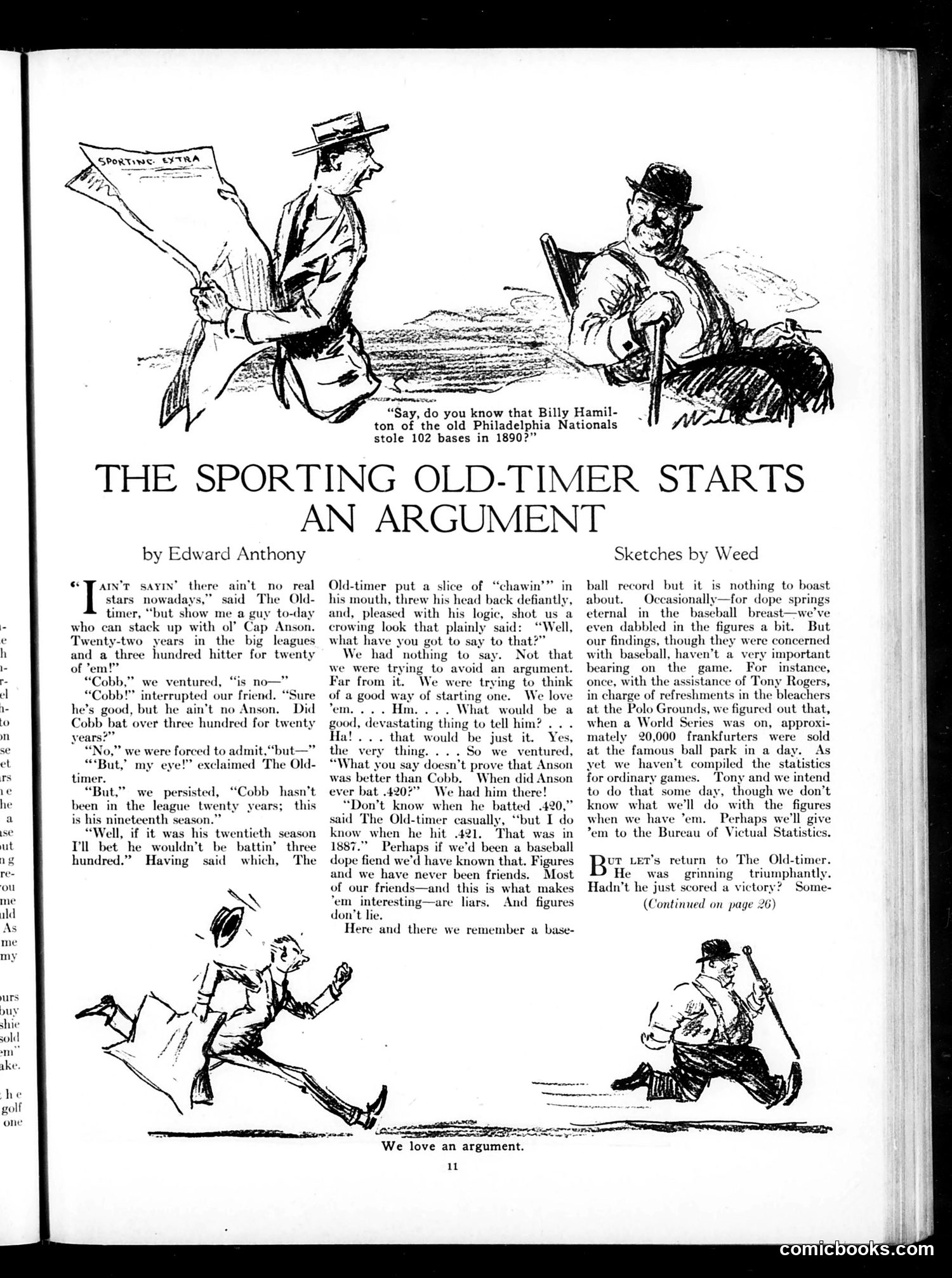
This article satirizes baseball fans who rely on outdated statistics and nostalgia rather than facts. The "Old-timer" character defends Cap Anson (a real 19th-century player) as superior to Ty Cobb, citing Anson's longevity and batting average. When challenged on specifics, he either deflects or produces dubious claims (batting .421 in an unspecified year). The satire targets how such arguments proceed: the old-timer treats vague memories and unverifiable "facts" as conclusive, then declares victory regardless. The author mock-admits they're equally unreliable with statistics—casually mentioning they once calculated frankfurter sales at the Polo Grounds but never knew what to do with the data. The cartoon captures the pointlessness and enjoyment of sports arguments among fans: it's not about truth-seeking but about the pleasure of debate itself. The final caption, "We love an argument," reveals the joke: these discussions are performative and self-perpetuating.
📄 Transcribed text from this page (OCR, searchable)
Machine-transcribed from the original scan — historical spelling and the odd misread are preserved.
SPortTne: &F “Say, do you know that Billy Hamil- stole 102 bases in 1890?” ton of the old Philadelphia Nationals THE SPORTING OLD-TIMER STARTS AN ARGUMENT by Edward Anthony ain't no real 6D ain’r sayin’ stars now said The Old- timer, “but show me a guy to-de who can stack up with ol? Cap Anson. Twenty-two years in the big leagues and a three hundred hitter for twenty of ’em!” “Cobb,” we ventured, “is no—” “Cobb!” interrupted our friend. “Sure he’s good, but he ain't no Anson. Did Cobb bat over three hundred for twenty there year: “No,” we were forced to admit,“but—” ““But, my eye!” exclaimed ‘The Old- timer. But,” we persisted, “Cobb hasn’t in the league twenty years; this neteenth son.” Well, if it was his twentieth season three which, The T'll bet’ he wouldn’t be battin’ Having said hundred.” Old-timer put a slice of “chawin’” in his mouth, threw his head back defiantly, and, pleased with his logic, shot us a crowing look that plainly said: “Well, what have you got to say to that?” We had nothing to y. Not that we were trying to id an argument. Far from it. We were trying to think of a good way of starting one. We love ‘em... . Hm... . What would be a good, devastating thing to tell him? Ha! ... that would be just it. Yes, the very thing. ... So we ventured, “What you say doesn’t prove that Anson was better than Cobb. When did Anson ever bat 420?” We had him there “Don’t know when he batted .420,” said The Old-timer casually, ‘‘but I do know when he hit .421. That was in Perhaps if we'd been a base dope fiend we'd have known that. Figures and we have never been friends. Most iends—and this is what makes ’em_interesting—are lia And figures don’t lie Here and there we remember a base- l os We love an argument. 1L Sketches by Weed ball record but it is nothing to boast about. Occasionally—for dope springs eternal in the baseball breast—we’ve even dabbled in the figures a bit. But our findings, though they were concerned with baseball, haven't a very important bearing on the game. For instance, once, with the assistance of Tony Rogers, in charge of refreshments in the bleachers at the Polo Grounds, we figured out that, when a World Series was on, approxi- mately 20,000 frankfurters were sold at the famous ball park in a day. As yet we n't compiled the statistics for ordinary games. Tony and we intend to do that some day, though we don’t know what we'll do with the figures when we have ’em. Perhaps we'll gi ’em to the Bureau of Victual Statistics. return to The Old-timer. grinning — triumphantly Hadn’t he just scored a victory? Some- (Continued on page 26) comicbooks.com