
Judge, 1923-07-21 · page 15 of 36
Judge — July 21, 1923 — page 15: what you’re looking at
What you’re looking at
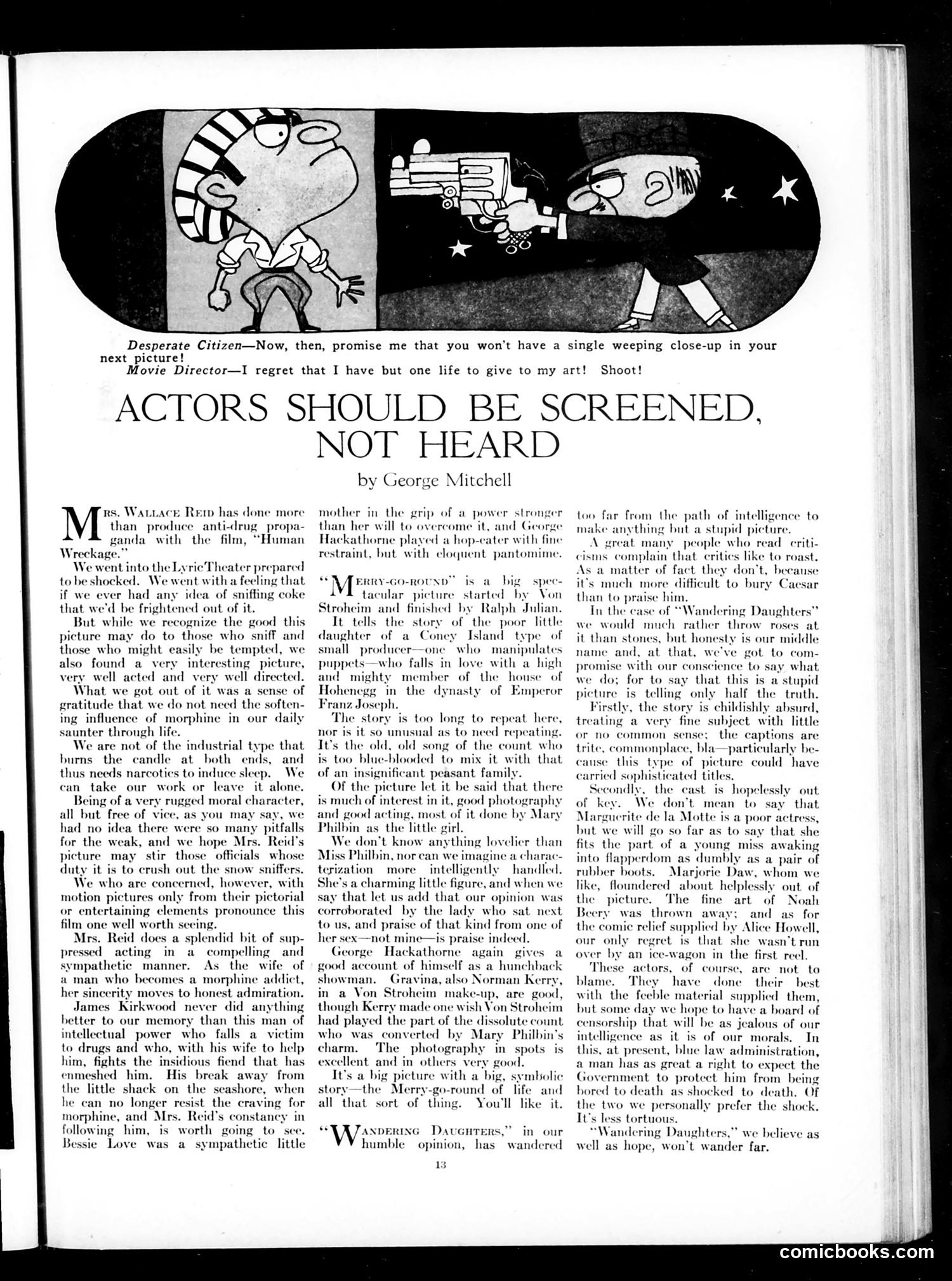
The cartoon shows a film director and desperate citizen negotiating over movie content. The citizen pleads for no "weeping close-ups" in the next picture; the director responds with theatrical self-sacrifice, declaring he has "but one life to give to my art" before shooting the citizen. **The satire:** This mocks early cinema's melodramatic excess—particularly the emotional manipulation through close-ups pioneered by filmmakers. The exaggerated response satirizes filmmakers' pretentious commitment to "art" over audience preferences or restraint. The article below, "Actors Should Be Screened, Not Heard," critiques silent film acting and filmmaking choices. It reviews recent films including Wallace Reid's drug-awareness picture "Human Wreckage" and a Von Stroheim production, praising some performances while criticizing overwrought storytelling and excessive length. **Context:** This reflects 1920s debates about cinema's artistic legitimacy and whether emotional manipulation constituted genuine artistry or mere hokum.
📄 Transcribed text from this page (OCR, searchable)
Machine-transcribed from the original scan — historical spelling and the odd misread are preserved.
Desperate Citizen—Now, then, promise me that you won't have a single weeping close-up in your next picture! Movie Director—I regret that I have but one life to give to my art! Shoot! ACTORS SHOULD BE SCREENED, rs. WaLLace Retp has done more M than produce anti-drug propa- ganda with the film, “Human Wreckage. We went into the Lyric'Theater prepared tobe shocked. We went with a feeling that if we ever had any idca of sniffing coke that we'd be frightened out of it. But while we recognize the good this picture may do to those who sniff and those who might easily be tempted, we also found a very interesting picture, very well acted and very well directed. What we got out of it was a sense of gratitude that we do not need the soften- ing influence of morphine in our daily saunter through life. We are not of the industrial type that burns the candle both ends, and thus needs narcotics to induce sleep. We can take our work or le; it alone. Being of a very rugged moral character, all but free of vice, as you may say, we had no idea there were so many pitfalls for the weak, and we hope Mrs. Reid's picture may stir those officials whose duty it is to crush out the snow sniffers. We who are concerned, however, with motion pictures only from their pictorial or entertaining elements pronounce this film one well worth seeing. Mrs. Reid does a splendid bit of sup- pressed acting in a compelling and sympathetic manner. As the wife of a man who becomes a morphine addict, her sincerity moves to honest admiration, James Kirkwood never did anything better to our memory than this 1 intellectual power who falls a to drugs and who, with his wife to help him, fights the insidious fiend that has enmeshed him. His break away from the little shack on the shore, when he can no longer resist the craving for morphine, and Mrs. Reid’s constancy in following him, is worth going to see. Bessie Love was a sympathetic little NOT HEARD by George Mitchell mother in the grip of a power stro than her will to overcome it, and Georg Hackathorne played a hop-eater with fine restraint, but with cloquent. pantomime. “OM Ent-co-not np” is a big i tacular picture started by Von Stroheim and finished by Ralph Julian. It tells the story of the poor little daughter of a Coney Island type of small producer—one who manipulates puppets—who falls in love with a high and mighty member of the Hohenegg in the dynasty of Emperor Franz Joseph. The story is too long to repeat here, nor is it so unusual as to need repeating. It’s the old, old song of the count who is too blue-blooded to mix it with that of an insignifieant peasant family. Of the picture let it be said that there is much of interest in it, good photography and good acting, most of it done by Mary Philbin as the little girl. We don’t know anything lovelier than iss Philbin, nor can we imagine ion more intelligently handled. rharming little figure, and when we say that let us add that our opinion was corroborated by the lady who sat next to us, and praise of that kind from one of her sex—not mine—is praise indeed. George Hackathorne again gives a good account of himself as a hunchback showman. Gravina, also Norman Kerry, in a Von Stroheim n spec- house of "d the part of the dissolute count as converted by Mary Philbin’s charm. The photography in spots is excellent and in others very good. It’s a hig picture with a big, symbolic story—the Merry-go-round of life and all that sort of thing. You'll like it. ANDERING humble Daventers,” in opinion, has our wandered 13 too far from the path of intelligence to make anything but a stupid picture, \ great many people who read _ criti- cisms complain that critics like to roast. As a matter of fact they don’t, because it's much more difficult to bury Caesar than to praise him, Tn the case of “Wandering Daughters” we would much rather throw roses at it than stones, but honesty is our middle name and, at that, we've got to com- promise with our conscience to say what we do; for to say that this is a stupid picture is telling only half the truth. irstly, the story is childishly absurd, treating a very fine subject with little or no common sense; the captions are trite, commonplace, bla—particularly be- cause this type of picture could have carried sophisticated titles. scondly, the cast is hopelessly out key We don’t mean that Marguerite de la Motte is a poor actress, but we will go so far as to say that she fits the part of a young miss awaking into flapperdom as dumbly as a pair of rubber boots. Marjorie Daw, whom we like, floundered about helplessly out of the picture. The fine art of Noah Beery was thrown ay; and as for the comic relief supplied by Alice Howell, our only regret is that she wasn't run over by an ice-wagon in the first recl. These actors, of course, are not to blame. The have done their best with the feeble material supplied them, but some day we hope to have a board of censorship that will be as jealous of our intelligence as it is of our morals. In this, at present, blue law administration, a man has as great a right to expect the Government to protect him from being bored to death as shocked to death. Of the two we personally prefer the shock. It’s less tortuous. “Wandering Daughters,” we believe as well as hope, won't wander far. to say comicbooks.com