
Judge, 1923-07-21 · page 12 of 36
Judge — July 21, 1923 — page 12: what you’re looking at
What you’re looking at
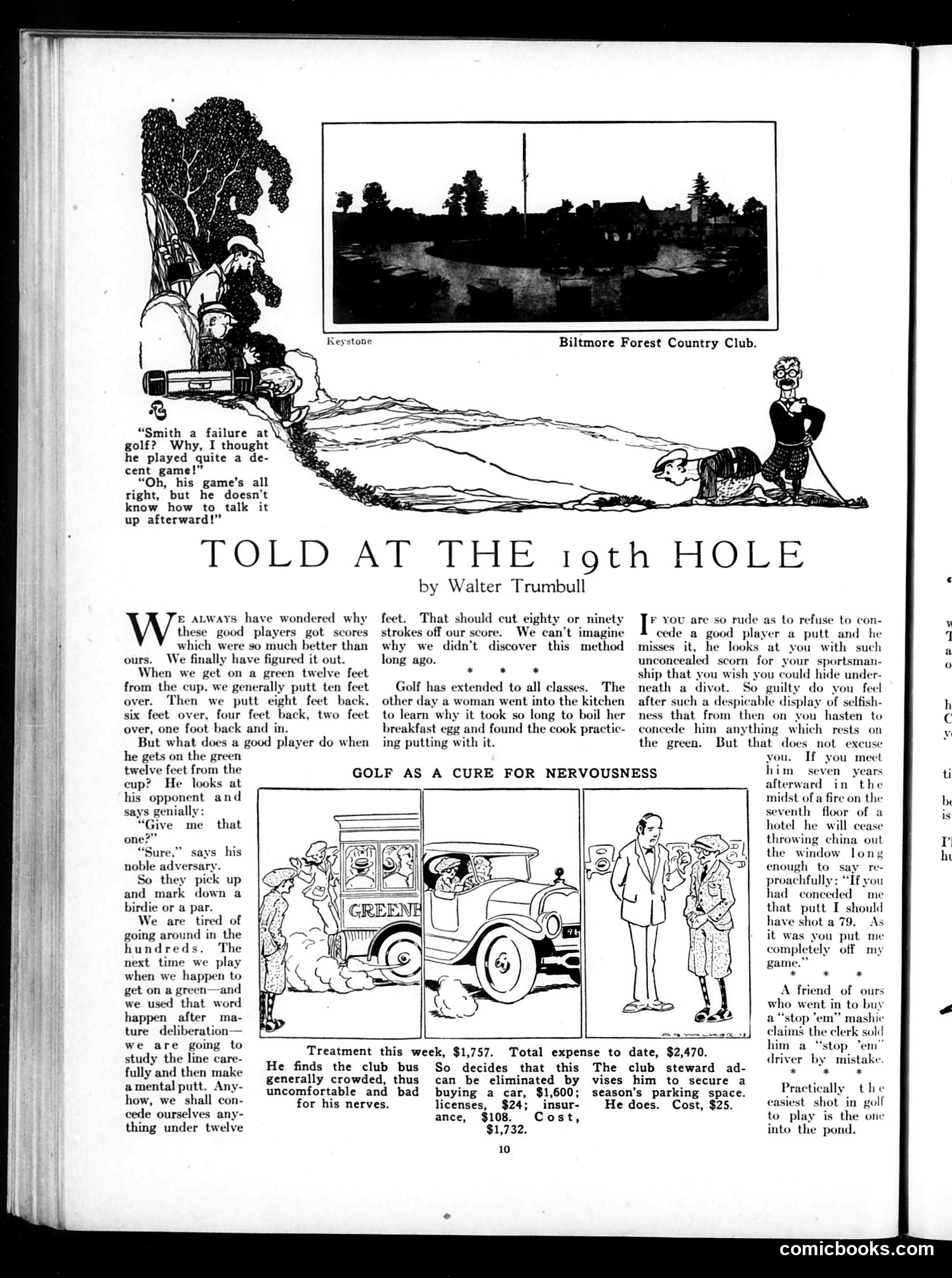
This page satirizes golf culture and player psychology circa the 1920s-30s. The main cartoon mocks how skilled golfers succeed through *psychological manipulation* rather than actual skill: they simply declare their poor shots as good ones, and opponents concede out of social pressure and fear of appearing unsportsmanlike. The "Golf as a Cure for Nervousness" section ridicules the expense and obsession surrounding the sport. A man spends $1,732 on a car and parking to avoid crowded buses at his country club—an absurd solution to a minor inconvenience. The accompanying illustrations show a nervous patient being "treated" by purchasing increasingly costly golf equipment and memberships. Additional jokes reference class mobility (golf extending "to all classes"), servants imitating their employers' hobbies, and the social shame of refusing to concede putts to fellow players. The satire targets both golf's pretensions as a gentleman's game and the era's conspicuous consumption among the wealthy.
📄 Transcribed text from this page (OCR, searchable)
Machine-transcribed from the original scan — historical spelling and the odd misread are preserved.
Keystone golf? Why, I thought he played quite a de- cent game!” “Oh, his game’s all right, but he doesn’t know how to talk it up afterward!” TOLD AT THE i9th HOLE E ALWAYS have wondered why W these good players got scores which were so much better than ours. We finally have figured it out. When we get on a green twelve feet from the cup, we generally putt ten feet over. Then we putt eight feet back, six feet over, four feet back, two feet over, one foot back and in. But what does a good player do when he gets on the green twelve feet from the cup? He looks at his opponent and says genially: me that noble adversa: So they and mark down a birdie or a par. We are tired of going around in the hundreds. The next time we play when we happen to get on a green—and we used that word happen after ma- ture deliberation— Biltmore Forest Country Club. by Walter Trumbull feet. That should cut eighty or ninety strokes off our score. We can’t imagine why we didn’t discover this method long ago. * 8 * Golf has extended to all classes. other day a woman went into the to learn why it took so long to boil her breakfast and found the cook practic- ing putting with it. GOLF AS A CURE FOR NERVOUSNESS ‘ I’ you are so rude as to refuse to con- . cede a good player a putt and he y mi it, he looks at you with such a unconcealed scorn for your sportsman- ship that you wish you could hide under- neath a divot. So guilty do you feel after such a despicable display of selfish- h ness that from then on you hasten to C concede him anything which rests on v the green. But that does not excuse . you. If you meet him seven years ti afterward in the midst of a fire on the b seventh floor of a is hotel he will cease throwing china out r the window long h enough to say proachfully: “If you had conceded “me that putt I should have shot a 79. As it was you put me completely off my game.” * say re- * * A friend of ours who went in to buy 6 “stop ’em” mashie ms the clerk sold we are going to him a “stop "em" Treatment this week, $1,757. Total expense to date, $2,470. study the line care- fully and then make a mental putt. Any- how, we shall con- cede ourselves any- thing under twelve He finds the club bus generally crowded, thus uncomfortable and bad for his nerves. So decides that this The club steward ad- can be eliminated by vises him to secure a buying a car, $1,600; season’s parking space. licenses, $24; insur- He does. Cost, $25. ance, $108. Cost, $1,732. 10 driver by mistake * "e « Practically the easiest. shot in golf to play is the one into the pond. comicbooks.com