
A complete issue · 36 pages · 1923
Judge — May 19, 1923
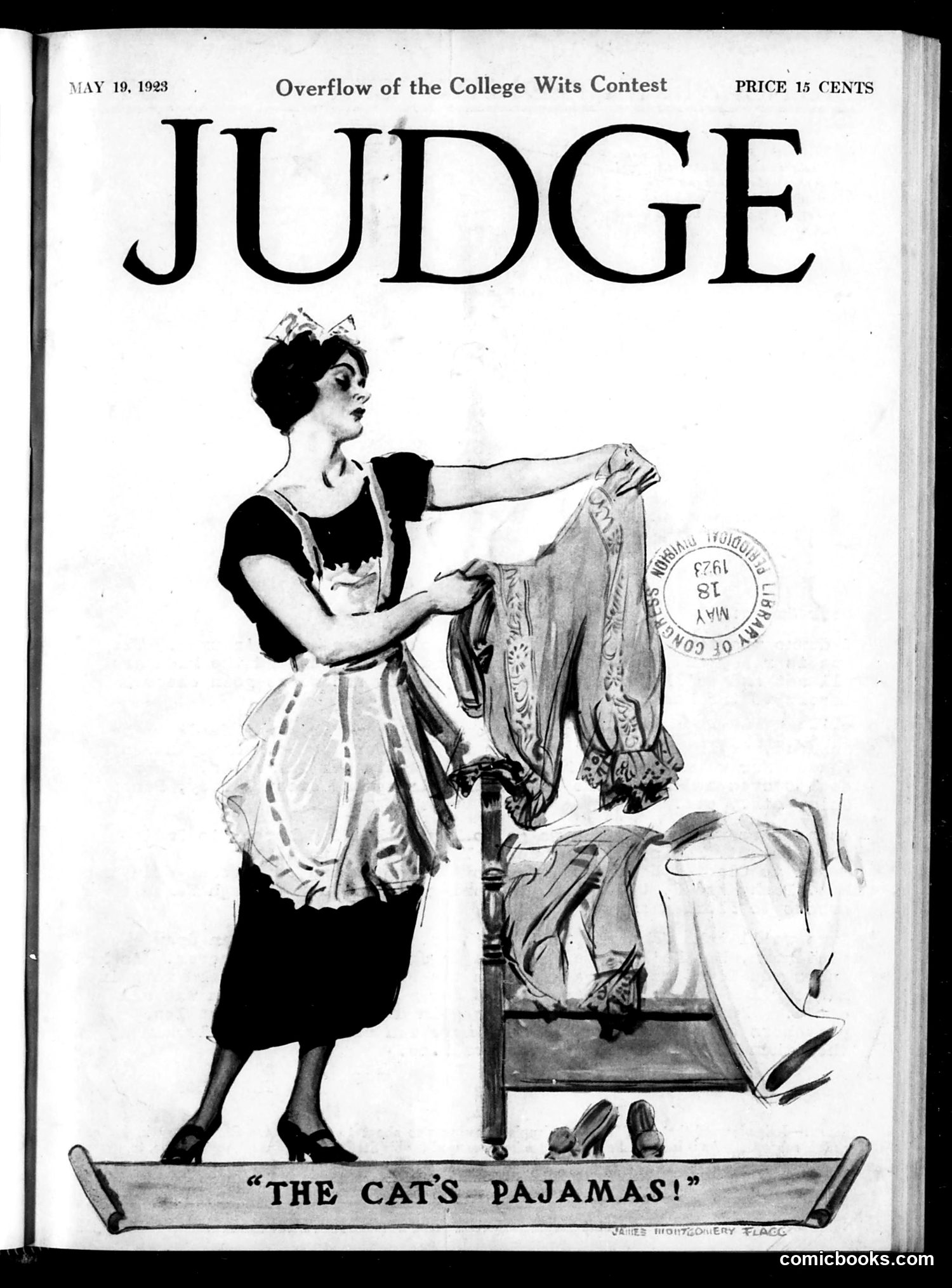
This satirical cover depicts a woman examining clothing, likely pajamas, labeled "The Cat's Pajamas"—a slang phrase from the 1920s meaning something excellent or fashionable. The cartoon appears to mock the era's casual attitude toward women's sleepwear and changing fashion norms. The woman's expression and gesture suggest judgment or disapproval of these garments. The title plays on the period's flapper culture, when younger women adopted more relaxed, unconventional clothing that scandalized conservative society. Judge magazine frequently satirized modern social trends, and this cover likely critiques both the new fashions themselves and the social anxieties they provoked among traditionalists. The "cat's pajamas" reference positions the garment as frivolous contemporary slang—treating serious concerns about changing morality and women's liberation with humorous dismissal.
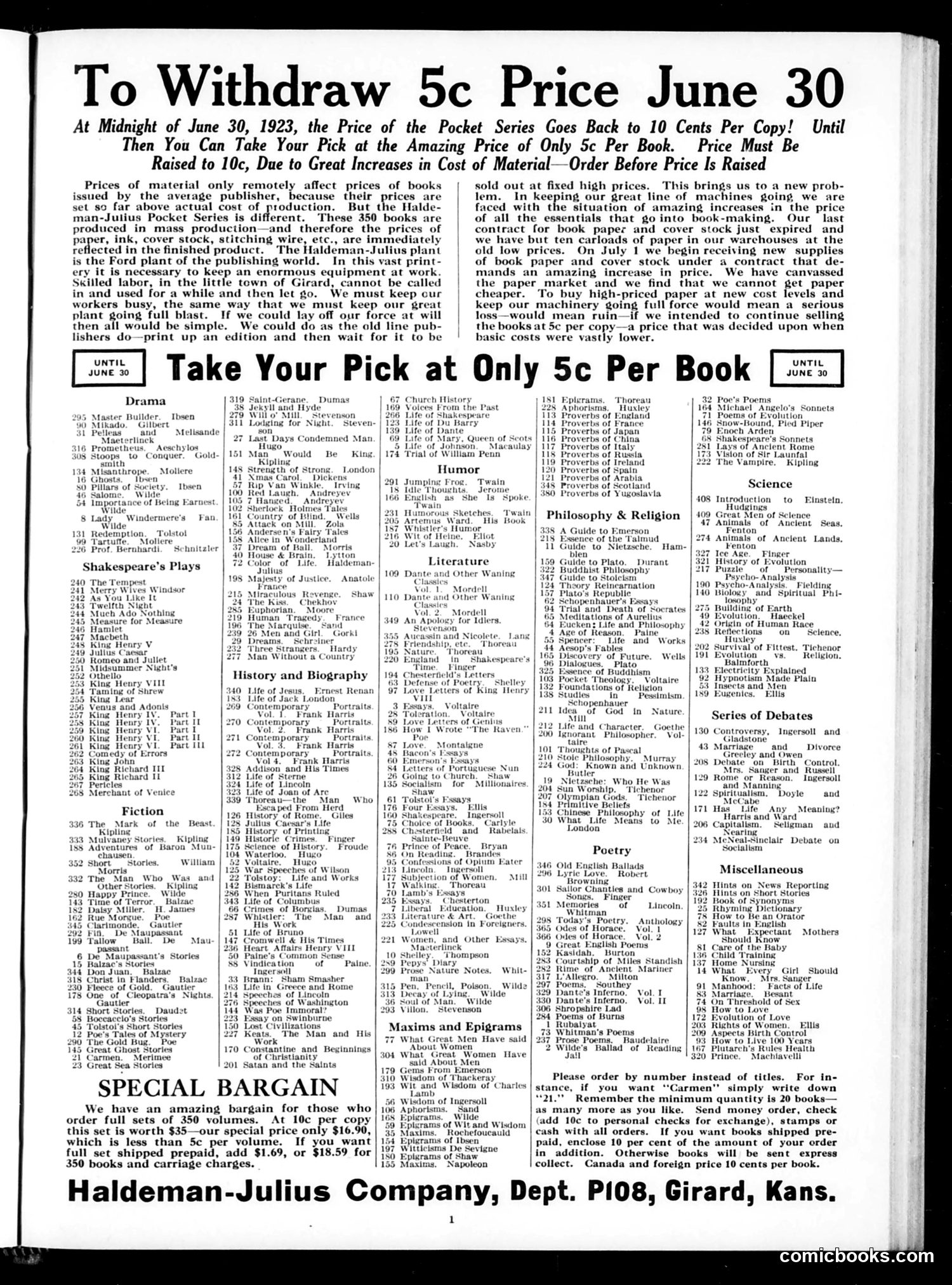
This page is **primarily an advertisement**, not a satirical cartoon or political commentary. It's a book catalog from the Haldeman-Julius Company advertising their "Pocket Series" books. The main content announces a price change: books that cost 10 cents will revert to that price on June 30, 1923, after being sold at 5 cents. The publisher explains rising paper and production costs forced the temporary discount to end. The bulk of the page lists available titles across categories: Drama, Shakespeare's Plays, Fiction, History and Biography, Humor, Literature, Philosophy & Religion, Science, Poetry, Series of Debates, and Miscellaneous works. There is **no political cartoon or satire visible**—this is a straightforward commercial notice with catalog listings, typical of magazine advertising from the 1920s.
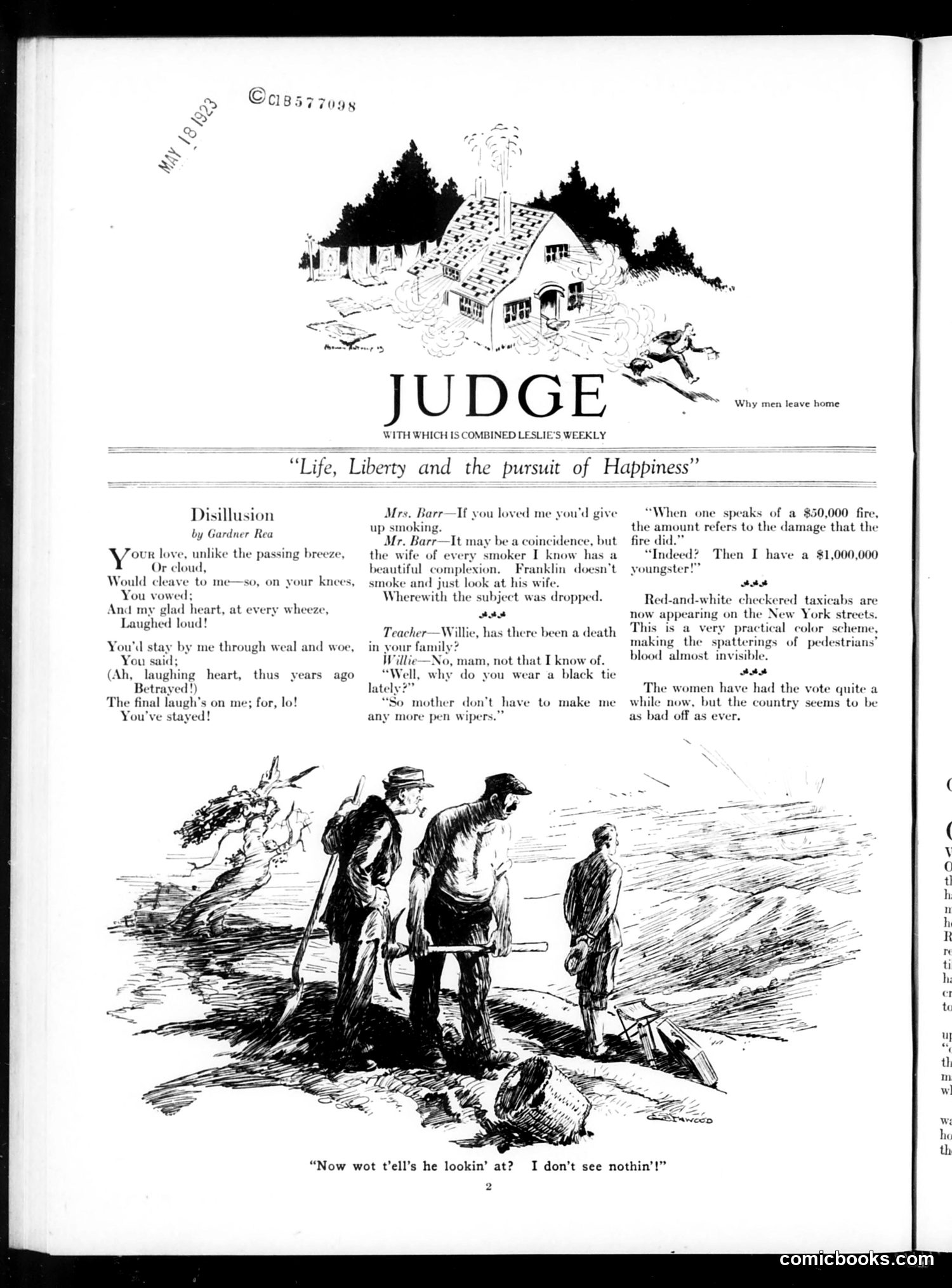
This page from *Judge* magazine contains a poem titled "Disillusion" by Gardner Rea, which satirizes romantic disappointment through contrasting idealized love with harsh reality. The main cartoon depicts three men examining something on a beach or shoreline, with the caption "Now wot t'ell's he lookin' at? I don't see nothin'!" The working-class dialect and body language suggest they're trying to locate something valuable or significant but finding nothing—likely social commentary on unfulfilled promises or empty expectations. The brief text snippets mock domestic life and social pretense: a wife's complaint about her husband's smoking, a teacher's dark humor about family death, and comments on new taxicabs and women's voting rights. The overall theme appears to be satirizing various disappointments in modern life—romantic, domestic, and civic.
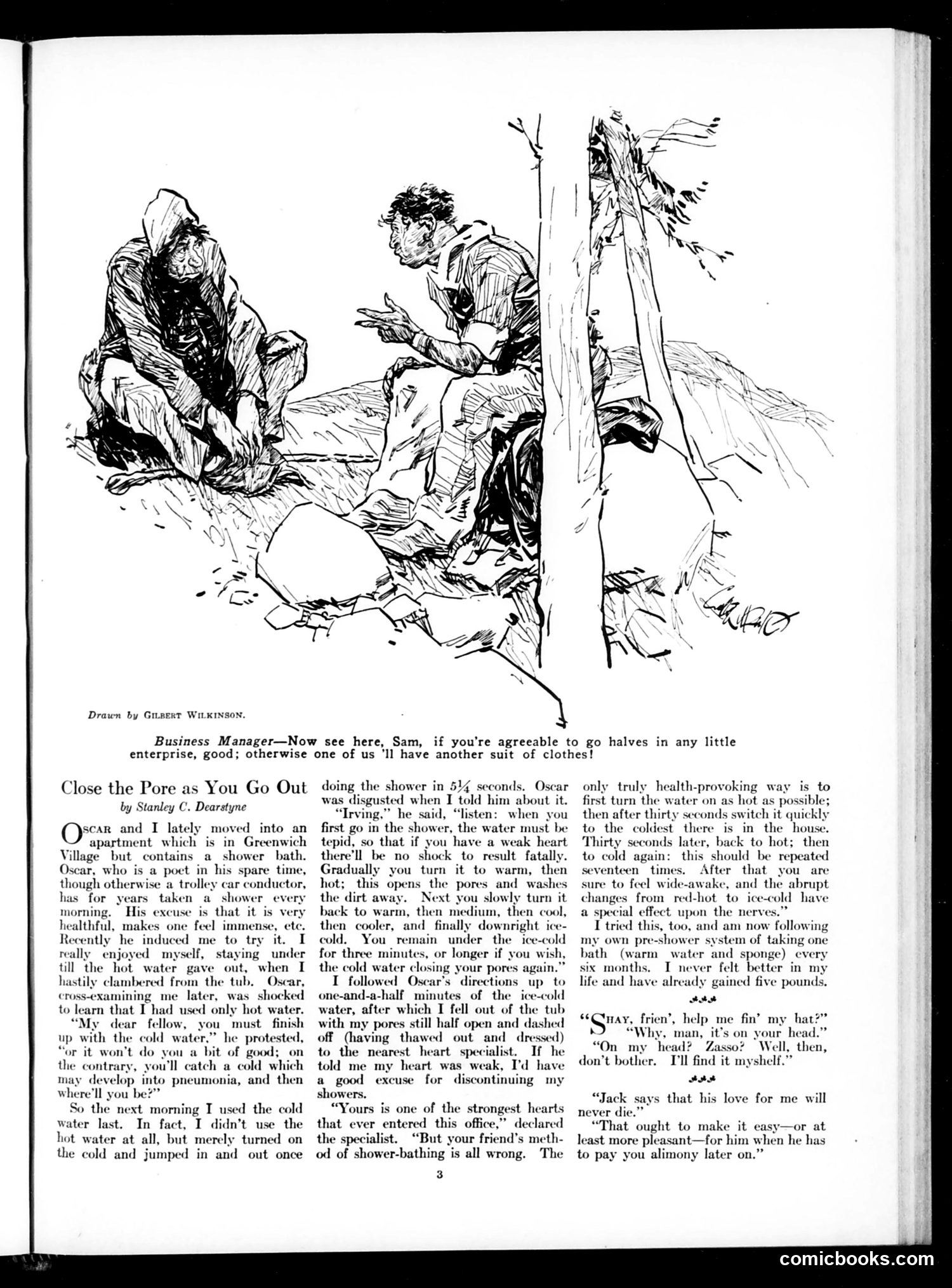
This page contains a satirical article titled "Close the Pore as You Go Out" by Samuel G. Blythe, illustrated by Gilbert Wilkinson. The cartoon depicts two men outdoors discussing shower techniques. The satire targets health fads and pseudo-scientific wellness advice popular in the early 20th century. Oscar, described as a poet and "trolley car conductor," has become obsessed with a elaborate cold-water shower regimen he believes promotes health. His friend Sam warns him the practice is excessive and potentially dangerous, noting that Oscar's obsession with "closing pores" and alternating water temperatures lacks real medical basis. The humor derives from mocking the era's tendency toward health pseudoscience and the comical extremes people adopted, presented as earnest but ultimately foolish self-care rituals. The illustration emphasizes the incongruity of Oscar's dedication to this peculiar practice.
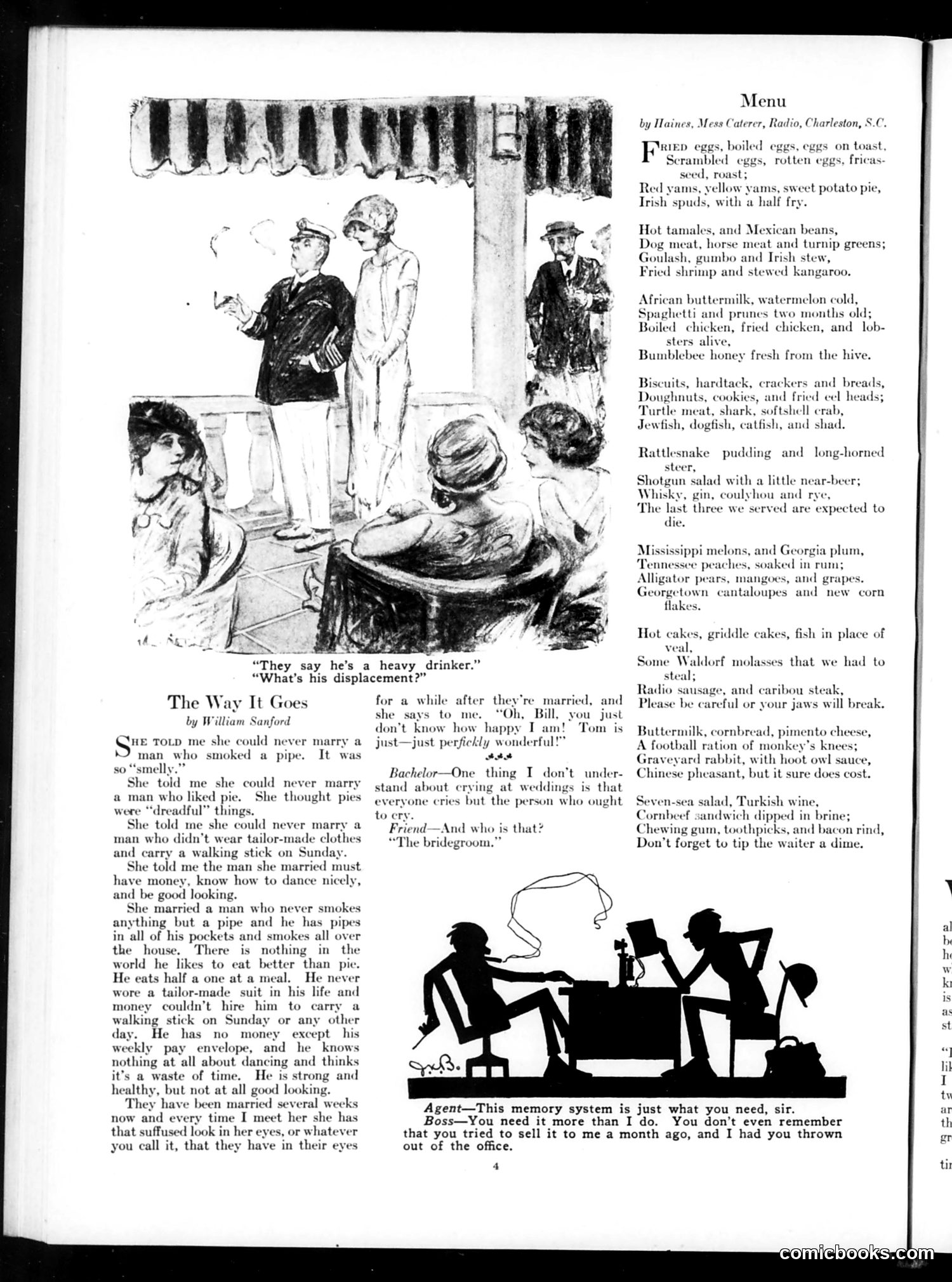
This page contains two separate pieces of humor: **"The Way It Goes"** (left column): A satirical story about marriage expectations. A woman lists absurd requirements for a husband—he must never smoke pipes, wear tailor-made clothes, or carry a walking stick on Sundays, yet must dance well, have money, and be good-looking. The joke satirizes contradictory marital demands and the impossibility of finding a "perfect" spouse. The humor targets both women's unrealistic expectations and the social performance of marriage. **Bottom cartoon**: Shows a boss-employee exchange about a "memory system." The agent promotes it as a solution, but the boss sarcastically retorts that the employee needs it more—since he forgot the agent tried selling him the same system a month ago. This mocks both office inefficiency and salesmen's aggressive tactics. The **menu** appears to be satirical food descriptions rather than genuine dining options.
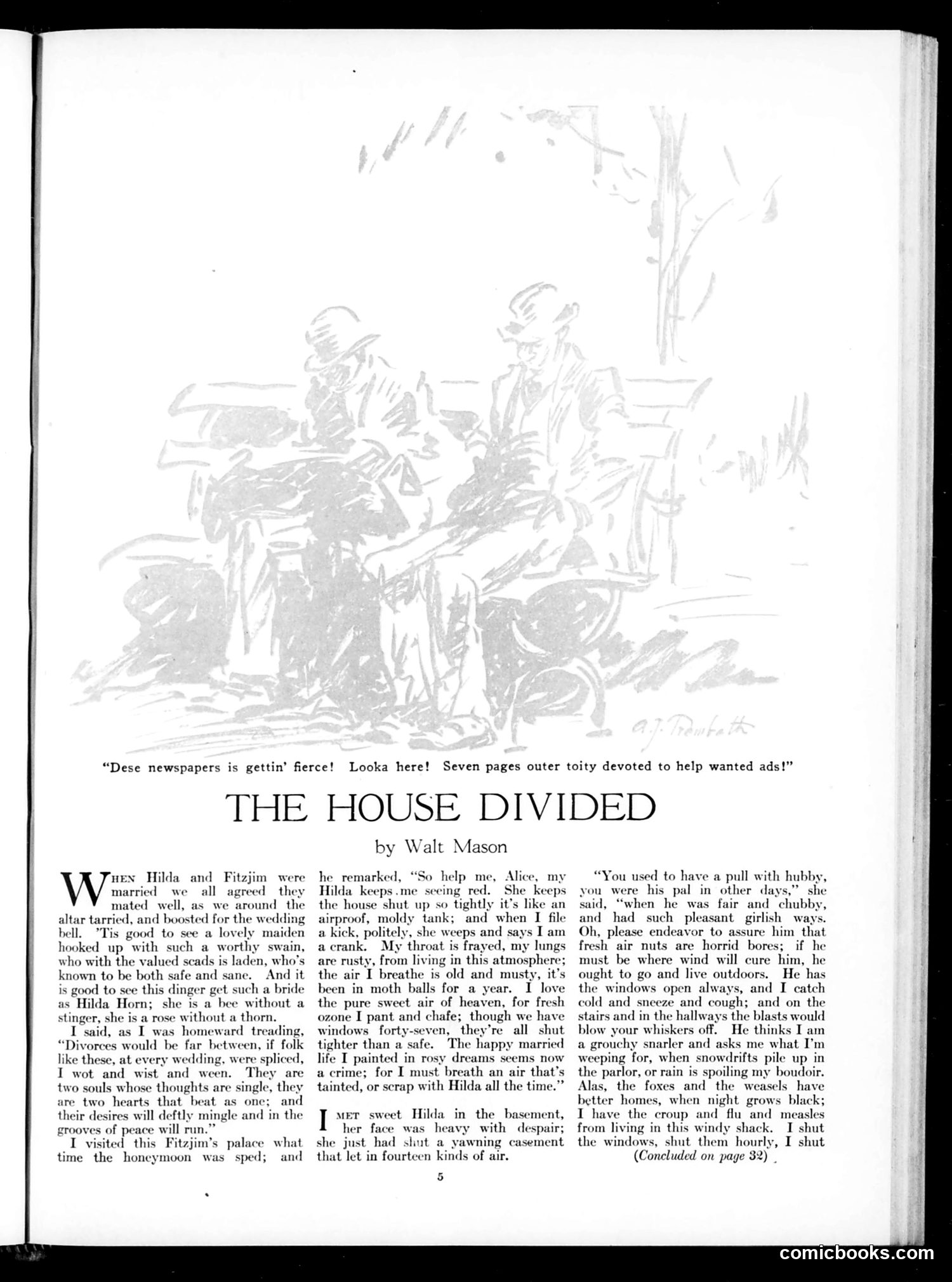
This is a humorous short story rather than a political cartoon. The opening joke references the contemporary proliferation of classified advertisements in newspapers—a satirical jab at how much newspaper space was devoted to "help wanted ads" during an apparent labor shortage or economic period requiring widespread job recruitment. The main narrative satirizes marital conflict over domestic comfort. Newlyweds Hilda and Fitzjim clash over ventilation: he demands fresh air and open windows; she insists on closure to prevent drafts and illness. Mason uses their opposing positions as a metaphor for incompatibility—even in an ideal marriage, fundamental lifestyle differences create conflict. The satire targets both perspectives: his obsession with "fresh air" health trends (popular in early 20th-century wellness culture) versus her domestic concerns about cold and disease. Neither compromise nor understanding prevails; they remain divided on basics, suggesting that even "perfect" couples face irreconcilable differences. It's gentle domestic comedy rather than sharp political satire.
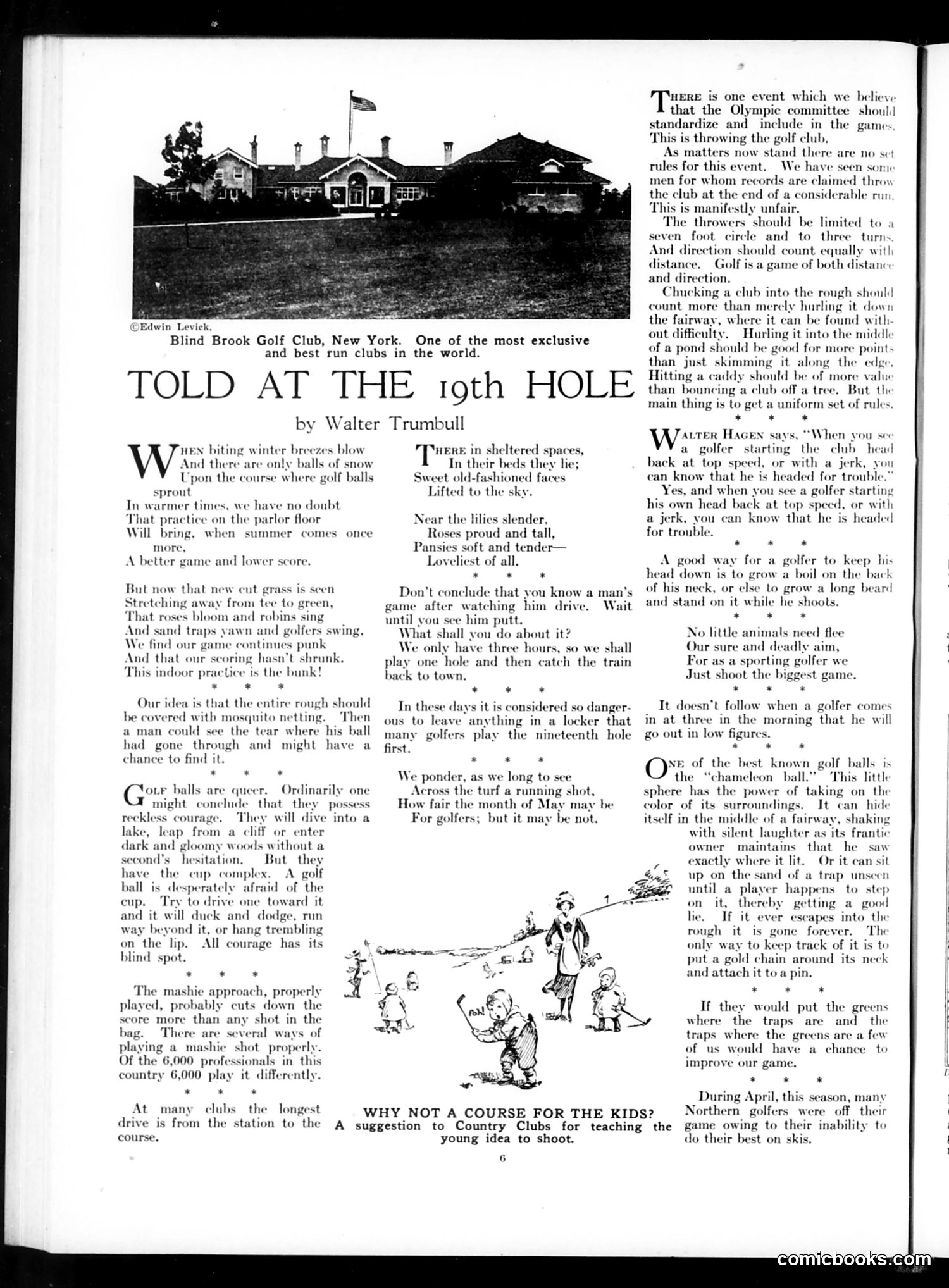
This is a humorous golf article by Walter Trumbull in *Judge* magazine, featuring commentary on golf culture at exclusive clubs like Blind Brook in New York. The "19th hole" refers to the clubhouse bar where golfers gossip after play. The satire mocks various golf absurdities: golfers' irrational fear of the cup despite fearlessness elsewhere; the futility of indoor winter practice; the inconsistency of professional golf instruction (6,000 pros, 6,000 different techniques); and commuters whose longest "drive" is from the train station to the course. A recurring joke proposes standardizing "golf club throwing" as an Olympic sport, satirizing both golfers' club-tossing tantrums and the era's enthusiasm for Olympic standardization. Other quips address the 19th hole's popularity (playing that hole first to avoid locker theft) and Walter Hagen's advice about head control during swings—with a humorous retort about controlling one's *own* head position. The cartoons show golfers in various situations on the course, illustrating the text's observations about typical club culture and behavior.
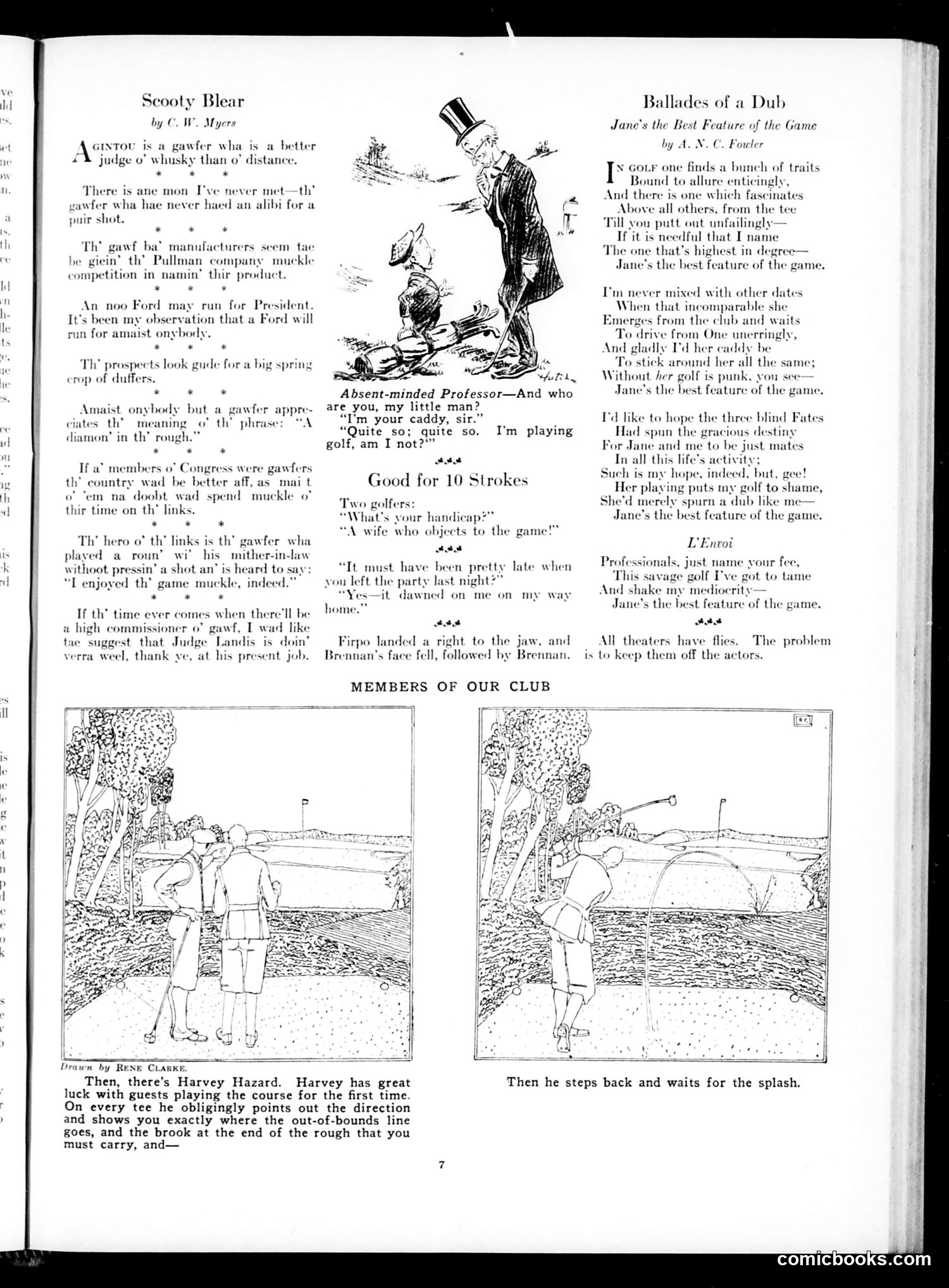
This page from *Judge* magazine contains three distinct pieces about golf, a major American leisure activity in the early 20th century: **"Scooty Blear"** (left column) is Scottish-dialect humor about golfers and golf culture. It satirizes golfers' excuses for poor shots ("alibi for a puir shot"), compares golf ball manufacturers to Pullman railway cars, jokes about Ford automobiles, and references Judge Landis (baseball commissioner), suggesting golfers need similar oversight. **"Ballades of a Dub"** (right) is a romantic poem celebrating "Jane," a female golfer, as the best feature of the golf club—a lighthearted take on women's participation in golf. **"Members of Our Club"** (bottom) features two illustrated panels by René Clarke showing "Harvey Hazard," a helpful caddy who deliberately points guests toward water hazards, then watches them splash in. The humor lies in his false courtesy masking malice—a common comic trope. The page reflects golf's popularity among middle and upper-class Americans during this era, treating the sport as a setting for humor about human nature, courtship, and social behavior.
This is a satirical short story mocking **moral reformers and censorship advocates** of the early 20th century. The unnamed narrator describes his bewilderment at discovering he cannot see "filth" where respectable people insist it exists—in photographs, books, and motion pictures. The satire's target: **self-appointed moral guardians** (church members, "upstanding citizens") who aggressively suppress art and literature they deem corrupting, yet the narrator finds these same works perfectly innocent. He visits doctors and psychiatrists, jokingly suggesting he's defective for *not* being scandalized. The joke exposes the **absurdity of censorship**: respectable reformers claim artistic content will "pervert the morals" of youth, yet the narrator—admittedly unrespectable himself—sees only harmless images. Roche implies the reformers' obsession with finding "dirt" reveals more about their own psychology than any actual danger in the art. This reflects genuine 1920s debates over **film censorship** (Ziegfeld Follies referenced), book banning, and the emerging "Comstock Laws."
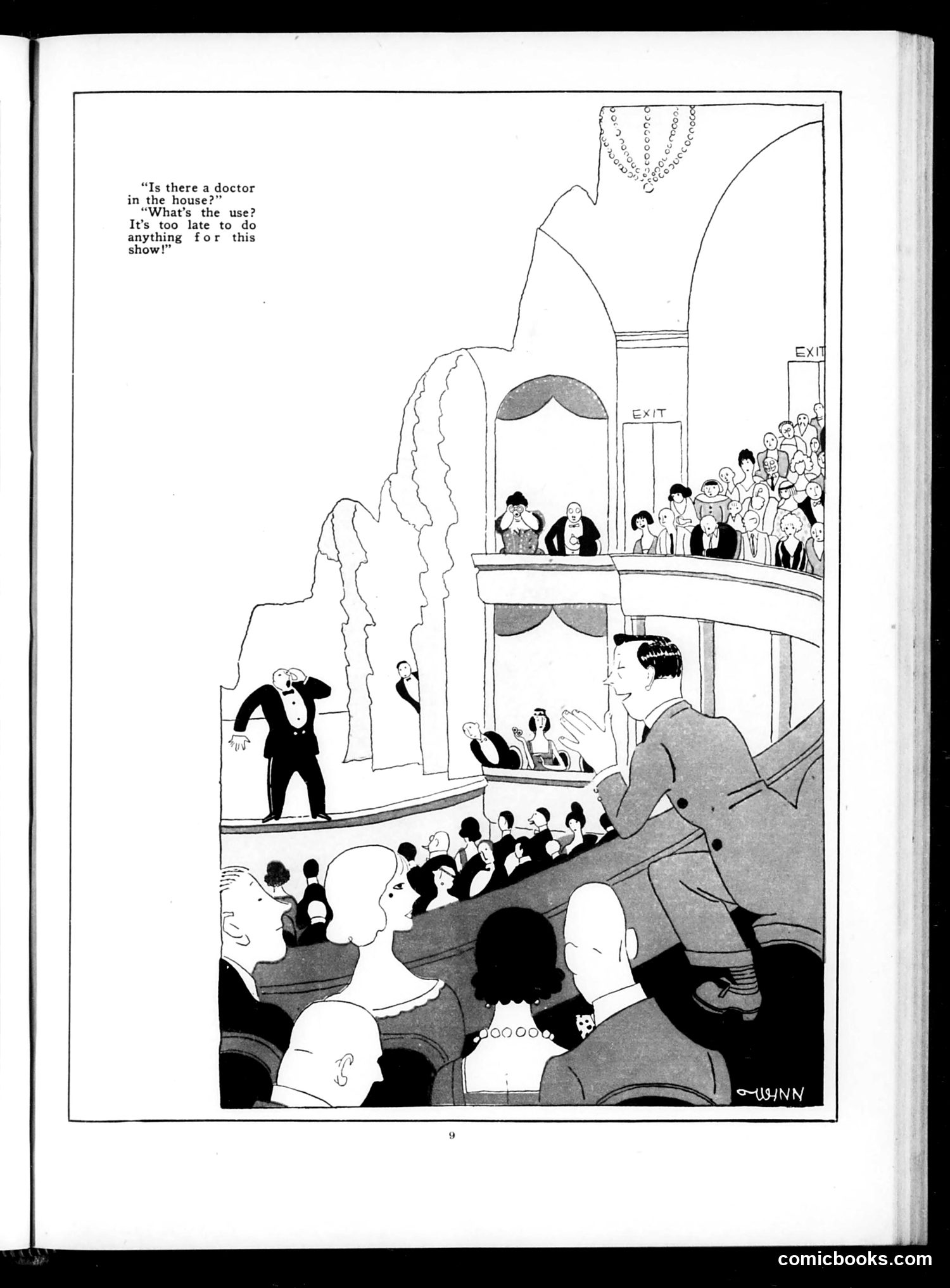
This is a theatrical satire depicting a performance in crisis. An actor has collapsed on stage (visible on the left), prompting someone in the audience to call out the classic emergency phrase: "Is there a doctor in the house?" However, another audience member responds cynically that it's pointless—the show itself is already "dead" and beyond saving. The joke conflates the actor's collapse with the show's poor quality, suggesting the performance is so bad it's essentially a lost cause anyway. The cartoon mocks theatrical productions of the era, implying that some shows were so terrible that even a medical emergency couldn't make them worse. It's a commentary on bad theater and audience disappointment, using dark humor typical of Judge magazine's satirical style.
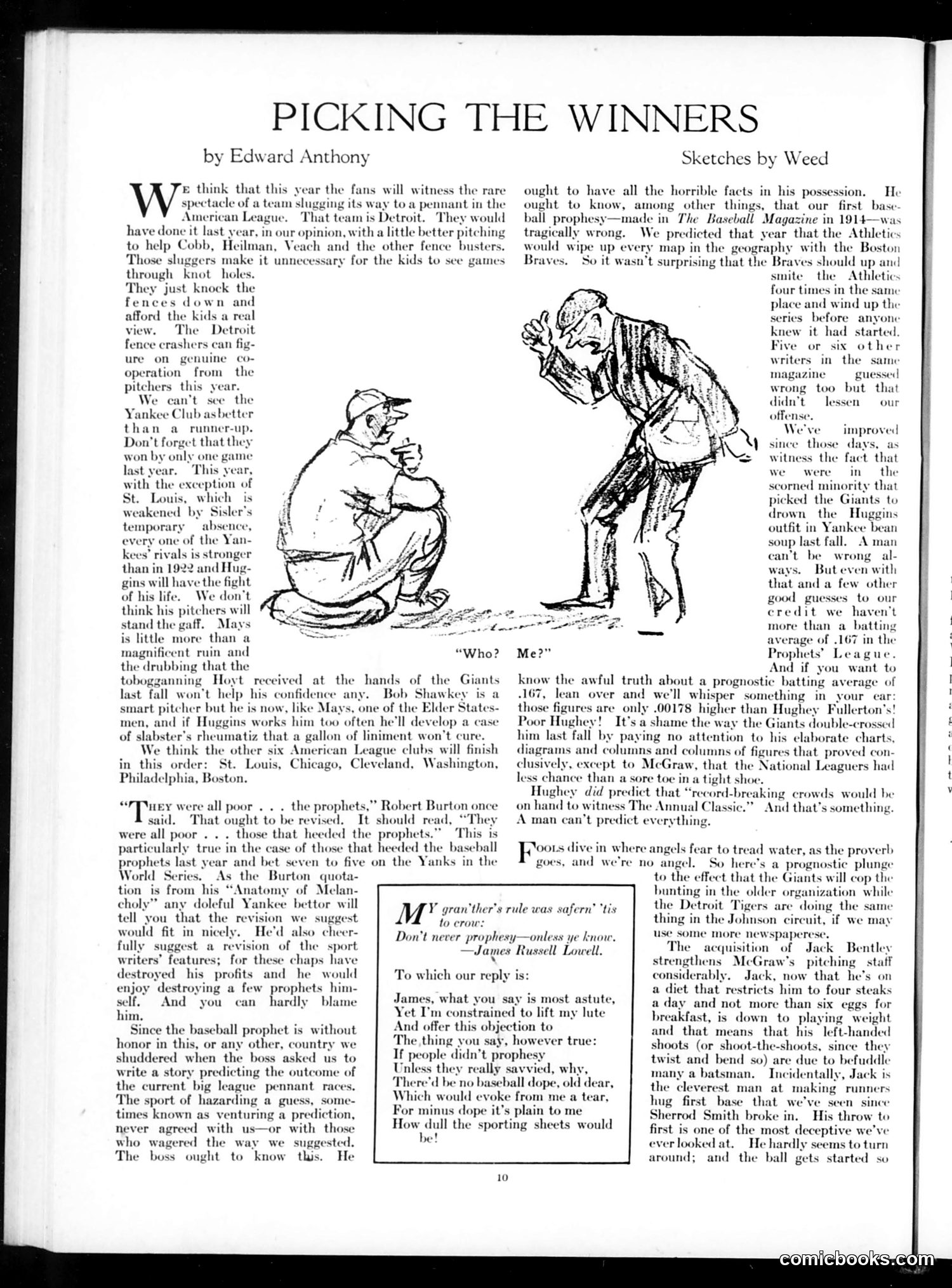
This 1920s *Judge* magazine article predicts the upcoming baseball season pennant winners, using two cartoon sketches to illustrate the concept of sports prediction. **The Cartoons:** The sketches by Weed show a baseball manager/expert confidently making predictions (left) and another figure seemingly caught off-guard ("Who? Me?"), likely representing a skeptical or unprepared predictor. **The Satire:** Anthony mocks baseball "prophets"—sportswriters and experts who make season predictions. He notes their track record is abysmal (batting average of .167, barely better than famous predictor Hughey Fullerton's). The article ridicules how confidently these writers make pronouncements despite constantly being wrong. **Historical Context:** The piece discusses specific 1920s teams (Detroit Tigers, Yankees, Giants) and players (Ty Cobb, Babe Ruth-era figures), treating their predictions with tongue-in-cheek skepticism. The humor relies on the universal human tendency to make bold guesses while ignoring past failures—a timeless target for satire.
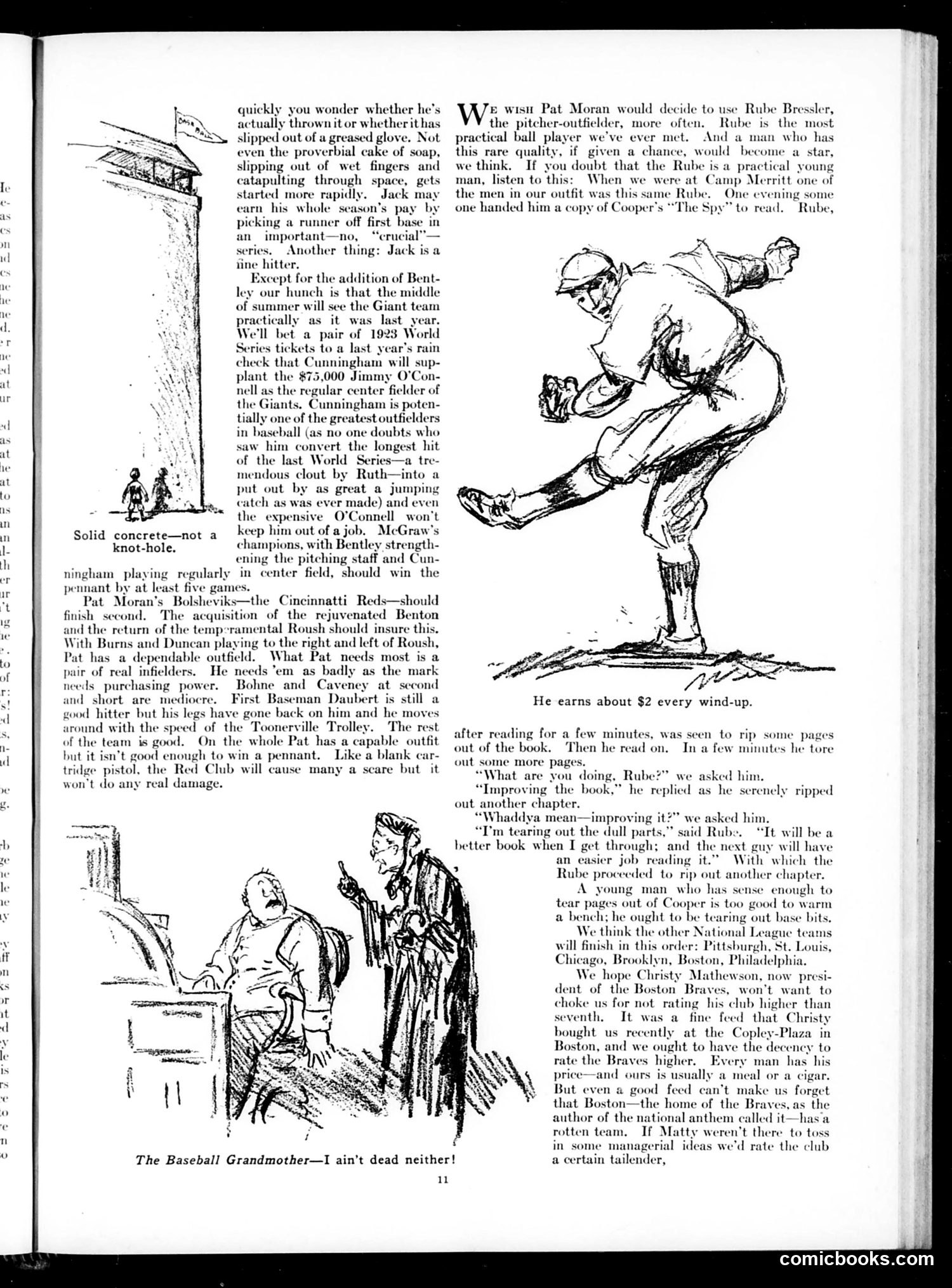
This page combines sports journalism with satirical cartoons about early 1920s baseball. The main text discusses National League teams and players—praising practical players like "Rube" Bressler and criticizing the expensive but underperforming Jimmy O'Connell. It predicts the Giants will win the pennant. The cartoons illustrate baseball moments: one shows a fielder making a dramatic catch; another depicts "The Baseball Grandmother"—an elderly woman—apparently being consulted or involved in baseball matters (the caption suggests she's alive and relevant to the sport). The Rube Bressler anecdote illustrates his practicality: a soldier at Camp Merritt tears pages from Cooper's *The Spy* while reading, reasoning the book will be "better" for the next reader. This portrays Bressler as sensible and direct—someone who should play more, not sit on the bench. The satire mocks both expensive, underperforming players and the magazine's own susceptibility to hospitality—they jokingly admit a good meal from Christy Mathewson might bias their baseball rankings.
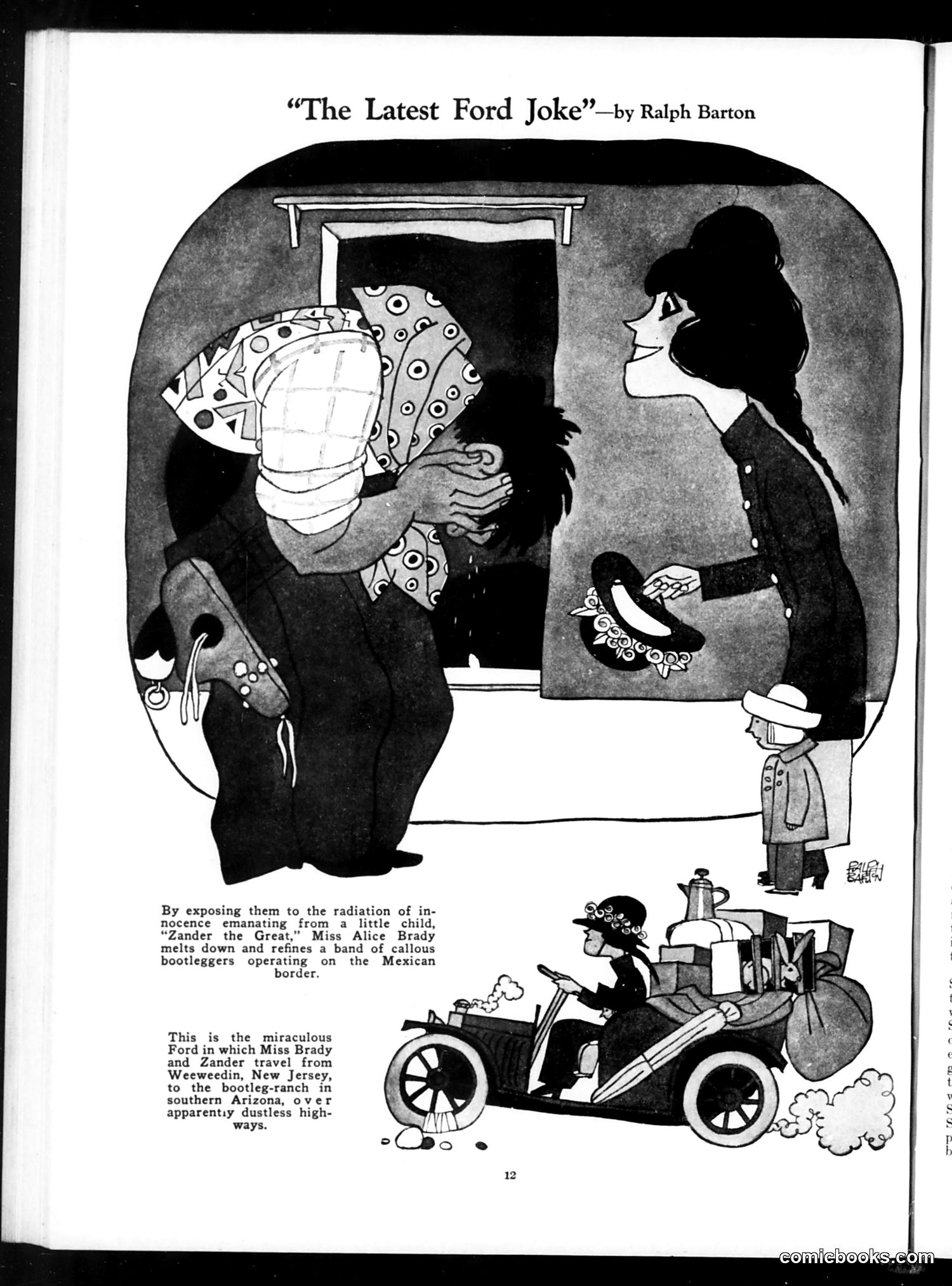
This cartoon satirizes both Ford automobiles and a contemporary film. The joke centers on a movie called "Zander the Great" starring actress Alice Brady, which involves travel from New Jersey to Arizona by car. The satire has two layers: First, it mocks Ford's advertising claims about durability and reliability—the caption jokes that the car mysteriously travels across desert highways "apparently dustless," an absurd exaggeration of Ford's marketing. Second, it ridicules the film's melodramatic plot (a child's "radiation of innocence" reforming criminals), treating the contrived storyline as equally implausible as a Ford performing automotive miracles. The bootleggers reference dates this to Prohibition era (1920s-1933), when such films exploited contemporary crime concerns for entertainment. The cartoon appears designed for Judge magazine's sophisticated audience to laugh at both automobile advertising excess and Hollywood's sentimental storytelling.
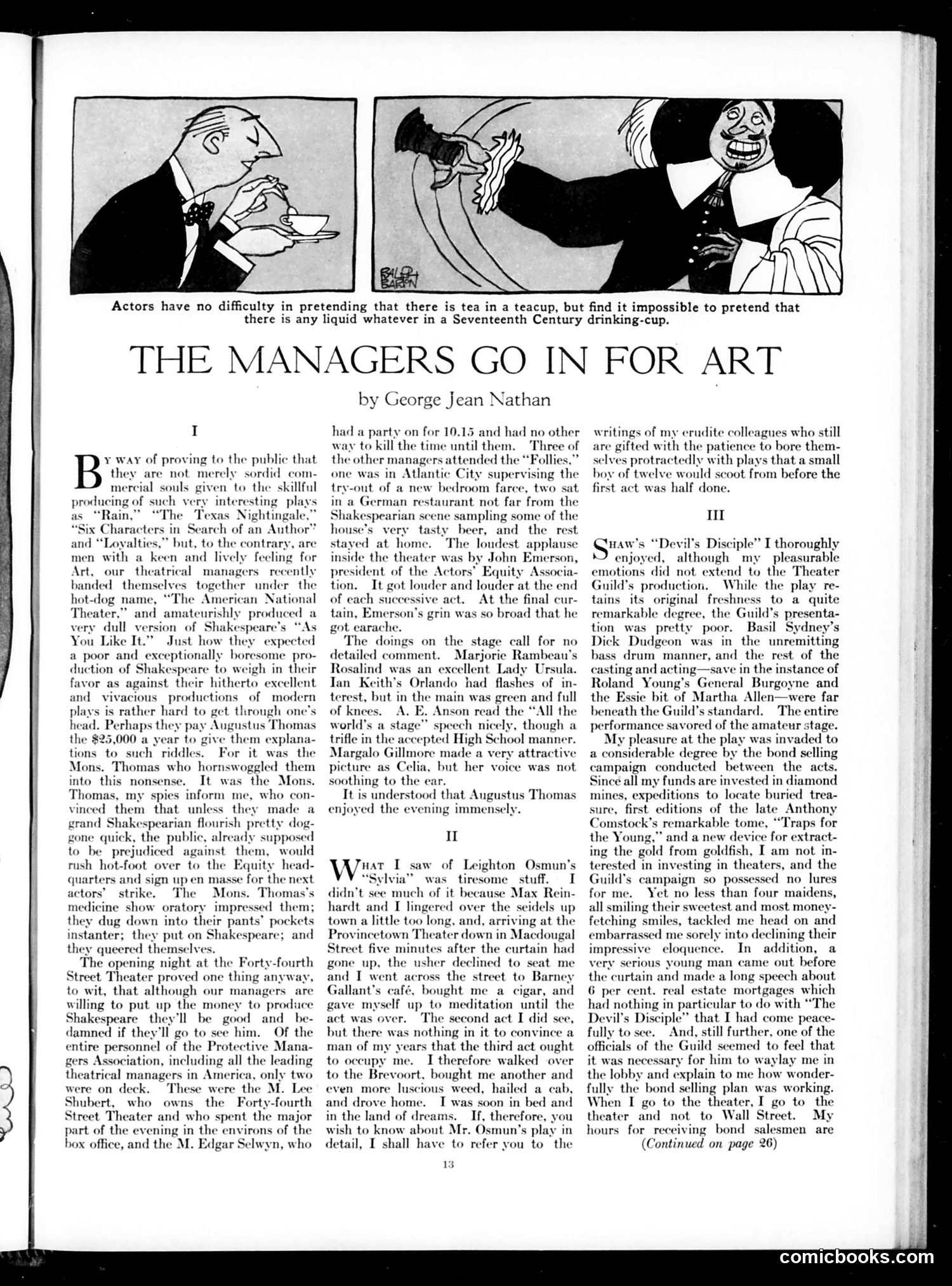
This satirical article by George Jean Nathan mocks New York theater managers' attempt to appear cultured. They formed "The American National Theater" and produced Shakespeare's *As You Like It* to counter public prejudice against them—allegedly pressured by Augustus Thomas, who convinced them an artistic production would improve their image. Nathan's bite is sharp: the managers themselves largely *didn't attend* their own Shakespeare production. Only two showed up; others went to the Follies, German restaurants, or stayed home. The only enthusiastic applause came from John Emerson of the Actors' Equity Association—suggesting Nathan saw irony in labor-management tensions. The cartoons above show actors struggling with theatrical props: pretending to drink from an empty Seventeenth-century cup. This illustrates Nathan's broader point: managers pursuing "art" while their actual theatrical instincts lean toward commercial productions like "Rain"—highlighting the gap between their pretensions and practices.
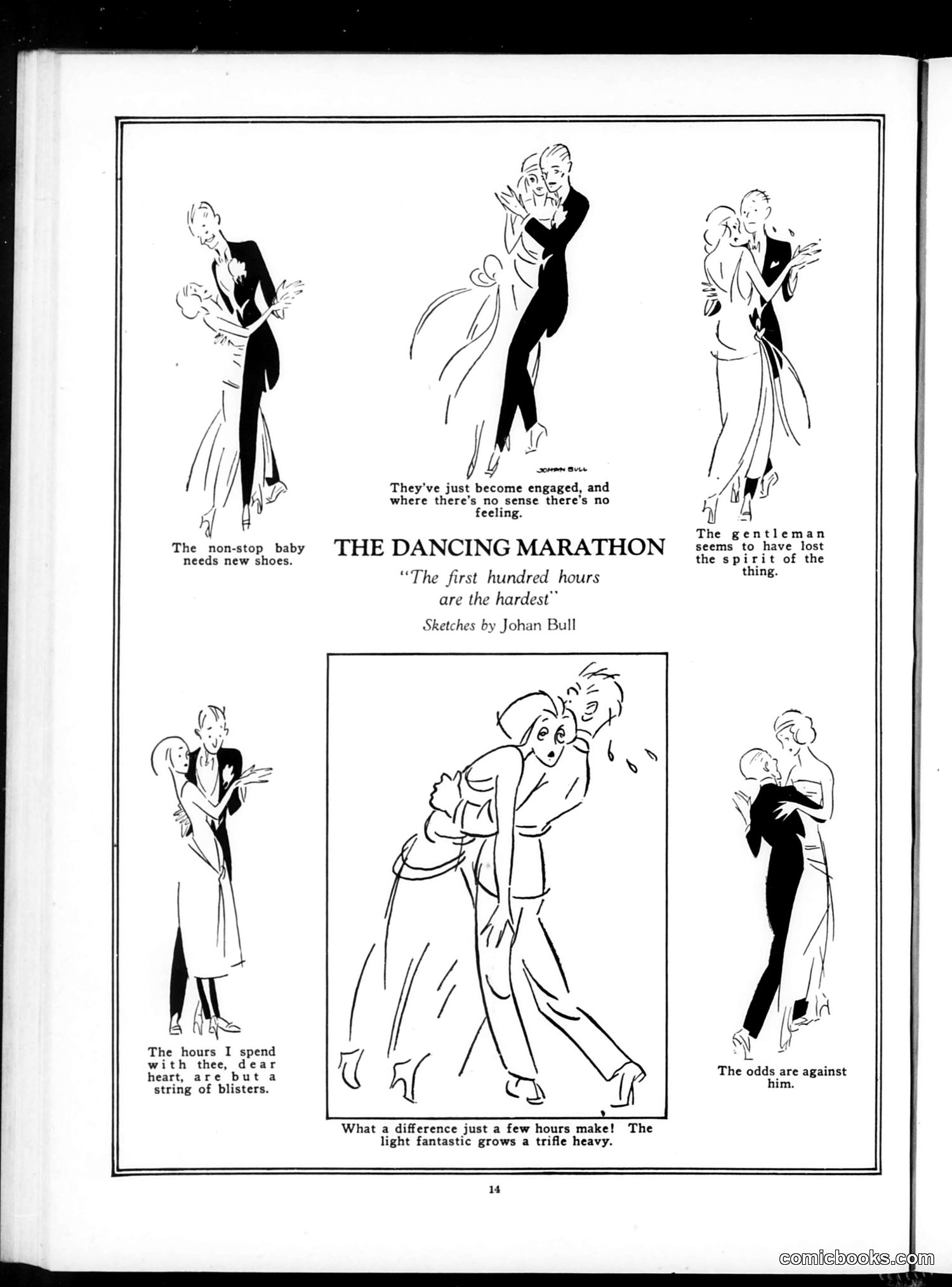
This page satirizes the 1920s craze of endurance dancing marathons—public competitions where couples danced continuously for days or weeks, often collapsing from exhaustion. Johan Bull's sketches mock the event's brutality disguised as entertainment. The cartoons contrast the marathon's romantic pretense with its physical reality: fresh couples begin energetically ("spirit of the thing"), but quickly deteriorate into pain and desperation. Captions like "string of blisters" and "the odds are against him" expose the suffering beneath the spectacle. The freshly engaged couple represents naive participants lured by excitement; their rapid decline illustrates how endurance marathons extracted entertainment value from human suffering. References to "the first hundred hours are the hardest" mock both participants' optimism and organizers' callousness. The satire targets both the marathons themselves and the public's appetite for such degrading spectacles—a common Judge critique of 1920s popular culture excess.
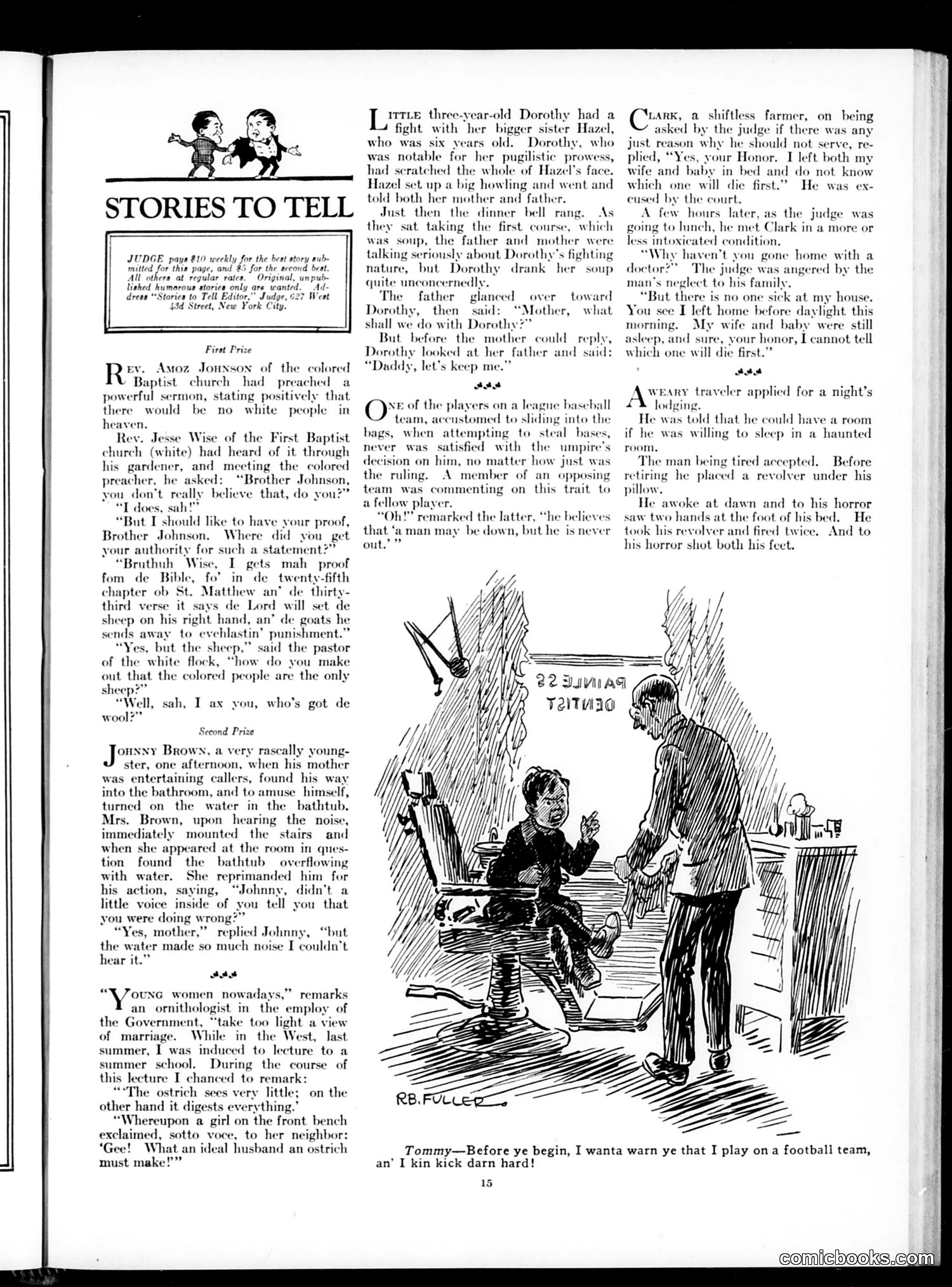
This page from Judge presents satirical humor typical of early 20th-century American magazines, featuring several short stories that mock social attitudes and human behavior: **The cartoons/jokes address:** 1. **Race relations**: A story satirizing a Black preacher's claim that no white people enter heaven, using biblical misinterpretation as the punchline—reflecting period racial stereotypes and religious debates. 2. **Class/behavior**: Stories about a shiftless farmer evading jury duty by feigning concern for sick family (then found drunk), a child's obliviousness to wrongdoing, and a baseball player's perpetual arguing with umpires. 3. **Gender commentary**: A final joke about women viewing marriage too casually, using an ostrich metaphor about digestion/silent suffering. The illustration shows a domestic scene with someone at a desk and another figure, likely accompanying one of these narratives. The humor relies on period stereotypes, malapropisms (spelled-out dialect), and moral lessons about character flaws—typical Judge content aimed at educated readers.
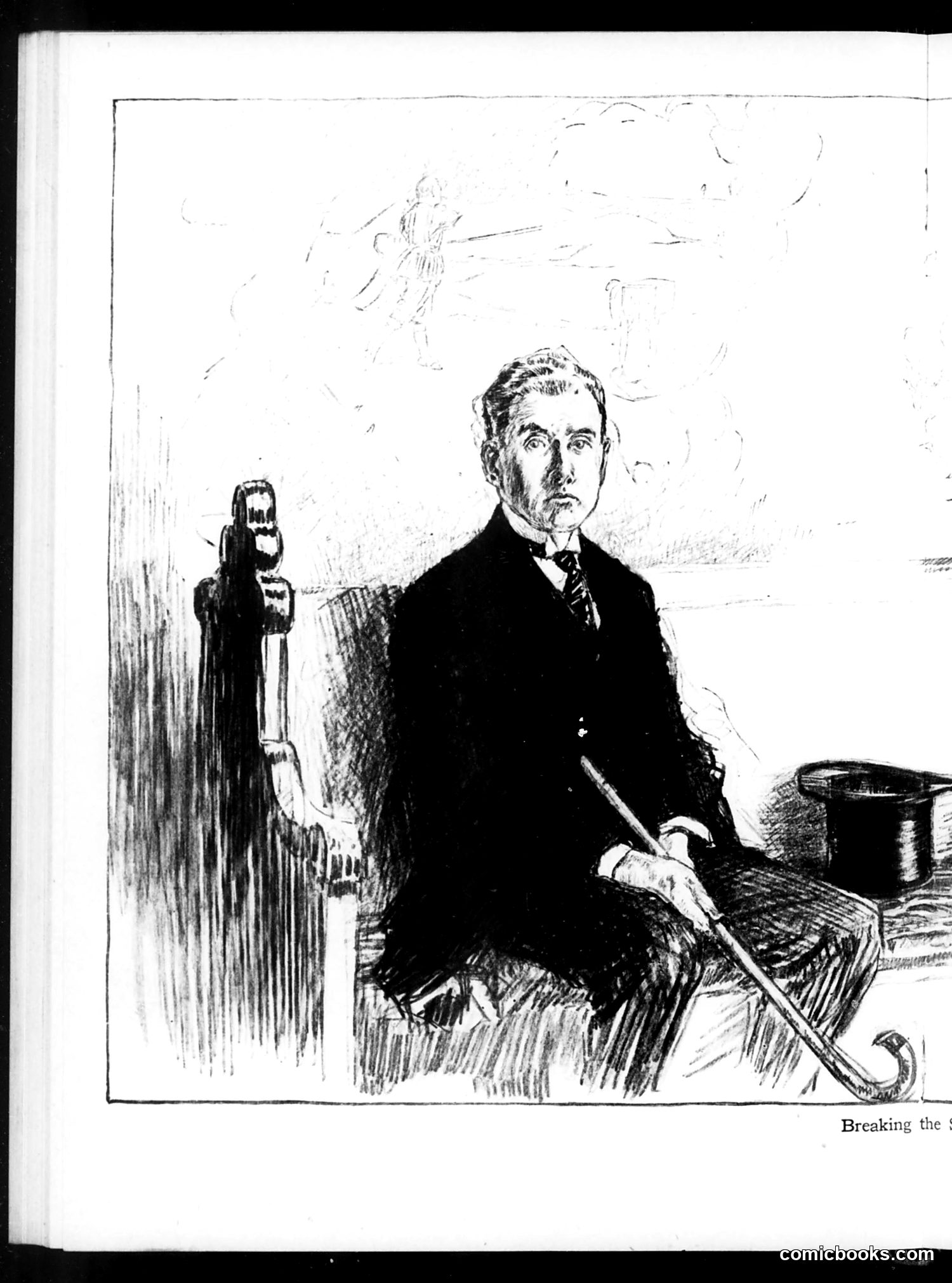
This appears to be a illustration from *Judge* magazine showing a well-dressed man in formal attire sitting on a chair, looking troubled or contemplative. Behind him stands what appears to be a skeletal or death-like figure. A hat and cane rest beside him. The visible caption reads "Breaking the s..." (cut off), which is insufficient to determine the specific cartoon's point. Without the complete caption or additional context, I cannot identify the particular figure depicted or the political/social issue being satirized. The image's style—late 19th or early 20th century—and the memento mori imagery (death figure) suggest commentary on mortality, fate, or consequences, but the specific satire remains unclear without the full text.
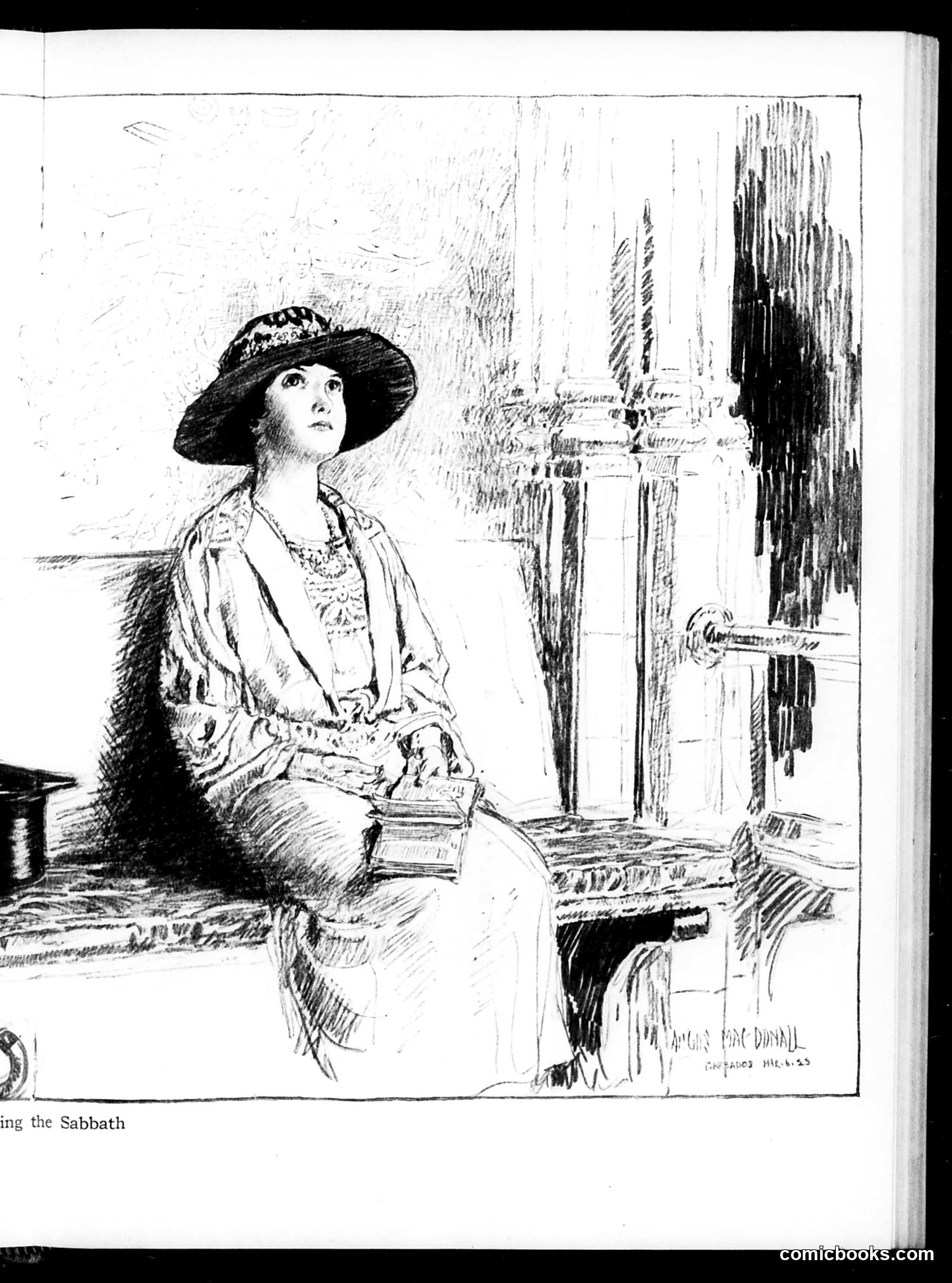
This appears to be a sketch titled "ing the Sabbath" (likely "Observing the Sabbath," with the beginning cut off). The illustration shows a woman in early 20th-century dress—including a wide-brimmed hat and jacket—sitting by a window, appearing to gaze outward pensively while holding what looks like a book or reading material. The satire likely critiques attitudes toward Sabbath observance, possibly mocking either overly strict religious adherence or, conversely, the restlessness of those confined to domestic, "proper" Sunday behavior. The woman's wistful expression and the composition suggest tension between prescribed religious duty and personal desire or freedom. Without additional context or visible author attribution, the specific satirical target remains unclear, though it engages with early-1900s debates about religious observance and social constraint.
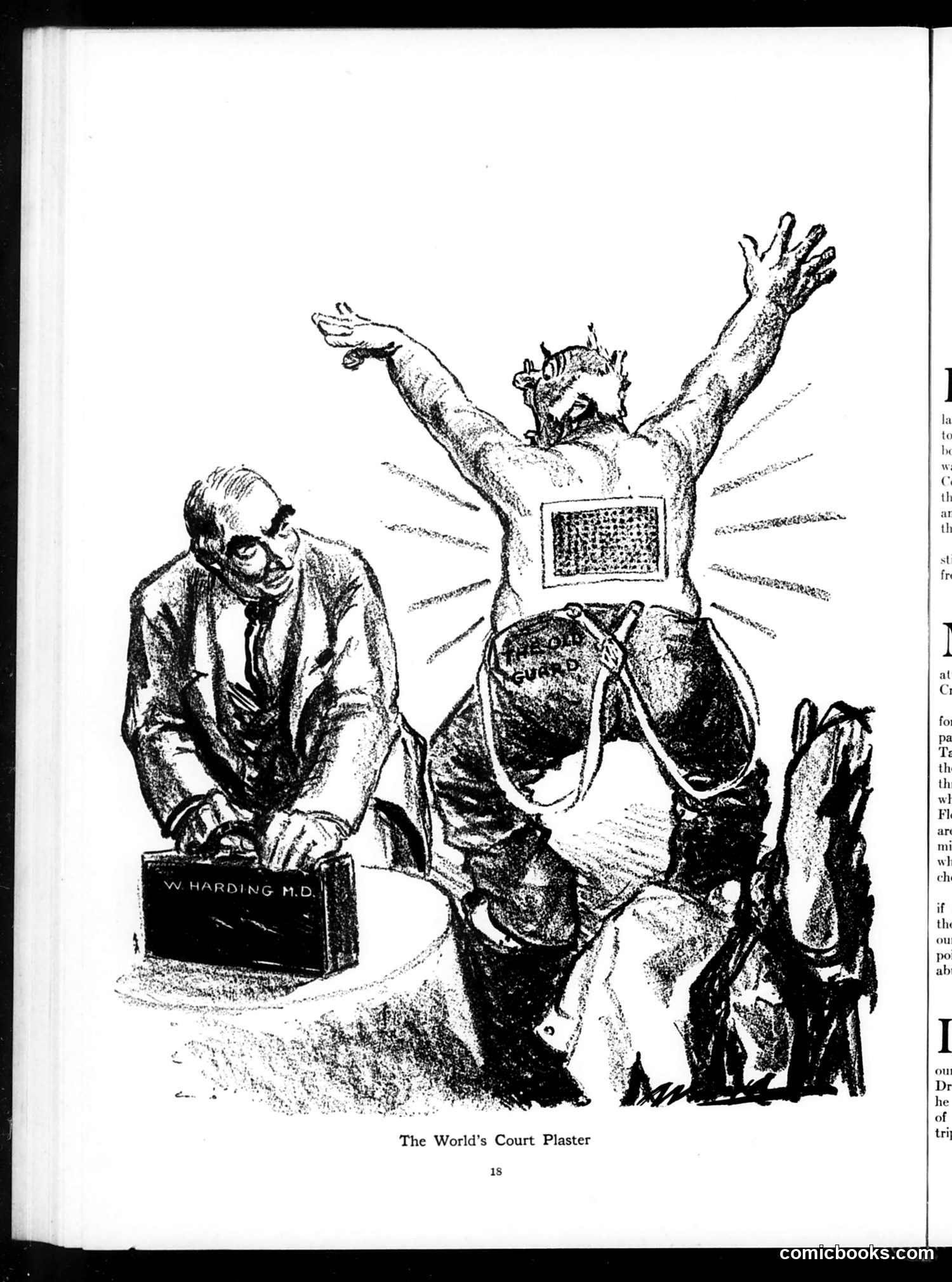
This political cartoon depicts a seated figure labeled "W. HARDING M.D." applying a medical plaster to an exuberant, radiating humanoid figure—likely representing world peace or international harmony. The imagery suggests President Warren G. Harding positioning himself as a "doctor" treating the world's ailments through a "court plaster" (an adhesive bandage). The satire appears to mock Harding's diplomatic efforts or international policies as superficial medical treatment—a mere band-aid solution to complex global problems. The exaggerated, jubilant figure suggests either optimistic public expectations or satirical overestimation of what such measures could achieve. The cartoon likely critiques the limitations of Harding's foreign policy approach during the early 1920s.
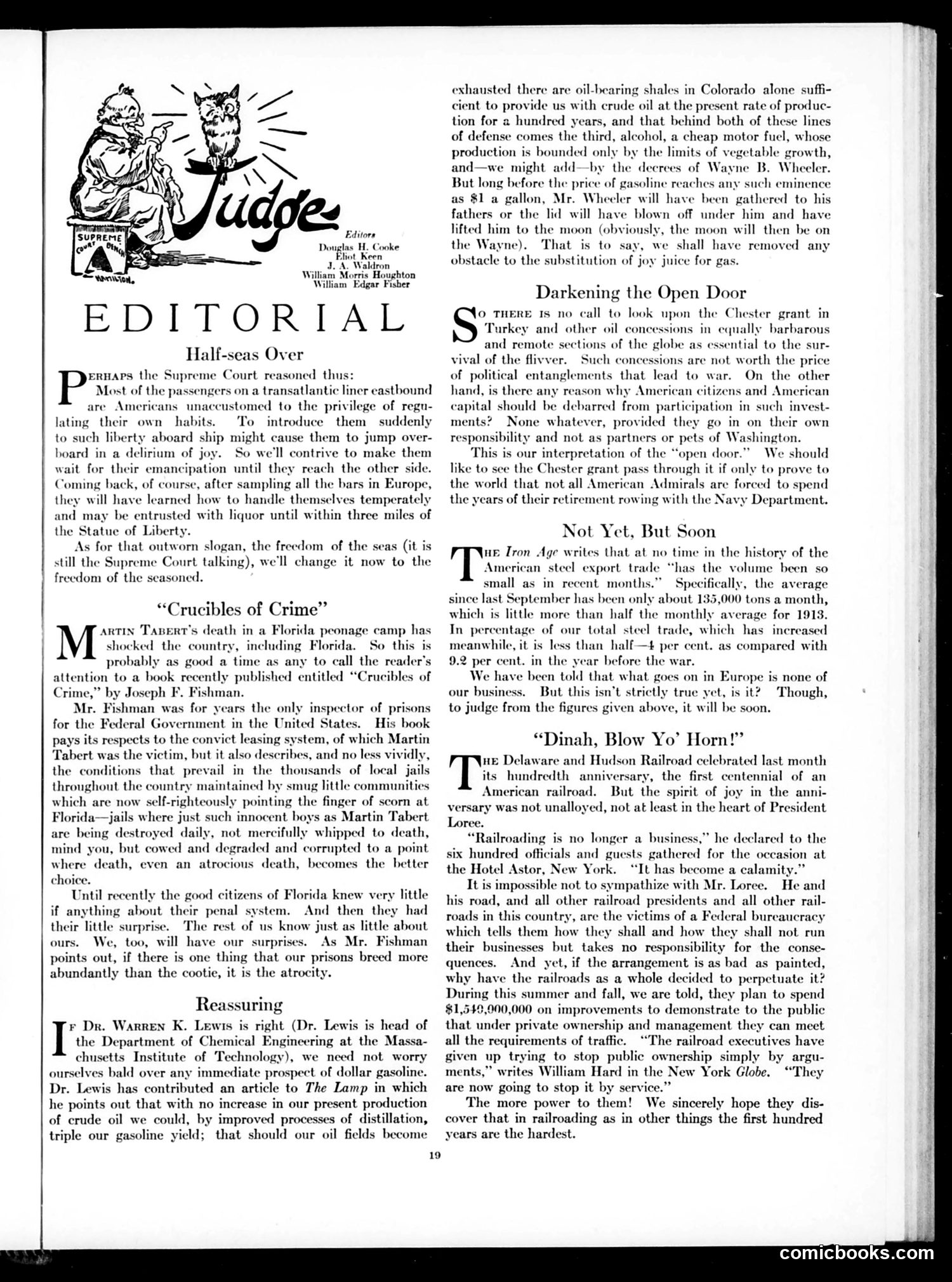
This editorial page contains several satirical pieces targeting American policies and social issues circa the 1920s: **"Half-seas Over"** mocks Prohibition's inconsistent enforcement. The joke: the Supreme Court allows alcohol consumption on transatlantic ships heading to Europe (where Americans are "unaccustomed to liberty") but not on return voyages—supposedly to protect seasoned drinkers from themselves. The satire critiques the absurdity of selective Prohibition enforcement based on location. **"Crucibles of Crime"** reviews a book exposing brutal conditions in American prisons and the convict-leasing system. It shames communities that criticized Florida's peonage camps (where Martin Tabert died) while maintaining similarly brutal local jails. **"Reassuring"** and subsequent sections discuss fuel supply—arguing Americans needn't fear gasoline shortages, with alternatives like Colorado oil shales and alcohol available. The *Judge* mascot (top left) appears to be the publication's satirical judge character, lending authority to these critiques of governmental hypocrisy and institutional injustice.
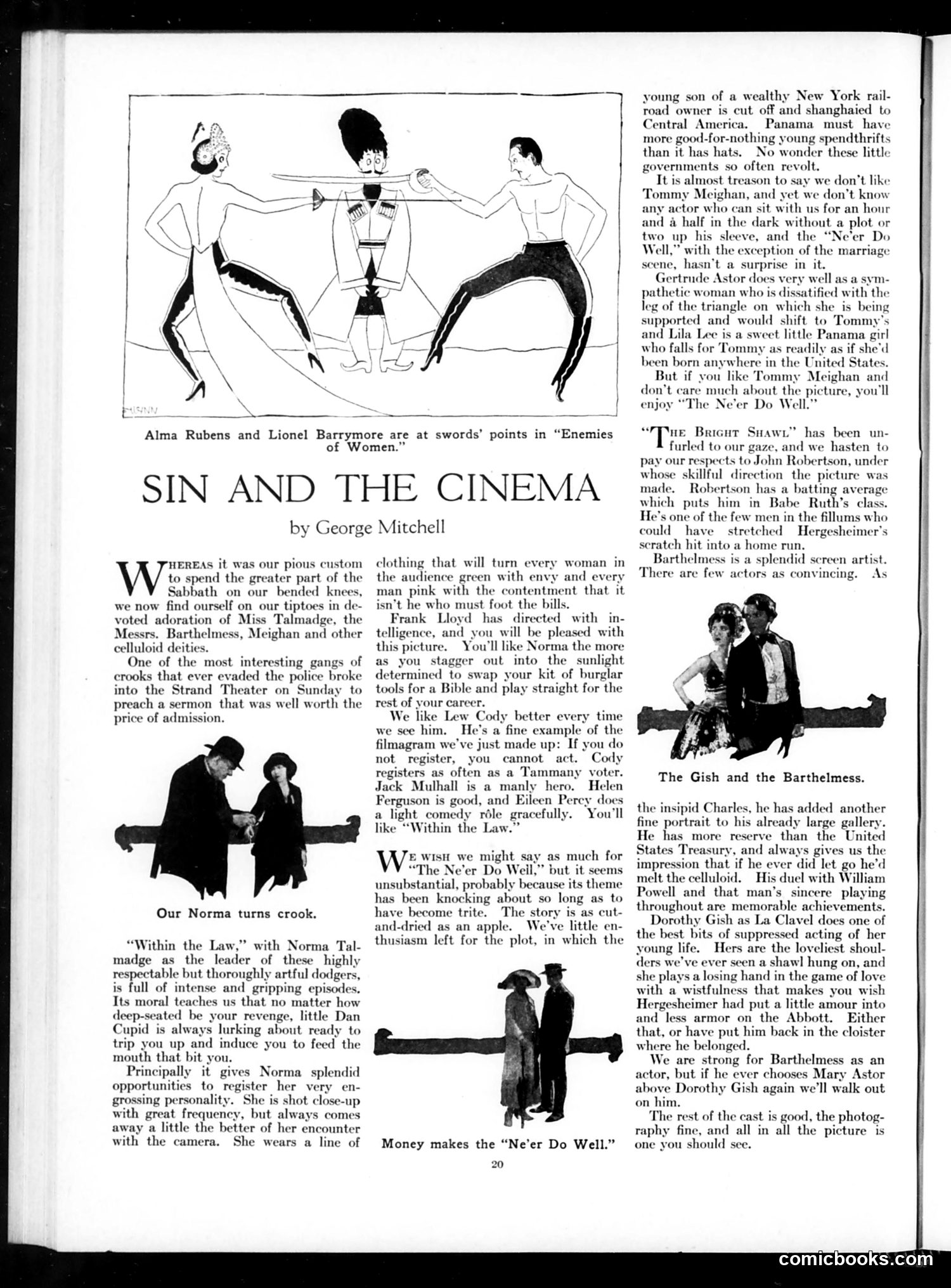
This is a film review column mocking 1920s movie culture. Mitchell satirizes how Americans have replaced religious devotion with worship of cinema stars like Norma Talmadge and the Barthelmess brothers—"celluloid deities." The reviews discuss three films: "Within the Law" (praised for Talmadge's close-ups and costumes that make women envious), "The Ne'er Do Well" (criticized as a tired, plot-thin story about a wealthy railroad heir exiled to Panama—a joke about how many dissolute young men apparently end up there), and "The Bright Shawl" (praised for director John Robertson's skill). The satire targets both cinema's shallow moralism and movie stars' limited range. One quip defines acting as "registration"—mere facial expressions—with Lew Cody compared to a "Tammany voter" for registering constantly (a jab at corrupt New York politics). The page mixes entertainment commentary with social critique of cinema's superficiality and mass appeal.
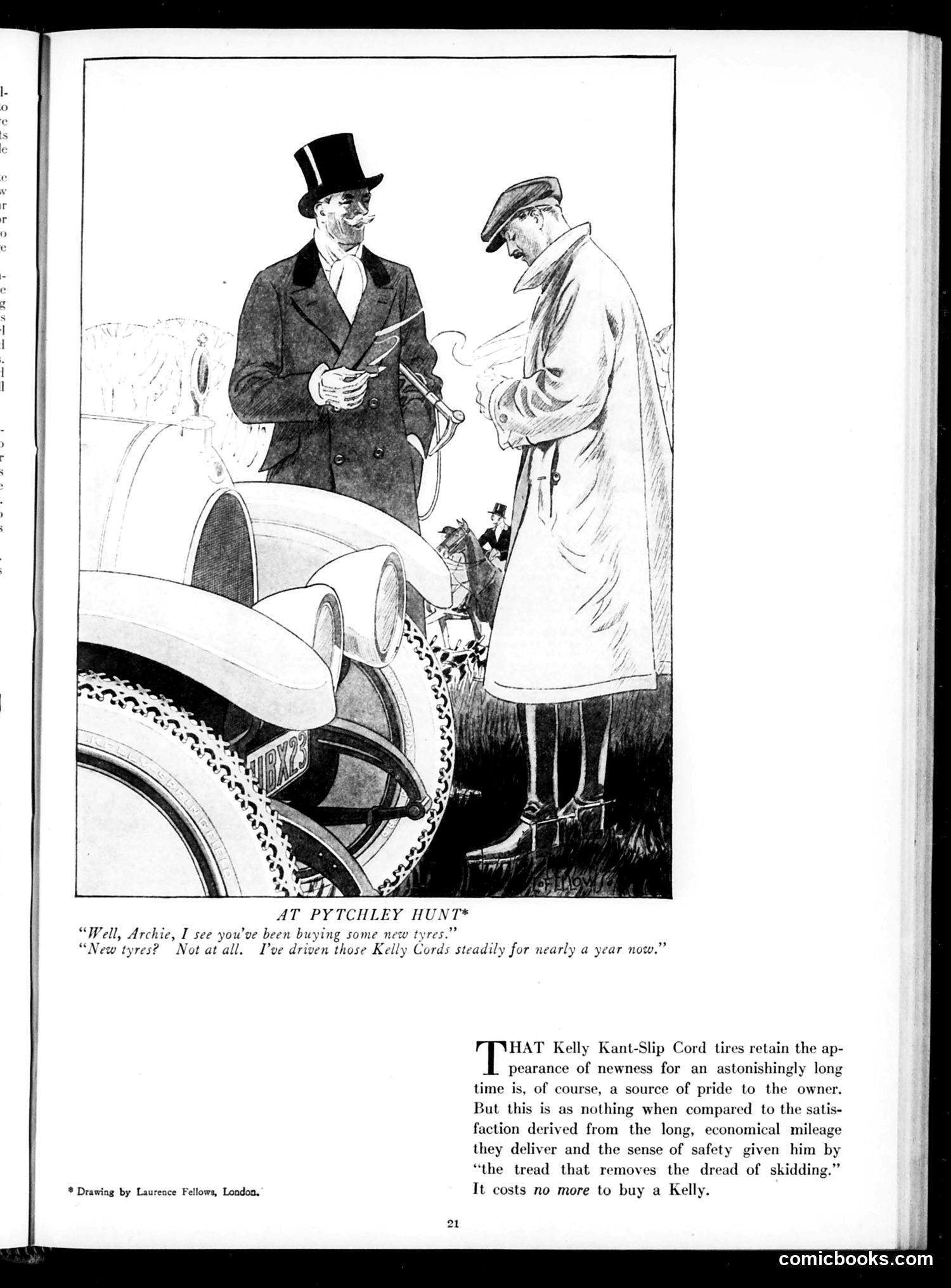
This is a **Kelly tire advertisement** disguised as humor, set at an English fox hunt (Pytchley Hunt is a real, prestigious hunt club). Two wealthy gentlemen discuss tires; one assumes the other bought new ones, but learns they're Kelly Cords driven for nearly a year—yet still look new. The satire targets **upper-class vanity and materialism**: these men prioritize how their cars appear to peers at exclusive social venues. The joke works on two levels: it mocks snobbish display while selling the product's durability and value ("It costs no more to buy a Kelly"). The drawing by Laurence Fellows is period advertising masquerading as editorial content—common in early-20th-century magazines. The social context emphasizes automobiles as status symbols among the wealthy.
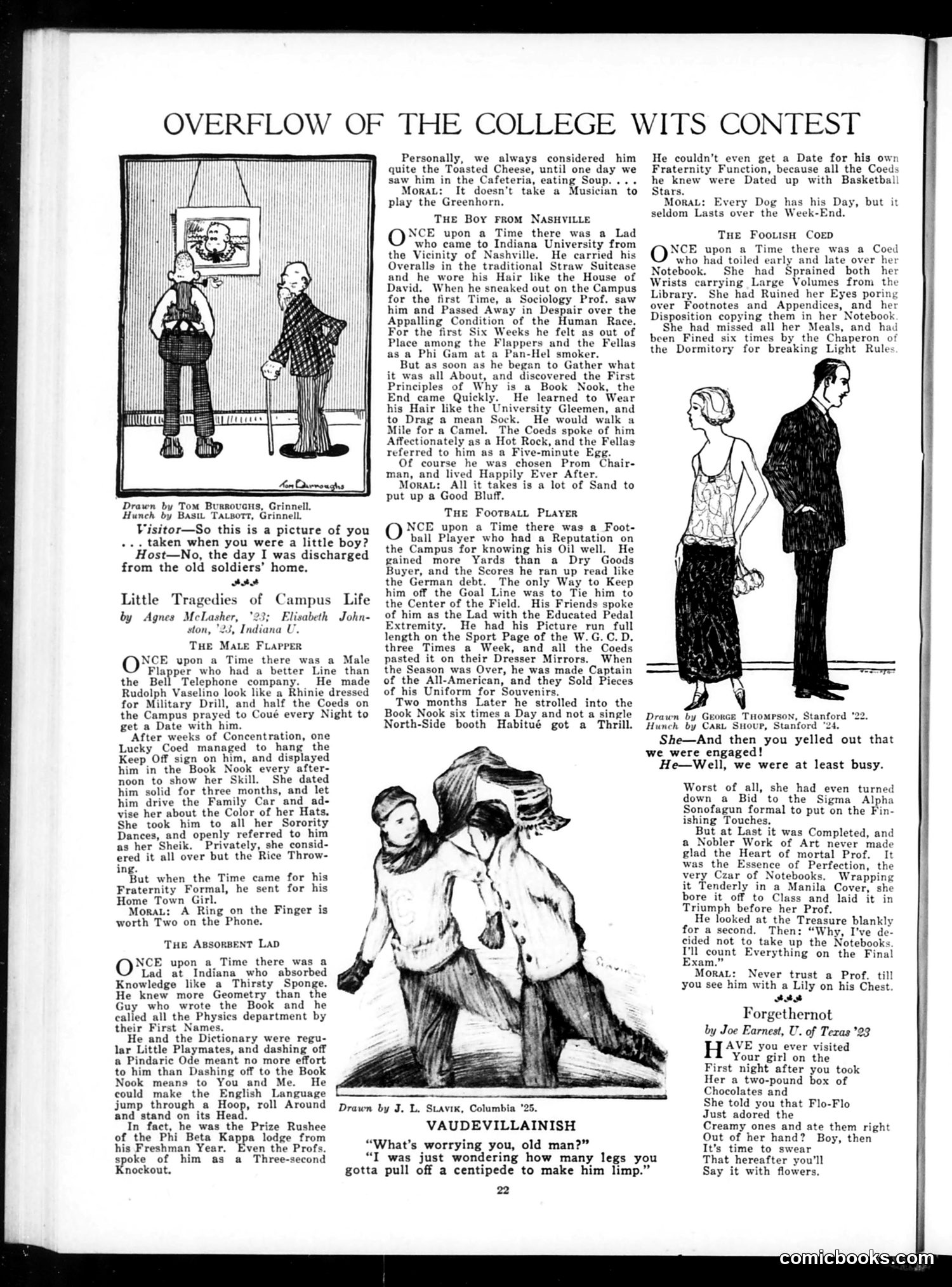
This page collects humorous short stories about college life, submitted to Judge magazine's contest. Each tale satirizes recognizable campus character types through exaggerated vignettes: **"The Male Flapper"** mocks the shallow romantic pretensions of college men who seduce coeds with smooth talk, then abandon them for their hometown girlfriend—exposing the hypocrisy beneath their confident personas. **"The Absorbent Lad"** ridicules the pedantic scholar who absorbs knowledge effortlessly yet proves utterly ordinary when observed eating soup in the cafeteria, suggesting intellectual prowess doesn't guarantee social sophistication. **"The Boy from Nashville"** traces a country bumpkin's rapid transformation into a campus sophisticate—satirizing how easily rural students adopt urban manners and attitudes, implying the transformation is superficial "bluff." **"The Football Player"** caricatures the celebrity athlete whose inflated reputation and media coverage obscure actual accomplishment. Each story includes a moralistic "conclusion," humorously mocking the didactic tone of fables. The cartoons by Tom Burroughs and others provide visual reinforcement of these campus stereotypes.
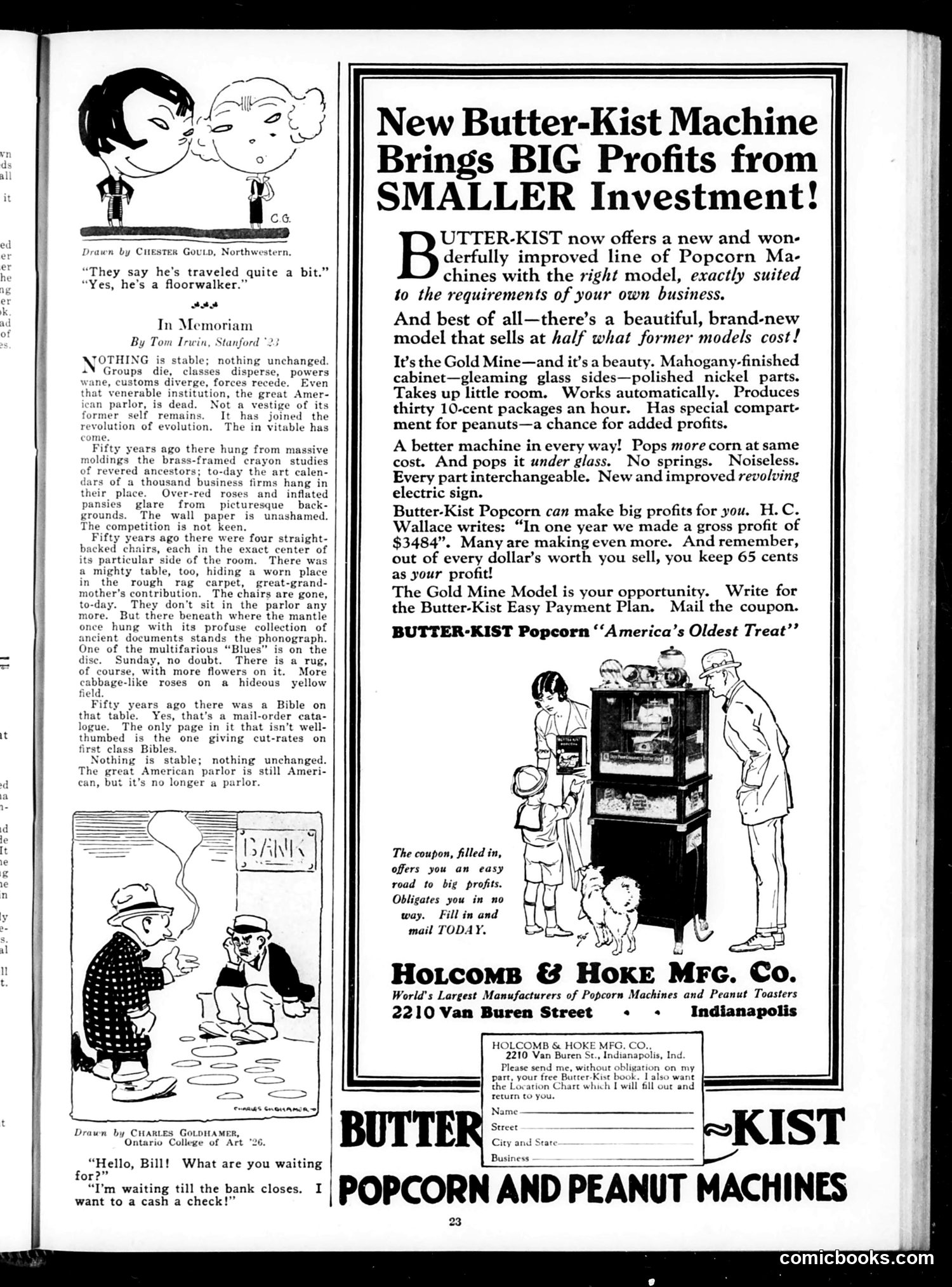
This page contains satirical cartoons and period advertising, primarily from the 1920s era. **The Cartoons:** Two brief joke comics appear on the left. The top one plays on the term "floorwalker"—a department store employee who assists customers—by depicting someone who literally walks floors. The bottom cartoon jokes about banking delays: a man waits for the bank to close before cashing a check, likely satirizing financial institutions' inconvenient hours or suggesting he's avoiding creditors. **The Editorial Content:** "In Memoriam" by Tom Irwin nostalgically laments the disappearance of the traditional American parlor, once a formal sitting room with period furnishings and family Bibles. Modern parlors now feature gramophones, mail-order catalogs, and cheap decorations—reflecting broader social anxieties about commercialization and the erosion of genteel domestic life during rapid modernization. **The Advertisement:** The dominant right side advertises Butter-Kist popcorn machines, pitched as low-investment business opportunities with high profit margins (65 cents per dollar sold). This reflects 1920s entrepreneurial culture promoting small vending businesses.
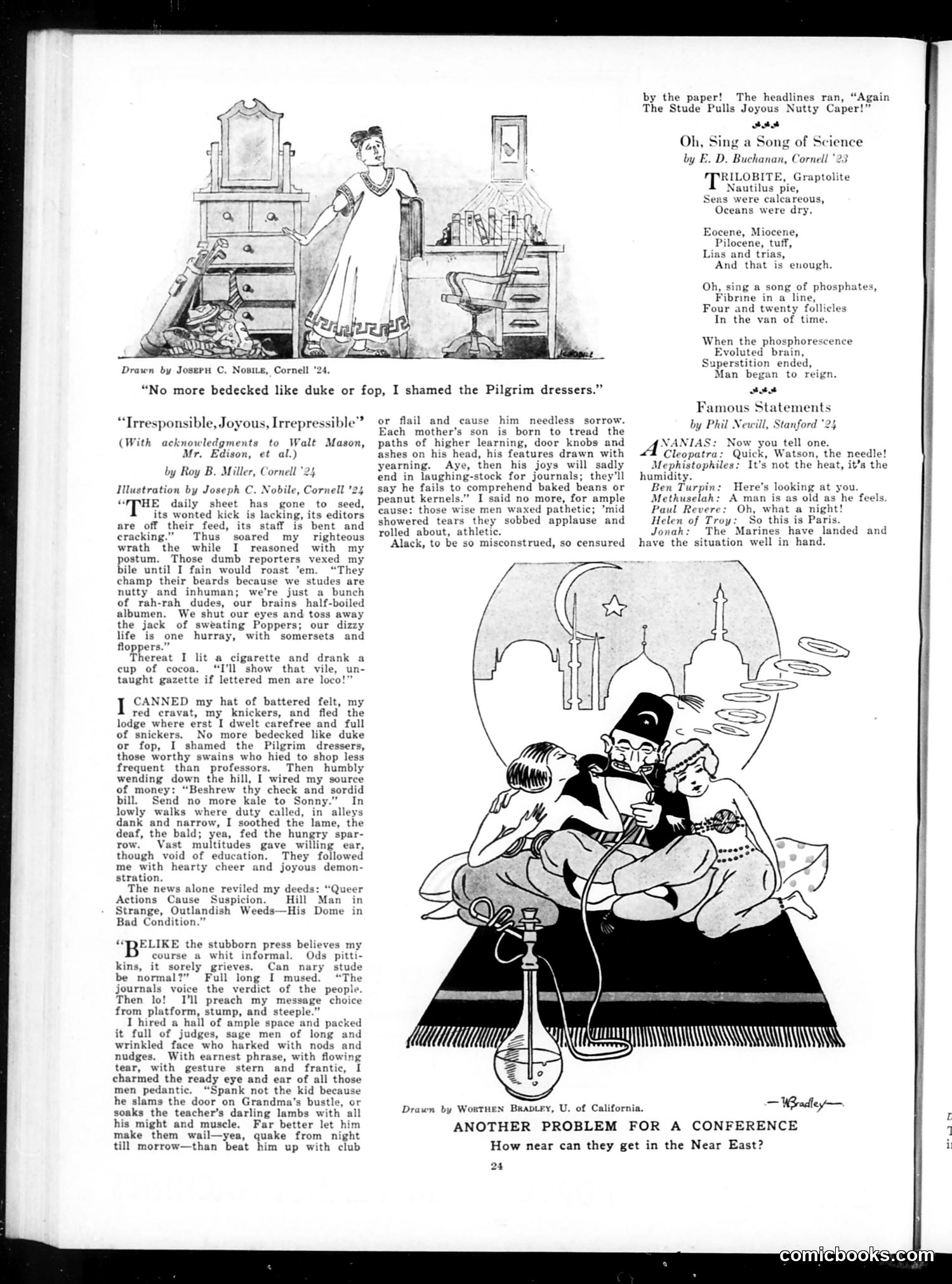
This page from Judge magazine contains student humor from the 1920s. The main illustrated piece satirizes college students' self-importance and hypocrisy. A Cornell student narrator claims to reject upper-class pretension ("no more bedecked like duke or fop"), adopts humble dress, then delivers a pompous lecture to judges about child-rearing philosophy. When the press mockingly reports his "nutty caper," he's outraged—the satire being that he sought exactly this attention while claiming moral superiority. The poem "Oh, Sing a Song of Science" parodies pseudo-intellectual student verse, stringing together geological and scientific terms meaninglessly. "Famous Statements" offers one-liners credited to celebrities—likely contemporary references (Ben Turpin was a silent film comedian), though several attributions' exact significance is now unclear. The illustration shows a student in Middle Eastern dress, possibly mocking orientalism or escapism as another form of undergraduate affectation.
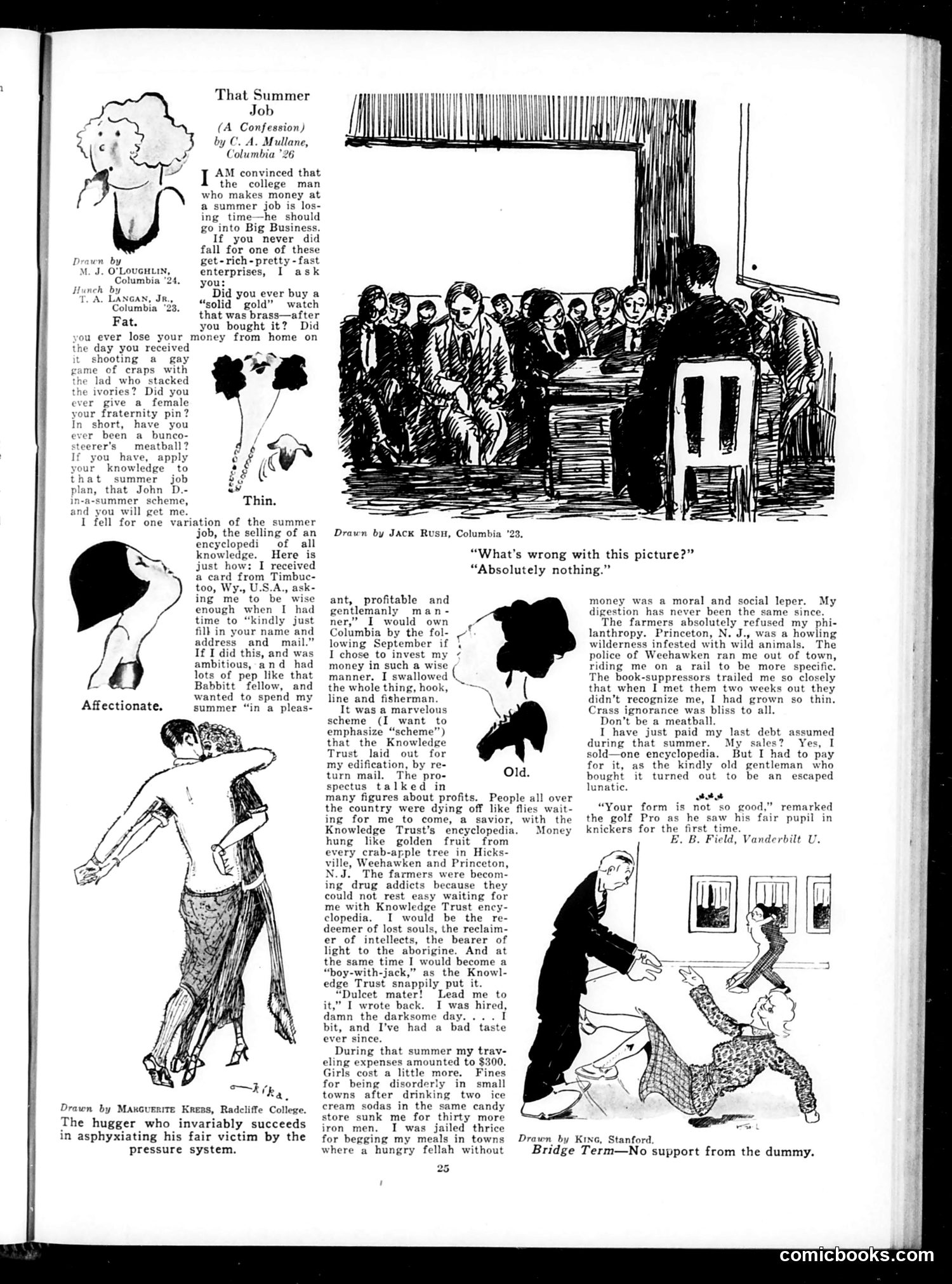
This confessional article by C.A. Mullane (Columbia '26) mocks college students seduced by get-rich-quick summer schemes. The author describes falling for an encyclopedia sales job promoted by the "Knowledge Trust," which promised easy profits if he'd recruit farmers hungry for education. The satire targets naive young men who believe they're shrewd businessmen while actually being "bunco-eers' meatballs" (con victims). Despite spending $300 in expenses, facing jails for vagrancy, police violence, and book-suppression raids, he sold only one encyclopedia—to an escaped lunatic—leaving him financially worse off. The cartoons (by various student artists) mock related masculine vanities: pompous "affectionate" types, the ineffectual "hugger," and condescending authority figures. The joke: college men imagining themselves as Babbitts or Rockefellers while actually becoming hapless dupes of corporate schemes.
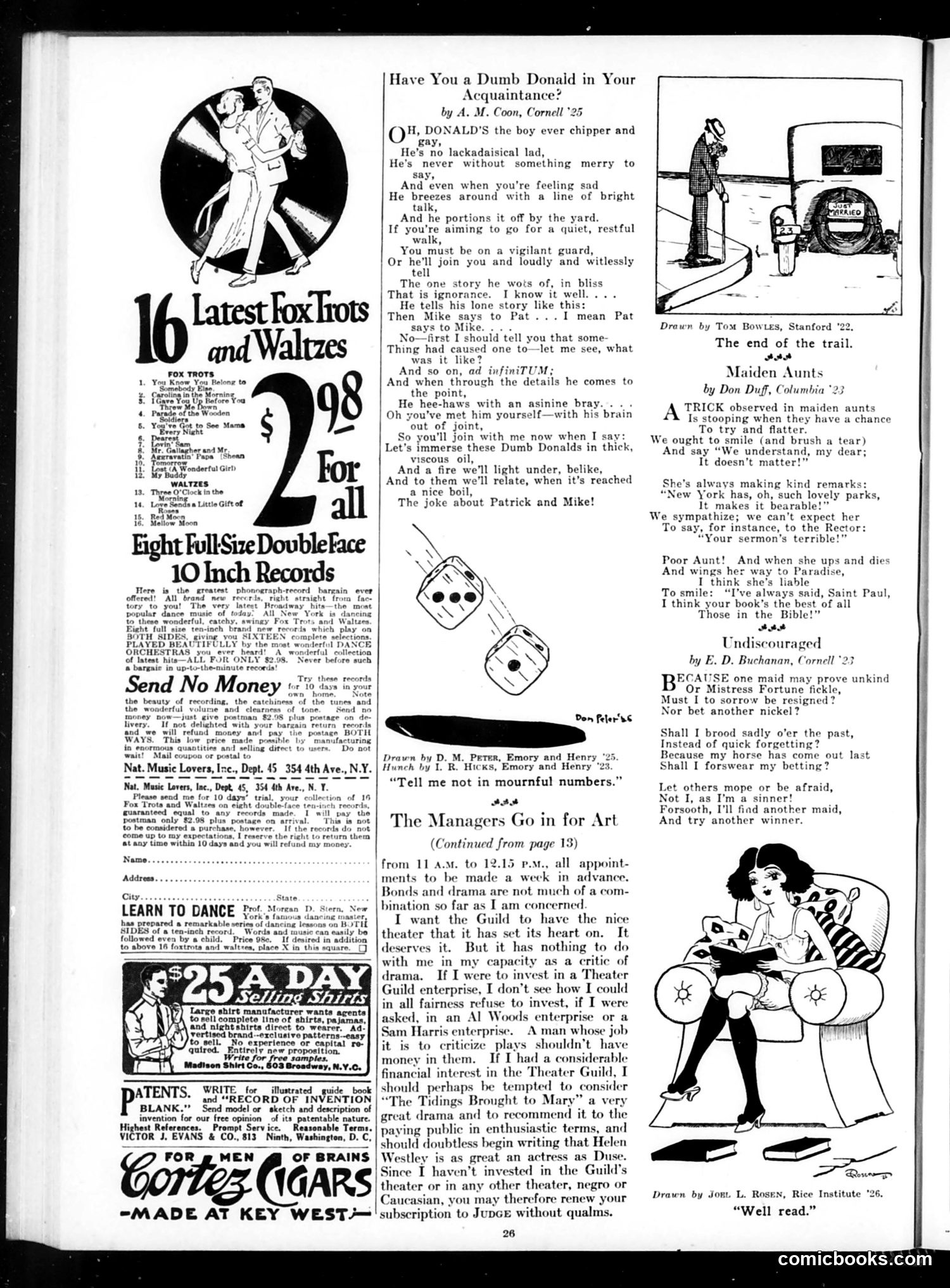
This page from Judge magazine contains satirical poetry and advertisements typical of 1920s American humor magazines. The main literary content is "Have You a Dumb Donald in Your Acquaintance?" by A.M. Coon—a humorous poem satirizing a specific social type: the relentlessly cheerful, talkative bore named Donald who won't shut up on walks and tells interminably long, pointless stories. The poem's punchline advocates boiling such people in oil, a hyperbolic expression of exasperation common to the era's comic writing. The other notable piece, "The Managers Go in for Art," discusses theater criticism ethics, arguing that arts critics shouldn't invest financially in theatrical enterprises to avoid conflicts of interest. The page is predominantly filled with advertisements: Fox Trots and Waltzes records ($2.98), dance instruction records, shirt manufacturing opportunities, and patent services—typical commercial fare for Judge's readership. The cartoons illustrate these pieces with period-appropriate drawings depicting the social situations described.
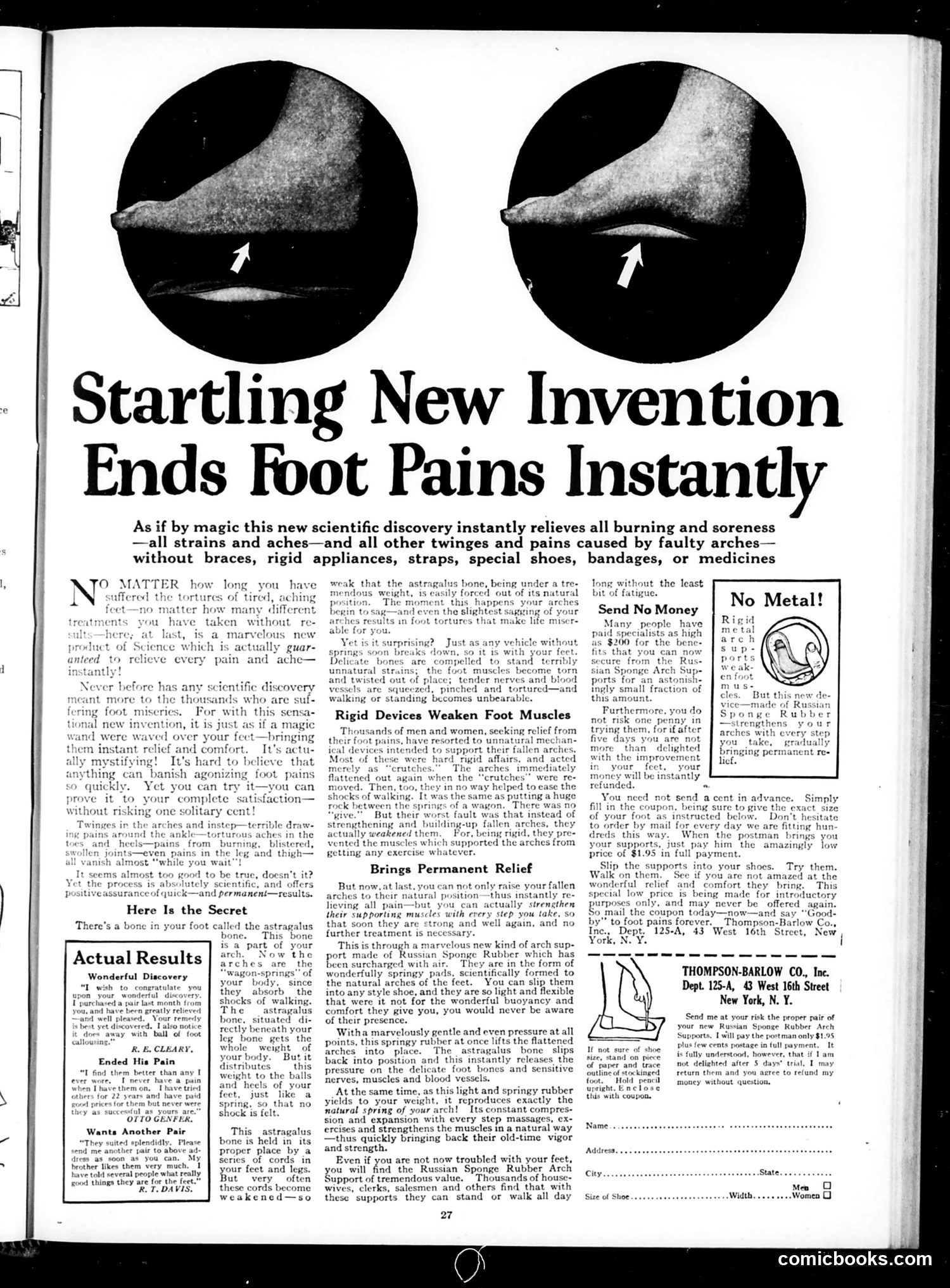
This is primarily a **full-page advertisement** for an arch-support device made of Russian Sponge Rubber, disguised as a medical discovery article. There is no political cartoon or satire here. The ad claims a revolutionary "invention" instantly cures foot pain caused by fallen arches—without braces, shoes, or medicine. It explains the anatomy (the astragalus bone), argues that rigid devices weaken foot muscles, and promotes this new springy rubber insert as the solution that strengthens arches naturally while walking. The page includes testimonial quotes from satisfied customers ("Otto Genfer," "R.T. Davis") and ordering information from Thompson-Barlow Co. **For modern readers:** This represents early 20th-century **medical advertising pseudoscience**—making exaggerated health claims with pseudo-scientific language about anatomy and biomechanics. Such claims would face FDA scrutiny today. The tone and layout mimic journalism to appear credible.
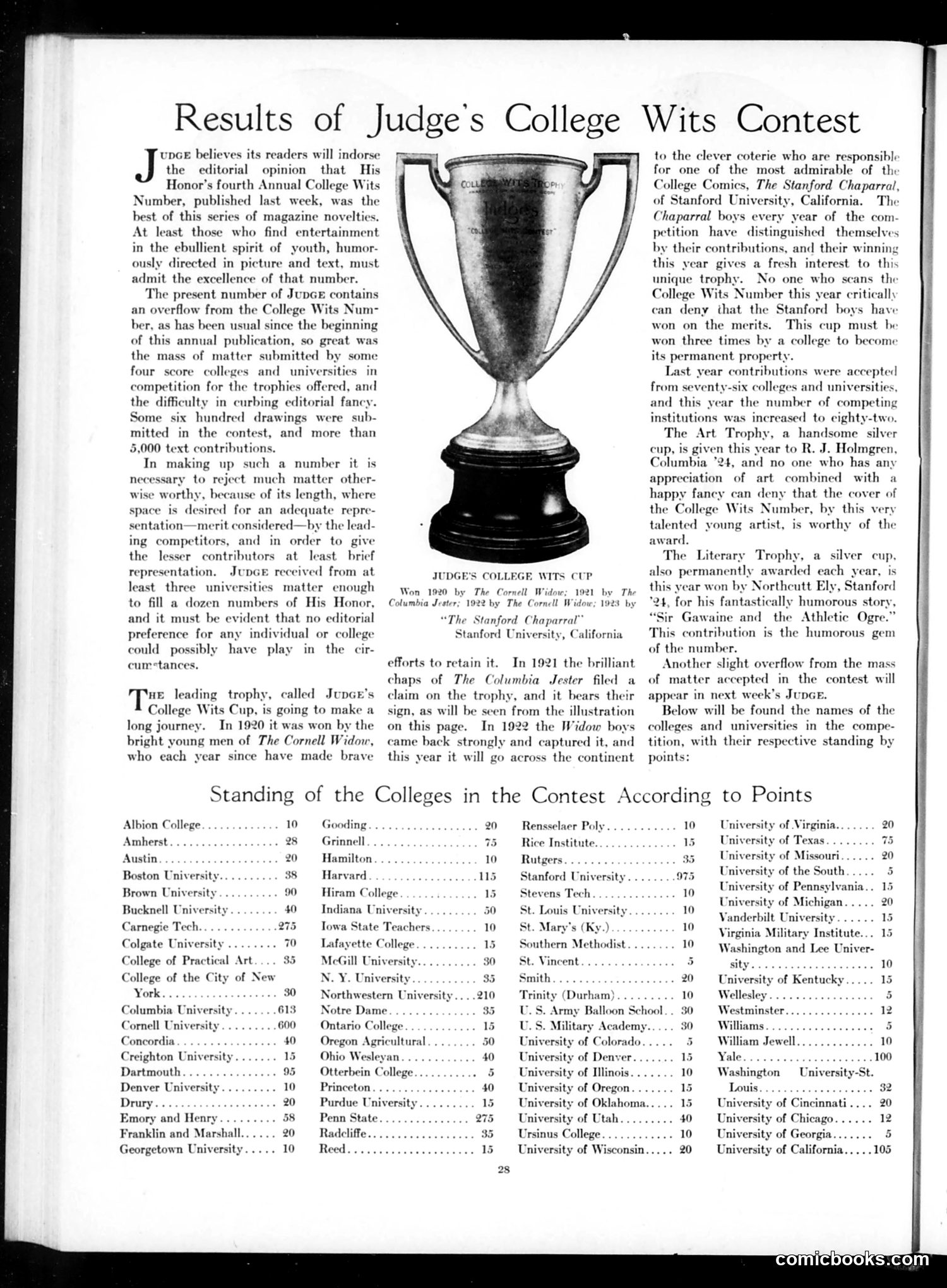
This page announces results of Judge magazine's annual collegiate humor competition. The central image is the "Judge's College Wits Cup"—a prestigious trophy contested among college humor publications. **The Context:** College humor magazines were significant cultural institutions in the 1920s, with prestigious titles like *The Cornell Widow*, *Columbia Jester*, and *Stanford Chaparral* competing for recognition. The trophy rotated among winners: Cornell held it 1920-1921, Columbia in 1921, Cornell again in 1922, and Stanford won in 1923. **The Point:** This celebrates Stanford's victory while emphasizing the competition's legitimacy—over 600 drawings and 5,000 text submissions from 82 institutions competed. Individual awards were given for art (R.J. Holmgren) and literature (Northcutt Ely). The editorial stresses judges couldn't favor particular colleges given the volume of submissions, lending credibility to Stanford's win "on the merits." The page essentially crowns Stanford's humor magazine as that year's best among American college publications.
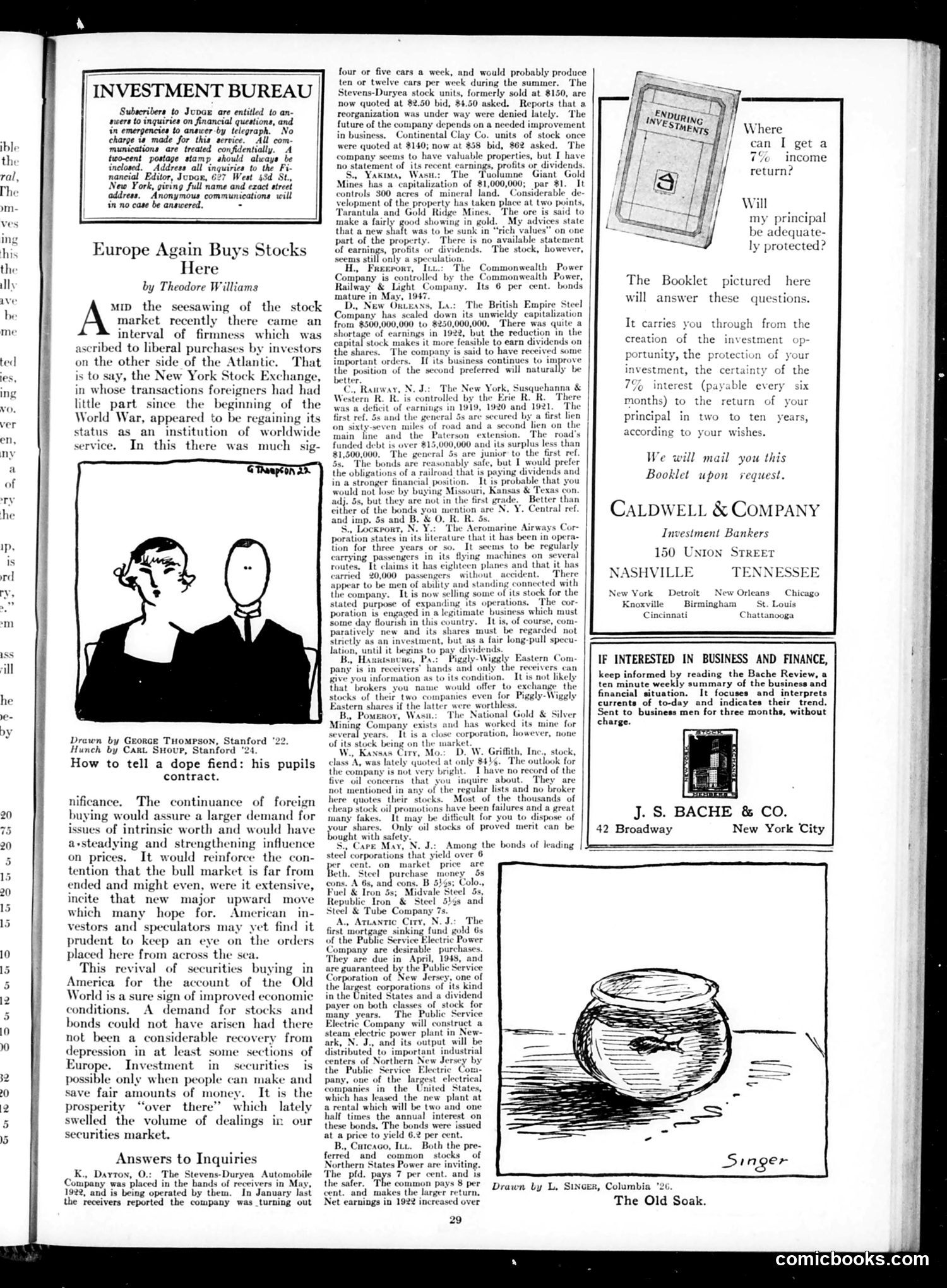
This page from *Judge* magazine contains investment advice and financial commentary from the 1920s, plus a small satirical cartoon. **The Main Cartoon:** "How to tell a dope fiend: his pupils contract" presents two simplified face drawings—one showing dilated pupils, one showing contracted pupils. This is a straightforward public health/anti-drug message comparing physiological signs of drug use. It's not politically satirical but rather educational awareness material, reflecting 1920s concerns about drug addiction. **The Article Content:** "Europe Again Buys Stocks Here" discusses European investors resuming purchases of American securities after World War I, interpreting this as a sign of European economic recovery. The page also includes an "Investment Bureau" advice column answering reader questions about various stocks and bonds—fairly technical financial content aimed at middle-class investors. **Historical Context:** This reflects the optimistic 1920s "bull market" period before the 1929 crash. The focus on foreign investment and economic recovery shows post-WWI financial concerns. The page is primarily informational/advisory rather than satirical.
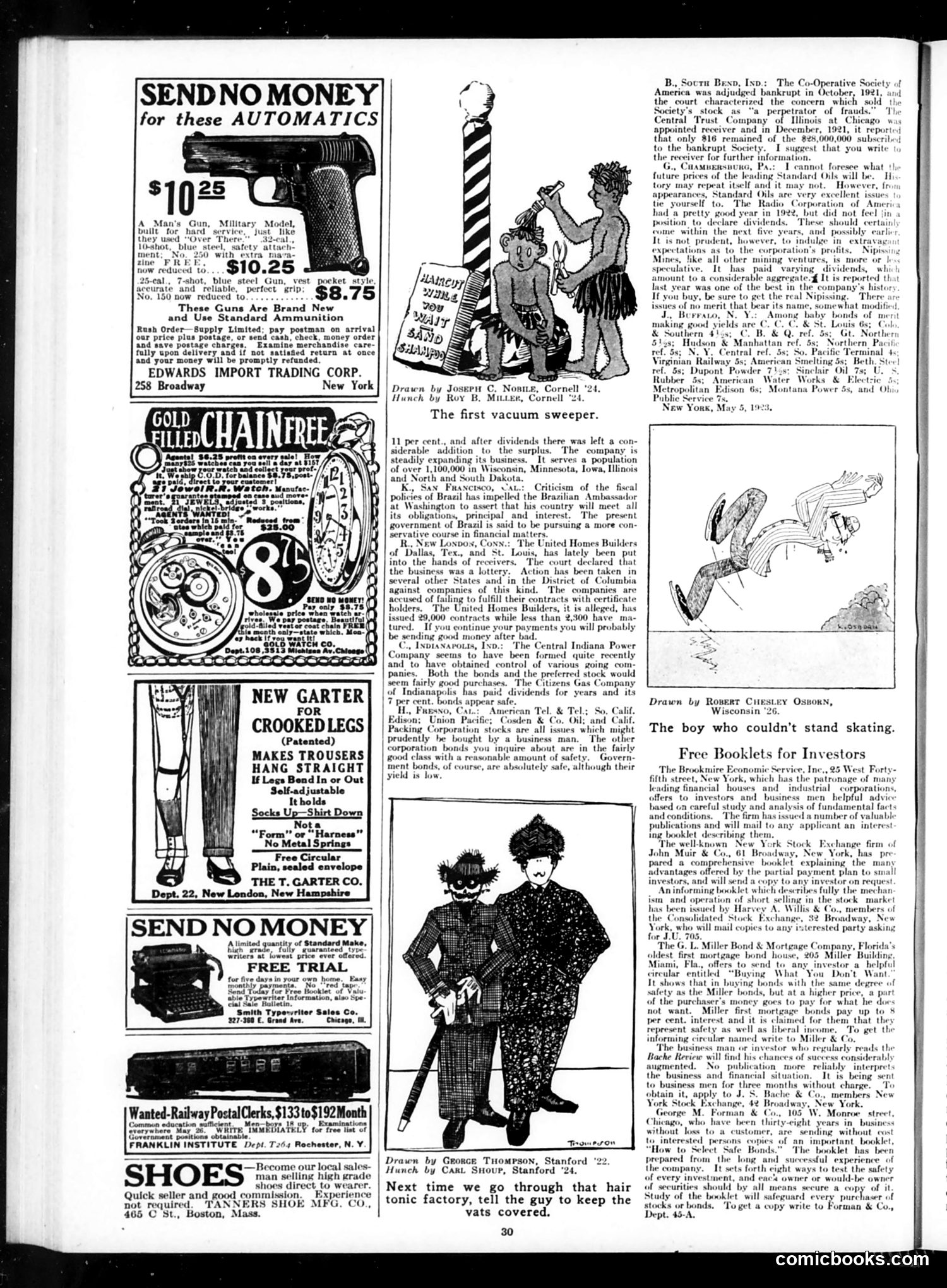
This is primarily an **advertising page** with minimal political content. The cartoons present are light social humor rather than satire: **"The Boy Who Couldn't Stand Skating"** shows two figures at a barber pole—likely depicting someone whose hair has gone white/gray from stress or shock related to skating. The caption's joke relies on a pun: the boy "couldn't stand" skating (couldn't tolerate it physically or emotionally), and now he's at the barber pole (a vertical striped post). It's gentle, absurdist humor typical of 1920s magazines. **"Next time we go through that hair tonic factory..."** is a grim joke about a factory accident—suggesting someone fell into a vat at a hair tonic factory and was killed or disappeared, hence "keep the vats covered." Dark workplace humor. The page is otherwise dominated by mail-order advertisements: firearms ($10.25), watches, leg garters for crooked legs, typewriters, and government job listings. These ads reflect post-WWI consumer culture and economic opportunity narratives of the 1920s.
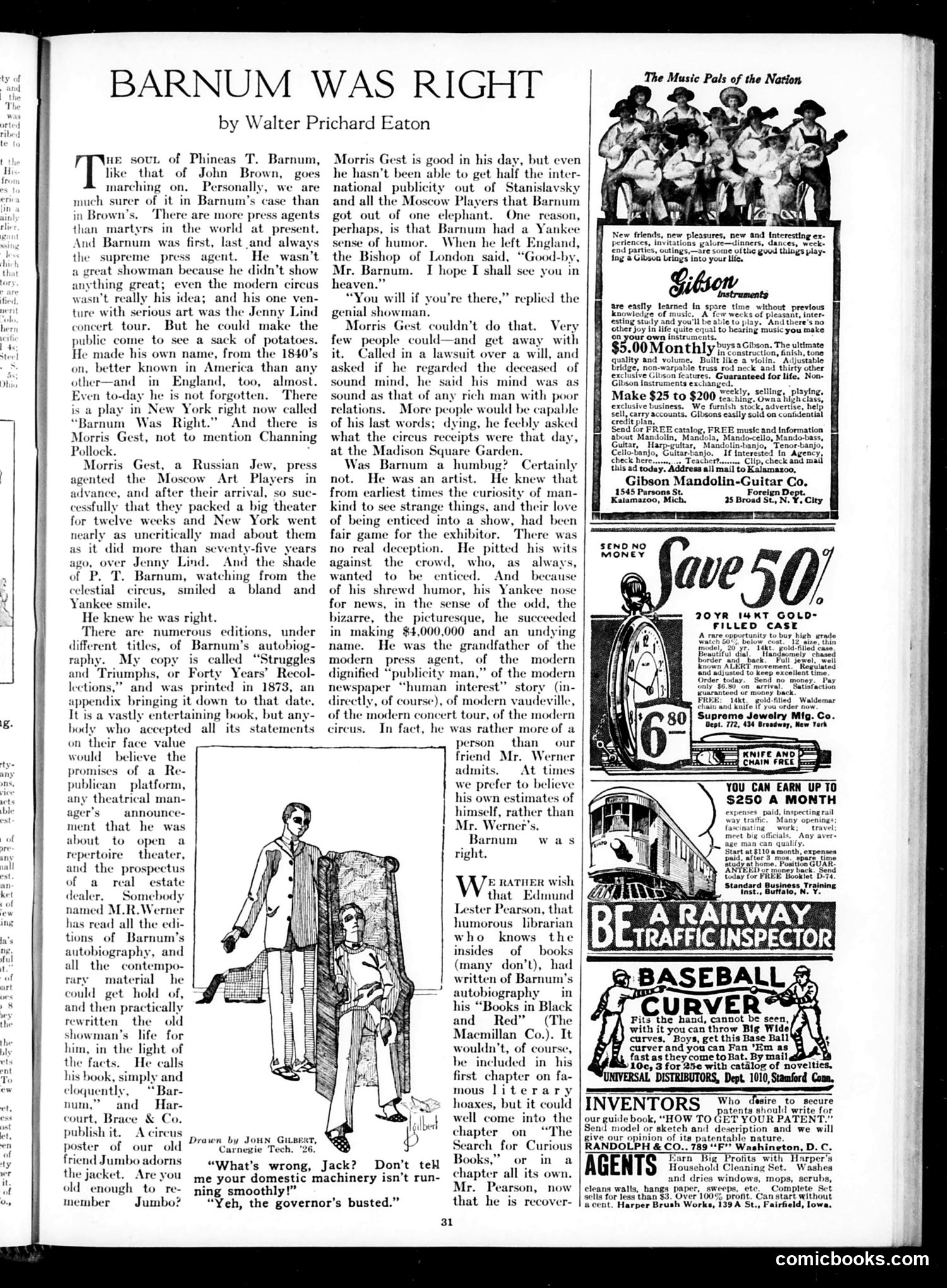
This article by Walter Prichard Eaton celebrates P.T. Barnum as history's greatest publicity genius, arguing his legacy lives on through modern showmen like **Morris Gest**, who promoted the Moscow Art Players theater company in New York. Eaton contrasts Barnum's unmatched ability to generate public interest—he made one elephant more famous than Gest managed with an entire Russian theater troupe—with Gest's more modest success. The piece emphasizes Barnum's shrewd understanding of human curiosity and entertainment, his wit (exemplified by his quip to a bishop), and his transformation of publicity into an art form. The article reviews a biography titled simply "Barnum" (published by Harcourt, Brace & Co.), positioning Barnum not as a mere "humbug" but as the prototype of the modern publicity man and architect of contemporary show business and "human interest" journalism. The piece essentially argues that modern entertainment culture descends directly from Barnum's innovations.
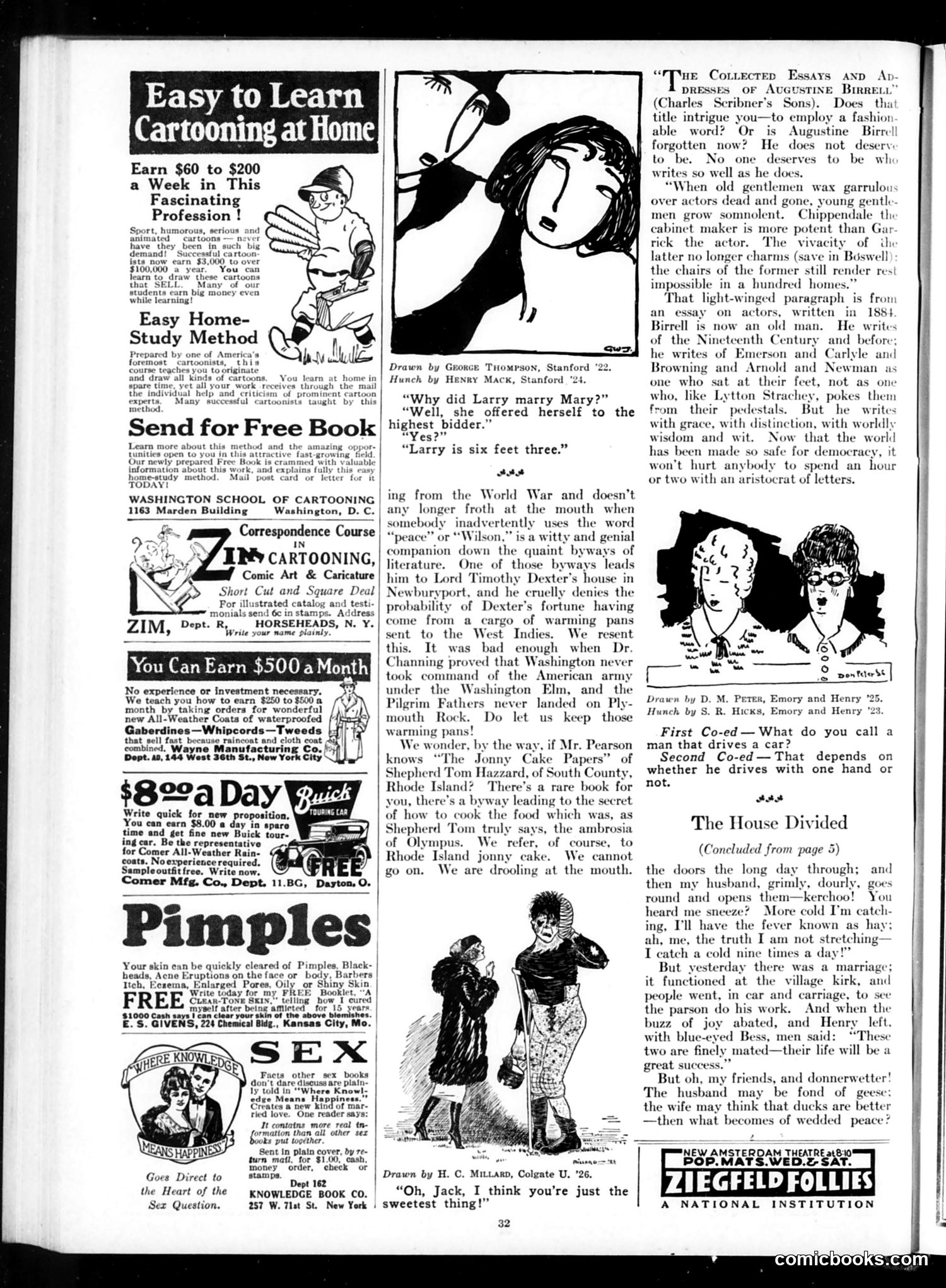
This page is primarily **advertising**, with two small cartoons and a literary review. The cartoons are brief jokes: 1. **"Why did Larry marry Mary?"** (Thompson/Mack): A play on mercenary marriage—Mary "offered herself to the highest bidder," and Larry won because he's tall (six feet three). The satire targets both gold-digging women and materialistic marriage. 2. **"Oh, Jack, I think you're just the sweetest thing!"** (Millar): Two young women; the caption suggests one is being insincere or manipulative—typical flirtation satire mocking courtship affectation. The page's bulk consists of **mail-order advertisements** (cartooning courses, raincoats, automobiles, acne treatments, sex education books)—characteristic of early 20th-century magazines. These ads suggest the magazine's working/middle-class readership. The literary review discusses Augustine Birrell's essays, praising his wit. **Overall**: A typical Judge page blending light social satire with commercial advertising.
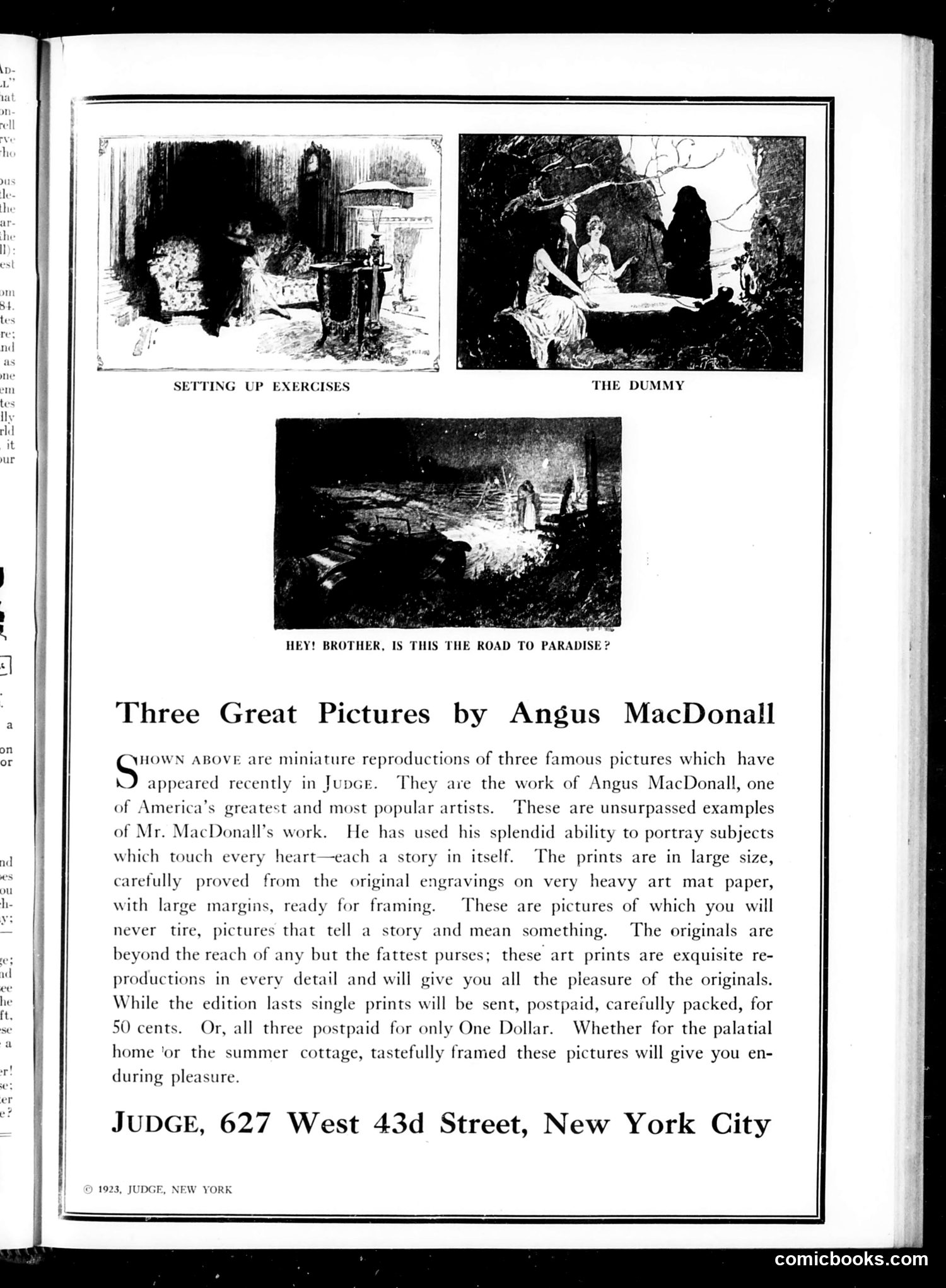
This page is primarily **advertising content** rather than satirical commentary. It promotes art prints by Angus MacDonall, described as "one of America's greatest and most popular artists." The three illustrations shown depict sentimental, narrative scenes: "Setting Up Exercises" (an interior domestic scene), "The Dummy" (figures outdoors), and "Hey! Brother, Is This the Road to Paradise?" (a rural scene). The accompanying text emphasizes their emotional appeal—"pictures that tell a story and mean something"—and their accessibility to average consumers through mail-order sales. The advertisement reflects early 1920s American consumer culture and the marketing of fine art reproductions for middle-class homes. There is no apparent political satire on this page; rather, it represents Judge magazine's commercial side, selling aspirational cultural products to readers.
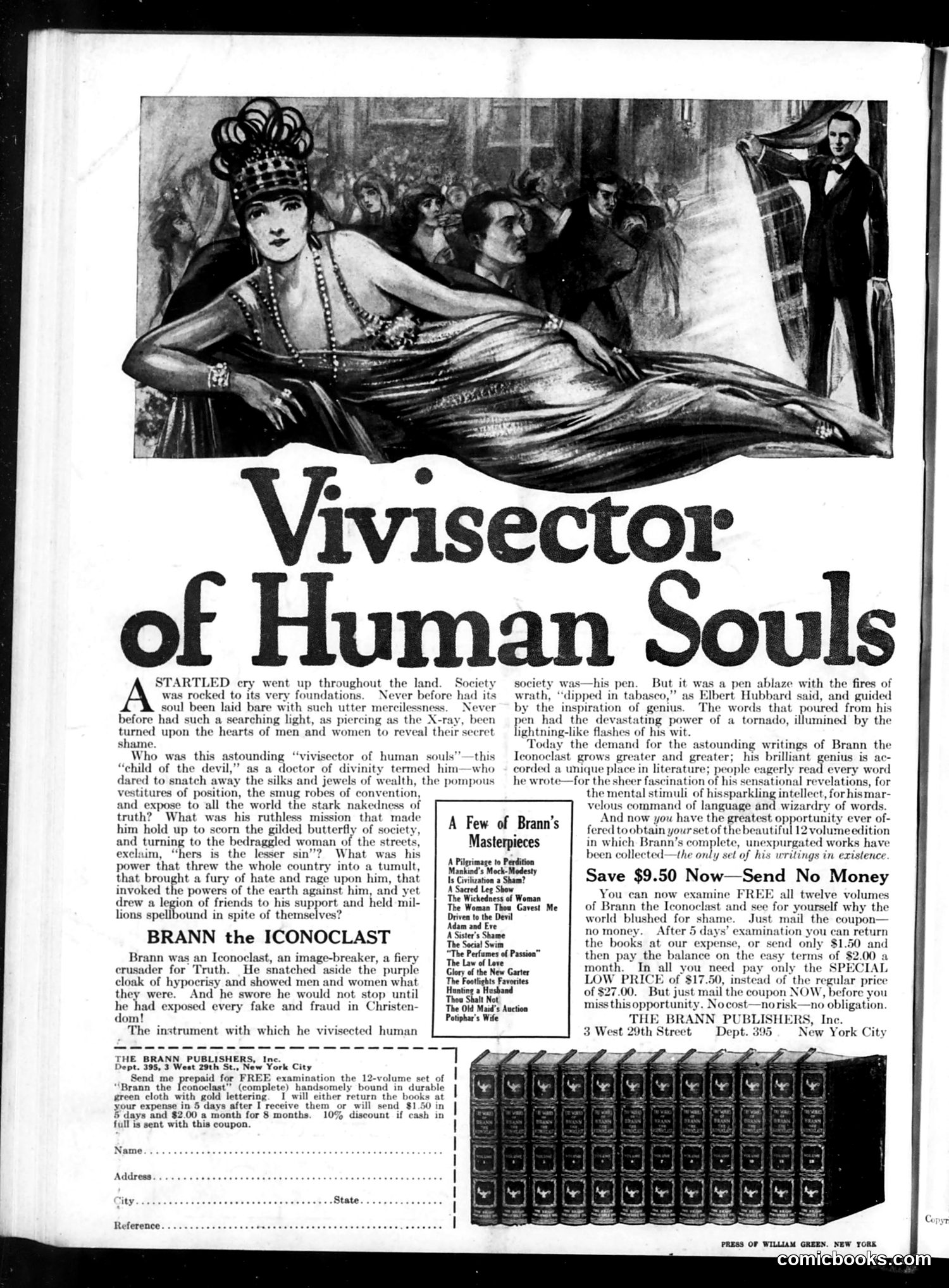
This is primarily an advertisement for a 12-volume collection of writings by **William Cowper Brann**, an early 20th-century social critic and journalist. The imagery depicts Brann as a fearless truth-teller who "vivisected" (dissected) society's hypocrisies—exposing the fakery beneath wealth, respectability, and religious convention. The illustration shows a reclining woman (likely representing Society or Truth) surrounded by shocked onlookers, emphasizing Brann's scandalous revelations about social pretense. The text describes him as an "iconoclast" who attacked "every fake and fraud in Christendom," particularly targeting moral hypocrisy among the wealthy and powerful. The ad's sensational framing ("A startled cry went up throughout the land," references to "fury of hate") marketed Brann's work as provocative social commentary. The listed essay titles ("The Wickedness of Woman," "Is Civilization a Sham?") confirm his focus on debunking conventional morality and social respectability. This represents *Judge* magazine promoting a controversial but commercially successful writer of muckraking social criticism.