
Judge, 1923-05-19 · page 10 of 36
Judge — May 19, 1923 — page 10: what you’re looking at
What you’re looking at
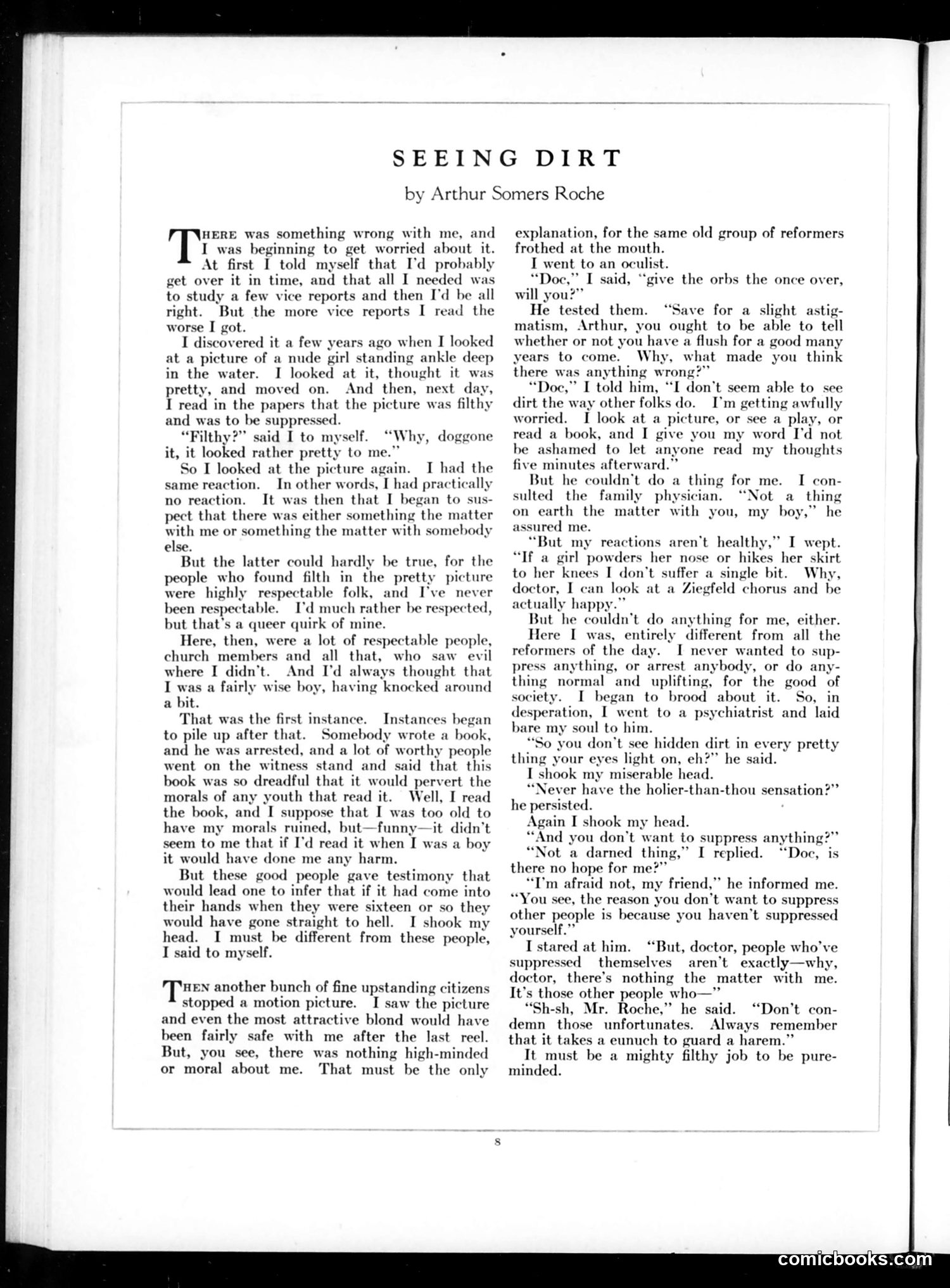
This is a satirical short story mocking **moral reformers and censorship advocates** of the early 20th century. The unnamed narrator describes his bewilderment at discovering he cannot see "filth" where respectable people insist it exists—in photographs, books, and motion pictures. The satire's target: **self-appointed moral guardians** (church members, "upstanding citizens") who aggressively suppress art and literature they deem corrupting, yet the narrator finds these same works perfectly innocent. He visits doctors and psychiatrists, jokingly suggesting he's defective for *not* being scandalized. The joke exposes the **absurdity of censorship**: respectable reformers claim artistic content will "pervert the morals" of youth, yet the narrator—admittedly unrespectable himself—sees only harmless images. Roche implies the reformers' obsession with finding "dirt" reveals more about their own psychology than any actual danger in the art. This reflects genuine 1920s debates over **film censorship** (Ziegfeld Follies referenced), book banning, and the emerging "Comstock Laws."
📄 Transcribed text from this page (OCR, searchable)
Machine-transcribed from the original scan — historical spelling and the odd misread are preserved.
SEEING DIRT by Arthur Somers Roche I was beginning to get worried about it. At first I told myself that I'd probably get over it in time, and that all I needed was to study a few vice reports and then I'd be all right. But the more vice reports I read the worse I got. I discovered it a few years ago when I looked at a picture of a nude girl standing ankle deep in the water. I looked at it, thought it was pretty, and moved on. And then, next day, I read in the papers that the picture was filthy and was to be suppressed. Filthy?” said I to myself. “Why, doggone it, it looked rather pretty to me.” So I looked at the picture again. I had the same reaction. In other words, I had practically no reaction. It was then that I began to sus- pect that there was either something the matter with me or something the matter with somebody else. But the latter could hardly be true, for t people who found filth the pretty pictu were highly respectable folk, and I’ve nev been respectable. I'd much rather be respecte but that’s a queer quirk of mine. Here, then, were a lot of respectable people. church members and all that, who saw evil where I didn’t. And I'd always thought that I was a fairly wise boy, having knocked around a bit. That was the first instance. Instances began to pile up after that. Somebody wrote a book, and he was arrested, and a lot of worthy people went on the witness stand and said that this book was so dreadful that it would pervert the morals of any youth that read it. Well, I read the book, and I suppose that I was too old to have my morals ruined, but—funny—it didn’t seem to me that if I'd read it when I was a boy it would have done me any harm. But these good people gave testimony that would lead one to infer that if it had come into their hands when they were sixteen or so they would have gone straight to hell. I shook my head. I must be different from these people, I said to myself. fl ac was something wrong with me, and THe another bunch of fine upstanding citizens stopped a motion picture. I saw the picture and even the most attractive blond would have been fairly safe with me after the last reel. But, you see, there was nothing high-minded or moral about me. That must be the only explanation, for the same old group of reformers frothed at the mouth. I went to an oculist. “De I said, “give the orbs the once over, will you?” He tested them. “Save for a slight astig- matism, Arthur, you ought to be able to tell whether or not you have a flush for a good many years to come. Why, what made you think there was anything wrong?” “Doc,” I told him, “I don’t seem able to see dirt the way other folks do. I'm getting awfully worried. I look at a picture, or see a play, or read a book, and I give you my word I'd not be ashamed to let anyone read my thoughts five minutes afterward.” But he couldn't do a thing for me. I con- sulted the family physician. “Not a thing on earth the matter with you, my boy,” he assured me. But my reactions aren't healthy,” I wept. “If a girl powders her nose or hikes her skirt to her knees I don’t suffer a single bit. Why, doctor, I can look at a Ziegfeld chorus and be actually happy.” But he couldn't do anything for me, either. Here I was, entirely different from all the reformers of the day. I never wanted to sup- press anything, or arrest anybody, or do any- thing normal and uplifting, for the good of I began to brood about it. So, in desperation, I went to a psychiatrist and laid bare my soul to him. “So you don’t see hidden dirt in every pretty thing your eyes light on, eh?” he said. I shook my miserable head. “Never have the holier-than-thou sensation?” he persisted. Again I shook my head. And you don’t want to suppress anything “Not a darned thing,” I replied. “Doc, is there no hope for me?” “I'm afraid not, my friend,” he informed me. “You see, the reason you don’t want to suppress other people is because you haven't suppressed yourself.” I stared at him. “But, doctor, people who've suppressed themselves aren't exactly—why, doctor, there’s nothing the matter with me. It’s those other people who—” “Sh-sh, Mr. Roche,” he said. ‘Don’t con- demn those unfortunates. Always remember that it takes a eunuch to guard a harem.” It must be a mighty filthy job to be pure- minded.