
Judge, 1923-05-19 · page 21 of 36
Judge — May 19, 1923 — page 21: what you’re looking at
What you’re looking at
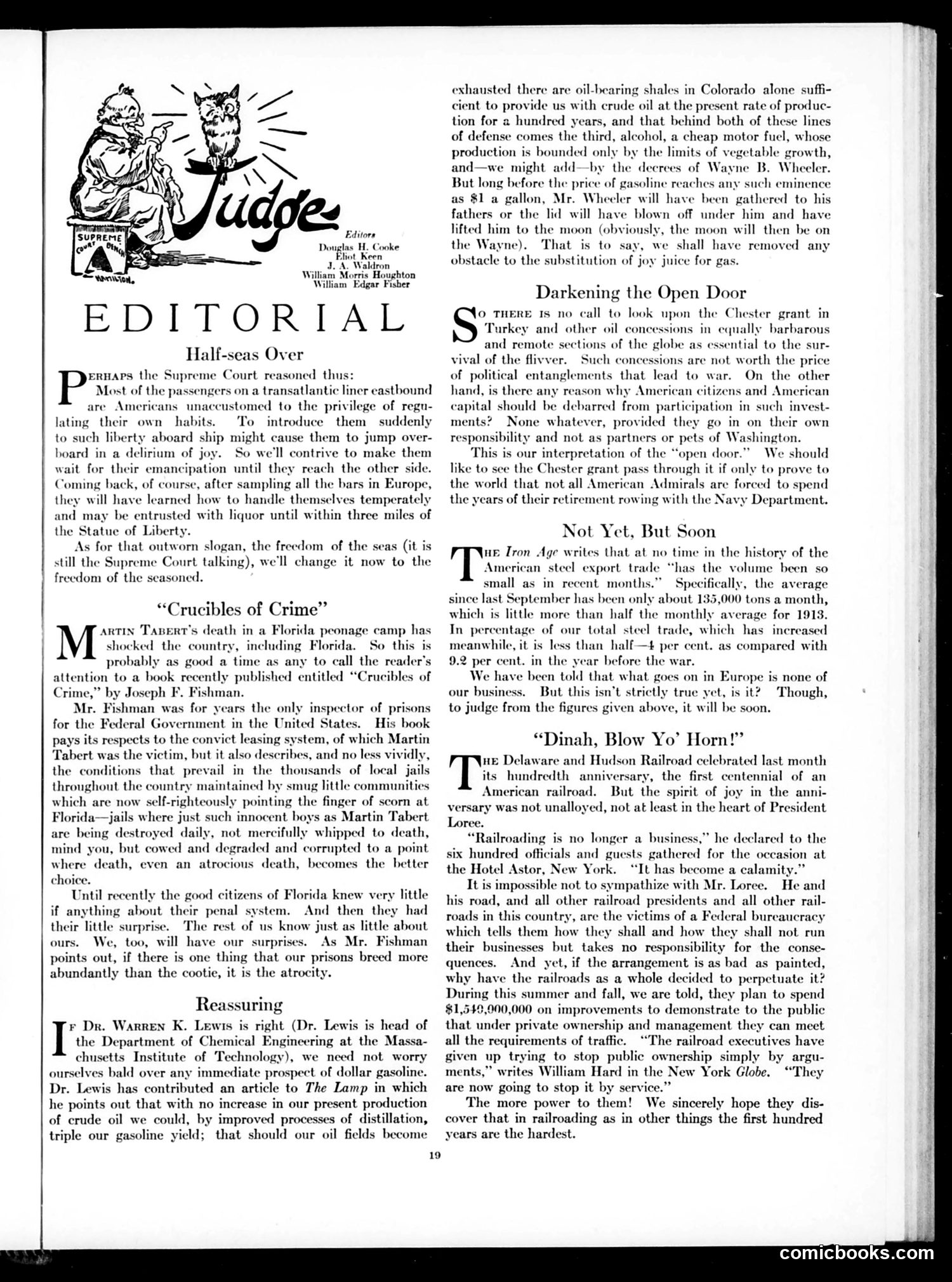
This editorial page contains several satirical pieces targeting American policies and social issues circa the 1920s: **"Half-seas Over"** mocks Prohibition's inconsistent enforcement. The joke: the Supreme Court allows alcohol consumption on transatlantic ships heading to Europe (where Americans are "unaccustomed to liberty") but not on return voyages—supposedly to protect seasoned drinkers from themselves. The satire critiques the absurdity of selective Prohibition enforcement based on location. **"Crucibles of Crime"** reviews a book exposing brutal conditions in American prisons and the convict-leasing system. It shames communities that criticized Florida's peonage camps (where Martin Tabert died) while maintaining similarly brutal local jails. **"Reassuring"** and subsequent sections discuss fuel supply—arguing Americans needn't fear gasoline shortages, with alternatives like Colorado oil shales and alcohol available. The *Judge* mascot (top left) appears to be the publication's satirical judge character, lending authority to these critiques of governmental hypocrisy and institutional injustice.
📄 Transcribed text from this page (OCR, searchable)
Machine-transcribed from the original scan — historical spelling and the odd misread are preserved.
FA William Morris H William Edgar EDITORIAL Half-seas Over ERHAPS the Supreme Court reasoned thus: P Most of the passengers on a transatlantic liner eastbound are Americans unaccustomed to the privilege of regu- lating their own habits. To introduce them suddenly to such liberty aboard ship might cause them to jump over- board in a delirium of joy. So we'll contrive to make them wait for their emancipation until they reach the other side. Coming back, of course, after sampling all the bars in Europe, they will have learned how to handle themselves temperately and may be entrusted with liquor until within three miles of the Statue of Liberty. As for that outworn slogan, the freedom of the seas (it is still the Supreme Court talking), we'll change it now to the freedom of the seasoned. Fisher i “Crucibles of Crime” Artin Tapert’s death in a Florida peonage camp has shocked the country, including Florida. So this is probably as good a time as any to call the reader's attention to a book recently published entitled “Crucibles of Crime,” by Joseph F. Fishman. Mr. Fishman was for years the only inspector of prisons for the Federal Government in the United States. His book pays its respects to the convict leasing system, of which Martin Tabert was the victim, but it also deseri nd no less vividly, the conditions that prevail in the thousands of local j throughout the country maintained by smug little communities which are now self-righteously pointing the finger of scorn at Florida—jails where just such innocent boys as Martin Tabert are being destroyed daily, not mercifully whipped to death, mind you, but cowed and degraded and corrupted to a point where death, even an atrocious death, becomes the better choice. Until recently the good citi: if anything about their penal s) And then they had their little surpri: The rest of us know just as little about ours. We, too, will have our surprises. As Mr. Fishman points out, if there is one thing that our prisons breed more abundantly than the cootie, it is the atrocity. I the Department of Chemical Engineering at the Massa- chusetts Institute of Technology), we need not worry ourselves bald over any immediate prospect of dollar gasoline. Dr. Lewis has contributed an article to The Lamp in which he points out that with no increase in our present production of crude oil we could, by improved processes of distillation, triple our gasoline yield; that should our oil fields become ens of Florida knew very little stem. Reassuring Fr Dr. Warren K. Lewis is right (Dr. Lewis is head of 19 xhausted there are oil-bearing shales in Colorado alone suffi- cient to provide us with crude oil at the present rate of produe- tion for a hundred years, and that behind both of these lines of defense comes the third, alcohol, a cheap motor fuel, whose stable growth, » B. Wheeler. production is bounded only by the limits of ve and—we might add—by the decrees of V But long before the price of gasoline reaches any such eminence as $1 a gallon, Mr. Wheeler will have been gathered to his fathers or the lid will have blown off under him and have lifted him to the moon (obviously, the moon will then be on the Wayne). T! is to say, we shall have removed any obstacle to the substitution of joy juice for gas. Darkening the Open Door O THERE Is no call to look upon the Chester grant in Turkey and other oil concessions in cqually barbs and remote vival of the fliv essential to the sur- not worth the price of political entanglements that le: On the other hand, is there any reason why Americs ens and American capital should be debarred from participation in such invest- ments? None whatever, provided they go in on their own responsibility and not as partners or pets of Washington. This is our interpretation of the ‘open door.” We should like to see the Chester grant pass through it if only to prove to the world that not all Americ forced to spend the years of their retirement rowing with the Navy Department. I Il as in recent months.” Specifically, the average t September has been only about 135,000 tons a month, which is little more than half the monthly average for 1913. In percentage of our total steel trade, which has increased meanwhile, it is less than half — per cent. as compared with 9.2 per cent. in the year before the war. We have been told that what goes on in Europe is none of our business. But this isn’t strictly true yet, is it? ‘Though, to judge from the figures given above, it will be soon. “Dinah, Blow Yo’ Horn!” T' E Delaware and Hudson Railroad celebrated last month i ctions of the globe r. Such concession: Not Yet, But Soon HE Tron Age writes that at no time in the history of the American stecl export trade “has the volume been so mdredth anniversary, the first centennial of an American railroad. But the spirit of joy in the anni- versary was not unalloyed, not at least in the heart of President Loree. “Railroading is no longer a business,” he declared to the six hundred officials and guests gathered for the occasion at the Hotel Astor, New York. “It has become a calamity.” It is impossible not to sympathize with Mr. Loree. He and his road, and all other railroad presidents and all other rail- in this country, are the victims of a Federal bureaucracy h tells them how they shall and how they shall not run their businesses but takes no responsibility for the conse- quences. And , if the arrangement is as bad as painted, why have the railroads as a whole decided to perpetuate it? During this summer and fall, we are told, they plan to spend $1,548,000,000 on improvements to demonstrate to the public that under private ownership and management they can meet all the requirements of traffic. ‘The railroad executives have given up trying to stop public ownership simply by argu- ments,” writes William Hard in the New York Globe. “They are now going to stop it by service.” The more power to them! We sincerely hope they dis- cover that in railroading as in other things the first hundred years are the hardest. road. comicbooks.com