
Judge, 1923-05-19 · page 15 of 36
Judge — May 19, 1923 — page 15: what you’re looking at
What you’re looking at
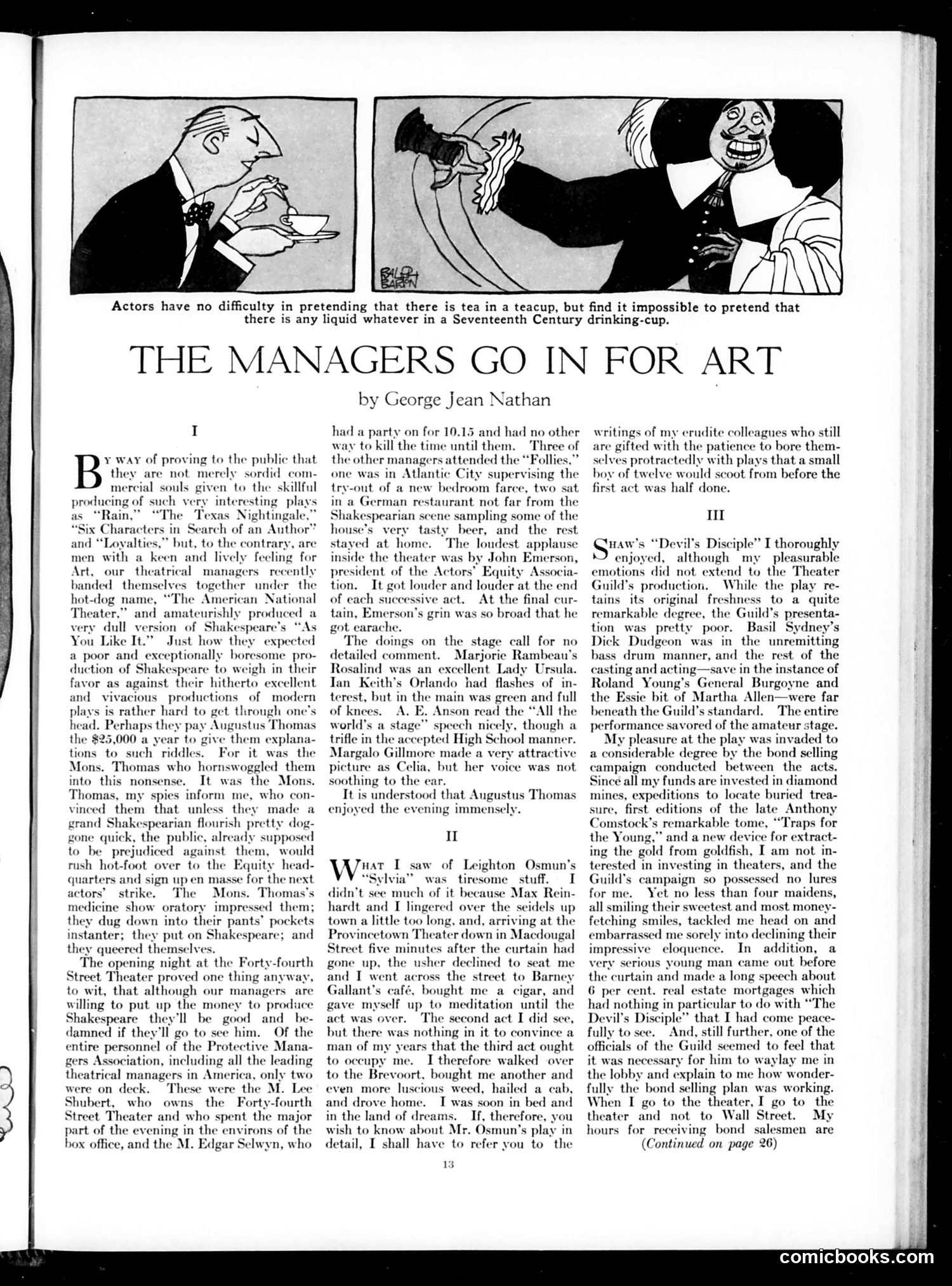
This satirical article by George Jean Nathan mocks New York theater managers' attempt to appear cultured. They formed "The American National Theater" and produced Shakespeare's *As You Like It* to counter public prejudice against them—allegedly pressured by Augustus Thomas, who convinced them an artistic production would improve their image. Nathan's bite is sharp: the managers themselves largely *didn't attend* their own Shakespeare production. Only two showed up; others went to the Follies, German restaurants, or stayed home. The only enthusiastic applause came from John Emerson of the Actors' Equity Association—suggesting Nathan saw irony in labor-management tensions. The cartoons above show actors struggling with theatrical props: pretending to drink from an empty Seventeenth-century cup. This illustrates Nathan's broader point: managers pursuing "art" while their actual theatrical instincts lean toward commercial productions like "Rain"—highlighting the gap between their pretensions and practices.
📄 Transcribed text from this page (OCR, searchable)
Machine-transcribed from the original scan — historical spelling and the odd misread are preserved.
Actors have no difficulty in pretending that there is tea in a teacup, but find it impossible to pretend that there is any liquid whatever in a Seventeenth Century drinking-cup. THE MANAGERS GO IN FOR ART I ¥ way of proving to the public that B they are not merely sordid. com- mercial souls given to the skillful producing of such very interesting pI as “Rain,” “The Texas Nightingale,” “Six Characters in Search of an Autho and “Loyalties,” but, to the contrary, a men with a keen and lively feelin Art, our theatrical managers recently banded themselves together under the hot-dog name, “The American National Theater,” and amateurishly produced a very dull version of Shakespeare's “As You Like It.” Just how they expected a poor and exceptionally boresome pro- duction of Shakespeare to weigh in their favor as against their hitherto excellent and vivacious productions of modern plays is rather hard to get through one’s head. Perhaps they pay Augustus Thomas the $25,000 sar to give them explana- tions to such riddles. For it was the Mons. Thomas who hornswoggled them into this nonsense. It was the Mons. Thomas, my spies inform me, who con- vinced them that unless they made a grand Shakespearian flourish pretty dog- gone quick, the public, already supposed to be prejudiced against them, would rush hot-foot over to the Equity head- quarters and sign up en masse for the next actors’ strike. The Mons. Thomas's medicine show oratory impressed them; they dug down into their pants’ pockets instanter; they put on Shak they queered themselves. The opening night at the Forty-fourth Street Theater proved one thing anyway, to wit, that although our managers are willing to put up the money to produce Shakespeare they'll be good and_ be- damned if they'll go to see him. Of the entire personnel of the Protective Mana- gers Association, including all the leading theatrical managers in America, only two were on deck. These were the M. Lee Shubert, who owns the Forty-fourth Street Theater and who spent the major part of the evening in the environs of the box office, and the M. Edgar Selwyn, who by George Jean Nathan had a party on for 10.15 and had no other way to kill the time until them. Three of the other managers attended the “Follies,” one was in Atlantic City supervising the try-out of a new bedroom farce, two sat in a German re: irant not far from the mpling some of the . beer, and the rest stayed at home. The loudest applause inside the theater was by John Emerson, president of the Actors” Equity Assoc tion. It got louder and louder at the end of each successive act. At the final cur- tain, Emerson’s grin was so broad that he got earache. The doings on the stage call for no detailed comment. Marjorie Rambeau’s Rosalind was an excellent Lady Ursula. Jan Keith’s Orlando had flashes of in- terest, but in the main was green and full of knees. A. E. Anson read the “All the world’s a stage ly, though a trifle in the accepted High School mar Margalo Gillmore made a ver, picture as Celia, but her voice was not soothing to the ear. It is understood that Augustus Thomas enjoyed the evening immensely. II Wis I saw of Leighton Osmun’s “Sylvia” was tiresome stuff. I didn’t see much of it because Max Rein- hardt and I lingered over the seidels up town a little too long, and, arriving at the Provincetown Theater down in Macdougal Street five minutes after the curtain had gone up, the usher declined to s and I went across the street to F Hant’s café, bought me a cigar, and gave myself up to meditation until the act was over. The second act I did see, but there was nothing in it to convince man of my years that the third act ought to occupy me. I therefore walked over to the Brevoort. bought me another and even more luscious weed, hailed a cab, and drove home. T was soon in bed and in the land of dreams. If, therefore, you wish to know about Mr. Osmun’s play in detail, I shall have to refer you to the 13 writings of my erudite colleagues who still are gifted with the patience to bore them- selves protractedly with plays that a small hoy of twelve would scoot from before the first act was half done. ll QtHaw’s “Devil's Disciple” I thoroughly J enjoyed, although my pleasurable emotions did not extend to the Theater Guild’s production. While the play re- tains its original freshness to a quite remarkable degree, the Guild’s presenta- tion was pretty poor. Basil Sydne Dick Dudgeon was in the unremitting bass drum manner, and the rest of the casting and acting—save in the instance of Roland Young’s General Burgoyne and the Essie bit of Martha Allen—were far beneath the Guild’s standard. The entire performance savored of the amateur stage. My pleasure at the play invaded to a considerable degree by the bond selling campaign conducted between the acts, Since all my funds are invested in diamond peditions to locate buried trea- st editions of the late Anthony Comstock’s remarkable tome, “Traps for the Young,” and a new device for extract- ing the gold from goldfish, I am not in- terested in investing in theaters, and the Guild’s campaign so possessed no lures for me. Yet no less than four maidens, all smiling their sweetest and most money fetching smiles, tackled me head on and ed me sorely into declining their impressive eloquence. In addition, a very serious young man came out before the curtain and made a long speech about 6 per cent. real estate mortgages which had nothing in particular to do with “The Devil's Disciple” that I had come peace- fully to see. And, still further, one of the officials of the Guild seemed to feel that it was necessary for him to waylay me in the lobby and explain to me how wonder- fully the bond selling plan was working. When I go to the theater, I go to the theater and not to Wall Street. My hours for receiving bond salesmen are (Continued on page 26) comicbooks.com