
A complete issue · 36 pages · 1923
Judge — April 21, 1923
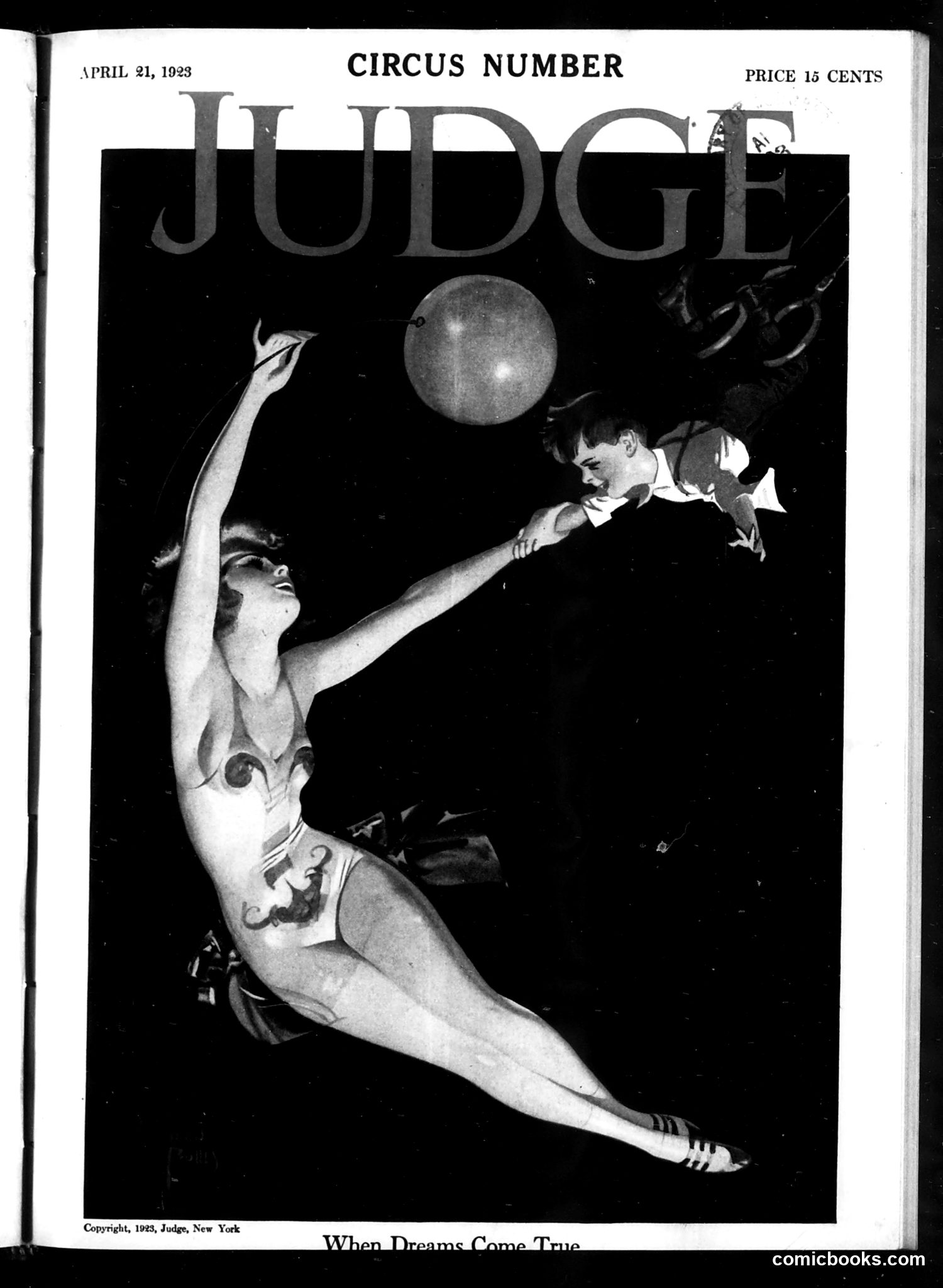
**Date & Publication:** April 21, 1923, Judge Magazine (15 cents) **Image Content:** The cover shows a circus performer doing an acrobatic move with a large ball, while a figure in formal dress (possibly a ringmaster or authority figure) watches from above. **Title:** "When Dreams Come True" **Interpretation:** This appears to be a circus-themed satirical illustration, likely commenting on entertainment, performance, or aspiration during the 1920s. The title suggests irony—contrasting the performer's dramatic acrobatic "dream" with reality. Without additional context from the magazine's interior, the specific political or social satire remains unclear. The composition emphasizes the contrast between the athletic performer and the formally-dressed observer, possibly commenting on class differences or the spectacle of entertainment culture during the Jazz Age.
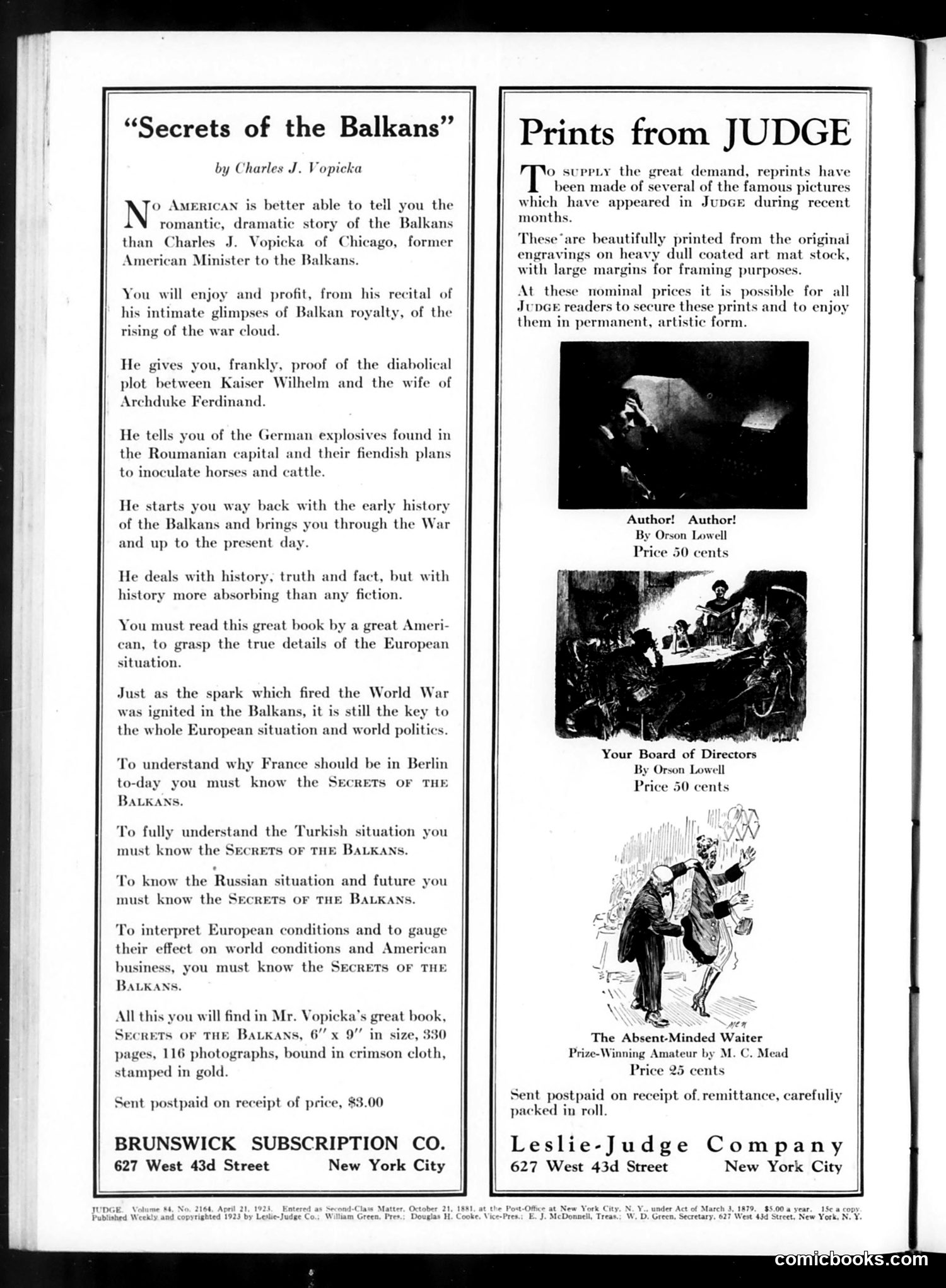
This page contains two sections: a book advertisement (left) and print advertisements (right). The left side promotes Charles J. Vopicka's "Secrets of the Balkans," emphasizing its relevance to understanding European and world politics. Vopicka, identified as a former American Minister to the Balkans, positions the book as essential for grasping conflicts in France, Turkey, and Russia—all connected to Balkan geopolitics. The right side advertises Judge magazine reprints, including works by Orson Lowell and M.C. Mead. The prints appear to be satirical illustrations typical of Judge's content, though specific subjects are unclear from the image quality. This is primarily **advertising content** rather than original satirical cartoons, reflecting how Judge monetized both its editorial voice and archival material during the early 1920s.
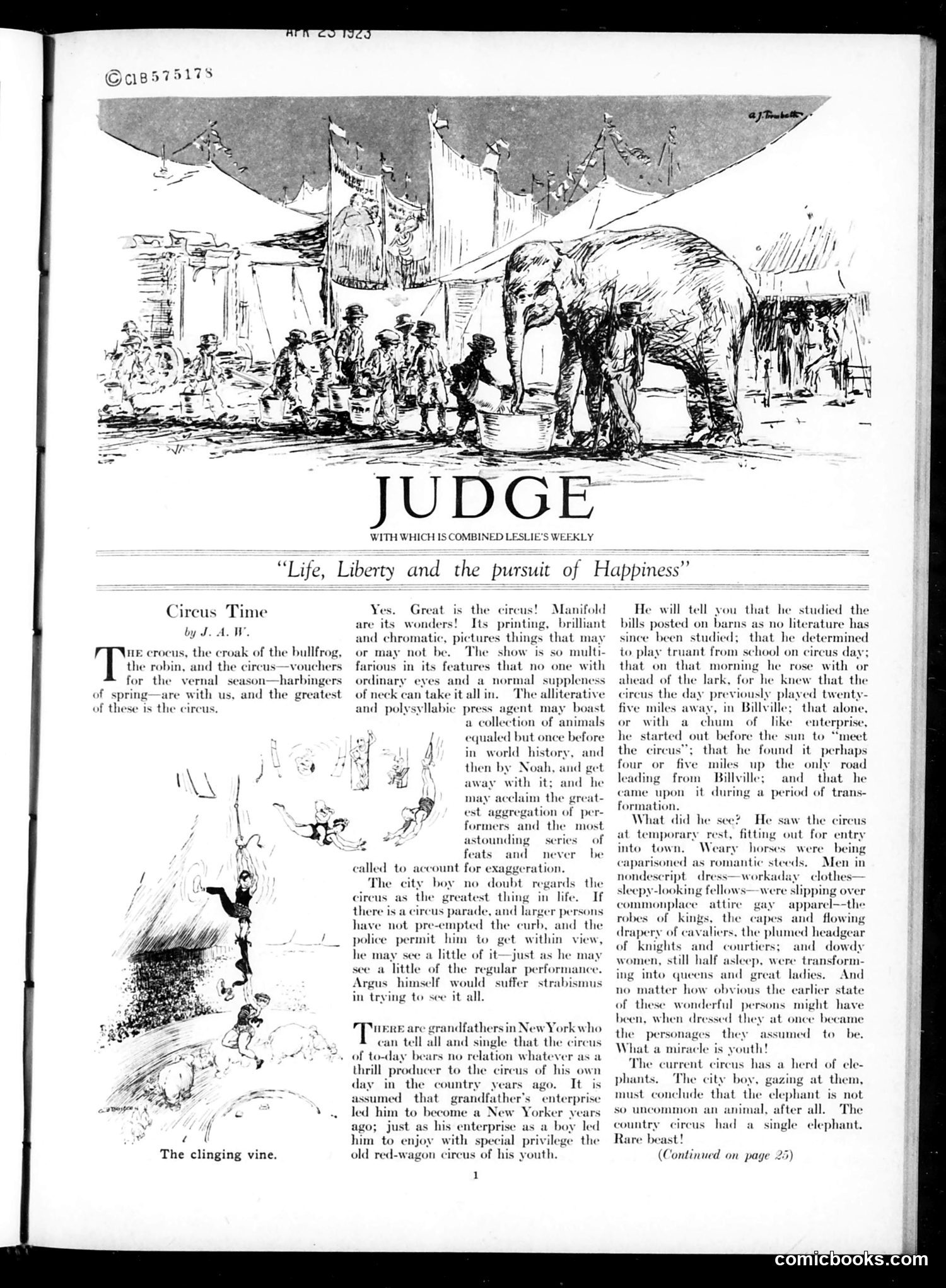
This page celebrates circus entertainment as American cultural spectacle. The main illustration shows a circus elephant and crowd, introducing an article titled "Circus Time" that treats the circus as quintessentially American—a democratic entertainment where diverse social classes gather. The text humorously references a New York grandfather who brought circus excitement to his family generations ago, establishing a tradition of circus patronage. The article celebrates how circuses transform ordinary people into wondrous sights (acrobats, performers), suggesting the circus democratizes spectacle and wonder. The smaller illustration labeled "The clinging vine" depicts an acrobat or circus performer, complementing the celebration of circus artistry and skill. Overall, this isn't political satire but rather lighthearted cultural commentary praising the circus as American leisure and aspiration.
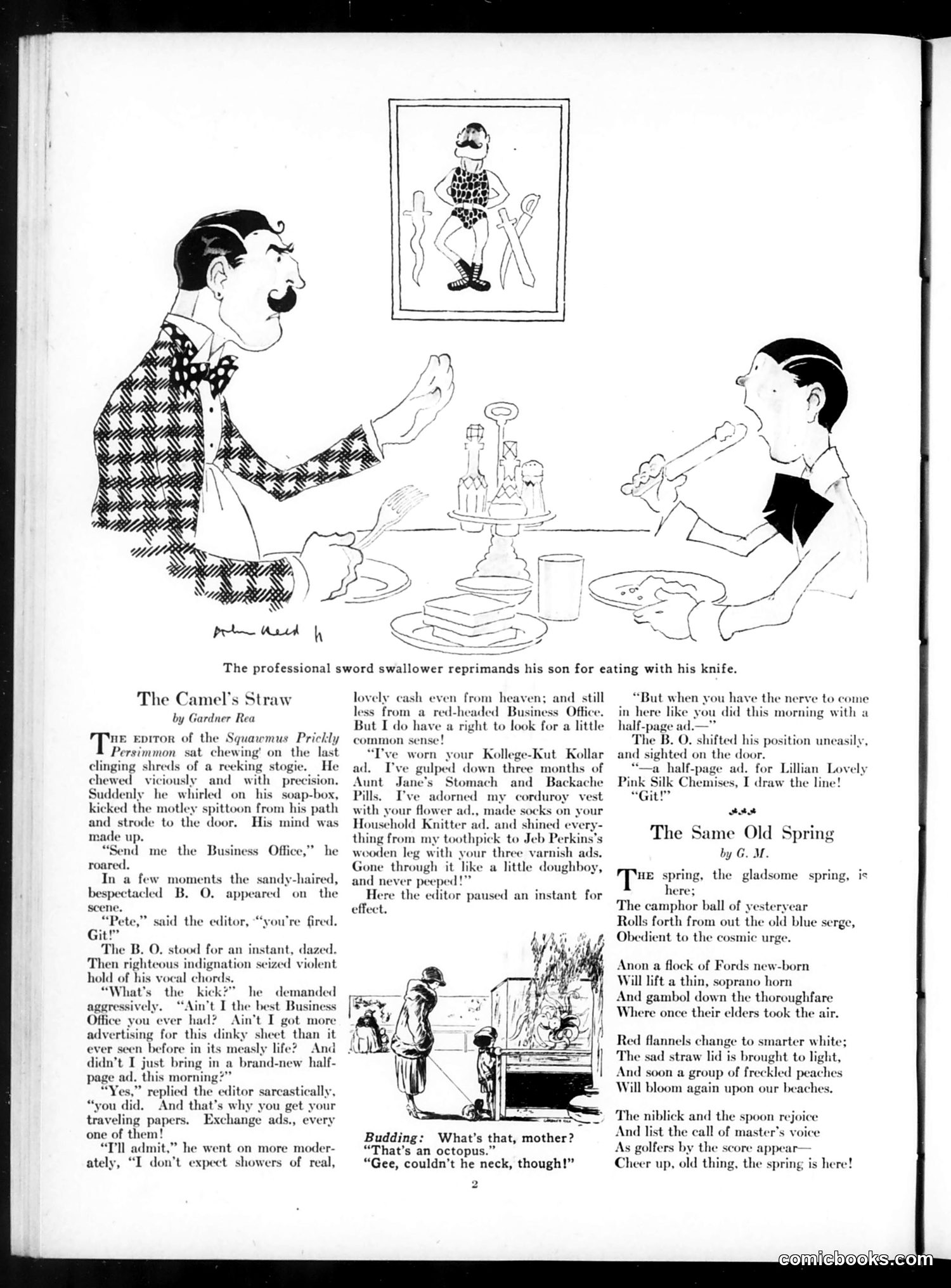
The top cartoon shows a father (a professional sword swallower, based on the caption) reprimanding his son for eating with a knife instead of proper table manners. The humor relies on the father's ironic hypocrisy: he performs the extreme act of swallowing swords professionally, yet demands his son follow civilized dining etiquette. This satirizes parental hypocrisy and the gap between parents' own behavior and standards they impose on children. The page also contains two poems ("The Camel's Straw" and "The Same Old Spring") and a brief joke about an octopus at the bottom. These appear to be typical filler content common in satirical magazines of this era, though they lack obvious political commentary.
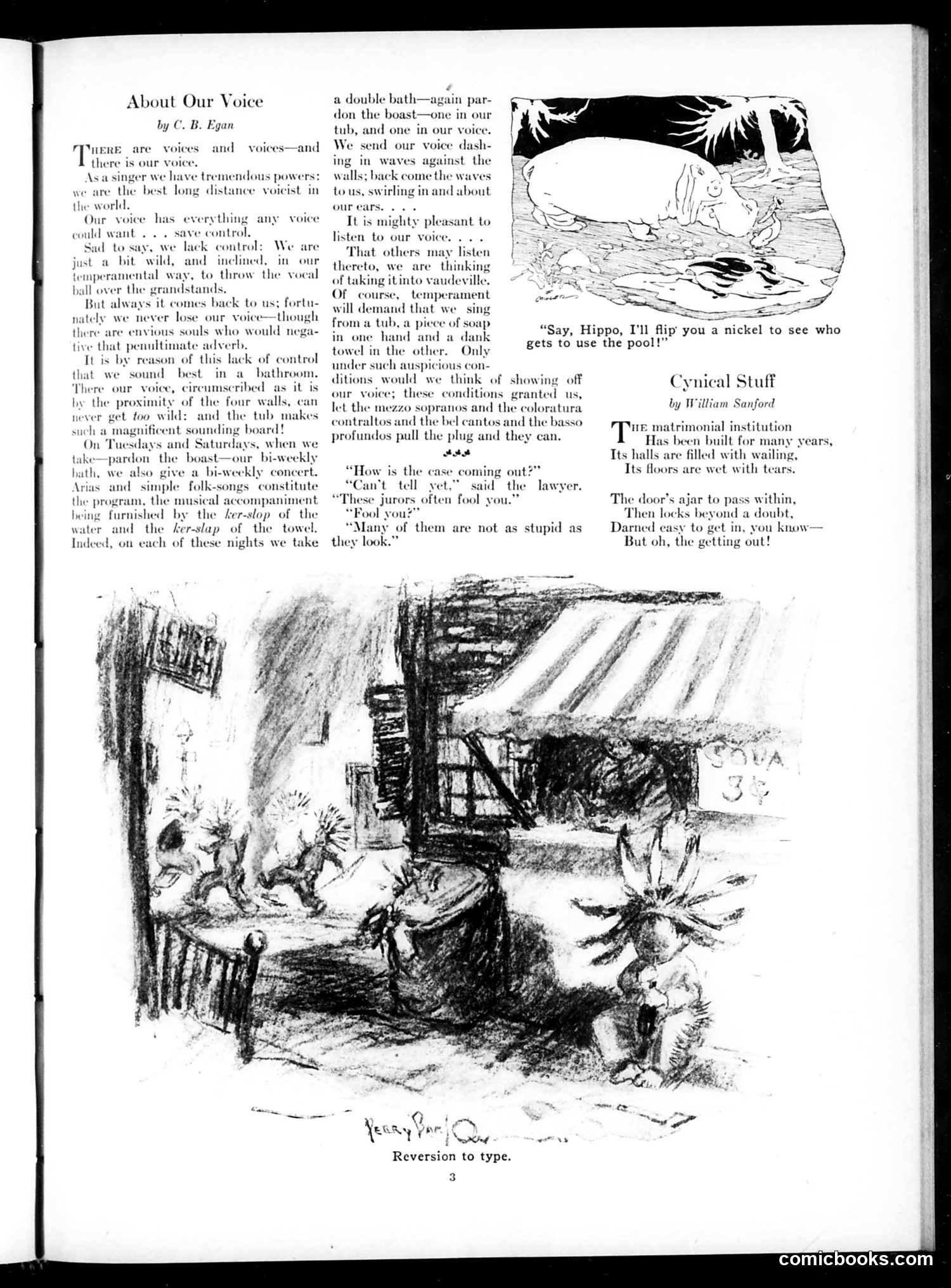
This page contains two unrelated pieces: "About Our Voice" by C.B. Egan (a humorous essay about singing in bathrooms) and "Cynical Stuff" by William Sanford (brief satirical verses about marriage). The bottom cartoon, titled "Reversion to type," depicts what appears to be a poor or working-class domestic scene. The sketch shows figures in shabby surroundings, likely satirizing social class or poverty conditions. The caption suggests commentary on human nature or social degradation, though the specific historical context remains unclear without additional information about Judge's publication date and contemporary events. The cartoons lack clear identification of specific political figures or dated references, making precise interpretation difficult.
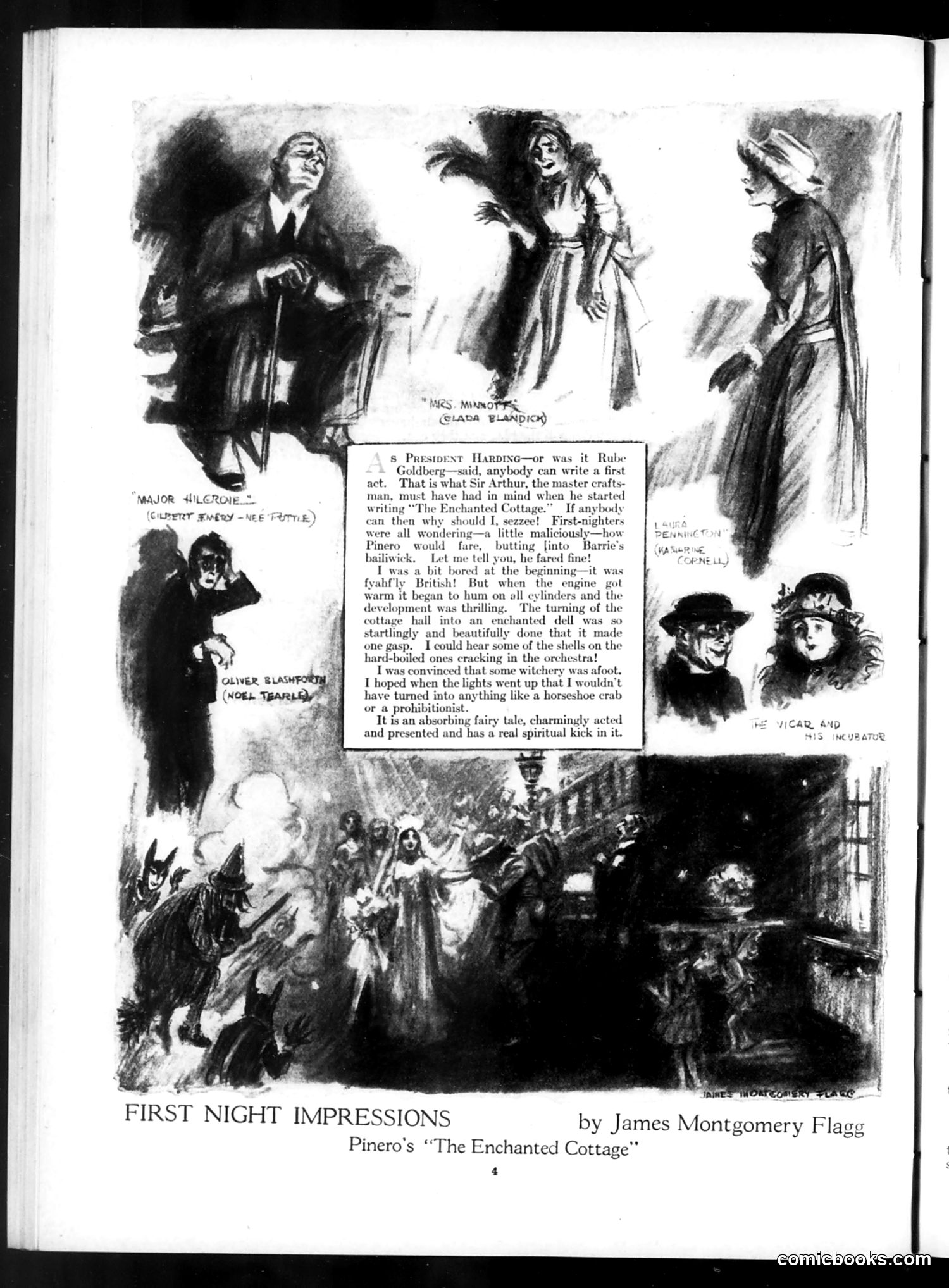
This page reviews Pinero's theatrical production "The Enchanted Cottage." The sketches depict various audience members and their reactions, labeled with names including Major Hilgrome, Mrs. Minnott (Clara Blandick), Oliver Blashford (Noel Tearle), and Edgar Kaid. The central text discusses the play's opening night, praising its imaginative staging and "enchanted dell" transformation scene. The reviewer notes initial skepticism about attending a "British" production but was impressed by the theatrical effects and the play's "spiritual kick." The bottom illustration shows what appears to be a theatrical scene from the production itself, likely depicting the magical transformation referenced in the review. This is primarily **theater criticism with character sketches** rather than political satire.
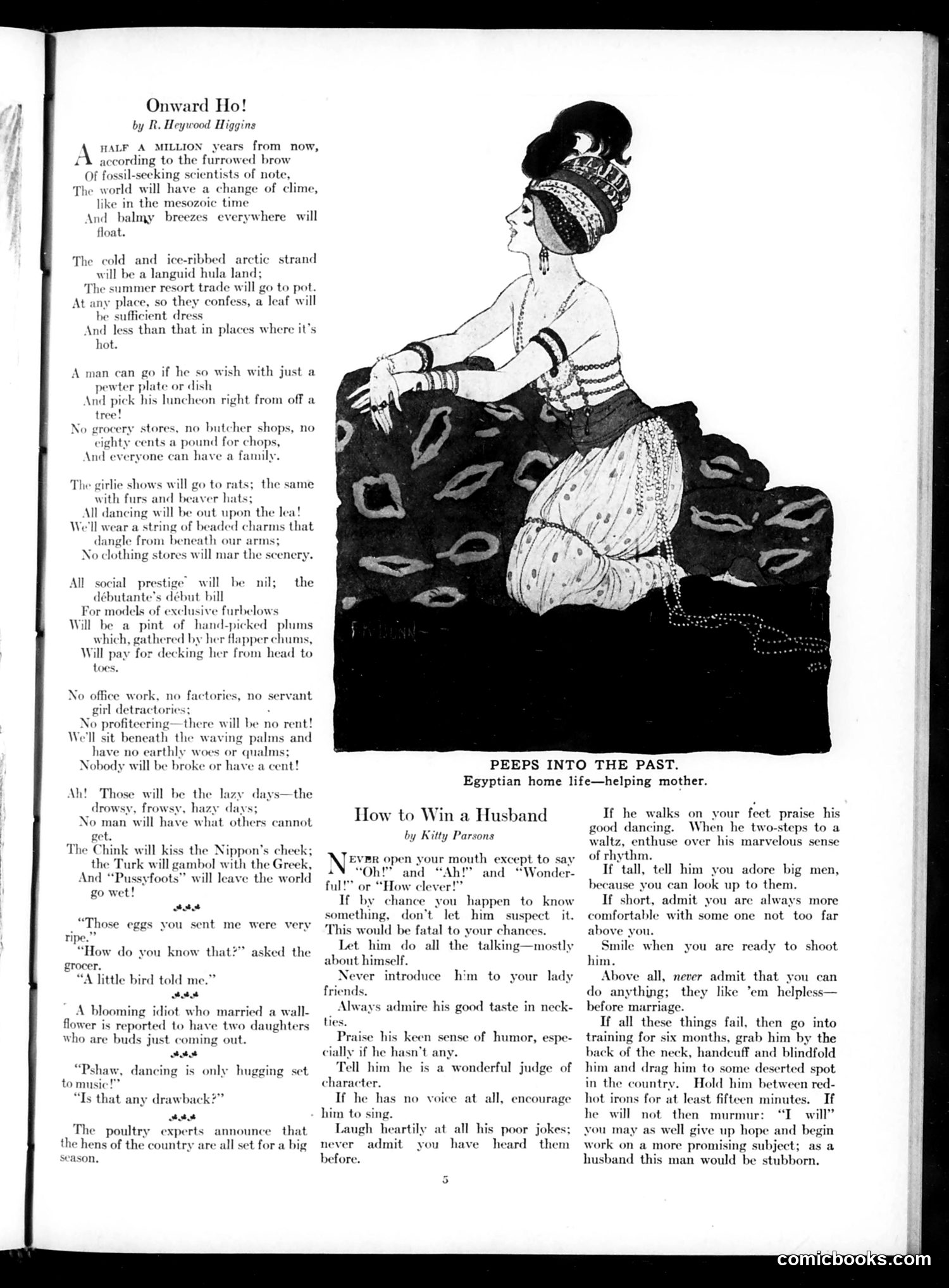
**"Onward Ho!"** is a satirical poem imagining Earth 500,000 years hence—a utopian future where climate change creates a tropical paradise. The satire targets early-20th-century anxieties: the poem mocks both socialist ideals (universal equality, no poverty) and contemporary consumer culture by imagining a world where wealth, labor, and social status vanish. The references to "Pussyfoots" (prohibition advocates), factories, and servant girls anchor it to the Progressive Era. **"How to Win a Husband"** offers tongue-in-cheek dating advice for women. The satire is clear: women must feign ignorance, flatter men's egos relentlessly, laugh at unfunny jokes, and accept being physically awkward with partners—essentially performing helplessness. The final lines mock this by suggesting actual force ("drag him...red-hot irons") might be necessary anyway. This reflects early-20th-century gender dynamics and marital expectations, satirizing both courtship conventions and the persistent male chauvinism underlying them.
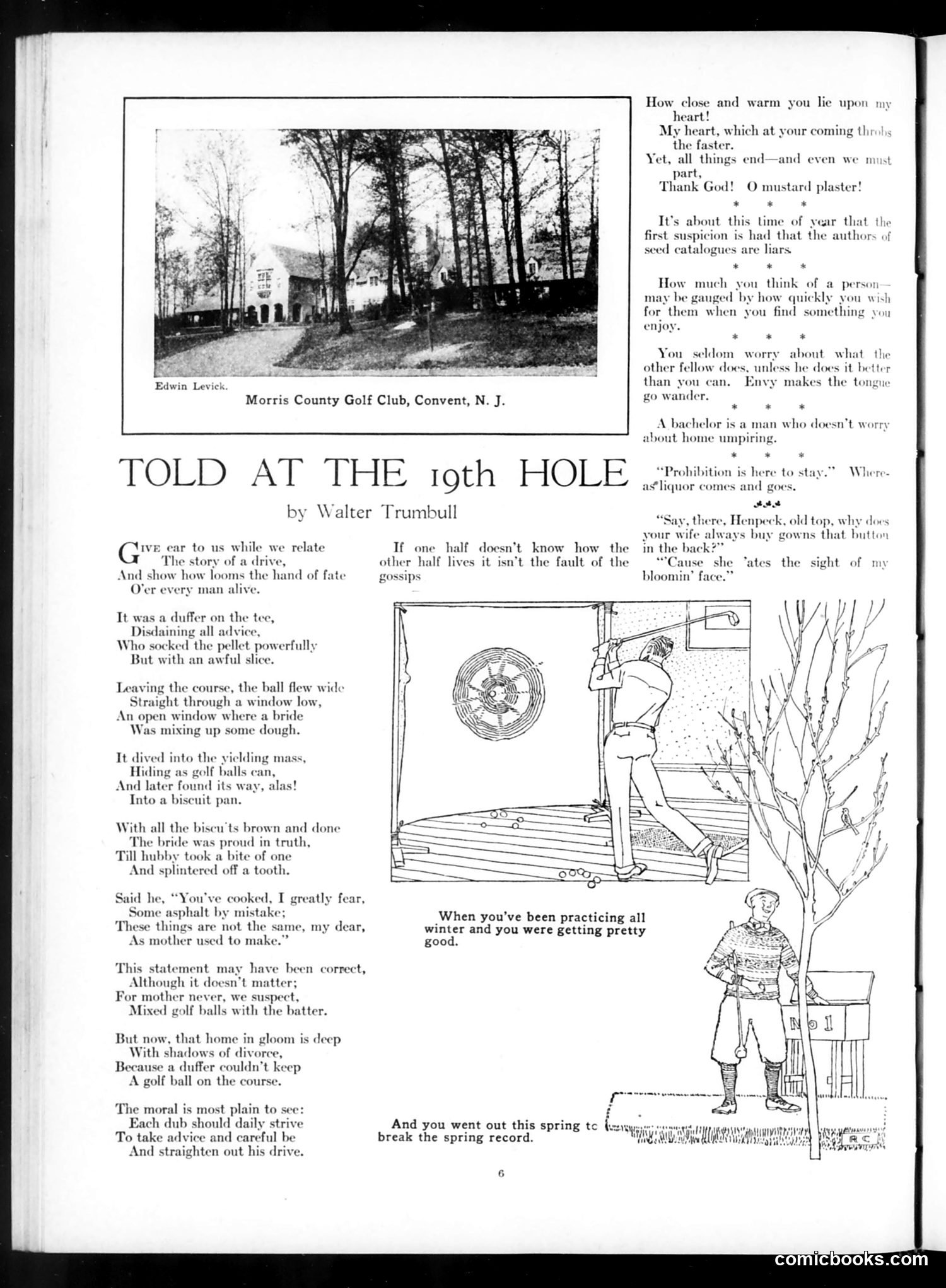
This is a humorous poem about golf mishaps, illustrated with cartoons. The main narrative tells of a duffer (poor golfer) who hits a wild shot through a window where a bride is baking. The golf ball lands in her dough, gets baked into biscuits, and breaks the husband's tooth when he bites it. This leads to the couple's divorce—the poem's ironic "moral" warning golfers to practice and improve their swing. The accompanying illustrations show indoor golf practice and a golfer in winter conditions, humorously commenting on amateur golfers preparing for spring season. The page also includes various one-liner jokes about marriage, gossip, and bachelor life—typical Judge magazine fare from the early 20th century. The humor relies on slapstick consequences and domestic situations familiar to middle-class readers of that era.
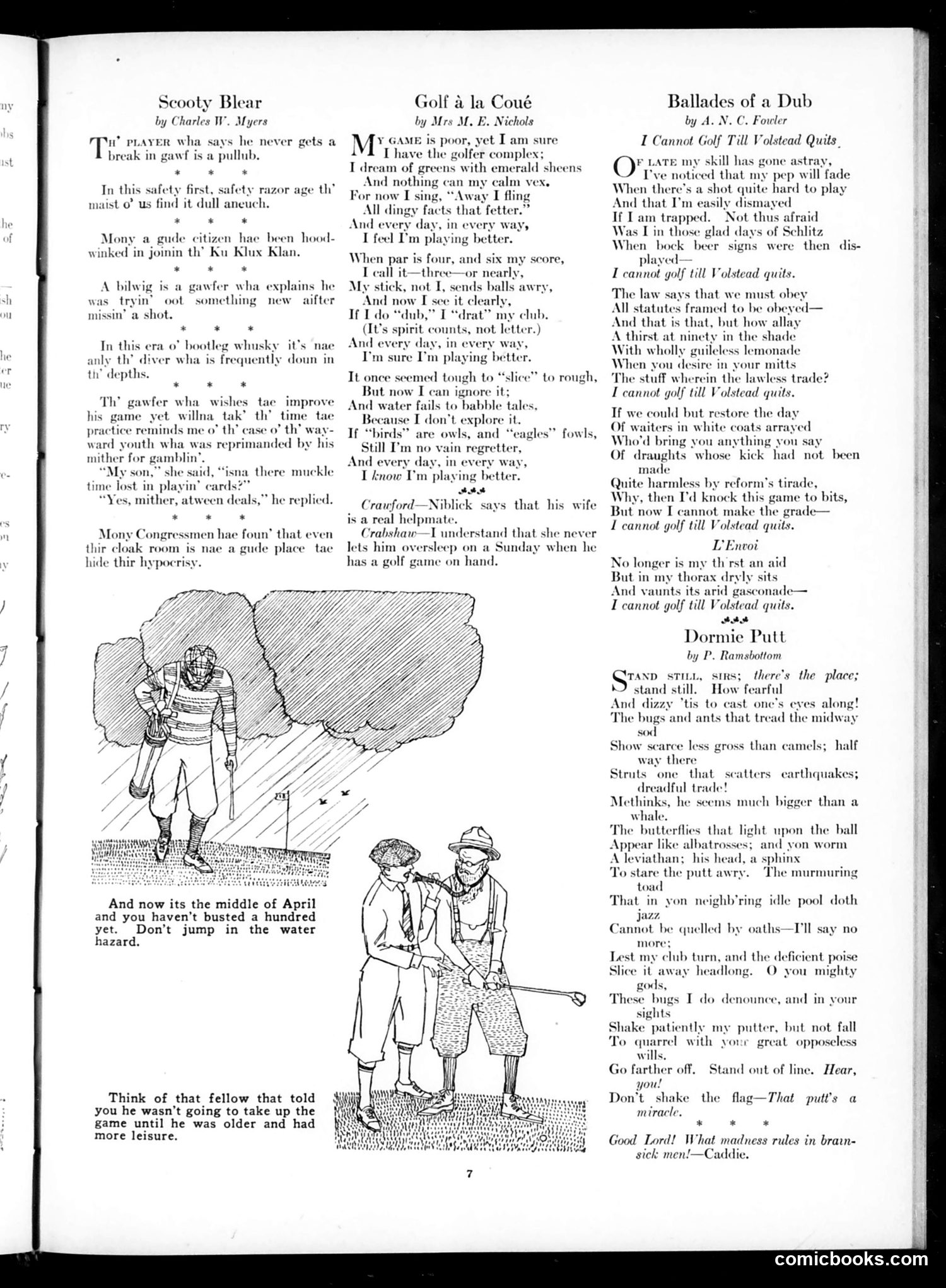
This 1920s Judge magazine page satirizes golf and Prohibition-era American culture through three poems and illustrations. **"Scooty Blear"** offers Scottish-dialect quips mocking golfers and contemporary society: references to the KKK (commenting on 1920s racial violence), Prohibition bootlegging, and Congressional hypocrisy. The golf jokes target players who blame equipment rather than skill. **"Golf à la Coué"** parodies positive-thinking psychology (the Coué method was trendy then), where a golfer rationalizes poor performance through self-delusion—calling a six-stroke hole a three, blaming the club not himself. **"Ballades of a Dub"** directly addresses Prohibition (Volstead Act, 1920-1933), claiming the speaker cannot golf well without alcohol. References to "Schlitz" beer and "bock beer signs" nostalgically recall pre-Prohibition drinking, blaming dry laws for athletic decline. The illustrations show period golfers; one caption warns against jumping into water hazards mid-April. The common thread: early 20th-century American anxieties about masculinity, legal restrictions, and self-improvement movements.
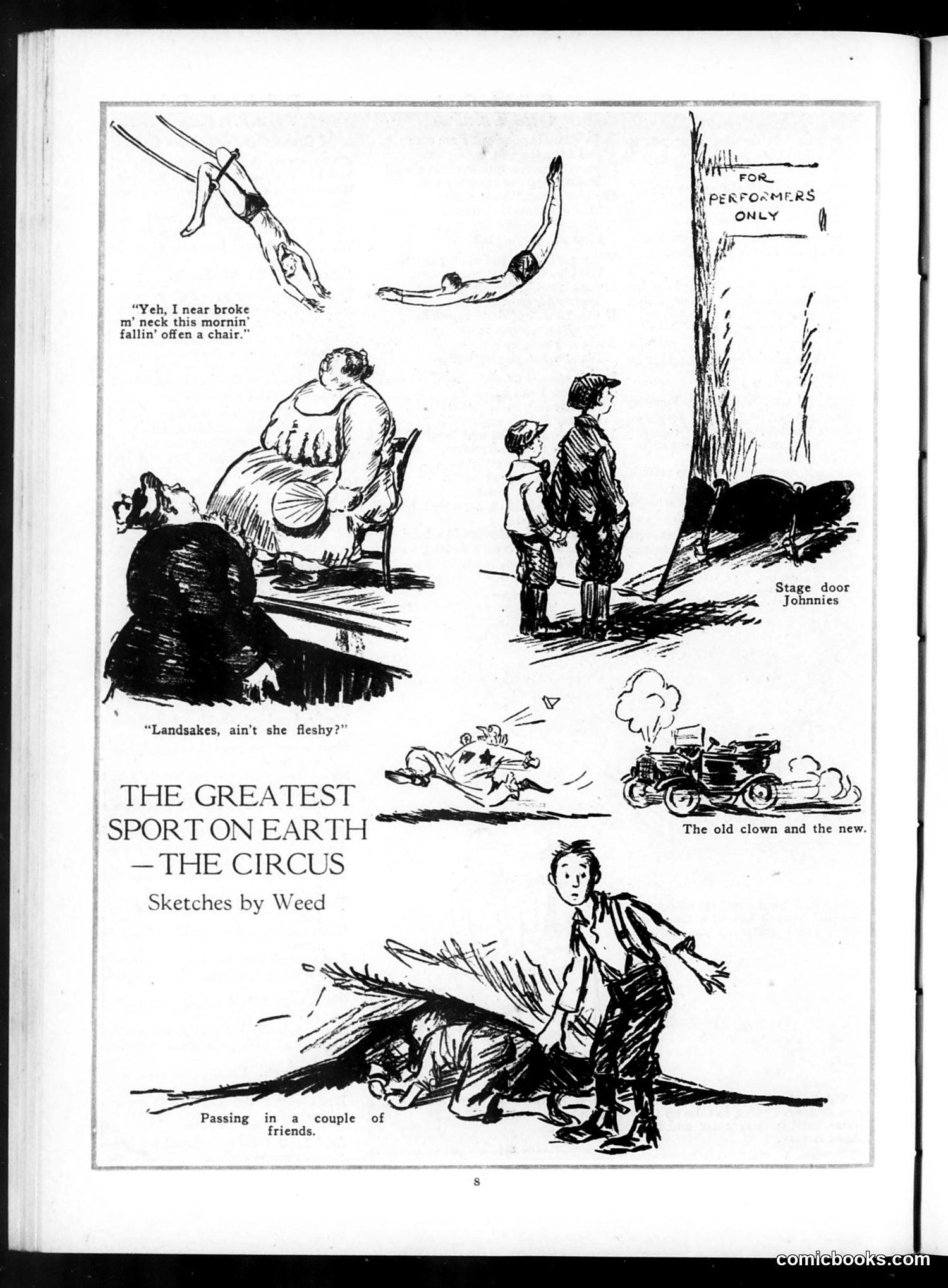
This is a humorous illustrated feature by artist Weed celebrating circus life. The sketches satirize circus culture through various scenes: **Key figures and jokes:** - A woman performer complains of breaking her neck falling from a chair—ironic given circus performers execute dangerous acrobatics - "Landsakes, ain't she fleshy?"—mocks a rotund woman, likely poking fun at circus sideshow attractions or performers' physiques - "Stage door Johnnies"—refers to men who loiter at theater/circus entrances to meet performers - "The old clown and the new"—contrasts old-fashioned circus tradition with modern mechanized entertainment (motorcars producing smoke) - "Passing in a couple of friends"—shows someone presenting companions to a performer The satire mocks circus personnel, audiences, and the collision between traditional circus acts and modern technology, presenting circus life as both physically dangerous and socially peculiar.
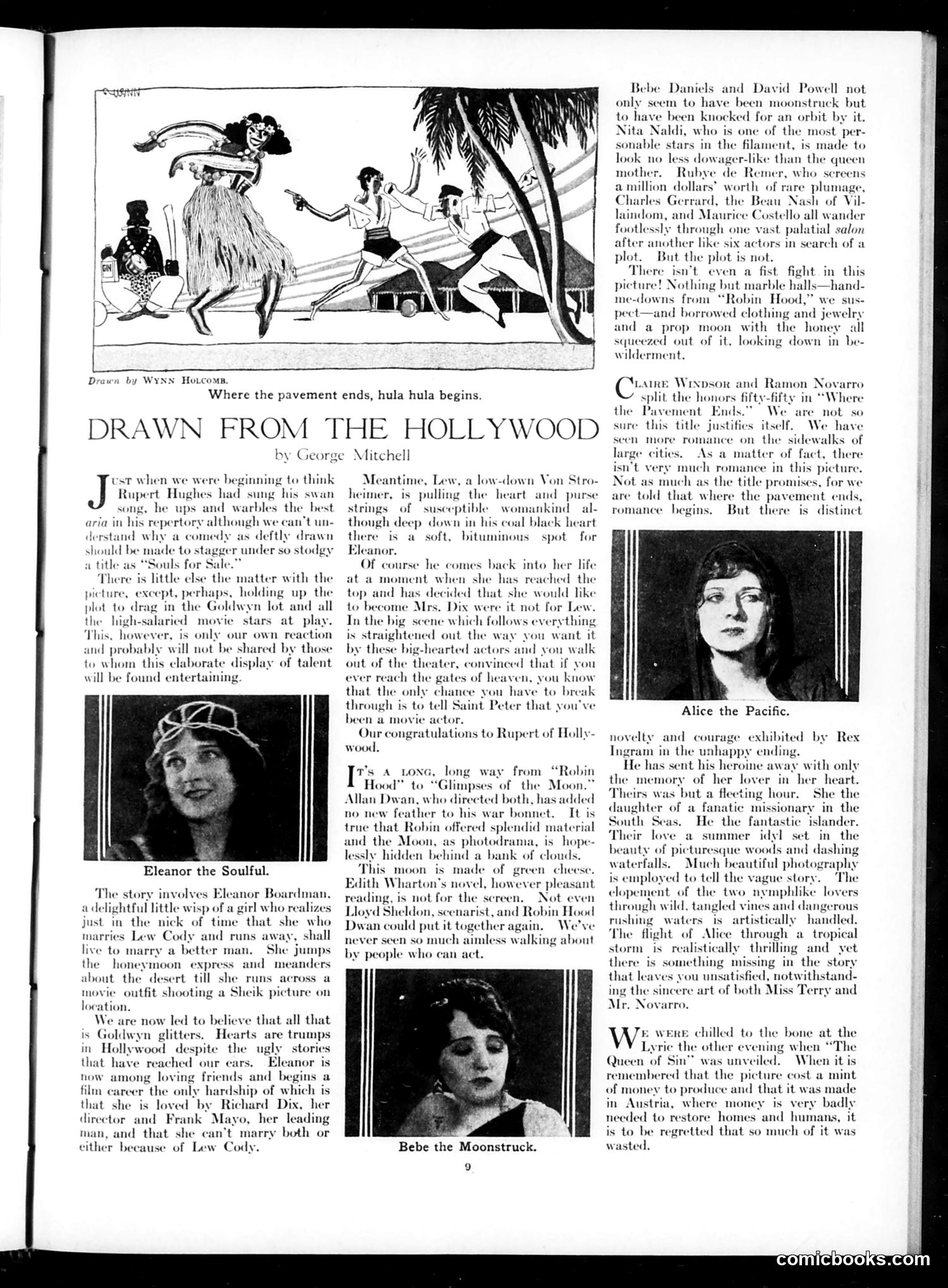
This page reviews several 1920s Hollywood films in George Mitchell's "Drawn from the Hollywood" column. The top cartoon satirizes the artificiality of studio filmmaking: titled "Where the pavement ends, hula hula begins," it depicts actors in a tropical scene surrounded by obvious props—borrowed jewelry, a fake moon, and set pieces from "Robin Hood"—mocking the gap between cinematic illusion and cheap stage construction. The reviews themselves critique recent releases for prioritizing star power and elaborate sets over coherent plots. Mitchell particularly dismisses "Glimpses of the Moon" (adapted from Edith Wharton) as aimless and "Bebe the Moonstruck" as plotless, despite featuring notable actors like Bebe Daniels and Nita Naldi. The satire targets Hollywood's tendency to showcase expensive production values and contract stars while neglecting storytelling fundamentals.
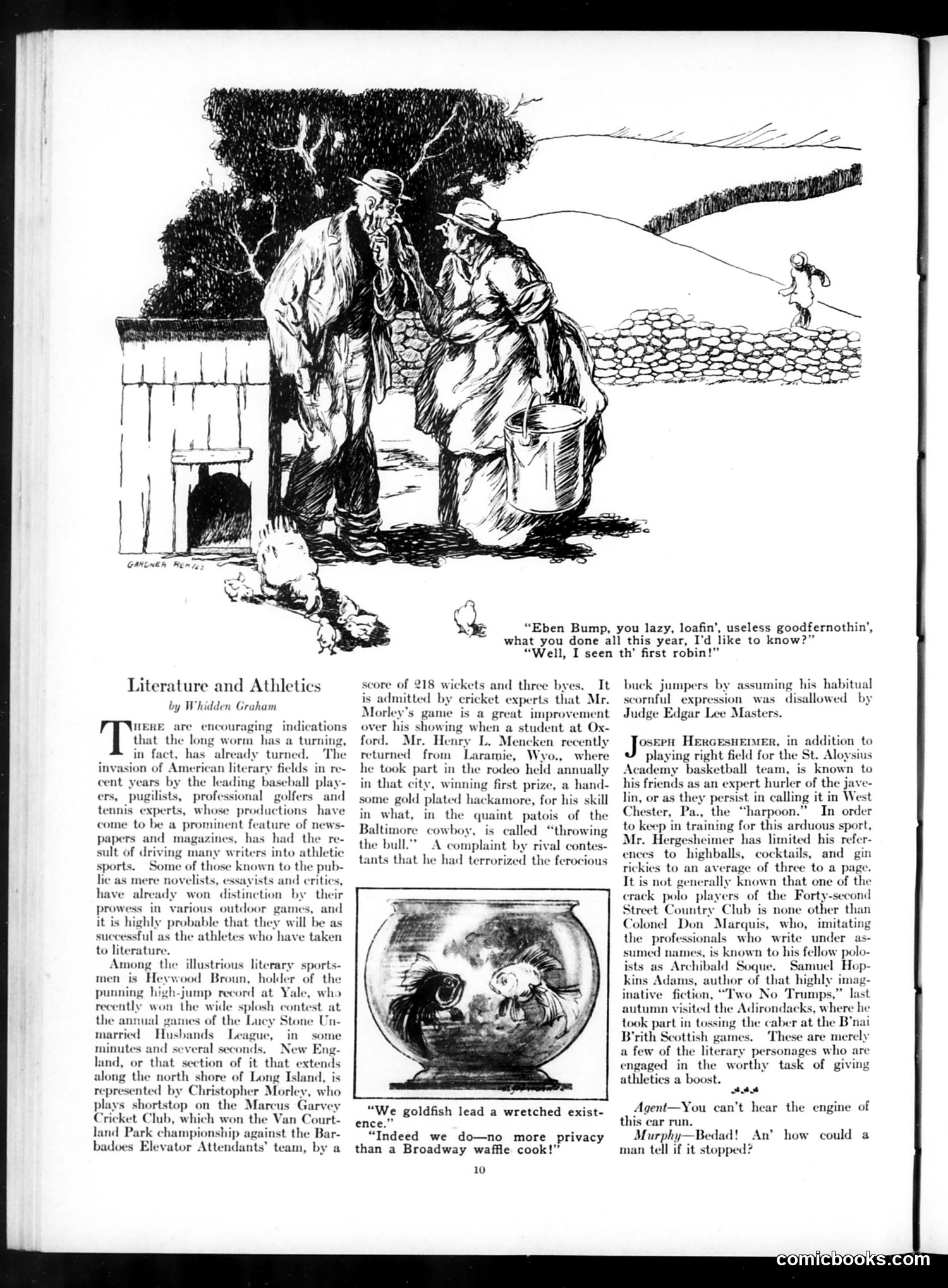
This is satirical commentary on a trend of American literary figures engaging in athletics. The article humorously claims famous writers—Heywood Broun, Christopher Morley, H.L. Mencken, Joseph Hergesheimer, and Don Marquis—are achieving athletic accomplishments, often with absurdly inflated or nonsensical details (winning at "throwing the bull," limiting cocktails "to an average of three to a page"). The satire mocks both the writers' ventures into sports and the sensationalist sports journalism reporting them. The accompanying cartoons are separate jokes: the top shows a rural scene where a lazy man claims his achievement is seeing the first robin; the lower cartoon jokes about goldfish lacking privacy in a Broadway waffle establishment. The piece reflects early-20th-century American culture where literary celebrities crossing into sports was apparently newsworthy enough to parody.
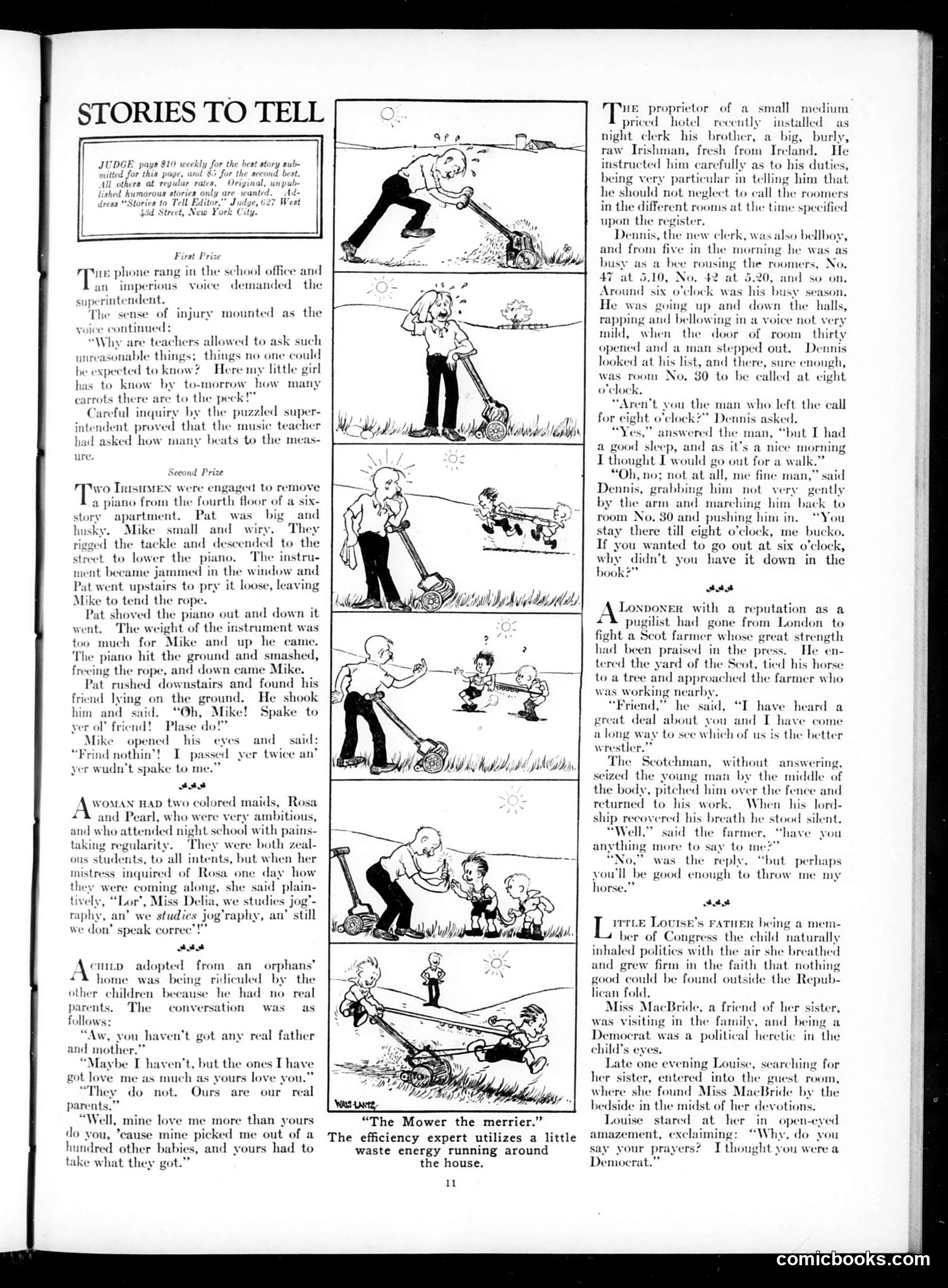
This page contains several humorous short stories illustrating everyday absurdities and class/ethnic humor typical of early 20th-century American satire: **"First Prize"** mocks parental obtuseness: a mother complains that teachers ask "unreasonable" questions, confusing musical terminology (beats per measure) with literal measurements of carrots. **"Second Prize"** depicts Irish laborers removing a piano; through miscommunication, one man gets lifted by the falling piano—slapstick humor playing on working-class incompetence. **The maids' story** uses dialect humor (common to the era) showing African American domestic workers studying geography but unable to master "correct" speech. **The orphan anecdote** sentimentally inverts class assumptions: the adopted child claims superiority because he was "chosen," while biological children were mere chance. The page's final story introduces an Irish hotel clerk character (stereotyped as brusque, thick-accented) forcing a guest to stay in his room per the booking. These stories reflect period stereotypes about immigrants, African Americans, and working-class people, presented as humor for Judge's educated, middle-class readership.
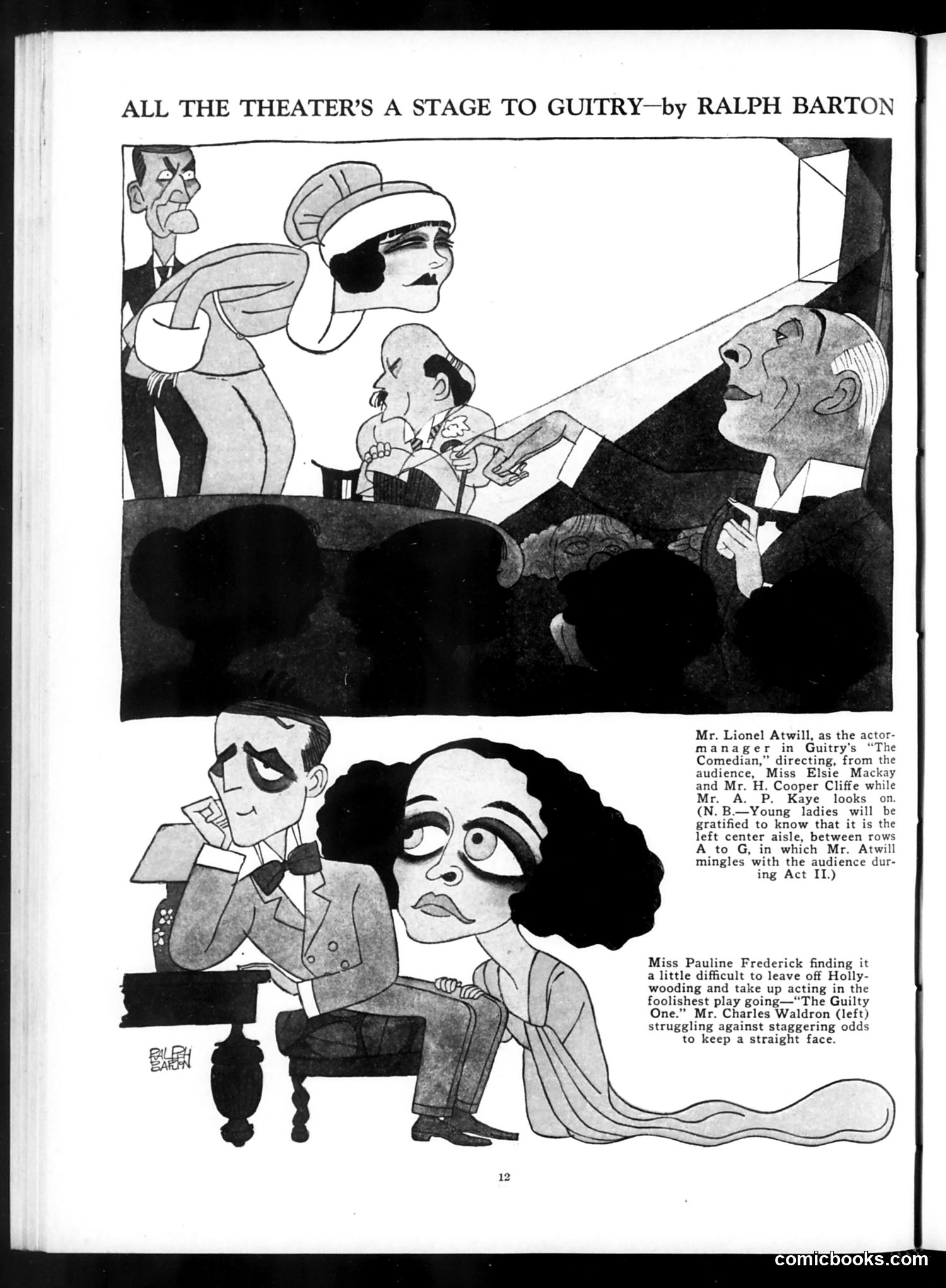
This satirical cartoon by Ralph Barton mocks theatrical productions and actors of the period. The top panel ridicules Sacha Guitry's play "The Comedian," where actor-manager Lionel Atwill directs from the audience during performance—an unusual and pretentious staging choice that Barton finds absurd. The detailed aisle reference ("left center aisle, between rows A to G") emphasizes the absurdity. The bottom panel targets actress Pauline Frederick's transition from Hollywood to stage acting in "The Guilty One," suggesting the play is foolish and she struggles with legitimate theater. Barton caricatures her exaggerated facial expressions and shows co-star Charles Waldron barely maintaining composure—implying the production is laughably bad. The satire targets theatrical pretension and actors' self-importance during this era of transitioning entertainment mediums.
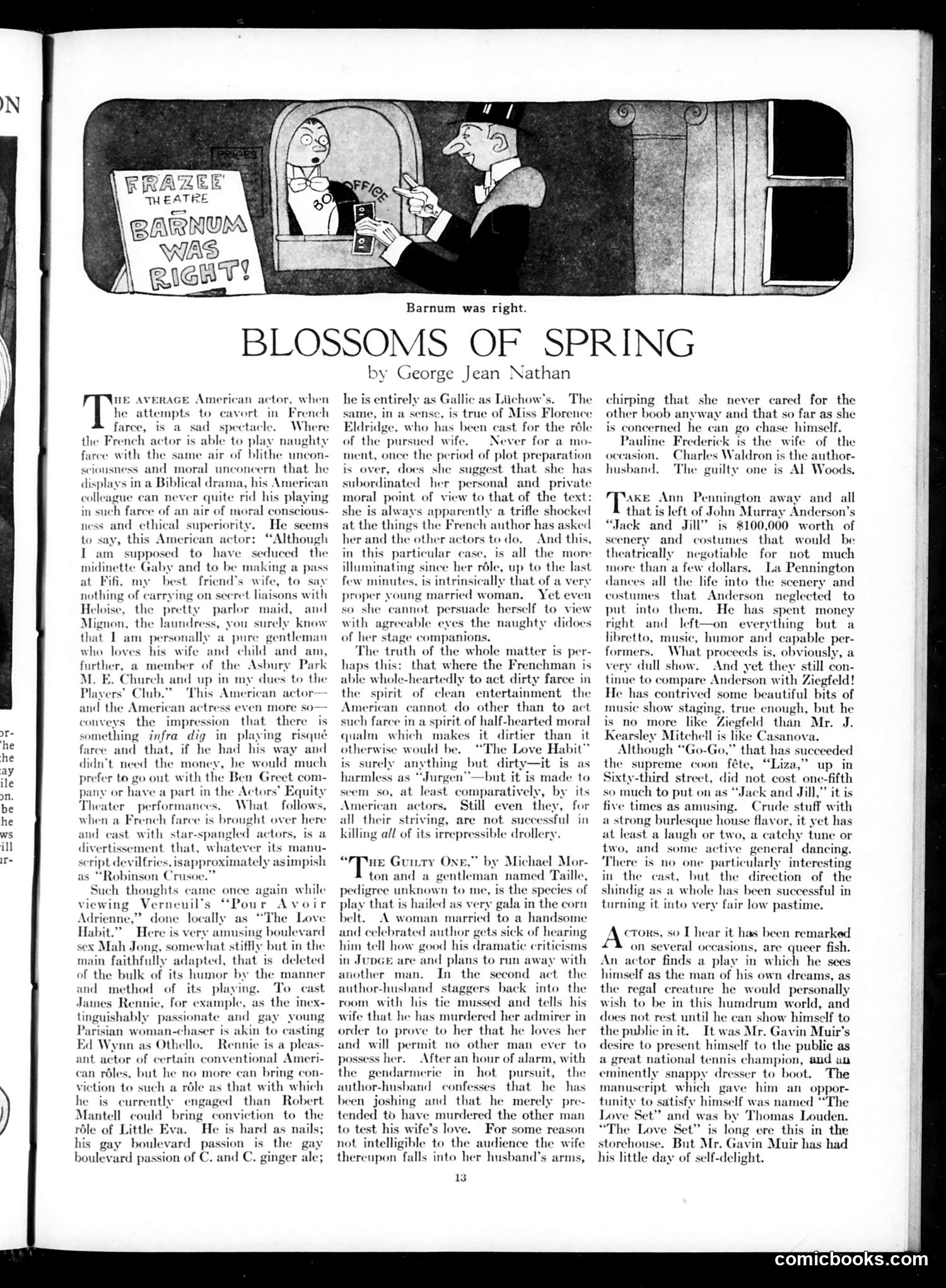
The cartoon depicts a theater box office scene where a woman (likely representing a theatrical producer or manager) sits at a ticket window while a man in formal dress gestures enthusiastically outside. The sign reads "FRAZEE THEATRE" and "BARNUM WAS RIGHT!" This references P.T. Barnum's famous dictum that "there's a sucker born every minute"—a cynical observation about audiences' gullibility. The cartoon suggests that theater management relies on exploiting public taste rather than artistic merit. The accompanying article by George Jean Nathan critiques American actors attempting French farce comedies. Nathan argues that American performers bring excessive moral consciousness and prudishness to risqué material, undermining the entertainment value. He contrasts this with French actors who perform such farces with unaffected ease. The cartoon thus humorously validates Nathan's point: theater succeeds through audience manipulation rather than artistic excellence—hence "Barnum was right."
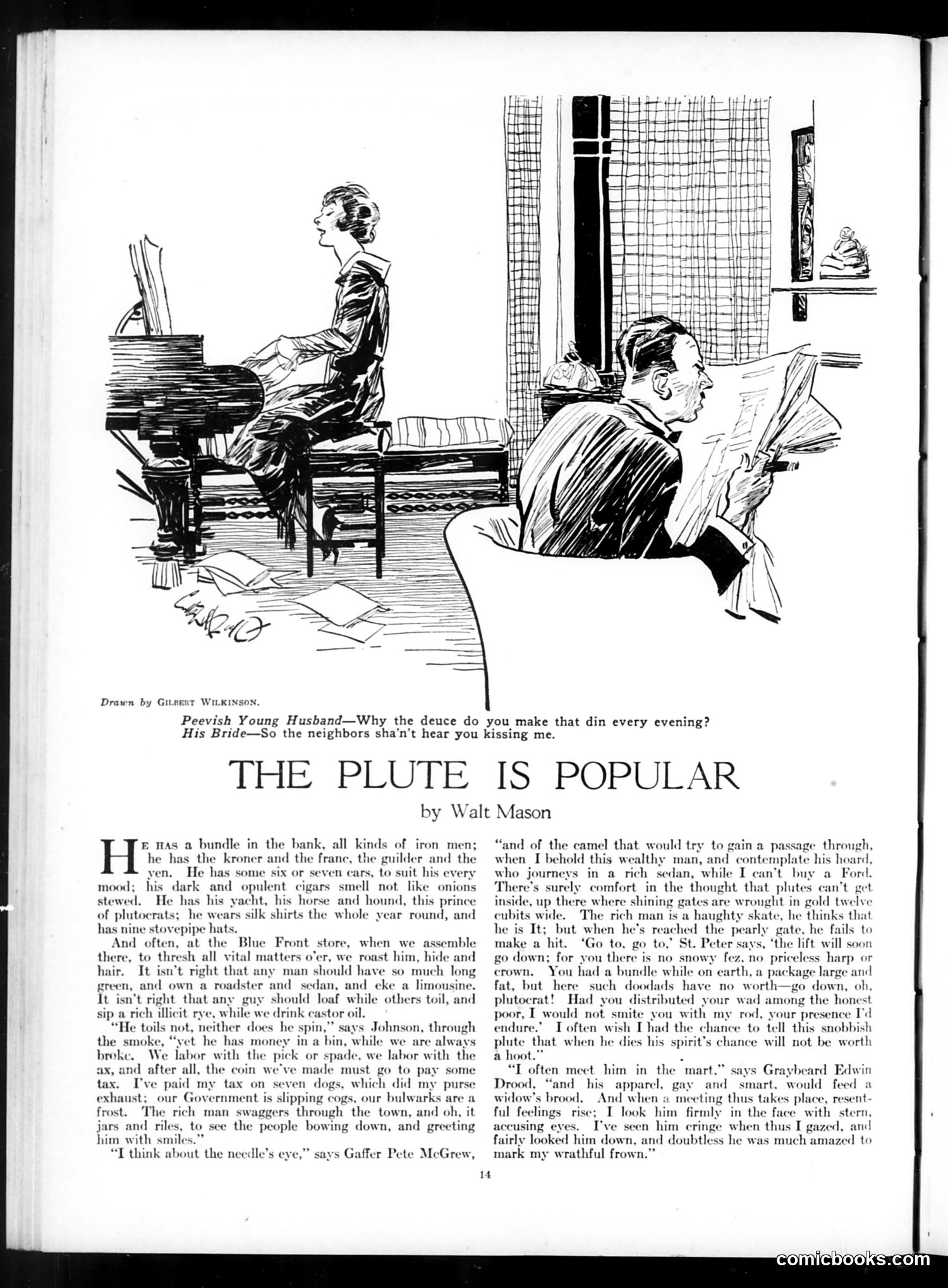
This page contains two separate pieces: **The Cartoon (top):** A newlywed couple in their home—the husband complains about the wife making noise with a musical instrument every evening. Her reply: she's playing the plute (flute) loudly so neighbors won't overhear them kissing. The joke relies on the husband's complaint being absurdly prudish, making his wife's solution humorous and slightly scandalous for the era. **The Story/Poem (bottom):** Walt Mason's "The Plute is Popular" satirizes working-class resentment of the wealthy. Common laborers gather and grumble about a rich man's ostentatious lifestyle—his cars, yacht, silk shirts, and lavish spending—while they struggle with taxes and poverty. The twist: they console themselves with religious belief that wealth means nothing in the afterlife; the rich man will be condemned while they're rewarded. It's social commentary dressed as moral reassurance, mocking both plutocrat excess and the poor's reliance on heavenly justice rather than earthly change.
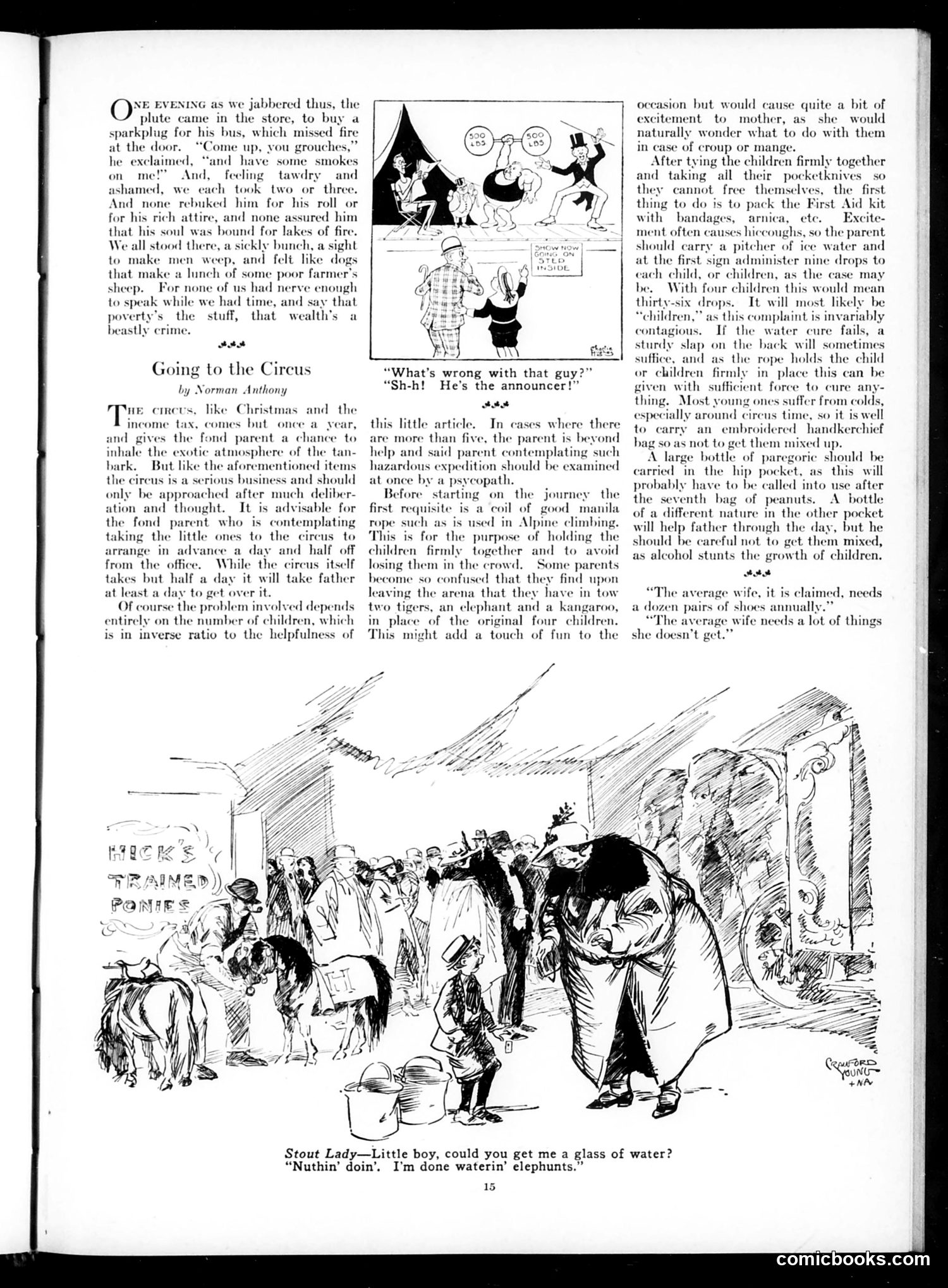
This is a humorous advice article by Norman Anthony satirizing middle-class parents taking children to the circus. The piece mocks parental anxiety through exaggerated practical warnings: tying children together with rope (to prevent losing them in crowds), packing first-aid kits, carrying paregoric for inevitable colic, and keeping alcohol separate so drunk fathers don't stunt children's growth. The cartoons illustrate the chaos: the top panel shows a circus announcer being heckled; the bottom depicts the crowded, overwhelming circus environment with animals and crowds, concluding with a joke about a boy refusing to fetch water for a woman because he's exhausted from "waterin' elephunts." The satire targets turn-of-the-century parental neurosis and class anxiety—the circus as overwhelming spectacle requiring military-level organization. The humor assumes readers recognize the circus as a standard (if chaotic) family outing.
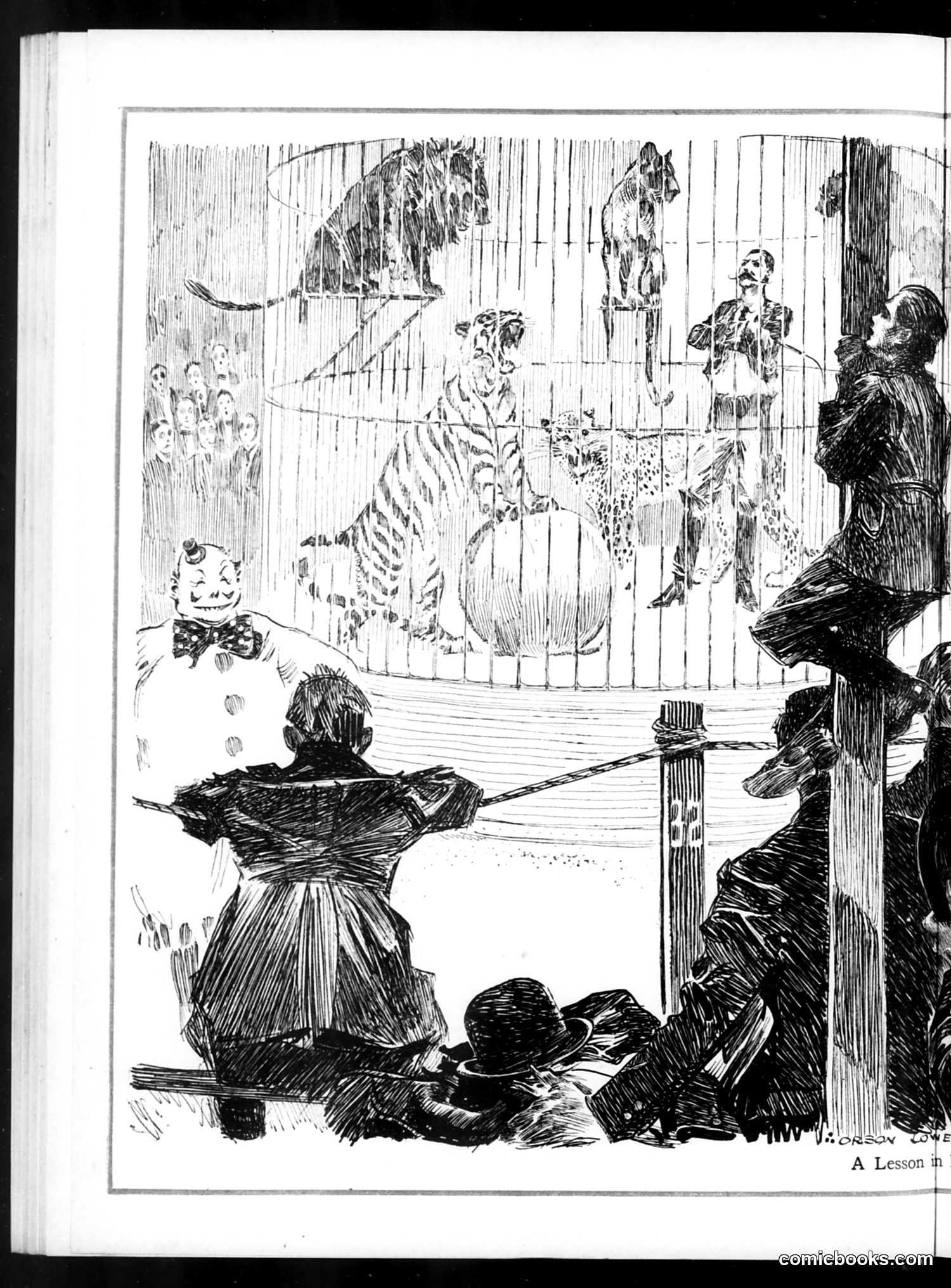
This is a satirical cartoon titled "A Lesson in..." (title cut off) from *Judge* magazine, drawn by the artist whose signature appears bottom right. The cartoon depicts a circus scene with a female trainer/tamer in the center ring demonstrating control over wild animals—tigers, leopards, and other big cats. The audience watches from seats on the left, while well-dressed gentlemen observe from the right. The satire likely uses the circus animal-taming as a metaphor for controlling or "taming" unruly elements of society or politics. The female trainer may represent a specific political figure or social force of the era, though without the complete title and additional context, the specific target remains unclear. The visual message emphasizes domination and control of dangerous forces through skill and authority.
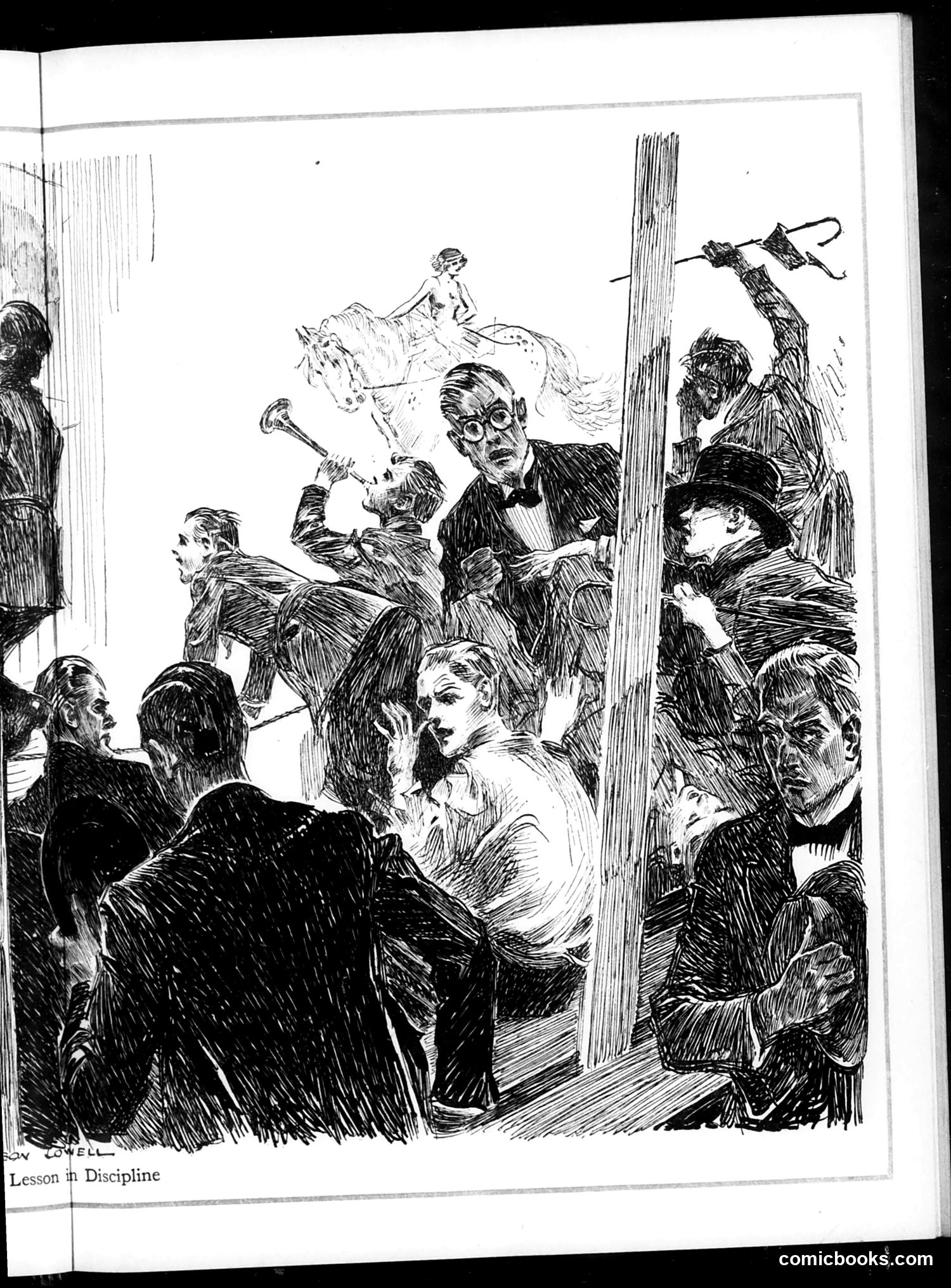
This political cartoon by Cowell depicts a chaotic scene of physical violence and disorder. A well-dressed man in the center (wearing glasses and formal attire) appears to be the target of aggressive action from multiple figures wielding implements—clubs, hammers, and other weapons. A woman on horseback observes from above. The title "Lesson in Discipline" suggests ironic commentary: rather than imposing orderly discipline, the scene shows anarchic mob violence. Without additional context about the publication date, specific political figures aren't clearly identifiable, but the cartoon likely satirizes debates about authority, labor unrest, or social disorder during the early 20th century. The chaos itself becomes the "lesson"—a critique of how discipline is actually administered.
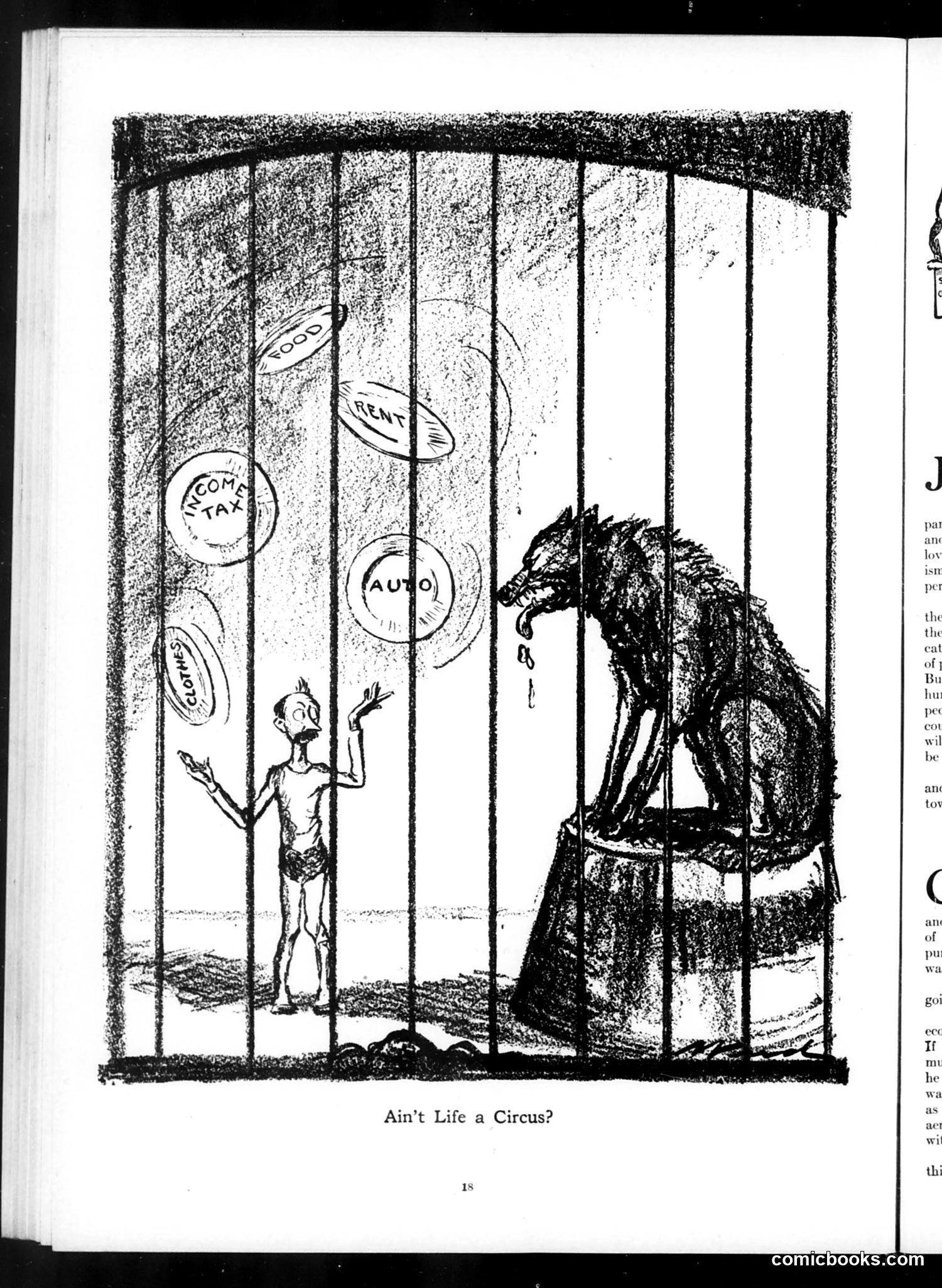
This political cartoon depicts a man juggling various financial obligations while caged with a menacing beast—likely representing economic hardship or creditors. The juggled items are labeled with common expenses and taxes: "FOOD," "RENT," "AUTO," "INCOME TAX," and others visible in circles. The satire critiques the financial pressures ordinary Americans faced, portraying modern life as a dangerous balancing act where citizens must constantly manage multiple financial burdens or risk collapse. The cage and threatening animal suggest these pressures are inescapable and threatening. The cartoon's title poses a rhetorical question—is life merely an entertainment spectacle, or should it offer more stability? This likely reflects Depression-era or post-war anxieties about economic security and the burden of taxation and living costs on working Americans.
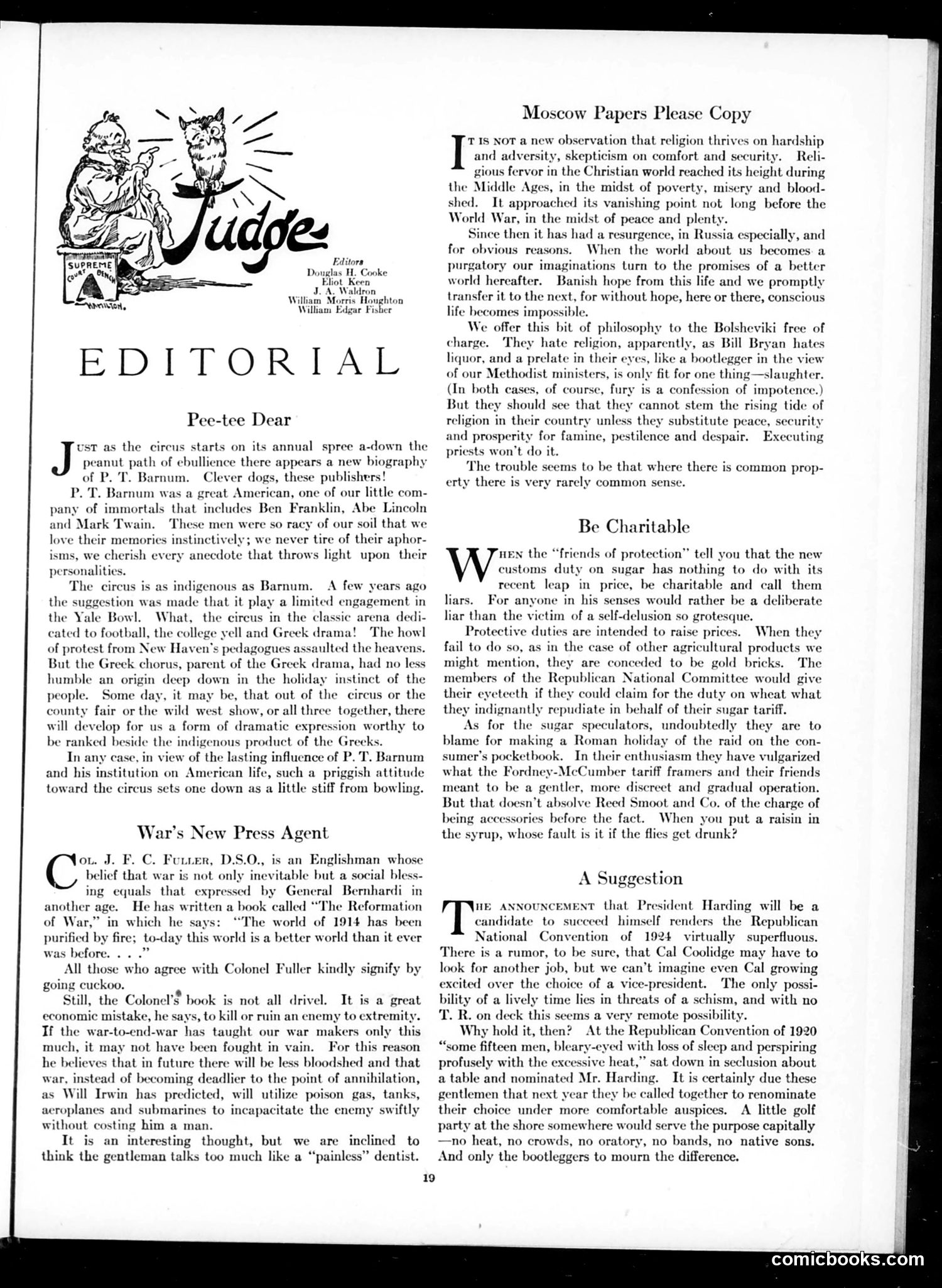
This editorial page contains three opinion pieces typical of Judge's satirical approach circa 1920s: **"Pee-tee Dear"** defends P.T. Barnum and the circus as legitimate American cultural institutions, arguing against Yale academics who protested a circus performance at the Yale Bowl. The editor argues the circus has indigenous American roots comparable to Greek drama. **"War's New Press Agent"** mocks Colonel J.F.C. Fuller, a British military theorist who argued WWI's devastation was justified and beneficial. The editor agrees with Fuller's observation that future wars should "incapacitate" enemies efficiently without massive casualties—but sarcastically suggests Fuller sounds like a "painless dentist," implying his optimism about "humane" warfare is naively delusional. **"Moscow Papers Please Copy"** argues that religion thrives during hardship and dies during prosperity, offering this observation to Soviet Bolsheviks who opposed religion. The editor suggests removing earthly hope pushes people toward religious faith. The page employs characteristic Judge irony: agreeing with arguments while mocking their advocates' naiveté.
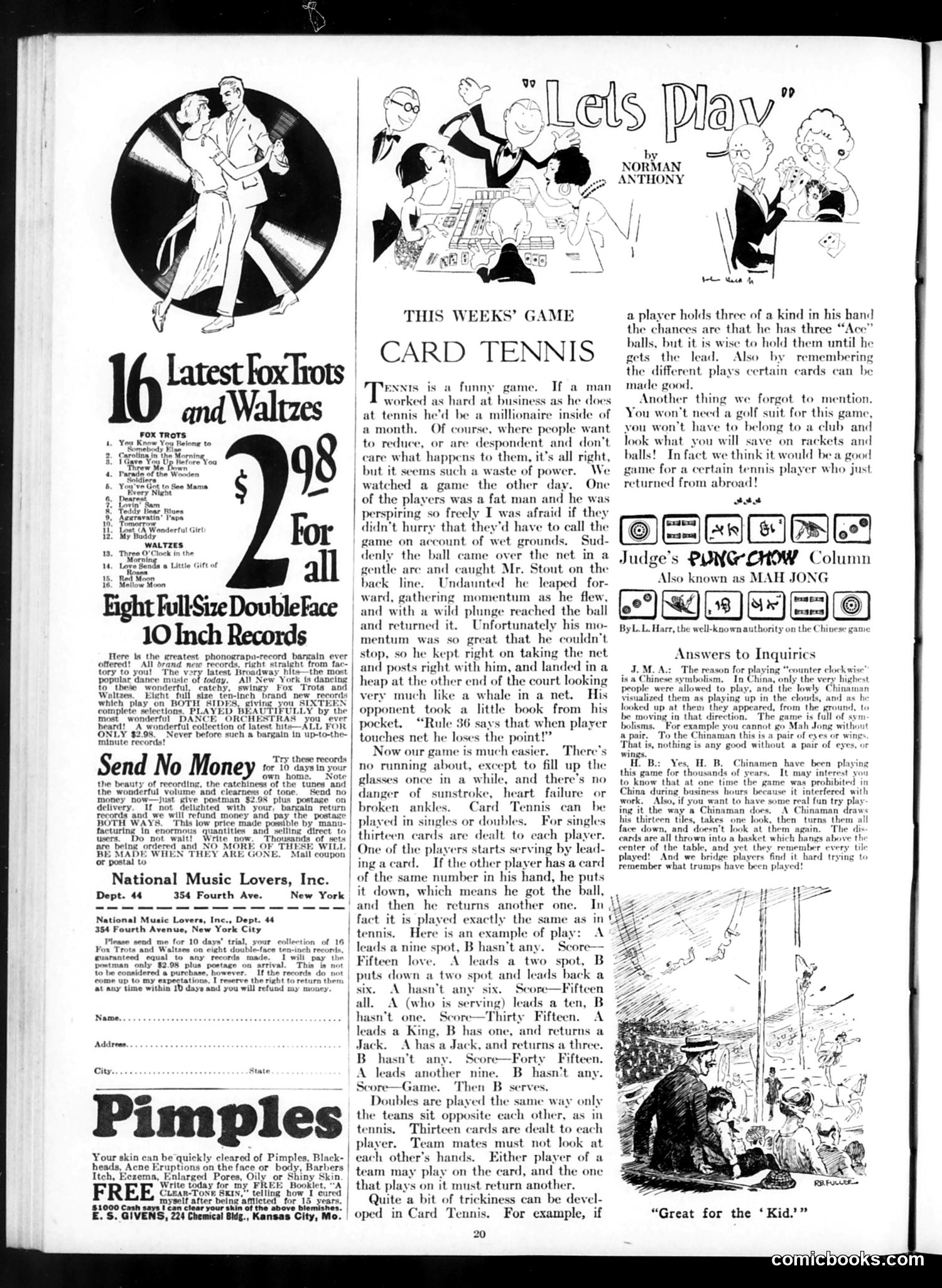
This page features a satirical game explanation by Norman Anthony. "Card Tennis" is a parlor game designed as an indoor alternative to lawn tennis, aimed at sedentary urban professionals. The satire works on multiple levels: The opening mocks businessmen who exert more energy at tennis than their actual jobs, and criticizes the sport's physical dangers (the humorous anecdote about "Mr. Stout" collapsing demonstrates this). Card Tennis solves these problems—no running, no heart attacks, no wet grounds—making it perfect for the wealthy elite wanting to appear athletic without actual exertion. The cartoon illustrations show well-dressed players engaged in the genteel card game, contrasting with the vigorous physical activity described in the text. The joke critiques the leisured classes' desire for entertainment that mimics respectability while avoiding genuine effort. The page is primarily this satirical article with supporting advertisements for Fox Trots records and beauty products typical of 1920s Judge magazine content.
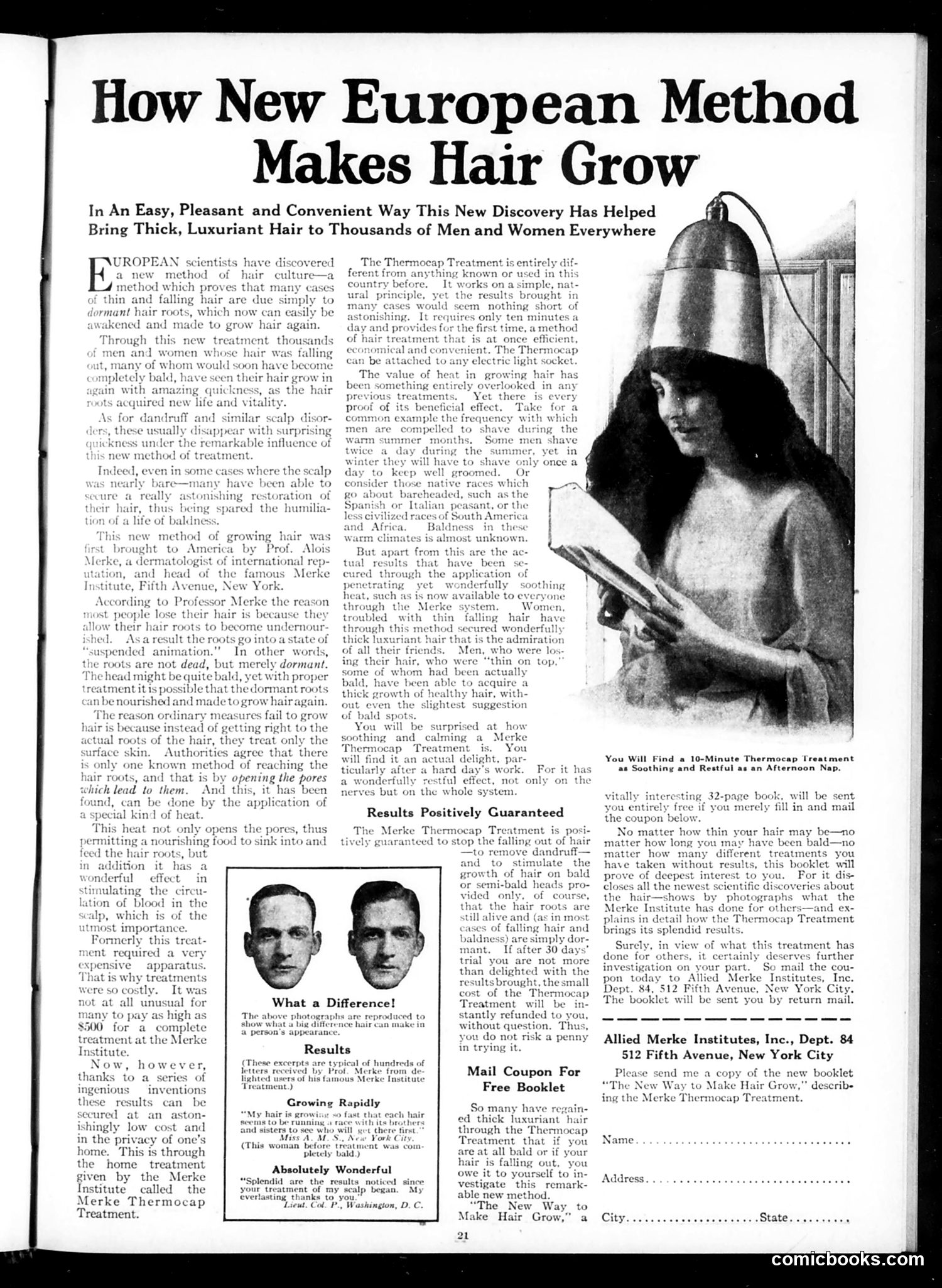
This page is primarily **advertising copy**, not satire or political commentary. It promotes the "Merke Thermocap Treatment"—a purported hair-growth device marketed as a "new European method" discovered by "Prof. Alois Merke," a dermatologist supposedly operating an institute in New York. The content uses before-and-after photographs of bald men to demonstrate claimed results. The pitch claims the treatment works by opening scalp pores and stimulating blood circulation using "heat," allegedly awakening "dormant" hair roots. **For modern readers**: This is a classic early-20th-century medical advertisement—the type that often made dubious claims about pseudo-scientific treatments. The emphasis on "European" origin and a named expert lent credibility in that era. The guaranteed results and promises of home treatment at low cost are hallmarks of period quack medicine advertising. This would appear in magazines like *Judge* alongside legitimate content, reflecting less stringent advertising regulation of the time.
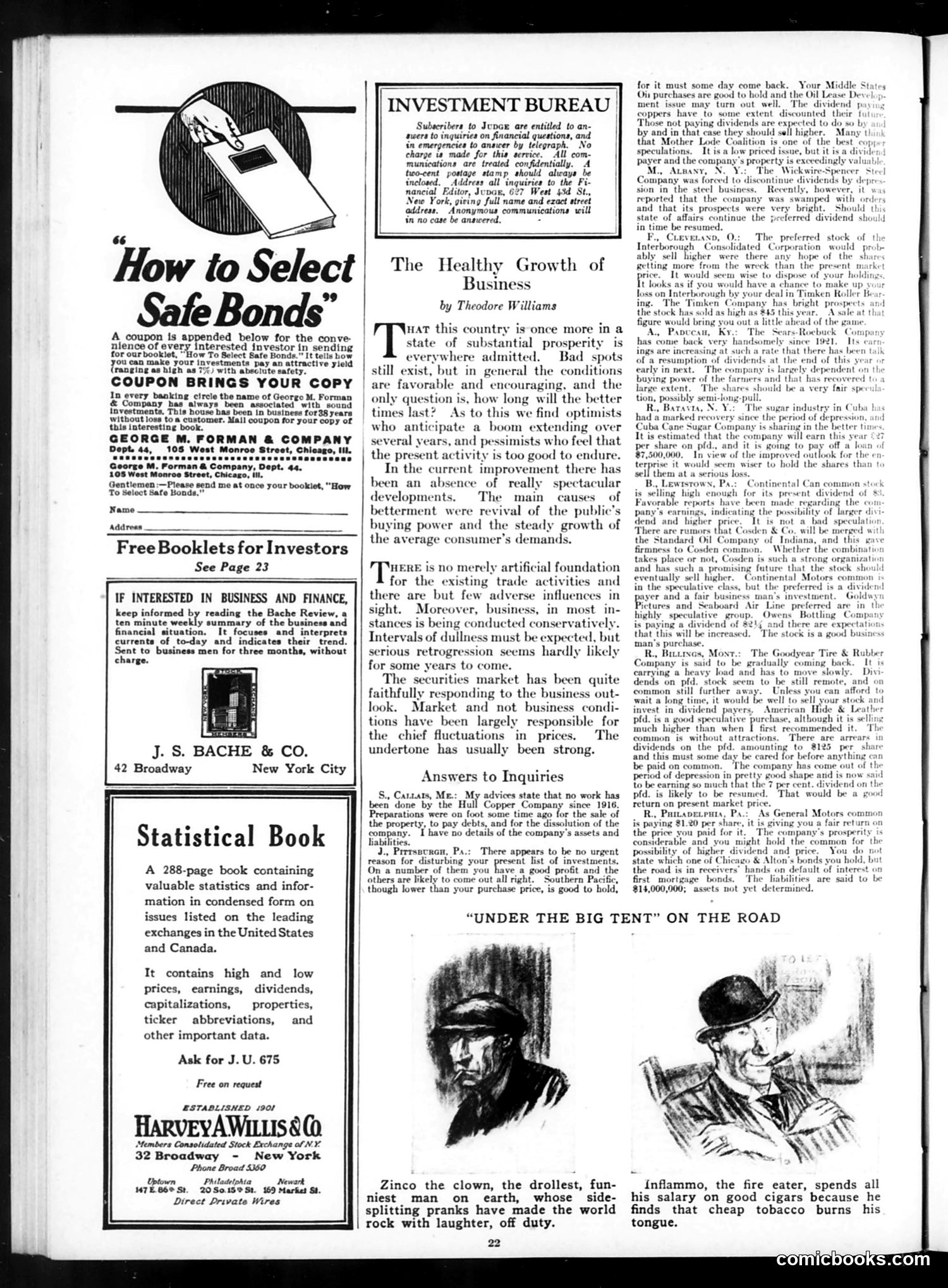
This page is primarily **financial advertising and investment advice**, not political satire. The cartoons at bottom ("Under the Big Tent on the Road") depict circus performers—a clown and fire-eater—illustrating a metaphorical comparison to economic life, but lack political content. The main content features investment firms (George M. Forman & Company, J.S. Bache & Co., Harvey Willis & Co.) promoting financial services and books to investors. The article "The Healthy Growth of Business" by Theodore Williams expresses optimism about post-WWI American economic recovery, noting steady consumer demand and conservative business practices, while cautiously warning that "serious retrogression seems hardly likely for some years." This reflects 1920s investment-culture messaging aimed at middle-class investors seeking safe returns. The page reflects the era's confidence in capitalist expansion before the 1929 stock market crash.
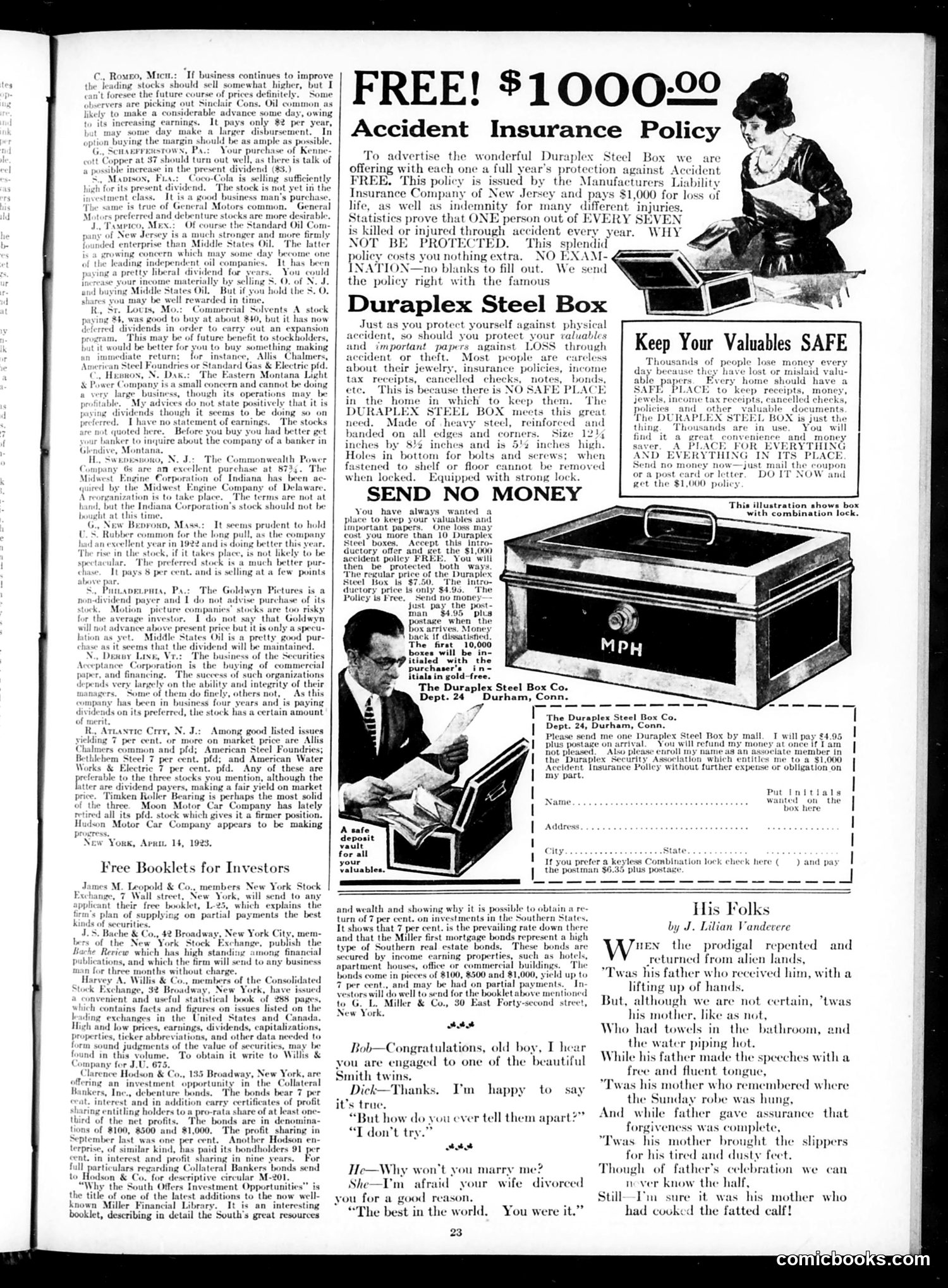
This page is primarily **advertising**, not political satire. The dominant content is a full-page advertisement for the Duraplex Steel Box, a home safe designed to protect valuables against theft and loss. The ad features an illustration of a woman examining the steel box and includes a man in a suit reading product literature. The pitch emphasizes security for jewelry, documents, and financial records, promising "FREE! $1000.00 Accident Insurance Policy" with purchase. The bottom of the page contains unrelated content: brief humorous exchanges ("His Folks" section) and stock market tips for investors. These appear to be standard Judge magazine filler content rather than political commentary or satire.
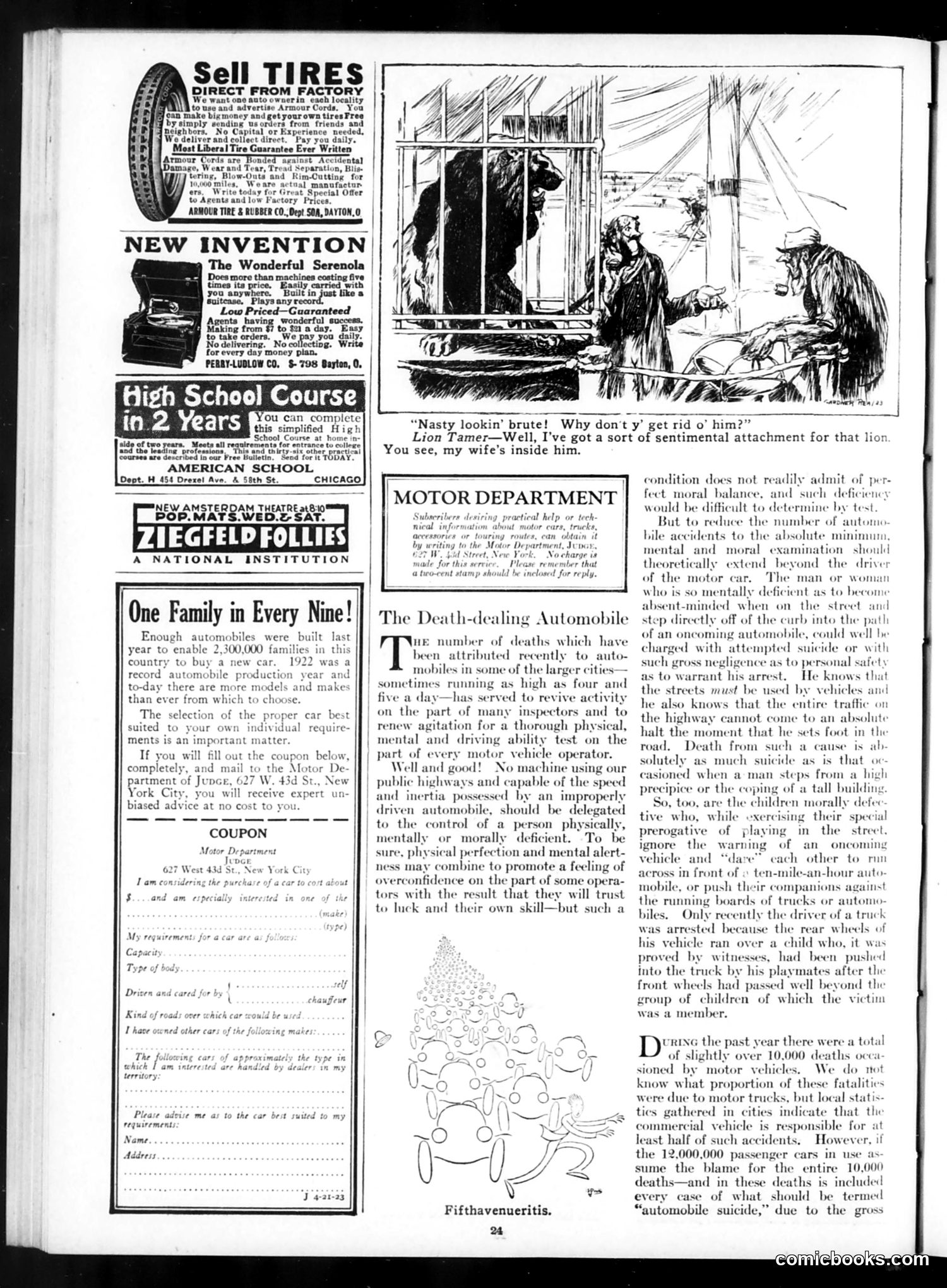
This page combines advertisements with satirical commentary on automobile safety, a major public concern in the 1920s. **The Main Cartoon** depicts a lion tamer defending his dangerous pet to a skeptic. The joke's punchline—"my wife's inside him"—is absurdist humor suggesting he tolerates the beast because of personal attachment. This satirizes people who continue driving despite automobiles' known lethality. **The Featured Article**, "The Death-dealing Automobile," directly addresses this tension. It argues that automobiles kill thousands annually (sometimes "four and five a day"), yet society permits their use. The article advocates for rigorous physical and mental testing of drivers, while sardonically noting that even "perfect" operators sometimes overestimate their skill and cause accidents. **The bottom illustration**, labeled "Fifthavenueritis," depicts a wealthy man afflicted with a medical condition—a satirical term suggesting that wealthy urban residents suffer from reckless automobile use despite understanding its dangers. Together, the page critiques societal acceptance of automobile fatalities as inevitable collateral damage of progress, while questioning drivers' fitness and judgment.
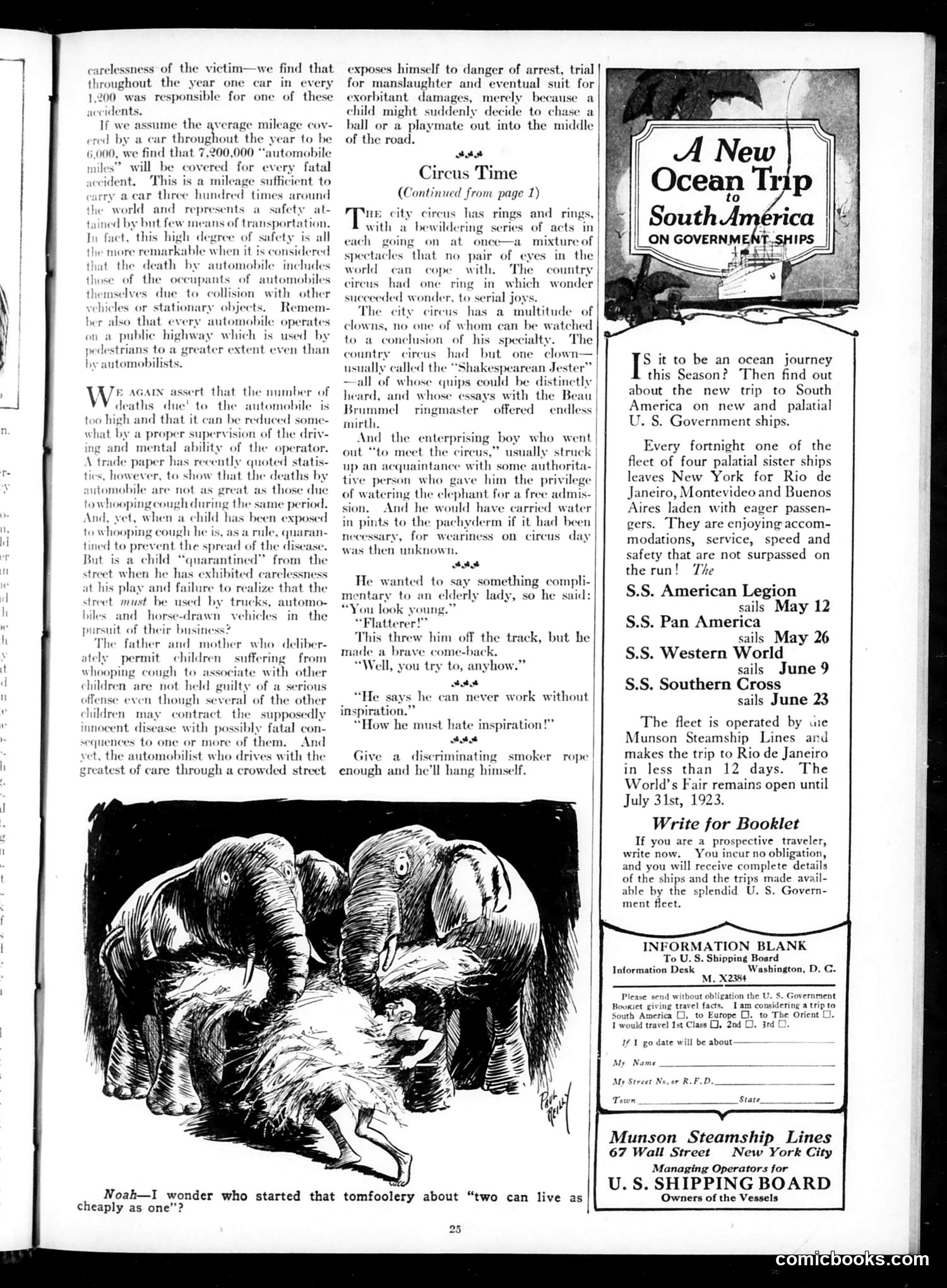
This page contains two distinct elements: a serious argumentative essay and an advertisement. **The Main Article** argues that automobiles are safer than commonly believed, citing statistics showing deaths per mileage are low—comparable to or less than deaths from whooping cough. The author contrasts the legal consequences facing careless drivers with the lack of prosecution for parents who expose children to contagious diseases. The satire targets what the author sees as inconsistent public safety enforcement: an automobilist driving carefully faces manslaughter charges if a child darts into traffic, yet parents spreading whooping cough face no legal penalty. **The Circus Time Column** (continued from earlier) humorously contrasts modern city circuses with nostalgic country circuses, lamenting the loss of intimate, focused entertainment where one could actually watch performers complete their acts. **The Advertisement** promotes ocean voyages to South America via U.S. Government ships—a period tourism offering. The page reflects 1920s concerns about automobile safety regulation and nostalgia for pre-modern entertainment.
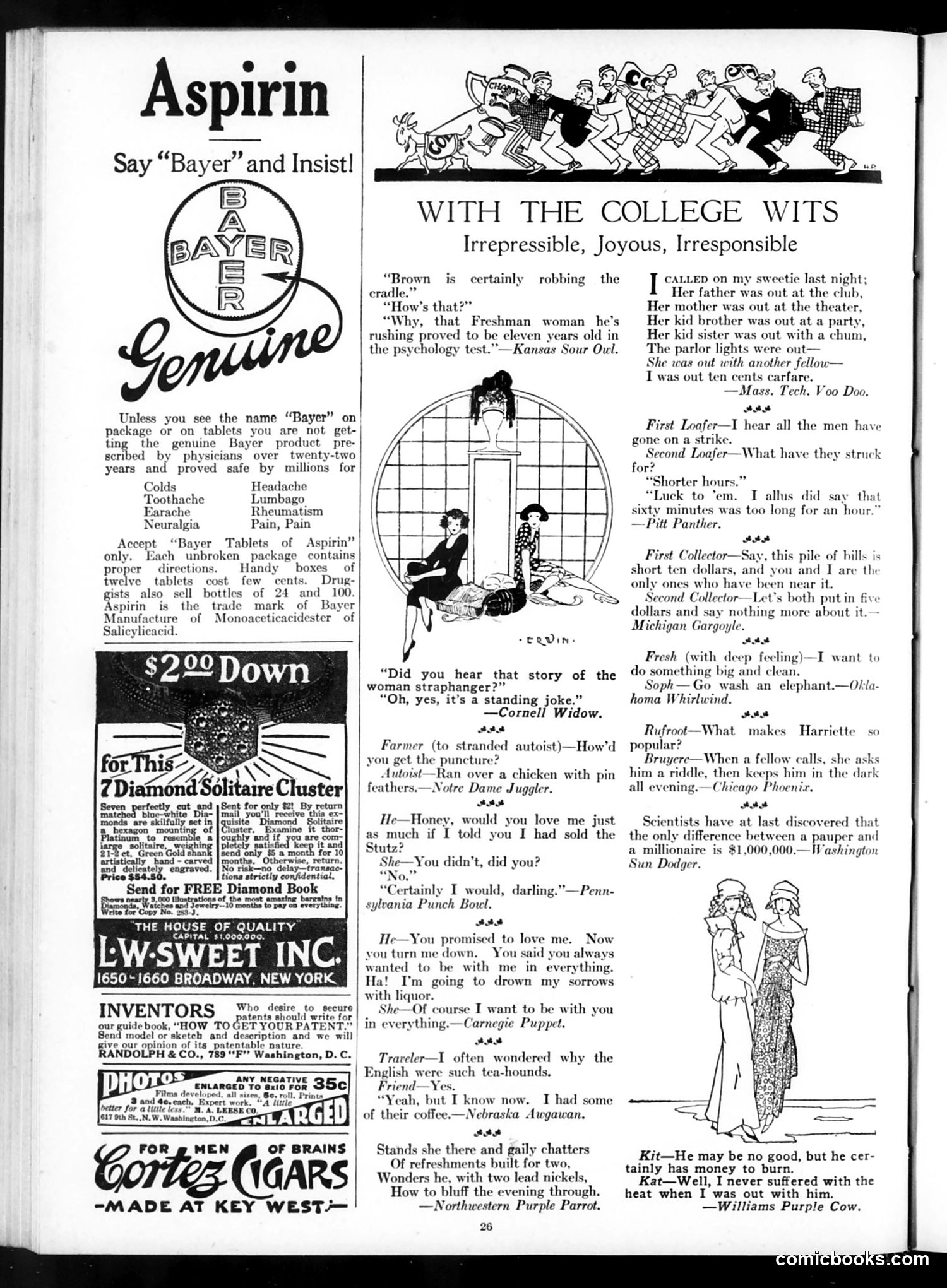
This is primarily an **advertising page** from Judge magazine, dominated by commercial pitches for Bayer Aspirin, diamond rings, and other products. The only satirical content is the section titled **"WITH THE COLLEGE WITS"**—a collection of brief jokes sourced from various college publications. These jokes mock **college students** as irrepressible, joyous, and irresponsible types. The humor targets: - **Dating/romance mishaps** (men short on money trying to impress dates) - **Class distinctions** (freshman-senior dynamics, working-class humor) - **Prohibition-era drinking** (references to drowning sorrows "with liquor") - **Gender relations** (women manipulating men; a woman entertaining suitors while her family is conveniently absent) The jokes are crude by modern standards and reflect 1920s attitudes toward youth, courtship, and class. The page essentially packages college humor as entertainment while selling products, using the rebellious "college wit" image as marketing appeal to young readers.
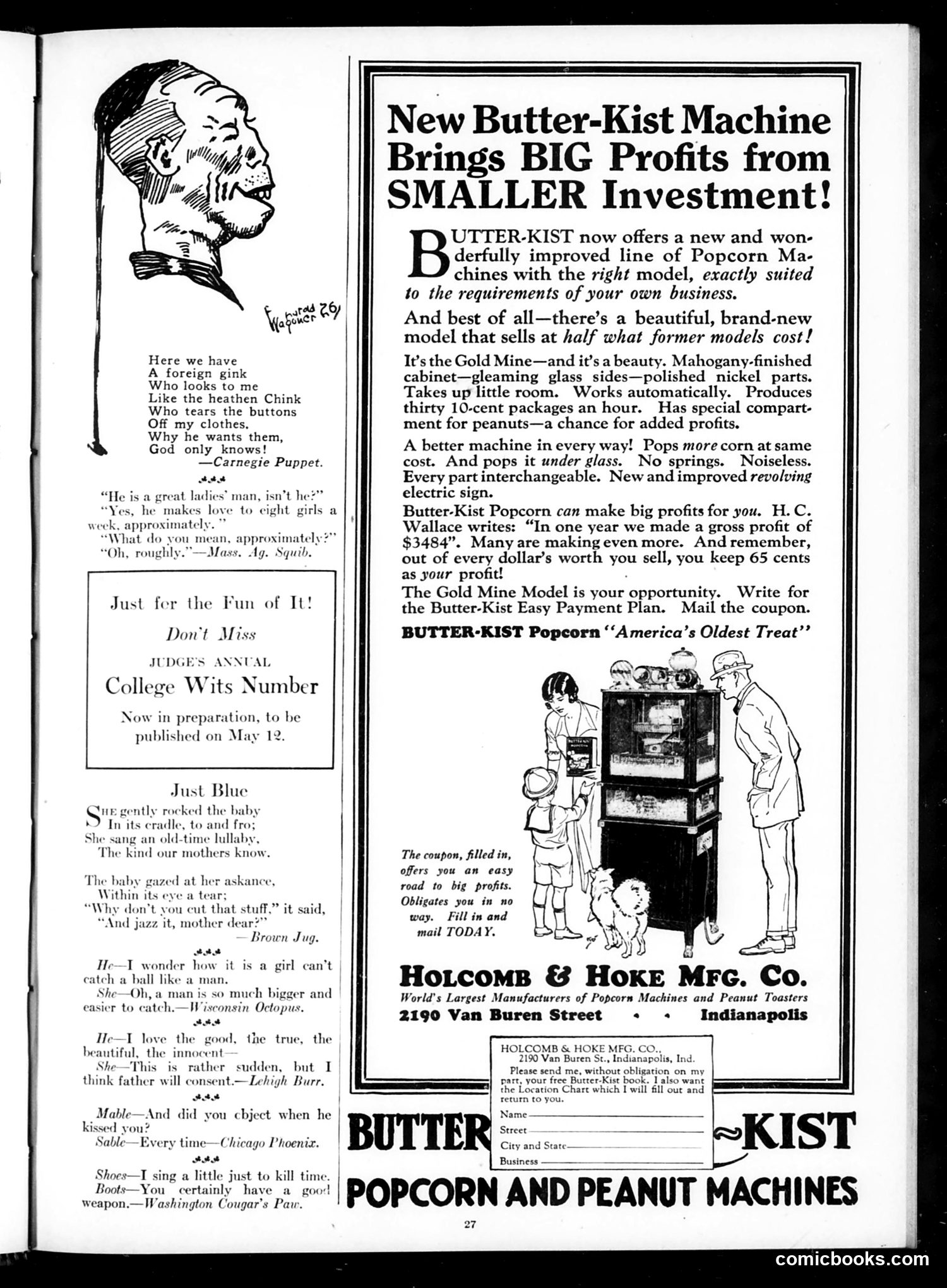
This page mixes advertising with light humor typical of early 20th-century satirical magazines. **The Main Content:** A full-page advertisement for Butter-Kist popcorn machines, promising entrepreneurs large profits from small investment—a classic get-rich-quick pitch. The "Gold Mine" model allegedly cost half the previous price and could produce thirty 10-cent packages per hour. **The Satirical Section:** The left column contains short jokes and quips, including one mocking a foreign man ("gink") who tears buttons off clothes—reflecting casual ethnic stereotyping common to the era. Other jokes play on romantic mishaps and miscommunication. **The Satire (Subtle):** The humor lies partly in the juxtaposition: Judge surrounds the earnest business pitch with jokes about foolishness and poor judgment, inviting readers to laugh at those tempted by such schemes. The "65 cents profit per dollar" claim may itself be jest. **Context:** This reflects the early 1900s when such popcorn machines were genuine business opportunities, but also when magazine advertisements made increasingly dubious promises.
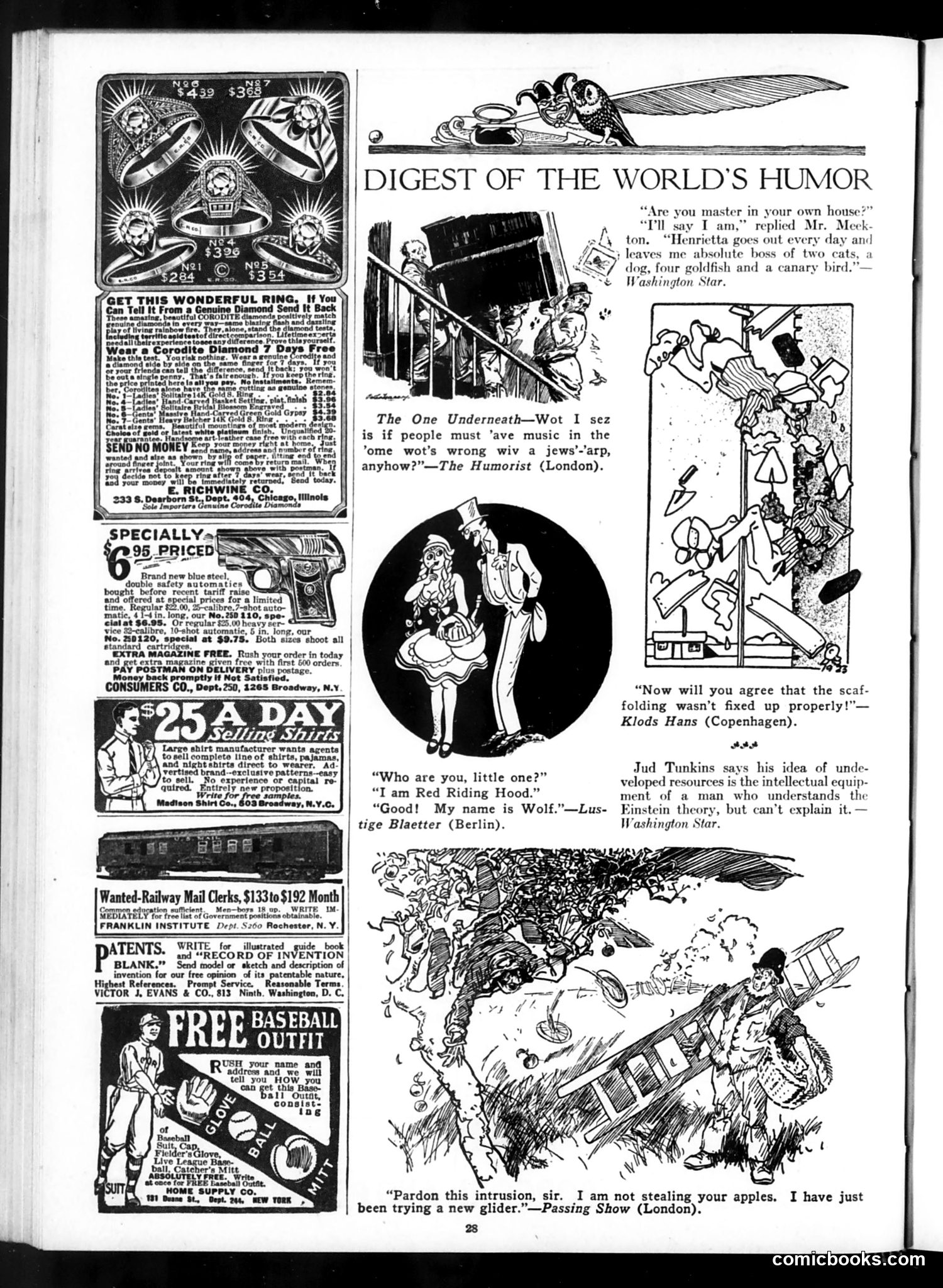
This page collects brief humorous anecdotes from international publications, presented as a satirical "digest." The jokes mock domestic power dynamics and absurdity: **"Master in Your Own House"**: A man claims authority while admitting his wife controls his schedule—he only "rules" the pets. The satire targets men's illusions of household dominance. **"The One Underneath"**: A working-class Londoner questions why anyone would use a fancy instrument (Jews'-harp) instead of simpler music. The joke mocks pretension and class differences in taste. **"Red Riding Hood"**: A dark twist where the wolf introduces himself openly—absurdist humor about the fairy tale's logic. **"The Scaffolding"**: A slapstick cartoon showing someone falling through poorly-constructed scaffolding, with blame-shifting dialogue. **"The Glider"**: A man claims he's testing a new aircraft, not stealing apples—implying he crashed into someone's orchard. These represent early 20th-century international humor emphasizing marital comedy, class commentary, and physical slapstick. The page also features period advertisements (rings, shirts, jobs, patents).
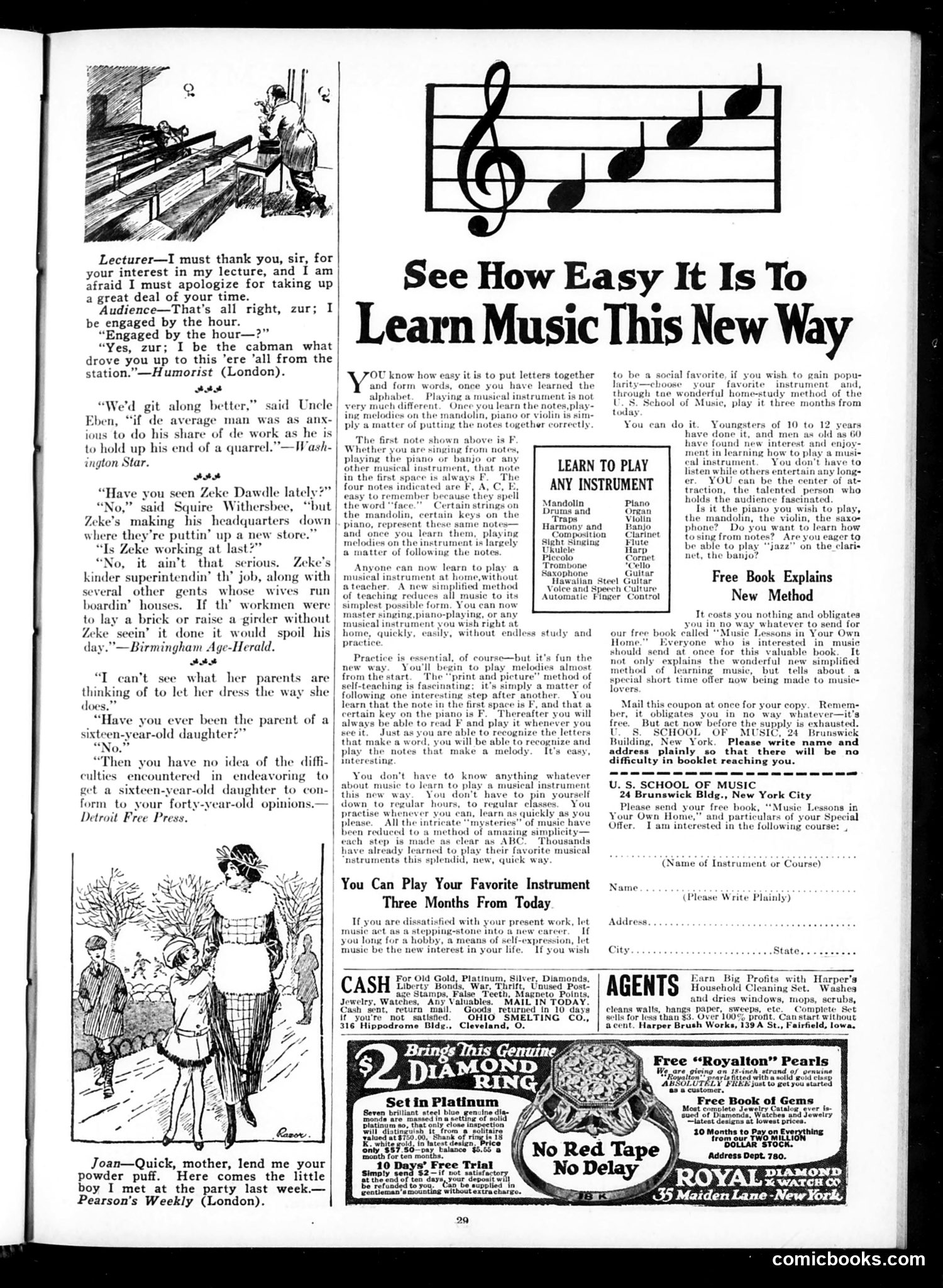
This page contains several unrelated jokes and one major advertisement for a music instruction course. **The Cartoons/Jokes:** The four brief comic anecdotes mock social pretension and generational conflict: 1. A lecturer apologizes for taking up the audience's time; they reply they're only there because they're a hired cabman being paid hourly—mocking the lecture's presumed importance. 2. Uncle Eben's observation about men's eagerness to quarrel rather than work. 3. A man won't stop supervising construction work his wife runs—humorously depicting male need for control. 4. A parent struggling to enforce "40-year-old opinions" on a "16-year-old daughter"—satirizing generational conflict over dress codes and propriety. 5. A girl borrows her mother's powder puff for a boy—suggesting precocious youth courtship. **The Advertisement (main content):** The "U.S. School of Music" promotes home music instruction, claiming anyone can learn piano, violin, or other instruments in three months through their "simplified" method requiring no teacher. This was typical early-20th-century mail-order education marketing.
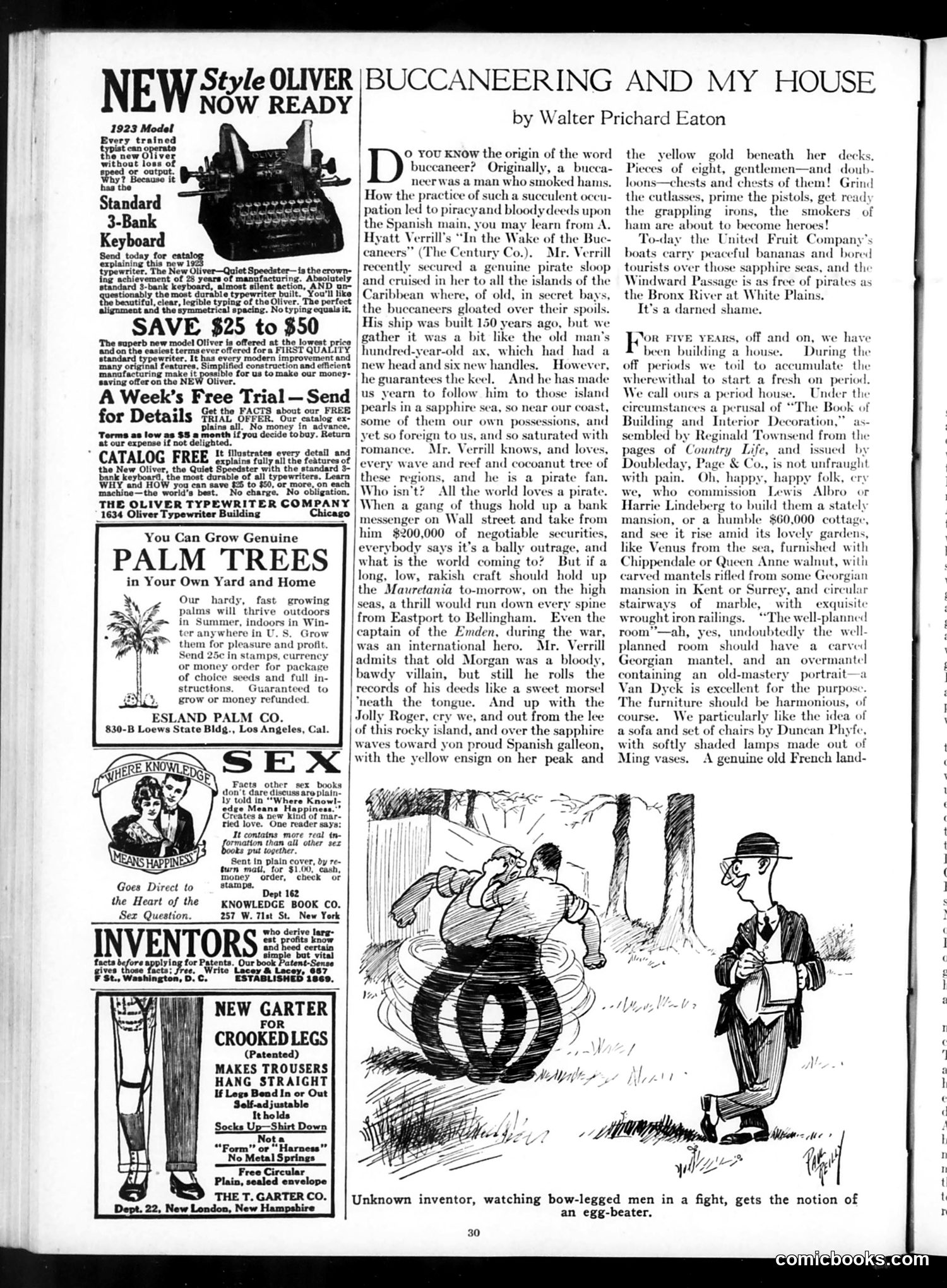
This page from Judge magazine (circa 1923) contains primarily **advertisements** rather than political cartoons requiring historical context. The single cartoon shows an **unknown inventor** observing two bow-legged men fighting over what appears to be an egg-shaped object. The caption reads: "Unknown inventor, watching bow-legged men in a fight, gets the notion of an egg-beater." This is a **visual pun**—the circular motion of fighting bow-legged men resembles an egg-beater's rotating motion, inspiring the fictional invention. It's a simple, observational humor piece with no political message. The page's main content is advertising: typewriters, palm trees, sex education books, patent services, and a garter for crooked legs. The editorial article about buccaneers and pirate ships appears to be period entertainment content promoting a book by A. Hyatt Verrill. For modern readers: this reflects 1920s consumer culture and product marketing typical of satirical magazines of that era.
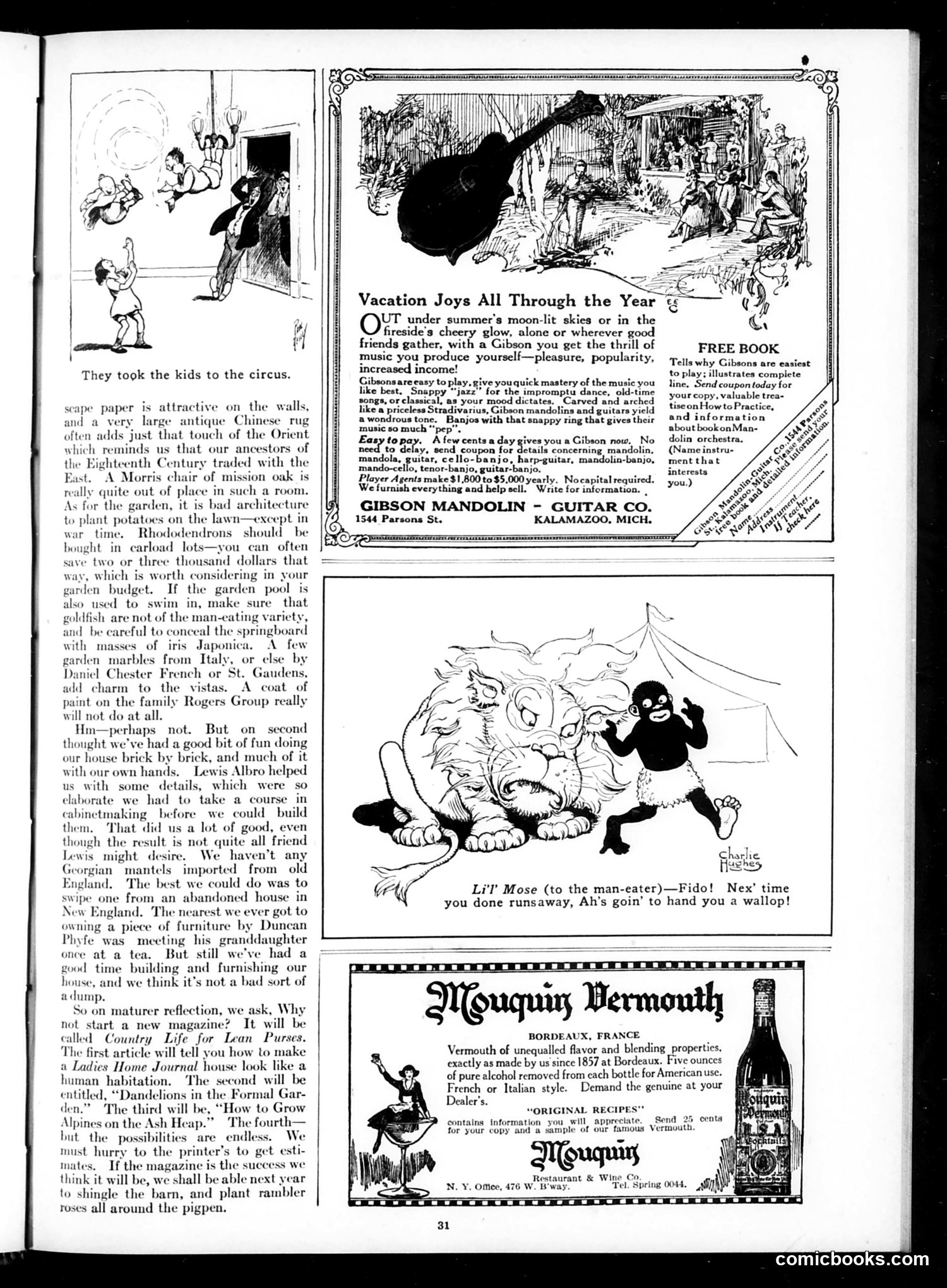
This page contains primarily **advertising and light domestic humor** rather than political satire. The main cartoon depicts a confrontation between a Black child ("Li'l Mose") and a large dog that has apparently eaten a man. The child threatens the dog with punishment ("gonna hand you a wallop"). This reflects early 20th-century minstrelsy conventions in American humor—the dialect and caricature are characteristic of the era's offensive racial stereotyping. The bulk of the page consists of **advertisements**: Gibson musical instruments (mandolins, guitars, banjos) and Marquin Vermouth wine. The text column discusses home decoration and furnishing on a budget, proposing a hypothetical magazine called "Country Life for Lean Purses" with tongue-in-cheek article titles like "Dandelions in the Formal Garden" and "How to Grow Alpines on the Ash Heap"—gentle satire of home-and-garden magazine pretension. The page is primarily **commercial content** with minor domestic humor rather than political commentary.
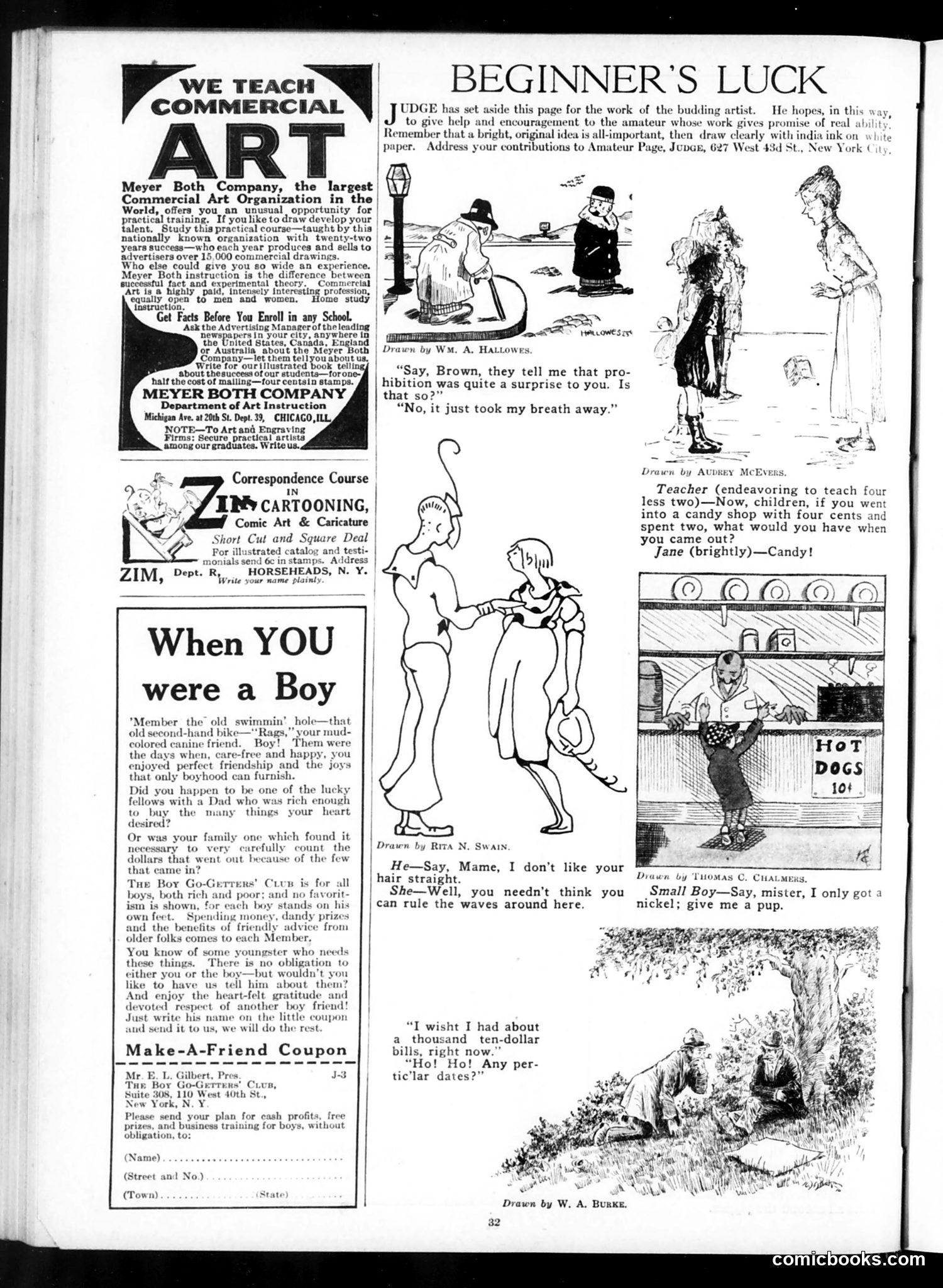
This page combines instructional advertising with humorous cartoons satirizing Prohibition and everyday life. **Main Cartoons:** The top cartoon by Hallowes depicts two men discussing Prohibition's surprise impact—one says it "just took my breath away," mocking how dramatically the alcohol ban affected people (likely heavy drinkers). A teacher-student exchange mocks literalism: when asked what remains after spending two cents of four, a child answers "Candy!"—the practical joke over arithmetic. Other cartoons show domestic comedy: a man complaining about his wife's straight hair, a boy trying to trade his nickel for a puppy, and someone wishing for thousand-dollar bills. **Context:** The page is primarily **advertisements for commercial art training** (Meyer Both Company, Zim Cartooning Course) mixed with light humor. The Prohibition cartoon references the 18th Amendment (1920), recently enacted. Overall, this reflects Judge's mix of satire, practical instruction, and genteel humor targeting middle-class readers.
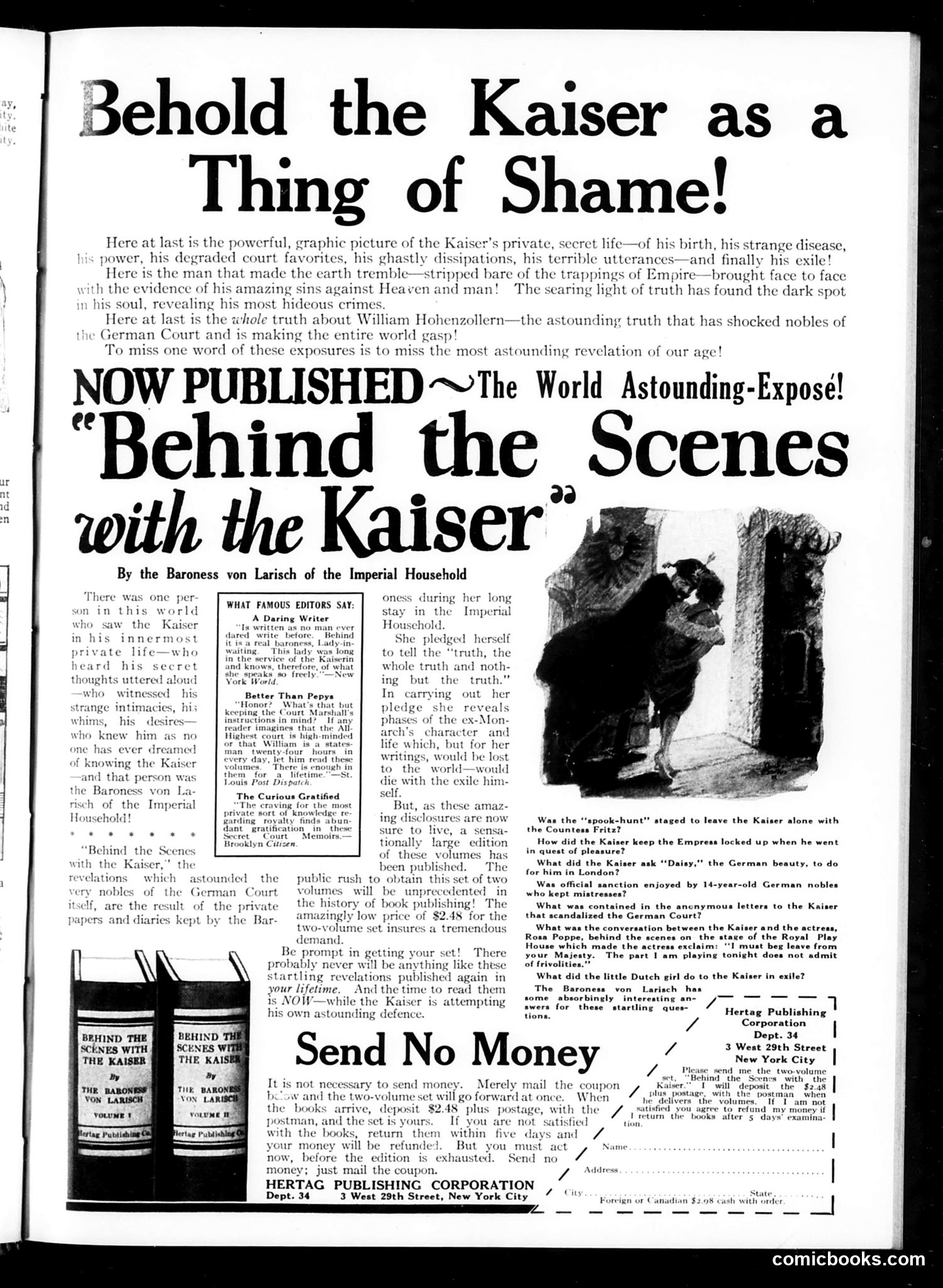
This page advertises a sensational two-volume book purporting to be exposé memoirs by "the Baroness von Larisch of the Imperial Household," claiming insider access to Kaiser Wilhelm II's private life, alleged diseases, sexual indiscretions, and "sins against Heaven and man." Published during or shortly after WWI, this is anti-German propaganda designed to discredit the German monarch by portraying him as morally corrupt, mentally unstable, and unfit to rule. The text promises scandalous "truth" about his character and conduct—locked-up empress, mistresses, anonymous incriminating letters, exile. The advertising copy uses hyperbole ("most astounding revelation of our age") to exploit wartime anti-Kaiser sentiment. This reflects how WWI combatants weaponized sensationalized character attacks against enemy leaders to justify the conflict and mobilize public support.
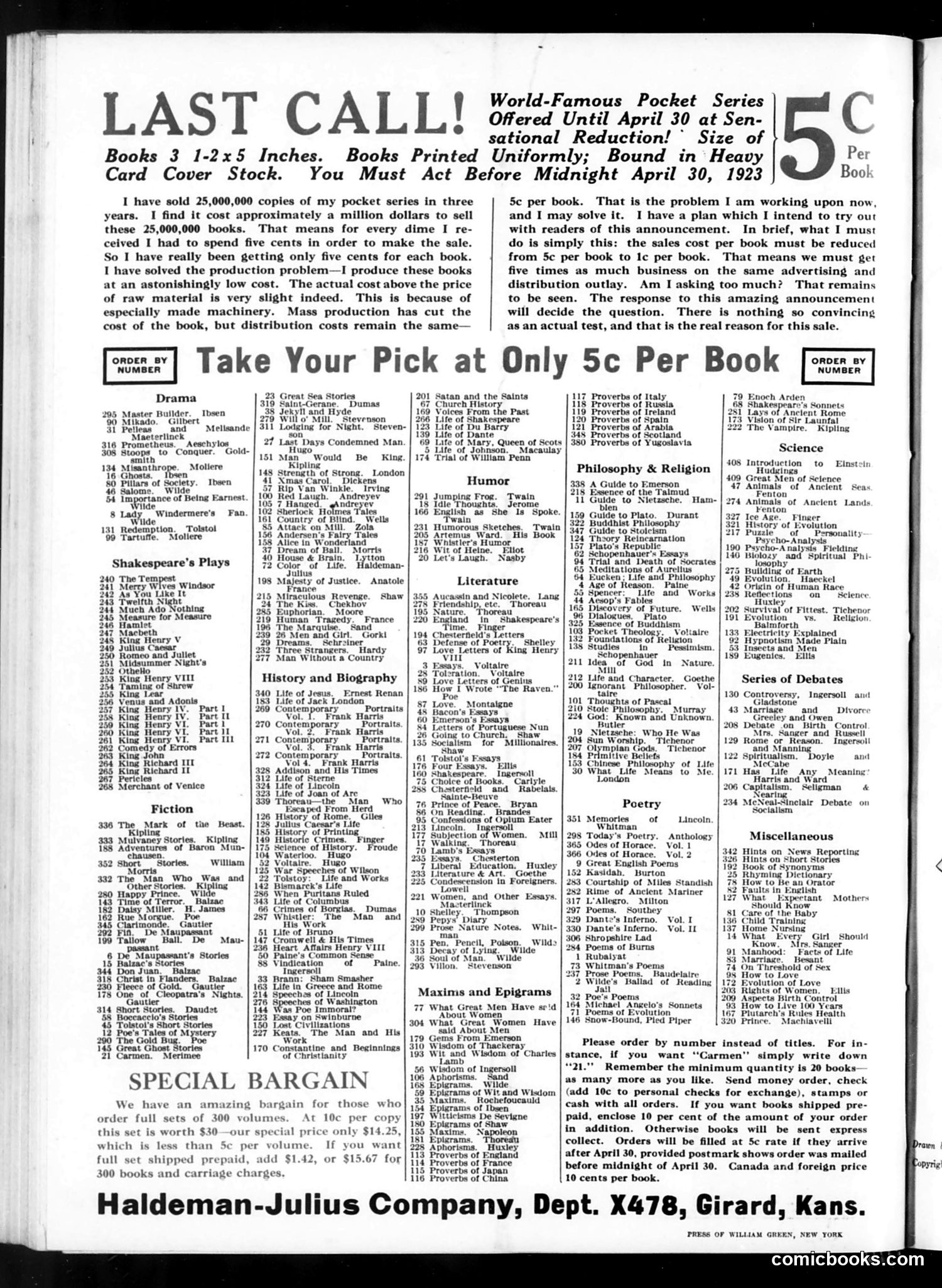
This page is primarily **advertising and product catalog**, not political satire or editorial cartoon content. It represents a "World-Famous Pocket Series" book offer from the Haldeman-Julius Company, a major early 20th-century publisher of affordable paperback classics. The "LAST CALL!" header announces a clearance sale: books originally sold at 5¢ per copy (hence "nickel libraries"), offered through April 30, 1923. The publisher explains his business model—massive distribution costs made the actual profit marginal despite low prices. The extensive catalog lists classic literature (Shakespeare, Dickens, Balzac), philosophy (Plato, Emerson, Nietzsche), history, poetry, and humor. A "Special Bargain" advertises 300-volume sets at under 5¢ per book. **No political commentary or satire is visible on this page**—it's purely commercial, reflecting the early-20th-century democratization of literature through mass-production and affordable pricing.