
Judge, 1923-04-21 · page 11 of 36
Judge — April 21, 1923 — page 11: what you’re looking at
What you’re looking at
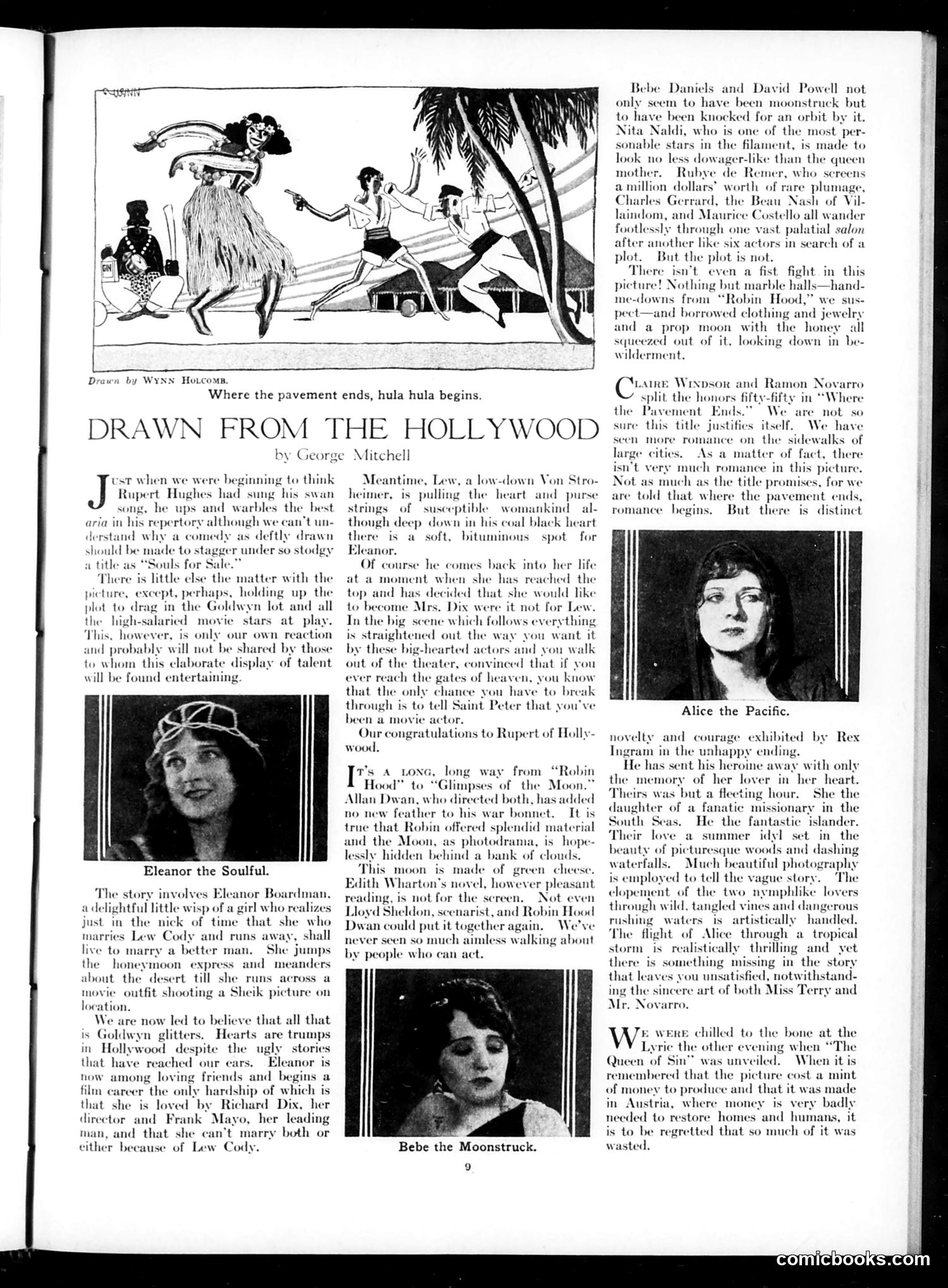
This page reviews several 1920s Hollywood films in George Mitchell's "Drawn from the Hollywood" column. The top cartoon satirizes the artificiality of studio filmmaking: titled "Where the pavement ends, hula hula begins," it depicts actors in a tropical scene surrounded by obvious props—borrowed jewelry, a fake moon, and set pieces from "Robin Hood"—mocking the gap between cinematic illusion and cheap stage construction. The reviews themselves critique recent releases for prioritizing star power and elaborate sets over coherent plots. Mitchell particularly dismisses "Glimpses of the Moon" (adapted from Edith Wharton) as aimless and "Bebe the Moonstruck" as plotless, despite featuring notable actors like Bebe Daniels and Nita Naldi. The satire targets Hollywood's tendency to showcase expensive production values and contract stars while neglecting storytelling fundamentals.
📄 Transcribed text from this page (OCR, searchable)
Machine-transcribed from the original scan — historical spelling and the odd misread are preserved.
awn by WYNN Hotcome. Where the pavement ends, hula hula begins. DRAWN FROM THE HOLLYWOOD by George Mitchell ust when we were beginning to think J Rupert Hughes had sung his swan song, he ups and warbles the best aria in his repertory although we can’t un- derstand why a comedy as deftly drawn should be made to st under so stodgy a title as vuls for There is little else the matter with the picture, except, perhaps, holding up the plot to drag in the Goldwyn lot and all the high-salaried mo’ This. however, is only our own reaction and probably will not be shared by those to whom this elaborate display of talent will be found entertaining Eleanor the Soulful. The story involves Eleanor Boardman, a delightful little wisp of a girl who realizes just in the nick of time that she who marries Lew Cody and runs away, shall live to marry a better man. She jumps the honeymoon express and meanders about the desert till she runs across a movie outfit shooting a Sheik picture on location. We are now led to believe that all that is Goldwyn glitters. Hearts are trumps in Hollywood despite tl stories that have reached our ears. E i now among loving friends and_ be film career the only hardship of which is that she is loved by Richard Dix, her director and Frank’ Mayo, her leading man, and that she can’t marry both or either because of Lew Cody. Meantime, Lew, a low-down Von Stro- heimer, is pulling the heart and purse strings of susceptible womankind —al- though deep down in his coal black heart there is a soft, bituminous spot for Eleanor. OF course he comes back into her life at a moment when she has reached the top and has decided that she would like to become Mrs. Dix were it not for Lew. In the big scene which follows everything is straightened out the way you want it by these big-hearted actors and you walk out of the theater, convinced that if you ever reach the s of heaven, you know that the onl ance you have to break through is to tell Saint Peter that you've been a movi wr. Our congratulations to Rupert of Holly- wood. T's A LonG, long way from “Robin Hood” to “Glimpses of the Moon.” Allan Dwan, who directed both, has added no new feather to his war bonnet true that Robin offered splendid ma | and the Moon, as photodrama, is hope- lessly hidden behind a bank of clouds. This moon is made of green cheese. Edith Wharton's novel, however pleasant reading, is not for the screen, Not even Lloyd Sheldon, scenarist, and Robin Hood Dwan could put it together again. | We've never seen so much aimless walking about by people who can act. Bebe the Moonstruck. 9 Bebe Daniels and David Powell not only scem to have been moonstruck but to have been knocked for an orbit by it. Nita Naldi, who is one of the most per- sonable stars in the filament, is made to look no less dowager-like than the queen moth Rubye de Remer, who. screens amillion dollars’ worth of rare plumage, les Gerrard, the Beau Nash of Vil- laindom, and Maurice Costello all wander footlessly through one vast palatial salon after another like six actors in search of a plot. But the plot is not. There isn’t even a fist fight in this picture! Nothing but marble halls—hand- me-downs from “Robin Hood,” we sus- pect—and borrowed clothing and jewelry and prop moon with the honey all squeezed out of it, looking down in be- wilderment. Cum Wrxpsor and Ramon Novarro split the honors fifty-fifty in “Where the Pavement Is." We are not so sure this title justifies itself. We have seen more romance on the sidewalks of large cities. As a matter of fact, there isn’t very much romance in this picture. Not as much as the title promises, for we are told that where the pavement ends, romance begins. But there is distinct Alice the Pacific. novelty and courage exhibited by Rex Ingram in the unhappy ending He has sent his heroine away with only the memory of her lover in’ her heart. Theirs was but a fleeting hour. She the daughter of a fanatic missionary in the He the fantastic islander. Their a summer idyl set in the beauty of picturesque woods and dashing waterfalls. Much beautiful photography is employed to tell the vague story. The clopement of the two nymphlike | through wild, tangled vines and dang rushing waters is artist iy andlec The flight of Alice through a_ trop’ storm is realistically thrilling and yet there is something missing in the story that leaves you unsatisfied, notwithstand- ing the sincere art of both Miss Terry and Mr. Novarro. FE Were chilled to the bone at the Lyric the other evening when “The Queen of Sin” was unveiled. When it is remembered that the picture cost a mint of money to produce and that it was made in Austria, where money is very badly needed to restore homes and humans, it is to be regretted that so much of it was wasted,