
Judge, 1923-04-21 · page 3 of 36
Judge — April 21, 1923 — page 3: what you’re looking at
What you’re looking at
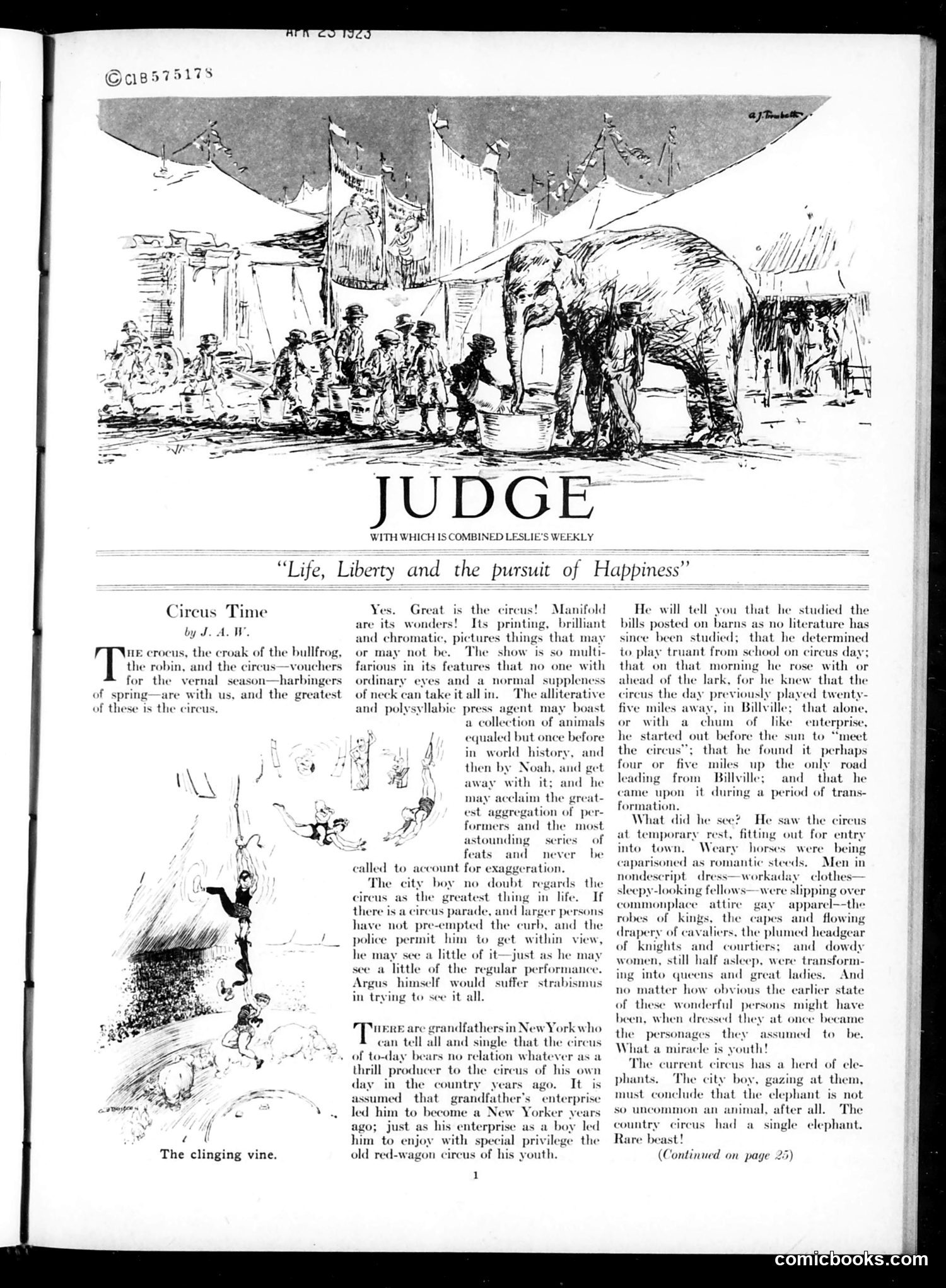
This page celebrates circus entertainment as American cultural spectacle. The main illustration shows a circus elephant and crowd, introducing an article titled "Circus Time" that treats the circus as quintessentially American—a democratic entertainment where diverse social classes gather. The text humorously references a New York grandfather who brought circus excitement to his family generations ago, establishing a tradition of circus patronage. The article celebrates how circuses transform ordinary people into wondrous sights (acrobats, performers), suggesting the circus democratizes spectacle and wonder. The smaller illustration labeled "The clinging vine" depicts an acrobat or circus performer, complementing the celebration of circus artistry and skill. Overall, this isn't political satire but rather lighthearted cultural commentary praising the circus as American leisure and aspiration.
📄 Transcribed text from this page (OCR, searchable)
Machine-transcribed from the original scan — historical spelling and the odd misread are preserved.
“Life, Liberty and the pursuit of Happiness” Circus Time by JAW. ie crocus, the croak of the bullfrog, the robin, and the circus—vouchers for the ‘vernal, season—harbingers of spring—are with us, and the greatest of these is the circus. The clinging vine. » of t WITH WHICH IS COMBINED LESLIE'S WEEKLY Yes. Great is the circus! Manifold are its wonders! Its printing, brilliant and chromatic, pictures things that may or may not be. The show is so multi- farious in its features that no one with ordinary eyes and a normal suppleness of neck eitallin. The alliterative ic press agent may | a collection of ani equaled but once before in world history, ation of per- formers and the most astounding — series of feats and never be called to account for ex: ation. The city boy no doubt regards the circus test thing in life. there is a circus parade, and larger p ve not pre-empted the curb, and the permit him to get within view, >a little of it—just as he may see a little of the regular performance. Argus himself would suffer strabismus in trying to see it all. dfathersin NewYork who nd single that the cireus y bears no relation whatever as a thrill producer to the cireus of his own day in the country years ago. It is assumed that grandfather's enterprise led him to become a New Yorker years ago; just as his enterprise as a boy led him to enjoy with special privilege the old red-wagon circus of his youth. 1 He will tell you that he studied the bills posted on barns as no literature has since been studied; that he determined io play truant from school on circus day; that on that morning he rose with or ahead of the lark, for he knew that the circus the day previously played twenty- five miles away, in Billville; that alone, or with a chum of like enterprise, he started out before the sun to “meet the circus”; that he found it perhaps four or five miles up the only road leading from Billville; and that he came upon it during a period of trans- He saw the circus fitting out for entry were being at did he see? at temporary rest, into town. Weary caparisoned as romantic steeds. Men in nondescript. dress—workaday clothes sleepy-looking fellows—were slipping over attire gay apparel—-the apes and. flowing rs. the plumed headgear horses commonplace robes of kit of knights women, still ing into queens a no matter how obvious the earlier state of these wonderful persons might have been, when dressed they at once became the personages they What a miracle is youth! The current cireus a herd of ele- phants. The city boy, gazing at them, must conclude that the clephant is not so uncommon an animal, after all. The country circus had a single elephant. Rare beast! (Continued on page 25) assumed to be,