
Judge, 1923-04-21 · page 15 of 36
Judge — April 21, 1923 — page 15: what you’re looking at
What you’re looking at
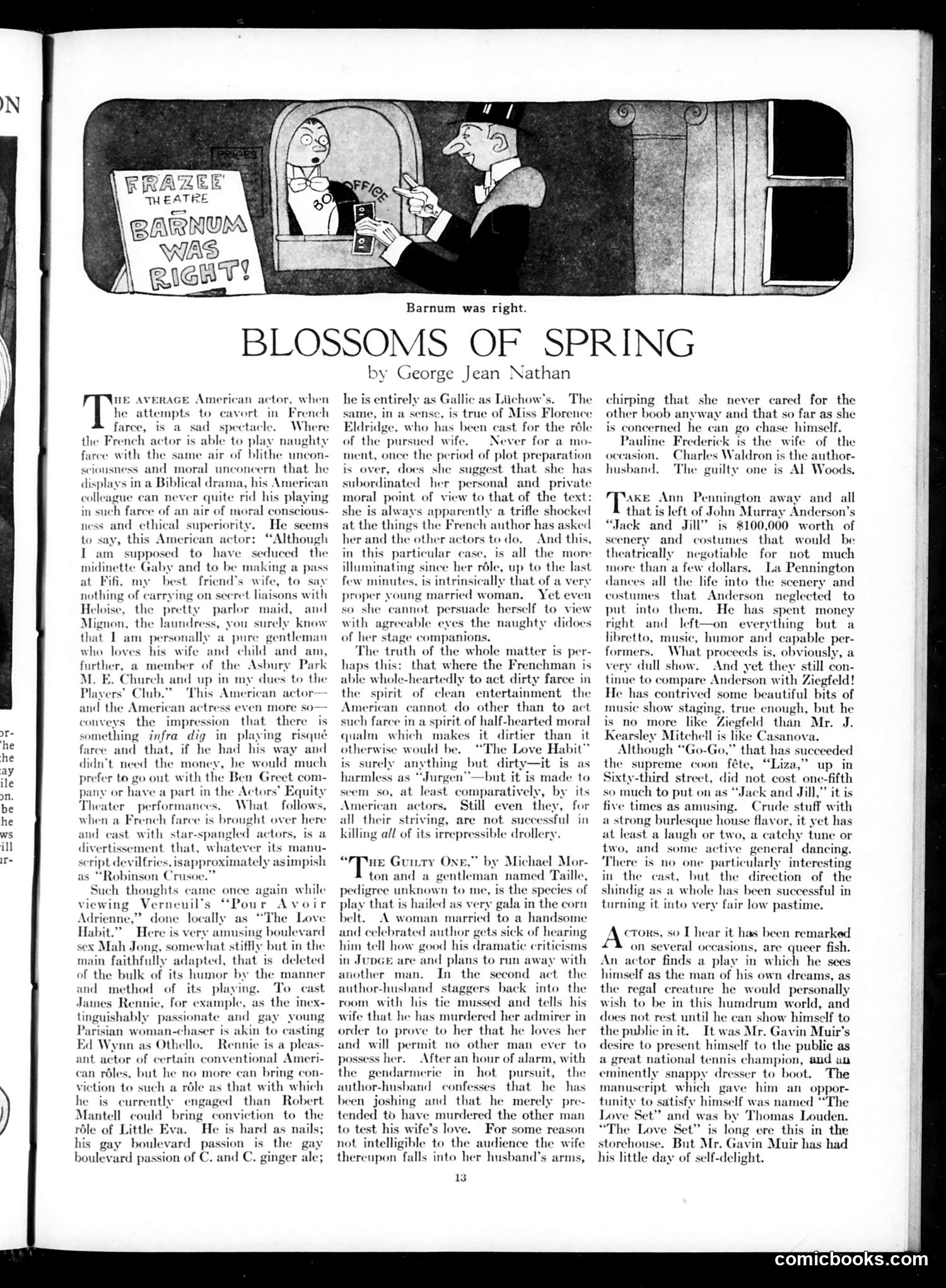
The cartoon depicts a theater box office scene where a woman (likely representing a theatrical producer or manager) sits at a ticket window while a man in formal dress gestures enthusiastically outside. The sign reads "FRAZEE THEATRE" and "BARNUM WAS RIGHT!" This references P.T. Barnum's famous dictum that "there's a sucker born every minute"—a cynical observation about audiences' gullibility. The cartoon suggests that theater management relies on exploiting public taste rather than artistic merit. The accompanying article by George Jean Nathan critiques American actors attempting French farce comedies. Nathan argues that American performers bring excessive moral consciousness and prudishness to risqué material, undermining the entertainment value. He contrasts this with French actors who perform such farces with unaffected ease. The cartoon thus humorously validates Nathan's point: theater succeeds through audience manipulation rather than artistic excellence—hence "Barnum was right."
📄 Transcribed text from this page (OCR, searchable)
Machine-transcribed from the original scan — historical spelling and the odd misread are preserved.
THEATRE Barnum was right. BLOSSOMS OF SPRING HE AVERAGE American actor, when he attempts to cavort in’ French farce, is a sad spectacle. Where the French actor is able to play naughty farce with the same air of blithe uncon- sciousness and moral unconcern that he displays in a Biblical drama, his American colleague can never quite rid his playing in such farce of an air of moral conscious- ness and ethical superiority. He seems this American actor: “Although supposed to have seduced the midinette Gaby and to be making a pass at Fifi, my t friend's wife, nothing of carrying on secret liaisons with Heloise, the pretty parlor maid, and Mignon, the laundress, you surely know that I am personally a pure gentleman who loves his wife and child and am, further, a member of the Asbury Park M. E. Church dup in my dues to the Players’ Club.” This American actor and the American actress even more so— conv the impression that there is something infra dig in playing risqué farce and that, if he had his way and didn’t need the money, he would much prefer to go out with the Ben Greet com- pany or have a part in the Actors’ Equity Theater performances. What follows, when a French fa is brought over here and cast with star-spangled actors, is a divertissement that, whatever its manu- script devilfries, isapproximately asimpish as “Robinson Crusoe Such thoughts came once again while viewing Verneuil’s “Pour Avoir Adrienne,” done locally as “The Love Habit.” Here is very amusing boulevard sex h Jong, somewhat stiffly but in the main faithfully adapted, that is deleted of the bulk of its humor by the manner and method of its playing. To. cast James Rennie, for example, as the inex- tinguishably passionate and gay young Parisian woman-chaser is akin to casting Ed Wynn as Othello. Rennie is a pleas- ant actor of certain conventional Ameri- can réles, but he no more can bring con- viction to such a role as that with which he is currently engaged than Robert Mantell could bring conviction to the réle of Little Eva. He is hard as nai his gay boulevard passion is the boulevard passion of C. and C, ginger al to say, I am to say by George Jean Nathan tirely as Gallic as Liichow’s. The is true of Miss Florence Eldric who has been cast for the réle of the pursued wife. Never for a mo- ment, once the period of plot preparation is over, suggest that. she has subordinated her personal and_ private point of view to that of the text she is always apparently a trifle shocked at the things the French author has asked her and the other actors to do, And this, in this particular case, is all the more illuminating since her réle, up to the last few minutes, is intrinsically that of a very proper young married woman. Yet even so she cannot persuade herself to view with agreeable eyes the naughty didoes of her stage companions. The truth of the whole matter is per- haps this: that where the Frenchman is able whole-heartedly to act dirty farce in the spirit of clean entertainment the Ameri cannot do other than to act such farce in a spirit of half-hearted moral qualm which makes it dirtier than it otherwise would be. “The Love Habit” is surely anything but dirty—it is as harmless urgen’’—but it is made to scem so, at least comparatively, by its American actors. Still even they, for all their striving, are not successful in killing all of its irrepressible drollery. he is sam does she mor: HE Guitty One,” by Michael Mor- ton and a gentleman named Taille, pedigree unknown to me, is the species of play that is hailed as very gala in the corn belt. A woman married to a handsome and celebrated author gets sick of hearing him tell how good his dramatic criticisms in JupGe are and plans to run away with another man. In the second act the author-husband staggers back into the room with his tie mussed and tells his wife that he has murdered her admirer in order to prove to her that he loves her and will permit no other man ever to possess her. After an hour of alarm, with the gendarmerie in hot pursuit, the author-husband confesses that he has been joshing and that he merely pre- tended to have murdered the other man to test his wife’s love. For some reason not intelligible to the audience the wife thereupon falls into her husband’s arms, 13 chirping that she never cared for the other boob anyway and that so far as she is concerned he can go chase himself. Pauline Frederick is the wife of the occasion. Charles Waldron is the author- husband. The guilty one is Al Woods. AKE Ann Pennington a y and all that is left of John Murray Anderson’s k and Jill” is $100,000 worth of scenery and costumes that would be theatrically negotiable for not much more t a few dollars. La Pennington dances the life into the scenery and costumes that Anderson neglected to put into them. He has spent money right and left—on everything but a libretto, music, humor and capable per- formers. What proceeds is, obviously, a very dull show. And yet they still con- tinue to compare Anderson with Ziegfeld! He has contrived some beautiful bits of music show staging, true enough, but he is no more like Ziegfeld than Mr. J. Kearsley Mitchell is like Casanova. Although “Go-Go,” that has succeeded supreme coon féte, “Liza,” up in Sixty-third street, did not cost one-fifth so much to put on as “Jack and Jill,” it is five times as amusing. Crude stuff with a strong burlesque house flavor, it yet has at least a laugh or two. atchy tune or two, and some ive general dancing. There is no one particularly interesting in the cast, but the direction of the shindig as a whole has been successful in turning it into very fair low pastime. ATO so I hear it has been remarked on several occasions, are queer fish. An actor finds a play in which he sees himself as the man of his own dreams, as the regal creature he would personally wish to be in this humdrum world, and does not rest until he show himself to the public in it. It was Mr. Gavin Muir’s desire to present himself to the public as a great national tennis champion, and ua eminently snappy dresser to boot. The manuscript which gave him an oppor- tunity to satisfy himself was named “The Love Set” and was by Thomas Louden. “The Love Set” is long ere this in the storehouse. But Mr. Gavin Muir has had his little day of self-delight. comicbooks.com