
Judge, 1923-04-21 · page 13 of 36
Judge — April 21, 1923 — page 13: what you’re looking at
What you’re looking at
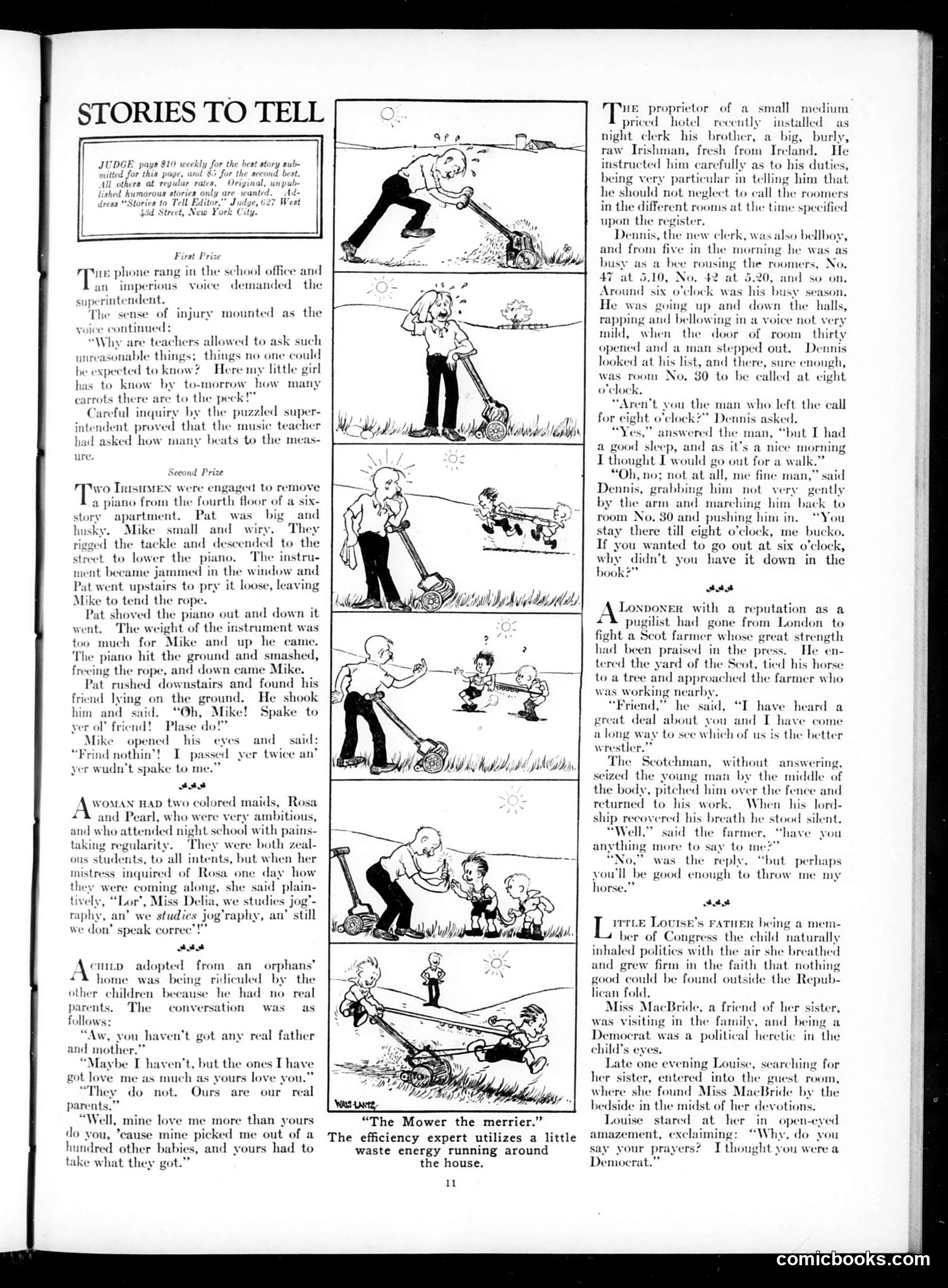
This page contains several humorous short stories illustrating everyday absurdities and class/ethnic humor typical of early 20th-century American satire: **"First Prize"** mocks parental obtuseness: a mother complains that teachers ask "unreasonable" questions, confusing musical terminology (beats per measure) with literal measurements of carrots. **"Second Prize"** depicts Irish laborers removing a piano; through miscommunication, one man gets lifted by the falling piano—slapstick humor playing on working-class incompetence. **The maids' story** uses dialect humor (common to the era) showing African American domestic workers studying geography but unable to master "correct" speech. **The orphan anecdote** sentimentally inverts class assumptions: the adopted child claims superiority because he was "chosen," while biological children were mere chance. The page's final story introduces an Irish hotel clerk character (stereotyped as brusque, thick-accented) forcing a guest to stay in his room per the booking. These stories reflect period stereotypes about immigrants, African Americans, and working-class people, presented as humor for Judge's educated, middle-class readership.
📄 Transcribed text from this page (OCR, searchable)
Machine-transcribed from the original scan — historical spelling and the odd misread are preserved.
STORIES TO TELL TPue phone rang in the school office and imperious voice demanded the rintendent. The sense of injury mounted as the voice continued: “Why are teachers allowed to ask such things no one could Here my little girl how many unreasonable things; be expected to know? has to know by to-morrow carrots there are to the peck!” Careful inquiry by the puzzled super- intendent proved that the music teacher had asked how many beats to the meas- ure. Second Prize 6 Dak TrisiMen were engaged to remove 1 piano from the fourth floor of a six- apartment. Pat was | Mike small and wiry. They ig: the tackle and descended to the street. to lower the piano. The instru- ment became jammed in the window and Pat went upstairs to pry it loose, leaving Mike to tend the rope. Pat shoved the piano out and down it went. The weight of the instrument was too much for “Mike and up he came. The piano hit the ground and smashed, freeing the rope, and down came Mike. at rushed downstairs and found his friend lying on the ground. He shook him and said. “Oh, Mike! Spake to Plase do!” ds his and said: I passed yer twice an’ story husky. rind nothin yer wudn’t spake to m as A woutan HAD two colored maids, Rosa 2% and Pearl, who were very ambitious, and who attended night school with pains- taking regularity. They were both z ous students, to all intents, but when her mistress inquired of Rosa one day how they were coming along, she said’ plain- tively, “Lor’, Miss Delia, we studies jog’- raphy, an’ we studies jog’raphy, an’ still we don’ speak corree’!” ste from an orphans’ ridiculed by the had no real was as cuiLp adopted home was being other children because he parents. The — conversation follows: “Aw, you haven't got any real father and me “Maybe fi haven't, but the ones Th got love me as much as yours love you hey do not. Ours are our real parents.” “Well, mine love me more than yours do you, ’cause mine picked me out of a hundred other babies, and yours had to take what they got. “The Mower the merrier.” The efficiency expert utilizes a little waste energy running around the house. 11 TT He proprietor of a small medium priced hotel recently installed as night clerk his brother, a big, burly, raw Irishman, fresh from Ireland. He instructed him carefully as to his duti being very par ar in telling him that he should not neglect to call the roomers in the different rooms at the time specified upon the register. Dennis, the new clerk, was also bellboy, and from five in the morning he was as busy as a bee rousing the roome: 47 at 5.10, No. 42 at 5.20, and so on. Around six o'clock was his busy season, He was going up and down the halls, rapping and bellowing in a voice not very mild, when the door of room thirty opened and a man stepped out. Dennis looked at his list, and there, sure enough, was room No. 30 to be called at eight o'clock, “Aren't you the man who left the call * Dennis asked. “el the man, “but T had a good sleep, and as it’s a nice morning I thought I would go out for a walk “Oh, no; not at all, me fine man,” said Dennis, grabbing him not very gently by the arm and marching him’ back to room No. 30 and pushing him in. “You stay there till eight o'clock, me bucko. If you wanted to go out at six o'clock, y didn’t you have it down in the sae A losvonze with a reputation as a pugilist had gone from London. to fight a Scot farmer whose great strength had been praised in the press. He en- tered the yard of the Scot, tied his horse and approached the farmer who “Friend,” aid, “I have heard a great de: about, you 1 and I have come a long way to see Which of us is the better wrestler. The Scotchman, without answering, seized the young man by the middle of the body, pitched him over the fence and returned to his work. When his lord- ship recovered his breath he stood silent, “W said the farmer, “have you anything more to say to me 0,” was the reply, “but perhaps you'll be good enough to throw me my horse.” Prd ITTLE Louise's FATHER being a mem- ber of Congress the child naturally inhaled polities with the air she breathed and grew firm in the faith that nothing good could be found outside the Repub- lican fold. Miss MacBride, a friend of her sister, was visiting in the family, and being a Democrat was a political heretic in the child’s eyes Late one evening Louise, searching for her sister, entered into the guest. room, where she found Miss MacBride by the bedside in the midst of her devotions. Louise stared at her in open-eyed amazement iming: “Why, do you say your prayers? I thought you were a Democrat.” comicbooks.com