
Judge, 1923-04-21 · page 12 of 36
Judge — April 21, 1923 — page 12: what you’re looking at
What you’re looking at
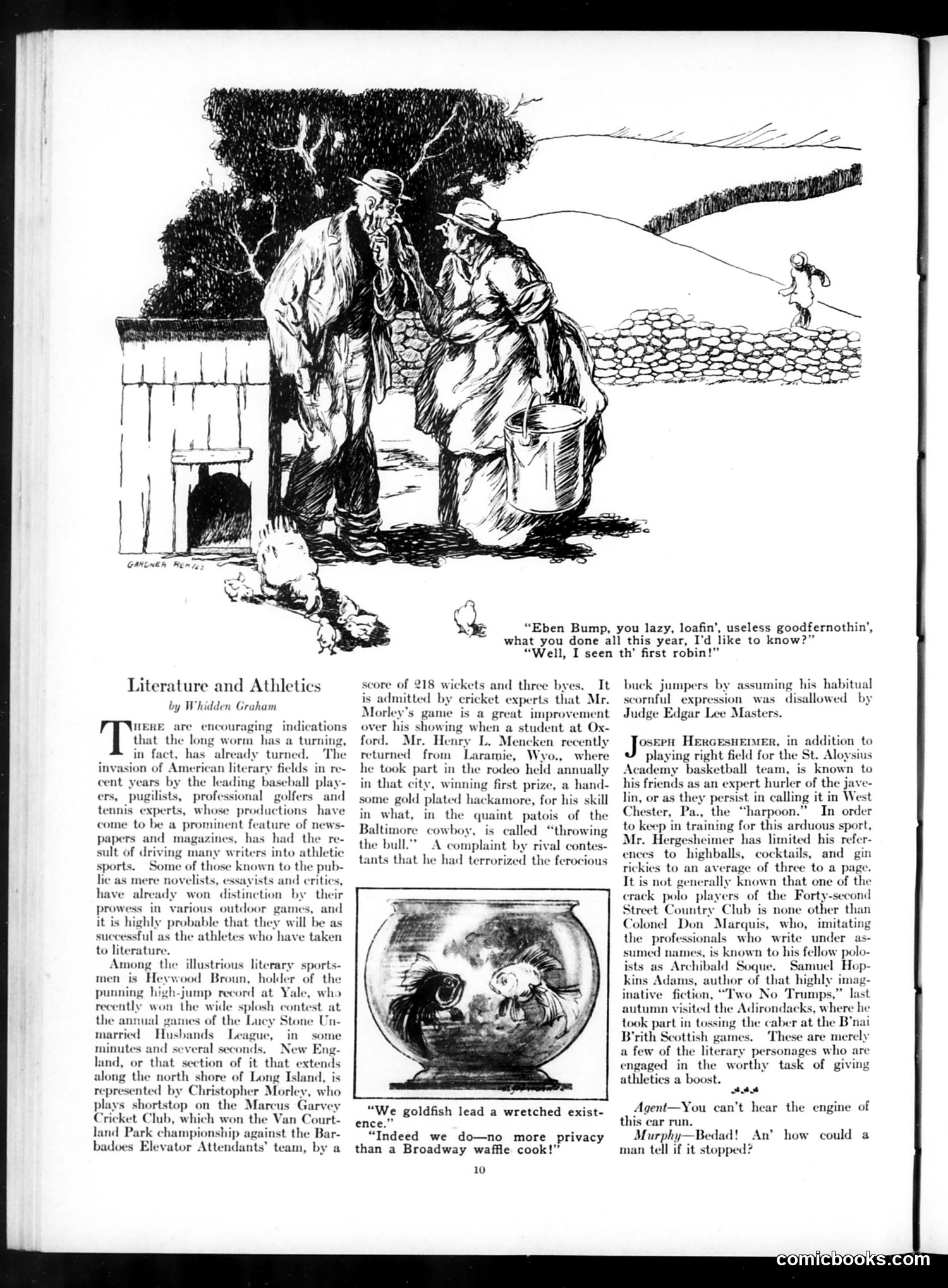
This is satirical commentary on a trend of American literary figures engaging in athletics. The article humorously claims famous writers—Heywood Broun, Christopher Morley, H.L. Mencken, Joseph Hergesheimer, and Don Marquis—are achieving athletic accomplishments, often with absurdly inflated or nonsensical details (winning at "throwing the bull," limiting cocktails "to an average of three to a page"). The satire mocks both the writers' ventures into sports and the sensationalist sports journalism reporting them. The accompanying cartoons are separate jokes: the top shows a rural scene where a lazy man claims his achievement is seeing the first robin; the lower cartoon jokes about goldfish lacking privacy in a Broadway waffle establishment. The piece reflects early-20th-century American culture where literary celebrities crossing into sports was apparently newsworthy enough to parody.
📄 Transcribed text from this page (OCR, searchable)
Machine-transcribed from the original scan — historical spelling and the odd misread are preserved.
Literature and Athletics by Whidden Graham are encouraging indications the long worm has a turning, ‘act, he ly turned. The invasion of American literary fields in re- cent years by the leading baseball play- ers, pugilists, professional golfers and tennis experts, whose productions have come to be a prominent feature of news- papers and magazines, has had the re- sult of driving many writers into athletic sports, Some of those known to the pub- ovelists, essayists and critics, have already won distinction by their prowess in various outdoor games, and it is highly probable that they will be as essful as the athletes who have taken to literature. Among the illustrious literary sports- men is Heywood Broun, holder of the punning high-jump record at Yale, who recently won the wide splosh contes the annual games of the Lu Stone Un- married Husbands ,» in some minutes and seve New Eng- land, or that section of it that extends along the north shore of Long Island, is represented by Christopher Morley, who shortstop on the Marcus Ga et Club, which won the Van Court- land Park championship against the Bar- badoes Elevator Attendants’ team, by a “Eben Bump, you lazy, loafin’, useless goodfernothin’, what you done all this year, I'd like to know?” “Well, I seen th’ first robin!” core of 218 wickets and three byes. It is admitted by cricket experts that Mr. Morley’s game is a great improvement over his showing when a student at Ox- ford. Mr. Henry L. Mencken recently returned from Laramie, Wyo., where he took part in the rodeo held annually in that city, winning first prize, a hand- some gold plated hackamore, for his skill in what, in the quaint patois of the Baltimore cowboy, is called “throwing the bull.” A complaint by rival cont tants that he had terrorized the ferocious “We goldfish lead a wretched exist- ence. “Indeed we do—no more privacy than a Broadway waffle cook!” 10 buck jumpers by assuming his habitual scornful expression was disallowed by Judge Edgar Lee Masters. Jo HercesHerer, in addition to playing right field for the St. Aloysius Academy basketball team, is known to his friends as an expert hurler of the jave- lin, or as they persist in calling it in West Chester, the “harpoon.” In order to keep in training for this arduous sport, Mr. Hergesheimer has limited his refer- ences to highballs, cocktails, and gin ickies to an average of three to a page. It is not generally known that one of the crack polo players of the Forty-second Street Country Club is none other than Colonel Don Marquis, who, imitating the professionals who write under as- sumed names, is known to his fellow polo- as Archibald Soque. Samuel Hop- kins Ads author of that highly imag- inative Two No Trumps autumn visited the Adirondacks, where he took part in tossing the caber at the B'nai B'rith Scottish gam These are merely a few of the literary personages whe engaged in the worthy task of giv’ athletics a boost. ree Agent—You can’t hear the engine of this car run. Murphy—Bedad! man tell if it stopped? An’ could a how