
Judge, 1923-04-21 · page 21 of 36
Judge — April 21, 1923 — page 21: what you’re looking at
What you’re looking at
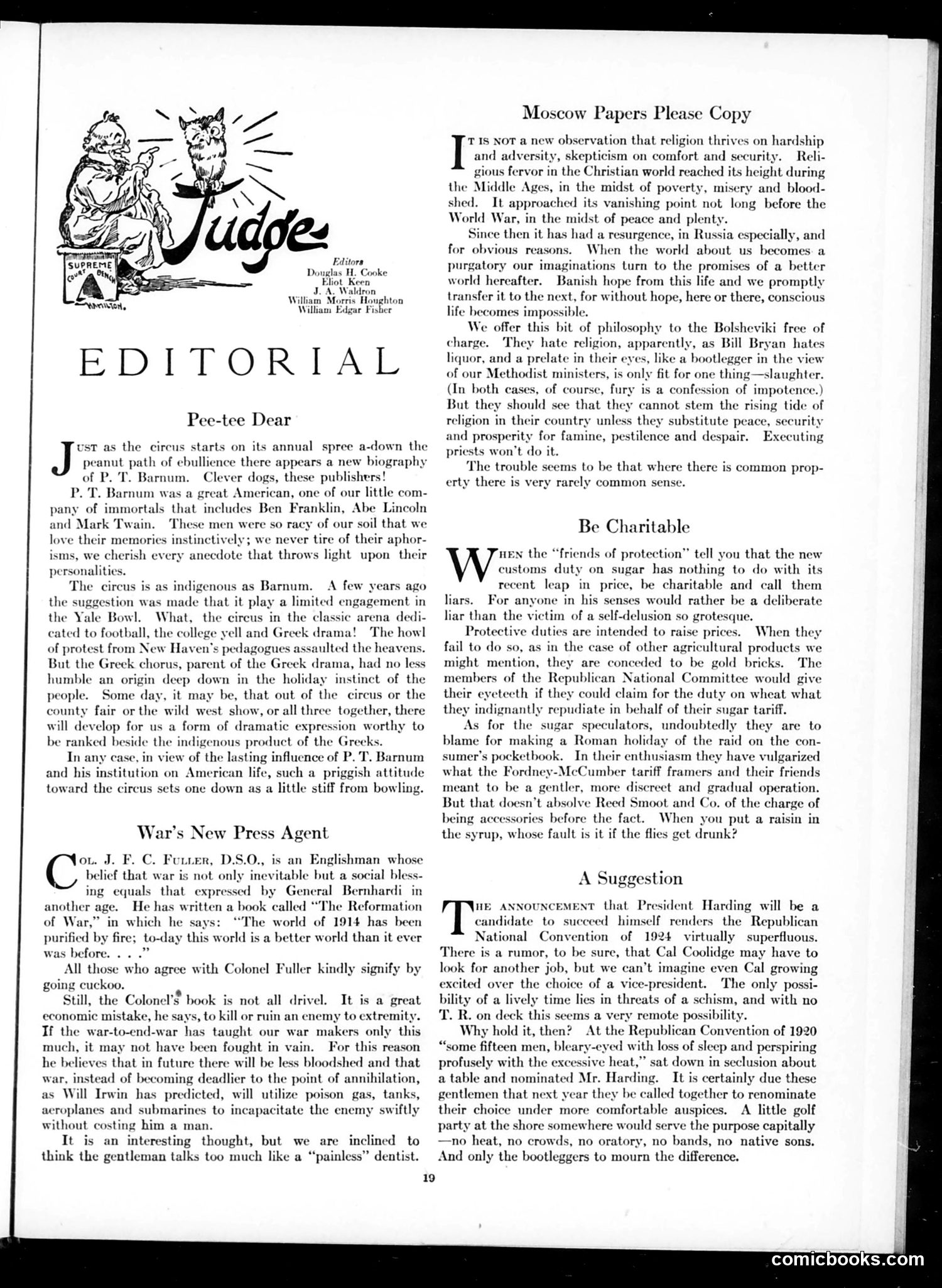
This editorial page contains three opinion pieces typical of Judge's satirical approach circa 1920s: **"Pee-tee Dear"** defends P.T. Barnum and the circus as legitimate American cultural institutions, arguing against Yale academics who protested a circus performance at the Yale Bowl. The editor argues the circus has indigenous American roots comparable to Greek drama. **"War's New Press Agent"** mocks Colonel J.F.C. Fuller, a British military theorist who argued WWI's devastation was justified and beneficial. The editor agrees with Fuller's observation that future wars should "incapacitate" enemies efficiently without massive casualties—but sarcastically suggests Fuller sounds like a "painless dentist," implying his optimism about "humane" warfare is naively delusional. **"Moscow Papers Please Copy"** argues that religion thrives during hardship and dies during prosperity, offering this observation to Soviet Bolsheviks who opposed religion. The editor suggests removing earthly hope pushes people toward religious faith. The page employs characteristic Judge irony: agreeing with arguments while mocking their advocates' naiveté.
📄 Transcribed text from this page (OCR, searchable)
Machine-transcribed from the original scan — historical spelling and the odd misread are preserved.
Editors Douglas H. Cooke Eliot Keen J. A. Waldron Houghton Fisher EDITORIAL Pee-tee Dear ust as the circus starts on its annual spree a-down the J peanut path of ebullience there appears a new biography of P. T. Barnum. Clever dogs, these publishers! P. T. Barnum was a great American, one of our little com- pany of immortals that includes Ben Franklin, Abe Lincoln and Mark Twain. These men were so racy of our soil that we love their memories instinctively; we never tire of their aphor- cherish every anecdote that throws light upon their isms, wi personalities. The circus is as indigenous as Barnum. A few the suggestion was made that it play a limited en the Yale Bowl. What, the circus in the classic arena dedi- cated to football, the college yell and Greek drama! The howl of protest from New Haven’s pedagogues assaulted the heavens. But the Greek chorus, parent of the Greek drama, had no less humble an origin deep down in the holiday instinct of the people. Some day, it may be, that out of the circus or the county fair or the wild west show, or all three together, there lop for us a form of dramatic expression worthy to be ranked beside the indigenous product of the Greeks. In any case, in view of the lasting influence of P. T. Barnum and his institution on American life, such a priggish attitude toward the circus sets one down as a little stiff from bowling. C anothe ars ago nt in will de War’s New Press Agent ou. J. F.C. Futter, D.S.O., is an Englishman whose belief that war is not only inevitable but a social bless- ing equals that expressed by General Bernhardi in ge. He has written a book called “The Reformation in which he say: “The world of 1914 has been purified by fire; to-day this world is a better world than it ever was before. . . All those who agree with Colonel Fuller kindly signify by going cuckoo. Still, the Colonel’? book is not all drivel. It is a great economic mistake, he says, to kill or ruin an enemy to extremity. If the war-to-end-war has taught our war makers only this much, it may not have been fought in vain. For this reason he believes that in future there will be less bloodshed and that war, instead of becoming deadlier to the point of annihilation, as Will Irwin has predicted, will utilize poison gas, tanks, aeroplanes and submarines to incapacitate the enemy swiftly without costing him a man. It is an interesting thought, but we are inclined to think the gentleman talks too much like a “painless” dentist. 19 Moscow Papers Please Copy T IS NoT a new observation that religion thrives on hardship and adversity, skepticism on comfort and security. Reli- gious fervor in the Christian world reached its height during the Middle Ages, in the midst of poverty, misery and blood- shed. It approached its vanishing point not long before the World War, in the midst of peace and plenty. Since then it has had a resurgence, in Russia especially, and for obvious reas When the world about us becomes: a purgatory our imaginations turn to the promises of a better world hereafter. Banish hope from this life and we promptly transfer it to the next, for without hope, here or there, conscious life becomes impossible. We offer this bit of philosophy to the Bolsheviki free of charge. They hate religion, apparently, as Bill Bryan hates liquor, and a prelate in their eyes, like a bootlegger in the v of our Methodist ministers, is only fit for one thing—slaughter. (In both cases, of course, fury is a confession of impotence.) But they should see that they cannot stem the rising tide of religion in their country unless they substitute peace, security and prosperity for famine, pestilence and despair. Executing priests won't do it. ‘The trouble ms to be that where there is common prop- erty there is very rarely common sense. I ons. Be Charitable =n the “friends of protection” tell you that the new customs duty on sugar has nothing to do with its recent leap in price, be charitable and call them liars. For anyone in his senses would rather be a deliberate liar than the victim of a self-delusion so grotesque. Protective duties are intended to raise prices. When they fail to do so, as in the case of other agricultural products we might mention, they are conceded to be gold bricks. The members of the Republican National Committee would give their eyeteeth if they could claim for the duty on wheat what they indignantly repudiate in behalf of their sugar tariff. As for the sugar speculators, undoubtedly they are to blame for making a Roman holiday of the raid on the con- sumer’s pocketbook. In their enthusiasm they have vulgarized what the Fordney-McCumber tariff framers and their friends meant to be a gentler, more discreet and gradual operation. But that doesn’t absolve Reed Smoot and Co. of the charge of When you put a raisin in flies get drunk? being accessories before the fact. the syrup, whose fault is it if th A Suggestion HE ANNOUNCEMENT that President Harding will be a ndidate to succeed himself renders the Republican National Convention of 1924 virtually superfluous. There is a rumor, to be sure, that Cal Coolidge may have to look for another job, but we can’t imagin n Cal growing excited over the choice of a vice-president. The only possi- bility of a lively time lies in threats of a schism, and with no 'T. R. on deck this seems a very remote possibility. Why hold it, then? At the Republican Convention of 1920 “some fifteen men, bleary-eyed with loss of sleep and perspiring profusely with the excessive heat,” sat down in seclusion about a table and nominated Mr. Harding. It is certainly due these gentlemen that next year they be called together to renominate their choice under more comfortable auspices. A little golf party at the shore somewhere would serve the purpose capitally —no heat, no crowds, no oratory, no bands, no native sons. And only the bootleggers to mourn the difference. T comicbooks.com