
A complete issue · 36 pages · 1923
Judge — February 17, 1923
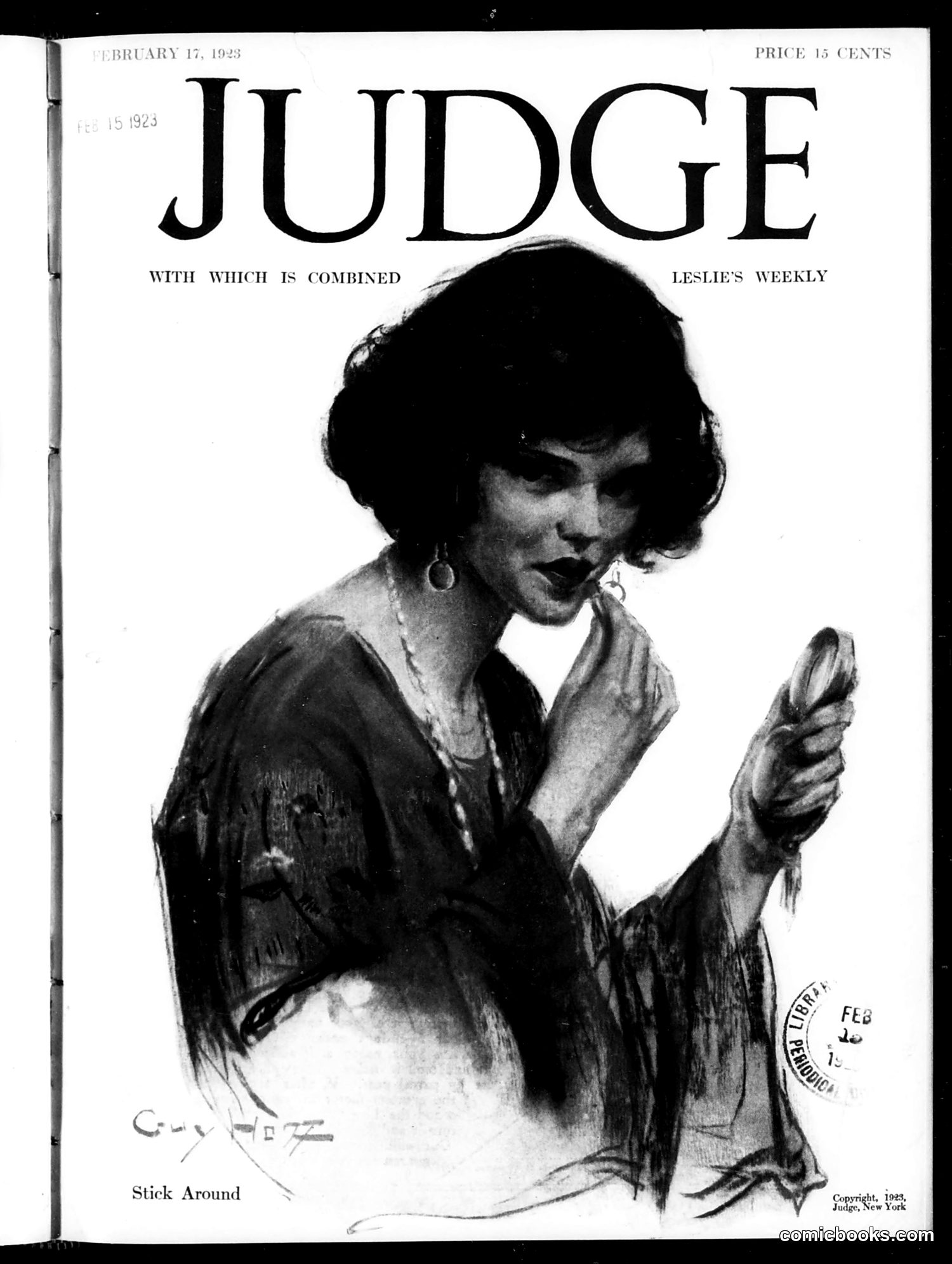
This is the cover of Judge magazine from February 17, 1923. The illustration shows a woman in 1920s attire (short bobbed hair, loose dress) examining what appears to be a stick or rod, with the caption "Stick Around" below. The image likely satirizes 1920s social concerns about changing women's roles and behavior during the Jazz Age. The woman's modern appearance—bobbed hair and relaxed clothing—represented the "flapper" aesthetic that conservative society viewed with alarm. The ambiguous object she's holding and the caption "Stick Around" may reference either courtship customs, discipline/authority issues, or other social anxieties of the era. Without additional interior content, the specific satirical target remains unclear, though it certainly comments on evolving gender dynamics.
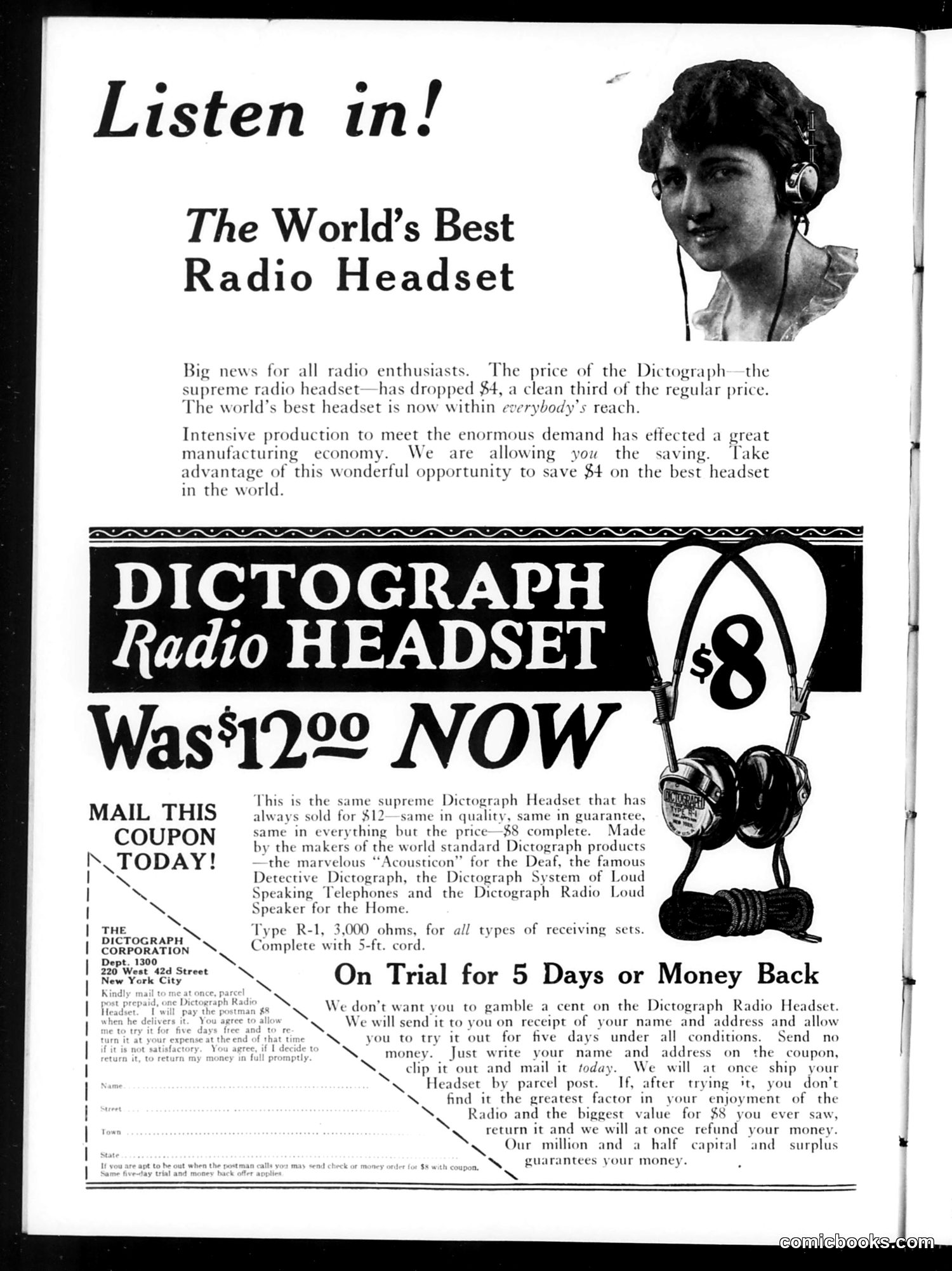
This page is primarily **a commercial advertisement**, not satirical content. It promotes the "Dictograph Radio Headset," marketed as "The World's Best Radio Headset," reduced from $12 to $8—a $4 savings emphasized as significant. The ad targets radio enthusiasts, claiming increased manufacturing efficiency allows this price reduction. It features a photograph of a woman wearing the headset and includes a mail-in coupon offering a five-day trial with money-back guarantee. The only potentially satirical element is the headline "Listen in!"—a period pun on radio listening—but the page functions primarily as consumer advertising for early radio equipment, reflecting 1920s enthusiasm for home radio technology and mail-order sales methods.
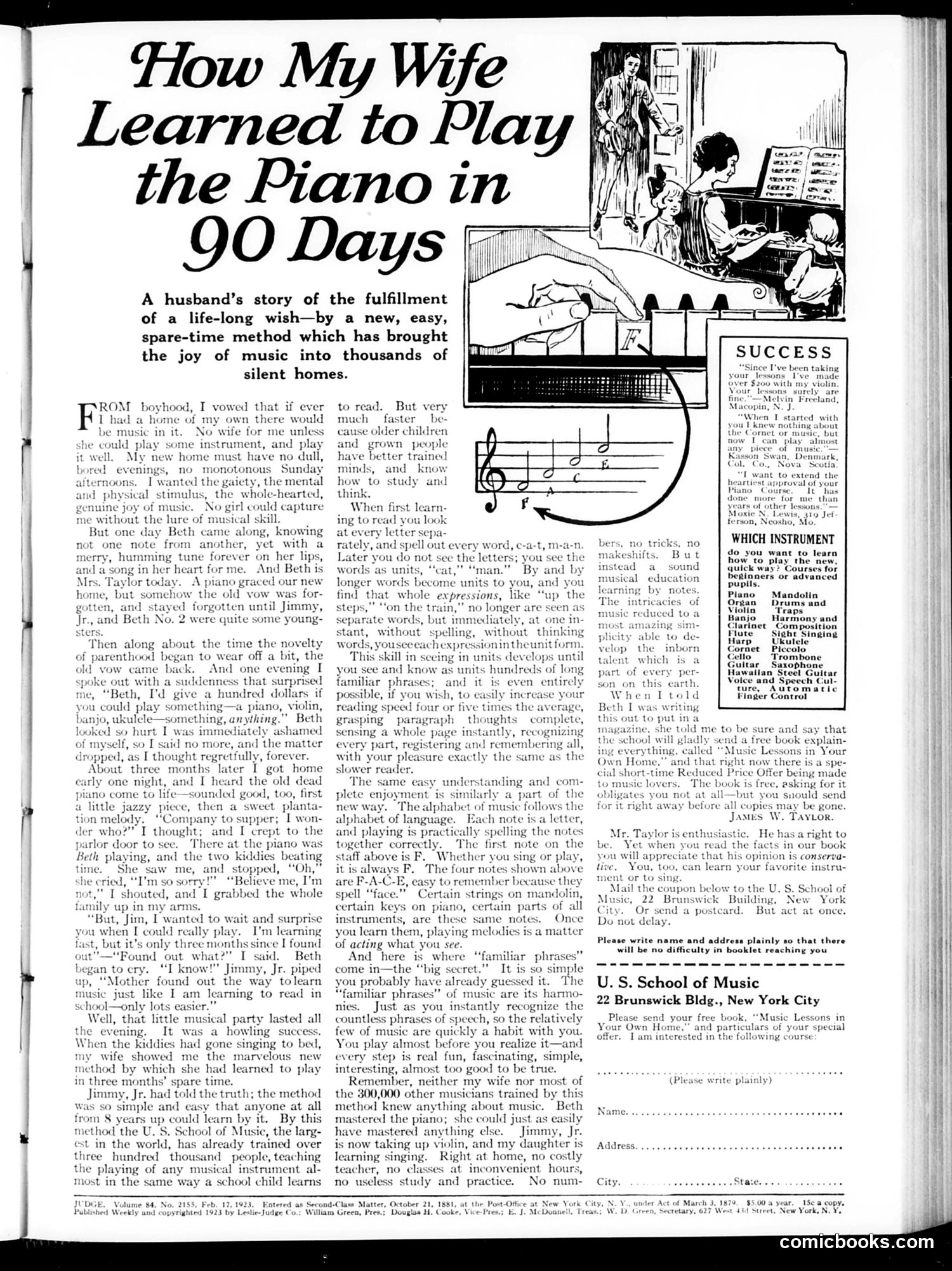
This page is **not primarily satirical content**. It's a hybrid advertisement and advertorial feature titled "How My Wife Learned to Play the Piano in 90 Days," presented as a husband's testimonial story. The article promotes the U.S. School of Music's mail-order piano instruction method, claiming it enables rapid musical literacy through simplified note-reading using letter names rather than traditional notation. The accompanying illustrations show a woman at a piano and a music lesson in progress. The "SUCCESS" testimonial box reinforces the marketing message. The right side includes an instrument selection survey and a tear-out coupon for free instructional materials. This represents typical early 20th-century magazine advertising disguised as lifestyle editorial content.
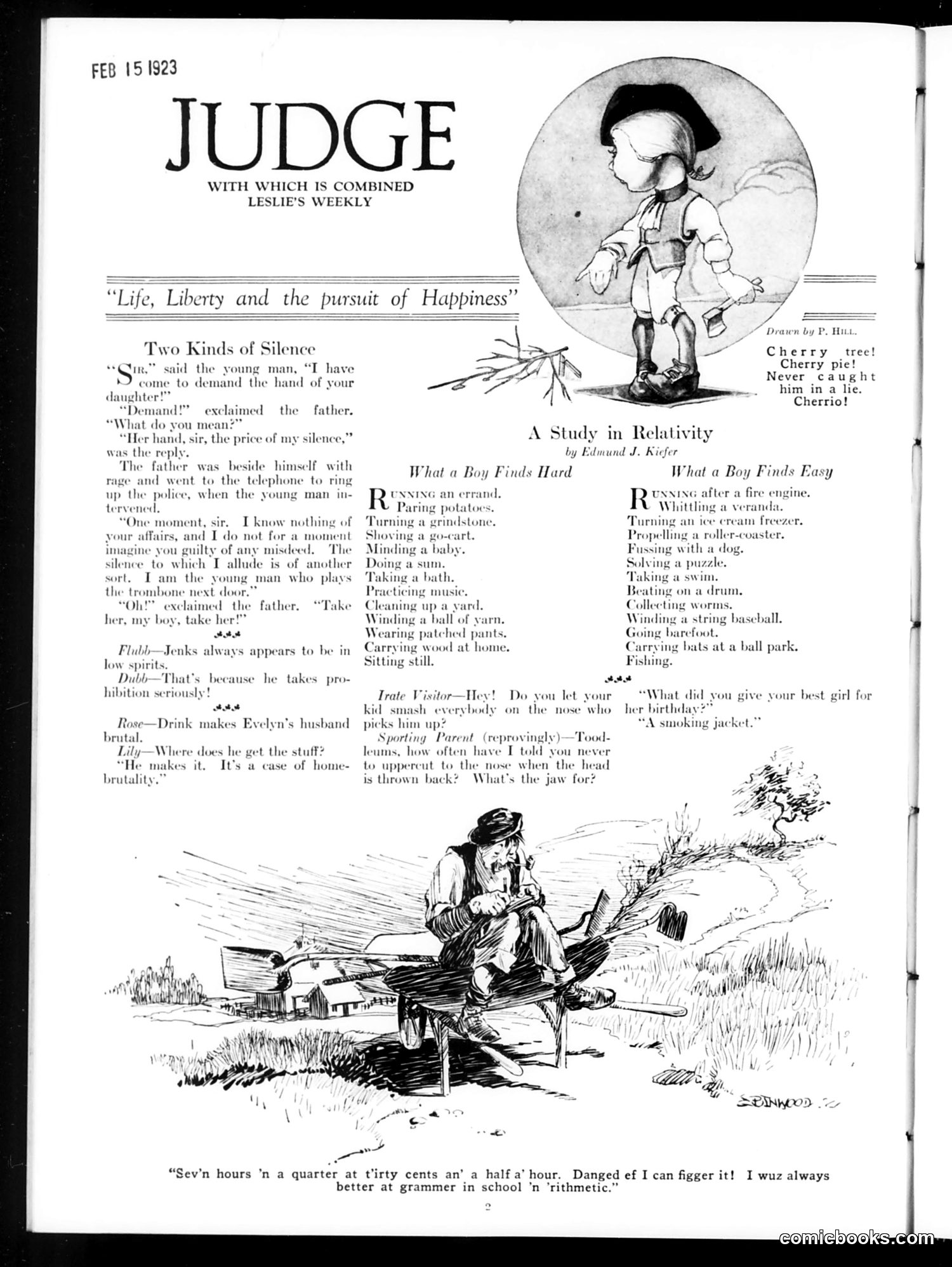
This page contains humor pieces and illustrations rather than political cartoons. The main content includes: **"Two Kinds of Silence"** — a dialogue joke about a young man's silence toward his father after bringing home a pregnant girlfriend, contrasted with his father's "silence" (rage). **"A Study in Relativity"** by Edmund J. Kiefer — two parallel lists contrasting what boys find "hard" versus "easy" (physical tasks vs. recreational activities). The large illustration shows a poor man sitting on a log, apparently explaining arithmetic to a judge or authority figure. His caption suggests working-class resentment about difficult math—he can calculate "sev'n hours 'n a quarter" of labor at low wages but struggled with school grammar. The overall tone reflects 1920s humor about class differences, working-class struggles, and generational conflict typical of Judge magazine's satirical approach.
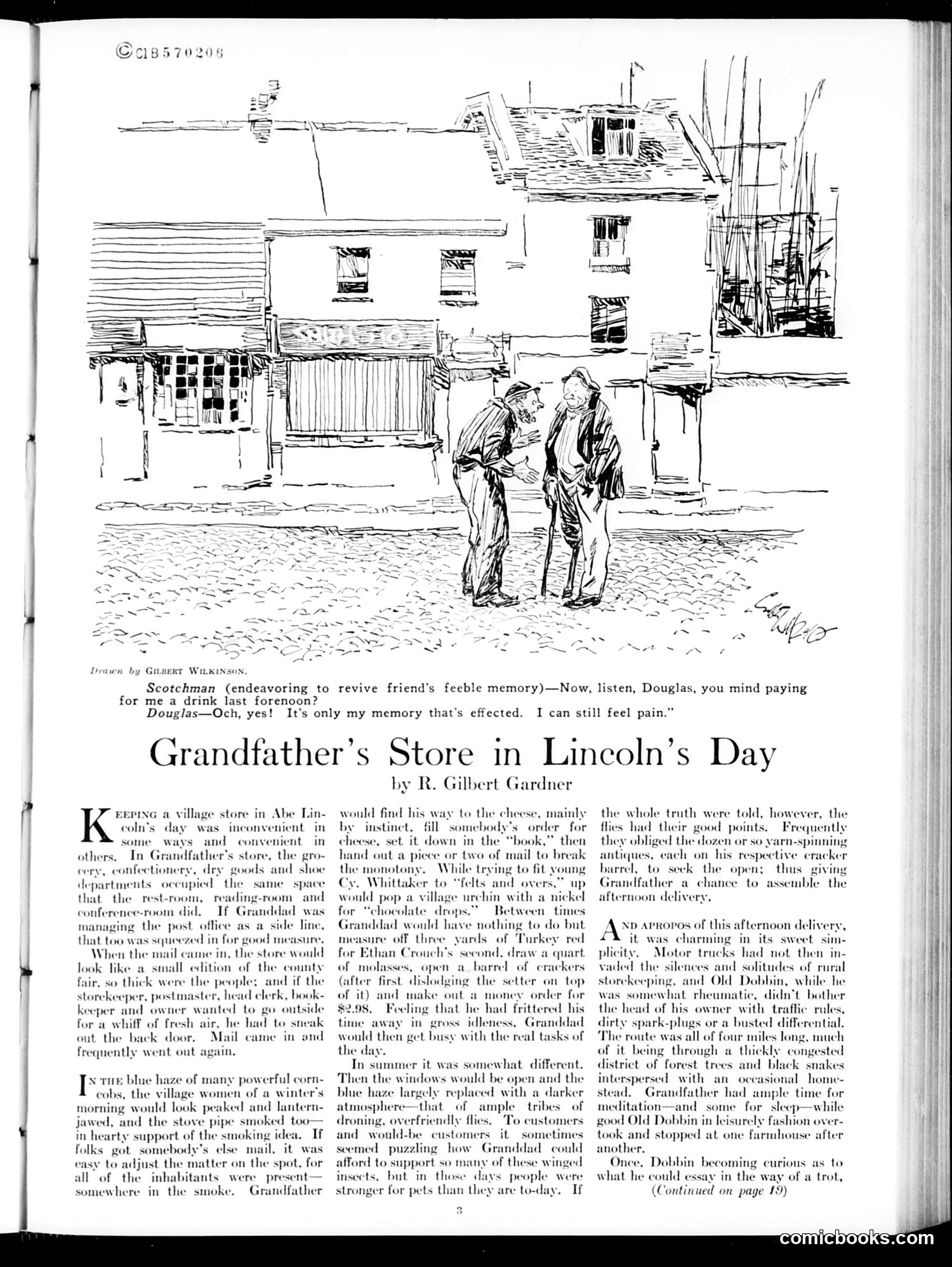
The cartoon depicts two men in conversation on a rural street. The dialogue addresses memory and pain: one man (identified as "Scotchman") asks if his friend Douglas remembers buying him a drink, and Douglas responds that while his memory is affected, he can still feel physical pain. This appears to be a **memory-and-aging joke** common to period humor—playing on the stereotype of Scottish frugality (the Scotchman hoping Douglas has forgotten the drink debt) combined with the universal experience of aging bodies retaining pain sensation even as mental recall fades. The accompanying story, "Grandfather's Store in Lincoln's Day," is a nostalgic piece about rural commerce and village life, seemingly unrelated to the cartoon above.
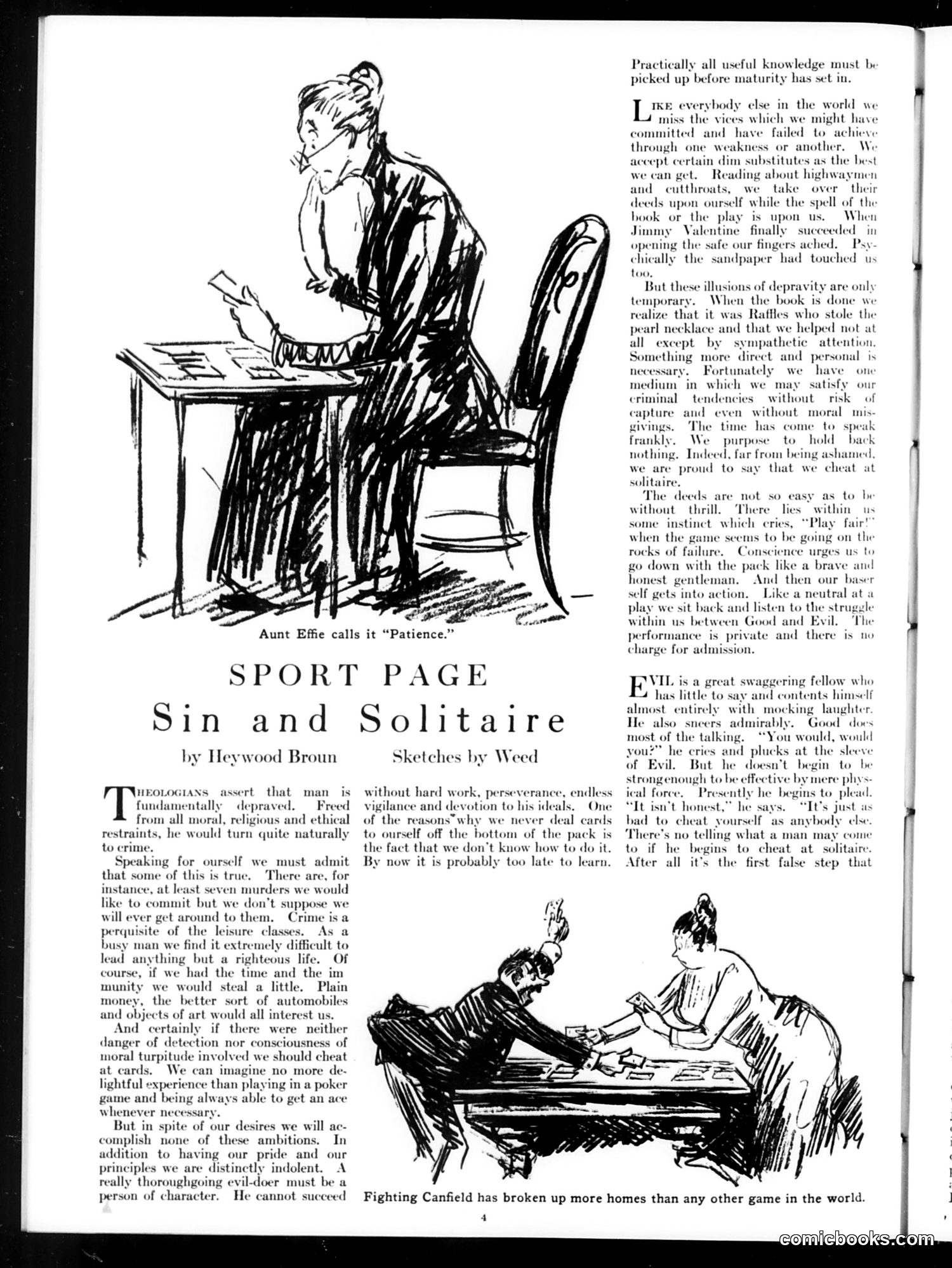
This is a satirical essay (not a political cartoon) about moral hypocrisy. The accompanying sketches illustrate the piece's argument: that people readily condemn crimes they wouldn't commit themselves, yet engage in their own moral failings. The top sketch shows "Aunt Effie calls it 'Patience'"—depicting card games as morally ambiguous leisure activities. The bottom sketch, captioned "Fighting Canfield has broken up more homes than any other game in the world," extends this theme, suggesting that gambling games like solitaire can destroy families despite appearing innocent. Broun argues that judging others' vices while overlooking our own constitutes moral dishonesty. The essay criticizes society's selective moral standards, particularly among the leisure classes.
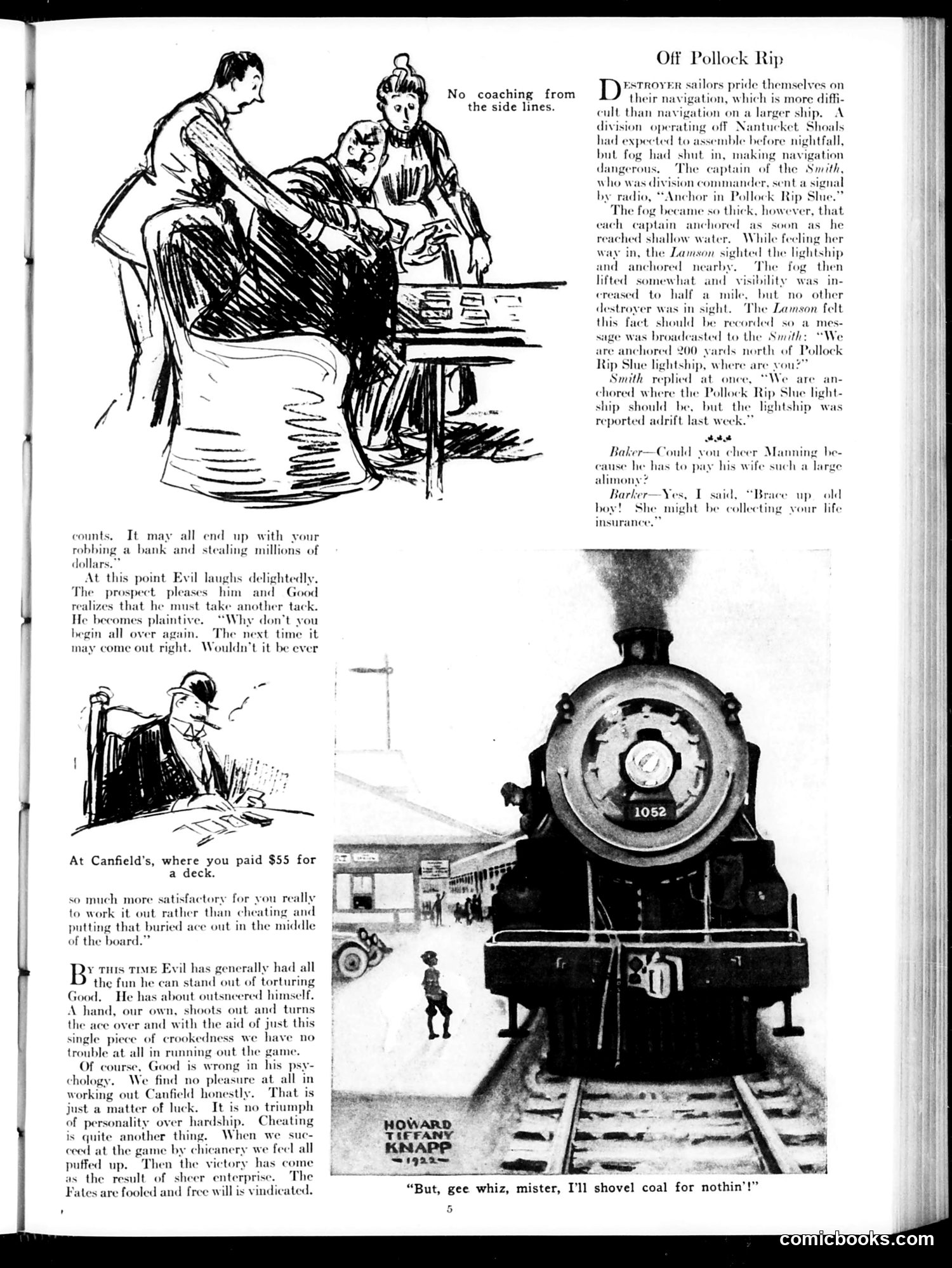
This page contains two distinct pieces: **Top Section - "Off Pollock Rip"**: A brief humorous naval anecdote about destroyer captains operating in fog near Nantucket Shoals. The USS *Smith* orders other ships to anchor at "Pollock Rip Slue," but the USS *Lamson* reports it's anchored 200 yards away from the lightship. The *Smith* replies the lightship was reported adrift last week—a deadpan punchline about navigation confusion caused by fog and faulty landmarks. **Middle Section - Canfield Card Game**: A philosophical debate between personified "Good" and "Evil" about whether cheating at solitaire is satisfying. Evil argues crime pays; Good counters that honest work feels better. The satire suggests people actually *prefer* cheating because it requires cunning and makes victory feel earned, whereas honest gameplay relies on mere luck. **Bottom - "Baker and Barber" Comic**: A brief joke where Baker asks the barber to cheer up a man facing alimony payments. The punchline: "She might be collecting your life insurance"—dark humor suggesting the wife benefits from his death. All pieces are morality-focused satire typical of Judge's style.
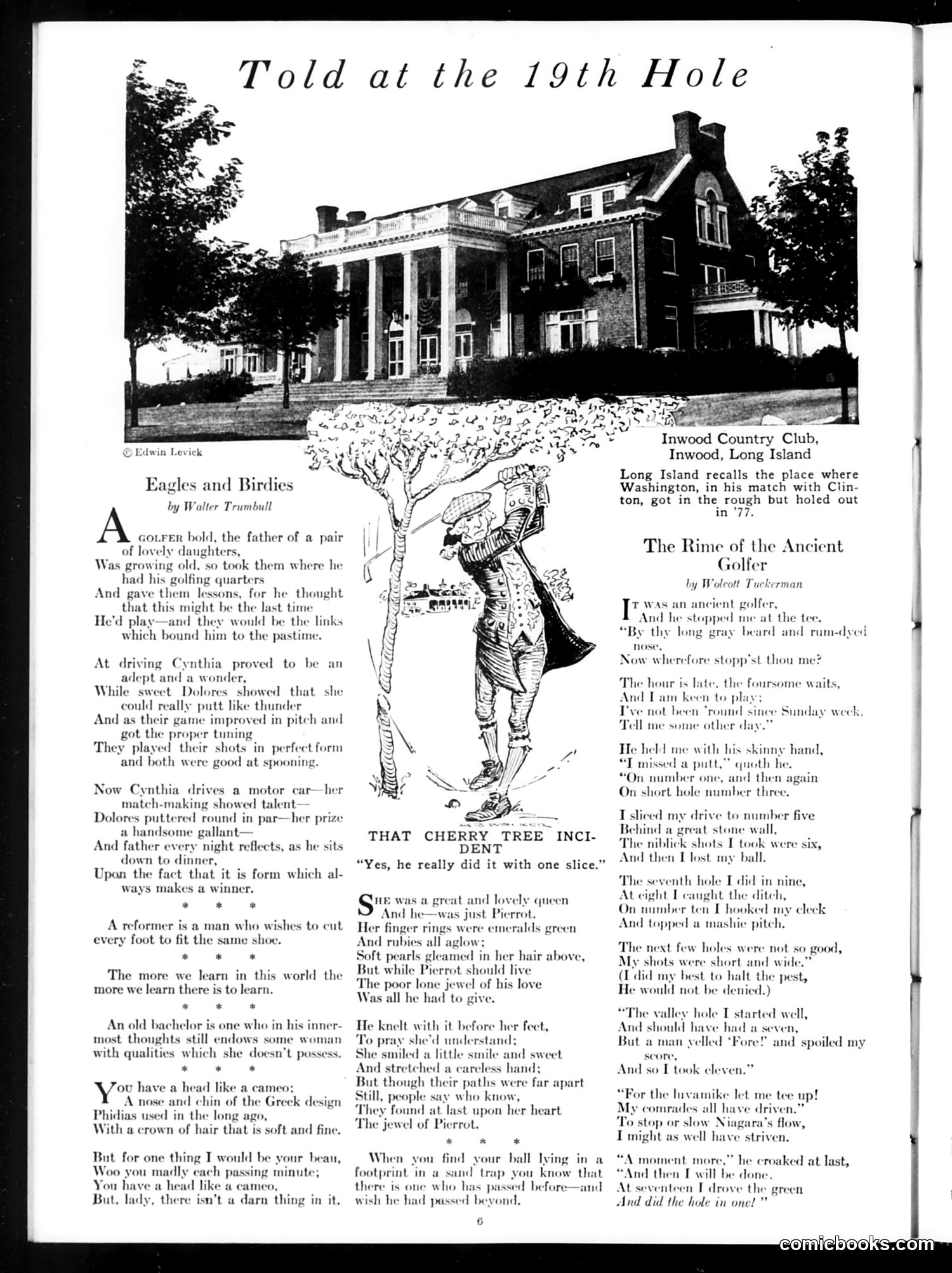
This page contains three distinct pieces of golf-themed humor typical of early 20th-century Judge magazine: **"Eagles and Birdies"** (Trumbull): A lighthearted poem about a father teaching his daughters golf. The joke plays on golf terminology—the daughters' success in driving and putting leads to advantageous marriages ("match-making"), while the father reflects that "form...always makes a winner," a double meaning about both golf technique and proper social behavior. **"The Cherry Tree Incident"**: A brief, unclear reference appearing to compare a golfer's single successful shot to Washington's famous cherry tree story, likely playing on American historical mythology. **"The Rime of the Ancient Golfer"** (Tuckerman): A parody of Coleridge's "Rime of the Ancient Mariner," where an elderly golfer obsessively recounts his terrible round to an impatient listener. The satire mocks golfers' tendency to bore others with detailed accounts of mediocre play—a relatable observation about the sport's culture. The page also includes miscellaneous aphorisms and romantic verses unrelated to golf.
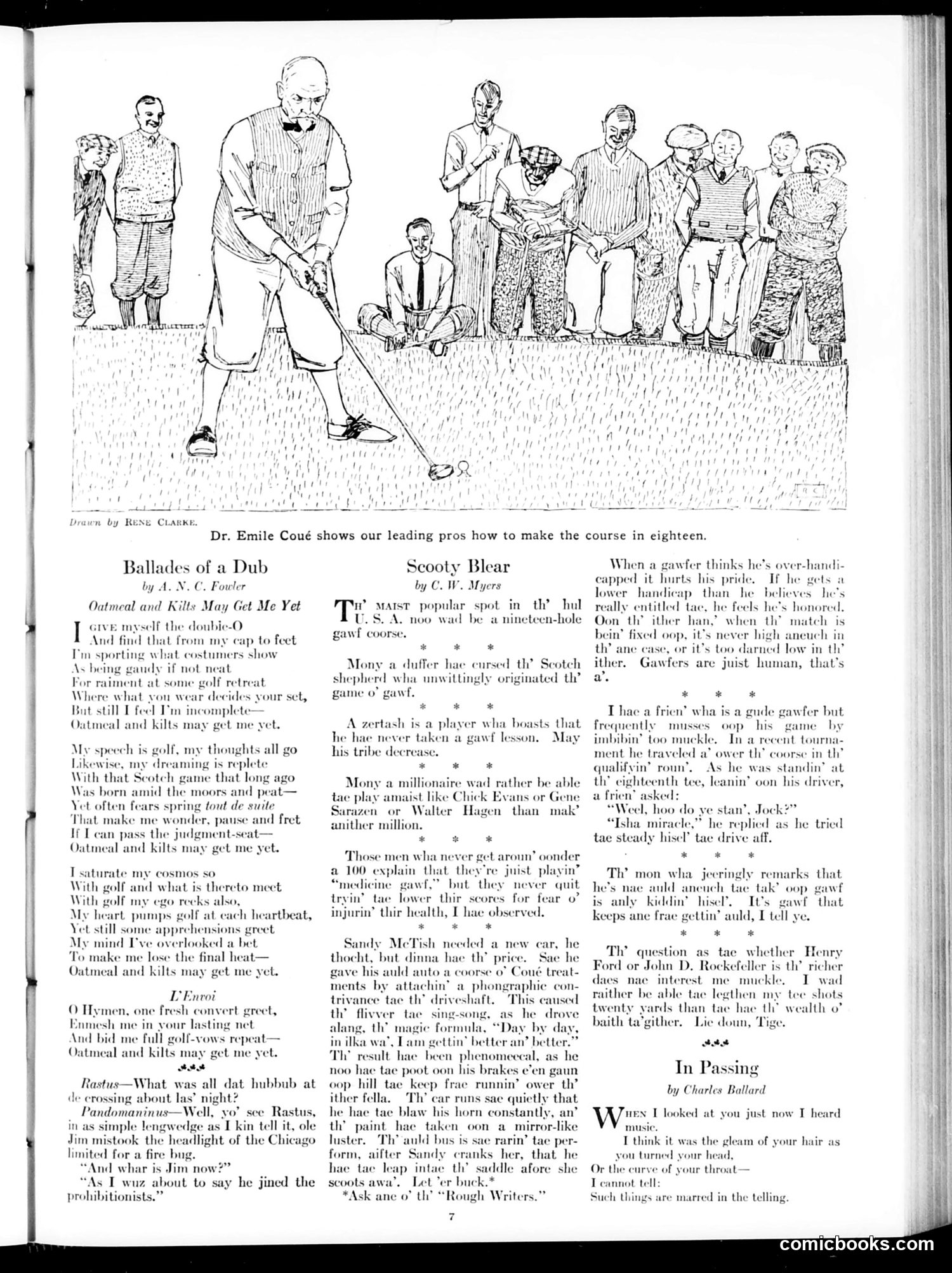
This page from *Judge* magazine satirizes early 20th-century golf culture, particularly the sport's adoption by wealthy Americans and its pretensions. **The main cartoon** depicts Dr. Émile Coué (a real French psychologist famous for his "autosuggestion" method) instructing golfers on achieving an eighteen-hole score. The satire mocks how Americans embraced pseudoscientific self-help trends and applied them to golf obsession. **The poetry and dialect pieces** ridicule golf's dominant position in American leisure and upper-class identity. References to "oatmeal and kilts" mock golf's Scottish origins and the affectation of wearing Scottish dress at golf clubs—a status symbol of the era. The Scottish dialect pieces ("gawf," "tae") parody both the sport's roots and American pretension in imitating them. The overall message: golf has become an almost religious obsession among the wealthy, consuming their thoughts, identity, and social standing to absurd degrees. The magazine uses humor to critique this class-based cultural phenomenon.
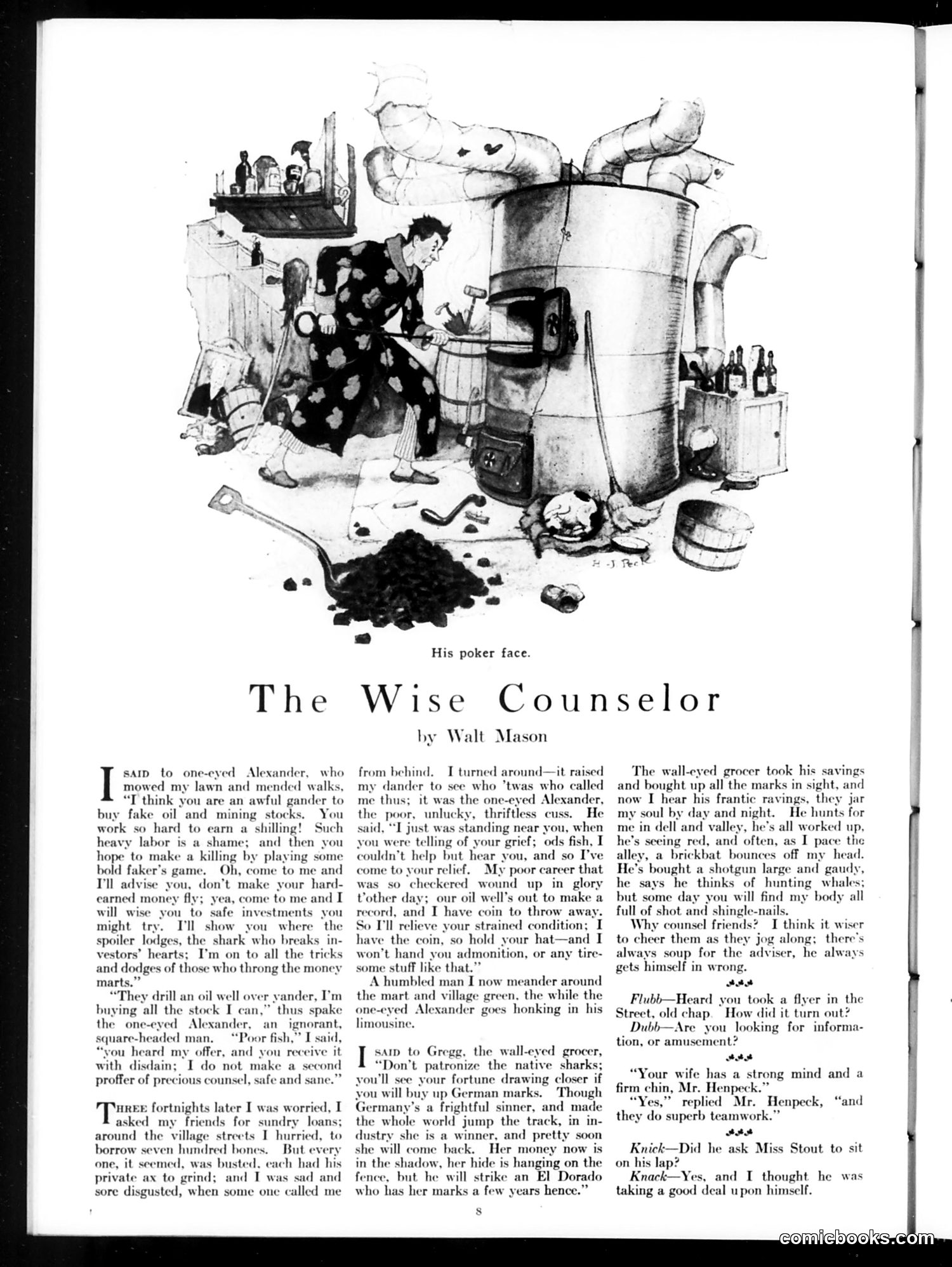
This satirical story mocks unsolicited financial advice and get-rich-quick schemes popular in the early 20th century. A narrator patronizes "one-eyed Alexander," a working-class laborer, urging him to invest in dubious oil and mining stocks rather than rely on honest labor. The narrator boasts of insider knowledge about "spoilers" and financial tricks. The joke inverts: Alexander ignores the advice and remains poor but honest. Meanwhile, the narrator loses money on bad investments and later borrows from friends. When he encounters Alexander again, the formerly poor man has struck it rich from an oil well and generously helps him. The moral: the narrator then foolishly advises a grocer to buy German marks (likely post-WWI financial speculation), causing financial ruin and the grocer's violent rage. The story concludes that giving unsolicited advice is dangerous—better to leave friends alone. The satire targets both financial speculation and presumptuous advice-giving among the middle class.
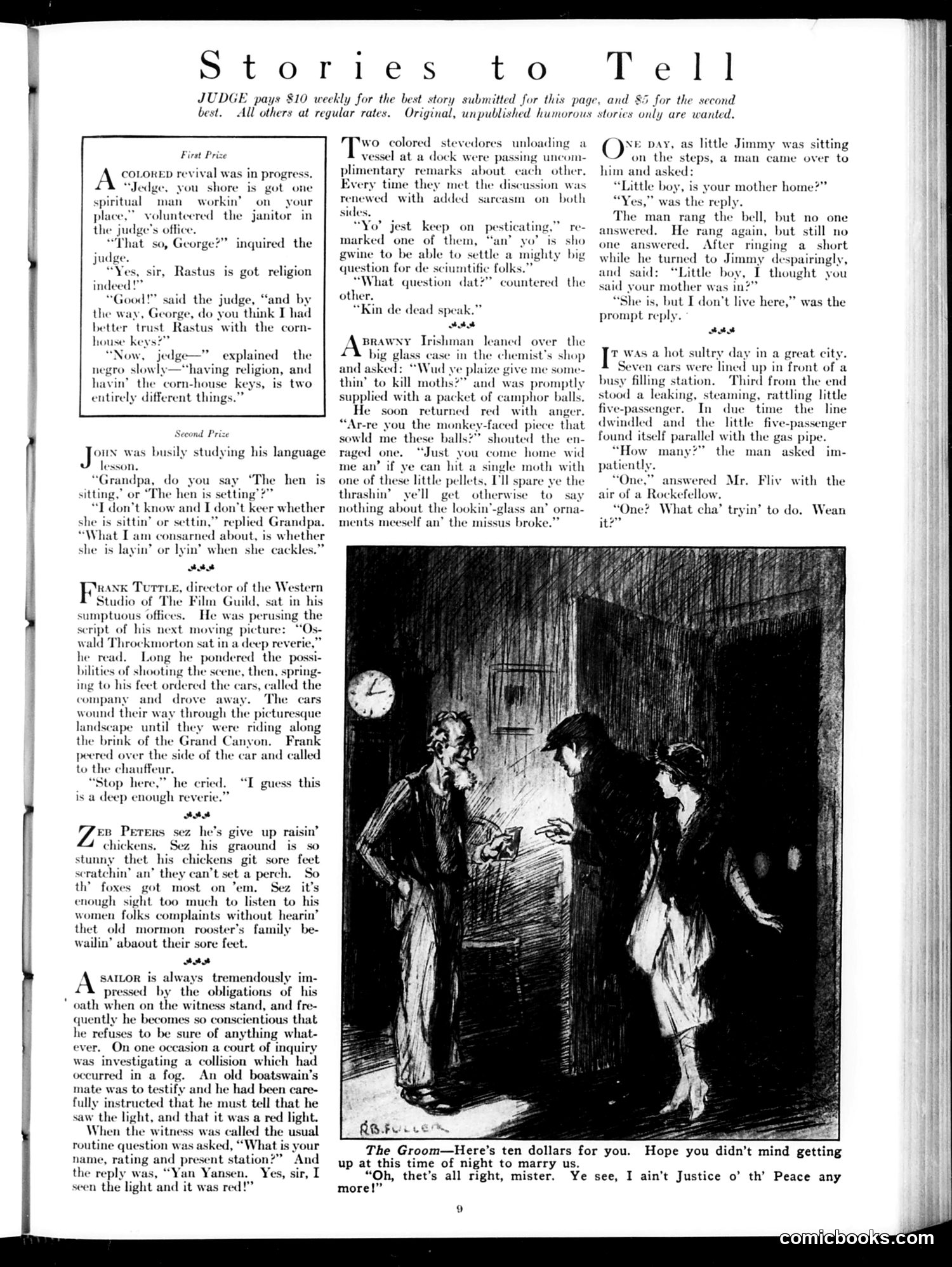
This page from *Judge* contains humorous short stories submitted by readers, not political cartoons. The content is entirely satirical fiction showcasing dialect humor popular in early 20th-century American comedy. The stories mock **racial and ethnic stereotypes** through exaggerated dialect: - African American characters ("colored stevedores," "Rastus") speak in phonetic, broken English - An Irish immigrant ("Brawny Irishman") is portrayed as dim-witted - A Mormon farmer is depicted as foolish The single illustration depicts a groom marrying at night—a joke about reluctant, hasty marriages where the groom jokes he's not a Justice of the Peace. **Modern context:** This represents *Judge*'s reliance on ethnic caricature and dialect humor—standard editorial practice then but reflecting deeply offensive racial attitudes. The satire targets working-class and immigrant groups, not powerful institutions or corruption.
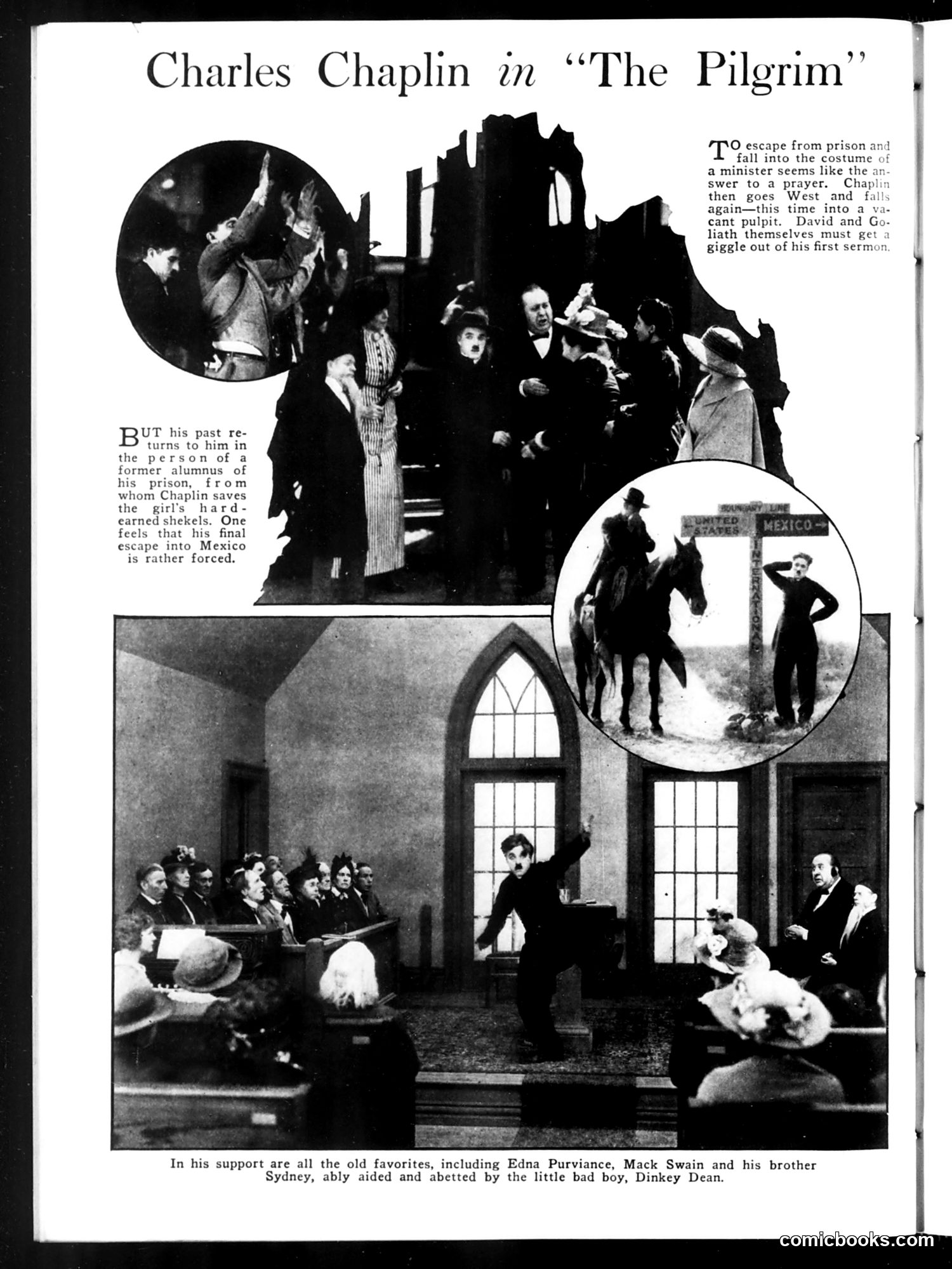
This is a promotional article for Charlie Chaplin's 1923 silent film *The Pilgrim*. The plot involves Chaplin's character escaping prison, disguising himself as a minister, and heading West where his religious incompetence causes comedic chaos (the "David and Goliath" reference suggests he mangles a biblical sermon). The satire targets religious hypocrisy—a criminal masquerading as a man of the cloth, duping a congregation. The text notes his past catches up with him when a former prison acquaintance recognizes him, creating complications. The page features promotional stills showing Chaplin in minister's garb preaching to congregants, plus a circular inset showing him at the Mexico border—suggesting his final escape. Supporting cast members (Edna Purviance, Mack Swain, Dinkey Dean) are credited. This represents Judge magazine's coverage of popular cinema and Chaplin's satirical commentary on fraud and respectability.
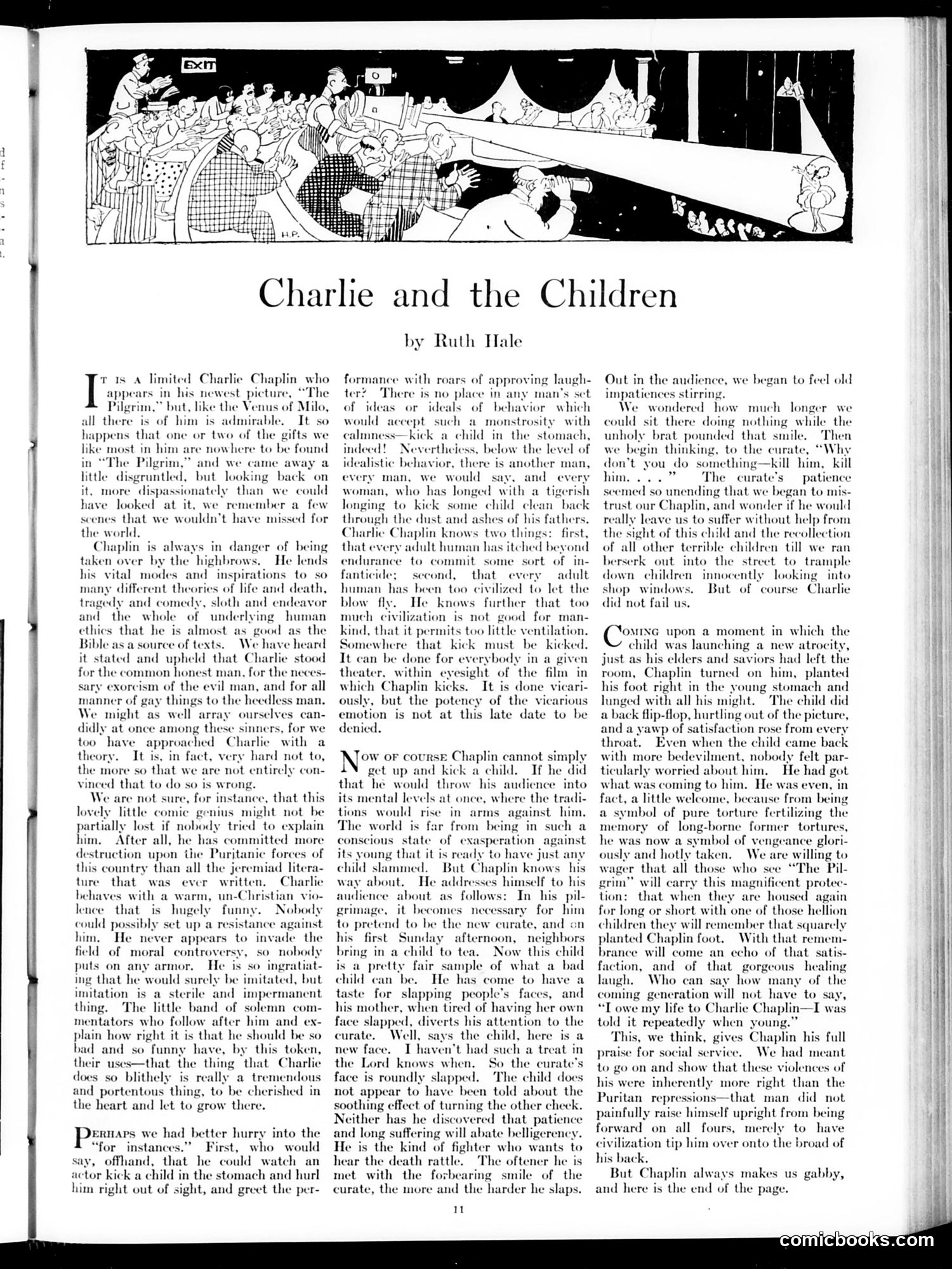
This is a film review of Charlie Chaplin's "The Pilgrim." Hale argues that Chaplin's genius lies in allowing audiences to vicariously experience forbidden impulses—specifically, she uses the example of kicking a child, which adult viewers have fantasized about but civilization prevents them from acting upon. The article defends Chaplin against "highbrows" who over-interpret his work as social commentary. Hale contends that Chaplin's value is in his uninhibited physical comedy that releases repressed aggression in a safe, theatrical context. She argues this cathartic function is actually morally healthy, providing necessary psychological "ventilation" against excessive civilization. The piece reflects 1920s psychological theories about sublimation and catharsis while celebrating Chaplin's appeal as pure entertainment unencumbered by intellectual analysis.
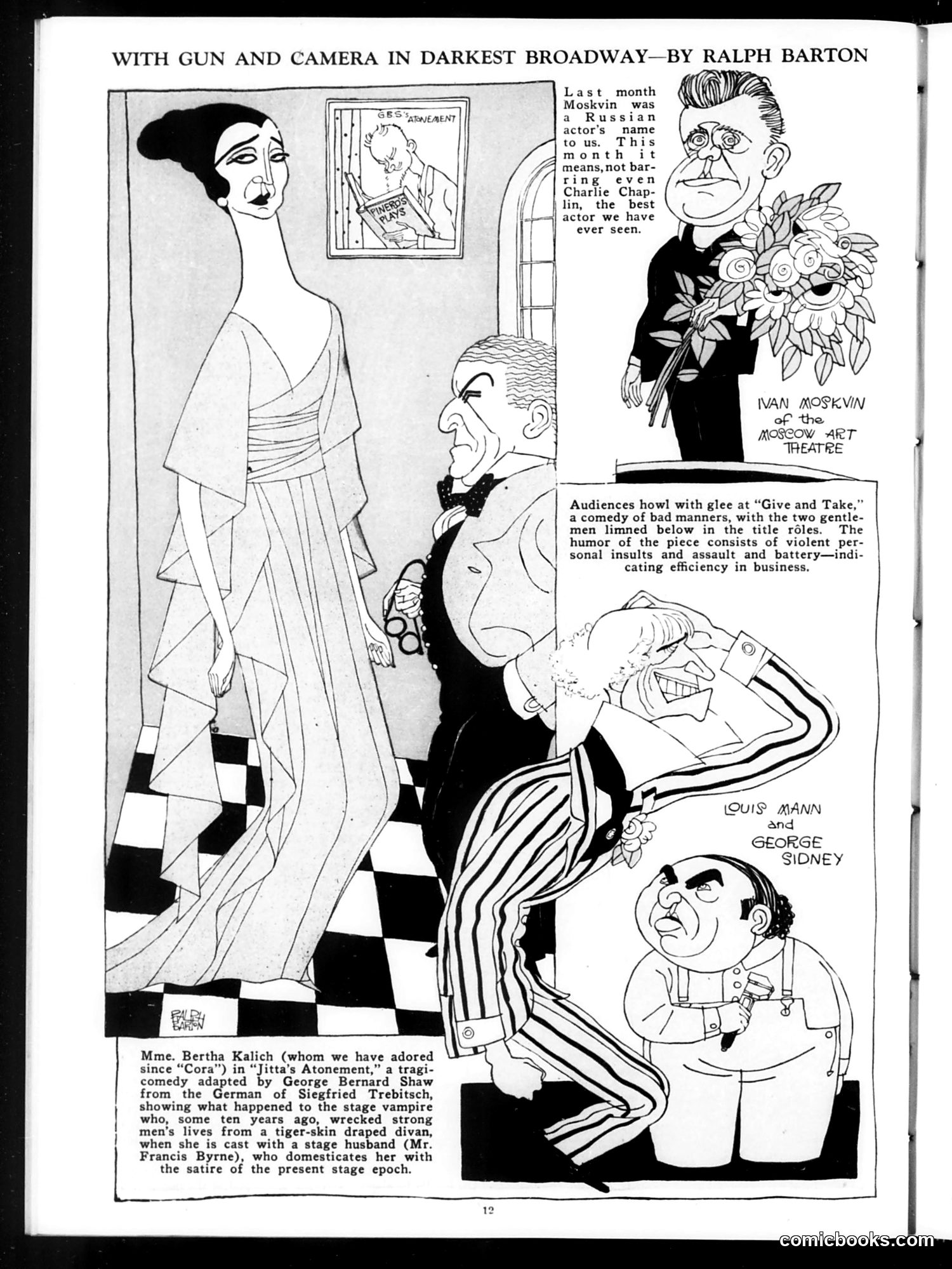
This page reviews contemporary Broadway productions. The top section praises Russian actor Ivan Moskvin of the Moscow Art Theatre as exceptionally talented—remarkably so, even compared to Charlie Chaplin. Below, caricatures of Louis Mann and George Sidney promote their comedy "Give and Take," which apparently relies on physical comedy: violent insults and stage violence as humor about business efficiency. The bottom section reviews Bertha Kalich in "Jitta's Atonement," adapted by George Bernard Shaw from a German play. The satire mocks the "stage vampire" archetype—the seductive woman who ruined men's lives from her "tiger-skin draped divan." The joke is that she's now domesticated by a conventional stage husband, rendering her dangerous allure harmless. This reflects early 20th-century anxieties about female sexuality and morality. All three reviews use exaggerated caricature drawing typical of Judge's satirical style.
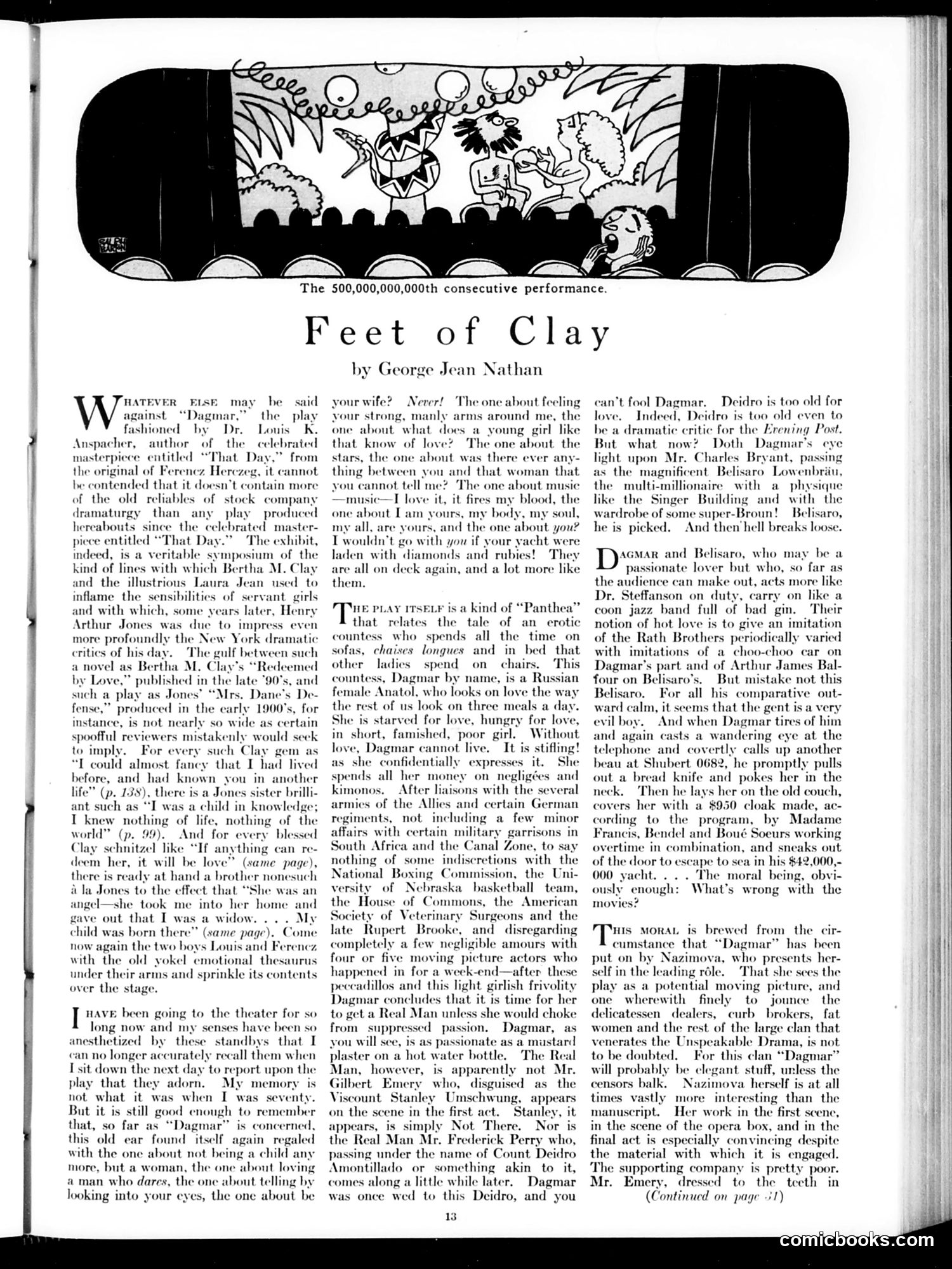
This page contains a theater review by George Jean Nathan (a prominent early-20th-century drama critic) of the play "Dagmar," satirizing its melodramatic conventions. **The cartoon** (top) shows the "500,000,000,000th consecutive performance"—hyperbolic mockery of how formulaic and endlessly repetitive such plays are. **Nathan's satire targets:** - The play's reliance on hackneyed stock situations and dialogue inherited from 19th-century pulp fiction (specifically Bertha M. Clay's serialized novels, which inflamed "servant girls'" sensibilities) - Its central character, Dagmar, a Russian countess obsessed with love/romance, who exists primarily on "sofas, chaises longues and in bed" - The parade of clichéd romantic lines: "I am yours, my body, my soul," "what does a young girl know of love?"—tired formulas recycled since the 1890s **The point:** Nathan argues the play offers nothing fresh, merely reheating decades-old melodramatic conventions for contemporary audiences, making it essentially artistic fraud dressed up as drama.
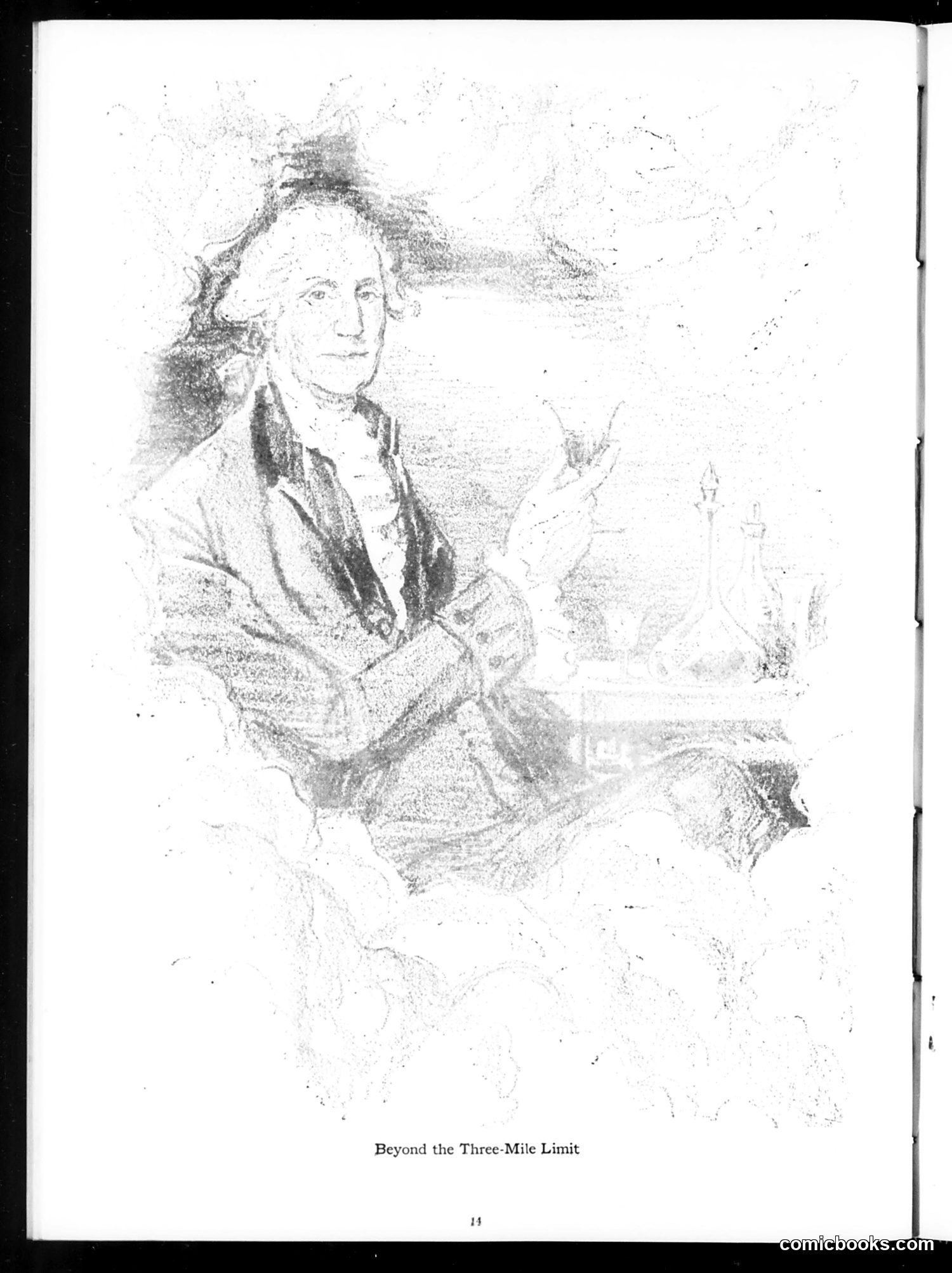
This page shows a sketch titled "Beyond the Three-Mile Limit," appearing to depict a man in 18th-century dress gesturing expressively. The "three-mile limit" refers to U.S. territorial waters—the satirical title suggests the figure is operating outside American legal jurisdiction. Without additional context or caption text visible on the page, the specific identity and political meaning remain unclear. The sketch's style and formal dress suggest this may reference a historical or contemporary political figure engaged in illicit activity beyond American authority—possibly relating to smuggling, privateering, or diplomatic intrigue during a period when this phrase held particular significance. The actual satirical point requires additional information not fully visible here.
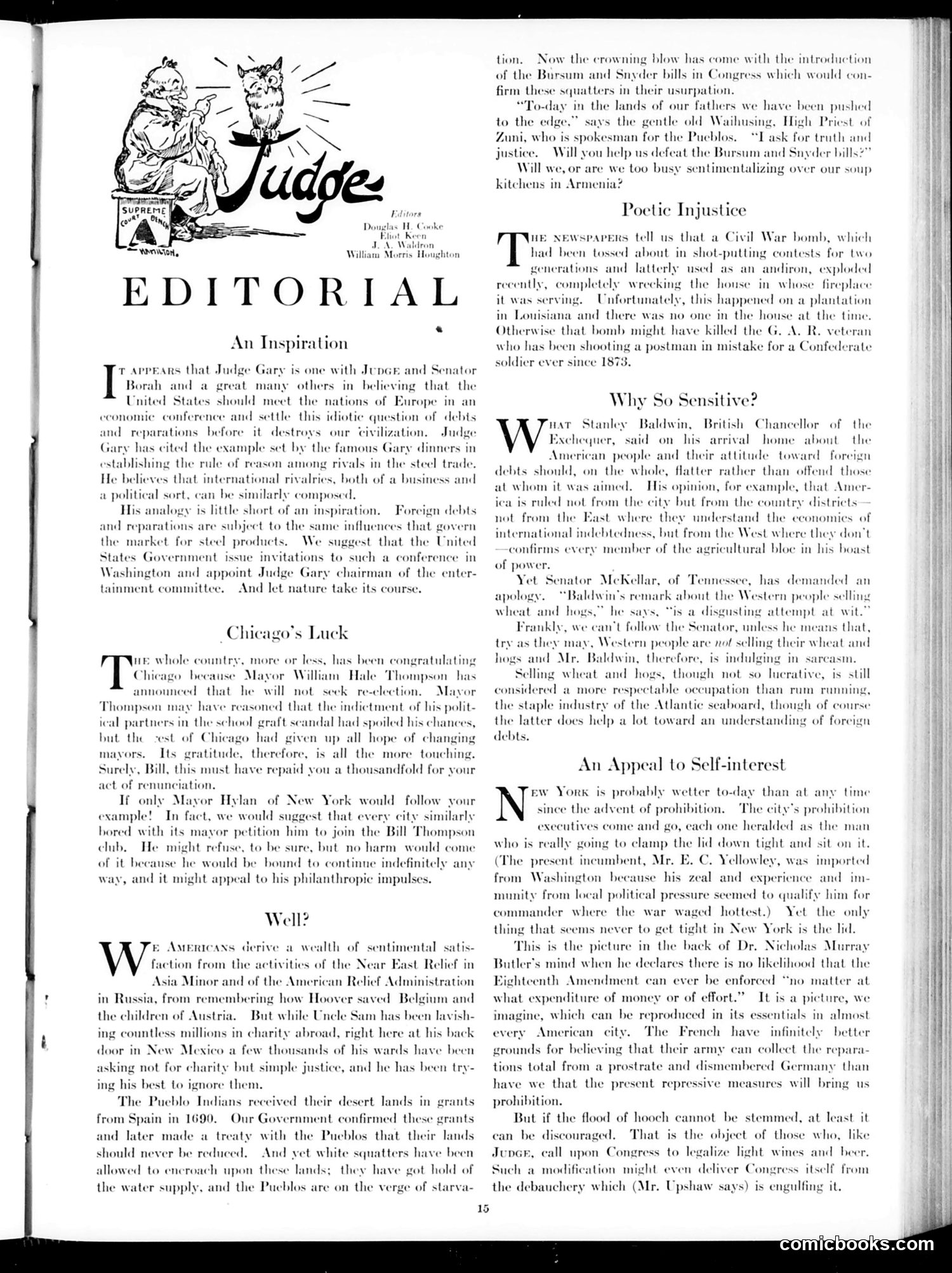
This editorial page from *Judge* magazine contains several satirical pieces criticizing American political and social issues: **The "Judge" Masthead Cartoon** shows an owl labeled "Supreme" — likely representing judicial wisdom or authority. **"An Inspiration"** mocks Judge Elbert Gary's proposal that the U.S. hold an economic conference to settle European war debts and reparations. The satire suggests applying his "rule of reason" from steel industry negotiations to international affairs is naively simplistic. **"Chicago's Luck"** sarcastically congratulates Mayor William Hale Thompson for announcing he won't seek re-election, implying his political partners faced indictment for school graft scandals. The piece suggests other cities should similarly pressure their mayors to resign. **"Well?"** criticizes American charity abroad (Near East Relief, Armenia) while ignoring injustices at home—specifically the Pueblo Indians' land rights being threatened by the Bursum-Snyder bills in Congress, which would confirm white squatters' claims to indigenous lands. The overall theme: America should address its own moral failures before congratulating itself on international generosity.
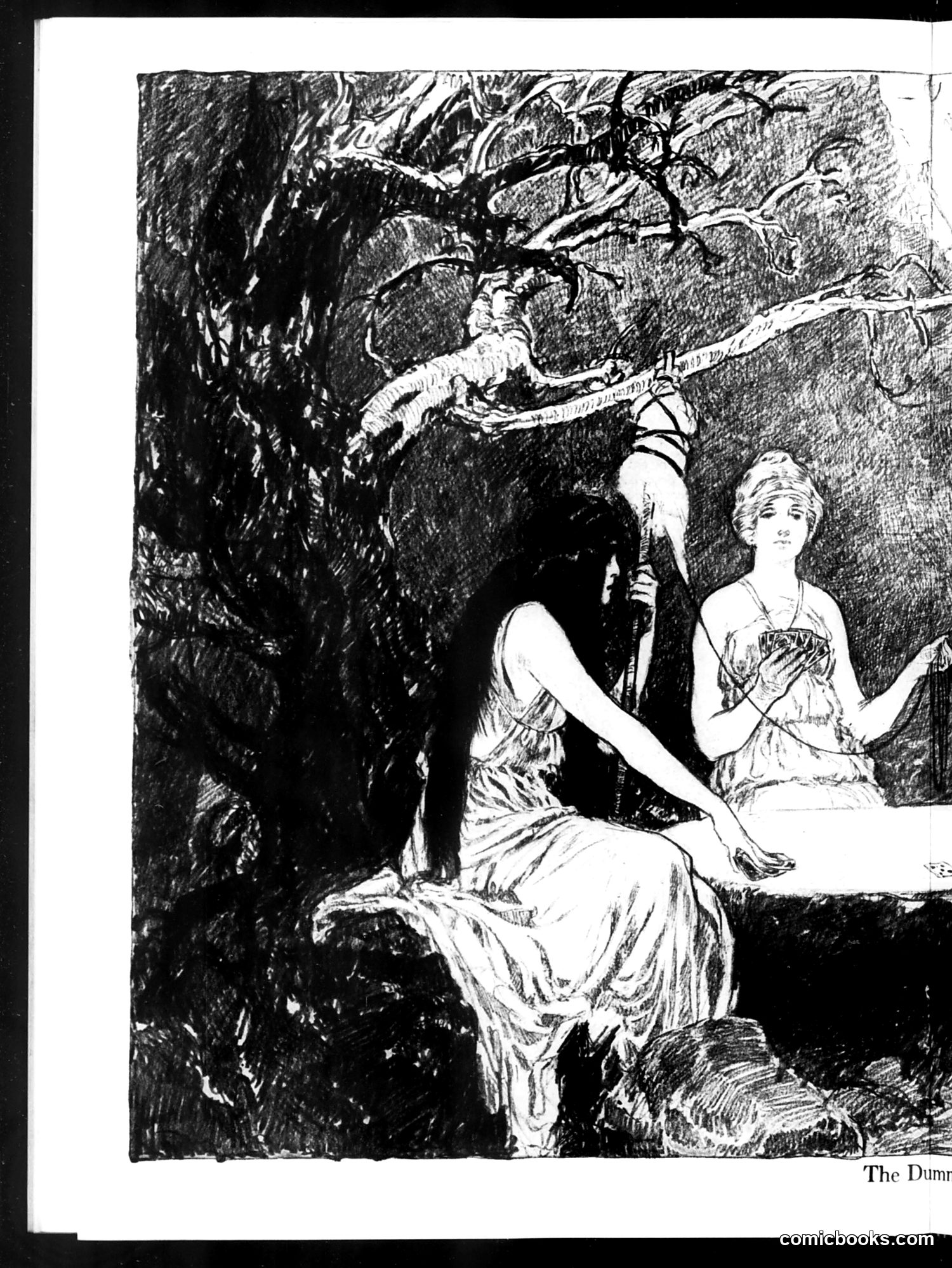
This appears to be an illustration from *Judge* magazine titled "The Dumb..." (title cut off). The image shows two classical female figures in Greco-Roman dress in a wooded setting. One woman, seated, reaches toward a tree branch while another stands nearby observing. The artistic style and classical setting suggest this is likely an allegorical illustration rather than political satire. Without the complete title or accompanying text, the specific satirical point remains unclear. The "dumb" reference in the title hints at social commentary, possibly about feminine behavior or intelligence, common subjects of period satire. The classical aesthetic and two-figure composition suggest commentary on traditional gender roles or female conduct, but the exact target of satire cannot be determined from the visible image alone.
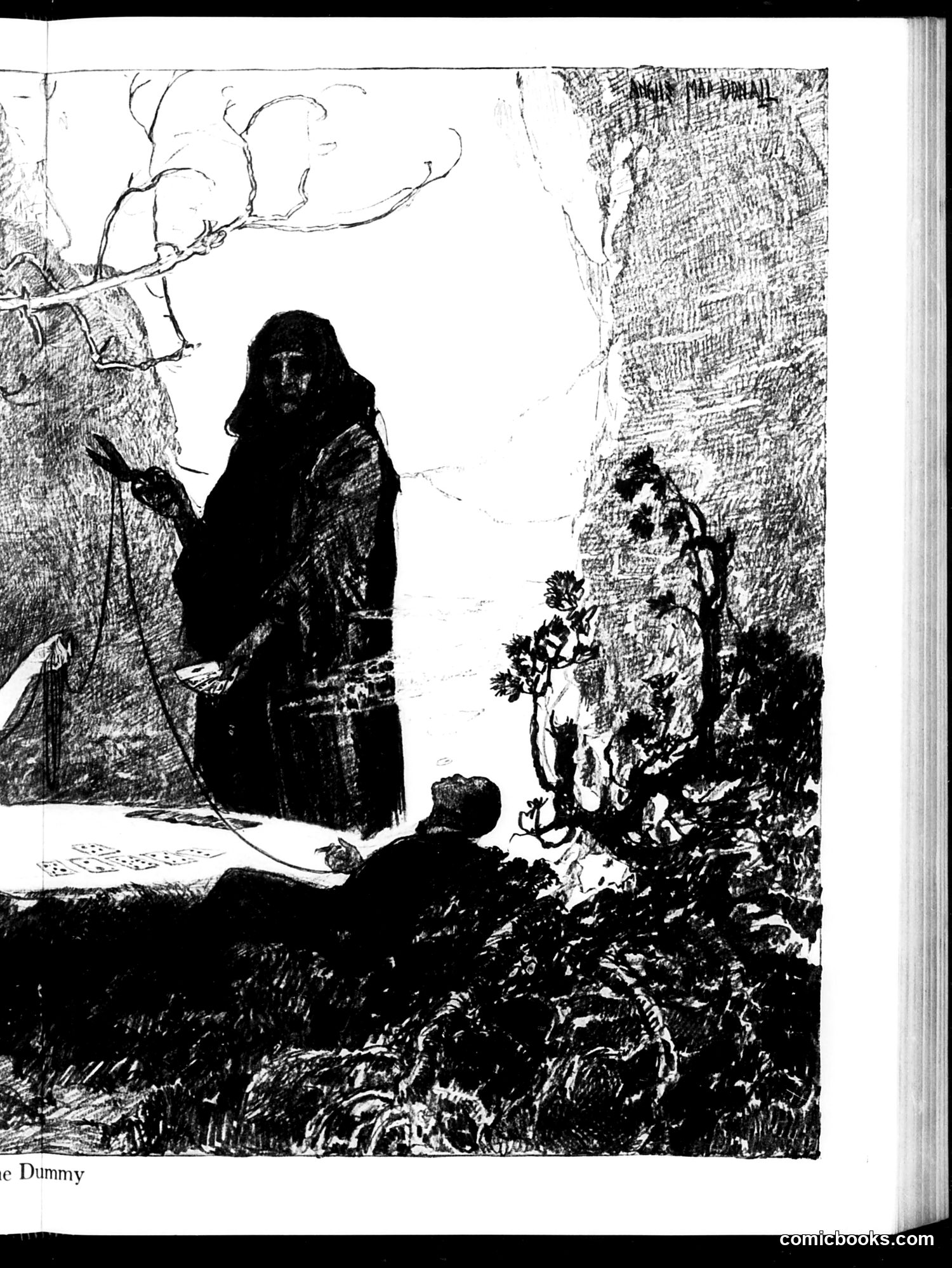
This appears to be an illustration titled "The Dummy" from *Judge* magazine. The image depicts a silhouetted figure in dark clothing standing in what appears to be an enclosed space or alley, gesturing toward or addressing another figure in the shadows. The stark black-and-white contrast and expressionistic style suggest psychological tension or menace. Without additional context visible on the page—such as a caption, date, or accompanying article—the specific political or social satire remains unclear. The image could reference contemporary political figures or social commentary from the publication's era, but I cannot definitively identify which event, scandal, or public figure "The Dummy" refers to based solely on what's shown here.
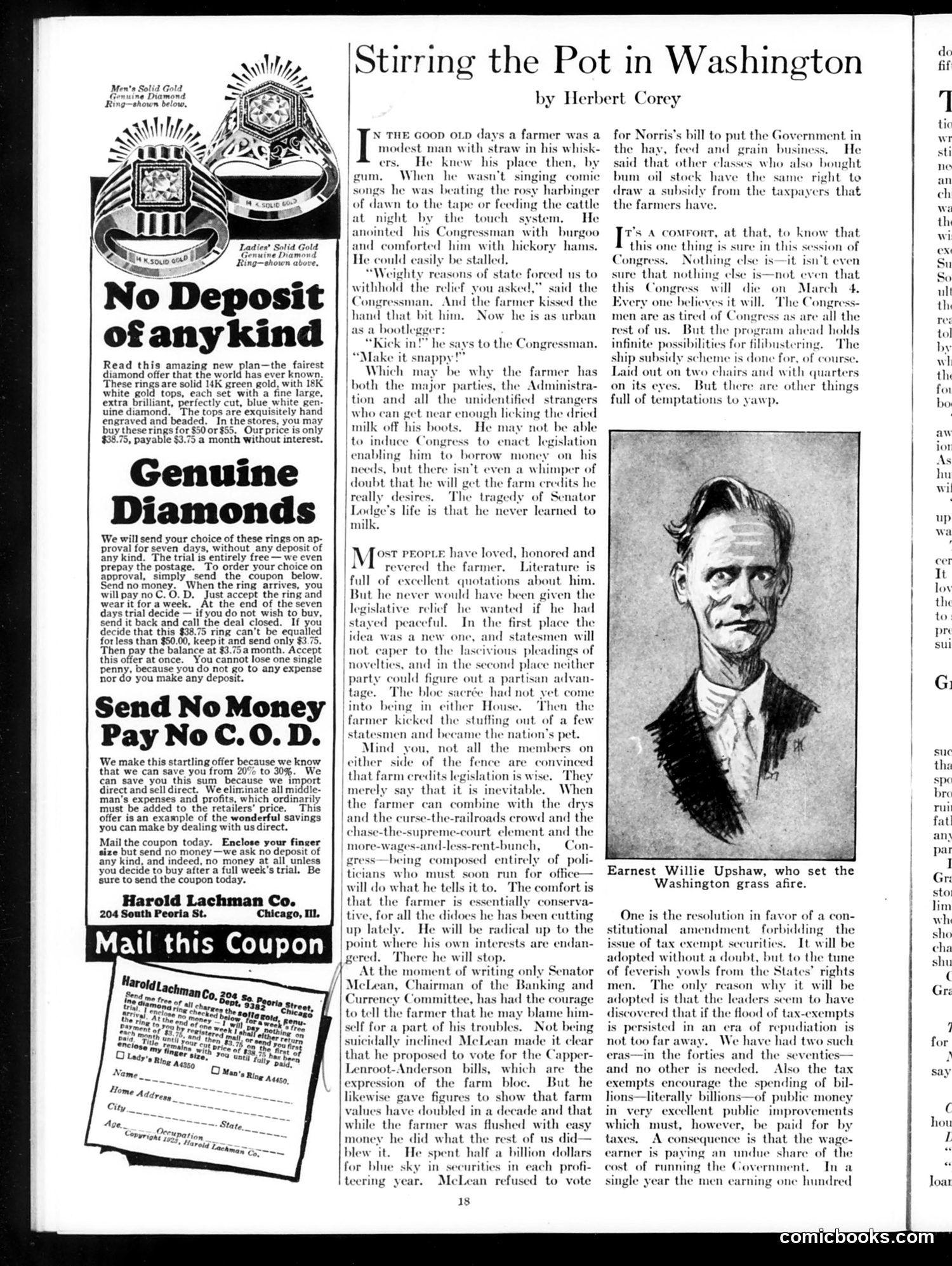
This satirical article by Herbert Corey critiques the shift in American farmers' political behavior and effectiveness. **The Main Point:** Farmers have transformed from deferential, easily-dismissed rural figures into aggressive political agitators who now successfully demand legislative action. The article contrasts the "good old days" when farmers passively accepted government excuses with the modern era, where they demand action with "Kick in! Make it snappy!" **Key Satire:** The author argues this aggressive approach *works*—farmers now secure farm credit legislation Congress previously ignored. However, Corey suggests this reflects poorly on democracy: politicians only respond to noise and pressure, not legitimate needs. The reference to "Senator Lodge's life is that he never learned to milk" implies that established politicians are disconnected from agricultural realities. **Social Context:** This reflects early 20th-century farm unrest and the emerging political power of agricultural interests, who successfully pushed for federal farm credit programs despite establishment resistance. The page also contains period advertising (diamond rings, mail-order schemes)—typical Judge magazine filler.
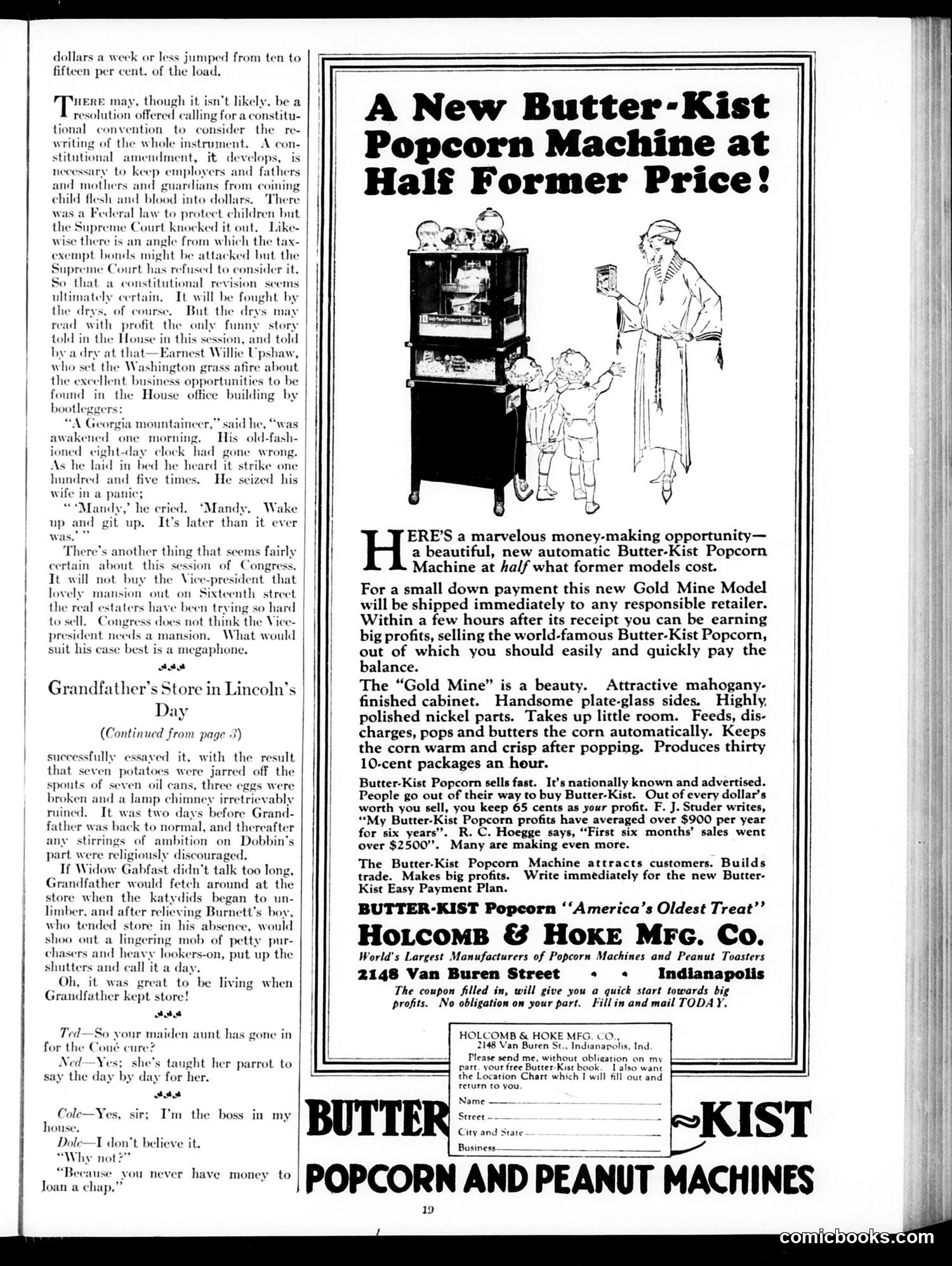
This page contains two distinct sections: **Left side:** Editorial commentary on congressional matters, including a humorous anecdote by Representative Willie Upshaw (identified in text) mocking the Vice President's housing situation. The joke suggests Congress won't fund a mansion for the VP, implying he needs a megaphone instead—likely satirizing the VP's perceived lack of influence or visibility. **Right side:** A full-page advertisement for Holcomb & Hoke Manufacturing Company's "Butter-Kist" popcorn machine, marketed as a money-making opportunity at "half former price." The ad targets small business owners with testimonials claiming $900+ annual profits. **Bottom section:** Humorous one-liner jokes about domestic life and relationships. The page reflects typical Judge content: political satire mixed with consumer advertising and light humor. The date and specific congressional session aren't clearly visible, limiting precise historical context.
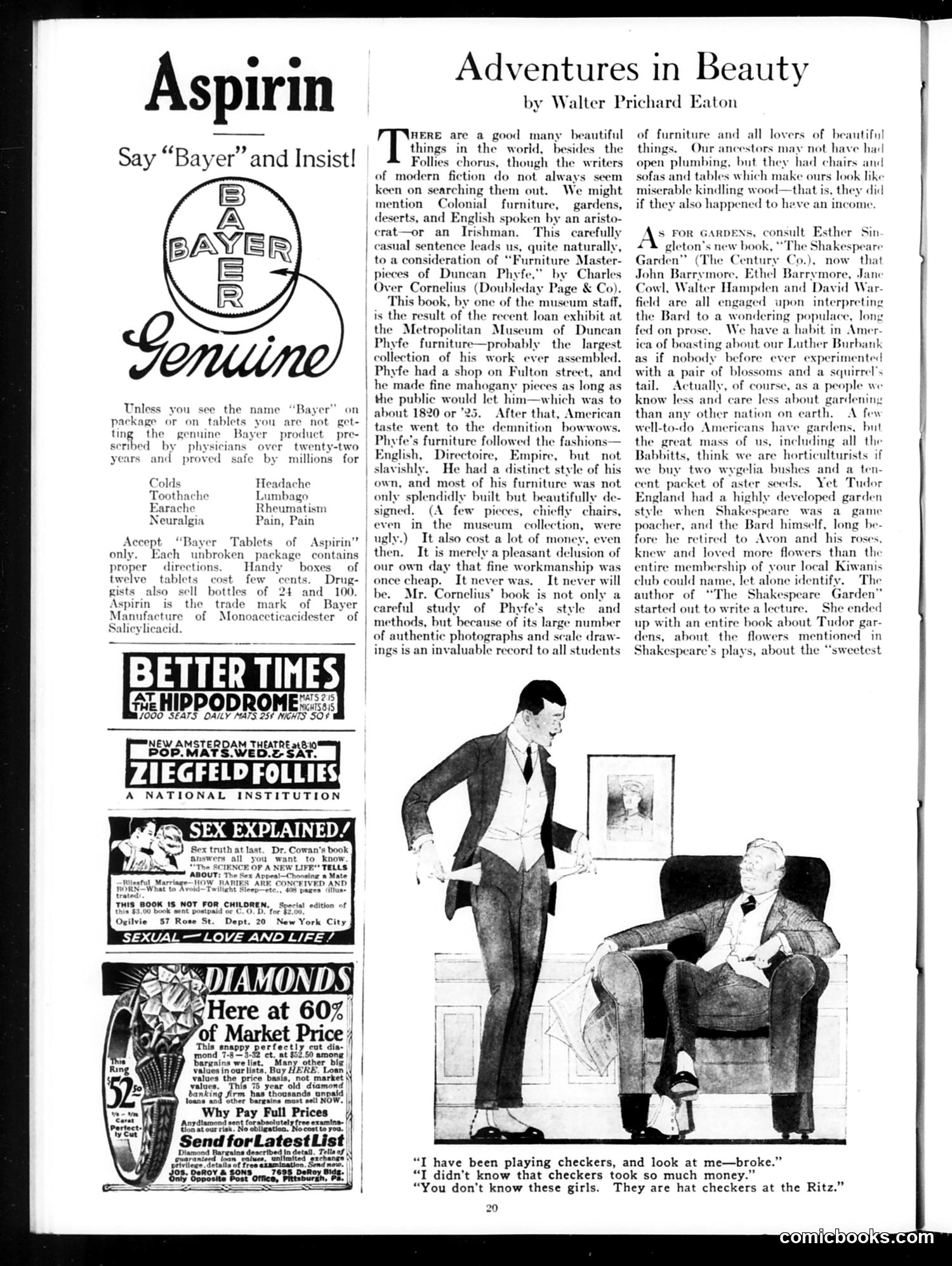
This page contains an **Aspirin advertisement** (Bayer brand) alongside a feature article on "Adventures in Beauty" by Walter Prichard Eaton discussing furniture design, gardens, and culture. The cartoon/illustration at the bottom shows two men in a domestic interior—one standing, one seated—with dialogue about checkers and money. The caption reads: "I have been playing checkers, and look at me—broke" / "I didn't know that checkers took so much money" / "You don't know these girls. They are hat checkers at the Ritz." **The joke**: This is a play on words. "Hat checkers" (attendants who check coats/hats at restaurants) sounds like "checkers" (the game), but the real point is that dating these young women at an upscale venue like the Ritz Hotel is expensive—they're sophisticated girls who cost money to entertain. It's a light social satire about the cost of dating women from fashionable establishments during the Jazz Age era. The page also includes vintage advertisements for theatrical productions and diamonds, reflecting 1920s consumer culture.
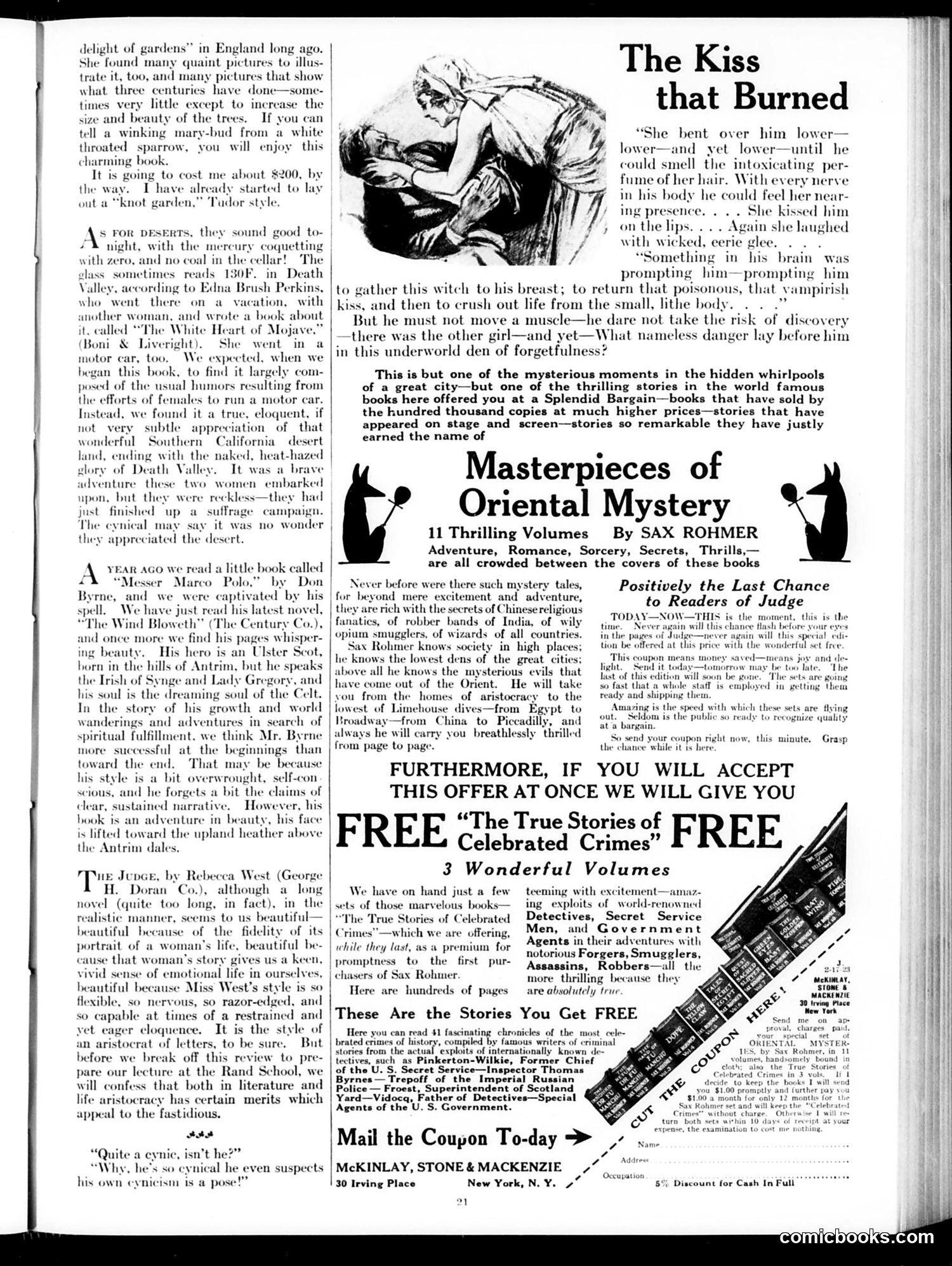
This page contains book reviews (left column) and advertising (right column). The main illustrated story titled "The Kiss that Burned" depicts a dramatic romantic/noir scene: a man and woman in an intimate embrace, with text suggesting forbidden desire and danger—she kisses him despite risk of discovery, while "another girl" creates stakes. The book reviews discuss literary works by Don Byrne, Rebecca West, and others—typical Judge cultural content. The substantial advertising dominates the right side: **Sax Rohmer's "Masterpieces of Oriental Mystery"** (11 volumes), marketed as thrilling tales of Chinese secrets, Indian criminals, wizards, and Limehouse dives. The pitch emphasizes exotic danger and "Oriental" intrigue—reflecting early 20th-century Western fascination with sensationalized Asia. A bonus offer promises free copies of "The True Stories of Celebrated Crimes" to encourage subscriptions. This is primarily a **book-review and advertising page**, not political satire. The illustrations support commercial content rather than commentary.
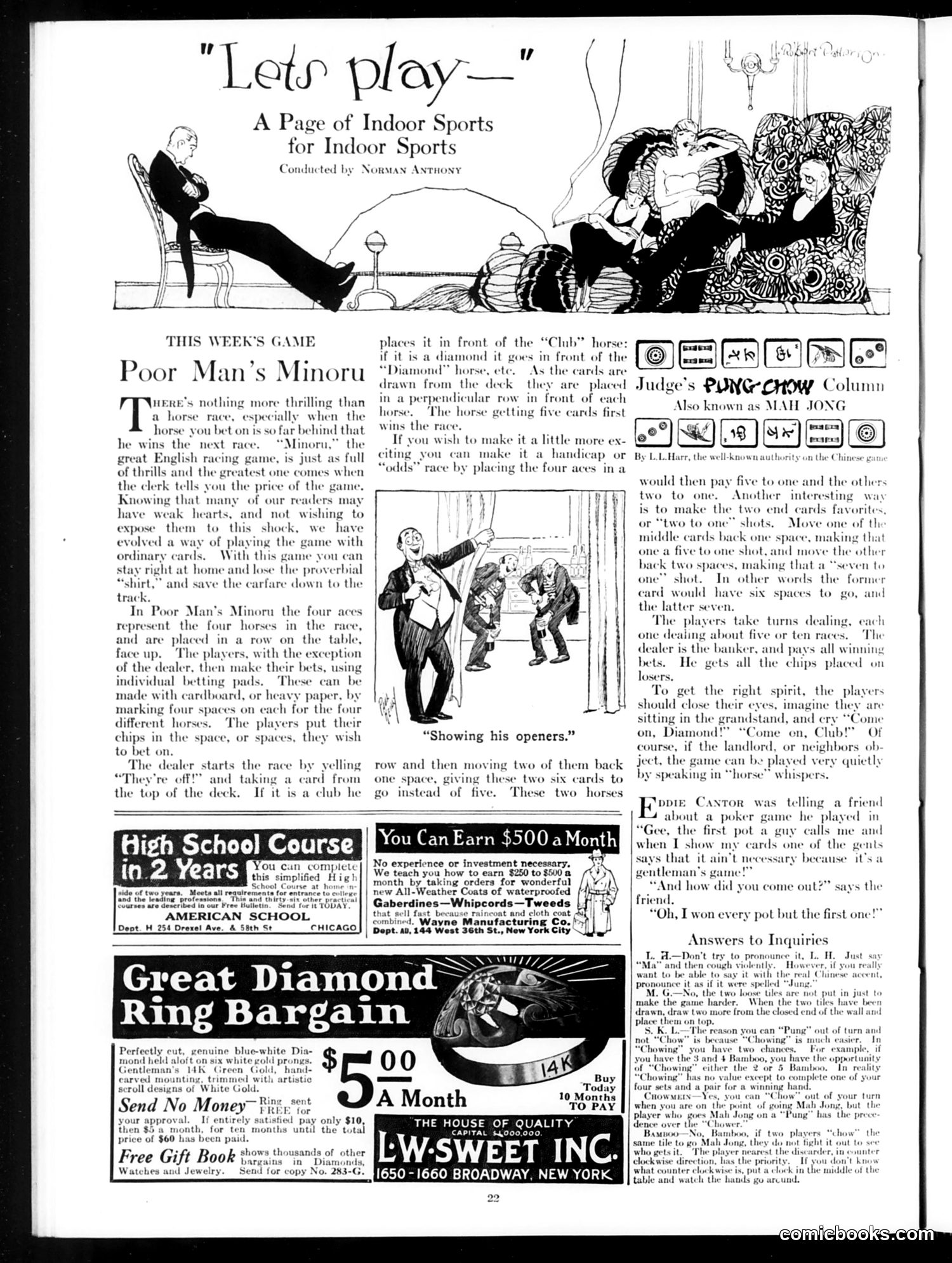
This page from Judge magazine presents home versions of popular gambling games for people unable to visit racetracks or casinos. The main feature, "Poor Man's Minoru," converts horse racing into a card game using the four aces to represent horses. Players make bets using cardboard chips on which horse (suit) will accumulate five cards first. A secondary feature, "Judge's Pung-Chow Column," explains rules for Mah Jong, a Chinese tile game gaining popularity in America during the 1920s-30s. The satirical angle targets wealthy leisure activities being democratized for ordinary people who lack access to actual racetracks or exclusive clubs. The title's irony—"Poor Man's Minoru" (Minoru being a famous racehorse)—underscores how working-class Americans improvised entertainment mimicking upper-class pastimes. The page also includes period advertisements for correspondence courses and jewelry sales.
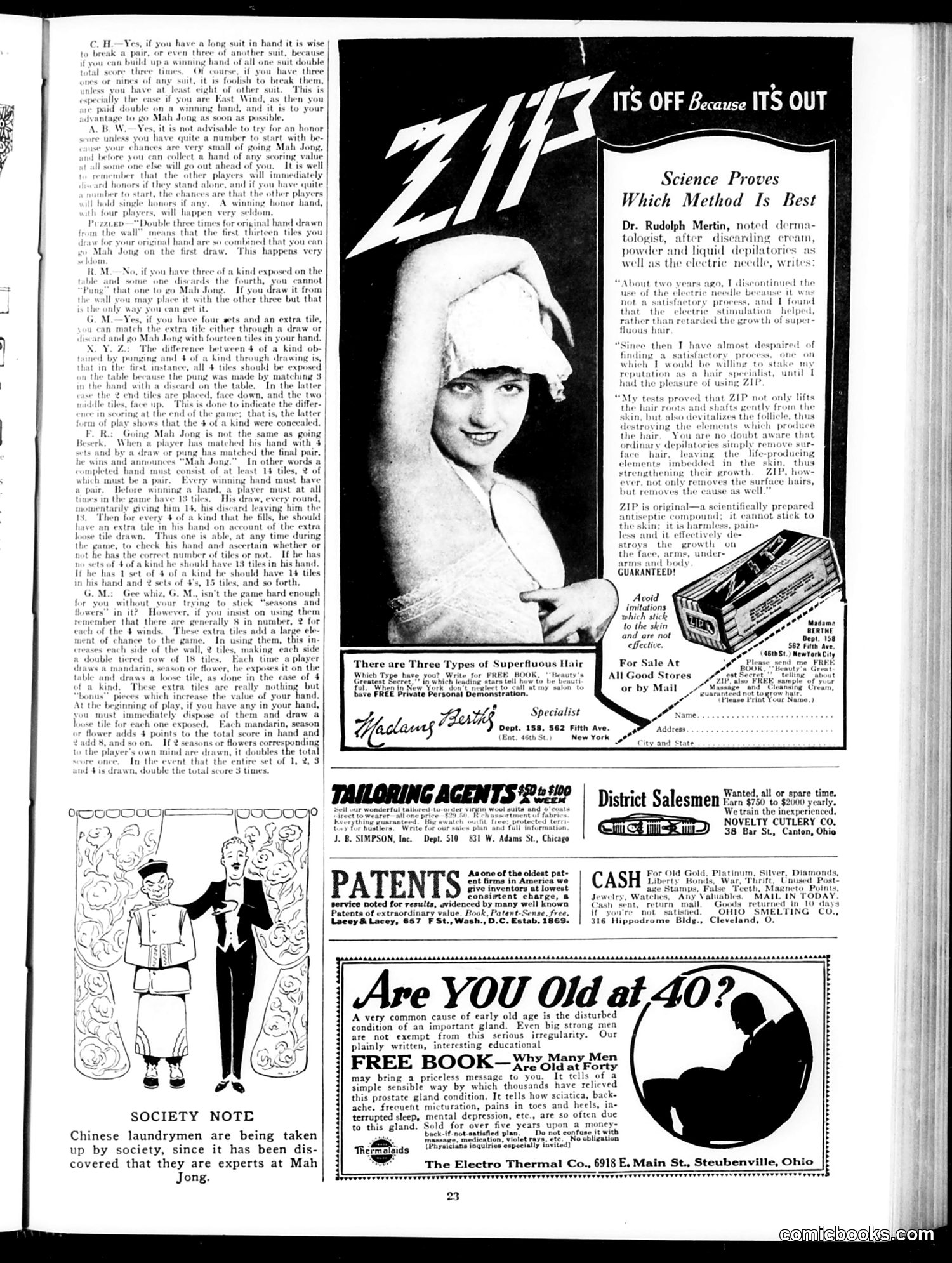
This page is primarily about **Mah Jong strategy and etiquette**, not political satire. The text column contains detailed Q&A rules for playing Mah Jong. The single cartoon (lower left) shows two well-dressed men surrounded by decorative panels labeled with Mah Jong tile designs, suggesting the game's association with Chinese culture and wealth. The **"Society Note"** reveals the satirical point: Chinese laundrymen—typically working-class immigrants—are now being socially elevated and invited to parties by wealthy Americans specifically because they're expert Mah Jong players. This reflects the 1920s craze for Mah Jong among affluent Americans seeking "Oriental" sophistication, while the immigrants themselves gained unexpected social standing through their skill at a game their employers suddenly valued. The remainder of the page contains product advertisements unrelated to the Mah Jong content.
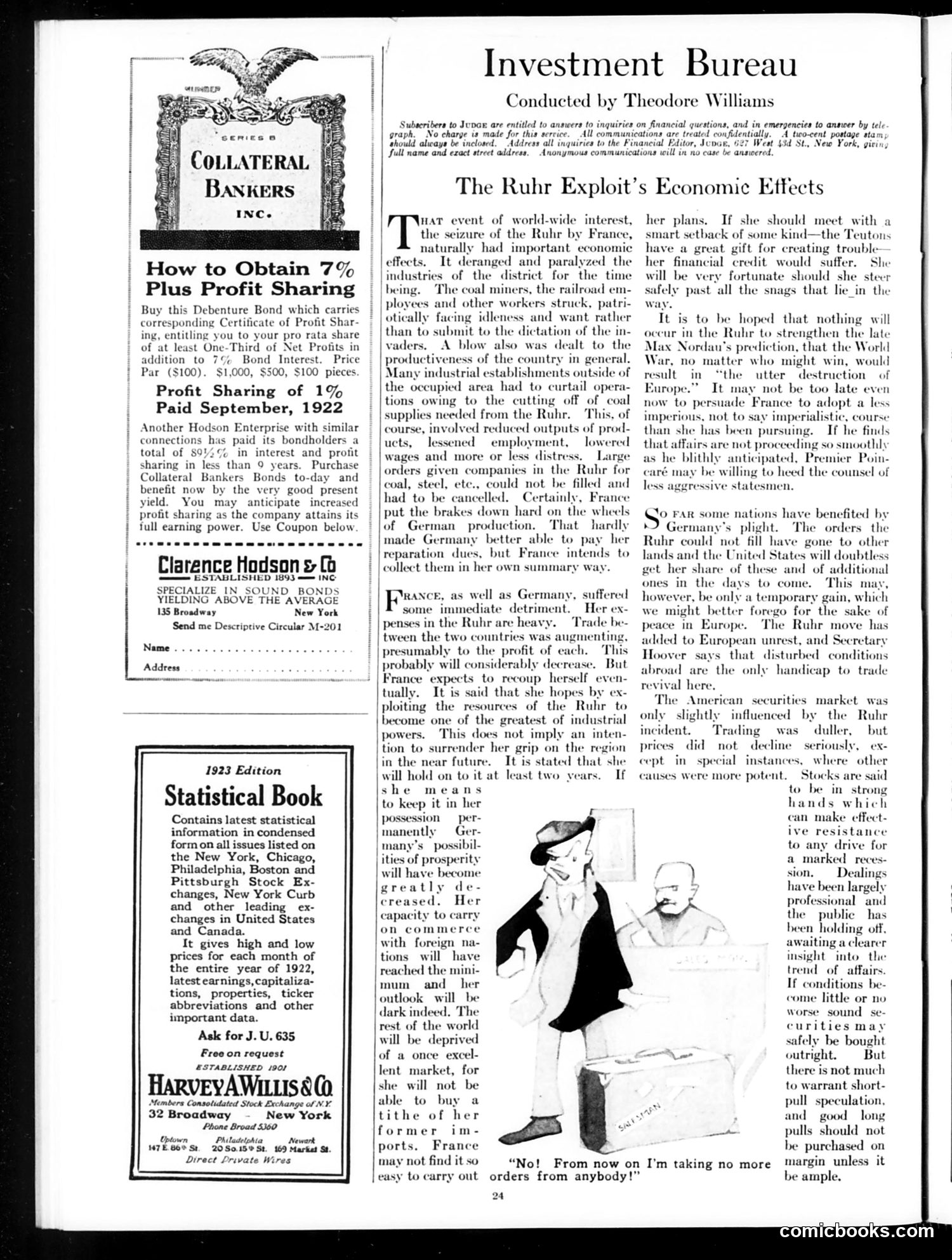
This article analyzes the 1923 French occupation of Germany's Ruhr Valley—a major industrial region—as reparation for World War I debts. The accompanying cartoon depicts a well-dressed French woman confidently confronting a distressed German man, illustrating France's aggressive seizure of German resources. The article explains the occupation's economic fallout: German coal miners and railroad workers struck in protest, industrial production collapsed, and companies across Germany lost access to critical Ruhr supplies. This disrupted international trade and affected American securities markets. The satire suggests France's shortsighted strategy: while seizing Ruhr resources to pay war debts and become an industrial power, the occupation actually *weakens* Germany's ability to repay those debts. The cartoon's caption—"Not from now on I'm taking no more orders from anybody!"—captures Germany's defiant but ultimately powerless resistance to French economic domination.
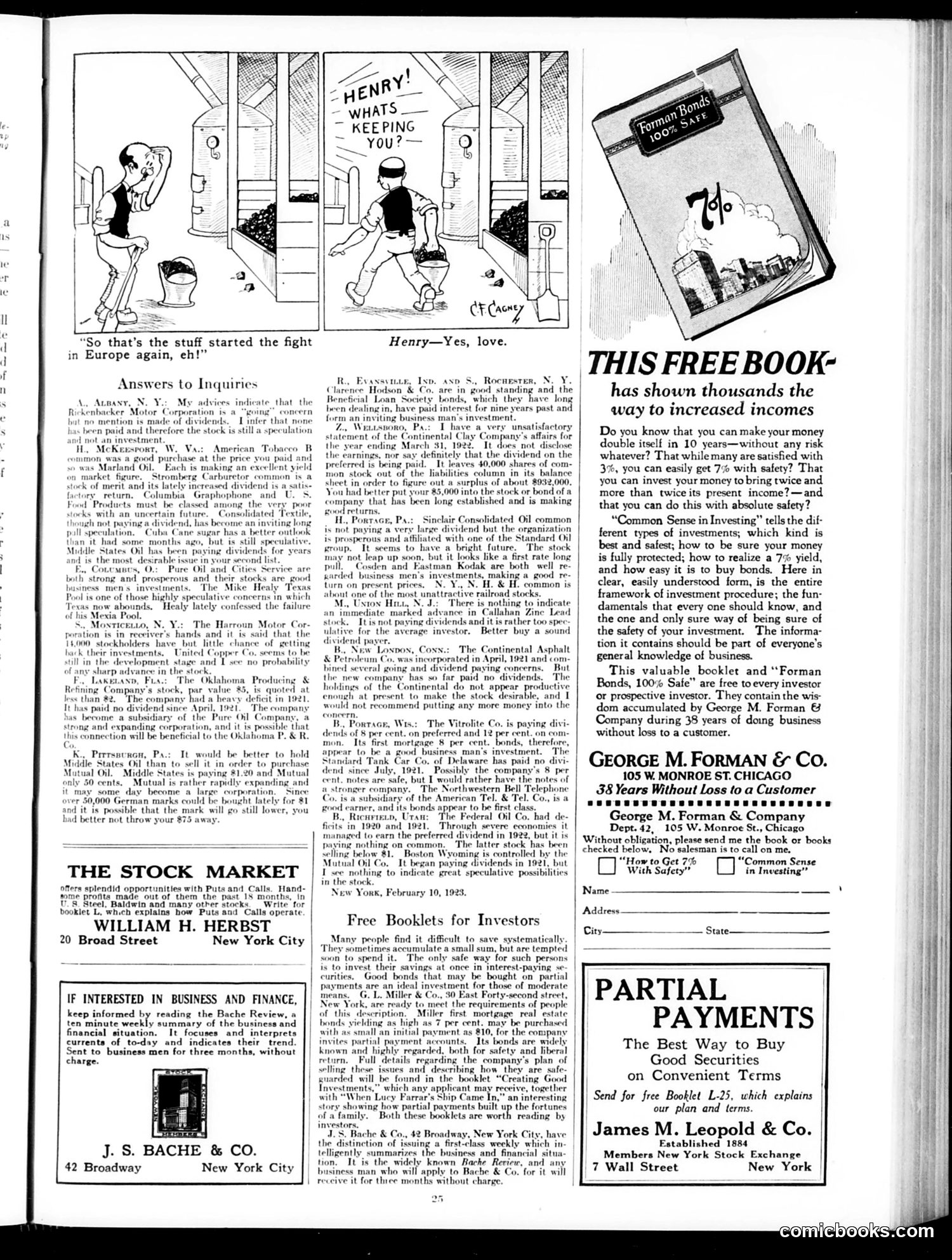
This page features a single cartoon by O. Cesare (signed lower right) depicting a domestic scene. A woman in a bathrobe stands near a bathroom doorway while a man in a hat and coat enters, asking "Henry! What's keeping you?" Henry responds from within: "Yes, love." **The Joke:** The cartoon plays on a common marital frustration—a spouse taking an excessively long time in the bathroom. The woman's impatient question and Henry's evasive non-answer ("Yes, love") suggest he's been hogging the bathroom while she waits. **Social Context:** This reflects early 20th-century domestic humor centered on household inconveniences. The cartoon mocks the typical male response to his wife's complaints: vague agreement without actually hurrying up. The surrounding content consists entirely of financial advice columns and investment advertisements, typical of Judge magazine's mixed editorial and advertising format during the post-WWI economic period.
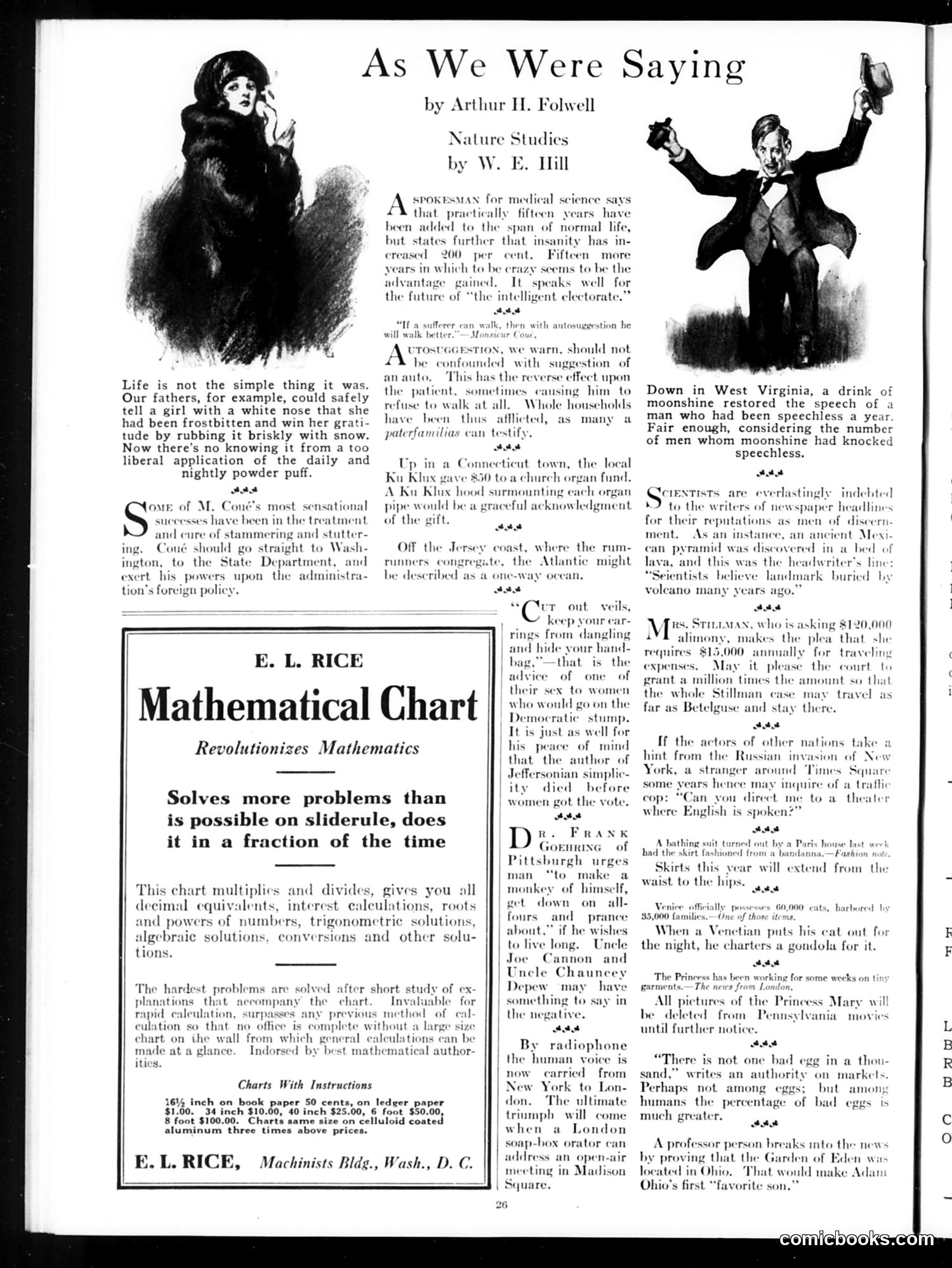
This is primarily a **humorous opinion/commentary page** rather than political cartoons. The main content comprises short satirical observations on contemporary life, with two illustrations by W.E. Hill accompanying the text. **Key satirical points:** - **Women's makeup**: Mocks modern women's heavy powder use, making it impossible to distinguish natural from artificial features - **Émile Coué's autosuggestion method**: Suggests the State Department should use Coué's stammering cure on its foreign policy communications - **Life expectancy vs. mental illness**: Notes that while lifespans increased 15 years, insanity rose 200%—implying modern life drives people crazy - **KKK donation**: Bitterly satirizes the Ku Klux Klan's $50 church donation as hypocritical - **Women voters**: Jokes that the Founding Fathers died before women could vote, implying they'd oppose women's suffrage - **Technology**: Predicts radiophone will eventually broadcast London street speakers to Madison Square—a joke about unwanted noise pollution The page reflects 1920s American anxieties about modernity, women's changing roles, and new technologies.
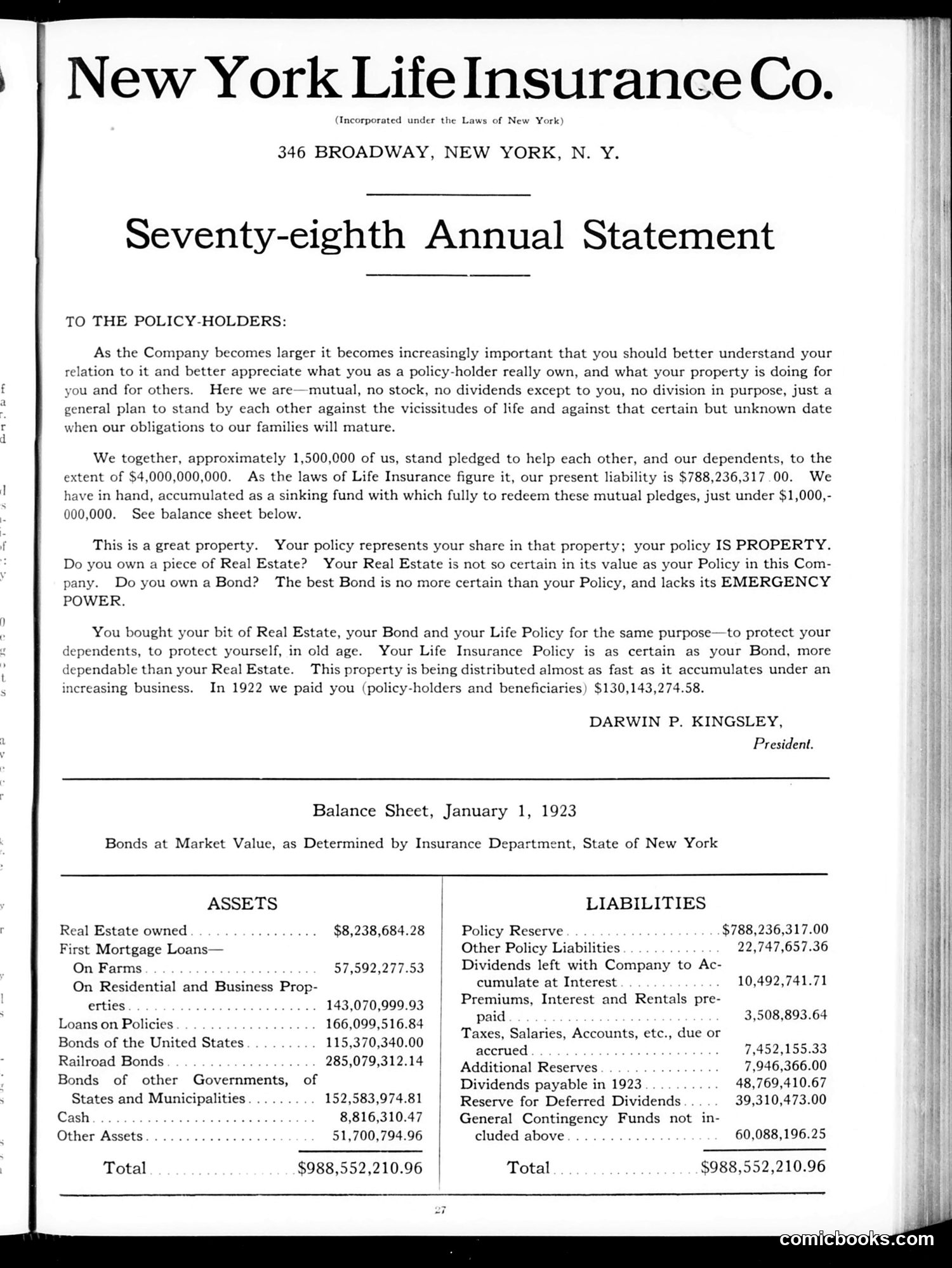
This page is **not a cartoon or satirical content**—it's a corporate advertisement disguised as a financial document. It's New York Life Insurance Co.'s 1923 annual statement to policyholders, written by President Darwin P. Kingsley. The persuasive text uses emotional appeals rather than satire. Kingsley argues that life insurance policies are superior to real estate or bonds because they offer "emergency power" and certainty. He emphasizes the company's mutual structure (no stock, profits returned to policyholders) and staggering scale: 1.5 million members collectively pledging $4 billion in protection. The balance sheet below demonstrates financial solidity—nearly $1 billion in reserves against $788 million in liabilities. **Context for moderns**: This reads like corporate PR, emphasizing stability during the 1920s economic boom. The repeated capitalization ("IS PROPERTY," "EMERGENCY POWER") suggests aggressive marketing toward middle-class Americans worried about family security and financial protection.
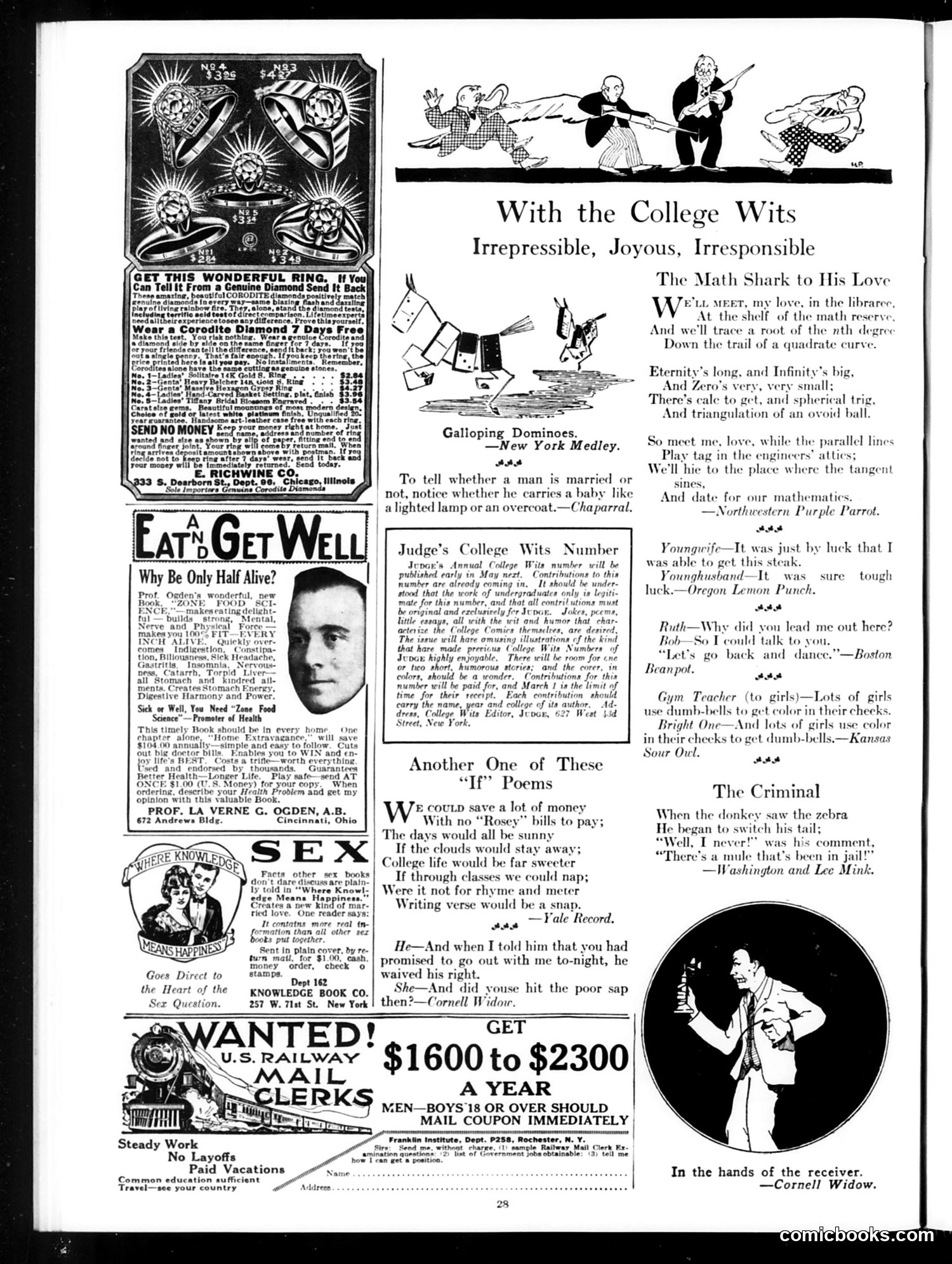
This is primarily a **humor section** rather than political satire. The page collects jokes and light verse from college newspapers, reflecting 1920s campus culture. **Main content:** - "The Math Shark to His Love": A parody romantic poem using mathematical terminology as flirtation ("parallel lines," "tangent sines") - "Galloping Dominoes" and other short jokes about college life, dating, and marriage - "Judge's College Wits Number": An editor's call for student contributions to an upcoming issue **Social context for modern readers:** The humor reflects era-appropriate dating customs (young men asking women out), academic life, and gender relations. The jokes assume familiarity with college courtship rituals and mathematical study. **Surrounding ads** for self-help books and job recruitment fill the page—typical 1920s magazine padding. **Notable:** The "Sex Question" book advertisement reflects period attitudes toward taboo subject matter. This is lighthearted collegiate humor, not political commentary.
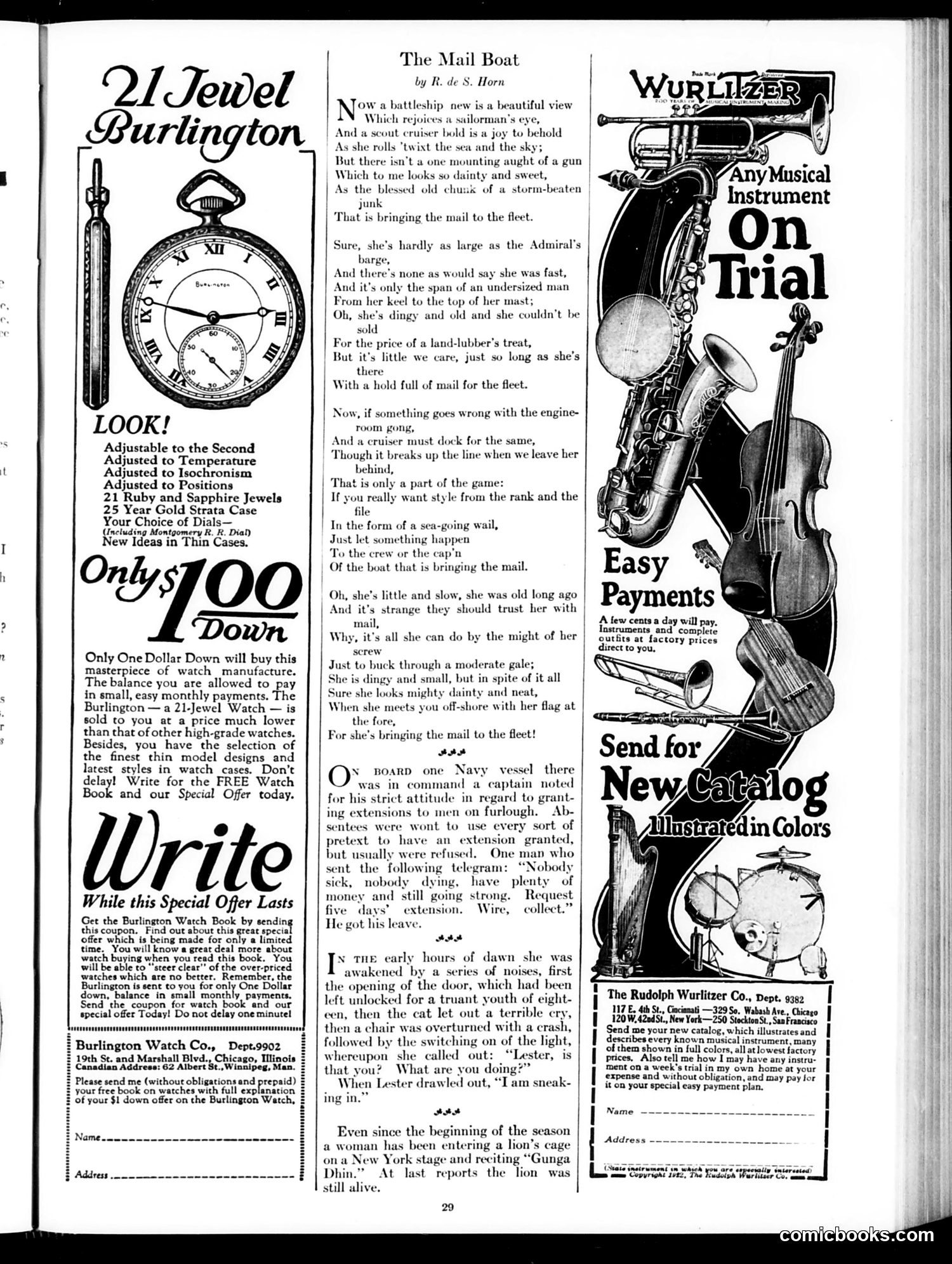
This page is primarily **advertising**, not political satire. The dominant content features two commercial ads: 1. **Burlington Watch** (left): Promotes an affordable 21-jewel watch at $1 down, targeting working-class consumers with installment payments—a common sales strategy of the era. 2. **Wurlitzer Musical Instruments** (right): Advertises instruments "on trial" with easy payment plans, similarly targeting middle-class buyers. The center contains **"The Mail Boat,"** a sentimental poem by R. de S. Horn celebrating the humble supply vessel that delivers mail to Navy fleet ships. The poem uses naval imagery (battleships, cruisers, scouts) to romanticize this unglamorous but essential service—appealing to patriotic sentiment during what appears to be the WWI era. No political cartoons or satirical commentary appears on this page. It's a straightforward commercial and literary content typical of *Judge* magazine's business model.
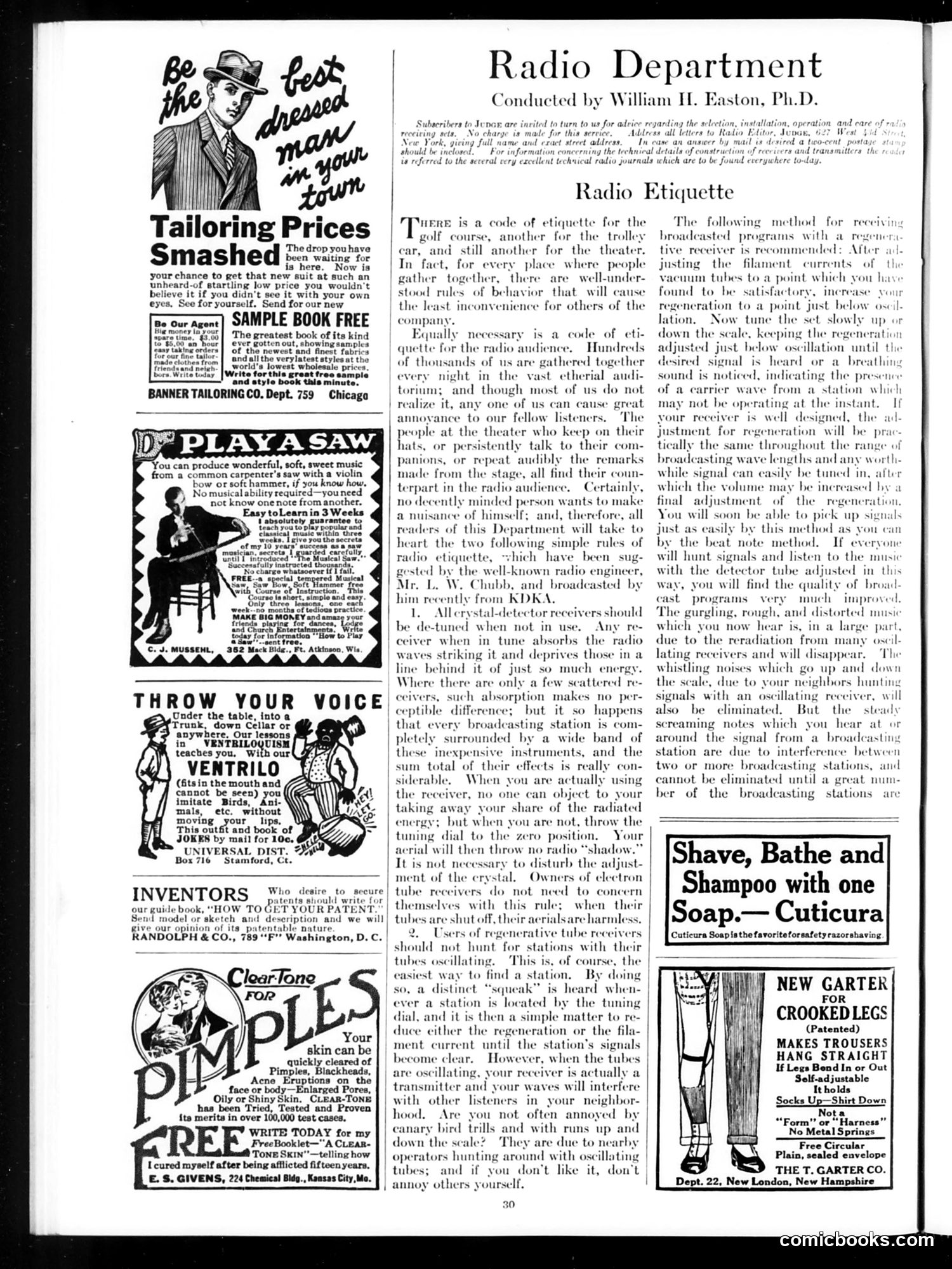
This page from *Judge* magazine presents an early "Radio Department" column offering etiquette guidance for radio listeners—a novel concern in the 1920s when radio broadcasting was new. The column, conducted by William H. Easton, Ph.D., establishes "rules of behavior" for radio audiences, comparing radio etiquette to established social codes (golf courses, theaters). **The two main rules discussed:** 1. **Turn off crystal radios when not in use** to avoid creating radio "shadows" that block signals to neighbors—an early recognition of signal interference and community responsibility in shared broadcast space. 2. **Don't unnecessarily disturb crystal receivers**, which were the common receiving technology of the era. The satire/humor lies in treating radio listening as requiring formal etiquette rules, applying stuffy social conventions to this brand-new domestic technology. The page also contains typical early-1920s advertisements (tailoring, ventriloquism lessons, acne treatment), reflecting the magazine's commercial nature.
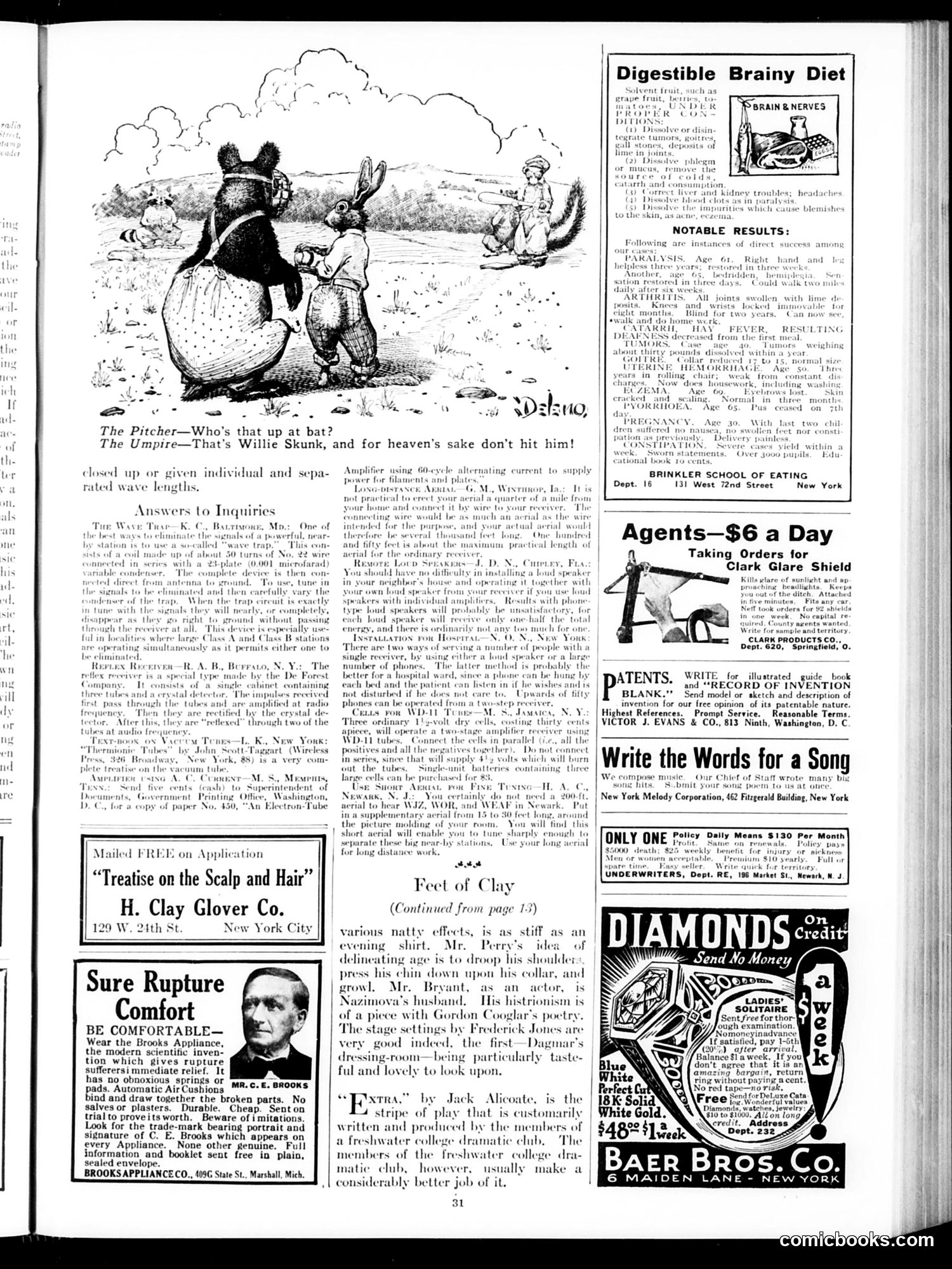
This page is primarily **advertising and advice columns** rather than political satire. The main cartoon depicts a baseball scene ("The Pitcher—Who's that up at bat?") with an umpire's response referencing "Willie Skunk," appearing to be a light humor piece rather than political commentary. The bulk of the page contains: - Health product advertisements (rupture comfort appliance, brainy diet treatment) - Technical advice columns on radio receivers and vacuum tubes - Patent and invention service ads - Song-writing and business opportunity pitches The "Feet of Clay" theater review discusses stage productions and acting performances. **No significant political satire or social commentary is evident.** This appears to be a typical early 20th-century magazine issue mixing humor, practical advice, and commercial advertising. The baseball cartoon is generic recreational humor rather than topical satire. The page reflects Judge's shift toward general-interest magazine content rather than the pointed political commentary the publication was historically known for.
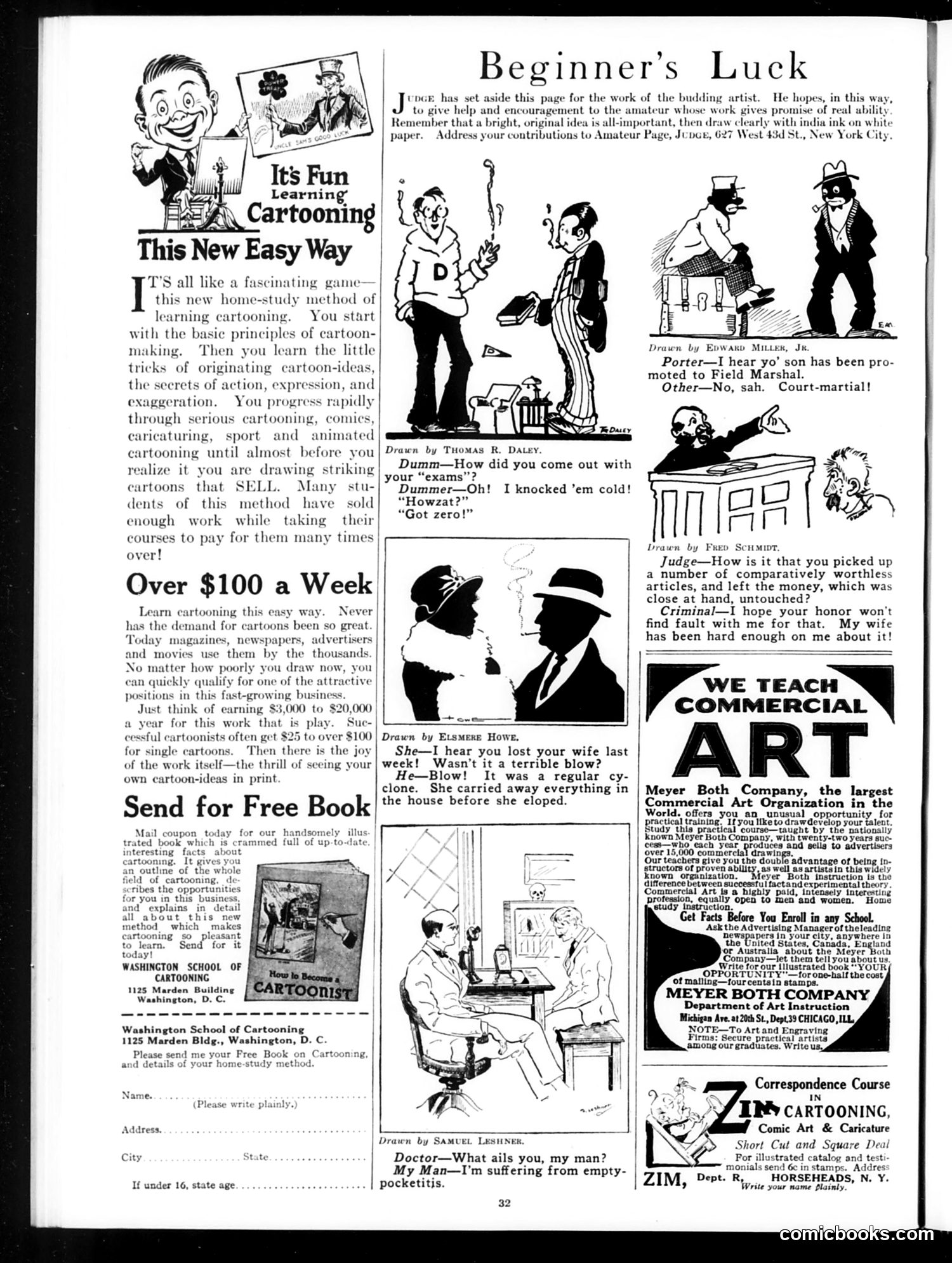
This is primarily a **advertisements and humor page** mixed together. The "Beginner's Luck" section features comic one-liners drawn by various cartoonists, each illustrating a joke or humorous situation: - A student claims he "knocked 'em cold" on exams but scored zero - A man lost his wife to elopement, describing it as a "cyclone" - A thief stole worthless items but left money behind—he fears his wife's disapproval more than the judge - A doctor's patient suffers from "empty-pocketitis" (poverty) - An African American man was promoted to "Field Marshal" (actually court-martialed—a play on words) The page primarily advertises **cartooning correspondence courses** (Washington School of Cartooning, Meyer Both Company, Zim's Cartooning). These ads emphasize earning "$100+ per week" and promise that cartooning skills can be quickly learned, appealing to Depression-era readers seeking income. The humor is gentle, working-class oriented, playing on marriage troubles, poverty, and military misunderstandings.
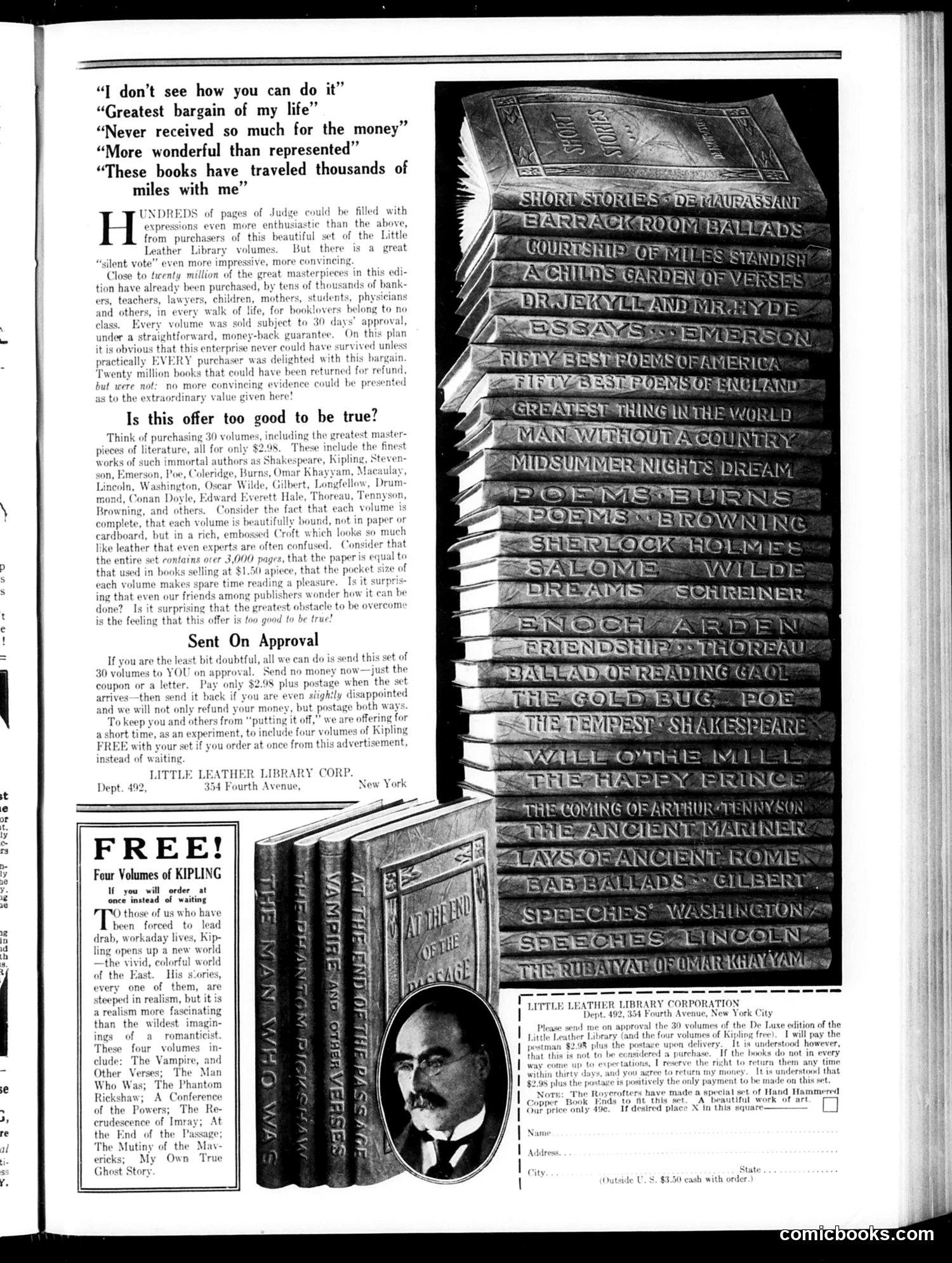
This page is primarily a **mail-order book advertisement**, not political satire. The Little Leather Library Corporation promotes a 30-volume set of classic literature (Shakespeare, Kipling, Emerson, etc.) for $2.98, sent on approval. The "cartoon" element is minimal—a stack of books photographed with their spines visible, and a portrait photo of what appears to be a man (likely a publisher or company representative, though unidentified in the visible text). **The satire/point**: The testimonial quotes ("Greatest bargain of my life," "Never received so much for the money") mock the exaggerated marketing claims. The text repeatedly asks "Is this offer too good to be true?"—itself acknowledging the offer *sounds* implausibly good. The emphasis on "20 million books sold" and "never returned" attempts to overcome reader skepticism about such an inexpensive premium product. This reflects early 20th-century direct-mail marketing tactics and consumer wariness toward too-good-to-be-true deals. The irony is the advertisement's awareness of its own implausibility.
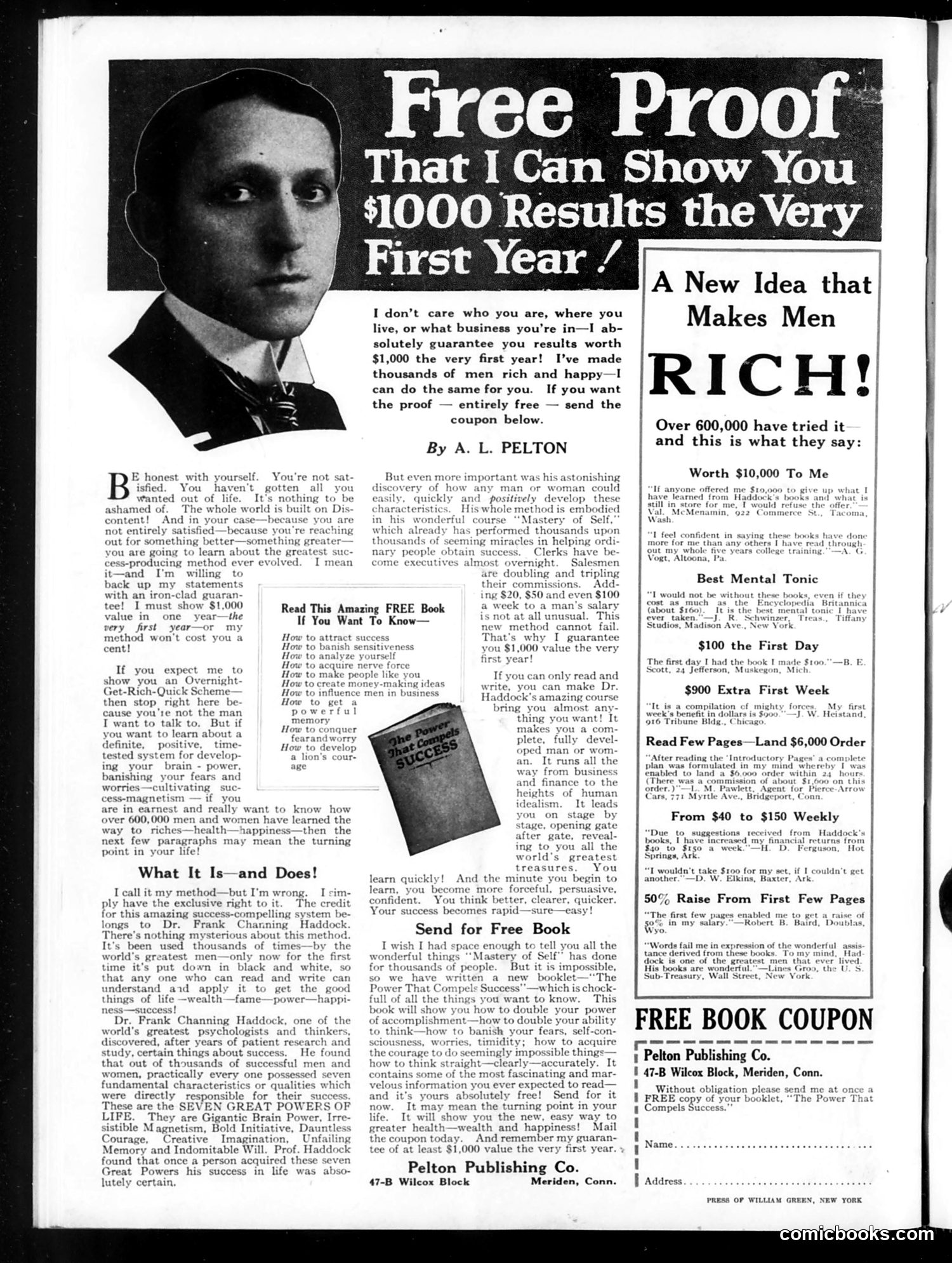
This page is primarily **advertising**, not satire or political commentary. It promotes A.L. Pelton's self-help book "The Power That Compels Success" through the Pelton Publishing Company. The advertisement uses classic early-20th-century direct-mail marketing tactics: a stern-faced photograph of the author, testimonials from supposed satisfied customers, claims of guaranteed wealth ($1,000 in the first year), and a free coupon. The rhetoric promises to unlock hidden mental powers and transform readers' lives through positive thinking and self-improvement. While not satirical itself, the ad represents the type of "get-rich-quick" scheme that satirical publications like *Judge* likely mocked elsewhere. The hyperbolic promises—600,000 people supposedly using it, salesmen tripling commissions overnight, $6,000 orders from reading a few pages—strain credibility even by period standards. This reflects early American consumer culture's appetite for self-improvement products marketed through pseudoscientific claims about "brain-power" and "success-magnetism."