
Judge, 1923-02-17 · page 5 of 36
Judge — February 17, 1923 — page 5: what you’re looking at
What you’re looking at
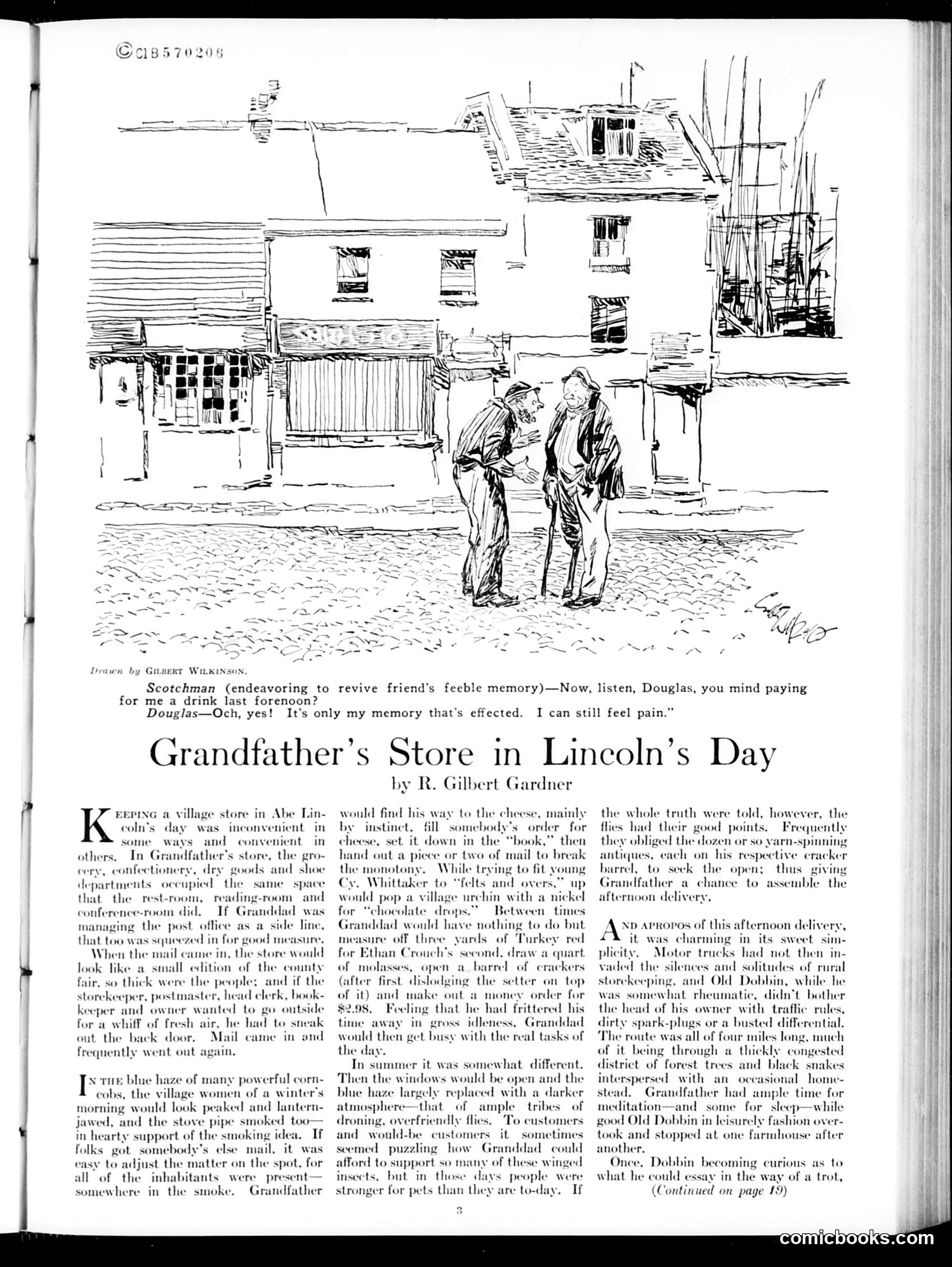
The cartoon depicts two men in conversation on a rural street. The dialogue addresses memory and pain: one man (identified as "Scotchman") asks if his friend Douglas remembers buying him a drink, and Douglas responds that while his memory is affected, he can still feel physical pain. This appears to be a **memory-and-aging joke** common to period humor—playing on the stereotype of Scottish frugality (the Scotchman hoping Douglas has forgotten the drink debt) combined with the universal experience of aging bodies retaining pain sensation even as mental recall fades. The accompanying story, "Grandfather's Store in Lincoln's Day," is a nostalgic piece about rural commerce and village life, seemingly unrelated to the cartoon above.
📄 Transcribed text from this page (OCR, searchable)
Machine-transcribed from the original scan — historical spelling and the odd misread are preserved.
Drawn by GILBERT WILKINSON Scotchman (endeavoring to revive friend’s fecble memory)—Now, listen, Douglas, you mind paying for me a drink last forenoon? Douglas—Och, yes! It’s only my memory that’s effected. I can still feel pain.” Grandfather’s Store in Lincoln’s Day id EEPING a village store in Abe Lin- coln’s day was inconvenient in some W others. In Grand: . confectioner: riments eceuy readin, ring the post offi too was squeezed in fe room iddad was. side line, vod measure, ds convenient in her’s store, the gro- yy goods and shoe nd ha Jhen the mail came in, the store would » look like a small edition of the county fair, so thick were the people keeper and owner wan and if the storekeeper, postmaster, head clerk, book- dd to go outside for a whiff of fresh air, he had to sneak out the back door, frequently went out Mail came in and I tue blue haze of many powerful corn- morning would look peaked and I jawed, and the stove pipe smoke ty support of the smoking bs, the village women of a winter's all of the inhabitants were present— somewhere in the smoke. | in he lea, folks got somel ‘semi as sasy to adjust the matter on the spot, for Grandfather by R. Gilbert Gardner would find his way to the cheese, mainly by instinct, fill somebody's. order for cheese, set it down in the “book,” then hand out a piece or two of mail to break the monotony. While trying to fit young Cy. Whittaker to “felts and overs,” up would pop a village urchin with a nickel for “chocolate dr Between times Granddad would have nothing to do but rds of Turkey red nd. draw a quart barrel of crackers the setter on top ke out a money order for that he had frittered his way in gross idleness, Granddad would then get busy with the ks of the day. In summer it was somewhat different. Then the windows would be open and the blue haze largely replaced with a darker atmosphere—that of ample tribes of droning, overfriendly flies. 'To customers and would-be customers it sometimes seemed puzzling how Granddad could afford to support so many of these winged insects, but in tl days people wei stronger for pets than they are to-day. If the whole truth were told, however, the flies had their good points. Frequently they obliged the dozen or so yarn-spinning antiques, each on his respective cracker barrel, to seek the open; thus giving Grandfather a chance to assemble the afternoon delivery. Np Apropos of this afternoon deliv it was charming in its sweet sim- y. Motor trucks had not then in- 1 the silences and solitudes of rural storekeeping, and Old Dobbin, while he was somewhat rheumatic, didn’t bother the head of his owner with t rules, dirty spark-plugs or a busted differential. The route was all of four miles long, much of it being through a thickly congested district of forest trees and black snakes interspersed with an occasional home- stead. Grandfather had ample time for meditation—and some for sleep—while good Old Dobbin in leisu fashion over- took and stopped at one farmhouse after another. Once, Dobbin becoming curious as to what he could essay in the way of a trot, (Continued on page 19)