
Judge, 1923-02-17 · page 15 of 36
Judge — February 17, 1923 — page 15: what you’re looking at
What you’re looking at
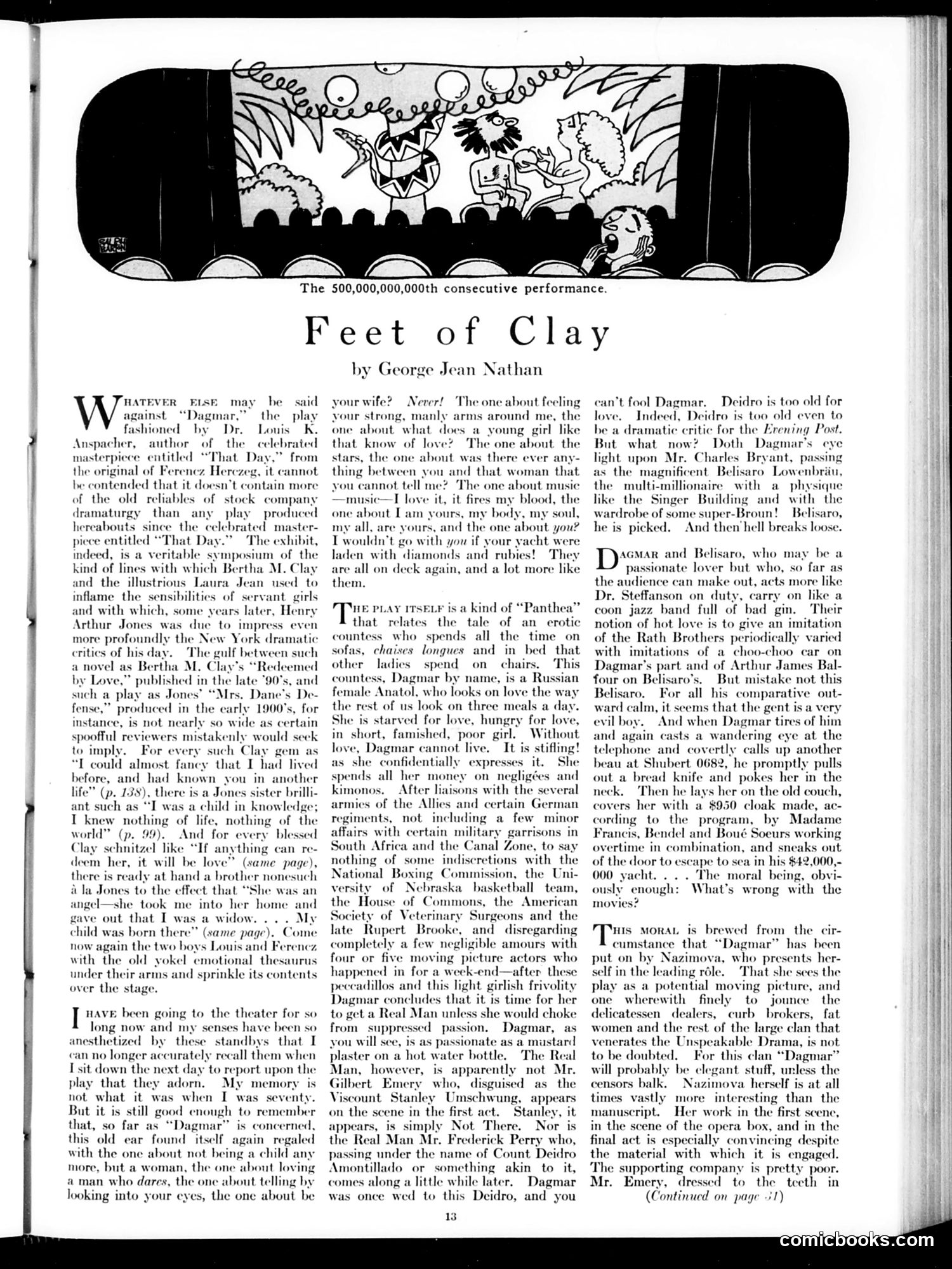
This page contains a theater review by George Jean Nathan (a prominent early-20th-century drama critic) of the play "Dagmar," satirizing its melodramatic conventions. **The cartoon** (top) shows the "500,000,000,000th consecutive performance"—hyperbolic mockery of how formulaic and endlessly repetitive such plays are. **Nathan's satire targets:** - The play's reliance on hackneyed stock situations and dialogue inherited from 19th-century pulp fiction (specifically Bertha M. Clay's serialized novels, which inflamed "servant girls'" sensibilities) - Its central character, Dagmar, a Russian countess obsessed with love/romance, who exists primarily on "sofas, chaises longues and in bed" - The parade of clichéd romantic lines: "I am yours, my body, my soul," "what does a young girl know of love?"—tired formulas recycled since the 1890s **The point:** Nathan argues the play offers nothing fresh, merely reheating decades-old melodramatic conventions for contemporary audiences, making it essentially artistic fraud dressed up as drama.
📄 Transcribed text from this page (OCR, searchable)
Machine-transcribed from the original scan — historical spelling and the odd misread are preserved.
a a The 500,000,000,000th consecutive performance. Feet of Clay HATEVER ELSE may be said ainst. “Dagmar,” the play hiened by Dr. Louis author of | the entitled of Ferencez Herezeg, it cannot be contended that it doesn’t contain more of the old reliables of stock company dramaturgy than any play produced hereabouts since the celebrated master- piece entitled it Day.” The exhibit, indeed, is a veritable symposium of the kind of lines with which Bertha M. Clay and the illustrious ra n used to inflame the sensibilities of servant. girls and with which, some years later, Henry Arthur Jones was due to impress even more profoundly the New York dramatic critics of his day. The gulf between such a novel as Bertha M. Clay’s “Redeemed by Lo published in the late °90) nd as Jones’ “Mrs. Dan De- * produced in the early 1900's, for instance, is not nearly so wide as certain spoofful reviewers mistakenly would seck to imply. For every such Clay gem as “T could almost fancy that I had lived before, and had known you in another life” (p. 138), there is a Jones sister brilli- ant such as “I was a child in knowle: I knew nothing of life, nothing of the world” (p. 99). And for every blessed Clay schnitzel like “If anything can re- deem her, it will be love” (same page), there is ready at hand a brother nonesuch a la Jones to the effect that “She was an angel—she took me into her home and gave out that I was a widow... . My child was born there” (same page). Come now again the two boys Louis and Ferenez with the old yokel emotional thesaurus under th ins and sprinkle its contents over the stage, “That Day,” from celebrat Anspacher, masterpiec the origi I HAVE been going to the theater for so long now and my senses have been so anesthetized by these standbys that I can no longer accurately recall them when I sit down the next day to report upon the play that they adorn. My memory is hot what it was when I nty. But it is still good enough to remember that, so far as “Dagmar” is concerned this old ear found itself again regal with the one about not being a child any more, but a woman, the one about loving aman who dares, the one about telling by looking into your eyes, the one about be by George Jean Nathan your wife? Never! The one about feeling your strong, manly arms around me, the one about what does a young girl like that know of love? The one about the stars, the one about was there ever any- thing between you and that woman that you cannot tell me? The one about music love it, it fires my blood, the . my soul, about you? —music—I one about Lam yours, my my all, are yours, and the one I wouldn't go with you if your yacht were laden with diamonds and rubies! They are all on deck again, and a lot more like them. T2 PLAY ITSELF is a kind of ‘Panthea” that relates the tale of an erotic countess who spends all the time on sofas, chaises longues and in bed that other spend on chairs, This countess, Dagmar by name, is a Russian female Anatol, who looks on love the way the rest of us look on three meals a day. She is starved for love, hungry for love, in short, famished, poor girl. Without love, Dagmar cannot live. It is stifling! as she confidentially expresses it. She spends all her money on negligées and kimonos. After liaisons with the several armies of the Allies and certain German regiments, not includi a few minor affairs with certain military garrisons in South Africa and the I Zone, to say nothing of some indiscretions with the National Boxing Commission, the Uni- versity of Nebraska basketball t the House of Commons, the Americ Society of Veterinary Surgeons and the Jate Rupert Brooke, and disregarding completely a few negligible amours with four or five moving picture actors who happened in for a week-end—after these peceadillos and this light girlish frivolity Dagmar conchides that it is time for her to get a Real Man unless she would choke from suppressed passion. Dagmar, as you will see, is as passionate as a mustard plaster on a hot water bottle. The Real Man, however, is apparently not Mr. Gilbert Emery who, disguised as the Viscount Umschwung, appears on the scene in the first act. Stanley, it appears, is simply Not There. Nor is the Real Man Mr. Frederick Perry who, passing under the name of Count Deidro Amontillado or something akin to it, comes along a little while later. Dagmar was once wed to this Deidro, and you ladies 13 Deidro is too old for Deidro is too old even to critic for the Evening Post. can’t fool Dagmar. love. Ind he a drat But what now? Doth D . light upon Mr. Charles Bryant, passit as the magnificent Belisaro. Lowenbriiu, the multimillionaire with a physique like the Singer Building and with the wardrobe of some super-Broun! — Belisaro, he is picked. And then hell breaks loose. Ds and Belisaro, who may be a passionate lover but who, so far as the audience can make out, acts more like Dr. Steffanson on duty, carry on like a coon jazz band full of bad gin. Their notion of hot love is to give an imitation of the Rath Brothers periodically varied with imitations of a choo-choo car on Dagmar’s part and of Arthur James Bal- four on Belisaro’ But mistake not this Belisaro. For all his comparative out- ward calm, it scems that the gent is a very evil boy. And when Dagmar tires of him and again casts a wandering eye at the telephone and covertly calls up another beau at Shubert 0682, he promptly pulls out a bread knife and pokes her in the nm Then he lays her on the old couch, covers her with a $950 cloak made, ac cording to the program, by Made Francis, Bendel and Boué Soeurs working overtime in combination, and sneaks out of the door to escape to sea in his ,000,- 000 yacht... . The moral being, obvi- ously enough: What's wrong with the movie Ts MORAL is brewed from the cir- cumstance that “Dagmar” has been put on by Nazimova, who presents her- self in the leading ré) That she sees the play as a potential moving picture, and one wherewith finely to jounce. the delicatessen dealers, curb brokers, fat women and the rest of the large that venerates the Unspeakable Drama, is not to be doubted. For this clan “Dagmar” will probably be elegant stuff, unless the k. Nazimova herself is at all censors times vastly more interesting than the manuscript. Her work in the first scene, in the scene of the opera box, and in the final act is especially convincing despite the material with which it is engaged. The supporting company is pretty poor. Mr. Emery, dressed to the teeth in (Continued on page -i1)