
Judge, 1923-02-17 · page 14 of 36
Judge — February 17, 1923 — page 14: what you’re looking at
What you’re looking at
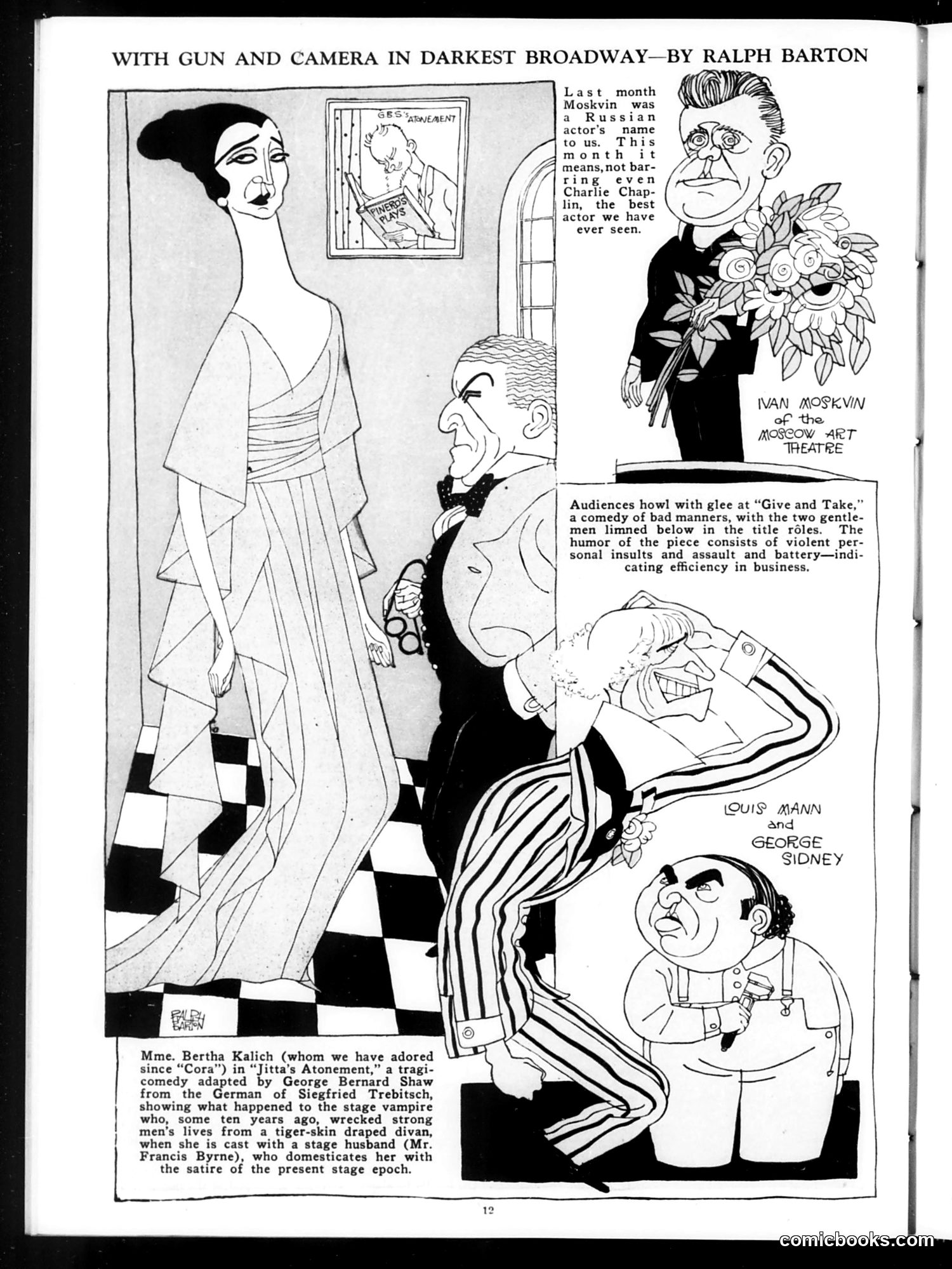
This page reviews contemporary Broadway productions. The top section praises Russian actor Ivan Moskvin of the Moscow Art Theatre as exceptionally talented—remarkably so, even compared to Charlie Chaplin. Below, caricatures of Louis Mann and George Sidney promote their comedy "Give and Take," which apparently relies on physical comedy: violent insults and stage violence as humor about business efficiency. The bottom section reviews Bertha Kalich in "Jitta's Atonement," adapted by George Bernard Shaw from a German play. The satire mocks the "stage vampire" archetype—the seductive woman who ruined men's lives from her "tiger-skin draped divan." The joke is that she's now domesticated by a conventional stage husband, rendering her dangerous allure harmless. This reflects early 20th-century anxieties about female sexuality and morality. All three reviews use exaggerated caricature drawing typical of Judge's satirical style.
📄 Transcribed text from this page (OCR, searchable)
Machine-transcribed from the original scan — historical spelling and the odd misread are preserved.
Last month Moskvin was a Russian actor’s name tous. This month it means, not bar- ring even Charlie Chap- lin, the best actor we have ever seen. IVAN MOSKVIN. of the MOSCOW ART TREATRE Audiences howl with glee at “Give and Take,” a comedy of bad manners, with the two gentle- men limned below in the title réles. The humor of the piece consists of violent per- sonal insults and assault and battery—indi- | cating efficiency in business. _“s Sib = © eS) \ OUI MANN and GEORGE — SIDNEY \ Mme. Bertha Kalich (whom we have adored since “Cora”) in “Jitta’s Atonement,” a tragi- comedy adapted by George Bernard Shaw from the German of Siegfried Trebitsch, | showing what happened to the stage vampire who, some ten years ago, wrecked strong ! men's lives from a tiger-skin draped divan, when she is cast with a stage husband (Mr. Francis Byrne), who domesticates her with the satire of the present stage epoch. Te ee an ve