
Judge, 1923-02-17 · page 17 of 36
Judge — February 17, 1923 — page 17: what you’re looking at
What you’re looking at
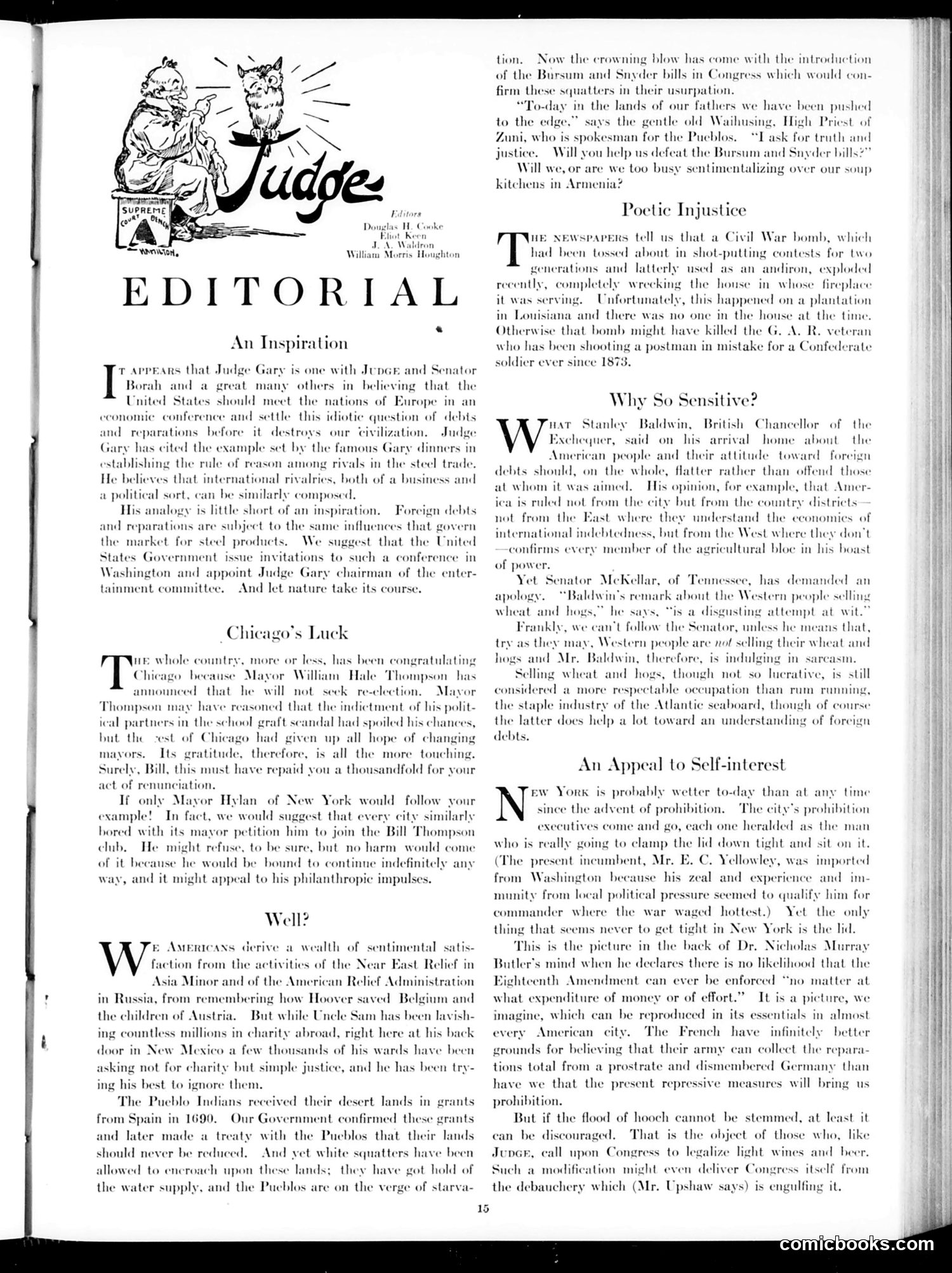
This editorial page from *Judge* magazine contains several satirical pieces criticizing American political and social issues: **The "Judge" Masthead Cartoon** shows an owl labeled "Supreme" — likely representing judicial wisdom or authority. **"An Inspiration"** mocks Judge Elbert Gary's proposal that the U.S. hold an economic conference to settle European war debts and reparations. The satire suggests applying his "rule of reason" from steel industry negotiations to international affairs is naively simplistic. **"Chicago's Luck"** sarcastically congratulates Mayor William Hale Thompson for announcing he won't seek re-election, implying his political partners faced indictment for school graft scandals. The piece suggests other cities should similarly pressure their mayors to resign. **"Well?"** criticizes American charity abroad (Near East Relief, Armenia) while ignoring injustices at home—specifically the Pueblo Indians' land rights being threatened by the Bursum-Snyder bills in Congress, which would confirm white squatters' claims to indigenous lands. The overall theme: America should address its own moral failures before congratulating itself on international generosity.
📄 Transcribed text from this page (OCR, searchable)
Machine-transcribed from the original scan — historical spelling and the odd misread are preserved.
= wivion, EDITORIAL « An Inspiration rT appears that Judge Gary is one with JepGe and Senator Borah and a great many others in’ believing that the United States should meet the nations of Europe in an economic conference nd settle this idiotic question of debts and reparations before it destroys our civilization. Judge Gary has cited the example set by the famous Gary dinners in establishing the rule of reason among rivals in the steel trade. He believes that international rivalries, both of a business and a political sort, can be similarly composed. His analogy is little short of an inspiration. For and reparations are subject to the same influences that govern the market for steel products. We suggest that the United States Government issue invitations to such a conference in Washington and appoint Judge Gary chairman of the enter- And let nature take its course. tainment committee, Chicago's Luck ne whole country, more or less, has been congratulating Chieago because Mayor William Hale ‘Thompson has announced that he will not seek re Mayor ction. Thompson may have reasoned that the indictment of his polit- ical partners in the school graft scandal had spoiled his chance: but the cest of Chicago had given up all hope of chan; Its gratitude, therefore, is all the more touching. mayors. Surely, Bill, this must have repaid you a thousandfold for your act of renunciation. If only Mayor Hylan of New York would follow your example! In fact, we would suggest that every city similarly bored with its mayor petition him to join the Bill ‘Thompson cub. He might refuse, to be sure, but no harm would come of it because he would be bound to continue indefinitely any way, and it might appeal to his philanthropic impulses. W in Russia, from rememberi the children of Austria. But while Uncle Sam has been lavish- ing countless millions in charity abroad, right here at his back Well? FE AMERICANS derive a wealth of sentimental satis- ction from the activities of the Near East Relief in sia Minor and of the American Relief Administration how Hoover saved Belgium and door in New Mexico a few thousands of his wards have been asking not for charity but simple justice, and he has been try ing his best to ignore them. The Pueblo Indians re from Spain in 1690, Our Government confirmed these grants sived their desert lands in grants and later made a treaty with the Pueblos that their lands should never be reduced, And yet white squatters have been allowed to encroach upon these lands; they have got hold of of slarva- the water supply, and the Pueblos are on the verg 15 tion. Now the crowning blow has come with the introduction of the Bursum and Snyder bills in Congress which would con- firm these squatters in their usurpation. “To-« to the edge.” says the gentle old Waihusing, High Priest of Zuni, who is spokesman for the Pueblos. “Task for truth and justice. Will you help us defeat the Bursum and Snyder bills?” Will we, or are we too busy sentimental kitchens in Armenia? y in the lands of our fathers we have been pushed vitig OVEN oir Soup Poetic Injustice HE NeEwsparers tell us that a Civil War bomb, which 1 been tossed about in shot-putting contests for two nerations and latterly used as an andiron, exploded recently, completely wrecking the house in whose fireplace it was serving. Unfortunately, this happened on a plantation in Louisiana and there was no one in the house at the tir ght have killed the G. A. R. veteran postman in mistake for a Confederate Otherwise that bomb m who has been shooting soldier ever since 1873. Why So Sensitive? Hat Stanley Baldwin, British Chancellor of | the Exchequer, said on his arrival home about — the American people and their attitude toward foreign debts should, on the whole, flatter rather than offend those His opinion, for example, that Amer- at whom it was aimed. ica is ruled not from the city but from the country distriets not from the East where they understand the economies of international indebtedness, but from the West where they don’t confirms every member of the agricultural bloc in his boast of power. itor MeKellar, of Tennessee, has demanded an Baldwin's remark about the Western people selling do hogs,” he says, “is a disgusting attempt at wit.” Frankly, we ean't follow the S s that, try as they may, Western people are nof selling their wheat and id Mr. Baldwin, therefore, is indulg Hing wheat and hogs, though not so lucrati Sunless hem hogs g in sar considered a more respectable occupation than rum running, the staple industry of the Atlantic seaboard, though of course the latter does help a lot toward an understanding of foreign debts. An Appeal to Self-interest EW York is probably wetter to-day than at any time since the advent of prohibition. The city’s prohibition executives come and go, each one heralded as the man to clamp the lid down tight and sit on it. who is really goi (The present incumbent, Mr. from Washington because his 2 Yellowley, was imported al and experience and im- munity from local political pressure seemed to qualify him for commander where the war waged hottest.) Yet the only thing that seems never to get tight in New York is the lid. This is the picture in the back of Dr. Nicholas Murra) Butler's mind when he declares there is no likelihood that the Eighteenth Amendment can ever be enforced “no matter at It is a picture, we what expenditure of money or of effort ne, which can be reproduced in its essentials in almost American city. The French have infinitely better grounds for believing that their army can collect: the repara- tions total from a prostrate and dismembered Germany than have we that the present repressive measures will bring us prohibition. But if the flood of hooch cannot be stemmed, at least it That is the object of those who, like June, call upon Congress to legalize light wines and beer. Such the de can be discouraged. ication might even deliver Congress itself from modi ichery which (Mr. Upshaw says) is engulfing it.