
Judge, 1923-02-17 · page 11 of 36
Judge — February 17, 1923 — page 11: what you’re looking at
What you’re looking at
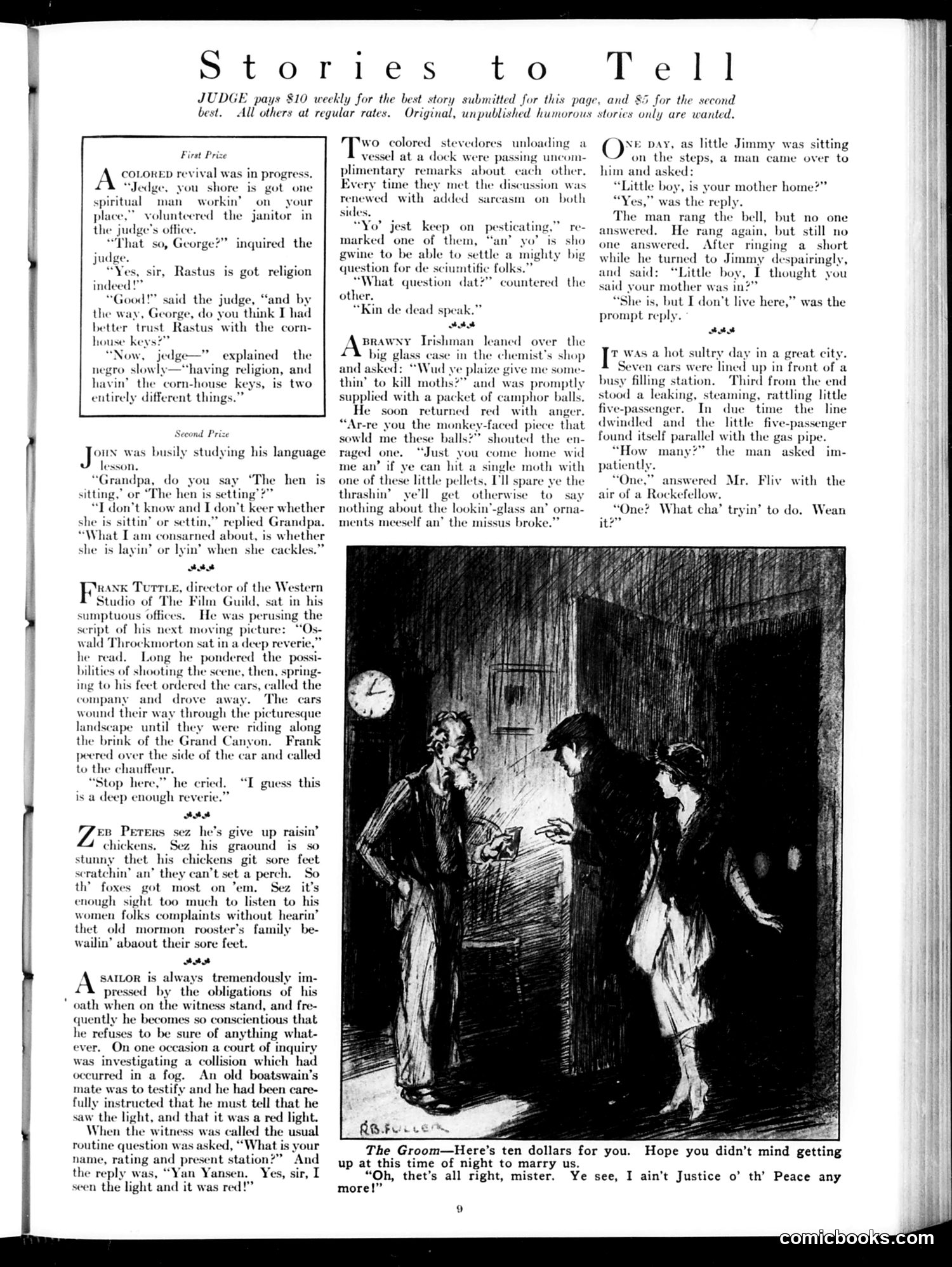
This page from *Judge* contains humorous short stories submitted by readers, not political cartoons. The content is entirely satirical fiction showcasing dialect humor popular in early 20th-century American comedy. The stories mock **racial and ethnic stereotypes** through exaggerated dialect: - African American characters ("colored stevedores," "Rastus") speak in phonetic, broken English - An Irish immigrant ("Brawny Irishman") is portrayed as dim-witted - A Mormon farmer is depicted as foolish The single illustration depicts a groom marrying at night—a joke about reluctant, hasty marriages where the groom jokes he's not a Justice of the Peace. **Modern context:** This represents *Judge*'s reliance on ethnic caricature and dialect humor—standard editorial practice then but reflecting deeply offensive racial attitudes. The satire targets working-class and immigrant groups, not powerful institutions or corruption.
📄 Transcribed text from this page (OCR, searchable)
Machine-transcribed from the original scan — historical spelling and the odd misread are preserved.
Stories to Tell 4 JUDGE pays $10 weekly for the best story submitted for this page, and $5 for the second best. All others at regular rates. Original, unpublished humorous stories only are wanted. Tre colored stevedores unloading a ( NE DAY, as little Jimmy was sitting vessel at a dock were passing uncom- on the steps, a man came over to First Prize remarks about each other. him and asked ro” jest keep on pesticatin re- answered. He rang again, but still no marked one of them, “an’ yo’ is sho one answered. After ringing a short gwine to be able to settle a mighty big while he turned to Jimmy despairingly, : A cororep revival was in progress, | Plimentary Jedge, you shore is got one | Every time they met the discussion was “Little boy, is your mother home?” spiritual man workin’ on your | Tenewed with added sareasin on both “Yes,” was the reply. | pla volunteered the janitor in | sides, . The man rang the bell, but no. one j in the judge's office. “That so, George?” inquired the sir, Rastus is got religion | uestion for de sciumtific folks.” and said: “Little boy, I thought you “What question dat?” countered the Suid your mother wae jt * said the judge, “and by | other. 4 “She is, but I don’t live here,” was the the way, George, do you think I had Kin de dead speak. prompt reply. sas better trust Rastus with the corn- house keys?” Brawxy Irishman leaned over the ; Now, jedge—” explained the big glass case in the chemist’s shop I" was a hot sultry day in a great city. ; negro slowly—“having religion, and | and asked: “Wud ye plaize give me some- Seven cars were lined up in front of a thin’ to kill moths?” and was promptly busy filling station. Third from the end havin’ the corn-house keys, is two entirely different things.” saking, steaming, rattling little ; ssenger. In due time the line {dwindled and the little five-passenger found itself parallel with the gas pipe. “How many?” the man asked im- supplied with a packet of camphor balls. He soon returned red with “Ar-re you the monkey-faced piece th sowld me these balls?” shouted the en- Jos was busily studying his language raged one. “Just you come home wid sson, me an’ if ye can hit a single moth with ‘The hen is one of these little pellets, I'll spare ye the Second Prize nswered Mr. Fliv with the “Grandpa, do you s sitting,’ or ‘The hen is setting’ ?” thrashin’ ye'll get otherwise to say air of a Rockefellow. “T don’t know and I don’t keer whether — nothing about the lookin’-glass an’ orna- “One? What cha’ tryin’ to do. Wean she is sittin’ or settin,” replied Grandpa. ments meeself an’ the missus broke.” it? “What I am consarned about, is whethel she is layin’ or lyin’ when she cackles. , {RANK Turrce, director of the Western Studio of The Film Guild, sat in his sumptuous offices. He was perusing the script of his next moving picture: “Os- wald Throckmorton sat in a deep reve he read. Long he pondered the possi- bilities of shooting the scene, then, spring- ing to his feet ordered the cars, called the company and drove away. The wound their way through the picturesque landscape until they were riding along the brink of the Grand Canyon. Frank peered over the side of the car and called > chauffeur. top here,” he cri a deep cnough reve sae he’s give up raisin’ sens. his graound is so stunny thet his chickens git sore feet seratchin’ an’ they can’t set a perch. So th’ foxes got most on ’em. it’s enough sight too much to listen to his women folks complaints without hearin’ thet old mormon. rooster's family be- wailin’ abaout their sore feet. ery A SAILOR is alw: tremendously im- LX pressed by the obligations of his “oath when on the witness stand, and fre- quently he becomes so co! he refuses to be sure of On one oceasion a * “IT guess this occurred in a fog. An old boatswain’s mate was to testify and he had bee fully instructed that he must tell that he 1 saw the light, and that it was a red light. When the witness was called the usual routine question was asked, “What - Me The Groom—Here’s ten dollars for you. Hope pS you didn’t mind getting name, rating and present station’ up at this time of night to marry us. the reply wa Yan Yansen. Yes, “Oh, thet’s all right, mister. Ye see, I ain't Justice o’ th’ Peace any seen the light and it was red!” more!” 9