
Judge, 1923-02-17 · page 3 of 36
Judge — February 17, 1923 — page 3: what you’re looking at
What you’re looking at
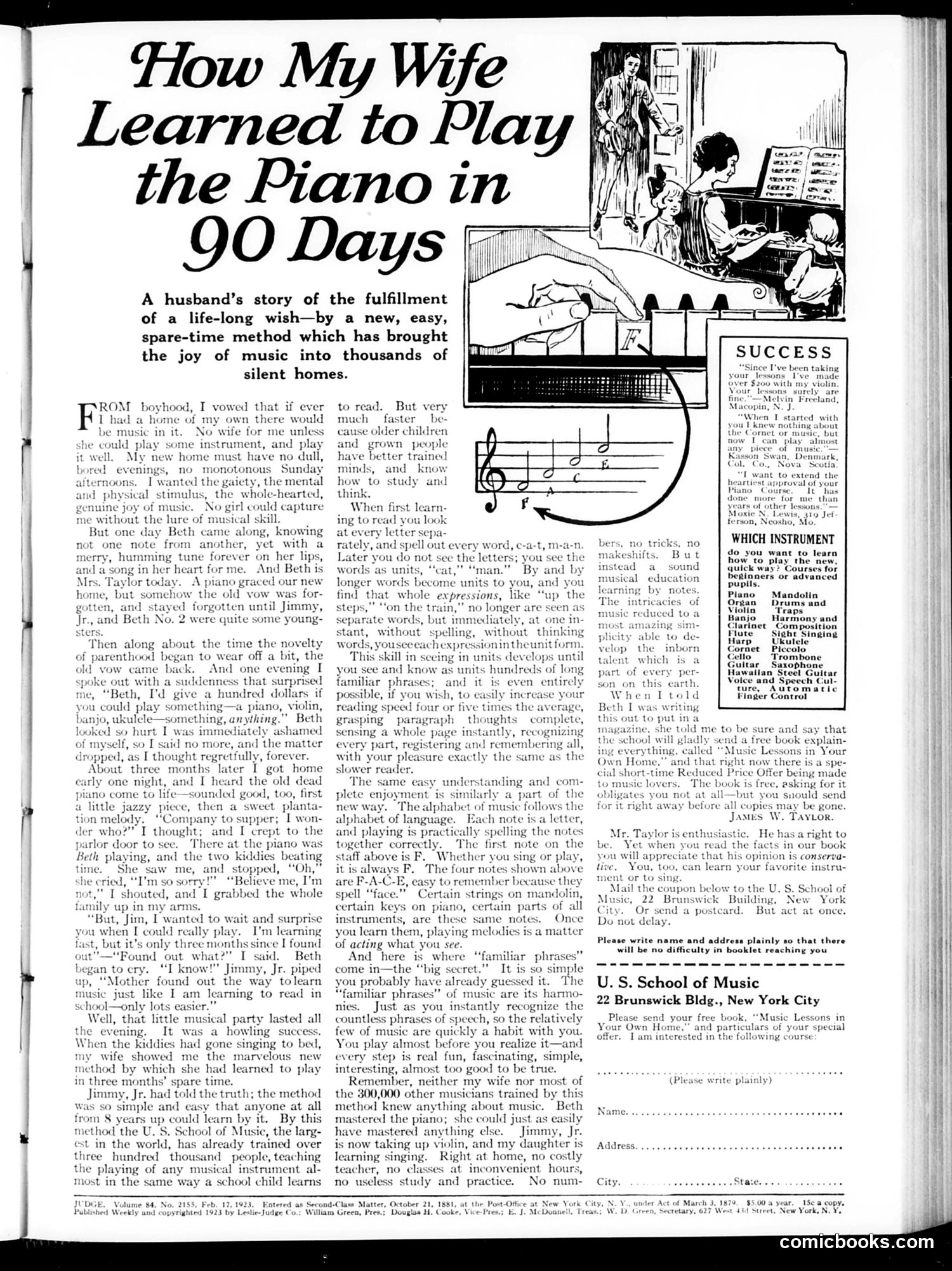
This page is **not primarily satirical content**. It's a hybrid advertisement and advertorial feature titled "How My Wife Learned to Play the Piano in 90 Days," presented as a husband's testimonial story. The article promotes the U.S. School of Music's mail-order piano instruction method, claiming it enables rapid musical literacy through simplified note-reading using letter names rather than traditional notation. The accompanying illustrations show a woman at a piano and a music lesson in progress. The "SUCCESS" testimonial box reinforces the marketing message. The right side includes an instrument selection survey and a tear-out coupon for free instructional materials. This represents typical early 20th-century magazine advertising disguised as lifestyle editorial content.
📄 Transcribed text from this page (OCR, searchable)
Machine-transcribed from the original scan — historical spelling and the odd misread are preserved.
. Flow My Wife Learned to Play the Piano in 9O Days A husband’s story of the fulfillment of a life-long wish—by a new, easy, spare-time method which has brought the joy of music into thousands of silent homes. ROM boyhood, I vowed that if ever F had a home of my own there would e music it. No wife for me unless could play some instrument, and play it well. My new home must have no dull, red evenings, no monotonous Sunday noons. I wanted the gaicty, the mental physical stimulus, the whole-hearted, tine joy of music. No girl could capture without the lure of musical skill. But one day Beth came along, knowing not one note from another, yet with a merry, humming tune forever on her lips, and a song in her heart for me. And Beth is Mrs. Taylor today. A piano graced our new home, but somehow the old vow was for- en, and stayed forgotten until Jimmy, and Beth No. 2 were quite some young- hen along about the time the novelty of parenthood began to wear off a bit, the old vow came back. And one evening I spoke out with a suddenness t surprised me, “Beth, I'd give a hundred dollars if 1 could play something—a piano, violin, jo, ukulele—something, anything.” Beth woked so hurt I was immediately ashamed of myself, so I said no more, and the matter dropped, as I thought regretfully, forever. About three months later I got home rly one night, and I heard the old dead uno come to life—sounded good, too, first 1 little ja: piece, then a sweet planta- ion melody. ‘Company to supper; I won- r who?” I thought; and I crept to the parlor door to see. There at the piano was Beth playing, and the two kiddies beating She saw me ad _Stopped, “Oh,” , “I'm so x “Believe me, I'm I shouted, and I grabbed the whole ly up in my’arms. But, Jim, I wanted to wait and surprise you when [ could really play. I'm learning but it’s only three months since I found ‘Found out what?" I said. Beth tocry. “I know!” Jimmy, Jr. piped ap, “Mother found out the way tolearn music just like I am learning to read in school—only lots easier. Well, that little musical party lasted all he evening. It was a howling success. When the kiddies had gone singing to bed, 1 wife showed me the marvelous new thod by which she had learned to play nonths’ spare time. , Jr. had told the truth; the method mple nd easy that anyone at all from 8 years up could learn by it. By this method the U. S. School of Music, the larg- est in the world, has already trained over three hundred ‘thousand people, teaching the playing of any musical instrument al- most in the same way a school child learns in three Jimm to read. But very much faster be- cause older children and grown people have better trained minds, and know how to study and think. When first learn- ing to read you look at every letter sepa- rately, and spell out every word, c-a-t, m-a-n. er you do not see the letters; you see the words as units, “cat,” “man.” By and by longer words become units to you, and you find that whole expressions, like “up the ste ‘on the train,” no longer are seen as 8 ‘ate words, but immediately, at one in- stant, without peli without thinking words, youseeeach expressionin the unitform, This skill in seeing in units develops until you see and know as units hundreds of long familiar phrases; and it is even entirely possible, if you wish, to easily increase your reading speed four or five times the average, grasping paragraph thoughts complete, sensing a whole page instantly, recognizing every part, registering and remembering all, with your pl actly the same as the slower reader The same easy understanding and com- plete enjoyment is similarly a part of the new way. The alphabet of music follows the alphabet of language. Each note is a letter, and playing is practically spelling the notes together correctly. The first note on the staff above is F. “Whether you sing or play, it is always F. The four not e F-A-C-E, easy to remember be spell “face.” Certain strings on mandolin, certain keys on piano, certain parts of all instruments, are these same notes. Once you learn them, playing melodies is a matter of acting what you s¢ And here is where “familiar phrases” come in—the ‘“‘big secret."" It is so simple you probably have already guessed it. The amiliar phi of music are its harmo- nies. Just as you instantly recognize the countless phrase: of speech, so the relatively few of music are quickly a habit with you. You play almost before you realize it—and every step is real fun, fascinating, simple, interesting, almost too good to be true. Remember, neither my wife nor most of the 300,000 other musicians trained by this method knew anything about music. Beth mastered the piano; she could just as easily have mastered anything else. Jimmy, Jr. is now taking up Violin, and my daughter is learning singing. Right at home, no costly teacher, no classes at inconvenient hours, no useless study and practice. No num- en taking Tve made ay violin surely are vin Freeland, ith piece of mu 2 Swan, Denmark, Co., Nova Se “1 want to extend the tiest approval of your Course. Tt has for her le WHICH INSTRUMENT do you want to | how to play the quick way? Courses for beginners or advanced pupils. Piano Mandolin Organ Drums and ber mak instead a musical education by notes. icacies of ic reduced to a pills Ds reduced to a Banjo Harmony and Clarinet Composition Sight Singing teel Guitar Voice and Speech Cul- Automatic Finger Controt ne to be sure and say that vol will end a free book explain- erything, called "Music Lessons in Your ne,” and that right now there is a sp t-time Reduced Price Offer being made lovers. Th free, asking for it uu not at all—but you snould send away before all copies may be gone. James W. Taytor ic. He has a right to 1 the facts in our book 1 will appreciate that his opinion is conse tive. You, too, can learn your favorite instru- nt or to sing Mail the c« Music, 22. Br City. ' Or Do not delay. 1 below to the U. S. School of swick Building, New York 1a postcard. But act at once. PI © write name and address plainly 0 that the: I be no difficulty in booklet reaching you U.S. School of Music 22 Brunswick Bldg., New York City Please send your free bool Your Own Home,” and particu offer. I am interested in the fo (Piease write plainly) NBG: caren ren evarennne sete eeeeereeeneees . Address. . City, 26. eee ee scene JUDGE. Volume 84, No. 2155, Feb. 17, 1923. Entere Published Weekly: an as Second-Class Matter, October ‘opytighted 1923 by Leslie Judge Co.; William Green, Pres; Douglas H. Cooke, Vice-Pres.: E. J. MeDounell, Trea 1, 1881, at t-Ottice at New York City, N.Y fer Act of Marc 0 a year. 15¢ a copy. et, New York, N. Ye Wb comicbooks.com 5 q