
Judge, 1923-02-17 · page 6 of 36
Judge — February 17, 1923 — page 6: what you’re looking at
What you’re looking at
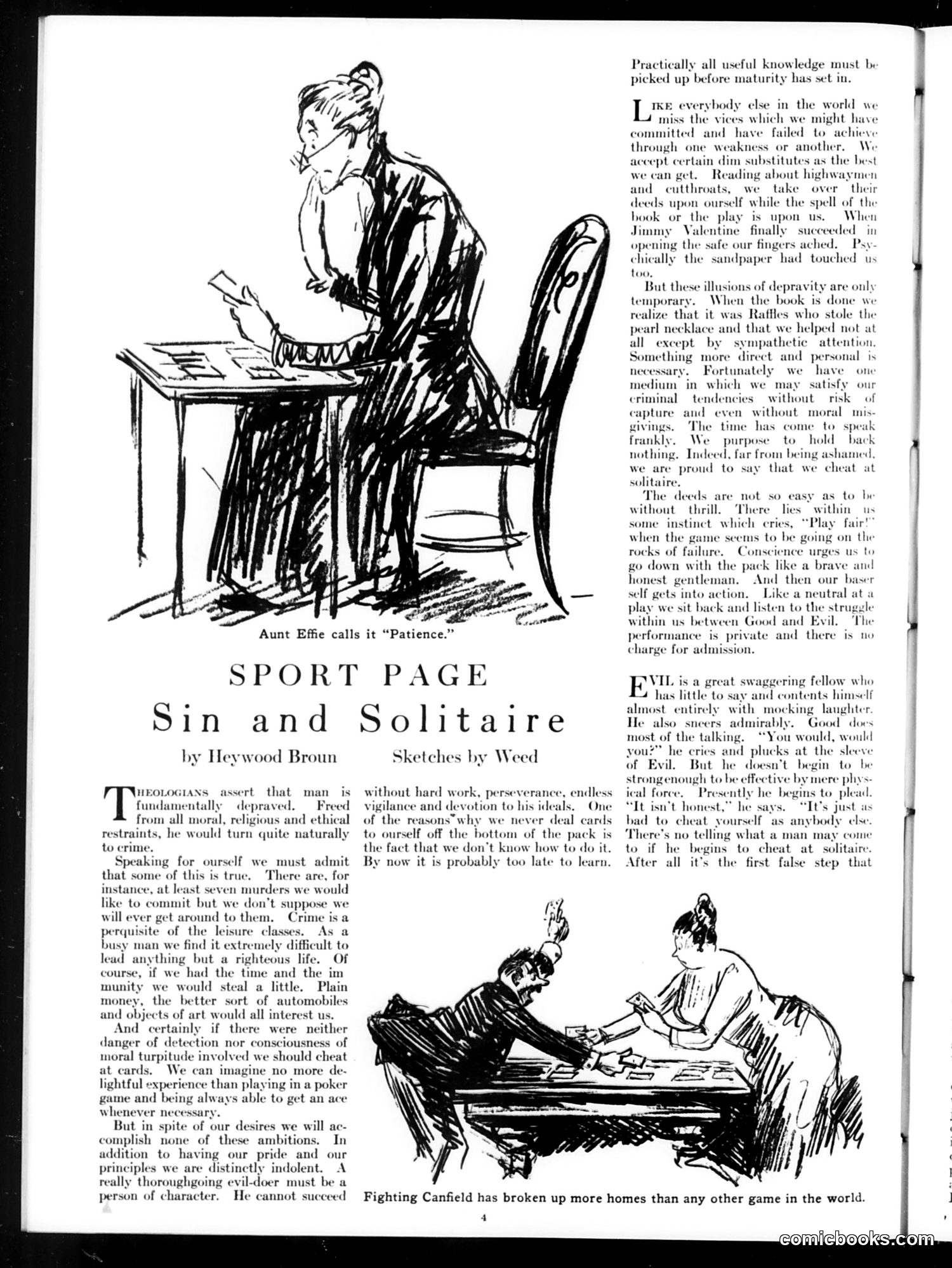
This is a satirical essay (not a political cartoon) about moral hypocrisy. The accompanying sketches illustrate the piece's argument: that people readily condemn crimes they wouldn't commit themselves, yet engage in their own moral failings. The top sketch shows "Aunt Effie calls it 'Patience'"—depicting card games as morally ambiguous leisure activities. The bottom sketch, captioned "Fighting Canfield has broken up more homes than any other game in the world," extends this theme, suggesting that gambling games like solitaire can destroy families despite appearing innocent. Broun argues that judging others' vices while overlooking our own constitutes moral dishonesty. The essay criticizes society's selective moral standards, particularly among the leisure classes.
📄 Transcribed text from this page (OCR, searchable)
Machine-transcribed from the original scan — historical spelling and the odd misread are preserved.
SPORT PAGE Sin and Solitaire by Heywood Broun HEOLOGIANS assert. that man_ is fundamentally depraved. — Freed from all moral, religious and ethical restraints, he would turn quite naturally to crime. Speaking for ourself we must admit that some of this is true. There are, for instance, at least seven murders we would like to commit but we don’t suppose we will ever get around to them, Crime i perquisite of the leisure classes. As a busy man we find it extremely lead anything but a righteous life. Of course, if we had the time and the im munity we would steal a little. Plai money, the better sort of automobiles and objects of art would all interest us. And certainly if there were neither danger of detection nor consciousness of turpitude involved we should cheat a ‘ds. We can imagine no more de- lightful experience than playing in a poker game and being always able to get an ace whenever necessary. But in spite of our desires we will ac- complish none of these ambitions. In addition to having our pride our principles we are distinctly indolent. A really thoroughgoing evil-doer must be a person of character. He cannot succeed Sketches by Weed without hard work, perseverance, endless vigilar and devotion to his ideals. One of the reasons*why we never deal cards to ourself off the bottom of the pack is the fact that we don’t know how to do it. By now it is probably too late to learn, Practically all useful knowledge must be picked up before maturity has set in. L E everybody else in the world we miss the vices which we might have committed and have failed to achieve through one weakness or another. We ain dim substitutes as the best we can get. Reading about highwaymen and cutthroats, we take over their deeds upon ourself while the spell of the book or the play is upon us. When Jimmy Valentine finally succeeded in opening the safe our fi ached. Psy chically the sandpaper had touched us accept ce too, But these illusions of depravity are only temporary. When the book is d e that it was Raflles who stole the rl neckle id that we helped not at all except by sympathetic attention Something more direct. and personal is Fortunately we h satisfy our without risk of moral mis- le We ) medium’ in which we criminal — tendencies capture and even without ivings. ‘The time has come to speak frankly. We pur to hold back nothing. Indeed, far from being ashamed are proud to say that we cheat at The deeds are not so easy as to be without thrill, ‘There lies within us some instinet which cries, “Play fair! when the ms to be going on the rocks of failure. Conscience urges us to go down with the pack like a brave and honest gentleman. And then our baser self gets into action. Like a neutral at a play we sit back and listen to the str within us between Good and Evil. The performance is private and there is no charge for admission. ne s ering fellow who id contents himself EME is a great sw: 4 has little to say a almost entirely with mocking laughter. He also sneers admirably. Good does most of the talking. “You would, would you?” he cries and plucks at the sleeve of Evil. But he doesn’t begin to. bx strongenough to be effective by mere phys- ical force. Py he begins to p! t isn’t honest ays. “It’s just d to cheat yourself as anybody els There’s no telling what n may to if he begins to cheat at solitaire. After all it’s the first false step that ‘ome |