
Judge, 1923-02-17 · page 22 of 36
Judge — February 17, 1923 — page 22: what you’re looking at
What you’re looking at
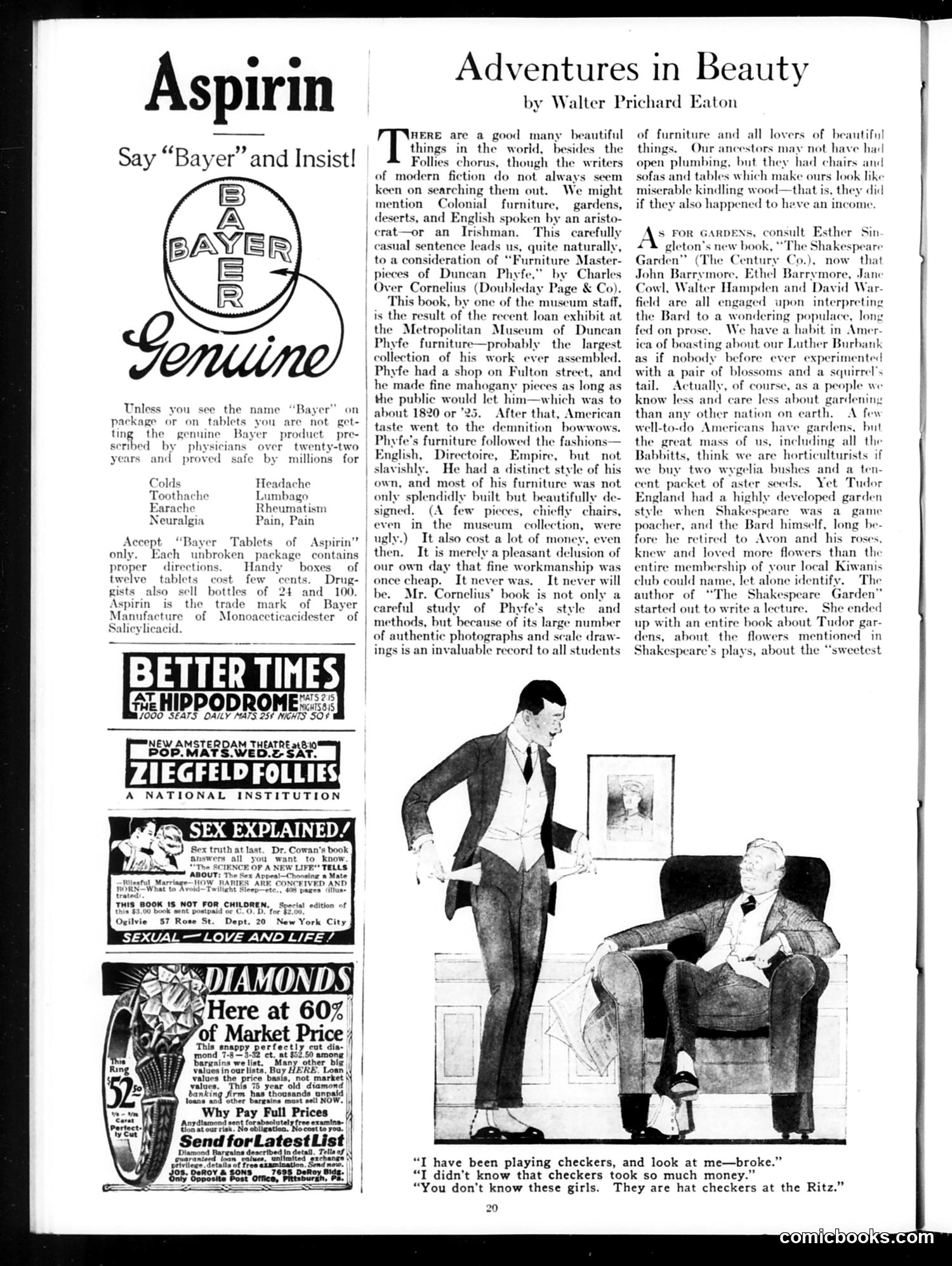
This page contains an **Aspirin advertisement** (Bayer brand) alongside a feature article on "Adventures in Beauty" by Walter Prichard Eaton discussing furniture design, gardens, and culture. The cartoon/illustration at the bottom shows two men in a domestic interior—one standing, one seated—with dialogue about checkers and money. The caption reads: "I have been playing checkers, and look at me—broke" / "I didn't know that checkers took so much money" / "You don't know these girls. They are hat checkers at the Ritz." **The joke**: This is a play on words. "Hat checkers" (attendants who check coats/hats at restaurants) sounds like "checkers" (the game), but the real point is that dating these young women at an upscale venue like the Ritz Hotel is expensive—they're sophisticated girls who cost money to entertain. It's a light social satire about the cost of dating women from fashionable establishments during the Jazz Age era. The page also includes vintage advertisements for theatrical productions and diamonds, reflecting 1920s consumer culture.
📄 Transcribed text from this page (OCR, searchable)
Machine-transcribed from the original scan — historical spelling and the odd misread are preserved.
Aspirin . things in the wor Say “Bayer” and Insist! Tits cliorus, Unless you see the name “Bayer” on package or on tablets you are not get- ting the genuine Bayer product —pre- scribed by physicians over twenty-two years and proved safe by millions for Colds Headache Toothache Lum| ache Rheumatism Neuralgia Pain, Pain Accept “Bayer Tablets of Aspirin” only. h unbroken contains proper directions. Handy — boxes of twelve tablets cost cents. Drug- gists also sell bi 24 and_ 100. Aspirin is. the mark of Bayer Manufacture of Monoaceticacidester | of Salicylicacid. fie HIPPODROME®:::: 1000 SEATS DAILY MATS 25¢ NKHTS Boe Ne TER DAM THEATRE at 8:10! POP.MAT TS Wee T. A NATIONAL ace, SEX EXPLAINED/ Dr. Cowan's book know INSTITUTION Sex truth at last you want tc rus BOOK IS NOT FOR cur Pook sent postpaid or Ord for 57 Rose St. Dept. 20 New York City This enappy perfectly cat di mond 7: Why Pay Full Prices Angatamen port raat free examina. Eom stour risk No obligation. Nocostts you. ui" il Send forLatestList Diamond Bargains described in detail. Tella of guaranierd iam eauea, unlimited exchange peivilewe. details of free Sind now. 78; $8 Bom 7695 DeRoy | about 1820 or ’25. HERE are a good many beautiful besides the igh the writers of modern fiction do not always seem keen on searching them out. We might mention Colonial furniture, gardens, deserts, and English spoken by an aristo- crat—or an Irishman. This carefully al sentence leads us, quite naturally, to a consideration of “Furniture Master- pieces of Duncan Phyfe,” Charles Over Cornelius (Doubleday Page & Co). This book, by one of the museum is the result of the recent loan exhibit at the Metropolitan Museum of Duncan Phyfe furniture—probably the largest collection of his work ever assembled. Phyfe had a shop on Fulton street, and he made fine mahog as long as the public would let him—which was to After that, American taste went to the demnition bowwows. Phyfe’s furniture followed the fashions— English, Directoire, Empire, but not slavishly. He had a distinct style of his own, and most of his furniture was not only splendidly built but beautifully de- signed. (A few pieces, chicfly chairs, even in the museum collection, were ugly.) It also cost a lot of money, even then. It is merely a pleasant delusion of our own day that fine workmanship w: once cheap. It never was. It never will be. Mr. Cornelius’ book is not only 2 careful study of Phyfe’s style and methods, but because of its large number of authentic photographs and scale draw- ings is an invaluable record to all students Y pieces as. Adventures in Beauty by Walter Prichard Eaton of furniture and all lovers of beautiful things. Our ancestors may not have had open plumbing, but they had chairs and s and tables which make ours look like miserable kindling wood—that is, they did if they also happened to have an income. As FOR GARDENS, ¢ £2 gleton’s new book arden” (1 vhn Barrymore. nsult Esther Sin The Shakespeare entury Co.), now that Ethel Barrymore, Jani owl, Walter npden and David War- field are all engaged upon interpretin the Bard to a wondering populace, long fed on prose. We have a habit in Amer- ica of boasting about our Luther Burbank as if nobody before ever experimented with ir of blossoms and a squirrel’s tai otu of course, as a people we know less and care less about gardening than any other nation on earth. A few well-to-do Americans have gardens, but the great mass of us, including all the Babbitts, think we are horticulturists if we buy two wygelia bushes and a ten- cent packet of aster seeds. Yet Tudor England a highly de 1 garden style when § are was a game poacher, and the Bard himself, long be- fore he retired to Avon and his roses, knew and loved more flowers than the entire membership of your local Kiwanis club could name, let alone identify. The author of “The Shakespeare Garden” arted out to write sture. She ended ith an entire book about Tudor gar- about the flowers mentioned in Shakespeare's plays, about the “sweetest “I have been playing checkers, and look at me—broke.” “I didn’t know that checkers took so much money.” “You don’t know these girls. 20 They are hat checkers at the Ritz.”