
A complete issue · 36 pages · 1922
Judge — October 21, 1922
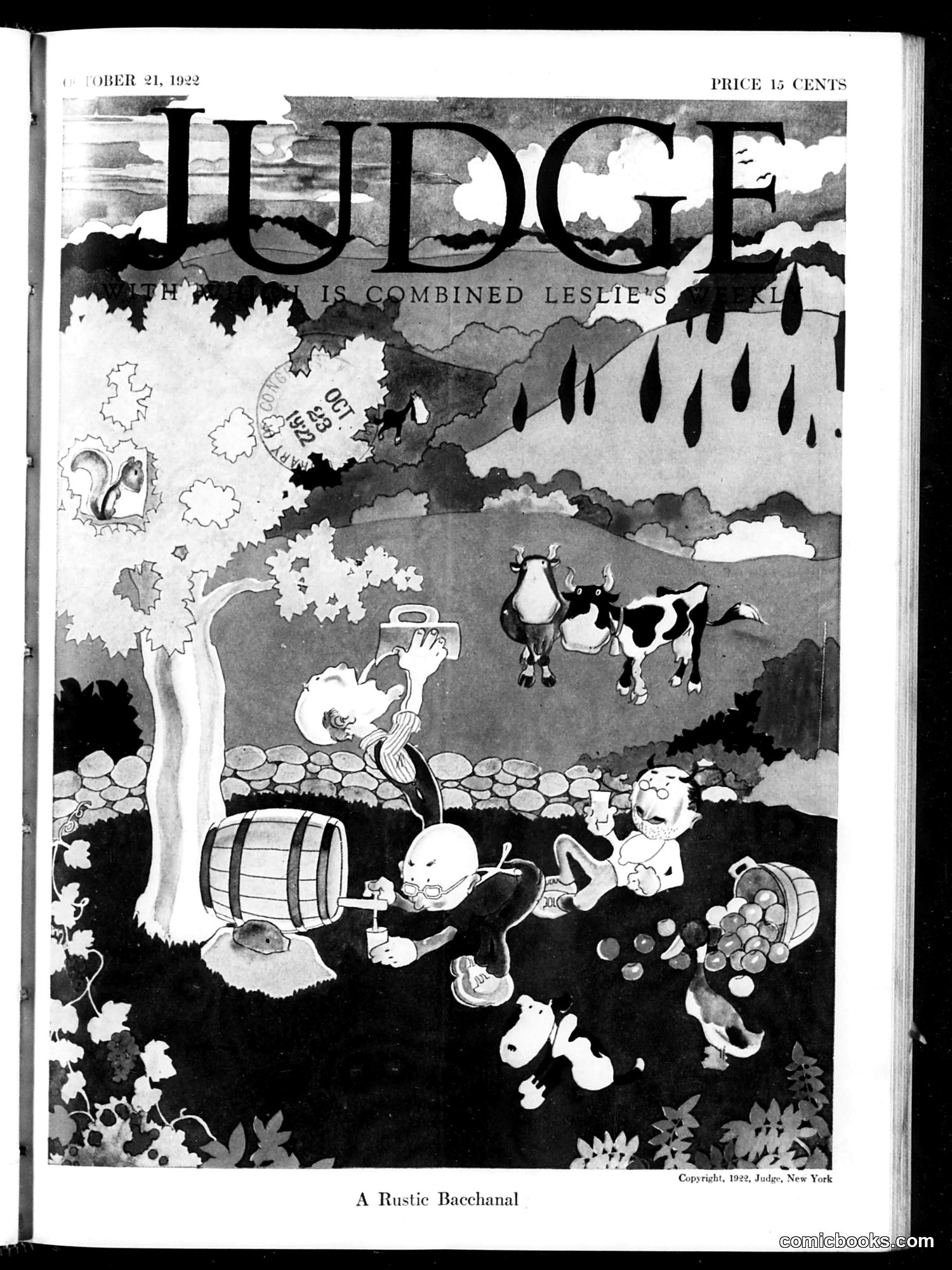
This cover illustrates "A Rustic Bacchanal"—a satirical scene of rural revelry, likely referencing Prohibition-era bootlegging. The cartoon depicts anthropomorphic animals and cherubic figures engaged in wine-making and drinking in a pastoral setting, with barrels, grapes, and harvest imagery. The satire targets the widespread violation of Prohibition laws (1920-1933), particularly in rural areas where home wine and alcohol production persisted despite federal ban. The "rustic" setting suggests hypocrisy among supposedly innocent country folk. The playful, mythological "bacchanal" framing (referencing Roman god Bacchus) mocks the contradiction between America's dry laws and actual widespread drinking culture. The elaborate illustration style was typical of Judge's sophisticated comic approach to contemporary social issues.
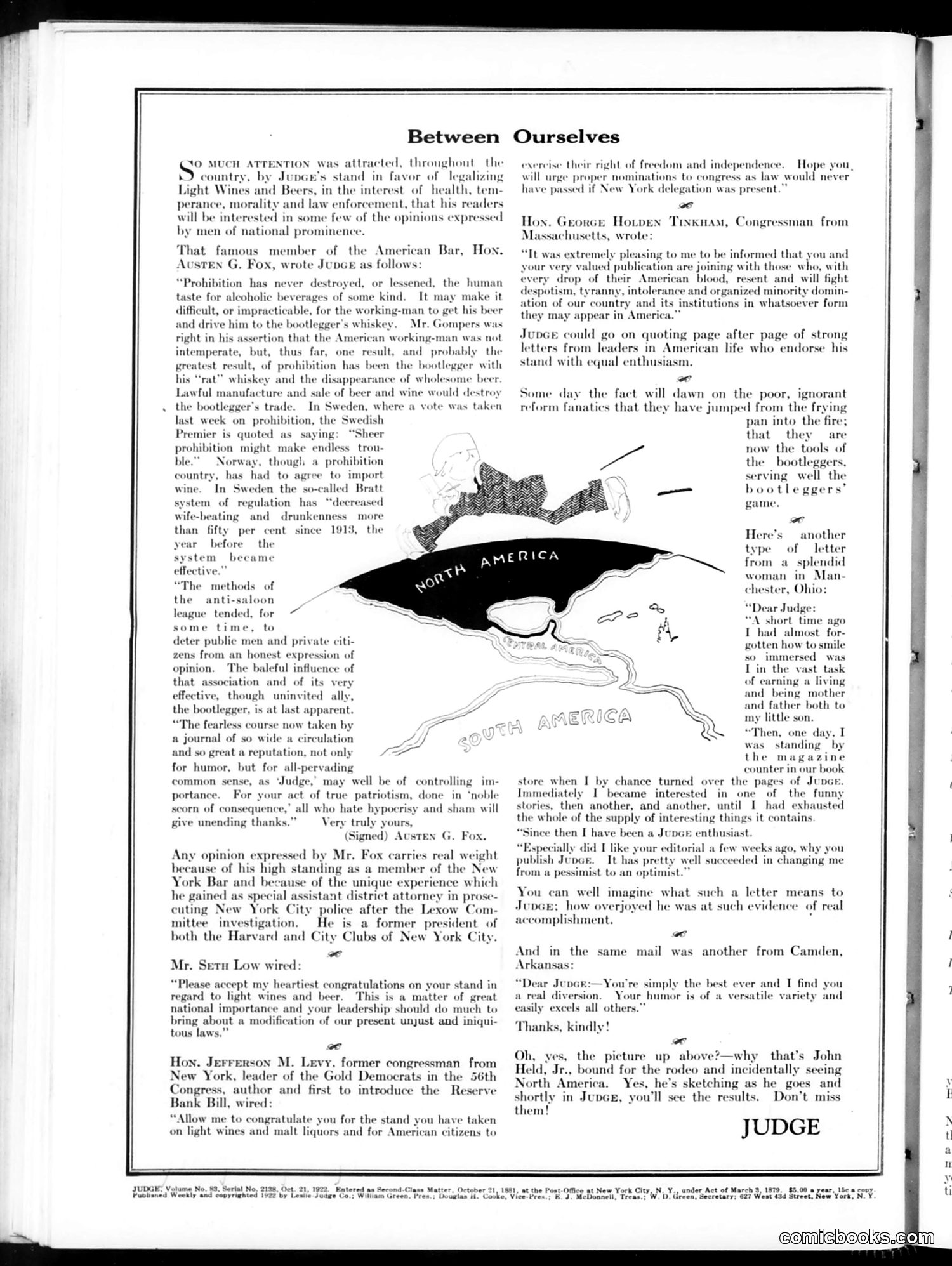
This page is primarily a "Letters to the Editor" column titled "Between Ourselves," featuring reader correspondence praising Judge magazine's editorial stance on Prohibition. **The Cartoon:** The single illustration depicts North America and South America as a whale or large fish, with the continents forming its body. This appears to be satirizing geographical/hemispheric themes, likely related to trade or international relations of the era. **Content:** Multiple prominent figures—including Congressman George Holden Tinkham and former congressman Jefferson M. Levy—write supportive letters endorsing Judge's anti-Prohibition position. The magazine had taken a strong stance against alcohol prohibition, framing it as destructive to American working-class life and commerce. The letters reflect 1920s-era debates over Prohibition's enforcement and social impact.
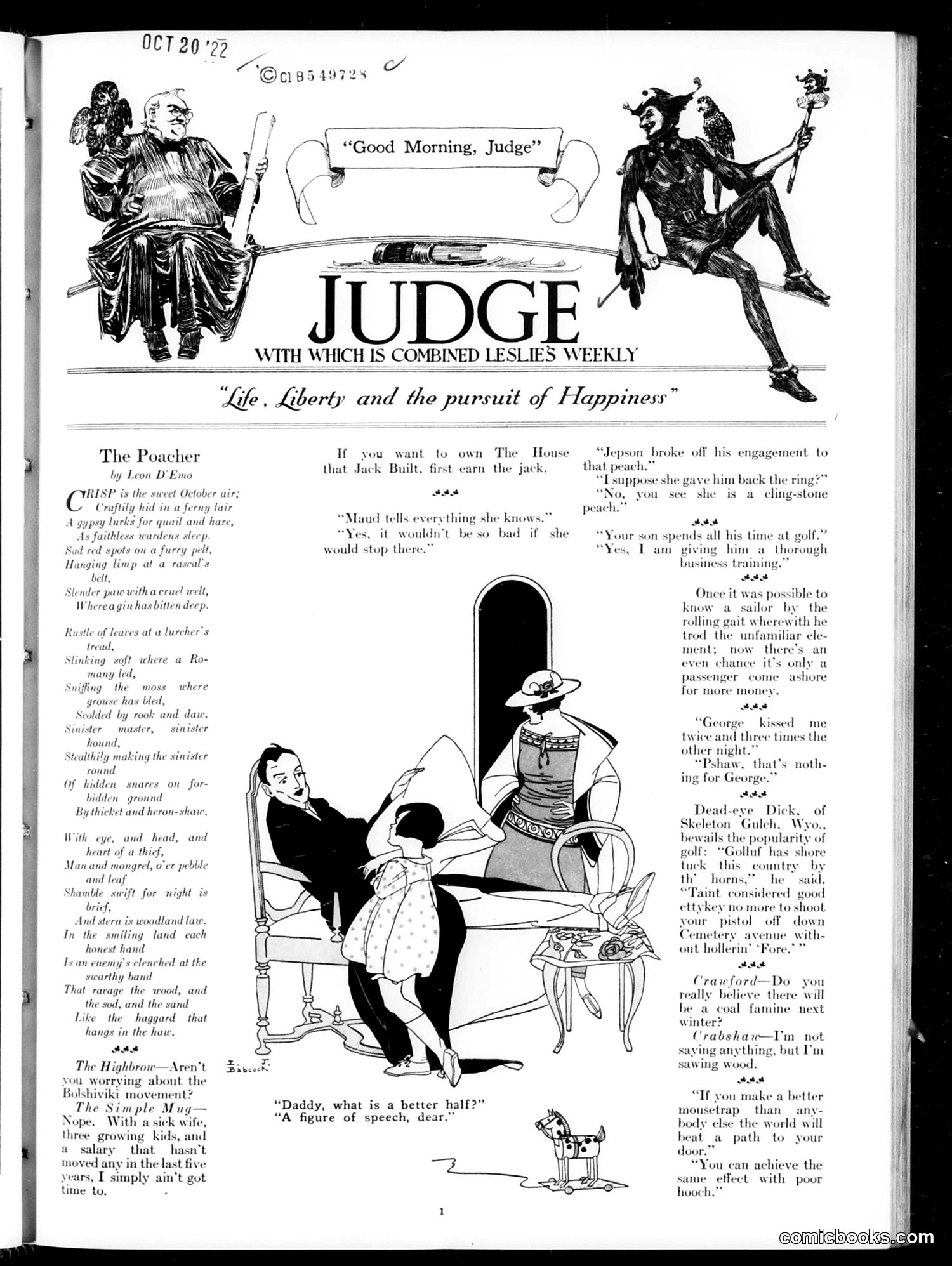
This October 20, 1922 page from *Judge* contains satirical commentary on contemporary social issues. **"The Poacher"** is a poem about class conflict—a poor man illegally hunting on a wealthy landowner's property, described with romantic sympathy for the working-class transgressor. **The central cartoon** depicts domestic life humor: a child asks his father "Daddy, what is a better half?"—a play on the term "better half" (meaning spouse). The father replies "A figure of speech, dear," suggesting the joke is about whether wives truly live up to this flattering description. **Right-side vignettes** offer society gossip and satirical commentary on wealthy leisure activities (golf, engagements, divorces) and class distinctions—typical *Judge* fare mocking the upper classes and their concerns during the Jazz Age.
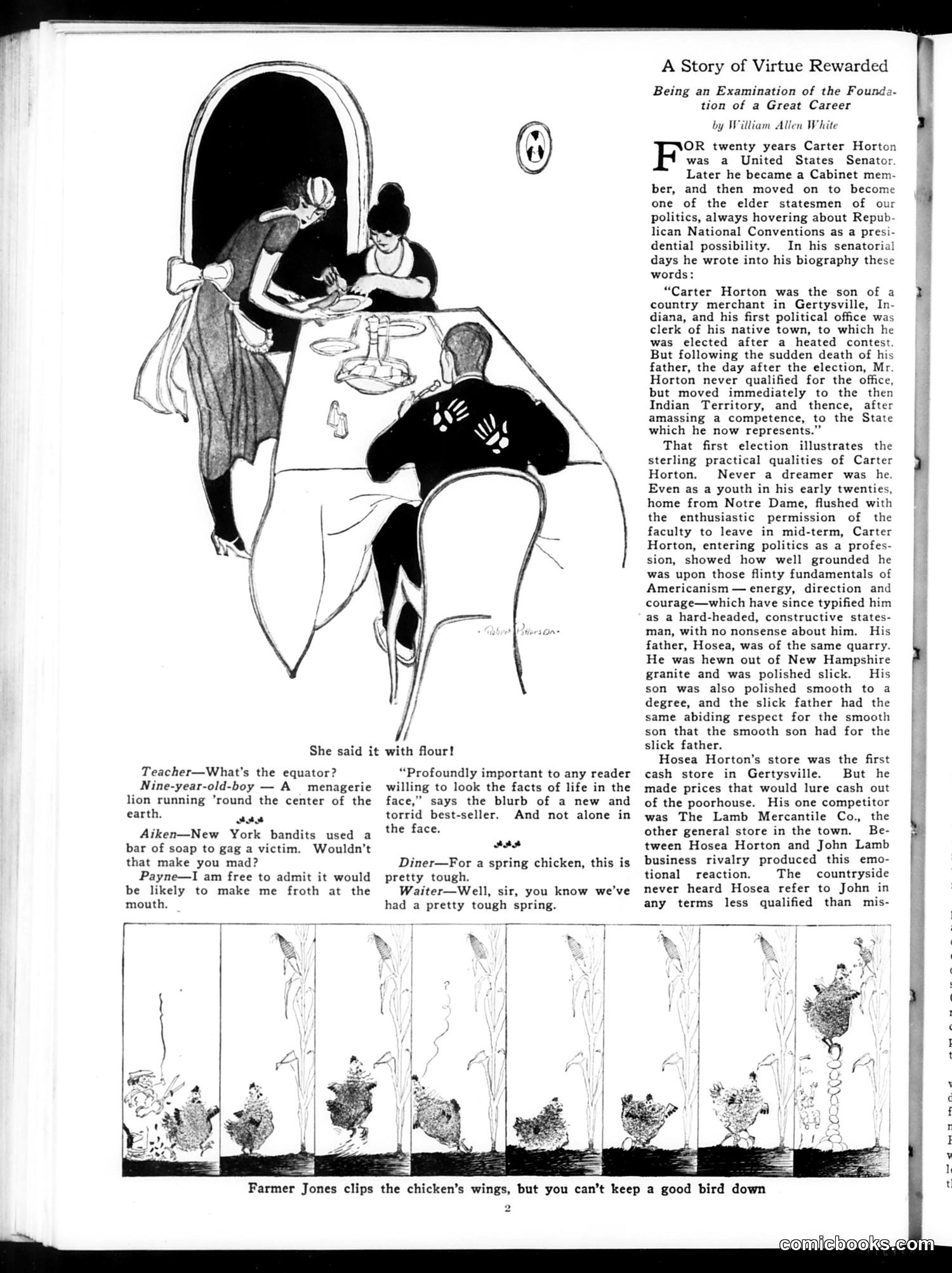
This page presents a biographical narrative about Carter Horton, a U.S. Senator who became a Cabinet member. The main illustration depicts a dinner scene where Horton (seated, back to viewer) dines with well-dressed companions, suggesting his social ascent. The text emphasizes Horton's practical, no-nonsense character—descended from New Hampshire granite stock, grounded in "fundamentals of Americanism." His rise began with a clerk position after his father's death, demonstrating meritocratic virtue. The humorous interjections below (about soap, equators, and tough chickens) appear to be unrelated comedic asides typical of Judge magazine's format. The bottom comic strip showing "Farmer Jones clips the chicken's wings" illustrates a separate visual gag about controlling ambition—the bird's repeated attempts to escape despite clipped wings.
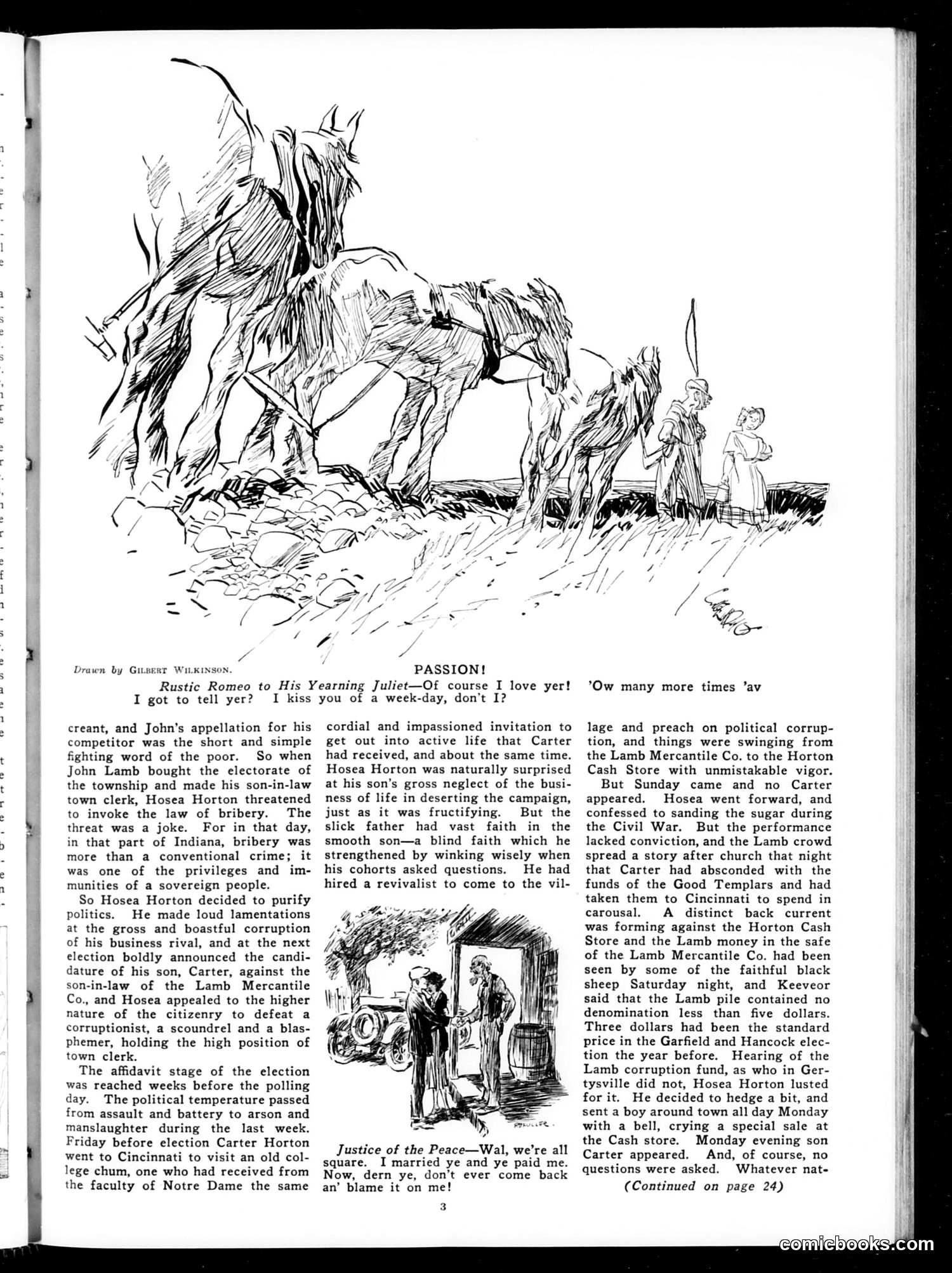
This page contains two illustrations satirizing Gilded Age political corruption. The top cartoon, titled "PASSION!," depicts a grotesque donkey (representing the Democratic Party or a corrupt politician) with townspeople nearby, referencing "Rustic Romeo to His Yearning Juliet"—likely mocking rural voters' naivety about urban political schemes. The text describes a storyline involving Hosea Horton, who discovers election corruption tied to the Lamb Mercantile Co. and a candidate named Carter. The narrative focuses on bribery, vote-buying, and financial manipulation—common Gilded Age practices. The lower cartoon, "Justice of the Peace," appears to satirize marital discord or domestic consequences of political corruption. Overall, the page exposes how mercantile interests corrupted American elections through bribery and intimidation of voters.
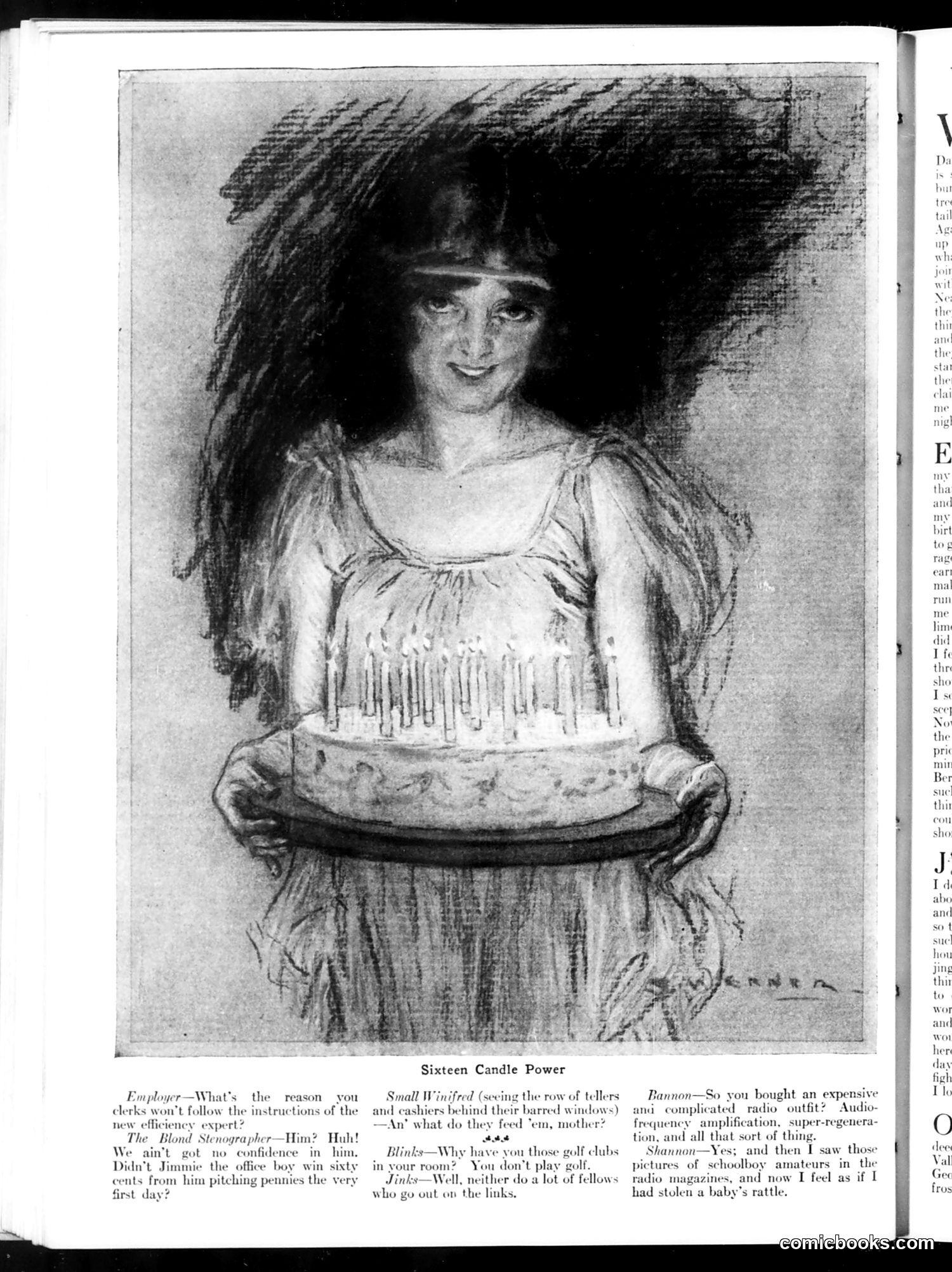
This page features a sketch of a young woman holding a serving platter, captioned "Sixteen Candle Power." The accompanying dialogue appears to be a humorous domestic exchange about household efficiency and modern conveniences. The "candle power" title is a pun referencing electrical measurement units, suggesting the young woman's limited mental capacity or usefulness. The dialogue mocks: - An employer questioning a new servant's competence - A maid's confusion about modern conveniences (golf clubs, radio amplification) - General commentary on servant hiring practices and worker intelligence The satire targets early 20th-century anxieties about finding capable domestic help and pokes fun at both the incompetence of young maids and their employers' frustrated expectations. It reflects Judge magazine's recurring theme of household management frustrations during the era of modernization.
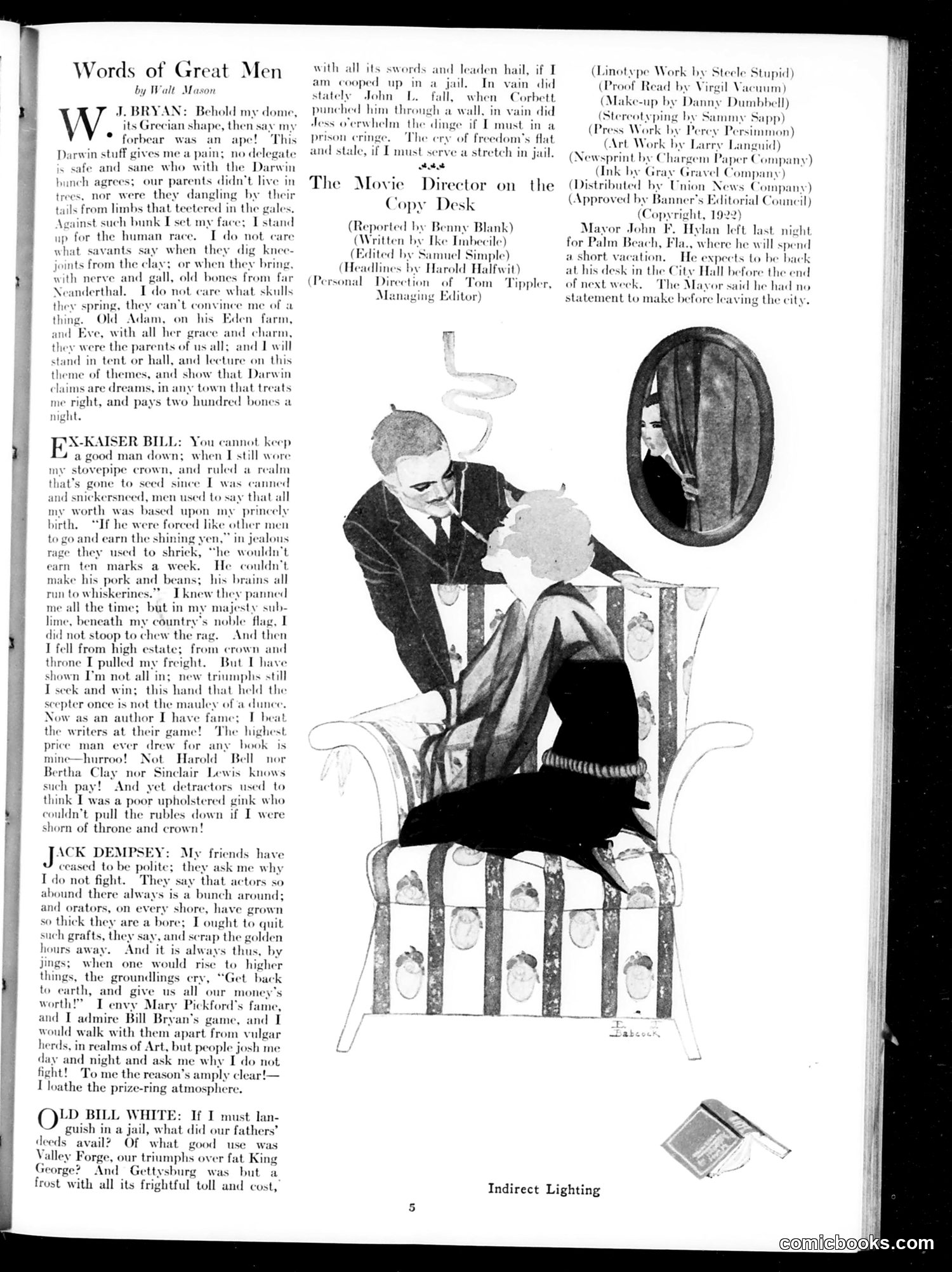
This page satirizes prominent public figures through mock first-person statements. **J. Bryan** (William Jennings Bryan, three-time presidential candidate) rails against Darwinism—a real controversy of the era where Bryan famously opposed evolutionary theory. **Ex-Kaiser Bill** (Germany's deposed WWI emperor) boasts of literary success despite his fall from power, mocking his attempts at relevance post-abdication. **Jack Dempsey** (heavyweight boxing champion) defends his acting career against critics demanding he return to fighting, reflecting 1920s celebrity culture tensions. **Old Bill White** appears to reference criminal justice concerns. The center illustration shows a film director at a newspaper desk—a visual pun on "The Movie Director on the Copy Desk," satirizing Hollywood's influence on journalism through elaborate mock credits listing absurdly incompetent staff (names like "Steele Stupid," "Virgil Vacuum"). The joke: modern media's theatrical pretension and declining standards.
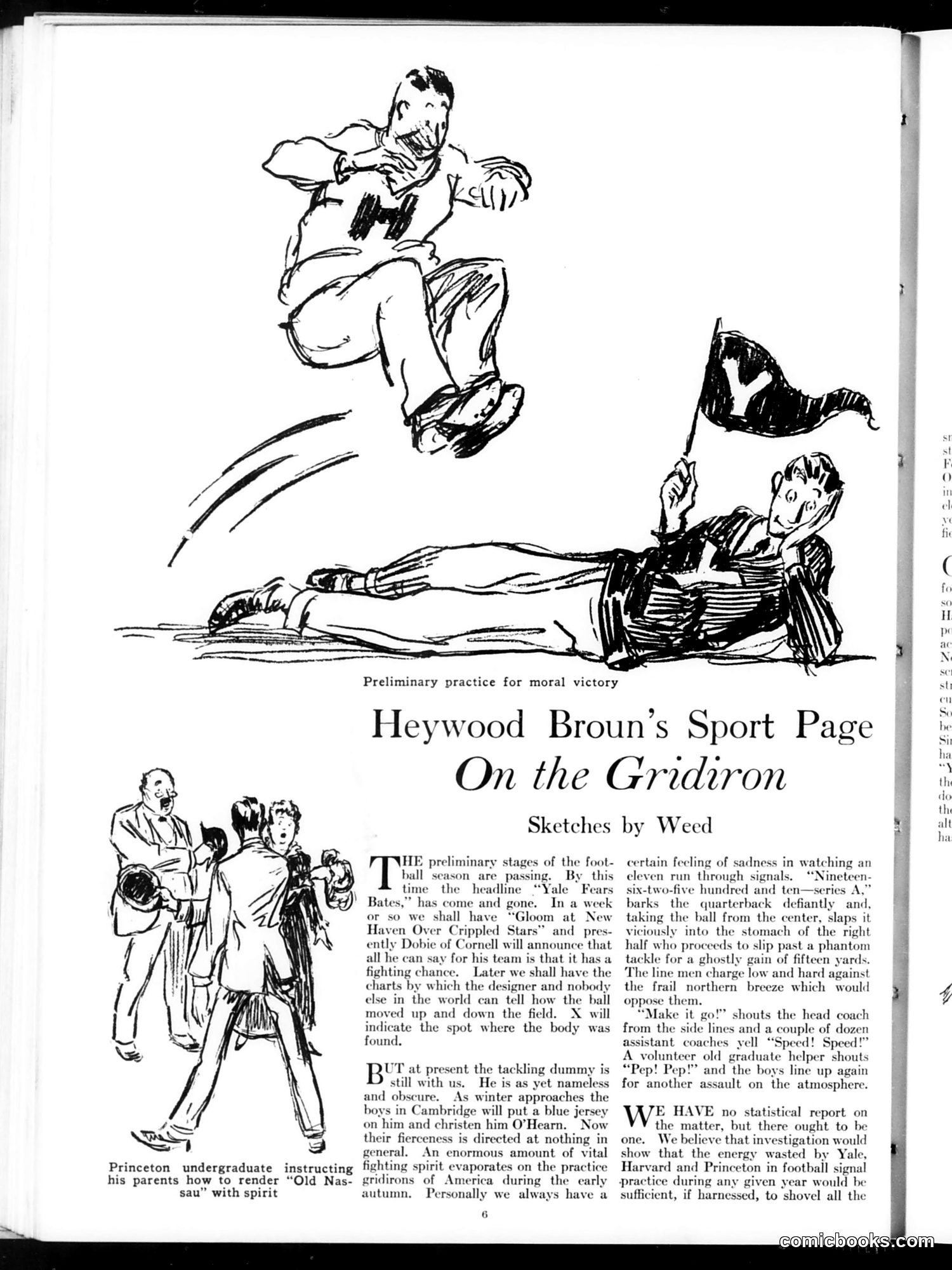
This page from *Judge* satirizes American college football in the early 20th century, particularly the intense training of Ivy League programs (Yale, Harvard, Princeton, Cornell). **The cartoons mock:** 1. **Top sketch**: A pretentious Princeton student demonstrating to his parents how to sing "Old Nassau" (Princeton's fight song) with exaggerated "spirit"—skewering collegiate elitism and performative enthusiasm. 2. **Bottom left**: A father learning football cheers from his son, ridiculing how parents mimic collegiate traditions without understanding them. **The main article by sports columnist Heywood Broun** satirizes pre-season football rhetoric and "tackling dummy" practice drills. Broun mocks: - Predictable sports headlines ("Yale Fears Bates," "Gloom at New Haven") - Pointless practice against phantom opponents—tackling dummies and non-existent defenders while coaches shout generic encouragement ("Speed! Speed!") - Energy wasted on football training that could accomplish real work The satire suggests college football is ritualistic theater divorced from actual accomplishment—players practice intensely against nothing, mimicking real competition without genuine opposition.
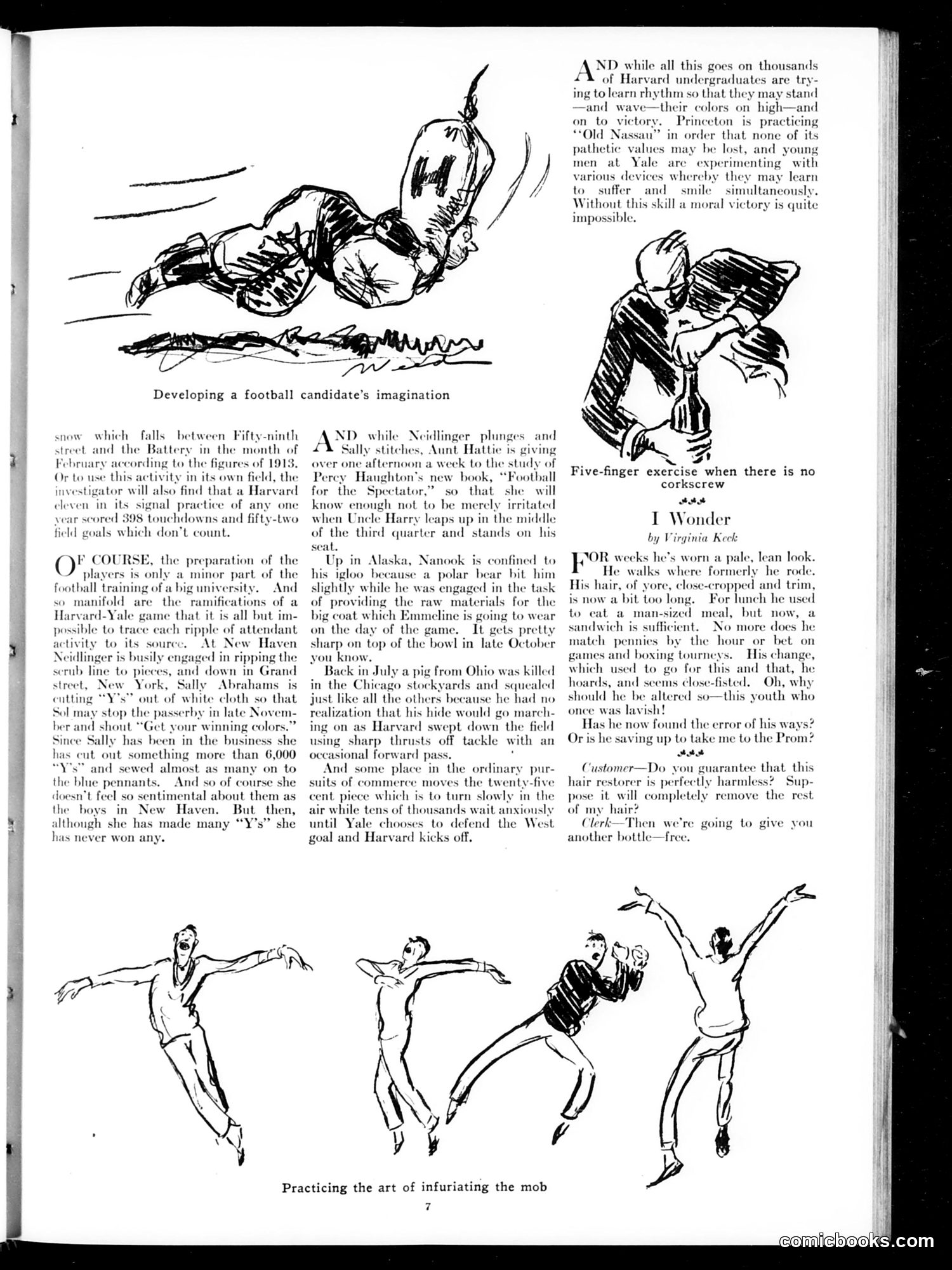
This page satirizes the elaborate social and athletic machinery surrounding the Harvard-Yale football rivalry circa 1913. The main text humorously traces how the game's preparation ripples across society: Neidlinger practices the scrub line; Sally Abrahams cuts thousands of "Y" pennants; Aunt Hattie studies Percy Haughton's "Football for the Spectator" to avoid looking foolish; Nanook hunts polar bears in Alaska for coat materials; an Ohio pig is slaughtered for its hide; and coin flippers prepare for the kickoff toss. Young men at Princeton and Yale learn to "suffer and smile simultaneously." The top cartoon depicts a player's imagination while training—an absurdist fantasy of acrobatic collapse. The bottom illustrations show young women practicing exaggerated kicks, captioned "Practicing the art of infuriating the mob"—likely referring to cheering demonstrations or suffragette-inspired activism around the game. "I Wonder" is a satirical poem about a once-lavish young man now economizing, questioning whether he's reformed or merely saving for prom. The page mocks both collegiate pretension and how major sporting events mobilize entire institutions.
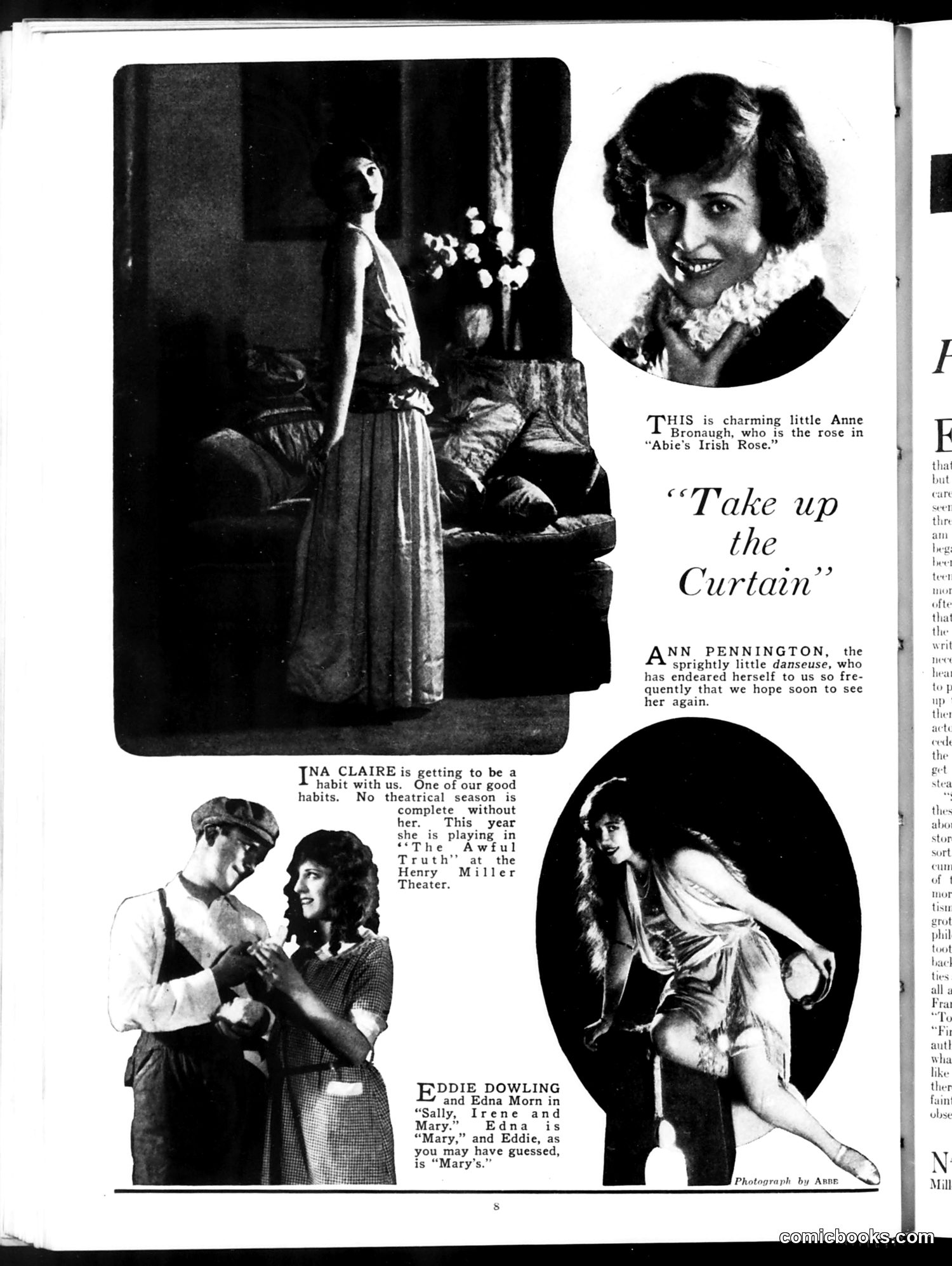
This is a **theatrical promotion page**, not political satire. It features photographs and brief reviews of Broadway performers and productions from the 1920s era. The page showcases: - **Anne Bronaugh** in "Abie's Irish Rose" (a notable play about Irish-Jewish romance) - **Ann Pennington**, described as a "danseuse" (dancer) - **Ina Claire**, whom the magazine notes is a reliable theatrical draw - **Eddie Dowling and Edna Morn** in the musical "Sally, Irene and Mary" The humor is gentle and promotional rather than satirical. The only joke appears to be about Dowling playing a character named "Mary" in a show titled "Sally, Irene and Mary"—a light pun suggesting he's so associated with the female character that he *is* "Mary's." Judge magazine regularly featured theater coverage alongside its political cartoons, serving as entertainment and cultural commentary for its educated, urban readership interested in Broadway productions.
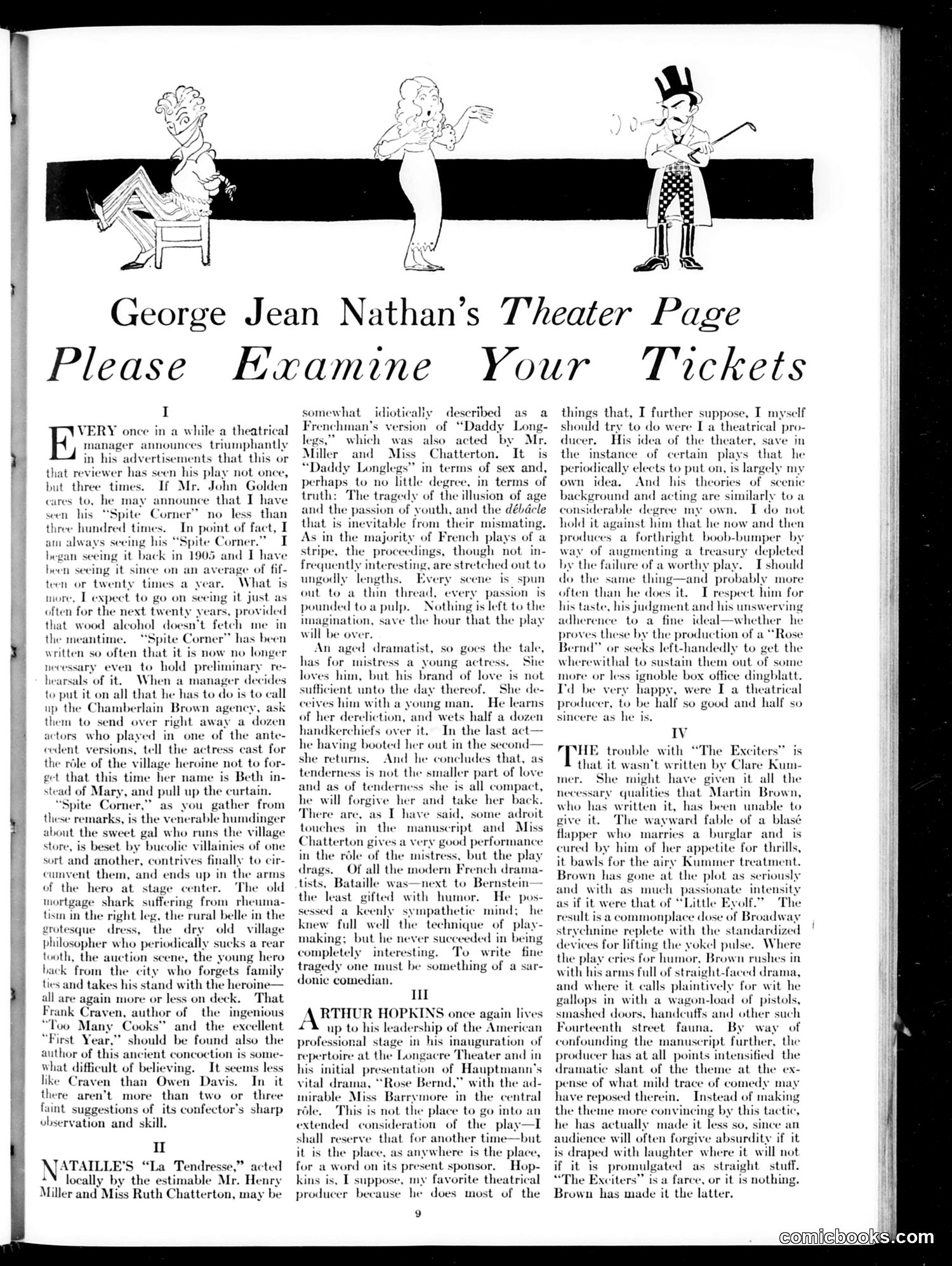
This page is theater criticism by George Jean Nathan, a prominent drama critic of the early 20th century. The three caricatured figures at the top represent theatrical types—likely representing stock characters or theatrical personalities of the era. Nathan reviews two plays: "Spite Corner" (which he claims to have seen repeatedly) and "La Tendresse" (a French play featuring Henry Miller and Ruth Chatterton). His satire targets: - **Theater recycling**: "Spite Corner" is so formulaic and frequently revived that it requires no rehearsal—just stock actors playing identical rural melodrama roles (villain with rheumatism, farm girl, city hero, etc.) - **French drama excess**: "La Tendresse" suffers from typical French theatrical faults—stretched plots, overwrought emotion, and maudlin sentiment, despite competent performances Nathan's point: American theater relies on worn-out conventions, while contemporary French dramatists lack wit and economy, prioritizing emotional excess over dramatic skill.
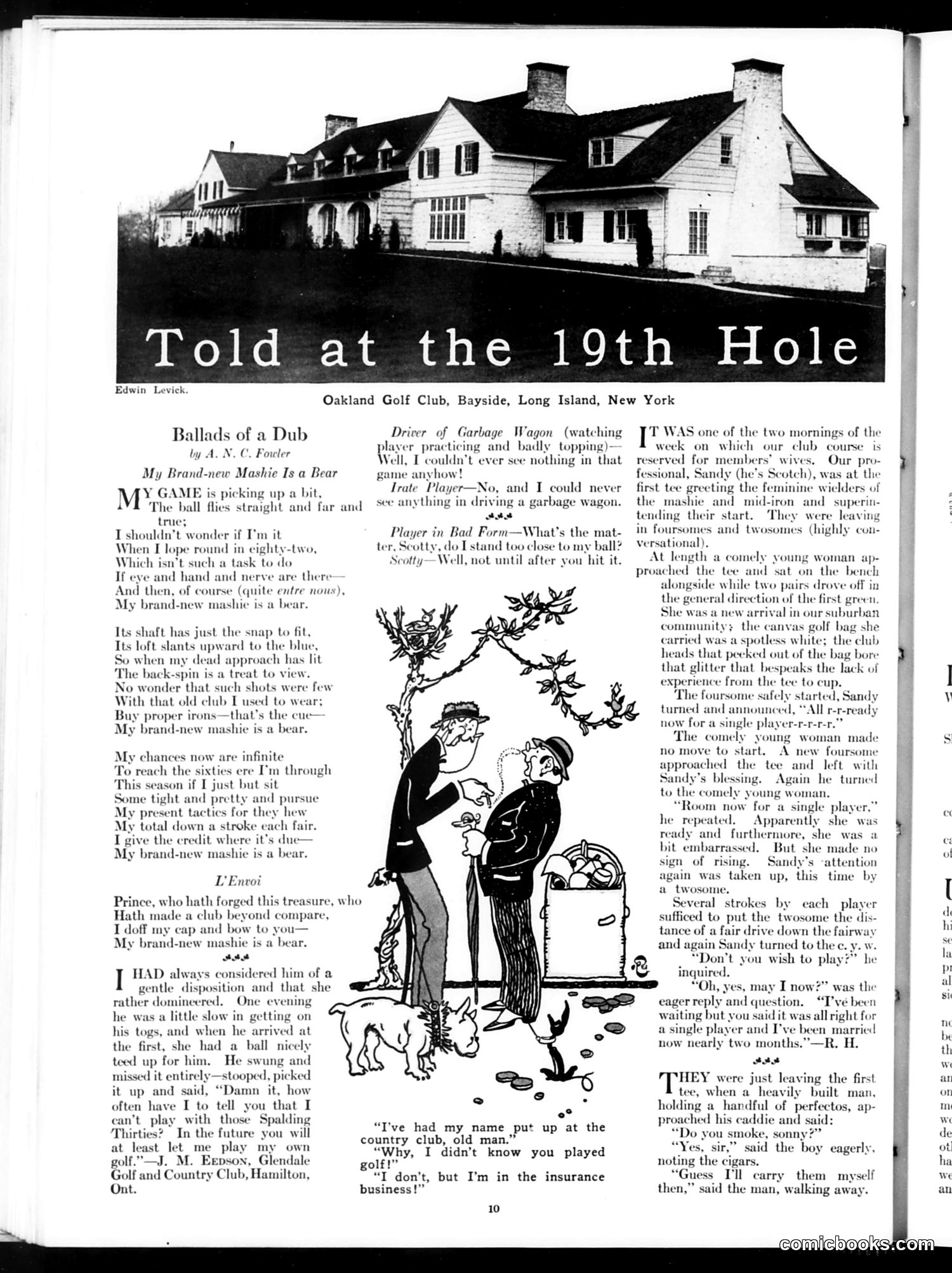
This page contains humorous golf anecdotes and verse from Oakland Golf Club. The cartoons satirize amateur golfers and club etiquette: **"Ballads of a Dub"**: A poem celebrating a new golf club (mashie—an iron) that supposedly improves the speaker's game, though the title ironically suggests he's still incompetent. **The main cartoon scenarios mock:** 1. **Gender dynamics**: A Scottish pro (Sandy) repeatedly asking a newly married woman if she wants to play, not realizing she's waiting for her husband's permission—satirizing women's subordinate social position even in recreation. 2. **Class/manners**: A caddie being corrected by a club member about smoking cigars, with the punchline suggesting the man is new money showing off his club membership. 3. **Incompetence**: A garbage wagon driver dismissing golf entirely while an angry golfer defends it—poking fun at both working-class skepticism and amateur golfers' defensiveness. The humor relies on period-appropriate golf culture, gender roles, and class consciousness typical of early 20th-century leisure activities.
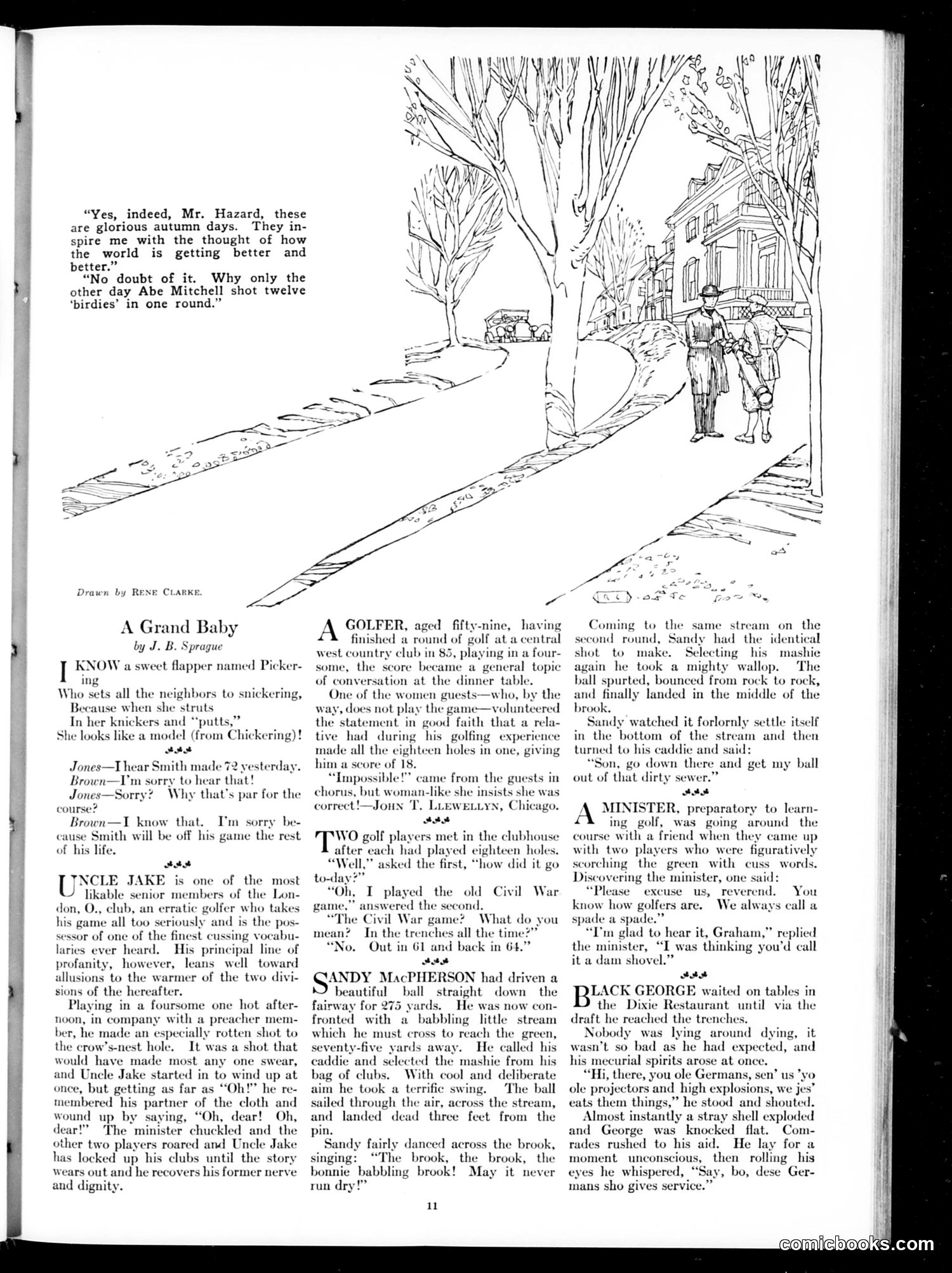
This page contains six humorous anecdotes about golf, a sport experiencing a popularity boom in early 20th-century America. The cartoons mock golf culture rather than political figures. The jokes target golfers' obsessive seriousness: one man's 72 score ruins his entire life; Uncle Jake nearly curses in front of a preacher after a bad shot; a woman claims her relative scored 18 (implying one hole-in-one per hole—impossible); Sandy MacPherson's ball lands in a "dirty sewer" after two attempts; a minister learns golfers call things by crude names. The broader satire: golf's pretensions to gentility mask intense competitiveness and profanity. Players treat recreational sport with unwarranted gravity. A flapper in "knickers and putts" is mocked for appearing model-like—commentary on modern women's athletic participation. The page illustrates 1920s leisure culture, where golf signaled status but also revealed human frustration and hypocrisy, particularly regarding the minister's observation about golfers' language masquerading as civility.
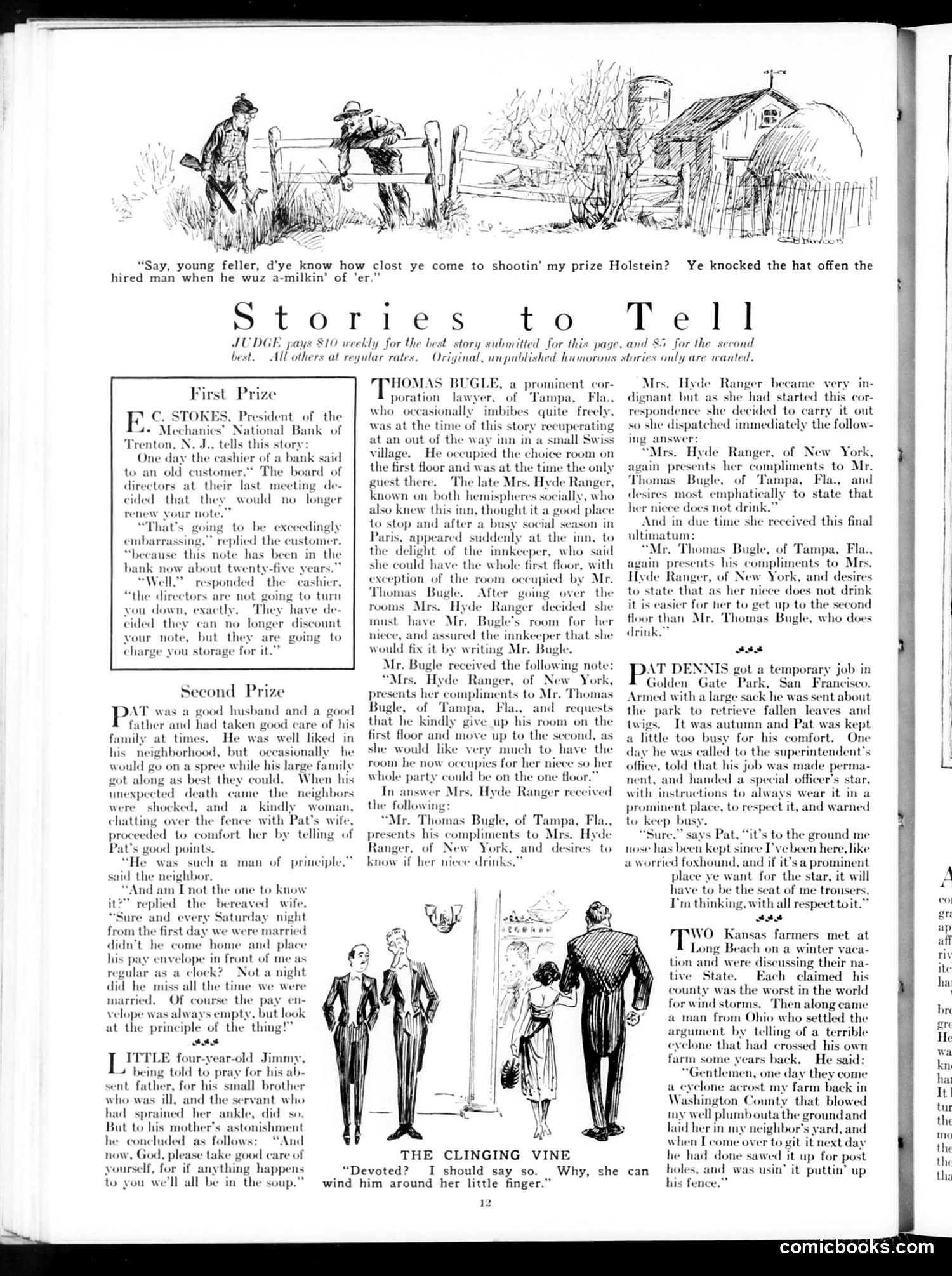
This page from *Judge* presents three humorous short stories competing for cash prizes ($10 for first place). The cartoons illustrate everyday American social situations with satirical twists: **Top cartoon**: A rural farmer warns a young man about nearly shooting his prize Holstein cow, having knocked off the hired man's hat while he milked her—playing on class distinctions and farm life dangers. **The stories mock**: - Banking pretension: A bank refuses to discount a customer's promissory note but offers to charge "storage" instead—satirizing corporate bureaucratic absurdity. - Working-class virtue: A widow praises her drunk husband's "principle" for always handing over his *empty* pay envelope regularly. - Wealthy entitlement: A prominent New York socialite (Mrs. Hyde Ranger) demands a lawyer's hotel room for her niece. He responds by asking if the niece "drinks"—implying her aunt's behavior is alcoholic-fueled rudeness. The humor targets pretense, class hypocrisy, and the gap between stated principles and actual behavior—typical *Judge* satirical concerns of the era.
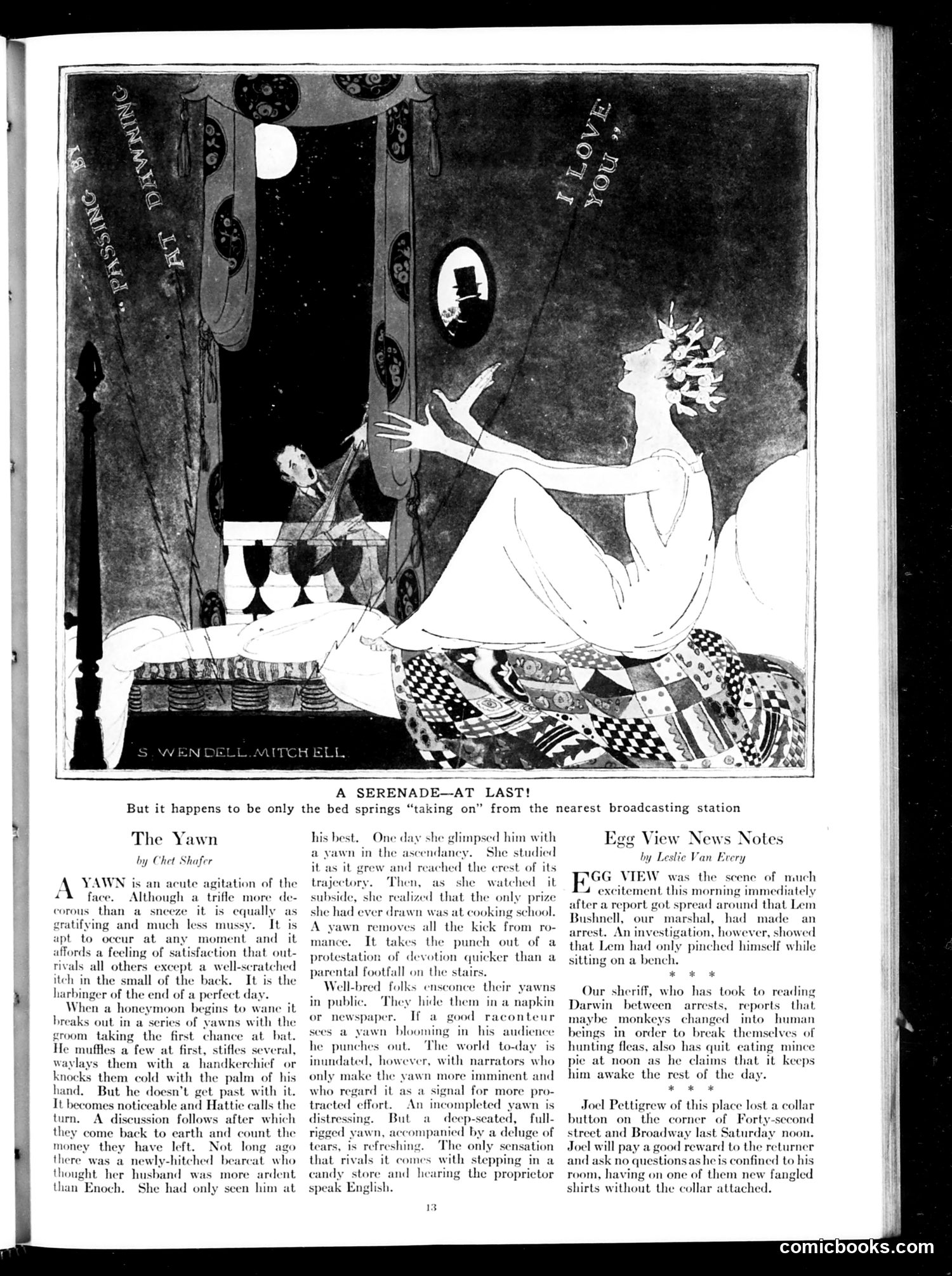
This Judge magazine page contains three satirical pieces mocking everyday life in the early radio era. **"A Serenade—At Last!"** (the illustration): The cartoon depicts a woman in bed hearing romantic "serenading" through her headboard—but the caption reveals it's just bed springs resonating from a nearby radio broadcasting station. The satire targets radio's pervasive presence in homes and the disappointment of modern romance undermined by technology. **"The Yawn"** (by Chet Shafer): A humorous essay-column mocking the social awkwardness of yawning during courtship. It jokes that a new husband's yawns reveal his true lack of ardor, destroying romantic illusions. The piece satirizes honeymoon expectations and the gap between courtship performance and married reality. **"Egg View News Notes"** (by Les Van Every): Brief local gossip items poking fun at small-town absurdities—a marshal "arresting" himself, a sheriff reading Darwin to explain animal behavior, a man confined indoors by a defective shirt. These mock provincial life's petty dramas and eccentricities. The page reflects 1920s-30s anxieties about technology, romance, and rural America.
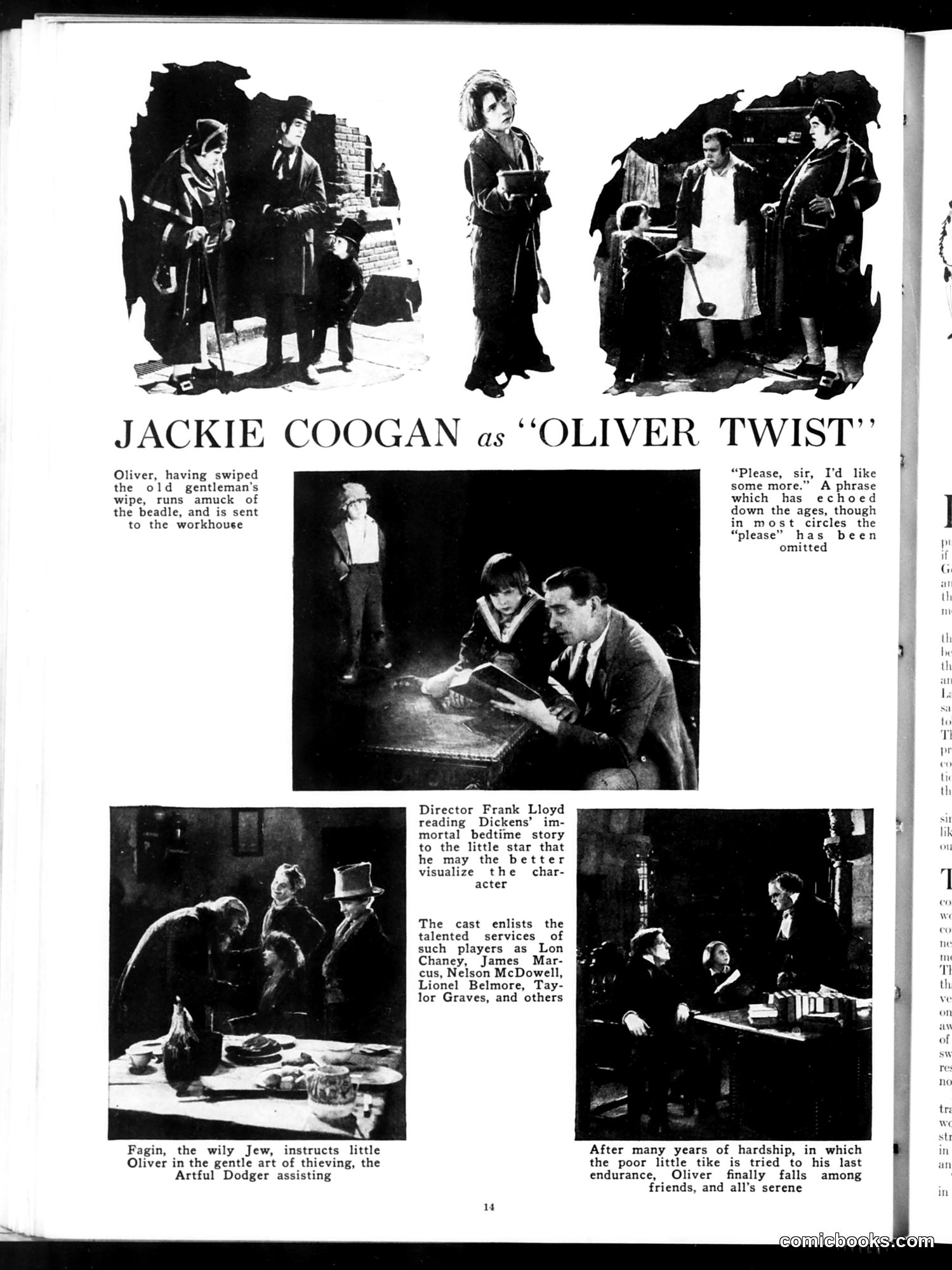
This page documents a film adaptation of Dickens' *Oliver Twist* starring child actor Jackie Coogan. The images show scenes from production: Oliver's theft and workhouse punishment, Fagin instructing the boy in pickpocketing, and Oliver's eventual refuge with kind friends. The satirical element appears subtle—the final caption's quip about "Please, sir, I'd like some more" notes the phrase has "echoed down the ages, though in most circles the 'please' has been omitted" suggests mild social commentary on manners or class degradation. The mention of Director Frank Lloyd reading Dickens to young Coogan to help him "visualize the character" may gently mock either the director's methods or the child star system itself. The page primarily functions as entertainment reporting rather than political satire, promoting the film and its notable cast.
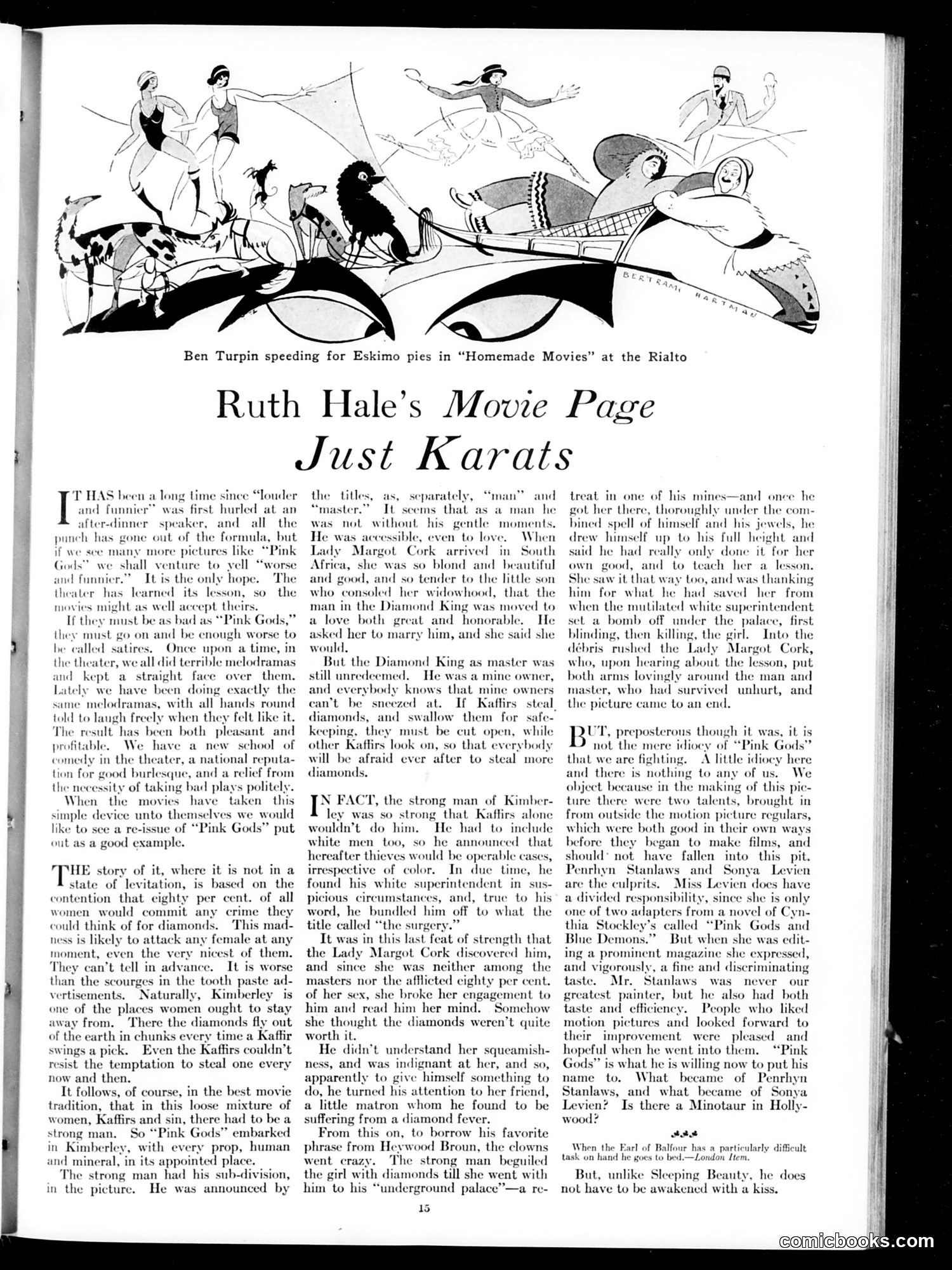
This is a film criticism column reviewing "Pink Gods," a silent movie set in the Kimberley diamond mines of South Africa. The illustration shows Ben Turpin, a famous cross-eyed silent comedian, in a slapstick scene. Hale's review satirizes the film's premise—that "eighty per cent. of all women would commit any crime for diamonds"—as absurd melodrama. She criticizes the plot: a strong mine owner (the "master") and a gentler "man" both love the widow Lady Margot Cork. When he brutally operates on (surgically cuts open) white thieves suspected of swallowing stolen diamonds, she's horrified and breaks their engagement. Hale argues the film is so poorly made it should be re-released *as satire*, suggesting studios adopt theatrical burlesque techniques—intentional over-the-top acting to mock bad drama rather than play it straight. Her broader critique: movies have borrowed melodrama's worst habits without learning its self-aware comedic potential.
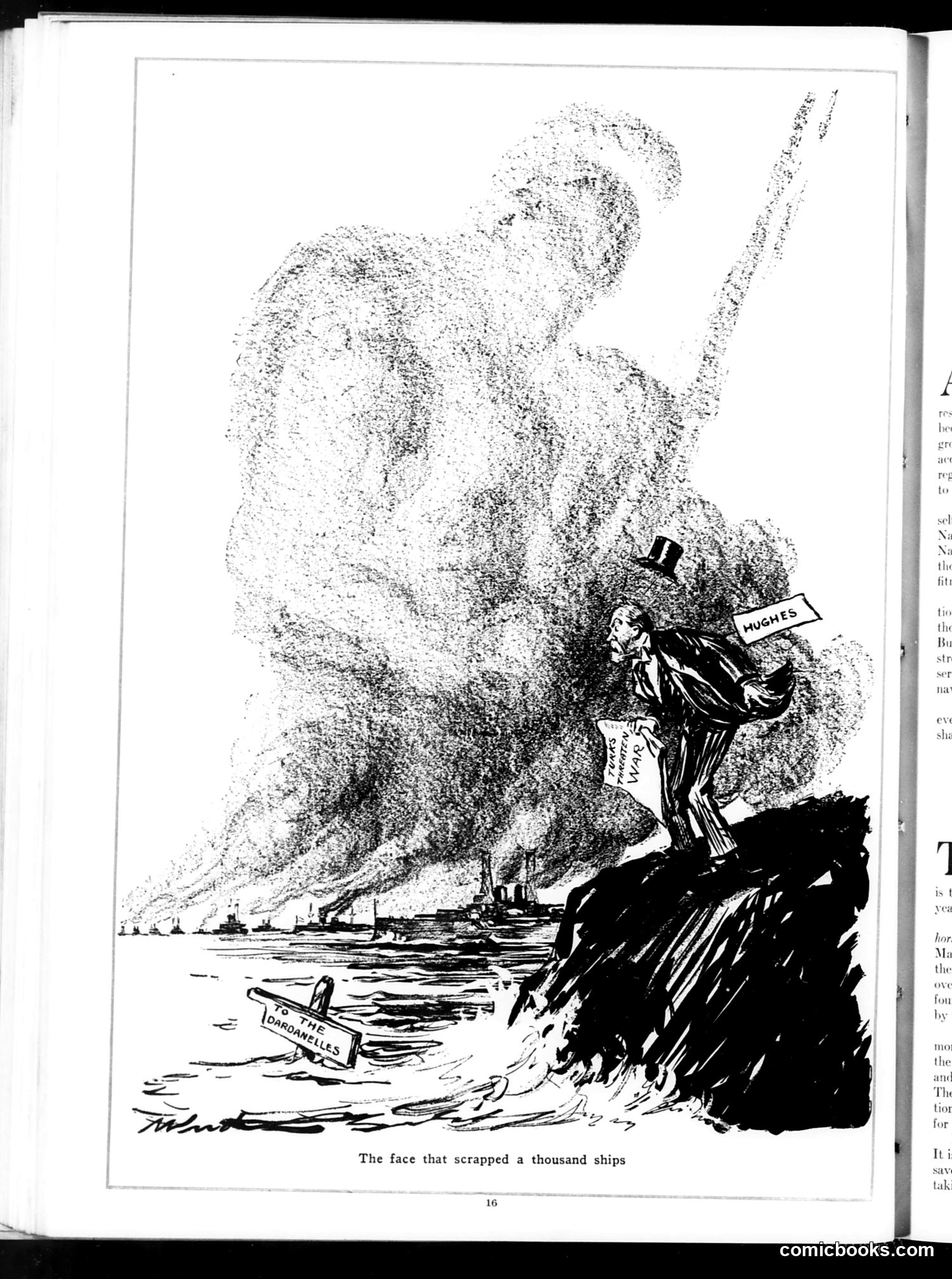
This cartoon satirizes a figure labeled "Hughes" (likely Howard Hughes, the aviation industrialist) standing atop a cliff overlooking a naval fleet. The caption "The face that scrapped a thousand ships" parodies Helen of Troy's legendary beauty, inverting the classical reference to suggest Hughes's influence caused mass destruction rather than creation. The cartoon criticizes Hughes's business decisions—likely related to his aircraft manufacturing or defense contracts—as catastrophically wasteful, destroying vast military resources. The ironic classical allusion emphasizes the scale of the damage attributed to one person's actions or negligence. The drowning vessel labeled "Dreadnoughts" in the foreground reinforces the naval destruction theme. This represents Depression-era criticism of industrial titans whose decisions devastated American economic assets.
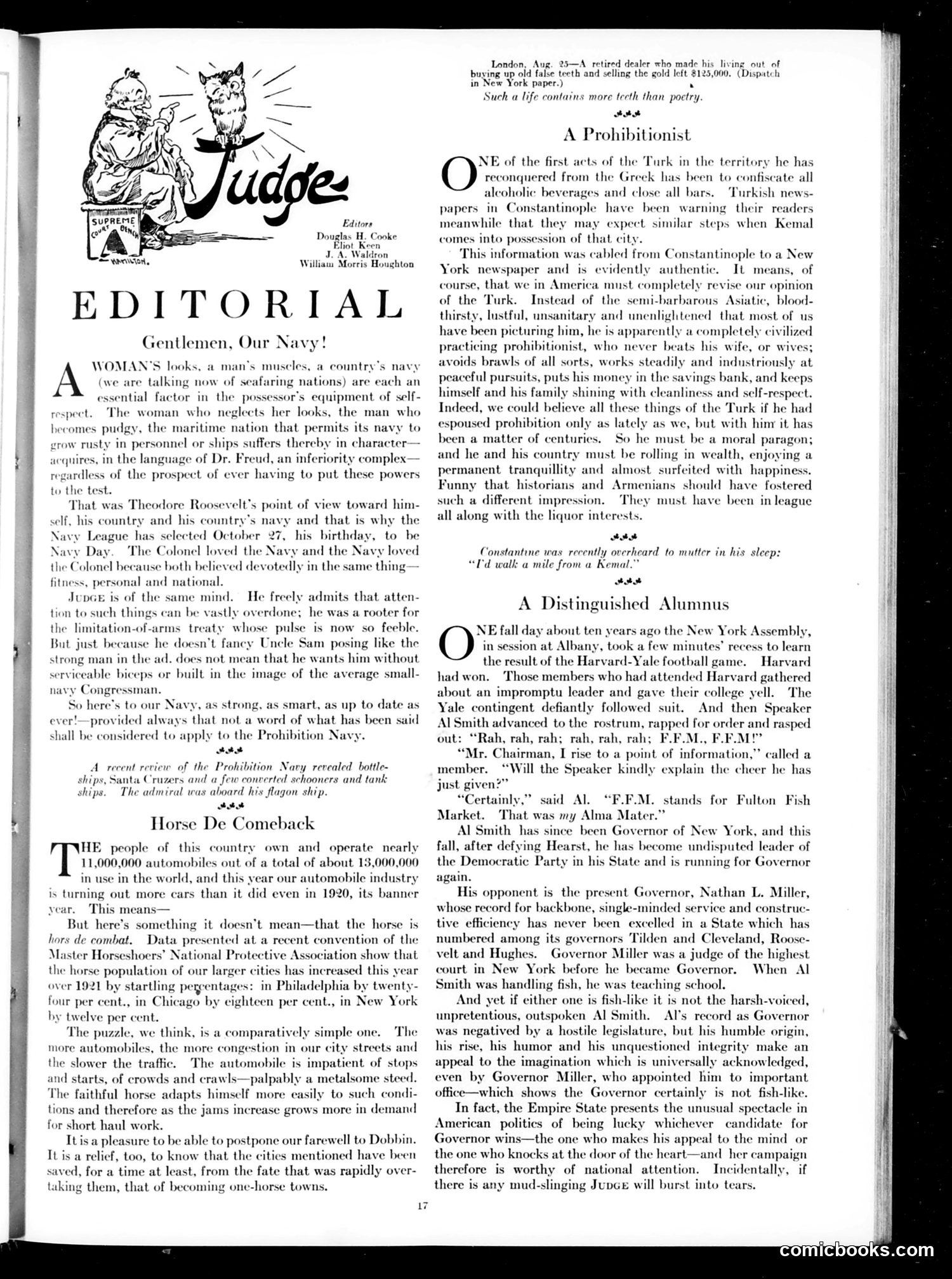
This editorial page from Judge magazine (circa 1920s, based on Prohibition references) contains three pieces: **"Gentlemen, Our Navy!"** argues for maintaining a strong naval force, invoking Theodore Roosevelt's philosophy that national fitness reflects character. Judge critiques both arms-limitation treaties AND the "Prohibition Navy"—a satirical jab at alcohol-banned naval vessels. **"Horse De Comeback"** humorously notes that despite automobile proliferation, horses are returning to American cities. The explanation: cars jam traffic with stops-and-starts, while horses adapt better to congested urban conditions for short hauls. The piece celebrates horses' unexpected revival. **"A Prohibitionist"** briefly reports Turkey's confiscation of alcohol under Kemal's rule, noting Turkish newspapers warned similar measures were coming. Judge's implied irony suggests America's own Prohibition policy mirrors authoritarian actions. The cartoon "Judge" (top left) shows the magazine's mascot character—a jowly, cigar-smoking figure representing the publication's satirical voice—presumably commenting on these topics.
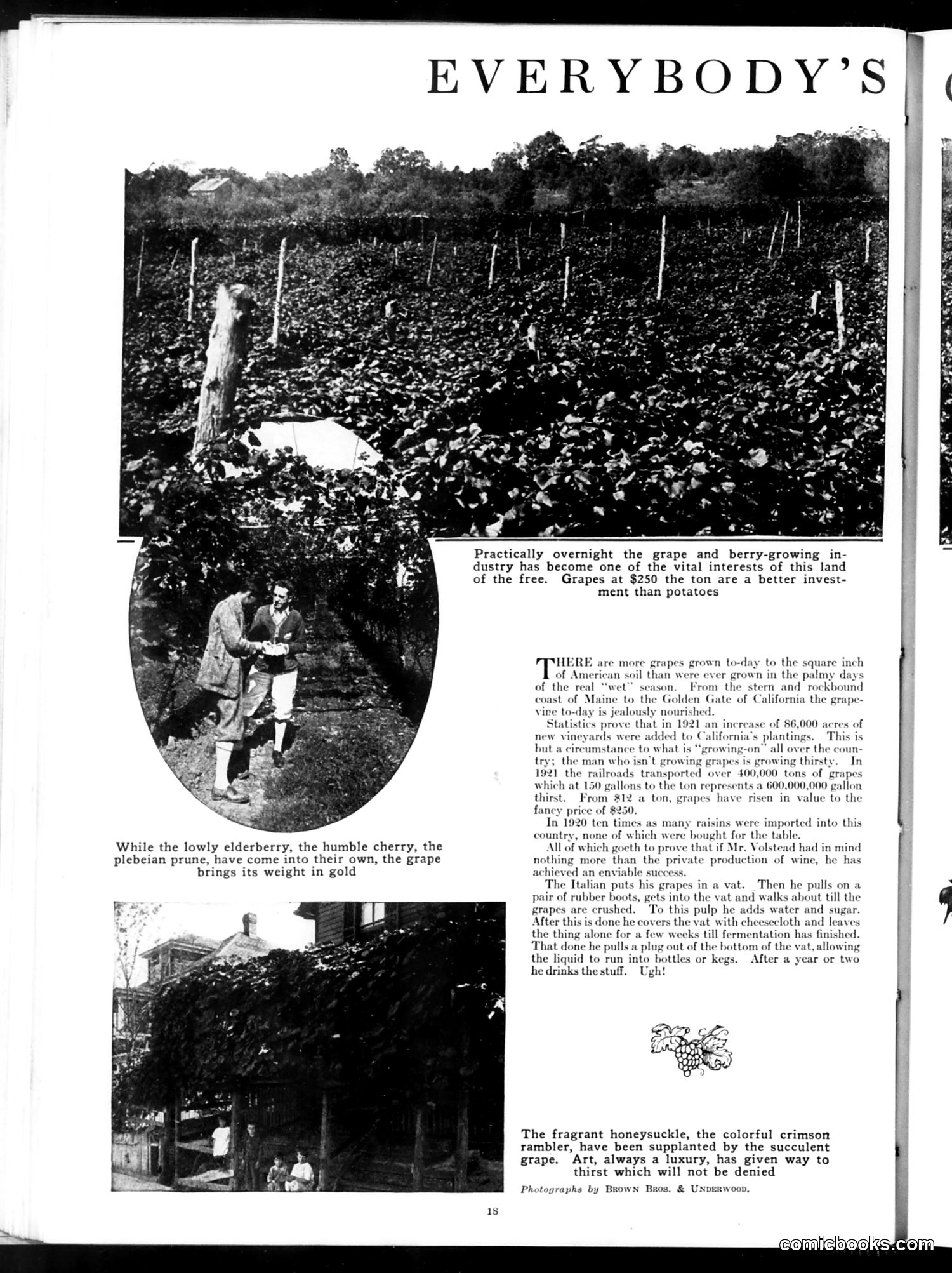
This is not a political cartoon but rather a satirical article about Prohibition's unintended consequences, likely from the early 1920s. **The Context:** The Volstead Act (Prohibition enforcement law) was intended to eliminate alcohol. Instead, it created massive demand for grapes—the raw material for home wine production, which was technically legal. **The Satire:** The piece mocks how Prohibition backfired spectacularly. Americans who weren't growing grapes before now rush to cultivate them. The text notes grape prices skyrocketed from $12 to $250 per ton, and railroads transported 400,000 tons annually (representing a theoretical 600-million-gallon "thirst"). **The Point:** Judge ridicules how Mr. Volstead's law—intended to stop alcohol consumption—actually created a booming grape industry and encouraged home winemaking. The photographs show vineyard prosperity and family wine-production. The final jab: ornamental plants like honeysuckle have been replaced by economically valuable grape vines, and art has given way to satisfying thirst "which will not be denied." The satire celebrates Prohibition's failure rather than its intent.
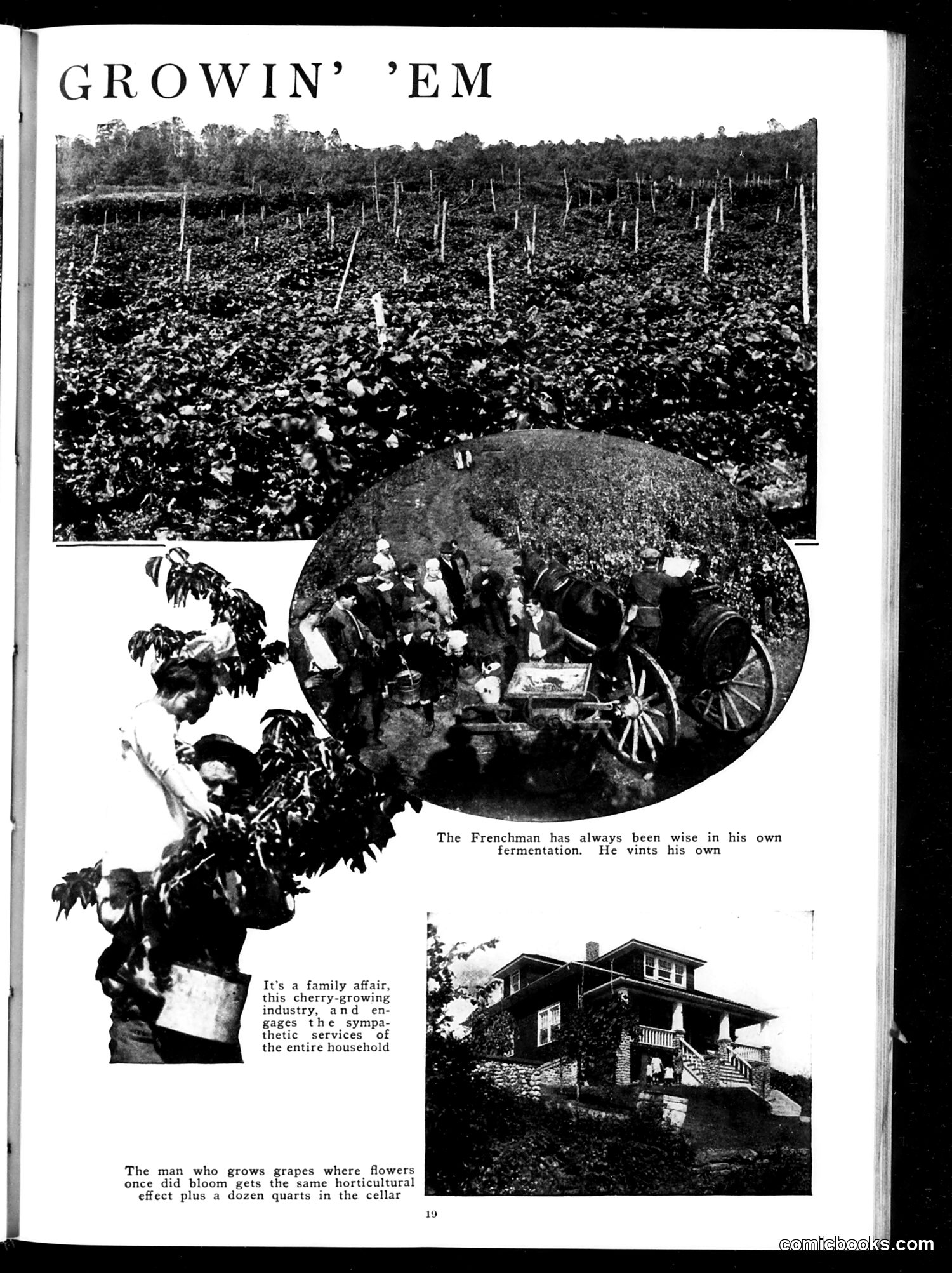
This page satirizes Prohibition-era home cultivation. The title and images celebrate domestic fruit-growing with double meanings—"vinting" wine and producing "a dozen quarts in the cellar" are euphemisms for illegal alcohol production. The top image shows a French family operating a wine press, praised for their fermentation wisdom. The cherry and grape references mock Americans' attempts to circumvent Prohibition by growing fruits ostensibly for eating, but actually for homemade wine and liquor production. The satire celebrates this domestic defiance of alcohol restrictions as a "family affair" involving "the entire household"—suggesting Prohibition enforcement was widely flouted through home production. The cartoonist endorses this common practice as clever, practical, and characteristically French.
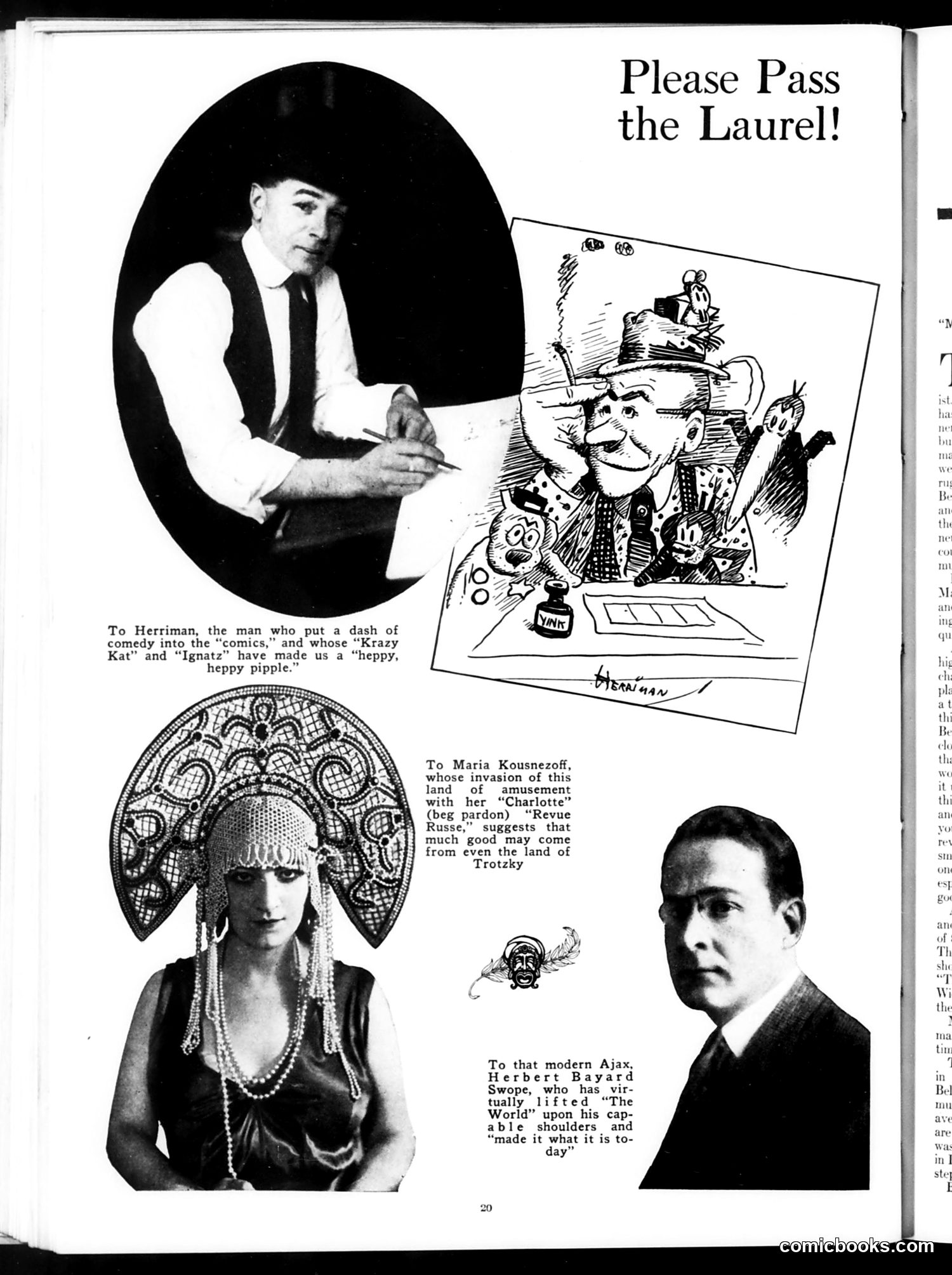
This page awards humorous "laurels" (honors) to three entertainment figures of the 1920s era: **George Herriman** (top) - Cartoonist credited with bringing comedy to newspaper comics through *Krazy Kat* and *Ignatz* (his famous cat-and-mouse strip). **Maria Kousnezoff** (lower left) - A Russian performer whose "Revue Russe" (Charlotte) brought Russian entertainment to America. The reference to "Trotzky" (Trotsky) reflects 1920s anxiety/fascination with post-Soviet Russian culture. **Herbert Bayard Swope** (lower right) - Newspaper editor of the *New York World*, credited with transforming it into a major publication. The satire gently mocks these figures by awarding them grandiose praise for their contributions to American entertainment and journalism, while the exaggerated portrait drawings emphasize their public personas. The "modern Ajax" reference compares Swope to the legendary Greek hero—humorous overstatement typical of Judge's style.
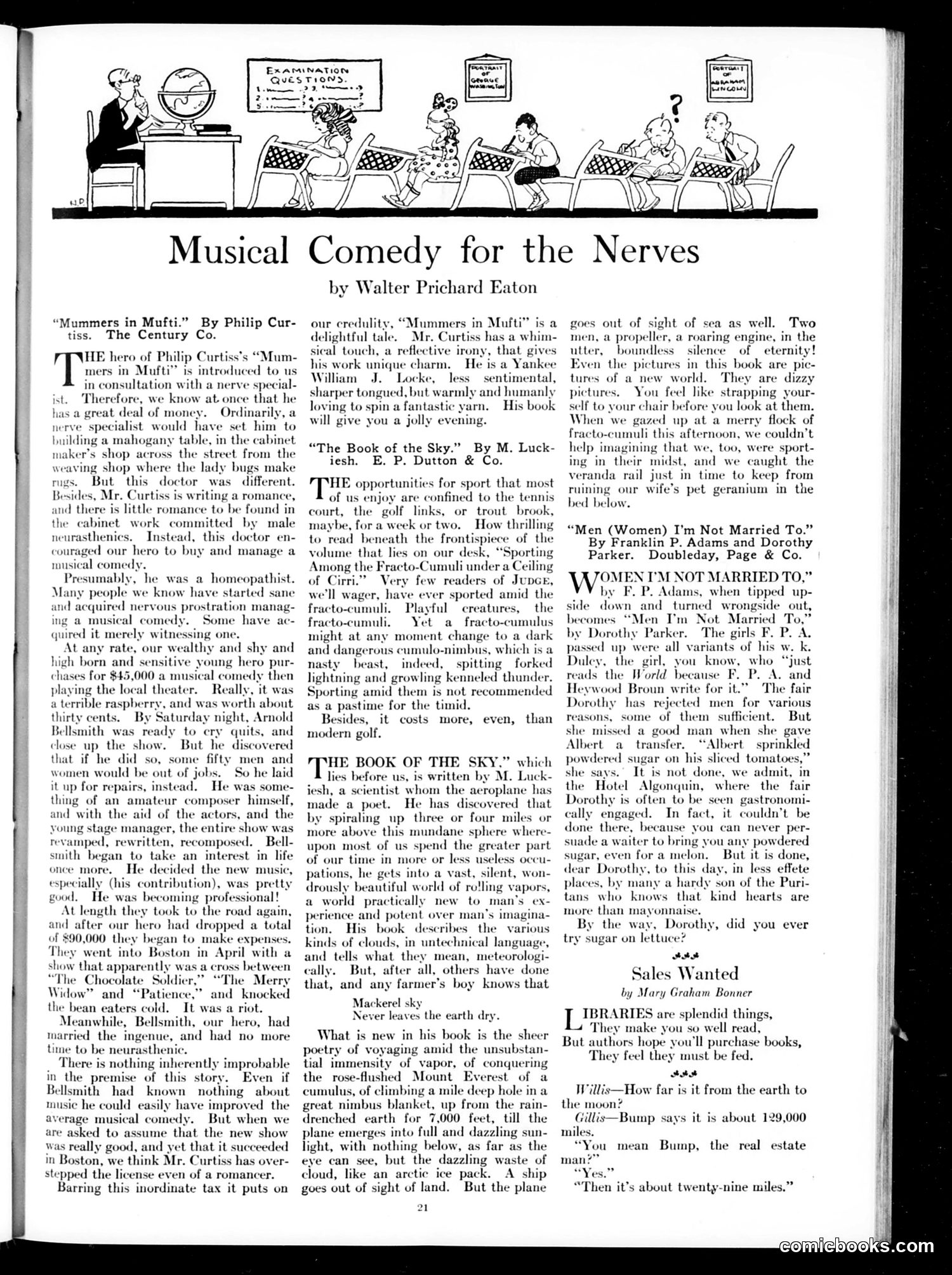
This page reviews three books. The cartoon at top illustrates the main review: a wealthy, nervous young man consults a doctor, who prescribes an unusual "cure"—buying and managing a musical comedy theater for $45,000. The satire targets two things: first, the absurdity of wealth-based "neurasthenia" treatments (nervous exhaustion was a real diagnosis among the privileged); second, the implausibility that a wealthy amateur with no theatrical experience could actually create a *good* show, even with help. The reviewer notes this strains credibility "even for a romancer." The cartoon's examination-board setup humorously suggests managing a musical comedy is itself a test of nerves—both for the protagonist and, implicitly, for audiences. The joke: only a nervous person would invest in Broadway theater; only a nervous person would watch it. The reviews of other books (about sky-sports, book-sales) are filler content typical of Judge magazine.
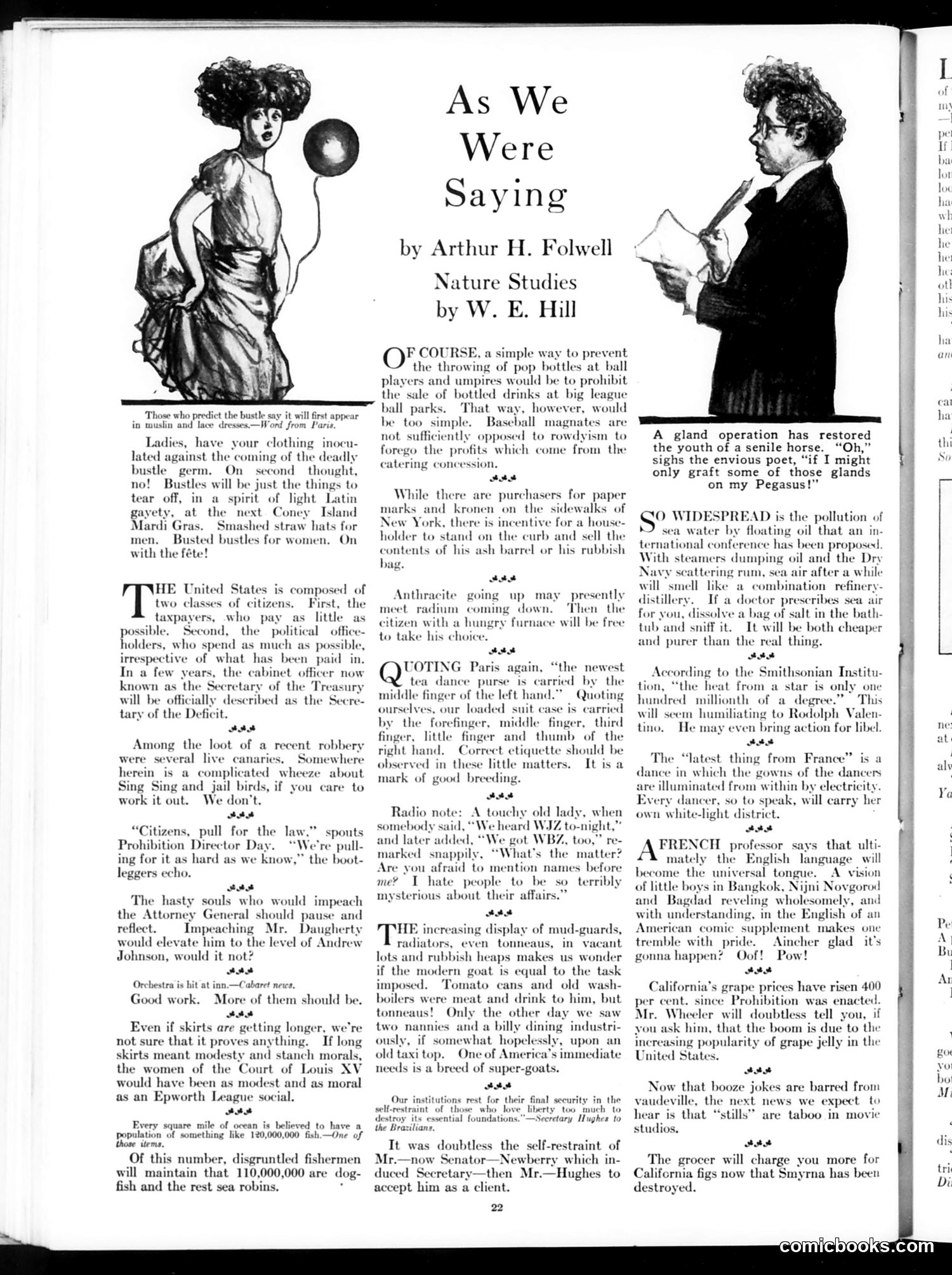
This page from **Judge** magazine contains satirical commentary on contemporary American life, likely from the 1920s based on references to Prohibition and modern technologies. The illustrated header shows a couple—a fashionably dressed woman and man—accompanying the column "As We Were Saying." The content consists of brief humorous observations on various topics: **Key satirical targets include:** - **Fashion**: Mocking the predicted return of bustles from Paris - **Government corruption**: Criticizing the Treasury Department's deficit spending - **Prohibition**: Joking about bootleggers and alcohol enforcement - **Baseball**: Mocking owners' prioritization of concession profits over fan safety - **Currency speculation**: Referencing worthless German marks being sold on New York streets - **Radio**: A joke about radio station call letters (WJZ, WBZ) - **Class commentary**: Observing goats eating discarded automobile parts The satire is light and domestic rather than sharply political, reflecting Judge's role as a general-interest humor magazine for middle-class readers concerned with social manners and everyday absurdities.
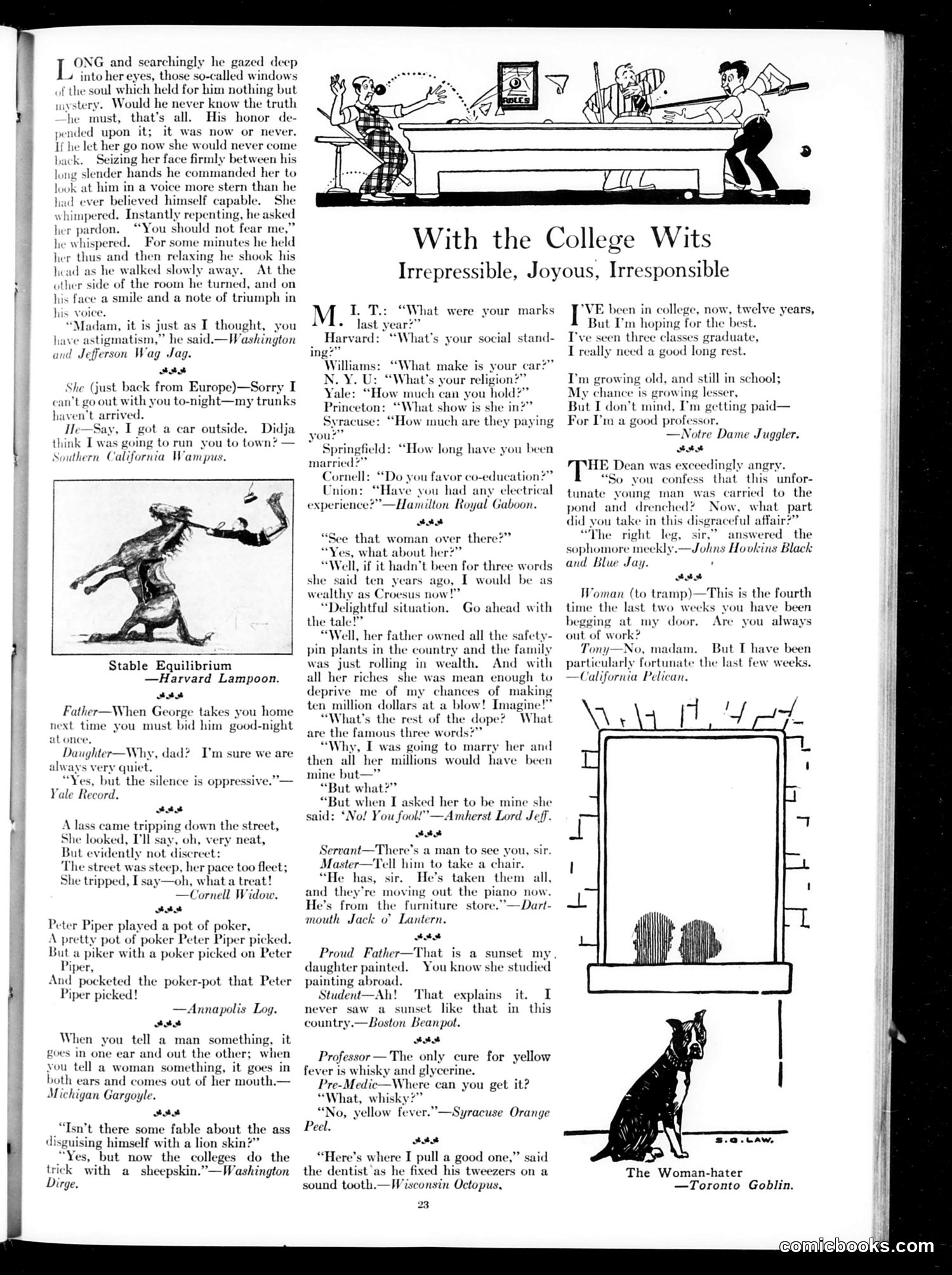
This page from Judge magazine collects humorous quips and short jokes typical of early 20th-century college humor. The content reflects period attitudes and college life: **Main Content:** "With the College Wits" features joke exchanges supposedly from various college newspapers (Yale, Princeton, Cornell, etc.), satirizing student behavior and concerns—social standing, dating, finances, academic struggles. **Notable Jokes:** - A woman's three-word rejection ("No! You fool!") that cost a man a fortune in potential marriage - A servant's deadpan report that a furniture-store visitor has removed all the chairs and is moving the piano - A dentist's pun about "pulling a good one" **Social Context:** The humor reflects class consciousness (wealth, inheritance), gender stereotypes (women as gossips), and the emerging collegiate culture. The "college wits" concept itself—presenting university students as clever humorists—was a popular magazine feature celebrating educated youth. **Visual Elements:** Simple line drawings accompany some jokes, including "Stable Equilibrium" (Harvard Lampoon) and "The Woman-hater" (Toronto Goblin). The page is essentially a compilation of brief collegiate witticisms with minimal political content.
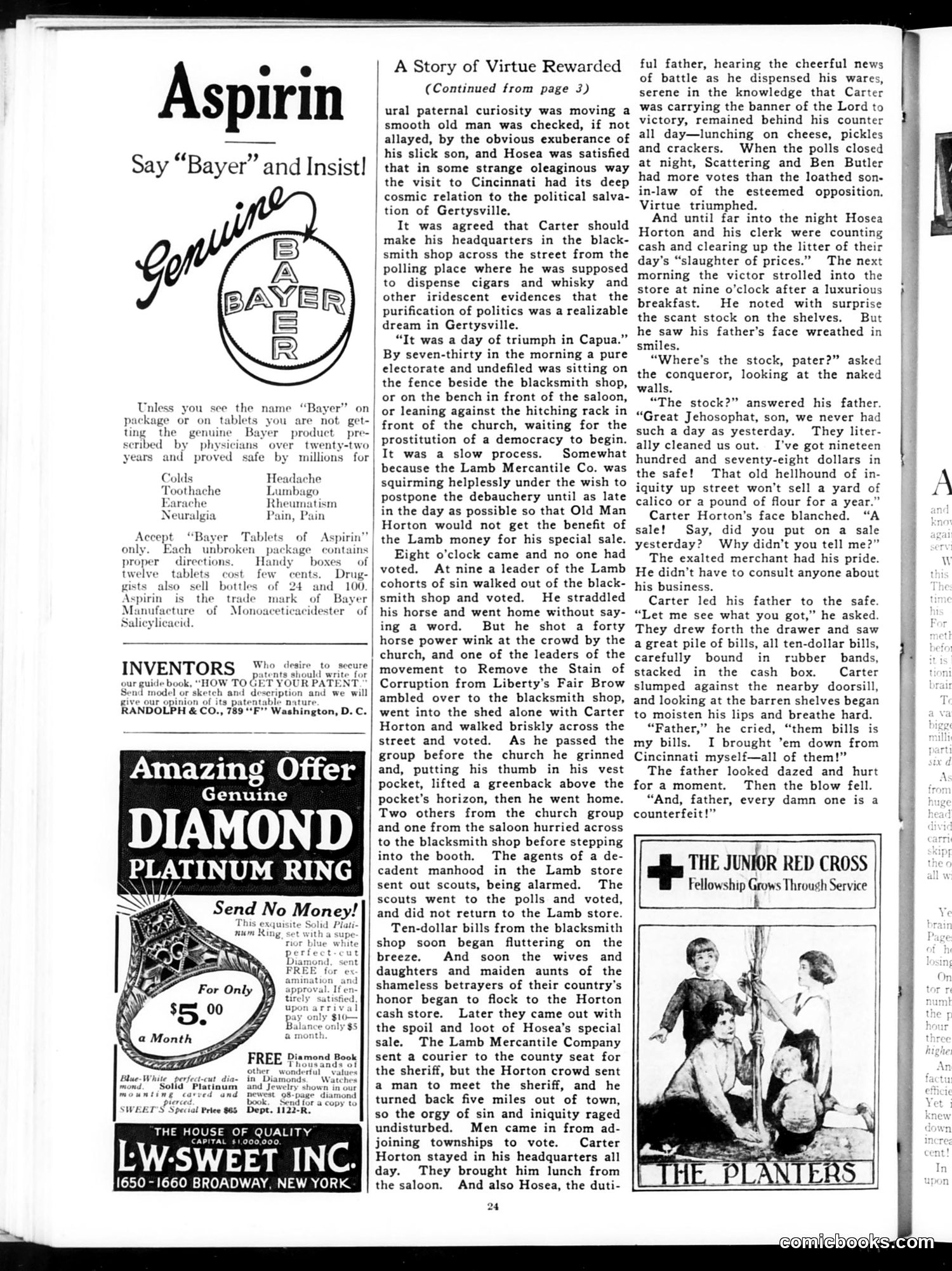
This page continues a serialized story satirizing electoral fraud in a fictional town called Gertysville. The narrative mocks the transparent bribery tactics deployed during a local election—specifically, how Carter Horton's faction uses cigars, whisky, and cash (ten-dollar bills) to buy votes from citizens at a blacksmith shop near the polling place. The satire targets the hypocrisy of "purification of politics" rhetoric while depicting blatant vote-buying. The competing Lamb Mercantile Company struggles to compete with Horton's bribes. The story mocks both the corruptors and the corruptible electorate—citizens casually trading their votes for cash and merchandise, while their wives and daughters eagerly spend the blood money at Horton's store. This reflects Progressive Era concerns about municipal corruption and the failure of democratic principles in practice.
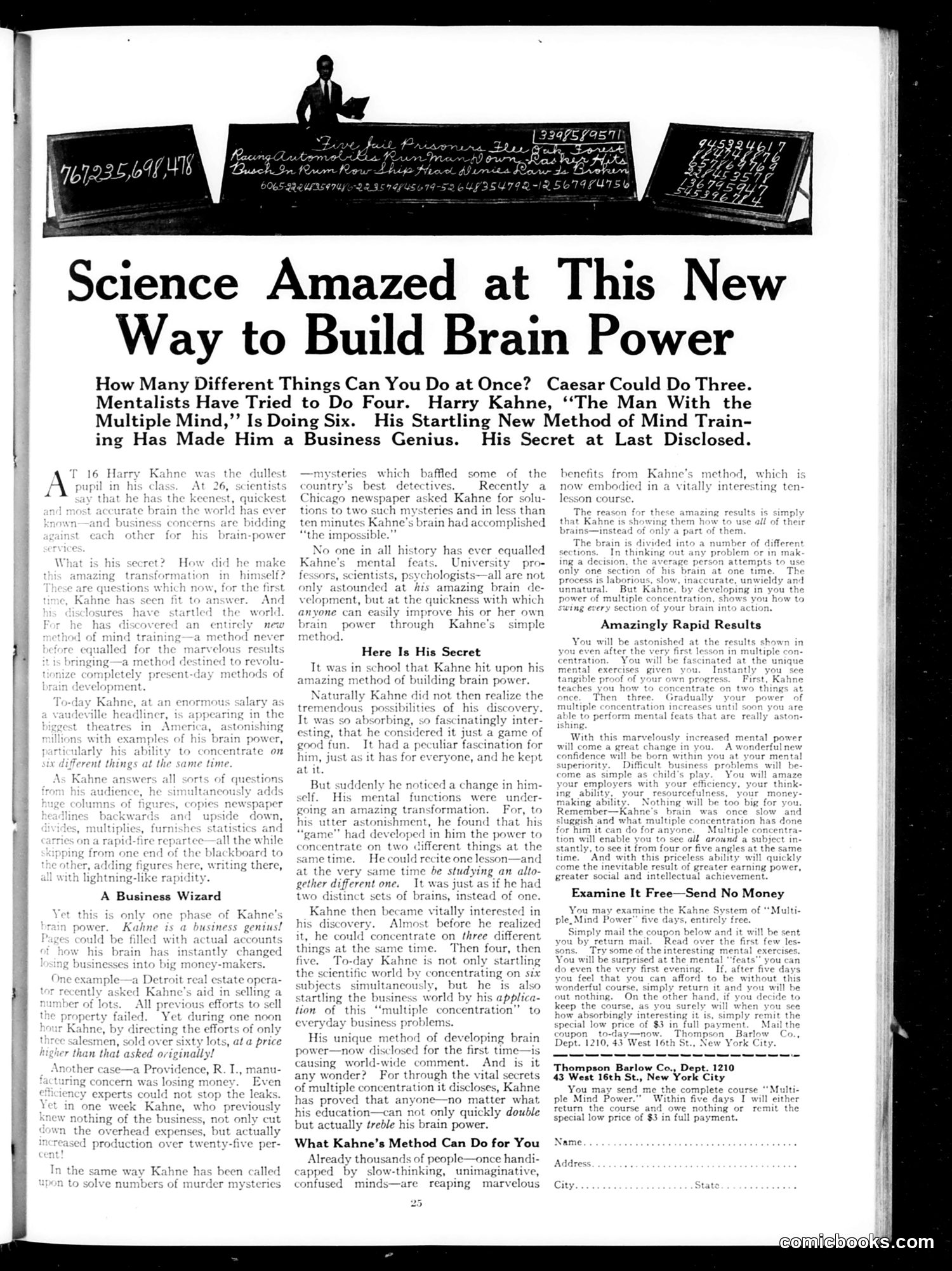
This page is primarily **advertising disguised as editorial content** for Harry Kahne's "Multiple Mind Power" correspondence course. Rather than satire, it's a straightforward (if hyperbolic) self-help pitch from the 1920s era. **The Figure:** Harry Kahne, billed as "The Man With the Multiple Mind," claims to teach readers to concentrate on six different tasks simultaneously—supposedly superior to Caesar (three) and stage mentalists (four). **The Hook:** The ad uses pseudo-scientific language ("brain power," "vital secrets of multiple concentration") and promises business success to appeal to early-20th-century readers eager for self-improvement. The comparison to historical figures adds false prestige. **The Satire/Irony (if any):** Judge's inclusion suggests *mockery* of such dubious mental-training schemes. The grandiose claims—that anyone can "triple his brain power"—would likely strike readers as exaggerated pseudoscience worthy of satire. **Missing Context:** Without knowing Judge's editorial stance that week, it's unclear whether this is genuine advertising or satirical commentary on mail-order schemes targeting vulnerable readers.
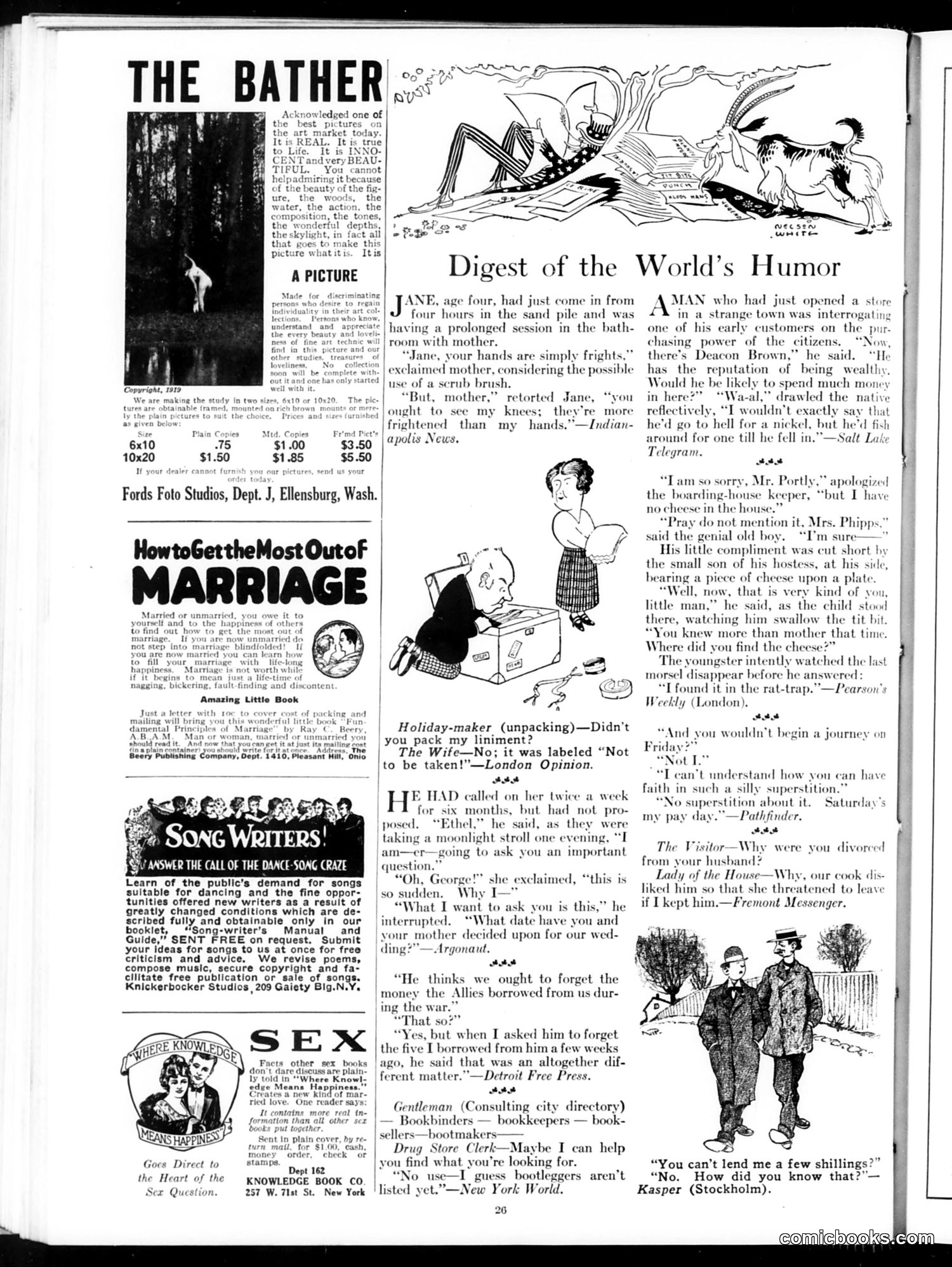
This is primarily an advertising and humor compilation page from Judge magazine (copyright 1919). **Main content:** The top features "The Bather," a illustrated poem about acknowledging life's beauty—a sentimental piece about finding meaning in simple scenes. Below it is a "Digest of the World's Humor" section collecting brief jokes from various publications. **The jokes reflect early 20th-century domestic humor:** a child's observation about dirty knees, a landlady's embarrassing moment when a guest finds cheese in a rat trap (exposing poor housekeeping), a man's proposal delayed by practical wedding-date discussion, and commentary on post-WWI debt and marital discord. **The advertisements** promote marriage advice books, song-writing opportunities, photography services, and sex education manuals—reflecting contemporary anxieties about modern life and relationships. The satire is gentle and domestic rather than political; it targets middle-class social pretensions and marital friction typical of Judge's humor tradition.
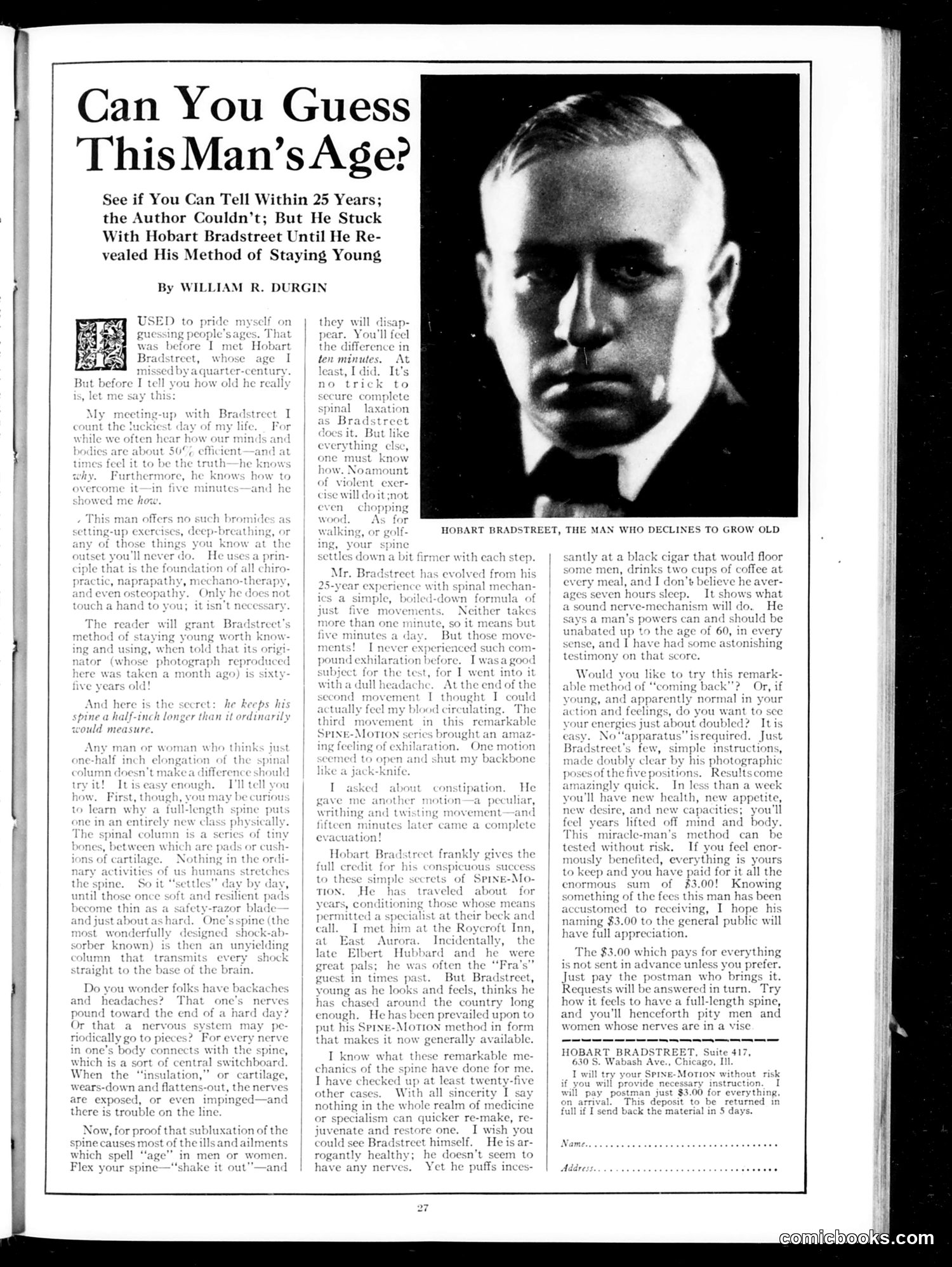
This is a **health/fitness advertisement disguised as editorial content** in Judge magazine. The piece promotes **Hobart Bradstreet's "Spine-Motion" exercise method** for staying young and healthy. The article claims Bradstreet—shown in the photograph—looks remarkably youthful despite his actual age. Author William R. Durgin provides testimonial-style narrative, describing how simple spinal exercises (taking "just one minute" daily) allegedly restore vitality, cure constipation, and improve overall health. The satire here is **implicit**: Judge is gently mocking the era's proliferation of dubious "scientific" health schemes and the credulity of readers willing to pay $3.00 for fitness secrets. The breathless enthusiasm and miraculous-sounding claims ("he doesn't seem to have any nerves") are characteristic of early 20th-century wellness hucksterism that magazines like Judge regularly lampooned. The actual point: readers shouldn't trust these dubious longevity claims.
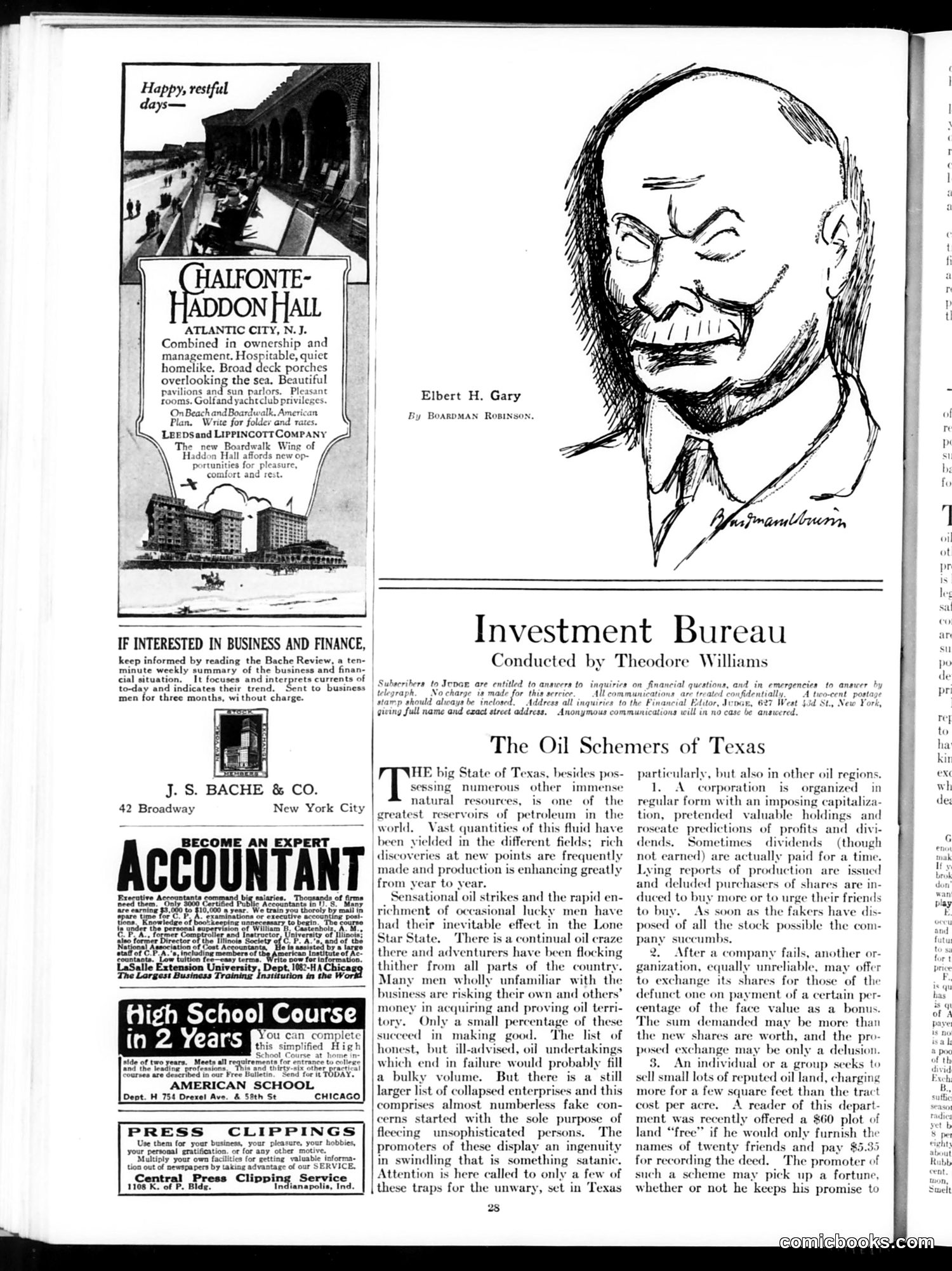
This Judge magazine page mixes advertisements with financial commentary. The prominent sketch portrays **Elbert H. Gary**, a major industrialist (likely steel industry), credited to cartoonist Boardman Robinson. The main article, "The Oil Schemers of Texas," warns readers about petroleum investment fraud during the Texas oil boom. It describes common scams: fake corporations with inflated capitalization, false production reports, and stock promoters who enrich themselves then disappear once shares are sold to duped investors. The satire is implicit rather than visual—the article functions as consumer protection journalism, exposing how oil swindlers exploit ordinary people's get-rich-quick dreams. The accompanying "Investment Bureau" column reinforces Judge's role advising readers on financial matters, making the fraud warnings feel authoritative and timely.
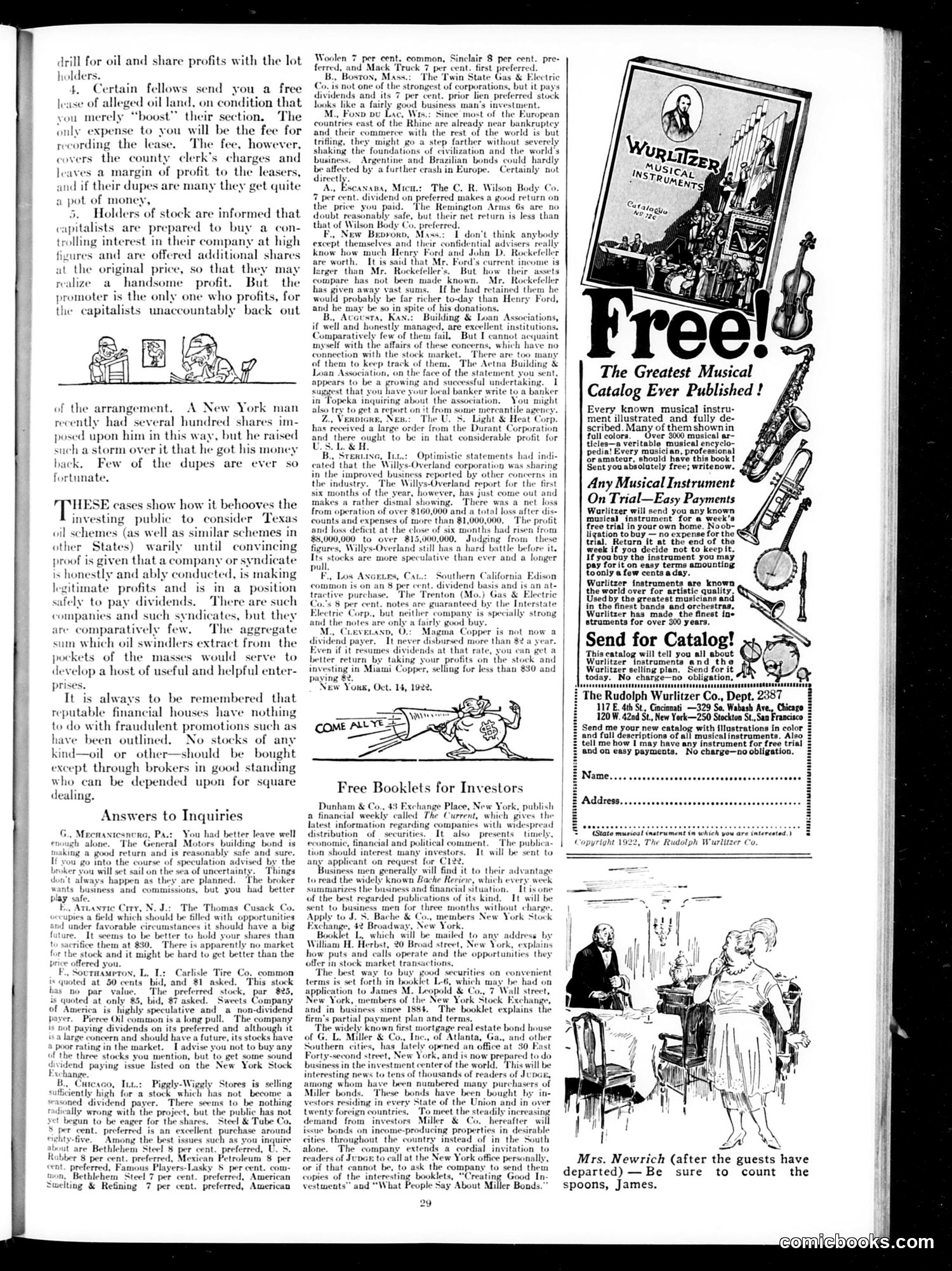
This page from Judge magazine (dated 1922, based on copyright notice) contains satirical commentary on oil investment schemes and stock fraud targeting ordinary Americans. ## Main Content: The article exposes five common oil-swindle tactics: fraudulent leasing arrangements, worthless stock promotions, and manipulative dividend schemes. It warns readers that while legitimate oil companies exist, most are operated by unscrupulous promoters who profit while investors lose money. ## The Satire: The accompanying cartoons mock the desperation of investment dupes and the slick operators who victimize them. The page functions as consumer protection journalism, educating readers about predatory financial schemes common in the 1920s oil boom. ## Advertisement: The "Wurlitzer Musical Instruments" ad on the right offers a free catalog—ironically positioned next to warnings about fraudulent "free" offers, though Wurlitzer was a legitimate company. The "Answers to Inquiries" section provides specific stock advice, suggesting Judge served investors seeking guidance during this speculative era.
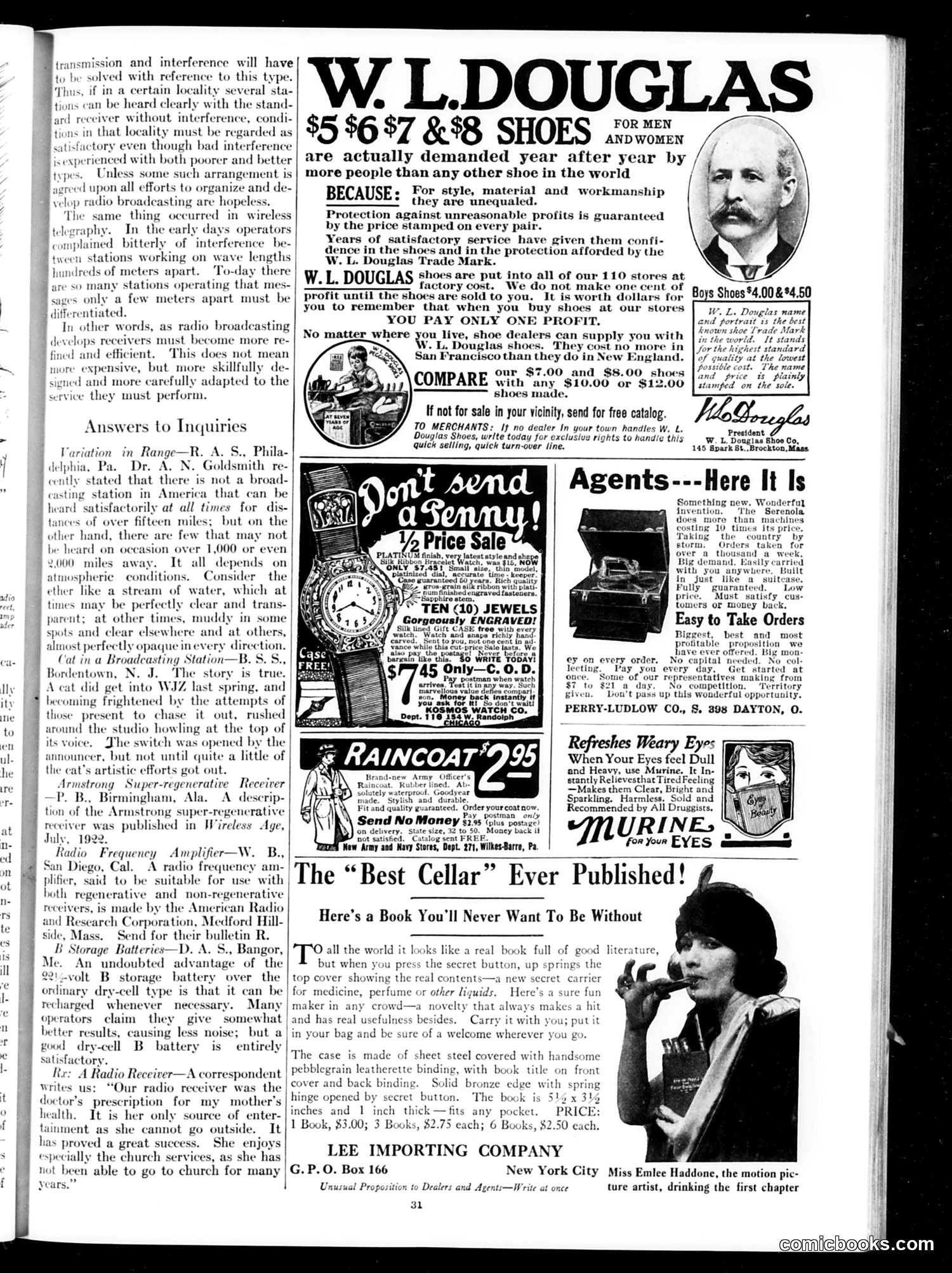
This page is primarily **advertising and reader correspondence**, not political satire or comics. The main content includes: **Advertisements:** - **W.L. Douglas Shoes**: A large ad featuring a portrait of William L. Douglas himself, emphasizing his shoes' value and quality control through price-stamped guarantees - **"Don't Send a Penny" half-price jewelry sale** with engraved items - **Raincoat** ($2.95) - **Murine** eye drops - **Lee Importing Company** secret-button book advertisement **Editorial Content:** - "Answers to Inquiries" column addressing radio reception, broadcasting stations, and early radio technology questions - References to specific radio stations (WJZ) and technical concerns about interference The page reflects **1920s consumer culture and early radio-era concerns**—no political cartoons or satire appear here. It's a typical magazine page mixing practical reader advice with period advertising.
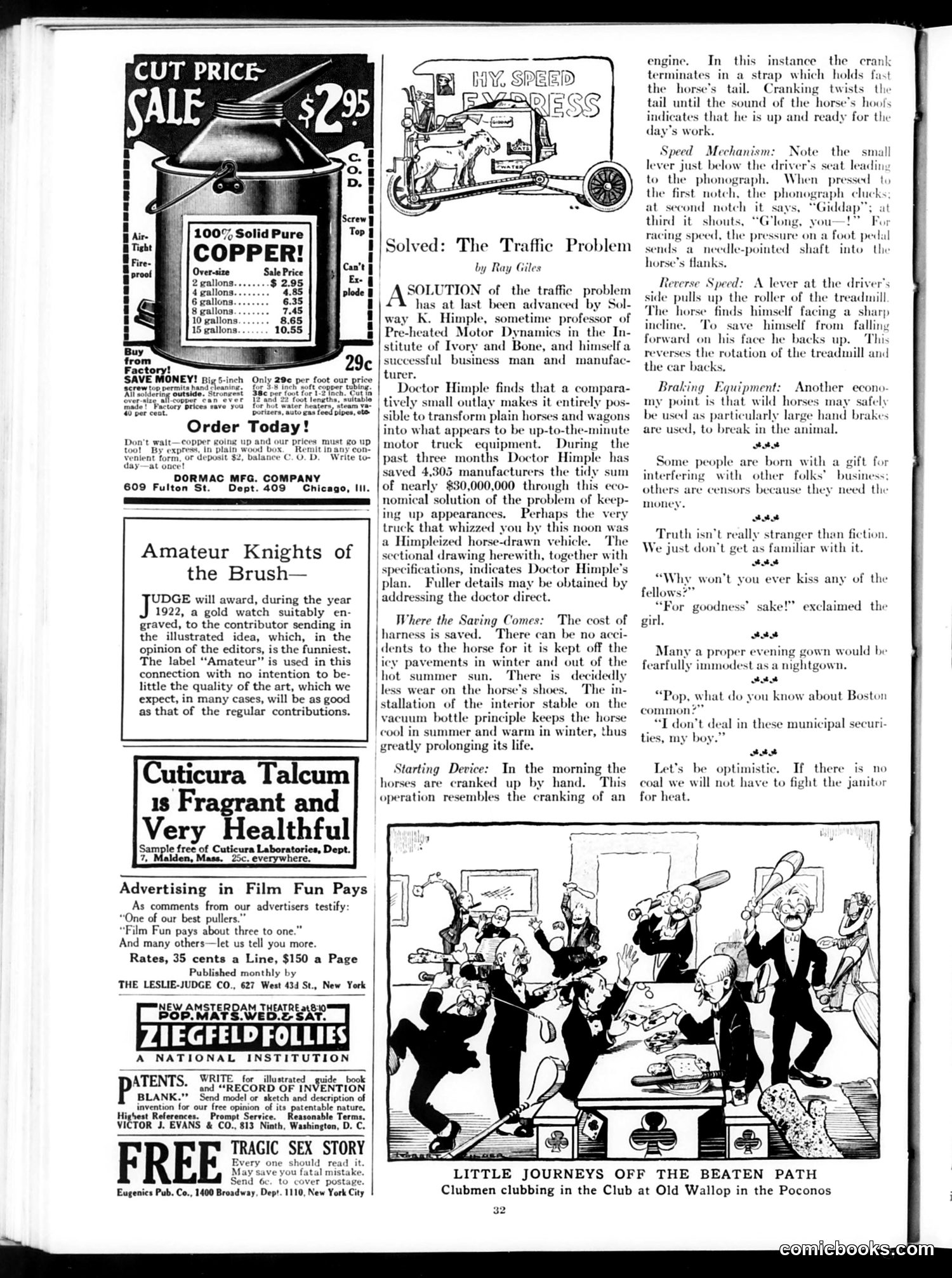
This article satirizes the tension between old and new technology in the 1920s. "Doctor Himple" proposes converting horse-drawn wagons into fake "motor trucks" by disguising horses with mechanical-looking contraptions—essentially dressing up horses to *appear* modern without actual modernization. The satire mocks: 1. **Manufacturers' greed**: They're supposedly saving $30 million by disguising horses rather than investing in real vehicles 2. **Superficial modernity**: The fake "improvements" (phonograph for speed control, foot pedals, a "starting device" that involves cranking the horse's tail) are absurdly impractical 3. **The slow pace of technological transition**: Even as automobiles existed, many still relied on horses; this ridicules the gap between marketing "progress" and actual practice The cartoon below (titled "Little Journeys Off the Beaten Path") shows clubmen in formal wear engaged in chaotic activity—likely commenting on wealthy leisure culture. The page is primarily advertisements and editorial content, typical of 1920s Judge magazine's mix of humor and commercialism.
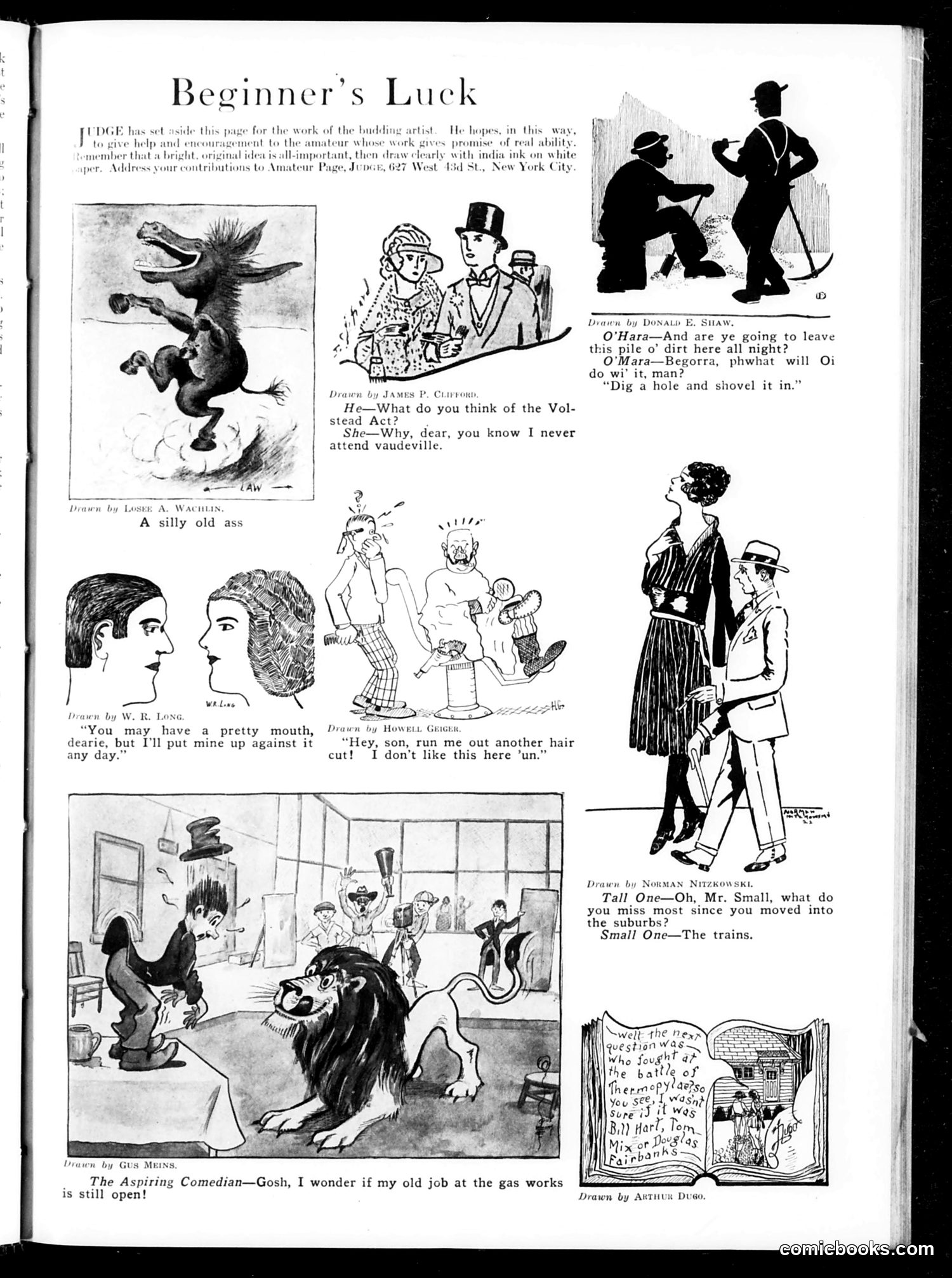
This is a collection of short joke cartoons from Judge magazine, showcasing amateur submissions. Each sketch targets recognizable social situations with brief punchlines: **The Volstead Act joke** mocks the 1920s Prohibition law by having a woman confuse "Volstead Act" with vaudeville entertainment—suggesting widespread ignorance about the controversial alcohol ban. **The Irish laborers' dialogue** uses stereotypical dialect ("Begorra," "phwhat") to joke about working-class men and manual labor. **The suburban train joke** satirizes the newly popular suburban lifestyle, implying that moving away from the city means losing convenient public transportation. **The barber and hair-cutting humor** plays on physical appearance and fastidiousness. **The gas works finale** suggests a failed comedian contemplating returning to his previous menial job—humor rooted in economic precarity and the entertainment industry's risks. The page's framing emphasizes these are "beginner's luck" submissions from amateur artists, giving them exposure while maintaining Judge's satirical edge about everyday American life, prohibition, and class dynamics.
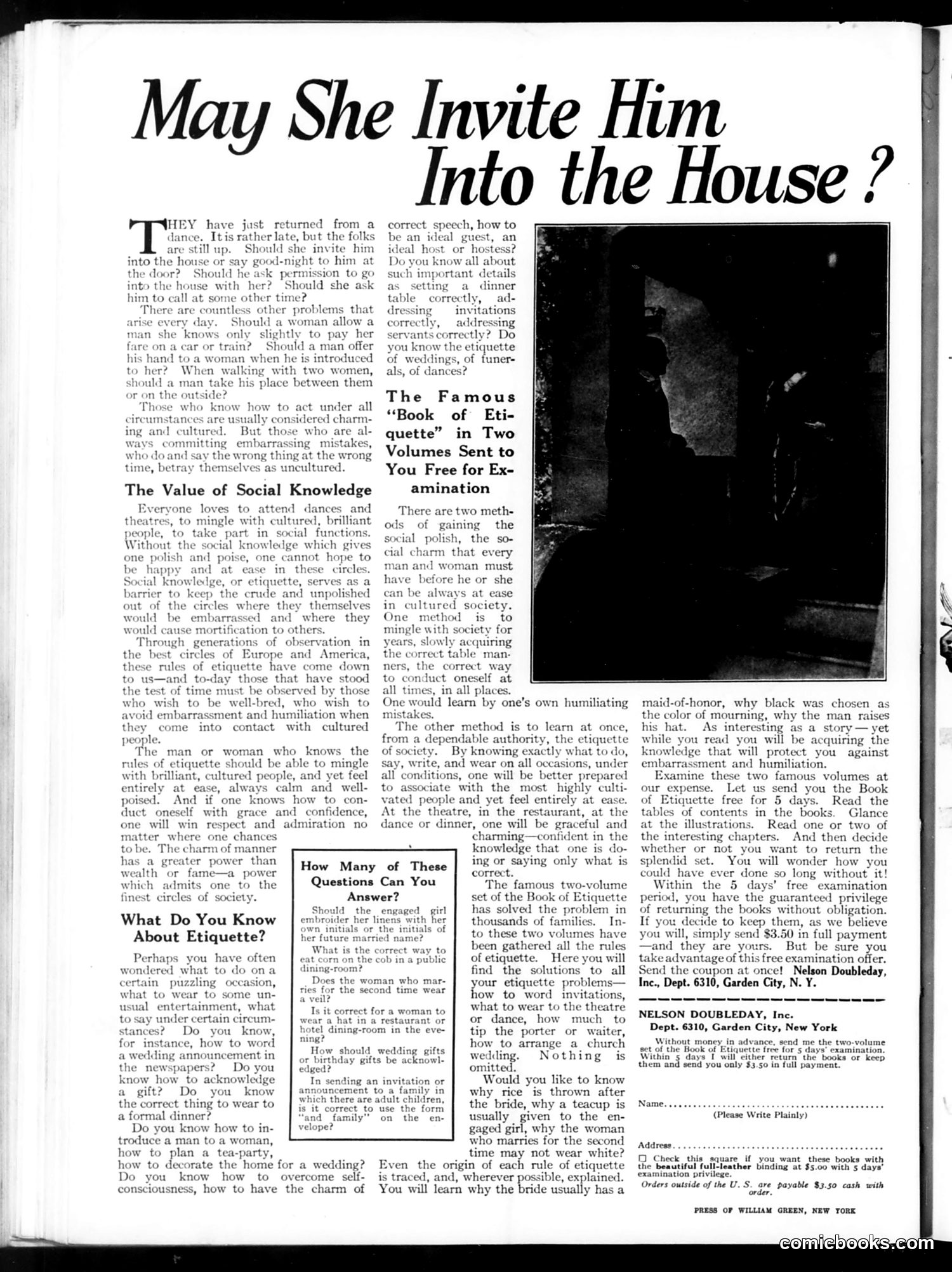
This page is primarily **advertising**, not satire or political commentary. The "cartoon" element is minimal—just a photograph of what appears to be a young couple at a doorway, illustrating the etiquette question posed in the title. The content reflects early 20th-century anxieties about **social propriety and class performance**. The page addresses genteel concerns: Should an unmarried woman invite a male caller inside late at night? How does one behave correctly at social events? The advertisement promotes a two-volume "Book of Etiquette" as the solution to social awkwardness. This reflects a broader cultural anxiety—that proper behavior could be *learned* from a book rather than acquired through breeding or family tradition. For modern readers, this reveals how etiquette guides functioned as aspirational self-help for the middle class seeking to navigate or enter "cultured society." The emphasis on avoiding "embarrassment and humiliation" through correct knowledge shows anxiety about social mobility and fear of exposure as uncultured.