
Judge, 1922-10-21 · page 11 of 36
Judge — October 21, 1922 — page 11: what you’re looking at
What you’re looking at
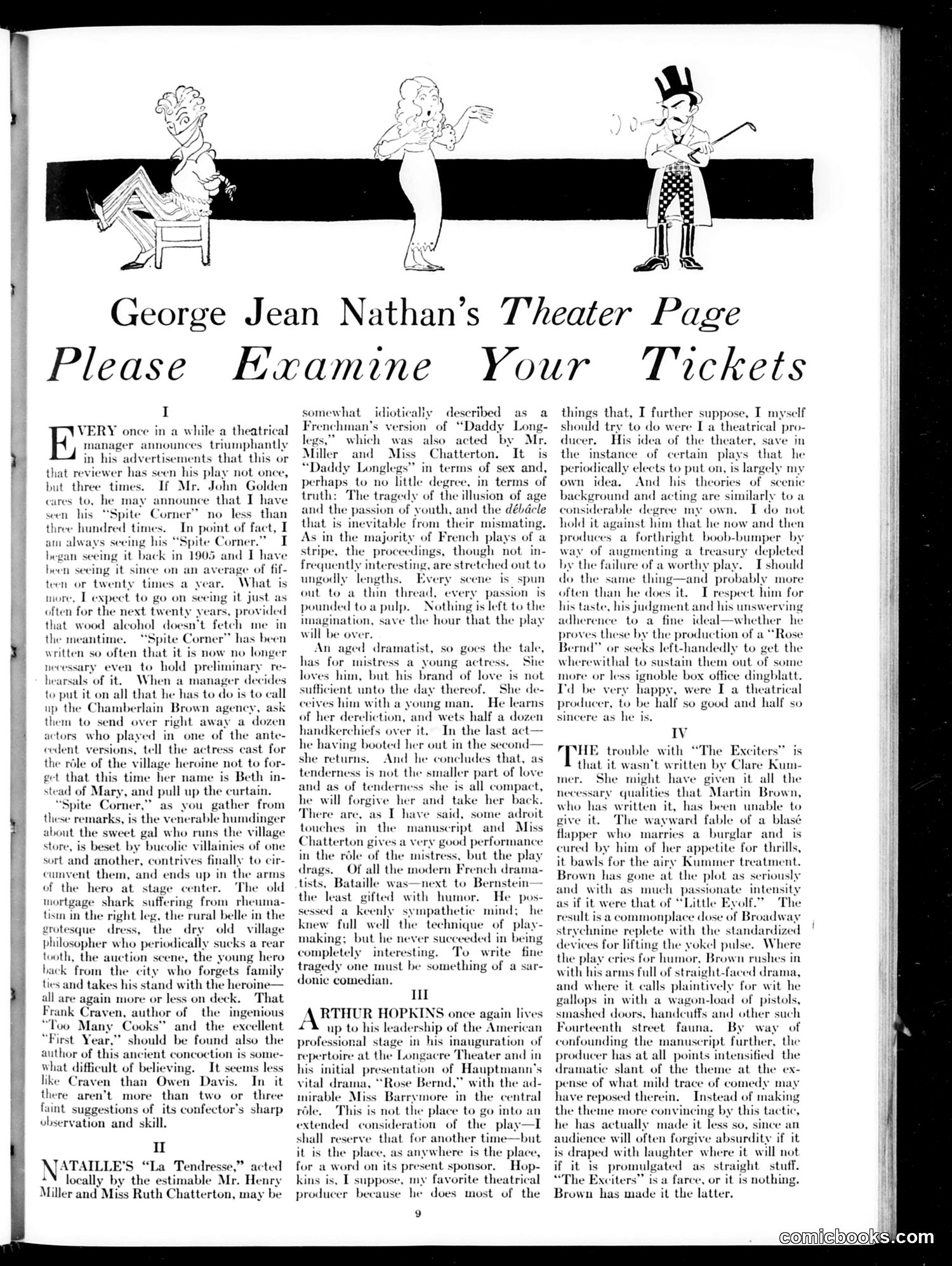
This page is theater criticism by George Jean Nathan, a prominent drama critic of the early 20th century. The three caricatured figures at the top represent theatrical types—likely representing stock characters or theatrical personalities of the era. Nathan reviews two plays: "Spite Corner" (which he claims to have seen repeatedly) and "La Tendresse" (a French play featuring Henry Miller and Ruth Chatterton). His satire targets: - **Theater recycling**: "Spite Corner" is so formulaic and frequently revived that it requires no rehearsal—just stock actors playing identical rural melodrama roles (villain with rheumatism, farm girl, city hero, etc.) - **French drama excess**: "La Tendresse" suffers from typical French theatrical faults—stretched plots, overwrought emotion, and maudlin sentiment, despite competent performances Nathan's point: American theater relies on worn-out conventions, while contemporary French dramatists lack wit and economy, prioritizing emotional excess over dramatic skill.
📄 Transcribed text from this page (OCR, searchable)
Machine-transcribed from the original scan — historical spelling and the odd misread are preserved.
George Jean Nathan’s T'heater Page Please I VERY once in a while a theatrical E manager announces triumphantly in his advertisements that this or that reviewer has seen his play not once, but three times. If Mr. John Golden cares to, he may announce that I have en his “Spite Corner” no less than three hundred times. In point of fact, I am always seeing his “Spite Corner.” I began seeing it back in 1 nd I he heen seeing it since on ge of fif teen or twenty times 2 What is more, I expect to go on it just as often for the next twenty years, provided that wood alcohol doesn’t fetch me in the meantime. “Spite Corner” has been written so often that it is now no longer necessary even to hold prelimina hearsals of it. When a manager decides to put it on all that he has to do is to call up the Chamberlain Brown agency, ask them to send over right away a dozen actors. who played in’ one of the ante- cedent versions, tell the actress cast for the role of the village heroine not to for- get that this time her name is Beth in- dof Mary, and pull up the curtain. Spite Corner,” as you gather from these remarks, is the venerable humdinger about the sweet gal who runs the store, is beset by bucolic villainies of ¢ sort and another, contrives finally to cir- cumvent them, and ends up in the arms of the hero at stage center. ‘The old mortgage shark suffering from rheuma- tisin in the right leg, the rural belle in the grotesque dress, the dry old village philosopher who periodically sucks a rear tooth, the auction scene, the young hero hack from the city who forgets family ties and takes his stand with the heroine— all are again more or less on deck. That Frank Craven, author of the ingenious foo Many Cooks” and the excellent irst Year,” should be found also the author of this ancient concoction is some- What difficult of believing. like Craven than Owen Davis. In it there aren’t. more than two or three faint suggestions of its confector’s sharp observation and skill. 1 JATAILLE’S “La Tendresse,” acted locally by the estimable Mr. Henry Miller and Miss Ruth Chatterton, may be It seems less Haamine somewhat idiotically described as a frenchman’s version of “Daddy Long- which was also acted by Mr. } and Miss Chatterton. i “Daddy Longlegs” in terms of perhaps to no little degree, in terms of truth: The tragedy of the illusion of age and the passion of youth, and the débdcle that is inevitable from their mismating. As in the majority of French plays of a stripe, the proc though not in- frequently interestin stretched out to ungodly lengths. scene is spun out to a thin thread, every passion is pounded toa pulp. — Nothing is left to the in tion, save the hour that the play will be over An aged dramatist, so gocs the ta has for mistress a young actress. She loves him, but his brand of love is not sufficient unto the day thereof. She de- ceives him with a young man, He learns of her dereliction, and wets half a dozen handkerchiefs over it. In the last act— he having booted her out in the seeond— she returns. And he concludes that, as tenderness is not the smaller part of love and as of tenderness she is all compact, he will forgive her and take her back. There are, as I have said, some adroit touches in the manuscript. and Miss Chatterton gives a very good performance in the rdle of the mistress, but the play Of all the modern French drama- next to Bernstein drags. tists, Bataille was the least gifted with hum He pos- sessed a keenly sympathetic mind; he knew full well the technique of play- making; but he never succeeded in being completely interesting. To write fine tragedy one must be something of a sar- donic comedian. III RTHUR HOPKINS once again lives LY. up to his leadership of the American professional stage in his inauguration of repertoire at the Longacre Theater and in his initial presentation of Hauptmann’s vital drama, “Rose Bernd,” with the inirable Miss Barrymore in the centr rile. ‘This is not the place to go into an extended consideration of the play—I shall reserve that for another time—but it is the 5 where is the place, for a word on its present sponsor. Hop- kins is, I suppose, my favorite theatrical producer because he does most of the ace, as an 9 Your Tickets things that, I further suppose, I myself should try to do were I a theatrical pro- ducer. His idea of the theater, save in the instance of certain plays that he periodically elects to put on, is largely my own idea. And his theories of scenic background and acting are similarly to a considerable degree my own. I do not hold it inst him that he now and then produces a forthright boob-bumper by wa) ugmenting a treasury deplet by the failu worthy play. I should do the same thing—and probably more often than he does it. I respect him for his taste, his judgment and his unswerving adherence to a fine ideal—whether he proves these by the production of a “Rose Bernd” or seeks left-handedly to the wherewithal to sustain them out of some more or less ignoble box office dingblatt. I'd be very happy, were I a theatrical producer, to be half so good and half so sincere as he is. IV ue trouble with “The Excite is that it wasn’t written by Clare Kum- might have giv it all the necess qualities that Martin Brown, who has written it, has been unable to give it. The wayward fable of a blasé flapper who marries a burglar and_ is cured by him of her appetite for thrills, it bawls for the airy Kummer t ment, Brown has gone at the plot as seriously and with as muel » intensity as if it were that of olf.” The result is a commonplace dose of Broadway vchnine replete with the standardized devices fo I pulse. Where the play cries for humor, Brown rushes in with his arms full of straight-faced drama, and where it calls plaintively for wit he gallops in with a wagon-load of pistols, smashed doors, handcuffs and other such Fourteenth street fauna, By way of confounding the manuscript furth the producer has at all points intensified: the dramatic slant of the theme at the ex- pense of what mild trace of comedy may have reposed therein, Instead of making the theme more convincing by this tactic, he has actually made it less so, since an audience will often forgive absurdity: if it is draped with laughter where it will not if it is promulgated as straight stuff. “The Exciters” is a farce, or it is nothing. Brown has made it the latter. mer. She comichoo)