
Judge, 1922-10-21 · page 20 of 36
Judge — October 21, 1922 — page 20: what you’re looking at
What you’re looking at
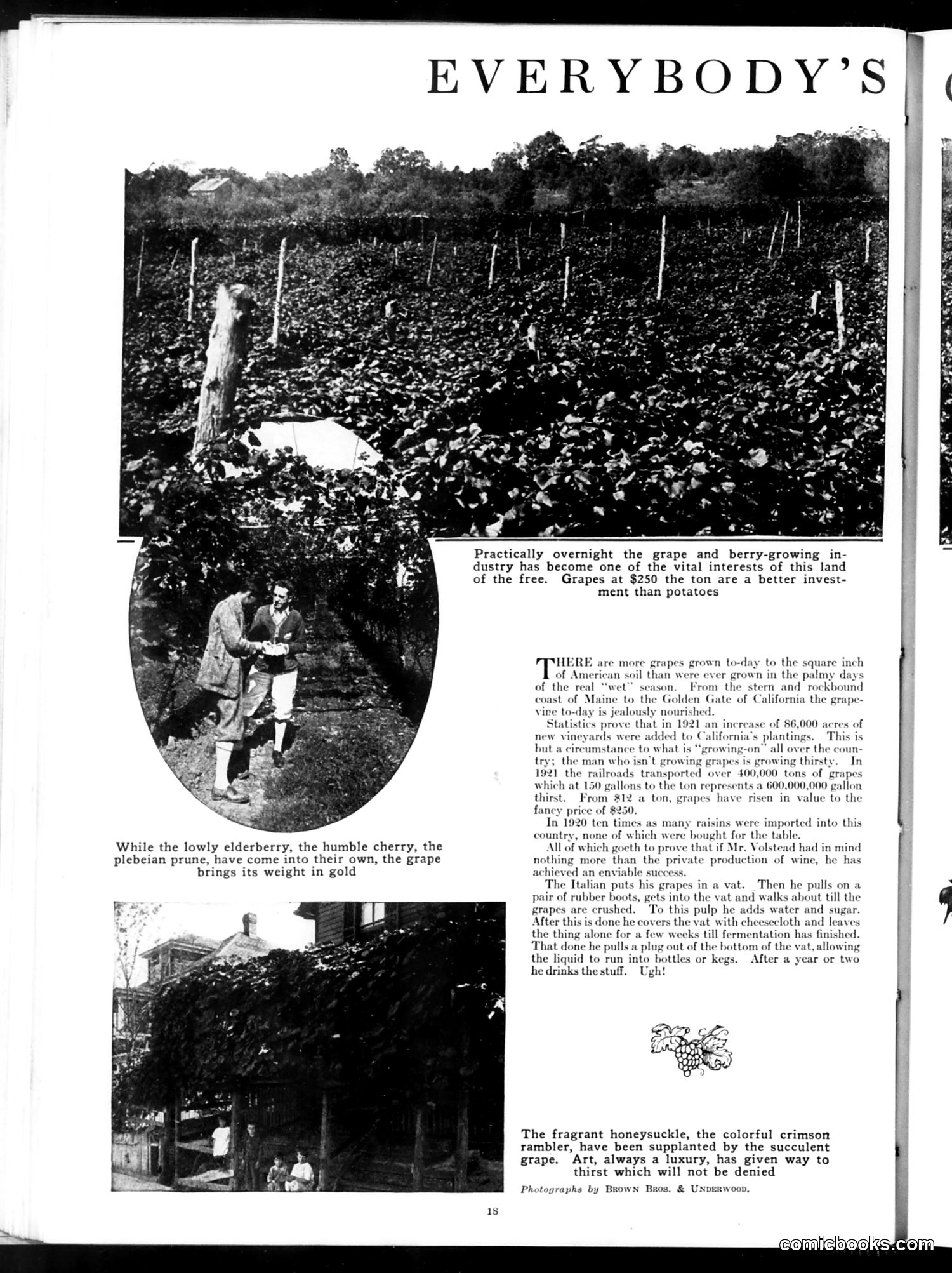
This is not a political cartoon but rather a satirical article about Prohibition's unintended consequences, likely from the early 1920s. **The Context:** The Volstead Act (Prohibition enforcement law) was intended to eliminate alcohol. Instead, it created massive demand for grapes—the raw material for home wine production, which was technically legal. **The Satire:** The piece mocks how Prohibition backfired spectacularly. Americans who weren't growing grapes before now rush to cultivate them. The text notes grape prices skyrocketed from $12 to $250 per ton, and railroads transported 400,000 tons annually (representing a theoretical 600-million-gallon "thirst"). **The Point:** Judge ridicules how Mr. Volstead's law—intended to stop alcohol consumption—actually created a booming grape industry and encouraged home winemaking. The photographs show vineyard prosperity and family wine-production. The final jab: ornamental plants like honeysuckle have been replaced by economically valuable grape vines, and art has given way to satisfying thirst "which will not be denied." The satire celebrates Prohibition's failure rather than its intent.
📄 Transcribed text from this page (OCR, searchable)
Machine-transcribed from the original scan — historical spelling and the odd misread are preserved.
EVERYBODY’S While the lowly elderberry, the humble cherry, the plebeian prune, have come into their own, the grape brings its weight in gold Practically overnight the grape and berry-growing in- dustry has become one of the vital interests of this land of the free. 18 Grapes at $250 the ton are a better invest- ment than potatoes nes grown to-day to the square inch were ever grown in th . of the real “wet season. From the stern and rockb coast of Maine to the Golden Gate of California the grape- vine to-day is jealously nourished. Statistics prove that in 1921 an increase of 86,000 acres of new vineyards were added lifornia’s plantings. This is but a circumstance to what is “growing-on” all over the coun- try; the man who isn’t growii rapes is growing thirsty. In 1921 the railroads transported over 400,000 tons of grapes which at 150 gallons to the ton represents a 600,000,000 gallon thirst. From $12 a ton, grapes have risen in value to the fancy price of $250. In 1920 ten times as many raisins were imported into this country, none of which were bought for the table. All of which goeth to prove that if Mr. Volstead had in mind nothing more than the private production of wine, he has eved an enviable success. The Italian puts his grapes in a vat. pair of rubber boot s into the vat and walks about till the grapes are crushed. To this pulp he adds water and sugar. After this is done he covers the vat with cheesecloth and leaves the thing alone for a few weeks till fermentation has finished. That done he pulls a plug out of the bottom of the vat, allowing the liquid to run into bottles or kegs. After a year or two he drinks the stuff. Ugh! © more gr: an soil the Then he pulls on a The fragrant honeysuckle, the colorful crimson rambler, have been supplanted by the succulent grape. Art, always a luxury, has given way to thirst which will not be denied Photographs by BrowN Bros. & UNbERwoop. EO