
Judge, 1922-10-21 · page 4 of 36
Judge — October 21, 1922 — page 4: what you’re looking at
What you’re looking at
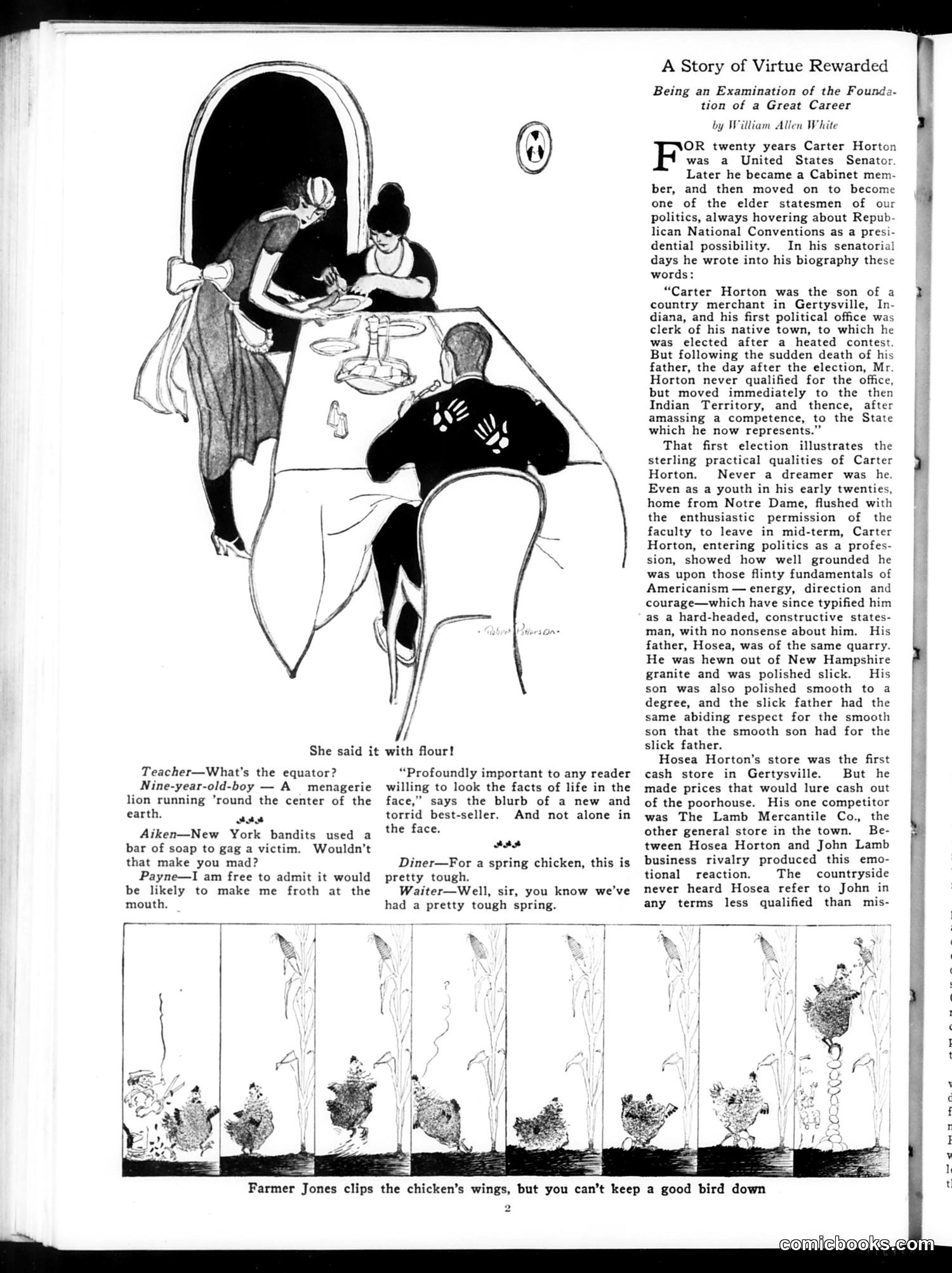
This page presents a biographical narrative about Carter Horton, a U.S. Senator who became a Cabinet member. The main illustration depicts a dinner scene where Horton (seated, back to viewer) dines with well-dressed companions, suggesting his social ascent. The text emphasizes Horton's practical, no-nonsense character—descended from New Hampshire granite stock, grounded in "fundamentals of Americanism." His rise began with a clerk position after his father's death, demonstrating meritocratic virtue. The humorous interjections below (about soap, equators, and tough chickens) appear to be unrelated comedic asides typical of Judge magazine's format. The bottom comic strip showing "Farmer Jones clips the chicken's wings" illustrates a separate visual gag about controlling ambition—the bird's repeated attempts to escape despite clipped wings.
📄 Transcribed text from this page (OCR, searchable)
Machine-transcribed from the original scan — historical spelling and the odd misread are preserved.
She said it with flour! Teacher—What's the equator? Nine-year-old-boy — A menagerie lion running ’round the center of the earth. ery Aiken—New York bandits used a bar of soap to gag a victim. Wouldn’t that make you mad? Payne—I am free to admit it would be likely to make me froth at the mouth. Farmer Jones clips the chicken’s wing: “Profoundly important to any reader willing to look the facts of life in the face,” says the blurb of a new and torrid best-seller. And not alone in the face. Sas Diner—For a spring chicken, this is pretty tough. Waiter—Well, sir, you know we've had a pretty tough spring. A Story of Virtue Rewarded Being an Examination of the Founda- tion of a Great Career by William Allen White OR twenty years Carter Horton was a United States Senator Later he became a Cabinet mem- ber, and then moved on to become one of the elder statesmen of our politics, always hovering about Repub- lican National Conventions as a presi- dential possibility. In his senatorial days he wrote into his biography these words: “Carter Horton was the son of a country merchant in Gertysville, In- diana, and his first political office was clerk of his native town, to which he was elected after a heated contest. But following the sudden death of his father, the day after the election, Mr. Horton never qualified for the office, but moved immediately to the then Indian Territory, and thence, after amassing a competence, to the State which he now represents.” That first election illustrates the sterling practical qualities of Carter Horton. Never a dreamer was he. Even as a youth in his early twenties, home from Notre Dame, flushed with the enthusiastic permission of the faculty to leave in mid-term, Carter Horton, entering politics as a profes- sion, showed how well grounded he was upon those flinty fundamentals of Americanism — energy, direction and courage—which have since typified him as a hard-headed, constructive states- man, with no nonsense about him. His father, Hosea, was of the same quarry. He was hewn out of New Hampshire granite and was polished slick. His son was also polished smooth to a degree, and the slick father had the same abiding respect for the smooth son that the smooth son had for the slick father. Hosea Horton's store was the first cash store in Gertysville. But he made prices that would lure cash out of the poorhouse. His one competitor was The Lamb Mercantile Co., the other general store in the town. Be- tween Hosea Horton and John Lamb business rivalry produced this emo- tional reaction. The countryside never heard Hosea refer to John in any terms less qualified than mis- > > | 's, but you can’t keep a good bird down a cae 0 aS