
Judge, 1922-10-21 · page 19 of 36
Judge — October 21, 1922 — page 19: what you’re looking at
What you’re looking at
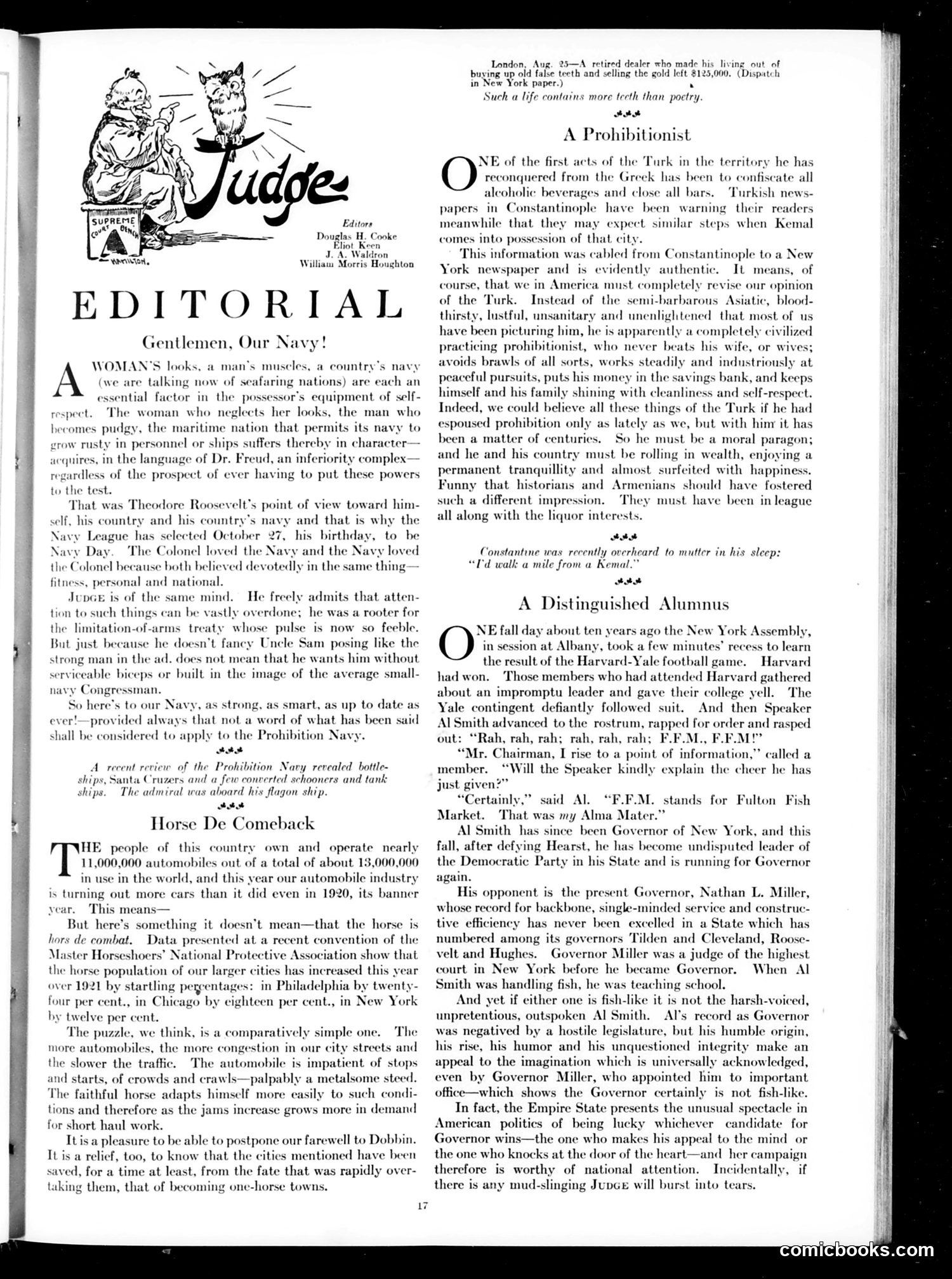
This editorial page from Judge magazine (circa 1920s, based on Prohibition references) contains three pieces: **"Gentlemen, Our Navy!"** argues for maintaining a strong naval force, invoking Theodore Roosevelt's philosophy that national fitness reflects character. Judge critiques both arms-limitation treaties AND the "Prohibition Navy"—a satirical jab at alcohol-banned naval vessels. **"Horse De Comeback"** humorously notes that despite automobile proliferation, horses are returning to American cities. The explanation: cars jam traffic with stops-and-starts, while horses adapt better to congested urban conditions for short hauls. The piece celebrates horses' unexpected revival. **"A Prohibitionist"** briefly reports Turkey's confiscation of alcohol under Kemal's rule, noting Turkish newspapers warned similar measures were coming. Judge's implied irony suggests America's own Prohibition policy mirrors authoritarian actions. The cartoon "Judge" (top left) shows the magazine's mascot character—a jowly, cigar-smoking figure representing the publication's satirical voice—presumably commenting on these topics.
📄 Transcribed text from this page (OCR, searchable)
Machine-transcribed from the original scan — historical spelling and the odd misread are preserved.
tbs | Editors Douglas H. Cooke Eliot Keen JA. Waldron Williau Morris Houghton EDITORIAL Gentlemen, Our Navy! WOMAN'S looks, a man’s muscles, a country’s navy A we are talking now of seafaring nations) are each an essential factor in the possessor’s equipment of self- t. The woman who neglects her looks, the man who hevomes pudgy, the maritime nation that permits its navy to grow rusty in personnel or ships suffers thereby in character— acquires, in the language of Dr. Freud, an inferiority complex regardless of the prospect of ever having to put these powers to the test. That was Theodore Roosevelt’s point of view toward him- self, his country and his country’s navy and that is why the Navy League has selected October Navy I The Colonel loved the N the Colonel because both believed devoted]y in the same thing fitness, personal and national. Junce is of the same mind. He freely admits that atten- tion to such things can be vastly overdone; he was a rooter for arms treaty whose pulse is now so feeble. the limitation But just because he doesn’t fancy Uncle Sam posing like the strong man in the ad. does not mean that he wants him without serviceable biceps or built in the image of the average small- navy Congressman. So here's to our Navy, as stro’ ever!—provided always that not a word of what has been said shall be considered to apply to the Prohibition Navy. Rta as smart, as up to date as A recent review of the Prohibition Navy revealed bottle- ships, Santa Cruzers and a few converted schooners and tank ships. The admiral was aboard his flagon ship. tae Horse De Comeback HE people of this country own and operate nearly 11,000,000 automobiles out of a total of about 13,000,000 in use in the world, and this year our automobile industry is turning out more cars than it did even in 1920, its banner year. This means— But here’s something it doesn’t mean—that the horse is hors de combat. Data presented at a recent convention of the Master Horseshoers’ National Protective Association show that the horse population of our larger cities has increased this year over 1921 by startling pegeent in Philadelphia by twenty- four per cent., in Chicago by eighteen per cent., in New York by twelve per cent. The puzzle, we think, is a compa more automobiles, the more congestion in our city streets and the slower the traffic. The automobile is impatient of stops and starts, of crowds and crawls—palpably a metalsome steed. The faithful horse adapts himself more easily to such condi- tions and therefore as the jams increase grows more in demand for short haul work. Itis a pleasure to be able to postpone our farewell to Dobbin. It is a relief, too, to know that the cities mentioned have been saved, for a time at least, from the fate that was rapidly over- taking them, that of becoming one-horse towns. re vely simple one. ‘The London, Aug. 25—A retired dealer who made his living out of buying up old false teeth and selling the gold left $125,000. (Dispatch in New York paper.) R Such a life contains more tecth than poetry. Rad A Prohibitionist NE of the first acts of the Turk in the territory he has O reconquered from the Greek has been to confiscate all alcoholic beverages and close all bars. Turkish news- papers in Constantinople have been warning their readers meanwhile that they may expect similar steps when Kemal comes into possession of that city. This information was cabled from Constantinople to York newspaper and is evidently authentic. It m New as, of course, that we in America must completely revise our opinion of the Turk. Instead of the semi-barbarous Asiatic, blood- thirsty, lustful, unsanitary and unenlightened that most of us have been picturing him, he is apparently a completely civilized Di avoids brawls of all sorts, works steadily and industriously at peaceful pursuits, puts his money in the savings bank, and keeps himself and his family shining with cleanliness and self-respect. Indeed, we could believe all these things of the Turk if he had cticing prohibitionist, who never beats his wife, or wives; espoused prohibition only as lately as we, but with hinr it has been a matter of centuries. So he must be a moral paragon; and he and his country must be rolling in wealth, enjoying a permanent tranquillity and almost surfeited with happiness. Funny that historians and Armenians should have fostered such a different impression. ‘They must have been in league all along with the liquor interests. tat Constantine was recently overheard to mutter in his sleep: “Fd walk a mile from a Kemal.” tot A Distinguished Alumnus NE fall d yout ten years ago the New York Assembly, O in session at Albany, took a few minutes’ recess to learn the result of the H: ‘d-Yale football game. Harvard had won. Those members who had attended Harvard gathered about an impromptu leader and gave their college yell. The Yale contingent defiantly followed suit. And then Speaker Al Smith advanced to the rostrum, rapped for order and rasped “Rah, rah, rah; rah, rah, rah; -M., F.F.M!” Mr. Chairman, I rise to a point of information,” called a member. “Will the Speaker kindly explain the cheer he has just given? “Certainly,” said Al. “F.F.M Market. That was my Alma Mate: Al Smith has since been Governor of New York, and this fall, after defying Hearst, he has become undisputed leader of the Democratic Party in his State and is running for Governor again. His opponent is the present Governor, Nathan L. Miller, stands for Fulton Fish whose record for backbone, single-minded service and construc- tive efficiency has never been excelled in a State which has numbered among its governors Tilden and Cleveland, Roose- velt and Hughes. Governor Miller was a judge of the highest court in New York before he became Governor. When Al Smith was handling fish, he was teaching school. And yet if either one is fish-like it is not the harsh-voiced, unpretentious, outspoken Al Smith. Al's record as Governor was ne} ed by a hostile legislature, but his humble origin, his rise, his humor and his unquestioned integrity make an appeal to the imagination which is universally acknowledged, even by Governor Miller, who appointed him to important office—which shows the Governor certainly is not fish-like. In fact, the Empire State presents the unusual spectacle in American politics of being lucky whichever candidate for Governor wins—the one who makes his appeal to the mind or the one who knocks at the door of the heart—and_ her campaign therefore is worthy of national attention. Incidentally, if there is any mud-slinging Jupce will burst into tears.