
Judge, 1922-10-21 · page 23 of 36
Judge — October 21, 1922 — page 23: what you’re looking at
What you’re looking at
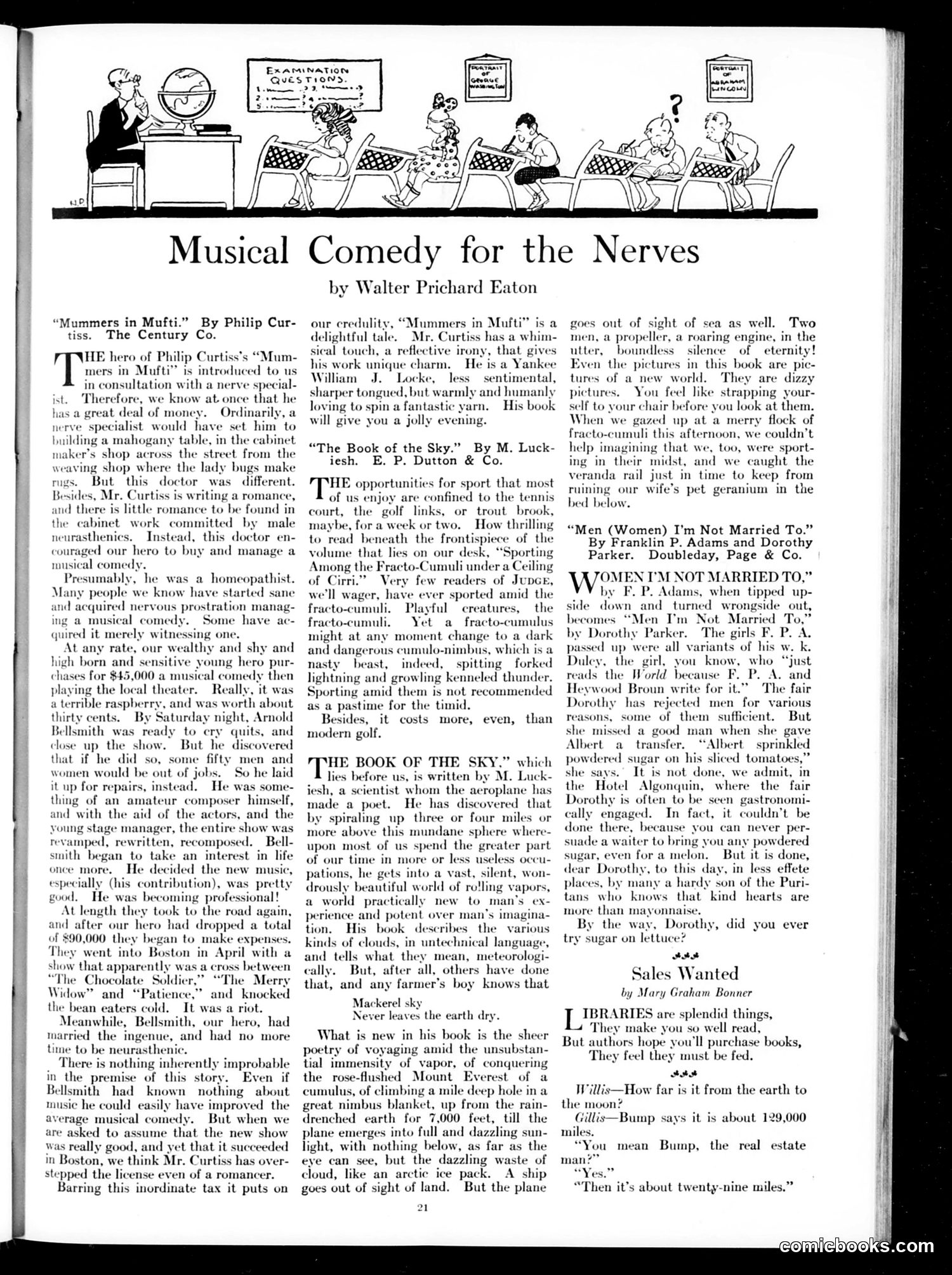
This page reviews three books. The cartoon at top illustrates the main review: a wealthy, nervous young man consults a doctor, who prescribes an unusual "cure"—buying and managing a musical comedy theater for $45,000. The satire targets two things: first, the absurdity of wealth-based "neurasthenia" treatments (nervous exhaustion was a real diagnosis among the privileged); second, the implausibility that a wealthy amateur with no theatrical experience could actually create a *good* show, even with help. The reviewer notes this strains credibility "even for a romancer." The cartoon's examination-board setup humorously suggests managing a musical comedy is itself a test of nerves—both for the protagonist and, implicitly, for audiences. The joke: only a nervous person would invest in Broadway theater; only a nervous person would watch it. The reviews of other books (about sky-sports, book-sales) are filler content typical of Judge magazine.
📄 Transcribed text from this page (OCR, searchable)
Machine-transcribed from the original scan — historical spelling and the odd misread are preserved.
Examination QUESTIONS. te Musical Comedy for the Nerves by Walter Prichard Eaton “Mummers in Mufti.” By Philip Cur- tiss. The Century Co. HE hero of Philip Curtiss’s “Mum- | mers in Mufti” is introduced to us in consultation with a nerve special- st. Therefore, we know at once that he Jeal of money. Ordinarily, a set him to huilding a mahogany table, in the cabinet rs shop across the street from the ving shop where the lady bugs make rugs. But this doctor was different. Besides, Mr. Curtiss is writing a romance, und there is little romance to be found in the cabinet. work committed by male neurasthenics. Instead, this doctor en- couraged our hero to buy and manage a musical comedy. Presumably, he was a homeopathist. Many people we know have started sane and acquired nervous prostration 1 ing a musi comedy. Some have quired it merely witnessing one. At any rate, our wealthy and shy and high born and sensitive young hero pur- es for $45,000 a musical comedy then ing the local theater. Really, it was and was worth about yy Saturday night, Arnold Bellsmith was ready to ery quits, and close up the show. But he discovered that if he did so, some fifty men and women would be out of jobs. So he laid it up for repairs, instead. He was some- thing of an amateur composer himself, and with the of the actors, and the young stage manager, the entire show was revamped, rewritten, recomposed. Bell- smith began to take an interest in life ce more. He decided the new music, especially (his contribution), was pretty od. He was becoming professional! At length they took to the road again, and after our hero had dropped a total of $90,000 they began to make expenses. They went into Boston in April with a show that apparently was a cross between “The Chocolate Soldier,” ‘The Merry Widow” and “Patienc and knocked the bean eaters cold. It was a riot Bellsmith, our he: married the ingenue, and had no more time to be neurasthenic. There is nothing inherently improbable in the premise of this story. Even if Bellsmith had known nothing about music he could easily have improved the average musical comed. But when we are asked to assume that the new show was really good, and yet that it succeeded in Boston, we think Mr. Curtiss has over- stepped the license even of a romancer. Barring this inordinate tax it puts on our credulity, “Mummers in Mufti” is a delightful t Mr. Curtiss has a whim- touch, a reflective irony, that gives his work unique charm, He is a Yankee William J. Locke, sentimental, sharper tongued, but v yand humanly loving to spin a fantastic His book will give you a jolly ev less “The Book of the Sky.” By M. Luck- iesh. E. P. Dutton & Co. THE opportunities for sport that most of us enjoy are confined to the tennis court, the golf links, or trout bro« maybe, for a week or two. How thrilling to read beneath the frontispiece of the volume that lies on our desk, “Sporting Among the Fracto-Cumuli under a Ceiling of Cirri.” Very few readers of June we'll wager, have ever sported amid the fracto-cumuli. Playful creatures, — the fracto-cumuli. Yet a_ fracto-cumulus might at any moment change to a dark and dangerous cumulo-nimbus, which is a nasty beast, indeed, spitting _ forked lightning and growling kenneled thunder. Sporting amid them is not recommended as a pastime for the timid. Besides, it costs more, modern golf. even, than HE BOOK OF THE SKY,” which lies before us, is written by M. Luck- iesh, a scientist whom the aeroplane has made a poet. He has discovered that by spiraling up three or four miles or more above this mundane sphere where- upon most of us spend the greater part of our time in more or less useless occ pations, he gets into a t, silent, won- drously beautiful world of ro!ling vapors, a world practically new to man’s © perience and potent over man’s imagin tion. His book the various kinds of clouds, in untechnical langue and tells what they me meteorolog' cally. But, after all, others have done that, and any farmer’s boy knows that Mackerel sky Never leaves the earth dry. What is new in his book is the sheer poetry of voyaging amid the unsubstan- tial immensity of vapor, of conquering the rose-flushed Mount Everest of a cumulus, of climbing a mile deep hole in a great nimbus blanket, up from the rain- drenched earth for 7,000 feet, till the plane emerges into full and dazzling sun- light, with nothing below, as eye can see, but the dazzli cloud, like an arctic ice pack. goes out of sight of land. But the plane 21 goes out of sight of sea as well. Two men, a propeller, a roaring engine, in the utter, boundless silence of eternity! Even the pictures in this book are pi tures of a new world. They are diz pictures. You feel like strapping your- self to your chair before you look at them. When we gazed up ata merry flock of fracto-cumuli this afternoon, we couldn't help imagining that we, too, were sport- ing in their midst, and we caught the veranda rail just in time to keep from ruining our wife’s pet geranium in the bed below. “Men (Women) I’m Not Married To.” By Franklin P. Adams and Dorothy Parker. Doubleday, Page & Co. V OMEN I'M NOT MARRIED TO,” by F. P. Adams, when tipped up- side down and turned wrongside out, becomes “Men I'm Not Married To,” by Dorothy Parker. The girls F. P. A. passed up were all variants of his w. k. Duley, the girl, you know, who “just reads the World because F. P. A. and Heywood Broun write for it.” The fair Dorothy has rejected men for various reasons, some of them sufficient. But she missed a good man when she gave Albert a transfer. “Albert sprinkled powdered sugar on his sliced tomatoes,” she says. It is not done, we admi the Hotel Algonquin, where the fair Dorothy is often to be seen gastronomi- cally engaged. In fact, it couldn't be done there, because you can never per- suade a waiter to bring you any powdered melon. But it is done, dear Dorothy, to this day, in less effete a hardy son of the Puri- kind hearts are places, by mas tans who knows more than m: By the way, Dorothy, did you ever try sugar on lettuce? ery Sales Wanted by Mary Graham Bonner IBRARIES are splendid things, + They make you so well read But authors hope you'll purchase books, They feel they must be fed. Rd Willis—How far is it from the earth to the moon? Gillis—Bump says it is about 129,000