
Judge, 1922-10-21 · page 5 of 36
Judge — October 21, 1922 — page 5: what you’re looking at
What you’re looking at
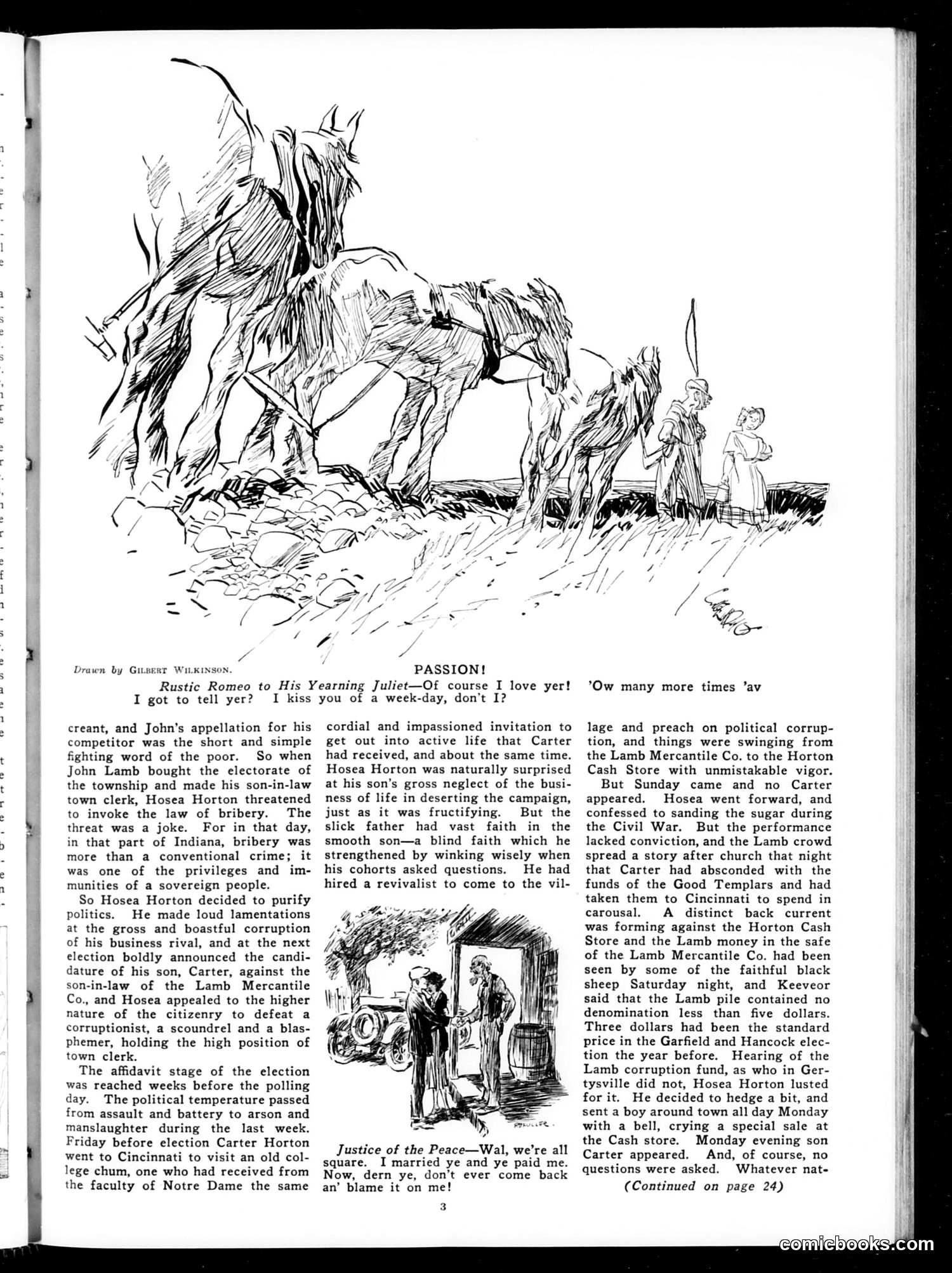
This page contains two illustrations satirizing Gilded Age political corruption. The top cartoon, titled "PASSION!," depicts a grotesque donkey (representing the Democratic Party or a corrupt politician) with townspeople nearby, referencing "Rustic Romeo to His Yearning Juliet"—likely mocking rural voters' naivety about urban political schemes. The text describes a storyline involving Hosea Horton, who discovers election corruption tied to the Lamb Mercantile Co. and a candidate named Carter. The narrative focuses on bribery, vote-buying, and financial manipulation—common Gilded Age practices. The lower cartoon, "Justice of the Peace," appears to satirize marital discord or domestic consequences of political corruption. Overall, the page exposes how mercantile interests corrupted American elections through bribery and intimidation of voters.
📄 Transcribed text from this page (OCR, searchable)
Machine-transcribed from the original scan — historical spelling and the odd misread are preserved.
3 f 1 1 oe EE EC ee ee gee, as —e Drawn by GiLbeRt WILKINSON. I got to tell yer? creant, and John’s appellation for his competitor was the short and simple fighting word of the poor. So when John Lamb bought the electorate of the township and made his son-in-law town clerk, Hosea Horton threatened to invoke the law of bribery. The threat was a joke. For in that day, in that part of Indiana, bribery was more than a conventional crime; it was one of the privileges and im- munities of a sovereign people. So Hosea Horton decided to purify politics. He made loud lamentations at the gross and boastful corruption of his business rival, and at the next election boldly announced the candi- dature of his son, Carter, against the son-in-law of the Lamb Mercantile Co., and Hosea appealed to the higher nature of the citizenry to defeat a corruptionist, a scoundrel and a blas- phemer, holding the high position of town clerk. The affidavit stage of the election was reached weeks before the polling day. The political temperature passed from assault and battery to arson and manslaughter during the last week. Friday before election Carter Horton went to Cincinnati to visit an old col- lege chum, one who had received from the faculty of Notre Dame the same SO L2N SS A> as THES PASSION! Rustic Romeo to His Yearning Juliet—Of course I love yer! I kiss you of a week-day, don’t I? cordial and impassioned invitation to get out into active life that Carter had received, and about the same time. Hosea Horton was naturally surprised at his son’s gross neglect of the busi- ness of life in deserting the campaign, just as it was fructifying. But the slick father had vast faith in the smooth son—a blind faith which he strengthened by winking wisely when his cohorts asked questions. He had hired a revivalist to come to the vil- Justice of the Peace—Wal, we’re all square. I married ye and ye paid me. Now, dern ye, don’t ever come back an’ blame it on me! 3 ’Ow many more times ’av lage and preach on political corrup- tion, and things were swinging from the Lamb Mercantile Co. to the Horton Cash Store with unmistakable vigor. But Sunday came and no Carter appeared. Hosea went forward, and confessed to sanding the sugar during the Civil War. But the performance lacked conviction, and the Lamb crowd spread a story after church that night that Carter had absconded with the funds of the Good Templars and had taken them to Cincinnati to spend in carousal. A distinct back current was forming against the Horton Cash Store and the Lamb money in the safe of the Lamb Mercantile Co. had been seen by some of the faithful black sheep Saturday night, and Keeveor said that the Lamb pile contained no denomination less than five dollars. Three dollars had been the standard price in the Garfield and Hancock elec- tion the year before. Hearing of the Lamb corruption fund, as who in Ger- tysville did not, Hosea Horton lusted for it. He decided to hedge a bit, and sent a boy around town all day Monday with a bell, crying a special sale at the Cash store. Monday evening son Carter appeared. And, of course, no questions were asked. Whatever nat- (Continued on page 24)