
A complete issue · 36 pages · 1922
Judge — October 7, 1922
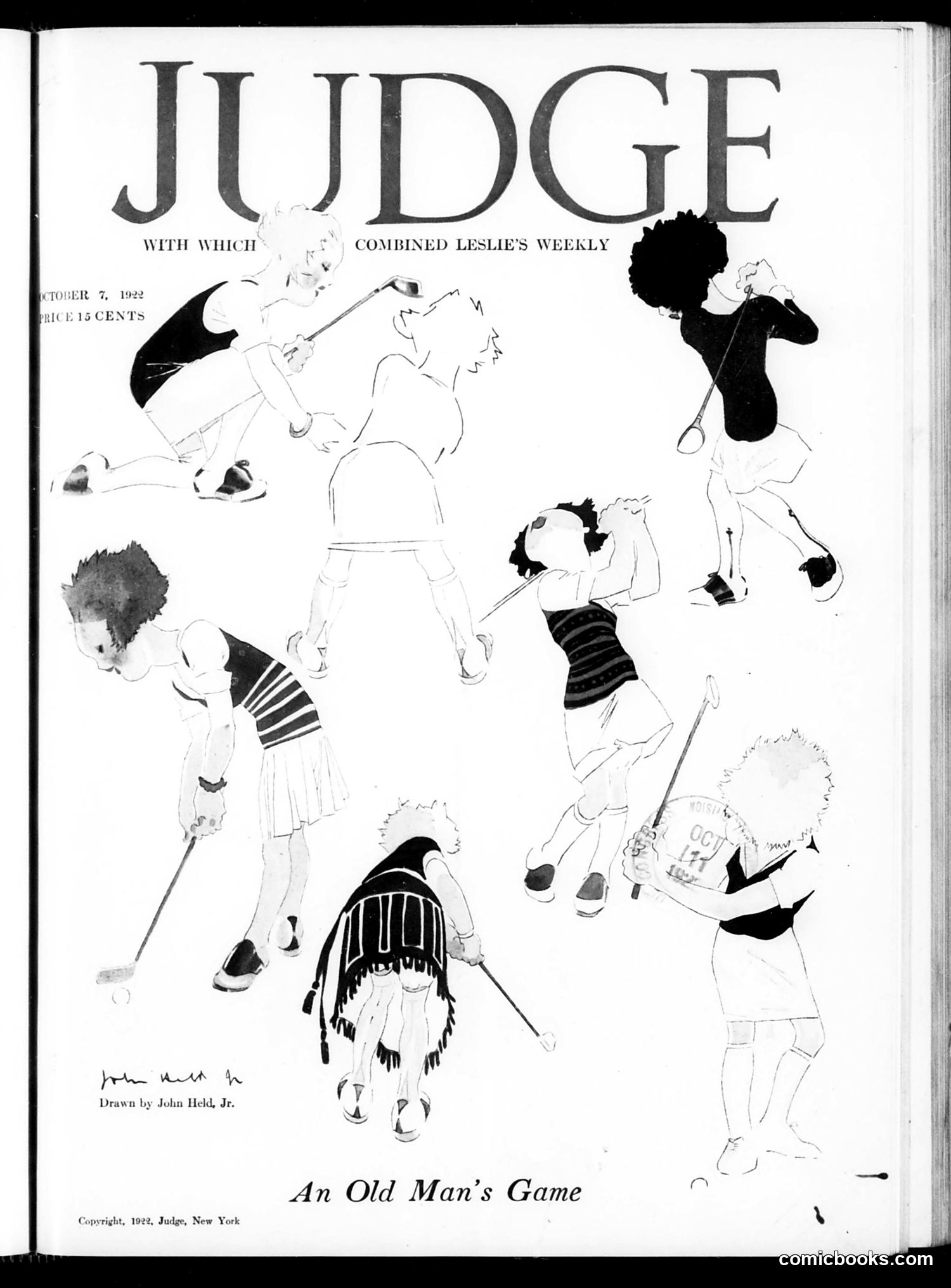
This cover illustrates "An Old Man's Game"—golf—through satirical depictions of various players. The cartoonist John Held Jr. portrays golf as a leisure activity pursued by different demographics, shown through exaggerated figures in various poses and attire. The satire likely mocks golf's popularity among wealthy Americans in the 1920s during the Jazz Age. The diverse players—distinguished by their clothing (striped sweaters, formal wear, etc.)—suggest golf's appeal across social classes, though the exaggerated, sometimes ungainly postures humorously undercut any dignity associated with the sport. The title "An Old Man's Game" implies golf is suited to aging players, contrasting with more vigorous pastimes. This reflects contemporary debates about golf's leisurely pace during an era valuing youth and dynamism.
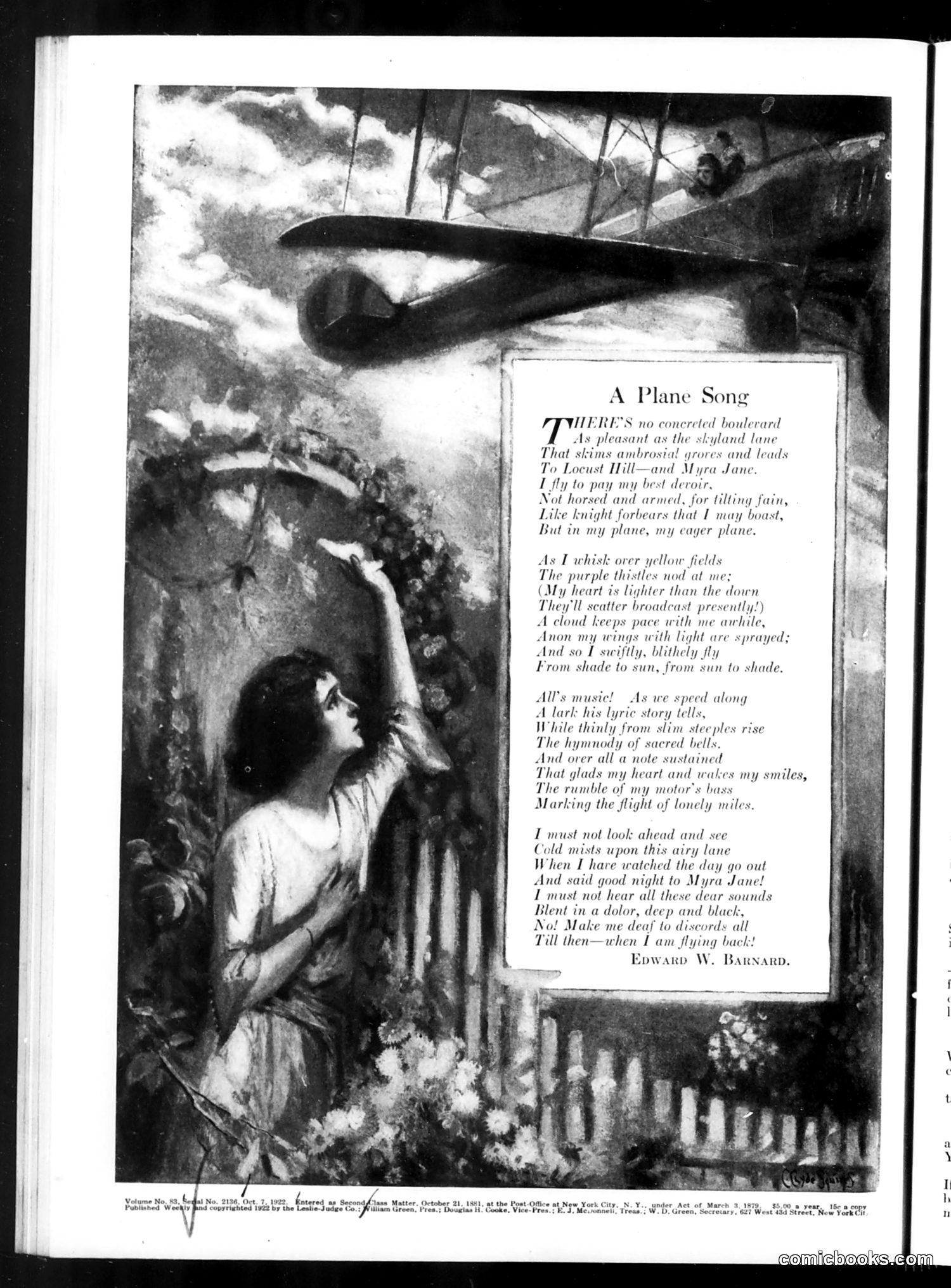
This page features a romantic poem celebrating aviation rather than political satire. The illustration shows a woman gazing upward toward an airplane, suggesting the early 20th-century cultural fascination with flight as a marvel and symbol of modernity. The poem romanticizes flying—depicting the pilot's experience with metaphorical language about freedom, speed, and escape from earthly concerns. References to "Myra Jane" and "Lowell Hill" appear to be personal, possibly autobiographical details. The content reflects the era's enthusiastic embrace of aviation technology as poetic subject matter, typical of Judge magazine's mix of humor, satire, and general interest content. Rather than mocking flight or fliers, this celebrates aviation as an exhilarating, almost spiritual experience—a notably optimistic take during aviation's early commercial development.
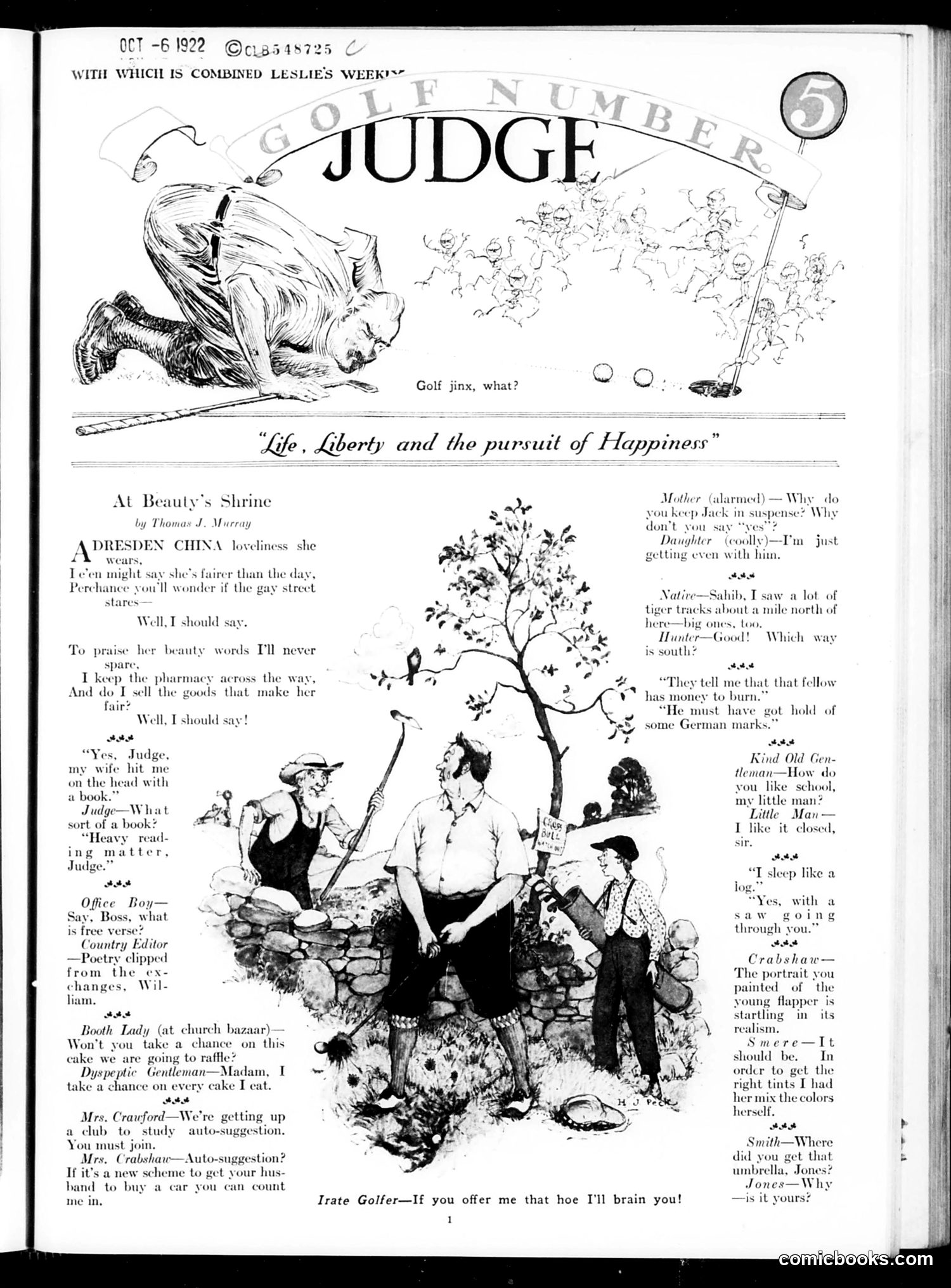
The main cartoon depicts a golfer who has dramatically fallen over while golfing, captioned "Golf jinx, what?" This illustrates the period's golf craze and the frustration players experienced—a relatable joke for 1920s readers when golf was becoming fashionable among the middle class. The lower illustration, titled "Life, Liberty and the Pursuit of Happiness," shows a domestic scene with multiple figures discussing various topics through humorous dialogue. The exchanges appear to mock everyday social situations and common complaints—marital dynamics, children's behavior, and class pretensions. The format uses witty one-liners typical of Judge's satirical humor, targeting middle-class American anxieties and social conventions of the early 1920s rather than specific political figures.
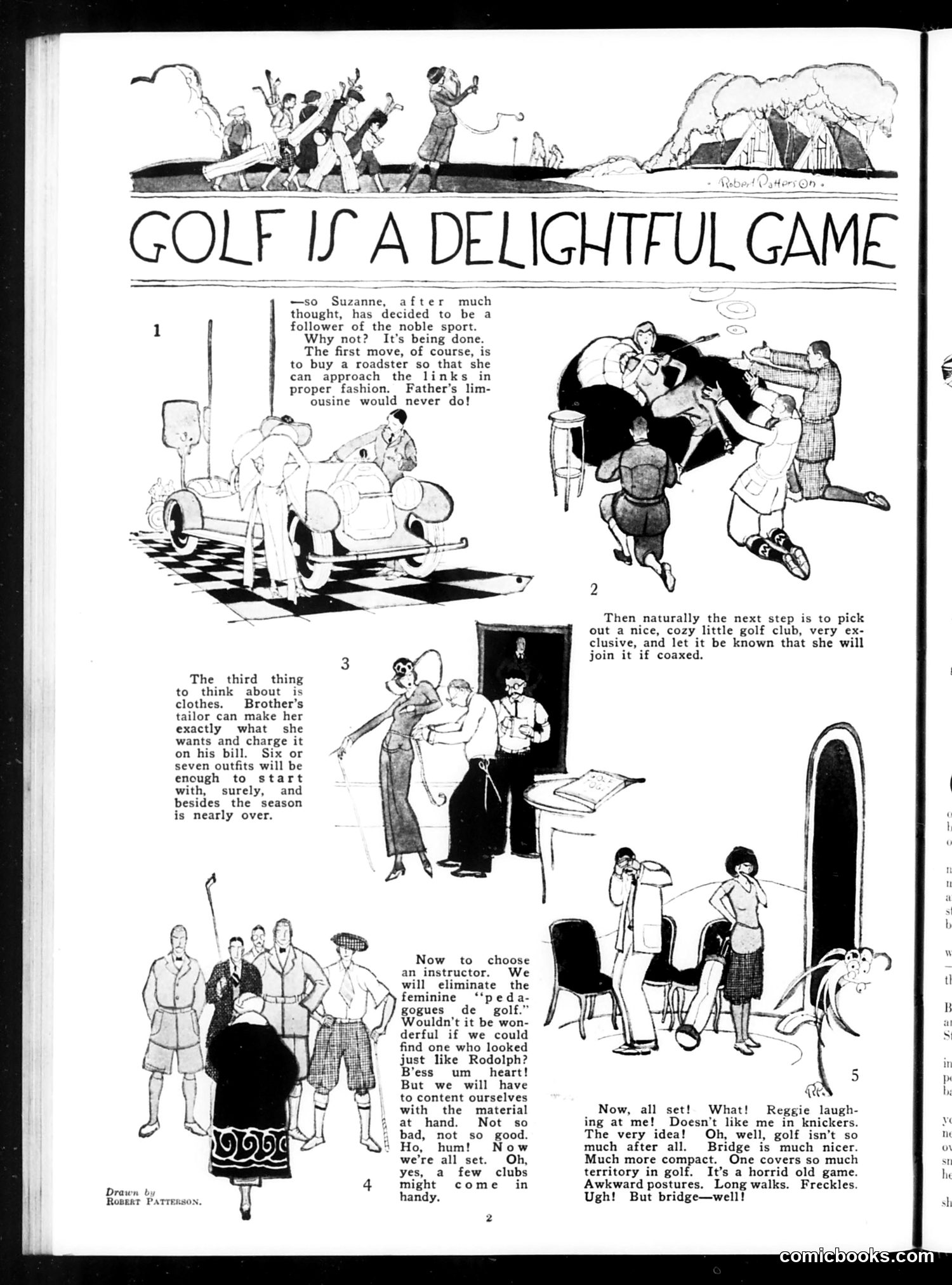
This satirical piece from Judge magazine mocks the adoption of golf by women in the early 20th century. The narrative follows "Suzanne," who decides to become a golfer and must navigate several social requirements: purchasing a fashionable "roaster" automobile to reach the links, acquiring an exclusive club membership (requiring coaxing), obtaining seven custom golf outfits from her brother's tailor, and selecting a suitably masculine instructor. The humor targets both the sport's pretensions and the elaborate social performances required of women entering male-dominated leisure spaces. The final panel's complaint about "knickers" (golf attire) and "bridge" (an alternative activity) suggests the author views women's golf participation as an affectation—women would supposedly prefer card games anyway. The satire reflects class anxieties and gender assumptions of the era.
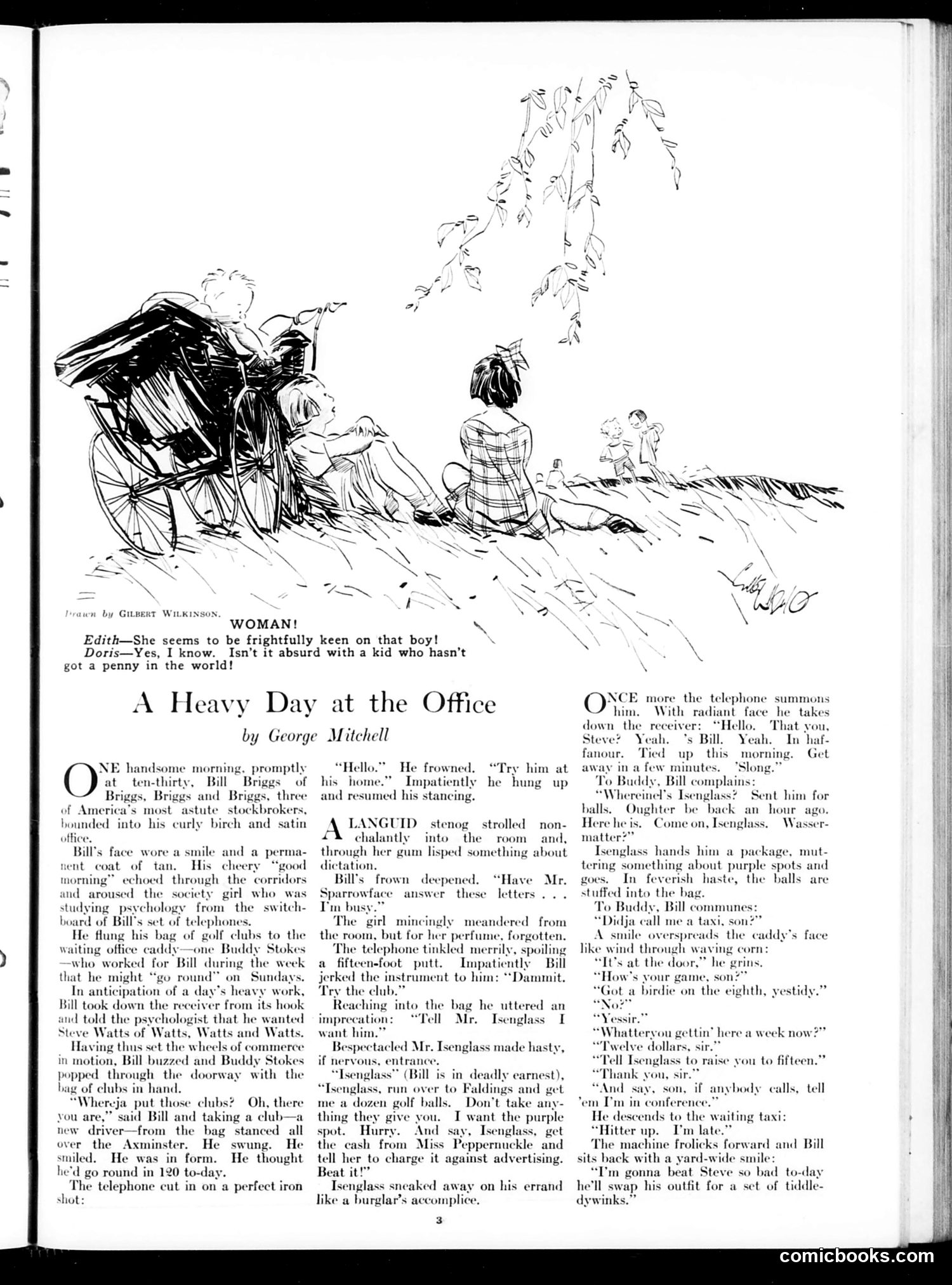
The page contains two distinct elements: **Top cartoon** (by Gilbert Wilkinson): A sketch showing a woman with a perambulator and child observing a boy on a cart pulled by what appears to be a donkey. The caption depicts dialogue about the boy being "frightfully keen" and lacking a penny—a reference to children's poverty or working-class street life in early 20th-century Britain. **Main story** ("A Heavy Day at the Office" by George Mitchell): A humorous narrative about Bill Briggs, a stockbroker, navigating office chaos—telephone interruptions, staff complaints, and client demands. The satire targets the absurdities of office bureaucracy and the demands placed on middle-management figures during a typical business day. Both pieces appear to offer light social commentary on class differences and workplace frustrations rather than political messaging.
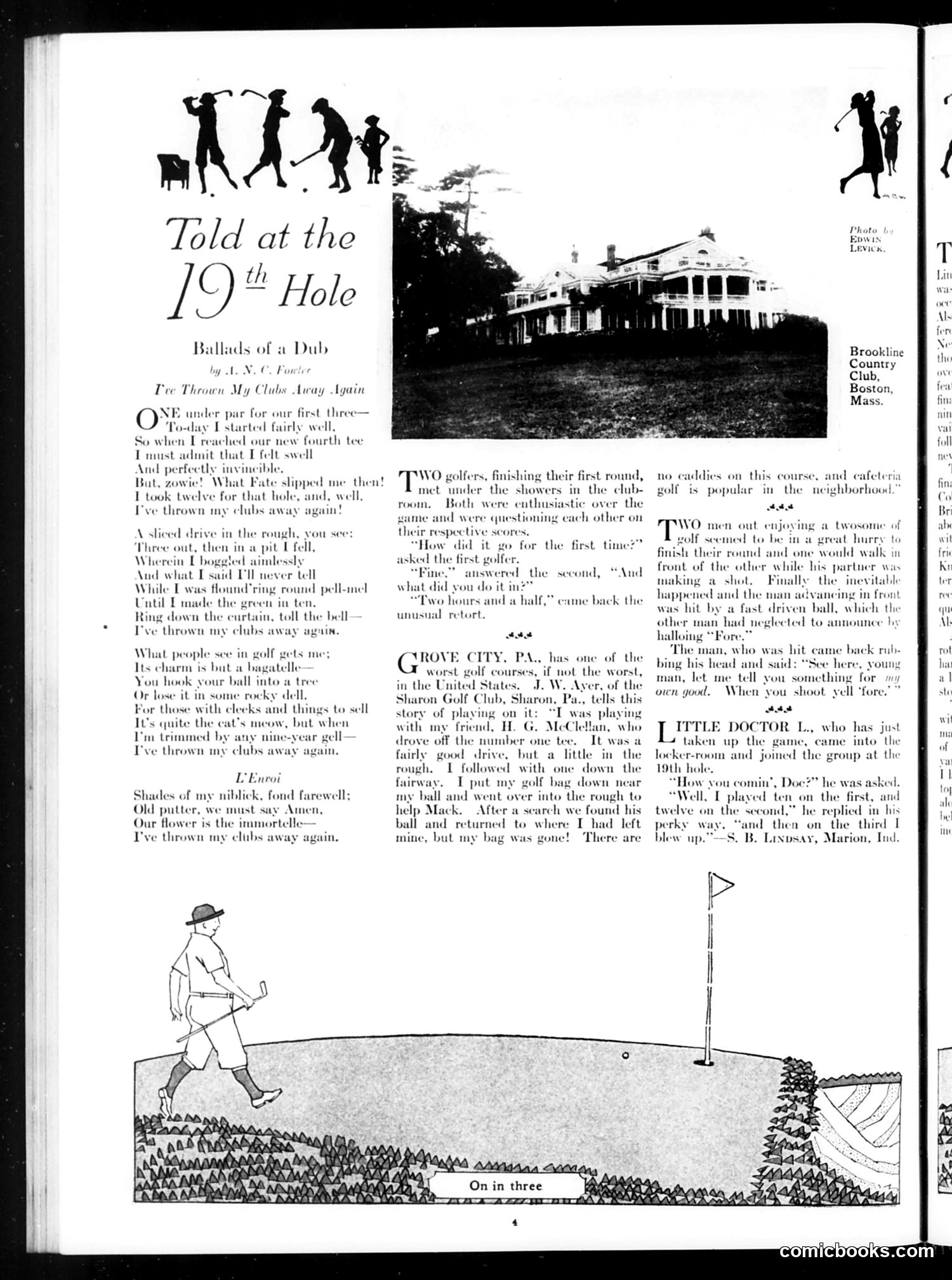
This page features a humorous poetry column and anecdotes about golf, set at Brookline Country Club in Boston, Massachusetts. The title references the "19th hole"—a golf tradition where players socialize at the clubhouse bar after completing 18 holes. The content comprises lighthearted stories about golfers' mishaps and competitive moments on the course. One anecdote mentions Grove City, Pennsylvania's poor golf course conditions; another describes a player named "Little Doctor L." joining a round and playing poorly. The satire is gentle social commentary targeting amateur golfers' vanity and competitive nature rather than political commentary. The illustration shows a golfer in action, accompanying these recreational leisure-class narratives typical of Judge magazine's affluent readership.
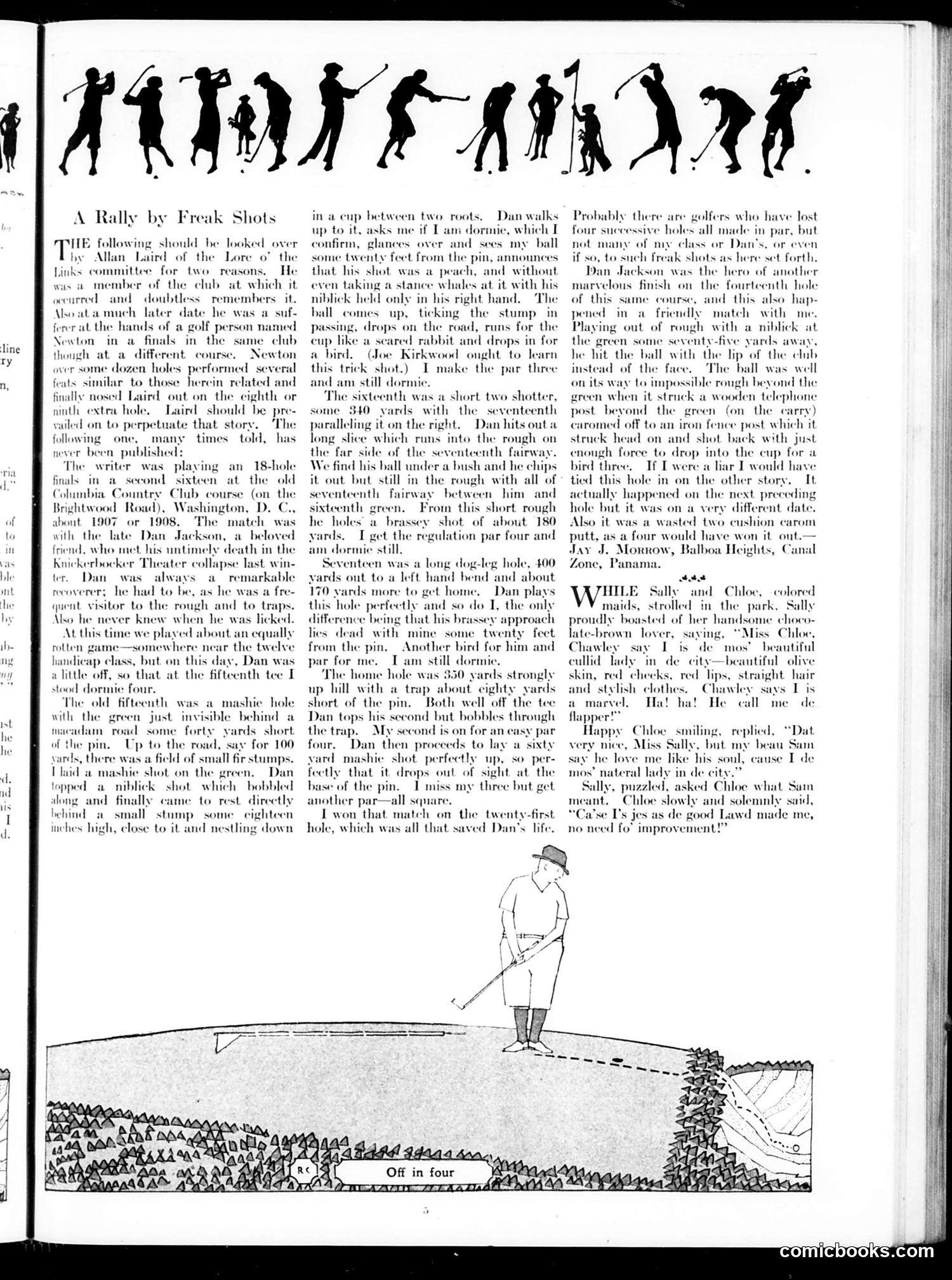
This is a golf anecdote by Allan Laird, not political satire. The article recounts an 18-hole match from around 1907-1908 at Columbia Country Club in Washington, D.C., between Laird and Dan Jackson (described as "a beloved friend" who later died in the Knickerbocker Theater collapse). The story highlights Jackson's remarkable recovery shots despite being in poor positions—hitting from rough grass, making improbable holes with unconventional swings. Laird eventually wins on the 21st hole. The piece celebrates Jackson's skill and nerve despite being "dormie" (losing position in match play). The accompanying illustration shows a golfer making an impossible shot "off in four"—depicted comically sinking a ball from an awkward lie. This is nostalgic sports journalism rather than social commentary.
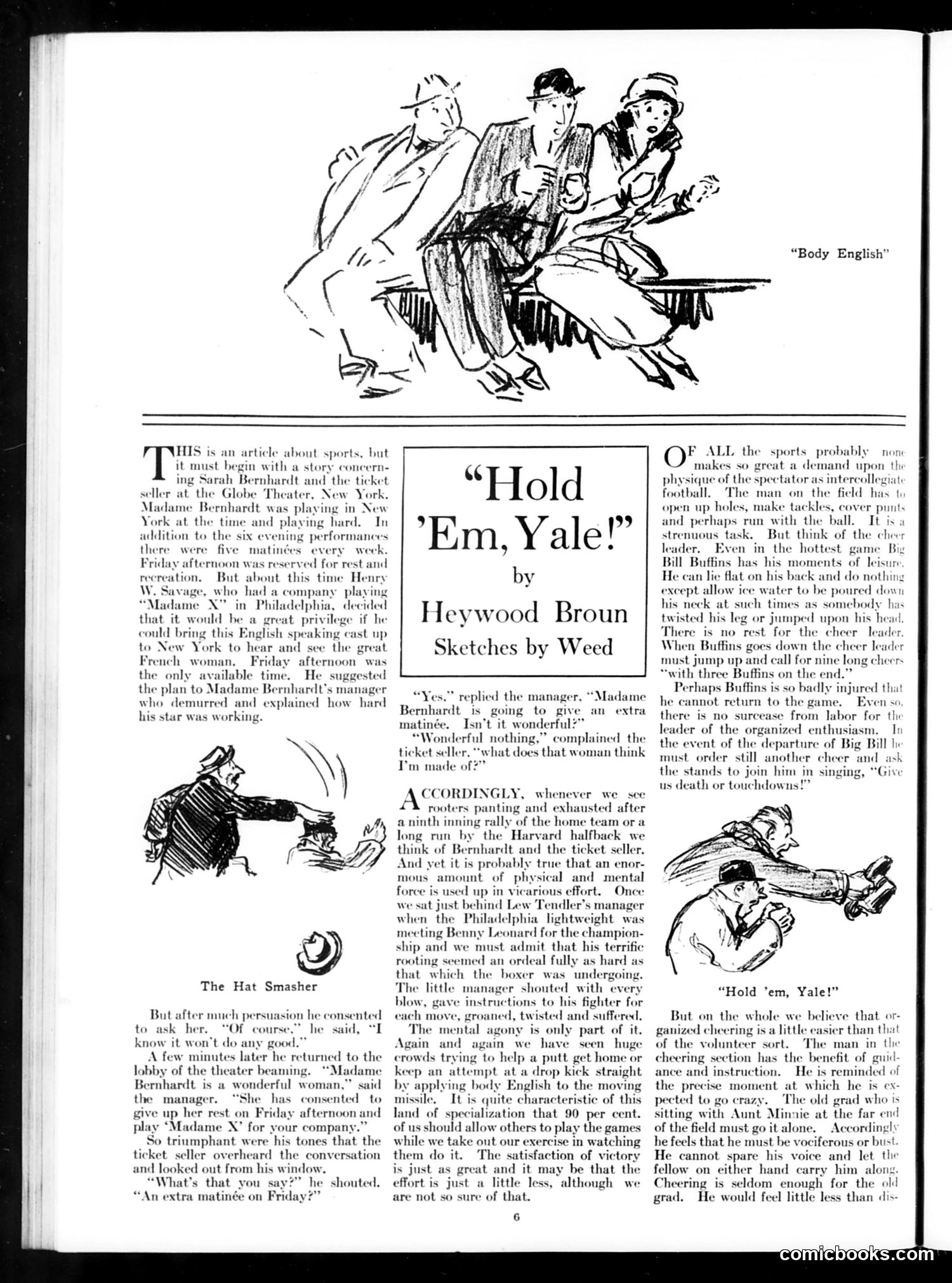
This Heywood Broun article satirizes the intense physical and emotional exertion fans expend while merely *watching* sports. The opening anecdote establishes the joke: a theater ticket seller complains that famous actress Sarah Bernhardt's demand for an extra matinee is unreasonable—she's already working so hard. The irony: spectators at games exert nearly comparable effort through emotional investment and what's called "body English" (unconscious physical mimicry). The article mocks how American sports culture has specialized labor so thoroughly that "90 per cent. of us allow others to play the games while we take out our exercise in watching them." The cartoon sketches illustrate examples: overzealous fans and cheerleaders like "Bill Buffins" who expend tremendous energy rooting, gesturing, and suffering vicariously. The satire critiques both spectator obsession and the odd contradiction that watching sports feels genuinely exhausting despite requiring no actual athletic participation.
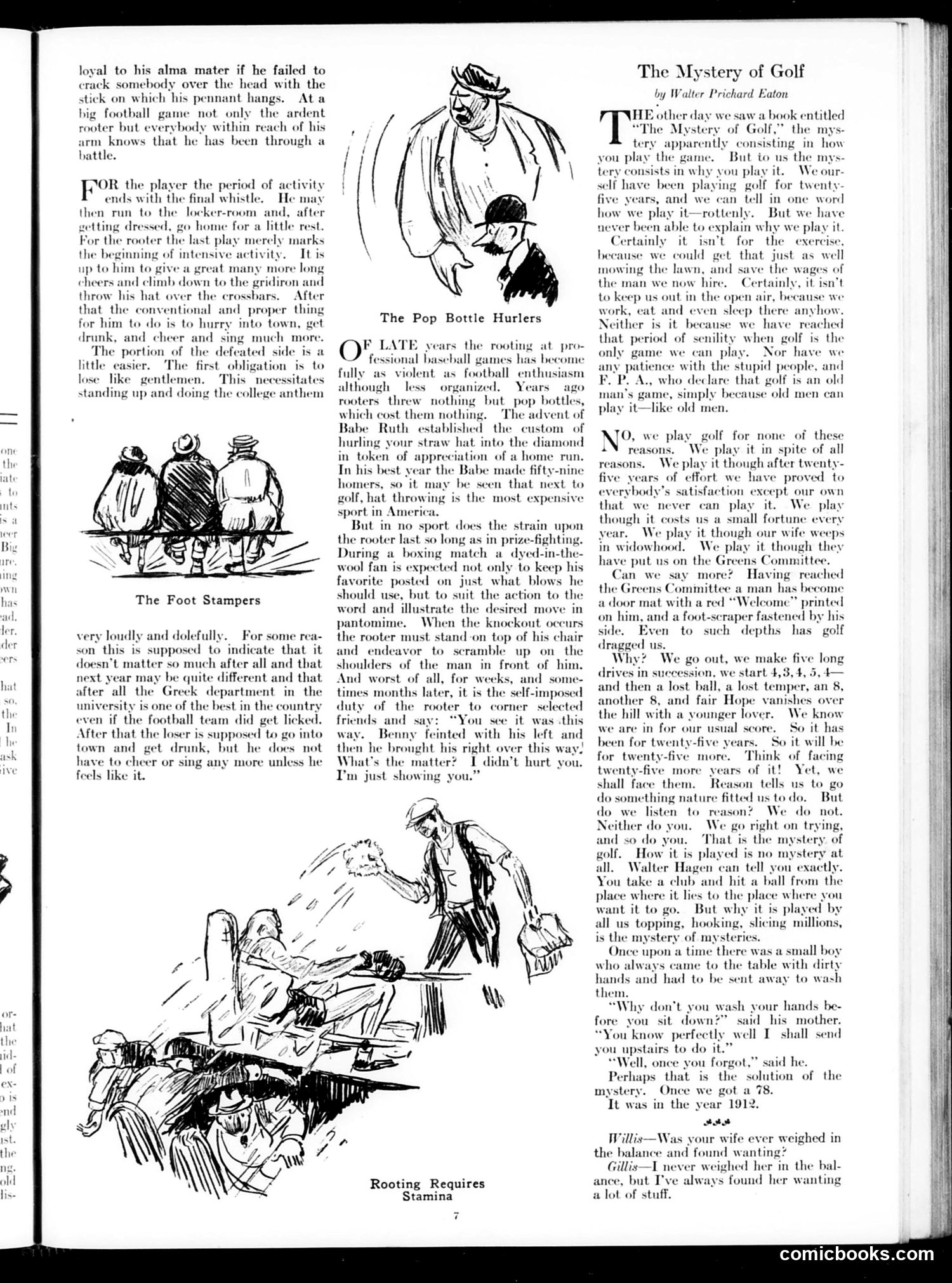
This page contains satirical commentary on American sports culture, specifically targeting enthusiastic sports fans ("rooters"). The three illustrations mock different fan behaviors: **"The Pop Bottle Hurlers"** and **"The Foot Stampers"** depict baseball fans whose excessive enthusiasm—throwing bottles and stamping feet—is presented as absurd overreaction. The text notes that fan behavior escalated when Babe Ruth inspired fans to throw straw hats into the diamond after home runs, making baseball rooting financially expensive. **"Rooting Requires Stamina"** shows boxing fans physically reenacting punches, standing on chairs, and later boring friends with detailed play-by-play pantomimes for weeks afterward. The main essay, **"The Mystery of Golf"** by Walter Pritchard Eaton, shifts tone to philosophical satire. Eaton admits playing golf poorly for twenty-five years while unable to explain *why* he plays—not for exercise, fresh air, or patience with "stupid people." The joke: golf's true appeal remains inexplicably irrational, despite its obvious futility. Together, these pieces mock American sports obsession as illogical mass behavior.
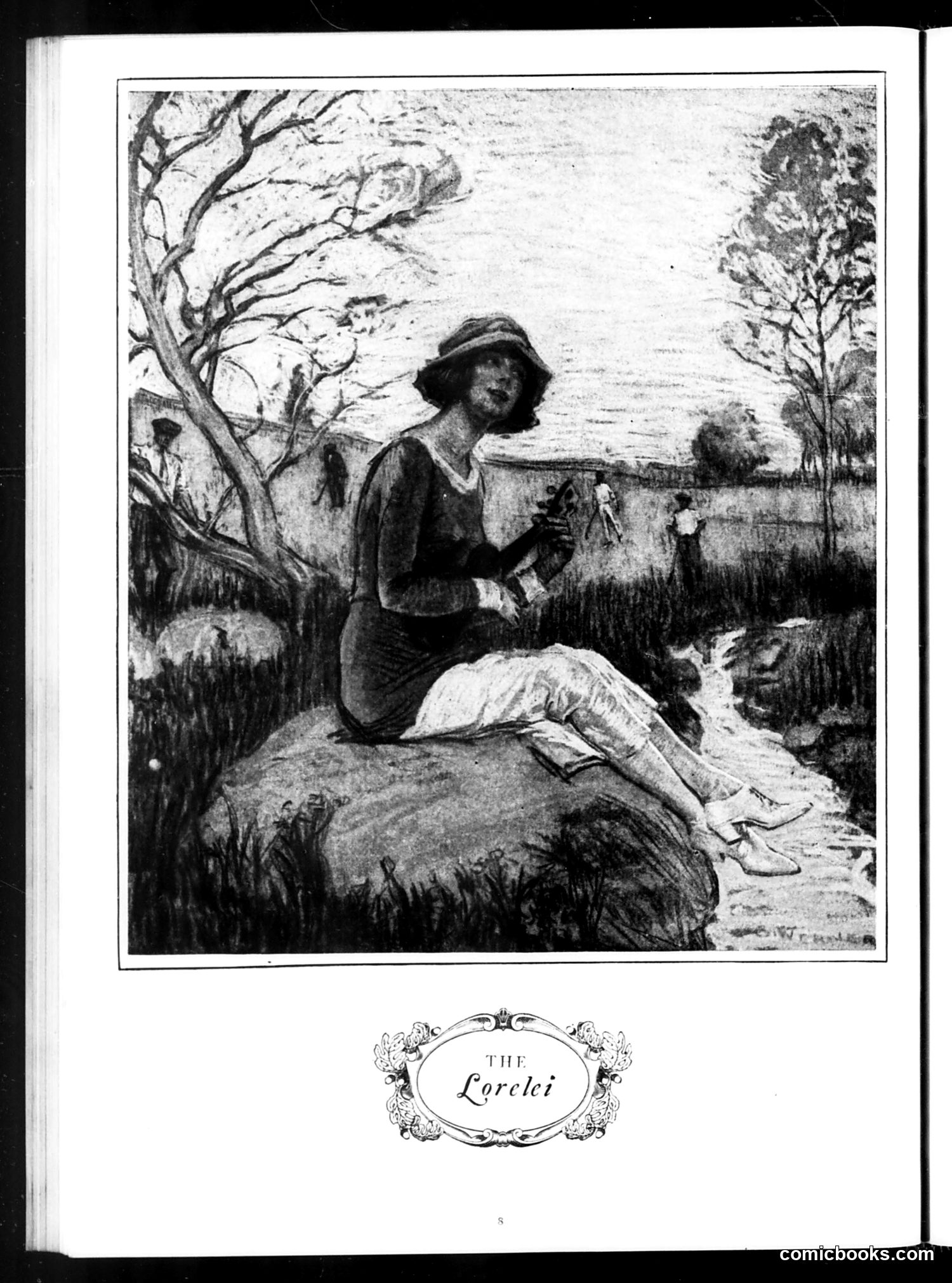
This page appears to be an illustration title from *Judge* magazine accompanying a literary work or story called "The Lorelei." The image depicts a woman in early 20th-century dress sitting by a riverbank with bare trees, gazing into the distance. Other figures appear in the background near the water. "The Lorelei" references the famous German legend of a siren—a beautiful woman whose enchanting song lures sailors to their deaths in the Rhine River. The illustration likely introduces a story adapting or satirizing this classic myth, possibly applying it to contemporary American society or social situations. Without additional context from the article text, the specific satirical target remains unclear, though the romantic/tragic imagery suggests themes about feminine allure and danger.
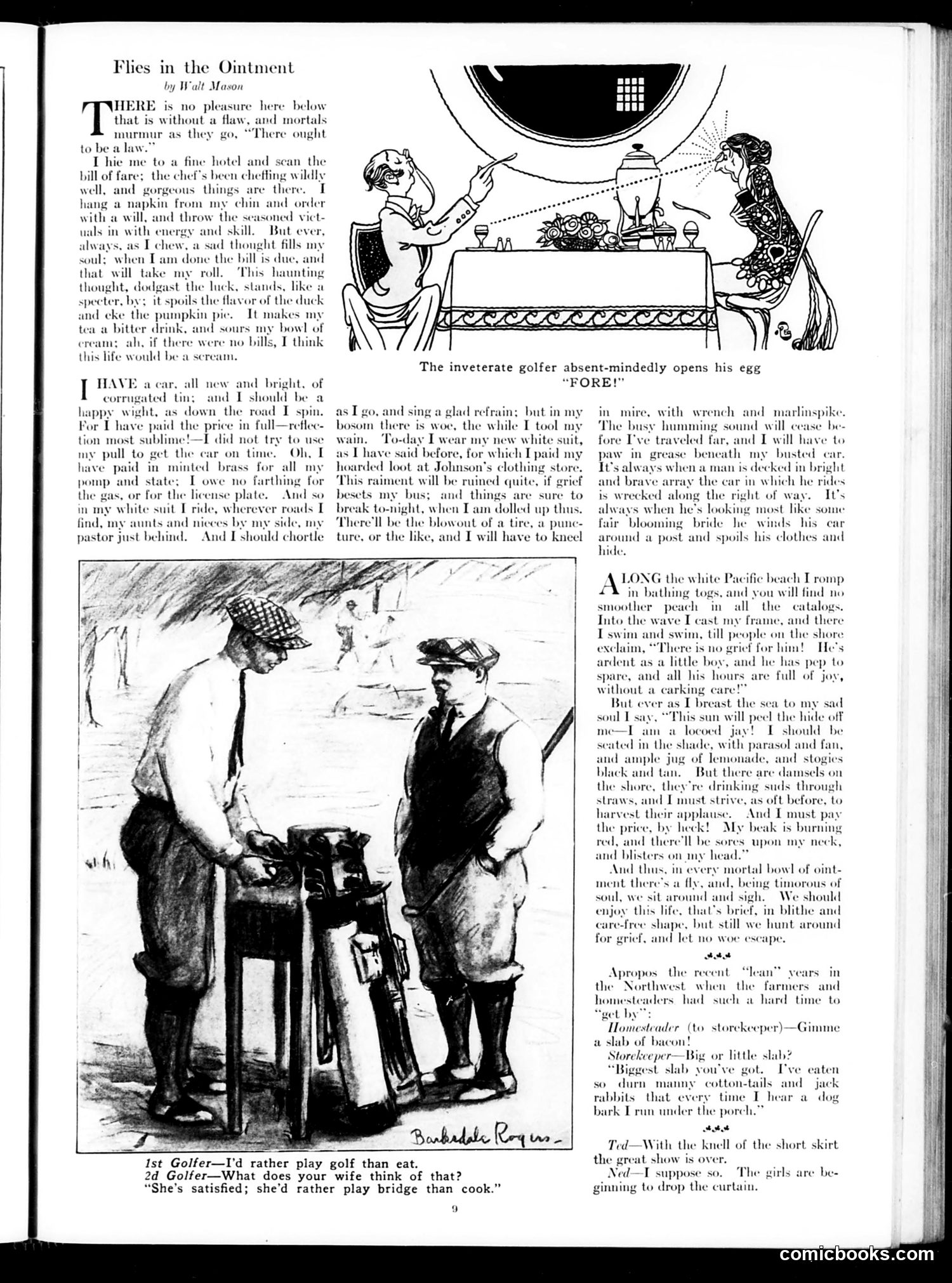
This page presents Walt Mason's humorous poem lamenting life's inevitable petty annoyances—the "flies in the ointment." Mason catalogs various scenarios where pleasure is spoiled: a fine restaurant meal ruined by the bill arriving, a new car damaged by mishap, a beach vacation interrupted by sunburn and insects, and golfing disrupted by accidents. The two cartoon panels reinforce this theme. The upper illustration shows a golfer at a fancy dinner absent-mindedly shouting "FORE!" (a golf warning), disrupting the meal. The lower panel depicts two golfers debating leisure priorities, with one stating he'd rather play golf than eat—his wife preferring bridge to cooking. The social commentary targets early 20th-century middle-class anxieties: financial worries (bills), automobile ownership concerns, and the tension between domestic duties and recreational leisure. The humor lies in recognizing how modern conveniences and pleasures are constantly undercut by practical realities and human fallibility.
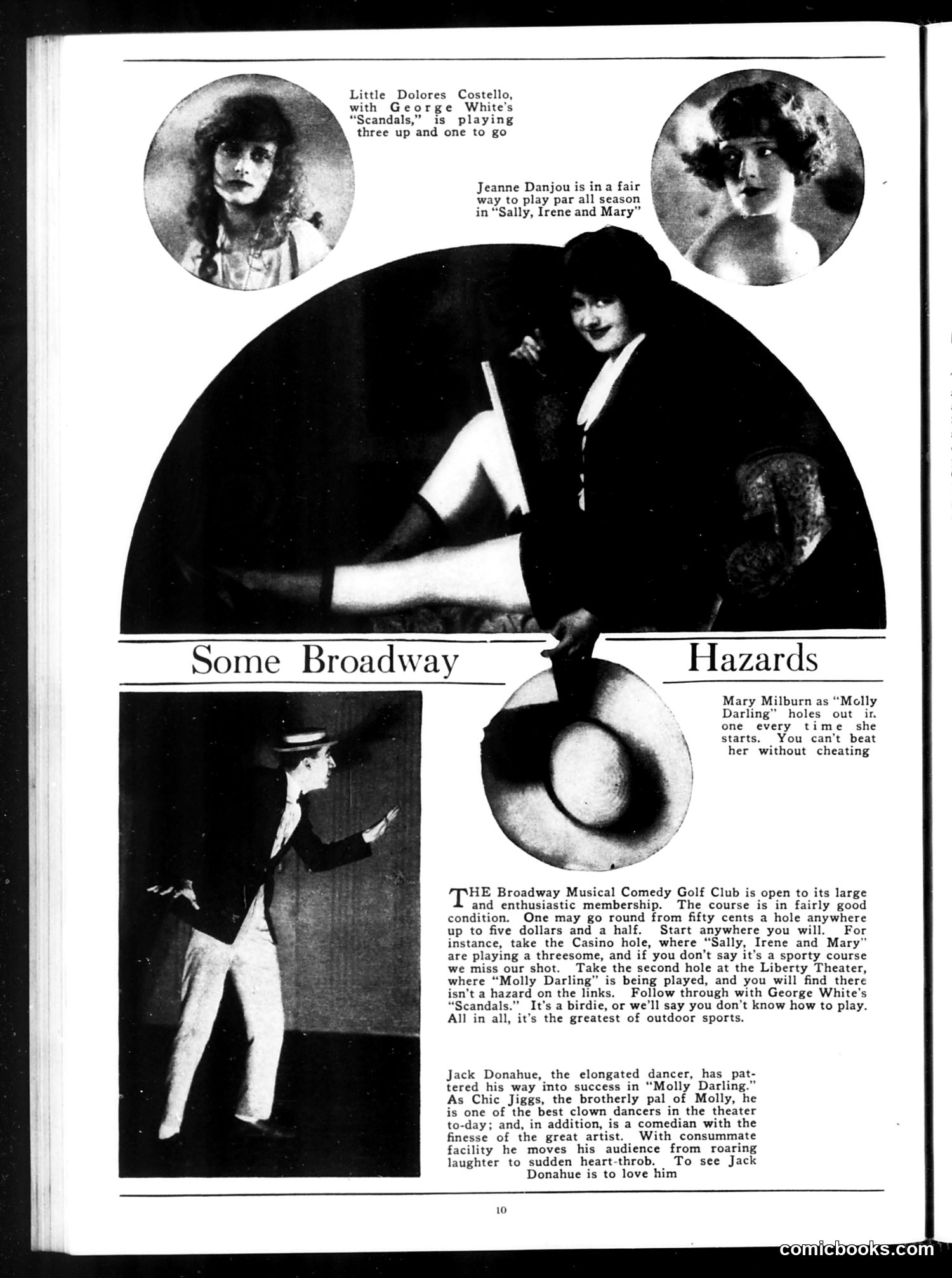
This page satirizes Broadway shows through a golf metaphor. Judge compares theatrical productions to a golf course, with each show representing a different "hole." The satire identifies three 1920s Broadway musicals as examples: "Sally, Irene and Mary" (at the Casino), "Molly Darling" (at the Liberty Theater), and George White's "Scandals." The piece playfully rates these productions using golf terminology—some shows are "birdies" (excellent plays), while "Molly Darling" allegedly has "no hazards" (is easy/unchallenging). Performers like Jack Donahue, Jeanne Danjou, Mary Milburn, and Dolores Costello are mentioned with theatrical "scoring" jokes. The central image shows a golfer mid-swing, reinforcing the sporting analogy. The satire mocks both the theatrical productions and the Broadway scene's emphasis on entertainment and commercial success—treating shows as recreational experiences to "play" rather than serious dramatic art.
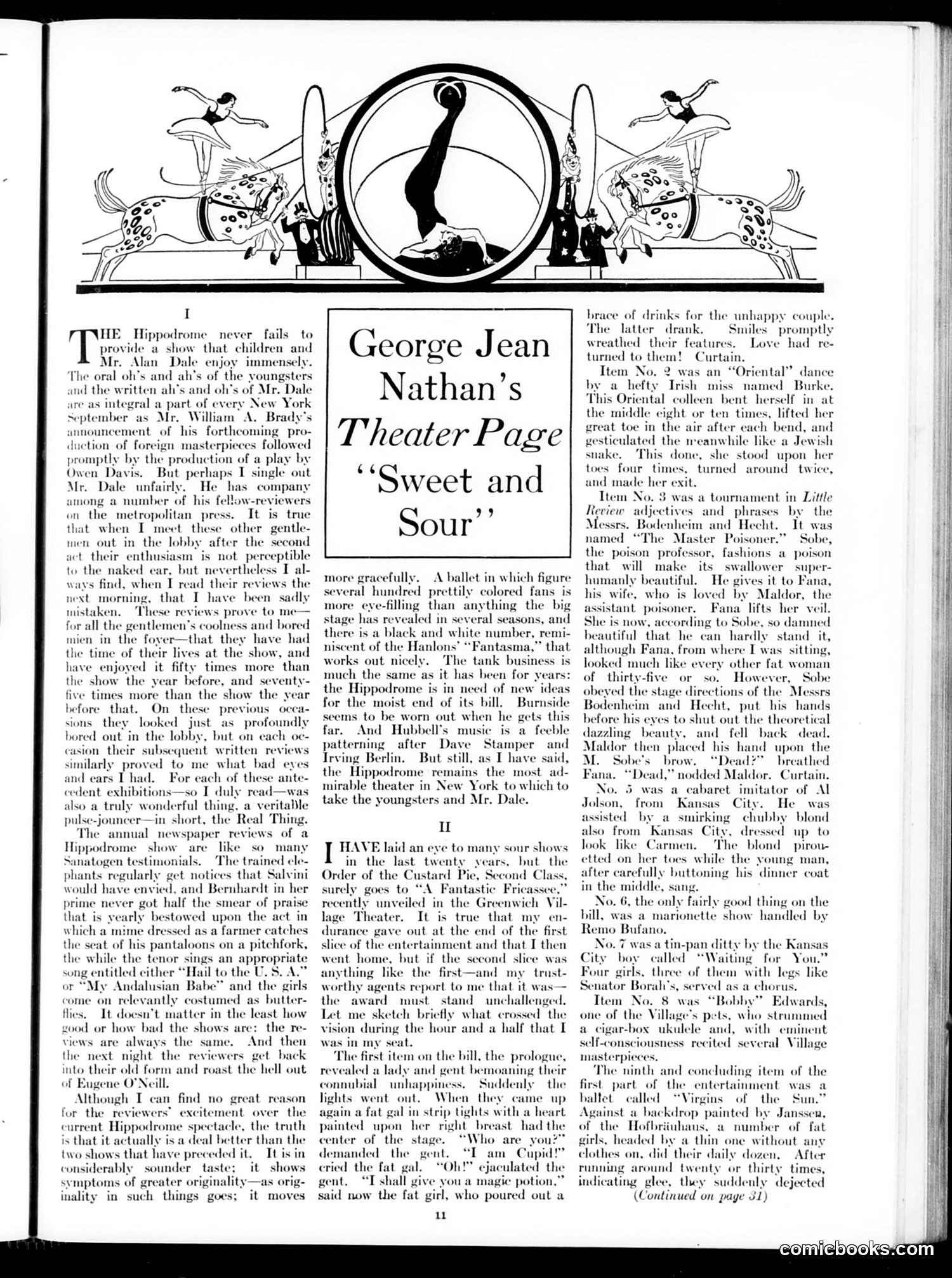
This is a theater criticism column by George Jean Nathan reviewing current Broadway shows, primarily the Hippodrome's latest spectacle and "A Fantastic Fricassee" at Greenwich Village Theater. Nathan satirizes theater critics' duplicitous behavior: they appear bored in the lobby after performances, yet their published reviews gush superlatives about every act—even trivial ones like a mime catching his pants on a pitchfork. He suggests this creates a false consensus that every annual Hippodrome show is "wonderful," while these same critics reserve their genuine vitriol for serious plays (like Eugene O'Neill's work). The irony is biting: Nathan notes the current Hippodrome show is actually better than predecessors, yet still relatively mediocre, lacking originality. He praises it as suitable for children and enthusiasts like Alan Dale, but acknowledges composer Hubbell's music is weak and the show needs new ideas.
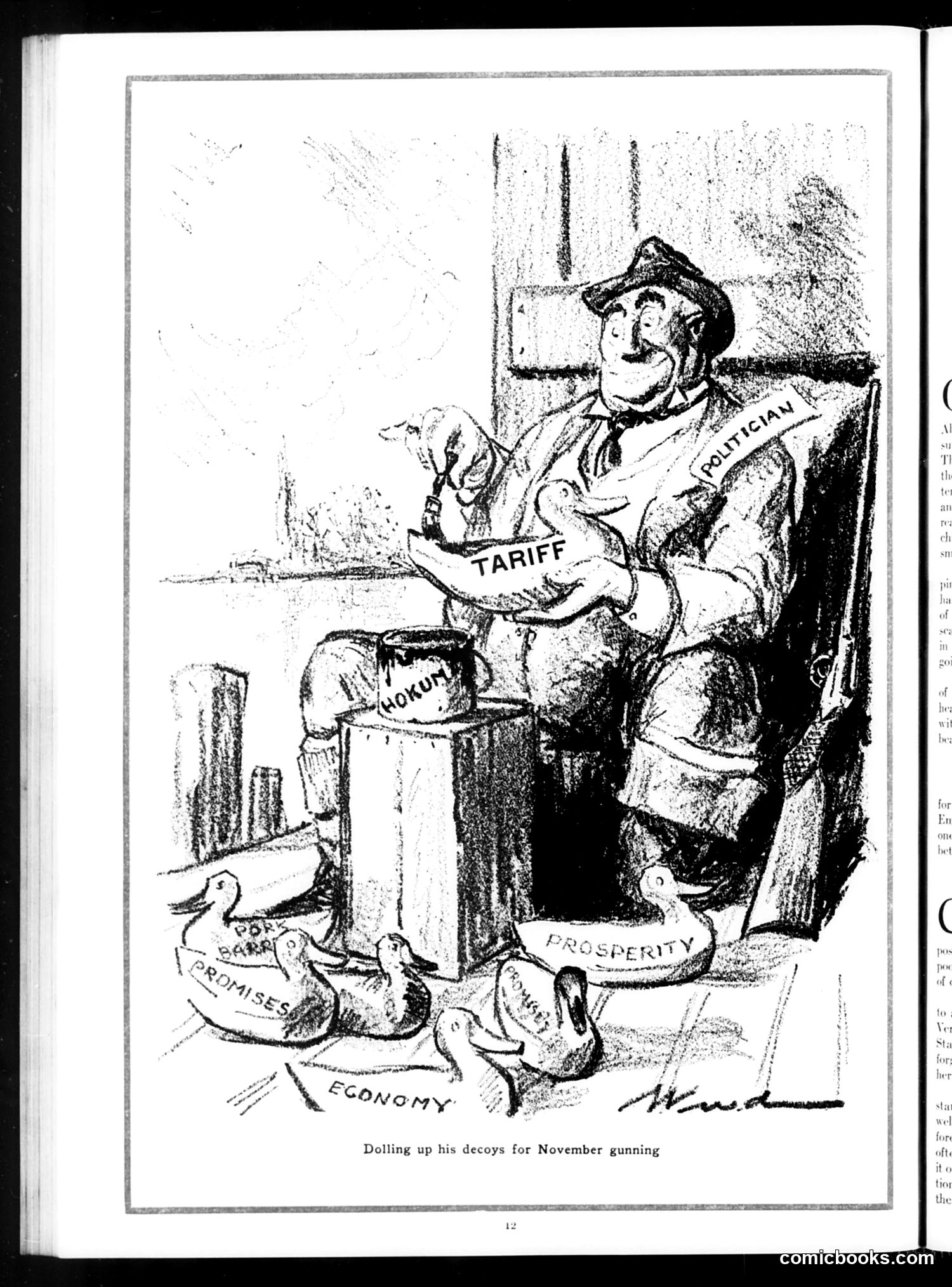
This political cartoon satirizes a politician preparing deceptive campaign strategies for November elections ("November gunning"). The caricatured figure, labeled as a "Politician," holds papers marked "Tariff" while surrounded by duck decoys labeled "Promises," "Economy," "Prosperity," and "Hokum." The satire suggests the politician uses false promises (decoys) to attract voters, much like hunters use decoys to attract ducks. The labels on the decoys represent hollow campaign pledges—economic promises that are essentially "hokum" (nonsense). The "Tariff" paper indicates this likely references early-20th-century American trade policy debates. The cartoon mocks politicians' manipulative electoral tactics, implying they cynically deploy attractive-sounding but dishonest campaign messages to win votes.
The cartoon at the top depicts **Judge himself** (the magazine's mascot—an elderly judicial figure) conversing with an owl, likely satirizing foolish or shortsighted commentary. The owl traditionally symbolizes wisdom, making the juxtaposition ironic. The editorials address contemporary 1920s issues: **"Emerald Isles and Hills"** discusses **Clare Sheridan**, a real journalist who published indiscreet remarks from famous figures in the New York World. The piece criticizes her for quoting **Michael Collins** (Irish revolutionary leader, recently deceased by 1922) without fear of contradiction. The Ulster analogy compares Ireland's political division to America's Vermont—suggesting Collins naively believed the U.S. handled its internal conflicts wisely. **"In the Near East"** tackles post-WWI geopolitics, criticizing both Christian hypocrisy toward Turkey and European diplomatic bungling in the collapsing Ottoman sphere. It mocks the failed interventionism of European powers ("solemn cooks"). **"Pessimists"** and **"Chewing and Eschewing"** critique American Prohibition enforcement and changing social mores respectively. The page showcases Judge's satirical treatment of contemporary politics, journalism ethics, and international affairs circa 1920-1922.
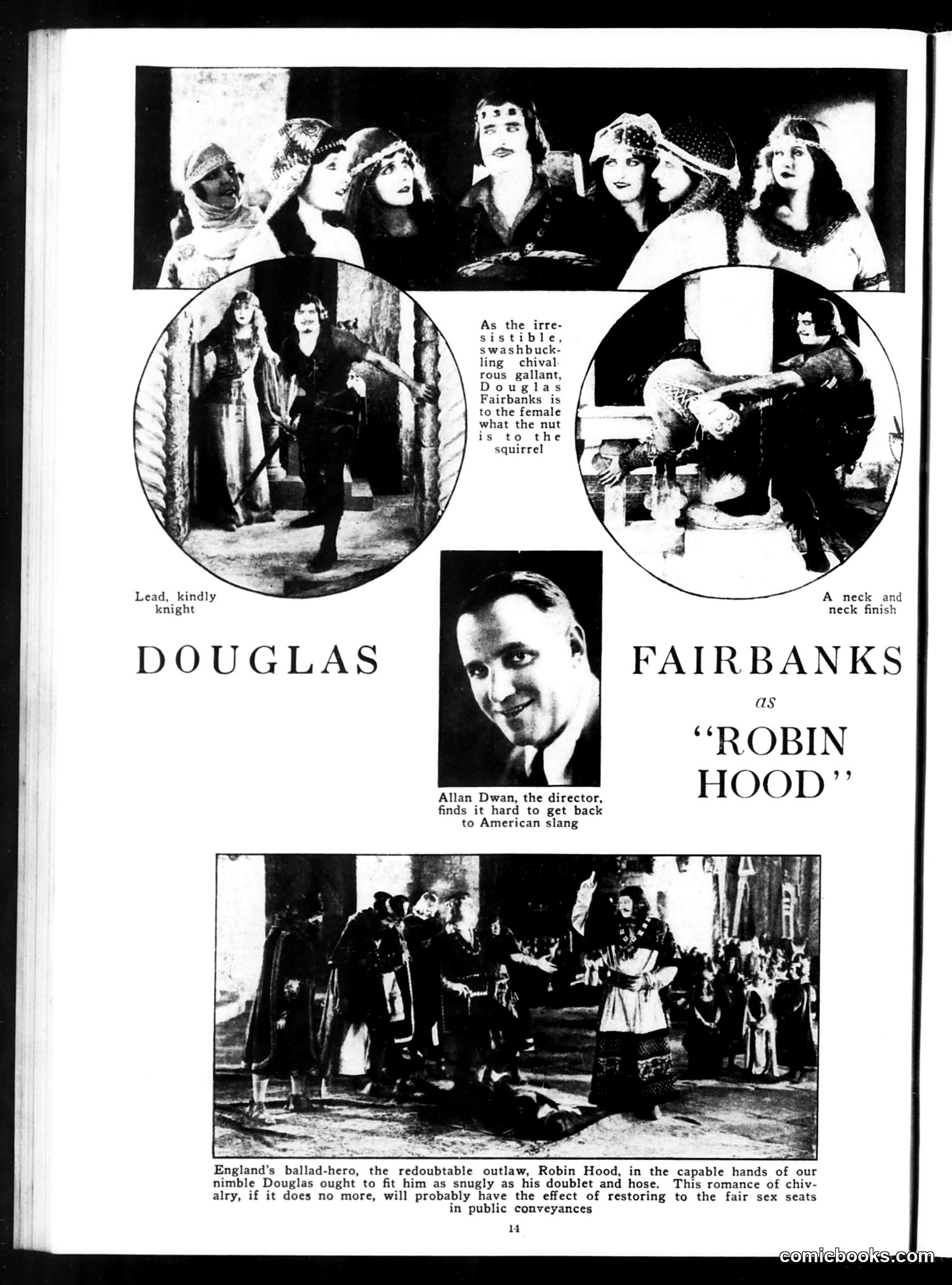
This is an advertisement/review for a Douglas Fairbanks film adaptation of *Robin Hood*, directed by Allan Dwan. The page celebrates Fairbanks as an "irresistible, swashbuckling" romantic hero, comparing his appeal to women to "what the nut is to the squirrel"—suggesting female audiences find him irresistibly attractive. The humor references Fairbanks's athleticism ("A neck and neck finish") and his established screen persona. A satirical caption notes that director Dwan "finds it hard to get back to American slang," possibly mocking the film's elaborate medieval English setting. The final caption contains period humor: it jokes that this chivalry romance might "restore to the fair sex seats in public conveyances"—sarcastically suggesting that watching Fairbanks's gentlemanly Robin Hood might remind men to offer women seats on public transportation, a courtesy apparently lacking in contemporary America.
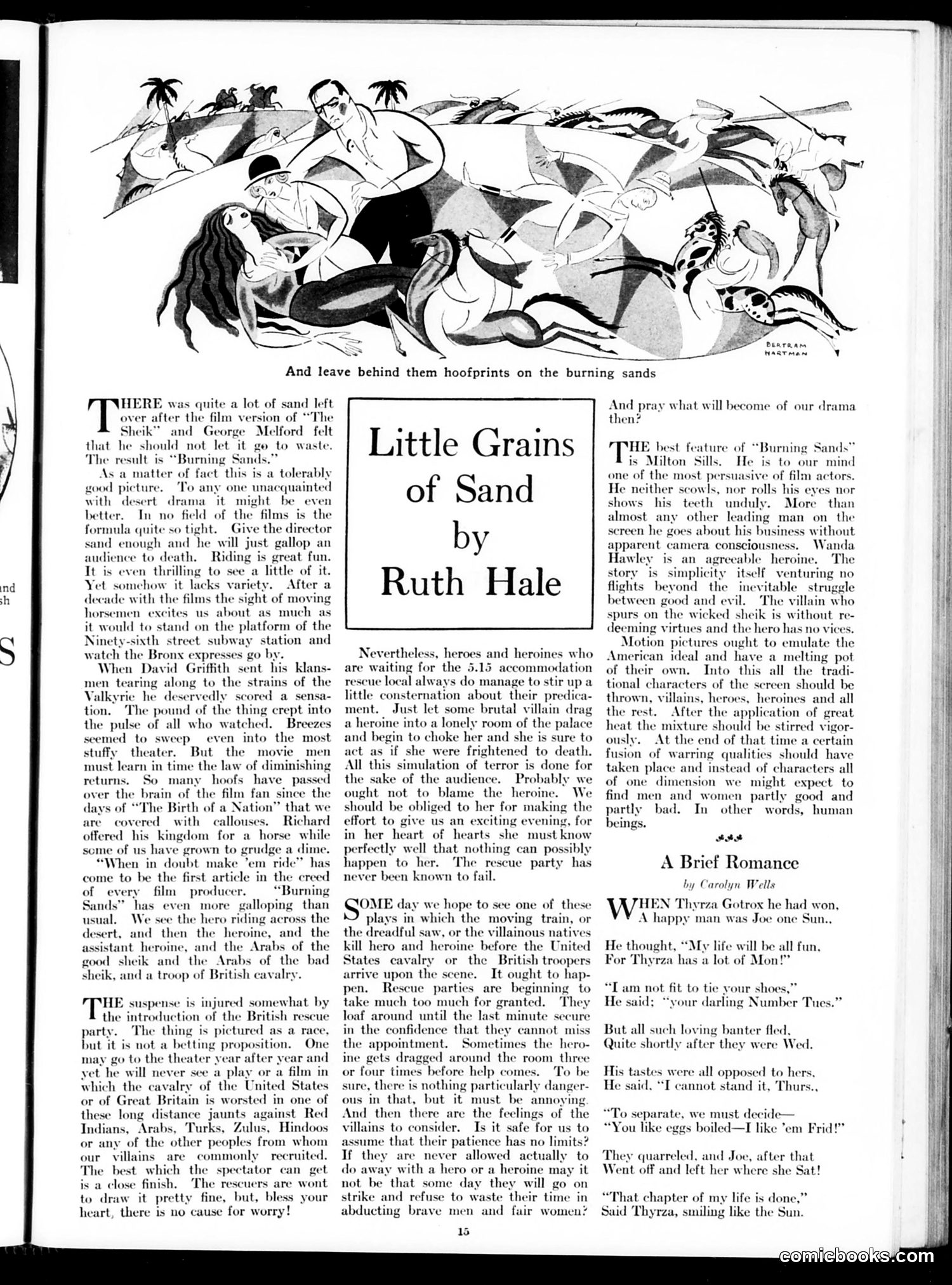
This page contains a film review by Ruth Hale critiquing the 1922 movie "Burning Sands," directed by George Melford. The accompanying cartoon illustrates the review's central complaint: that desert action films have become formulaic and repetitive. **The Satire:** Hale argues that filmmakers, following the success of D.W. Griffith's "Birth of a Nation" and the original "Sheik," have exhausted audiences by endlessly repeating the same scenes—heroes riding across deserts, heroines being dragged and threatened, and last-minute cavalry rescues. She notes that this "law of diminishing returns" means audiences have become desensitized to such spectacles. **The Cartoon's Point:** The illustration shows multiple identical scenes of desert horsemen, barely varying poses, emphasizing how interchangeable and tiresome these sequences have become across multiple films. Hale even proposes a satirical solution: what if the villain *actually succeeded* for once? The critique reflects early 1920s concerns about film industry standardization and audience fatigue.
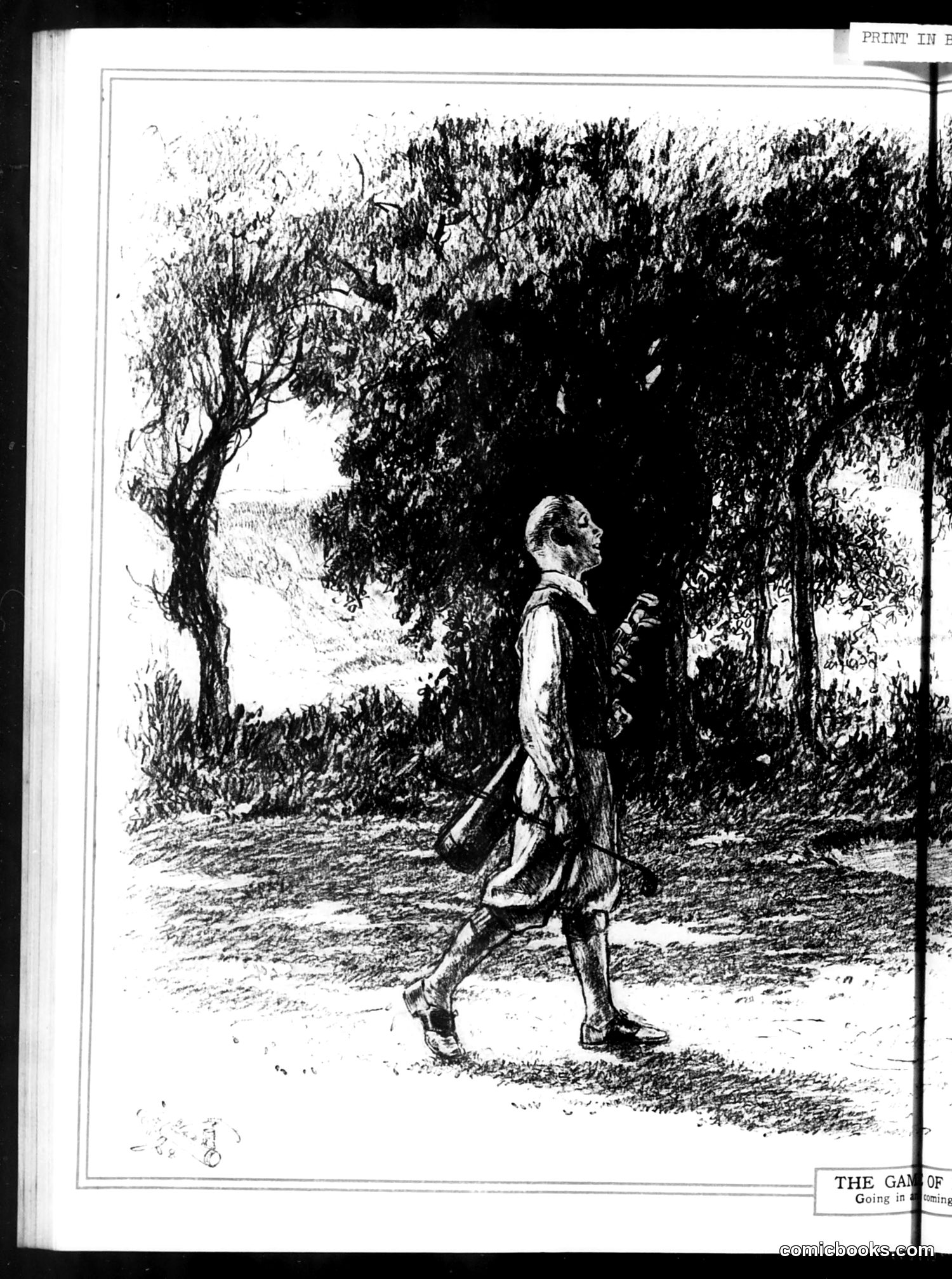
This appears to be an illustration from Judge magazine showing a man jogging or running on a tree-lined path. The figure is dressed in early-to-mid 20th century athletic wear (sleeveless shirt, shorts) and carries what looks like a water bottle or canteen. The partial caption reads "THE GA[ME] / Going in..." with the rest cut off, making the specific satirical point unclear. Without the complete caption text, I cannot definitively identify who this figure represents or what social or political commentary this illustration was intended to convey. The artwork style is typical of Judge's period illustrations—detailed pen work showing a naturalistic outdoor scene. More context from the full page or caption would be needed to explain the satire or joke to modern readers.
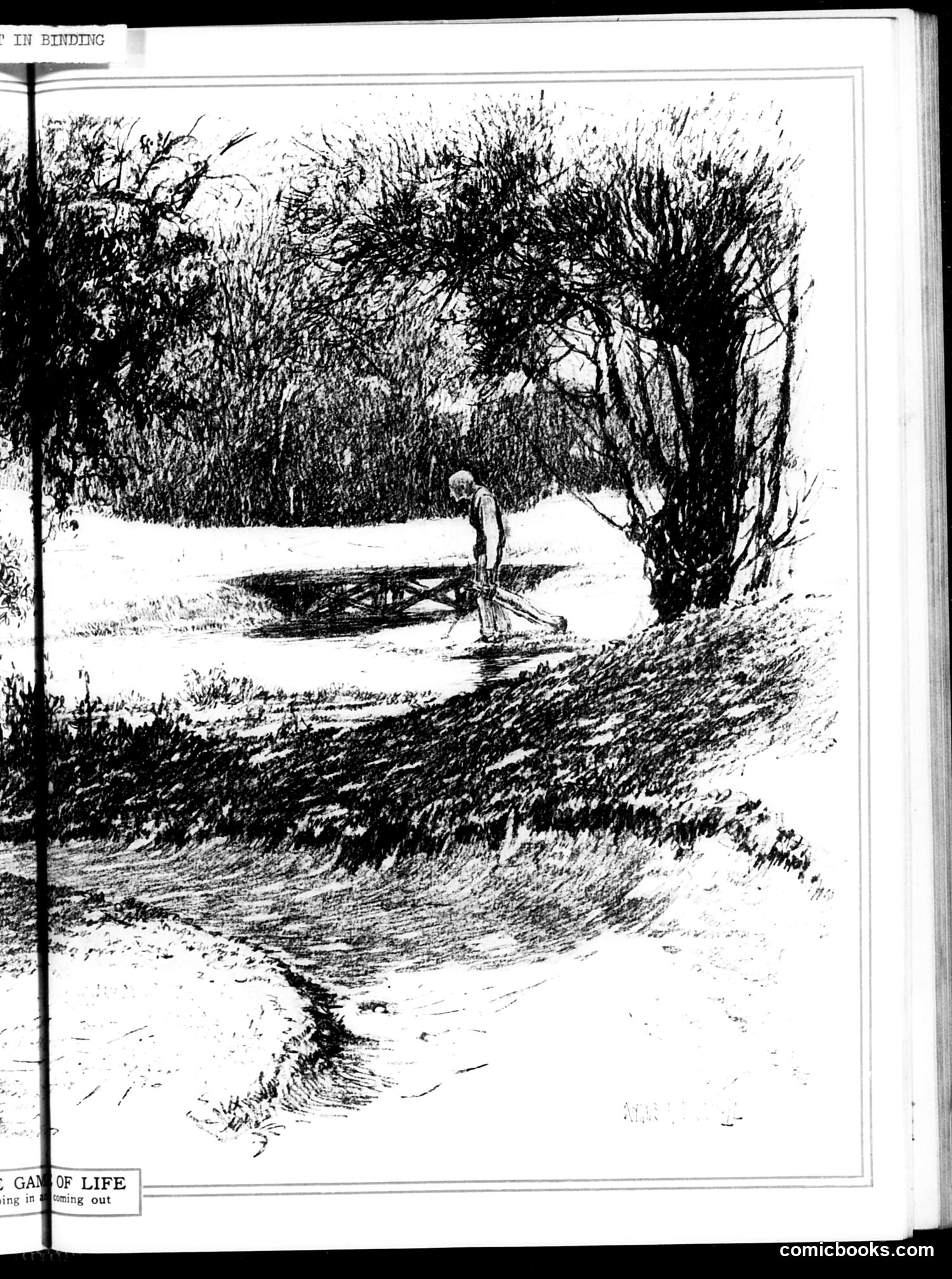
This page appears to be from a **Judge magazine satirical cartoon**, though the OCR text is too corrupted to read clearly. The illustration shows a figure standing on what appears to be a wooden platform or bridge over water, surrounded by bare, gnarled trees in a desolate landscape. The sketchy, dramatic pen work suggests a cautionary or moralistic tone. The partial caption "GAME OF LIFE" and reference to "coming in" and "coming out" suggest this is likely a **social commentary cartoon about life's risks or moral choices**—possibly depicting someone at a crossroads or precarious situation. The isolated, barren setting emphasizes the precariousness of the moment. Without clearer text or additional context, the specific satirical target remains **unclear**, though the composition suggests commentary on human vulnerability or the unpredictability of fate.
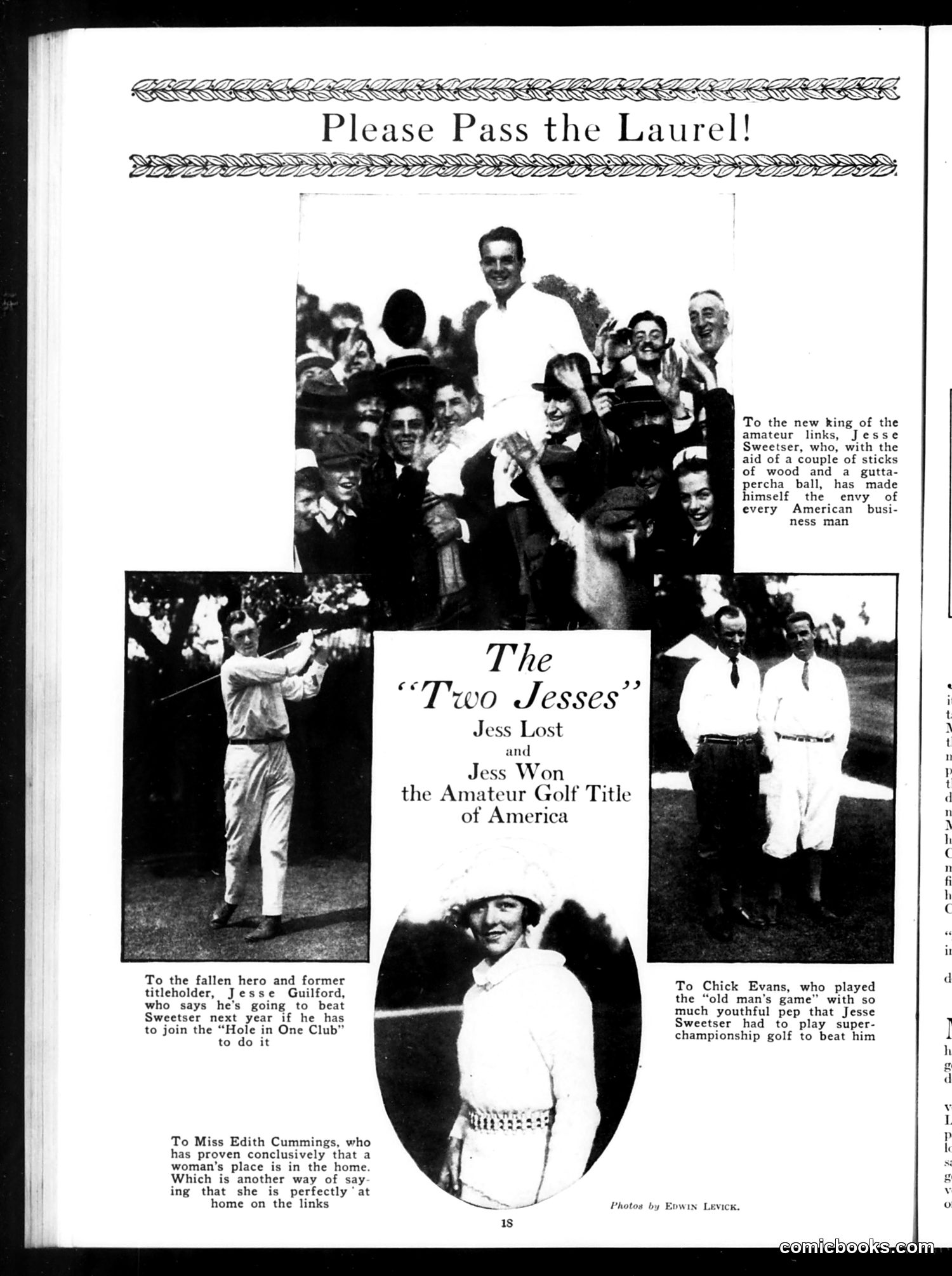
This page celebrates Jesse Sweetser's victory in the 1923 U.S. Amateur Golf Championship. The "Two Jesses" refers to Sweetser (winner) versus Jesse Guilford (former champion). The satire mocks American businessmen's obsession with golf—Sweetser has become "the envy of every American business man" simply by hitting a ball with sticks. The tributes are tongue-in-cheek: Guilford is portrayed as a "fallen hero," while Chick Evans is noted as needing youth to compete with Sweetser's superior skill. The final jab targets women's golf: Edith Cummings' excellence is sarcastically presented as "proof" that women belong at home—the implication being that if women excel at golf (traditionally a male domain), they're clearly "at home" doing it, thus reinforcing rather than challenging domestic stereotypes. This reveals era-typical sexism in amateur sports coverage.
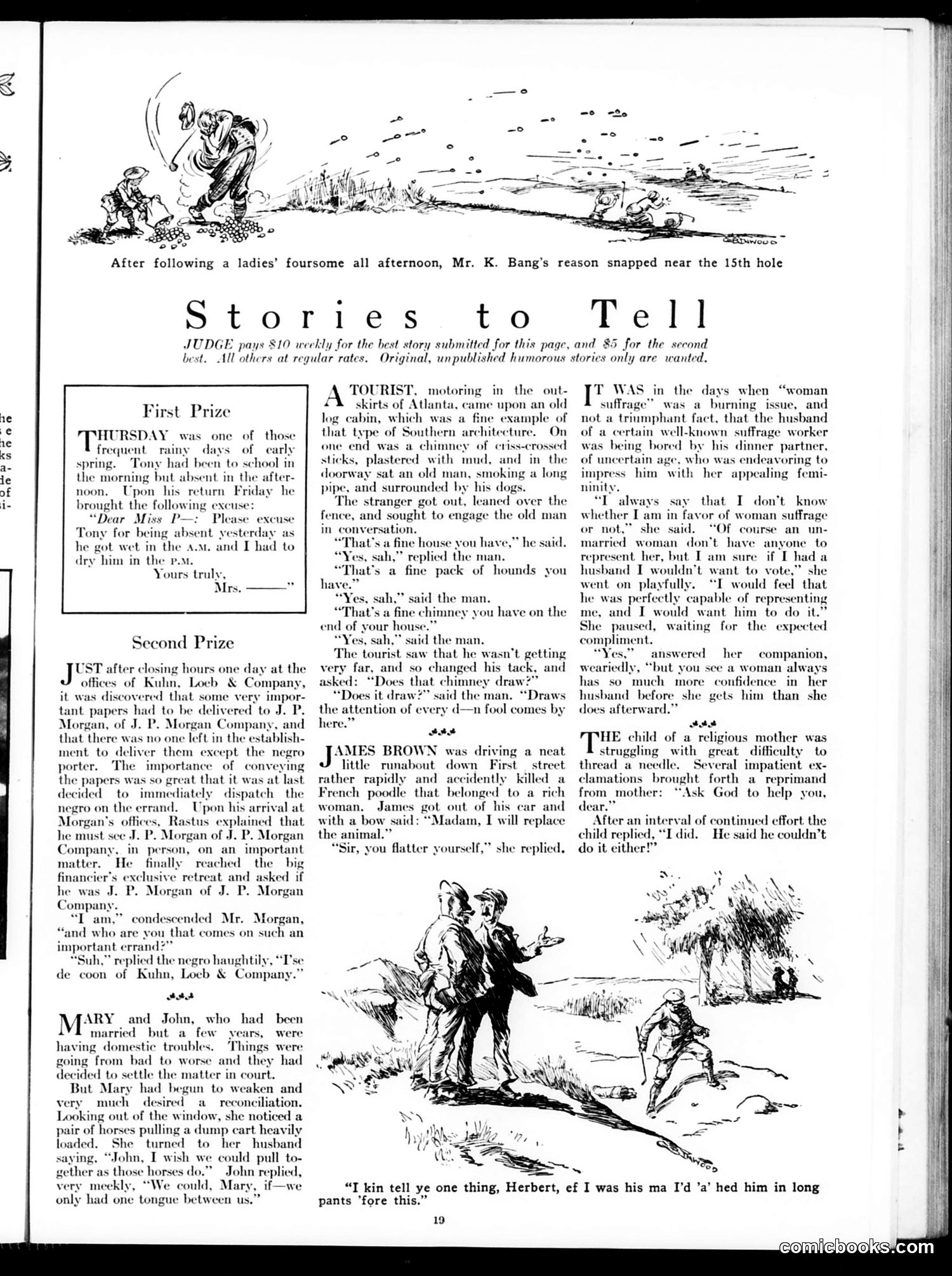
This page from Judge magazine features humorous short stories competing for prizes ($10 for first place, $5 for second). The content reflects early 20th-century American attitudes: **Key Stories:** - A school excuse note with risqué abbreviations ("a.a." and "p.m.") suggesting bathroom/toilet humor - A racial stereotype story: a Black porter from Kuhn, Loeb & Company proudly identifies himself as "de coon" to J.P. Morgan, playing on racist language and the assumption of servility - A marital dispute resolved through a pun about "one tongue between us" - A suffrage-era story where a woman argues against her own voting rights, preferring male representation **The Satire:** The page satirizes contemporary social issues—marital discord, racial hierarchies in business, and opposition to women's suffrage—through crude humor. The racism is particularly stark by modern standards, relying on dialect comedy and demeaning caricature. The suffrage story mocks anti-suffrage arguments through an ironically self-defeating female character.
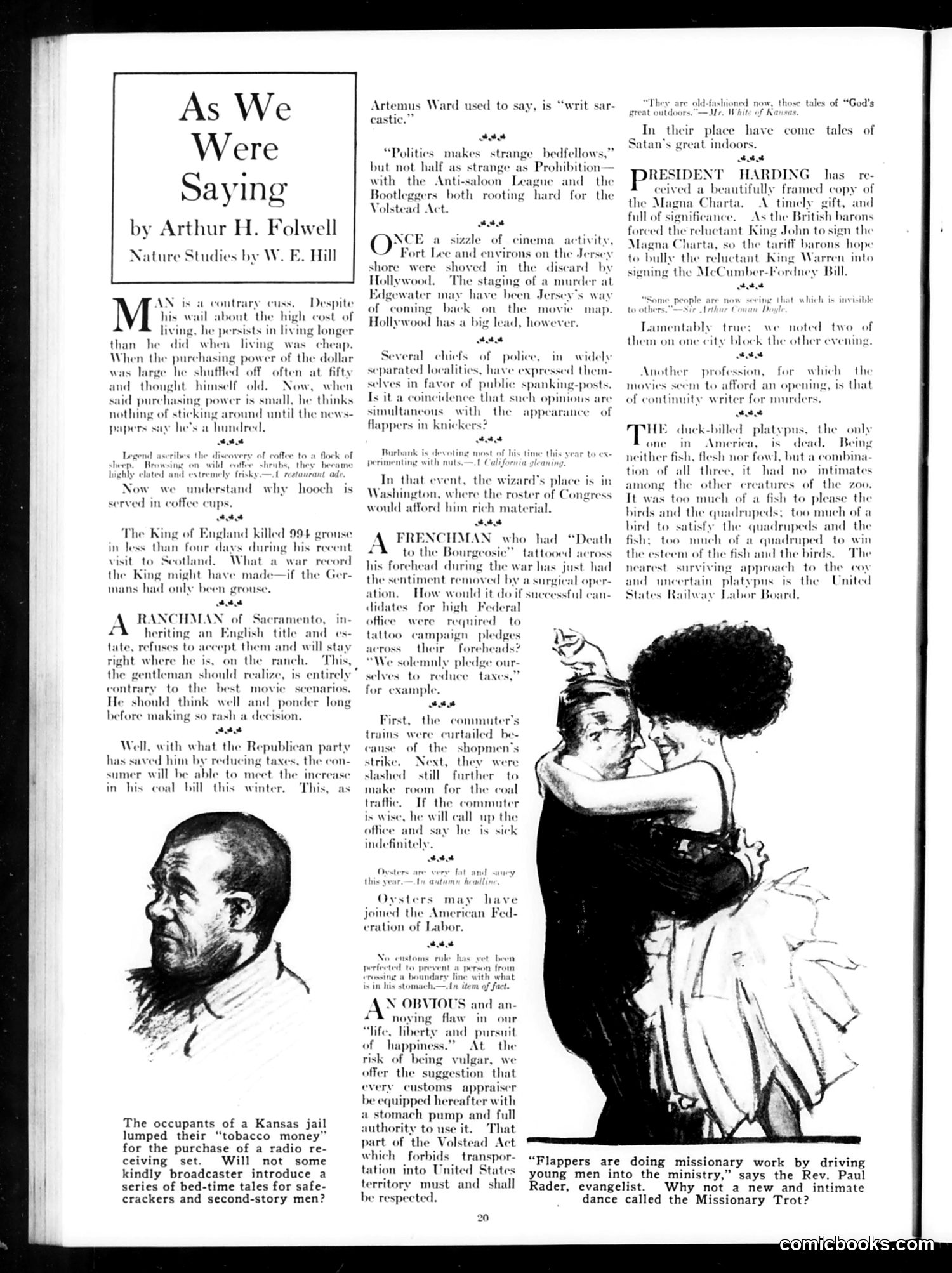
This page from Judge contains satirical commentary on contemporary early 1920s American life and politics by Arthur H. Folwell, with illustrations by W.E. Hill. **Key Satirical Items:** The column mocks various targets: Man's complaint about living costs while living longer than when life was cheap; a ranchman refusing an English inheritance (contrary to movie narratives); Kansas jail inmates pooling "tobacco money" for a radio; police chiefs advocating public spanking coinciding with the appearance of flappers in knickers (suggesting hypocrisy about morality). **Political References:** The piece criticizes Prohibition through mentions of bootleggers and the Volstead Act. It references President Harding receiving a framed Magna Charta, drawing a parallel between King John being forced to sign it and Harding being pressured to sign the McCumber-Fordney tariff bill by "tariff barons." **The Cartoons:** Two sketched portraits appear—apparently unnamed individuals illustrating specific anecdotes within the text. The satire employs typical Judge-style social commentary: mocking contemporary contradictions, political hypocrisy, and social changes (especially regarding Prohibition and changing sexual mores).
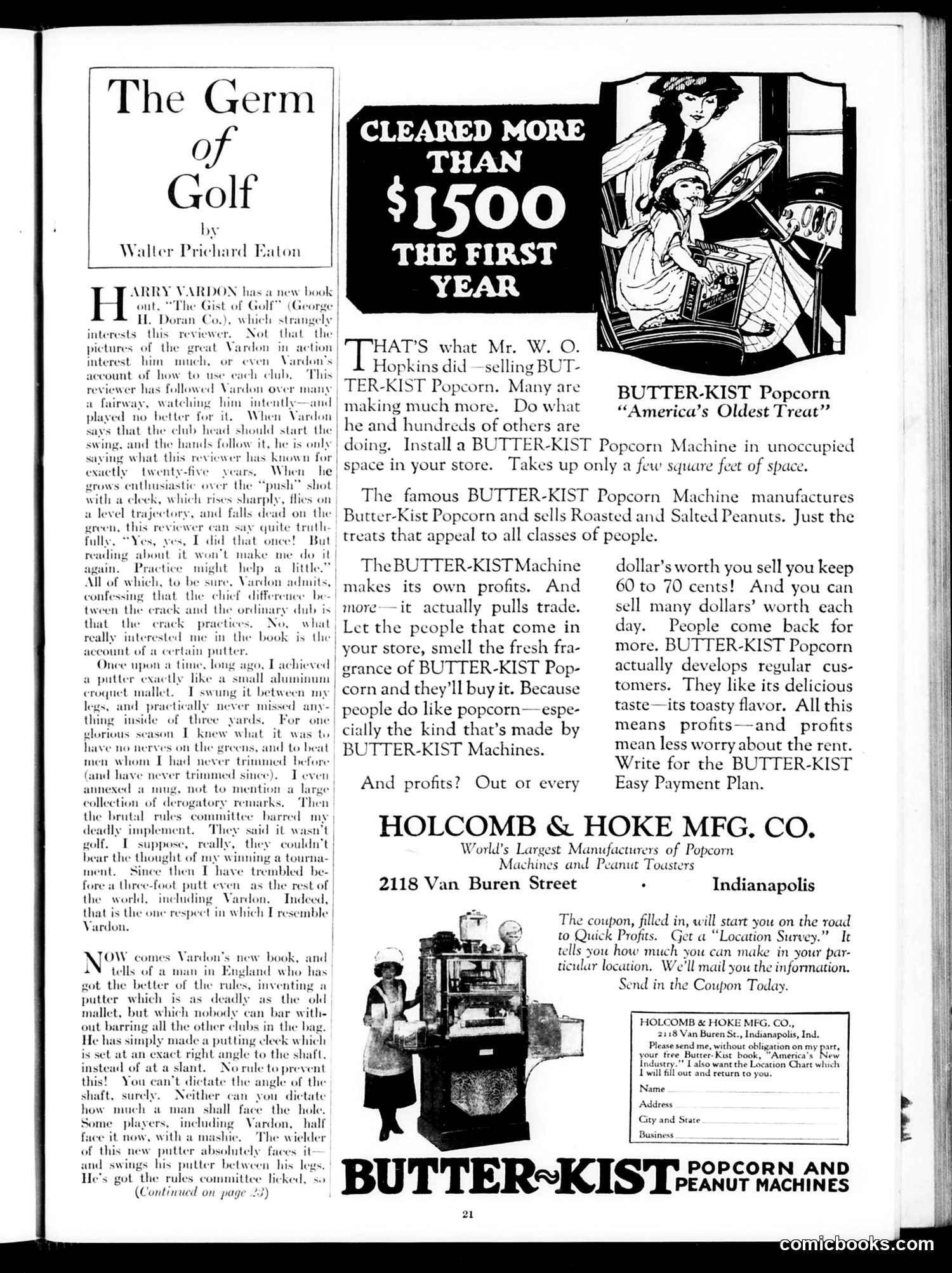
This page mixes editorial content with advertising. The left side features a book review by Walter Prichard Eaton discussing Harry Vardon's new golf instructional book. Eaton reflects humorously on golf practice and rules, recounting his own experience with an unconventional aluminum putter that was deemed "not golf" by a rules committee—satirizing how golf's rigid establishment guards against innovation that threatens tradition. The dominant right side is a **Butter-Kist Popcorn Machine advertisement**—not a political cartoon. It showcases a business opportunity pitch claiming Mr. W.O. Hopkins cleared $1,500 in his first year selling popcorn from a Butter-Kist machine. The ad targets small business owners, emphasizing high profit margins (60-70 cents per dollar) and steady customer demand. This reflects early 20th-century American entrepreneurial optimism and the vending machine business boom. There is **no political satire** on this page—it's primarily a book review and commercial advertisement.
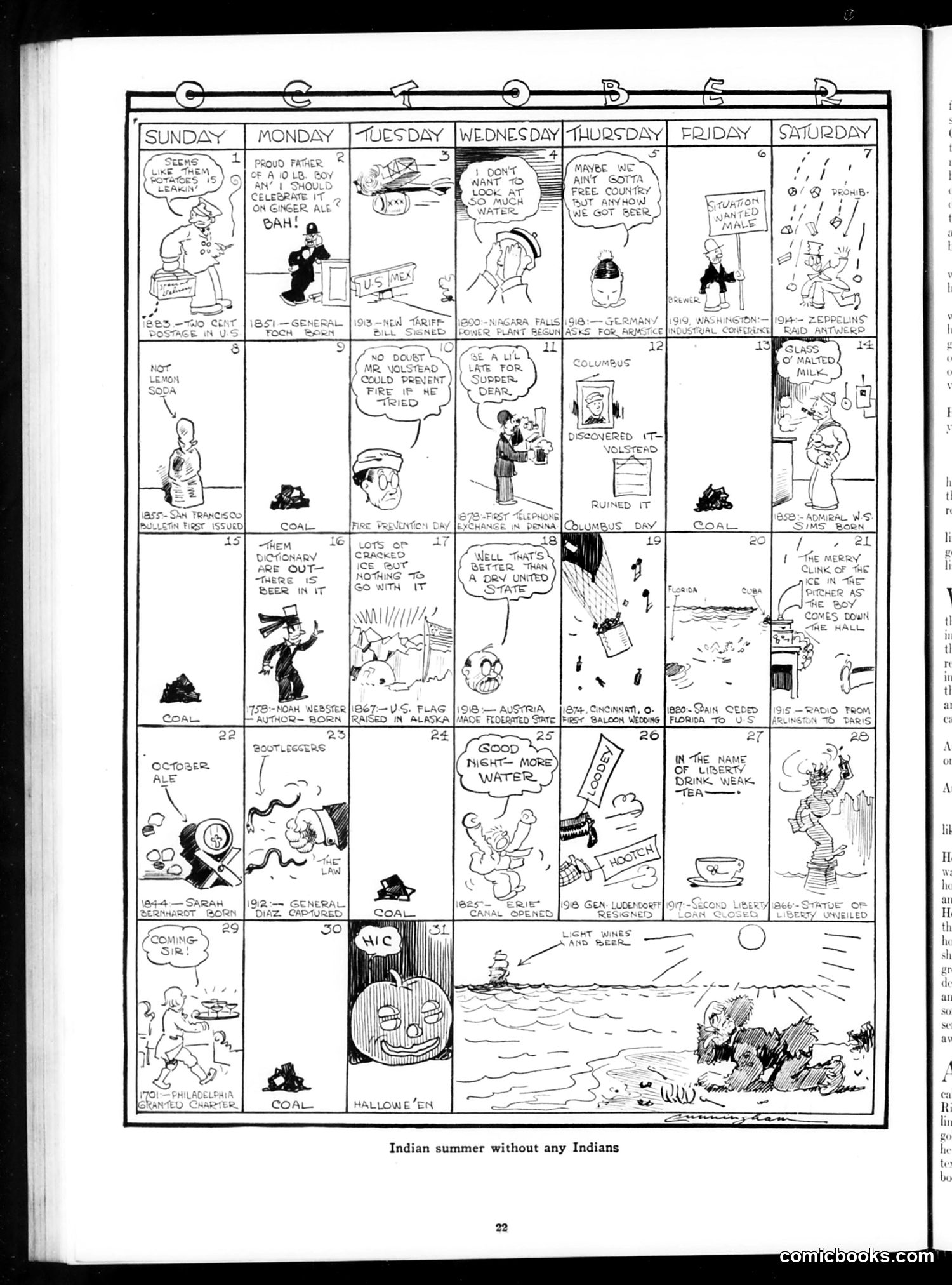
This calendar-style comic tracks October through early November, satirizing America's "Indian summer" weather phenomenon while pointedly noting the absence of actual Native Americans from the landscape. Each day's panel depicts historical American events—coal mining disasters, General Toch's actions, the U.S. flag raising in Alaska, Austria ceding territory, balloon flights, and other 19th-century occurrences. The recurring "COAL" references suggest industrial expansion and labor issues of the era. The title's dark humor critiques American society: the comfortable autumn season called "Indian summer" exists in a nation where Indigenous peoples have been systematically removed or displaced through westward expansion, industrial development, and government policy. The juxtaposition of celebrating this pleasant weather against the historical erasure of Native Americans reflects Judge's satirical commentary on American hypocrisy—enjoying the bounty of stolen land while erasing its original inhabitants. The Halloween panel at month's end adds sardonic tone to this grim subject matter.
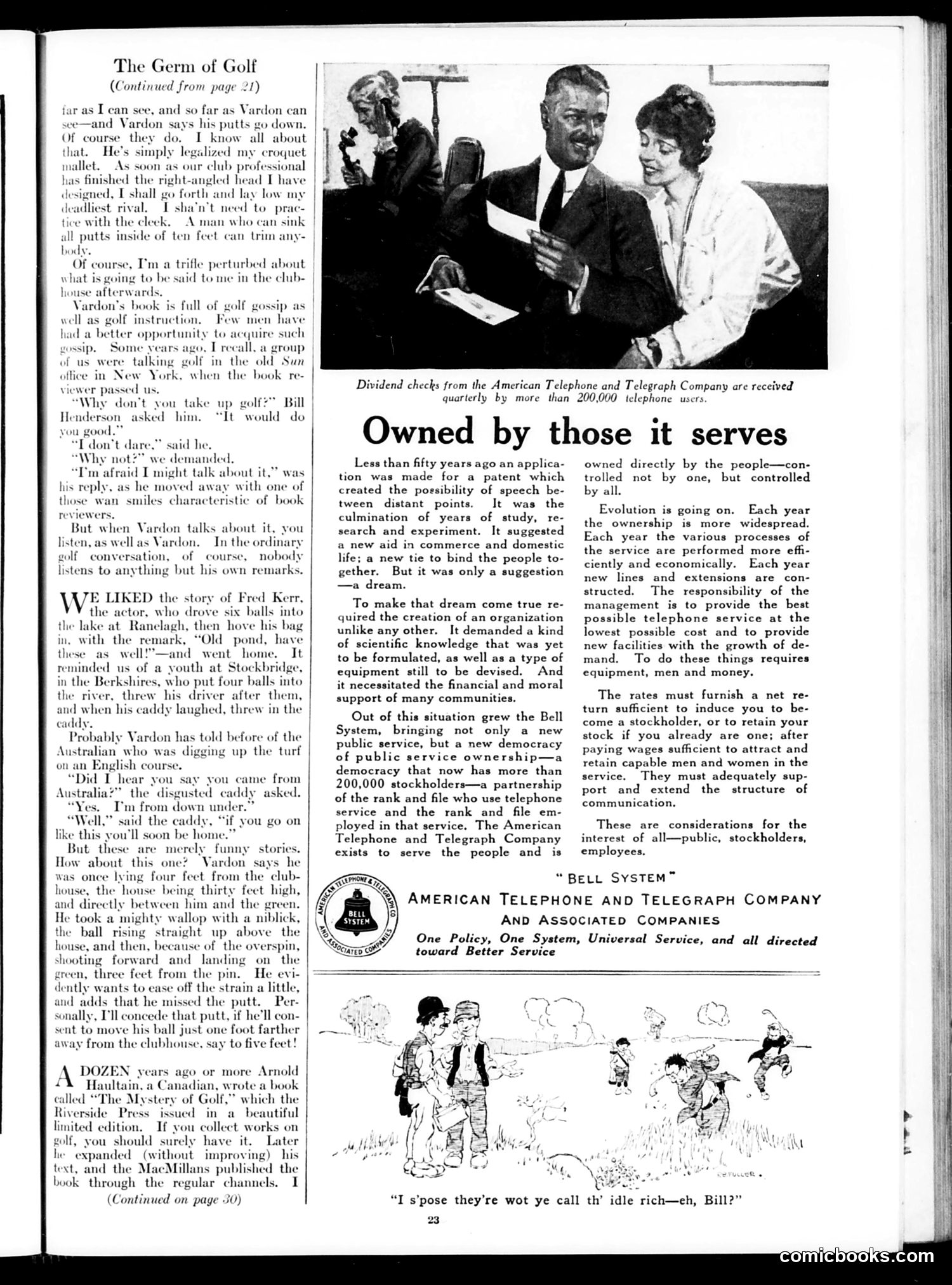
This Judge magazine page contains two distinct sections: **Left Side - Golf Humor Article**: A satirical piece about golf instruction and Harry Vardon (a famous golfer of the era). The humor mocks how people adopt golf pretentiously and how golfers exaggerate their exploits. Anecdotes about actors and caddies poke fun at wealthy Americans taking up the sport. **Right Side - Corporate Advertisement**: The Bell System presents itself as "owned by those it serves"—promoting the idea that 200,000 telephone stockholders democratically control the company. This appears to be early corporate public relations, positioning the telephone monopoly as a democratic, community-serving enterprise rather than a profit-driven monopoly. The language emphasizes scientific progress, widespread ownership, and public benefit to counter anti-monopoly sentiment of the era. The juxtaposition is typical of Judge: satirizing society's foibles while accepting advertising that reinforces establishment institutions.
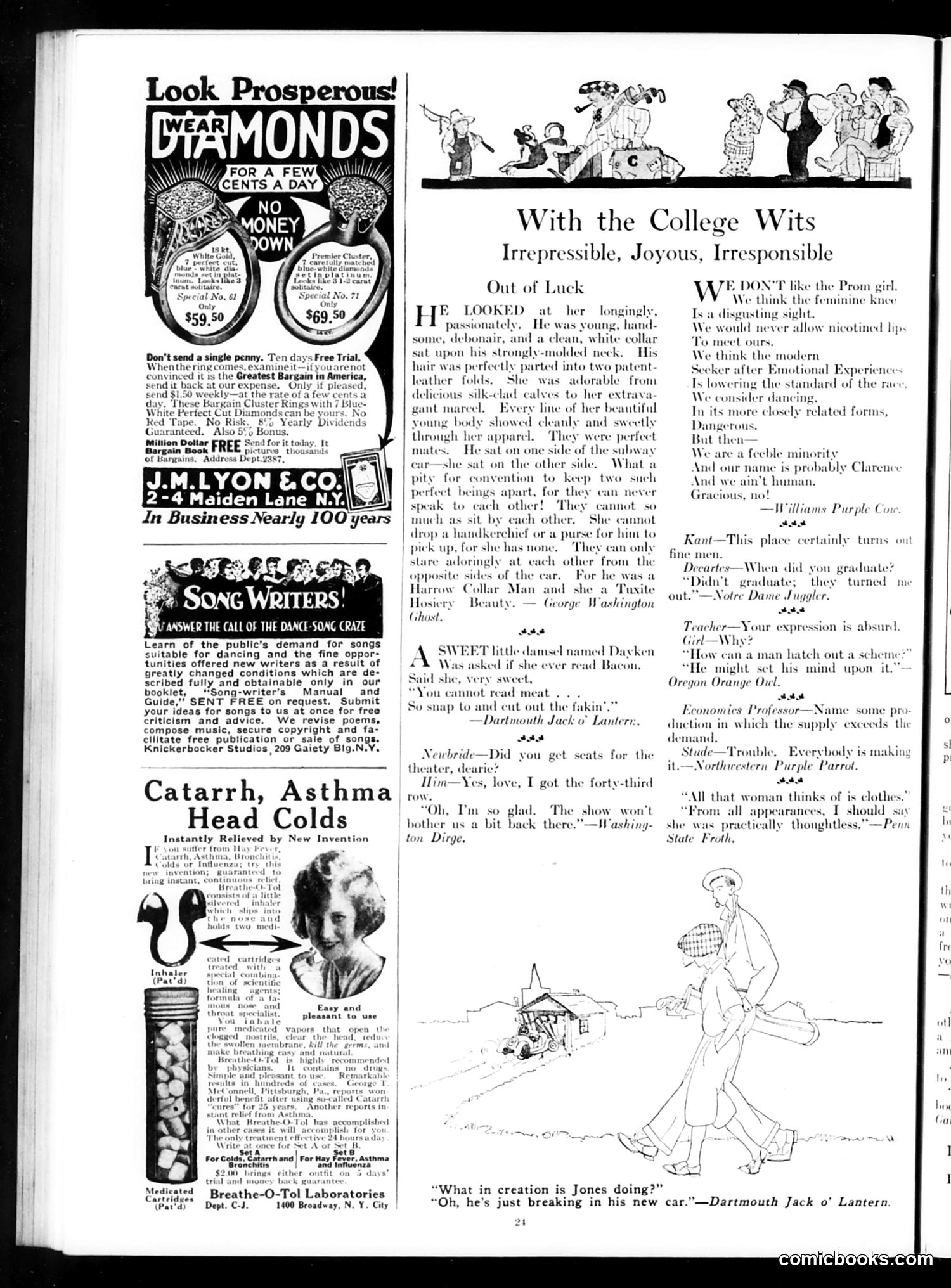
This page is primarily **advertisements and college humor** rather than political satire. The main content includes: **Advertisements**: Diamond rings ($59.50-$69.50), song-writing courses, and a medical device ("Breathe-O-Tol") for respiratory ailments—typical 1920s mail-order products. **"College Wits" Section**: A humor column featuring jokes from various college publications (Williams, Notre Dame, Northwestern, etc.). The jokes satirize: - Uptight moral guardians (represented by "Clarence") who oppose dancing and modern fashion (bare knees) - Campus life stereotypes (struggling economics, romance in subway cars) - Academic pretension The "Out of Luck" piece mocks social convention—two attractive subway passengers on opposite sides, unable to interact due to class/propriety barriers (he's a "Harrow Collar Man," she's a "Tuxite Beauty"). The overall tone is lighthearted campus satire aimed at college-age readers, not serious political commentary. The humor targets generational attitudes and social rigidity rather than specific political figures or events.
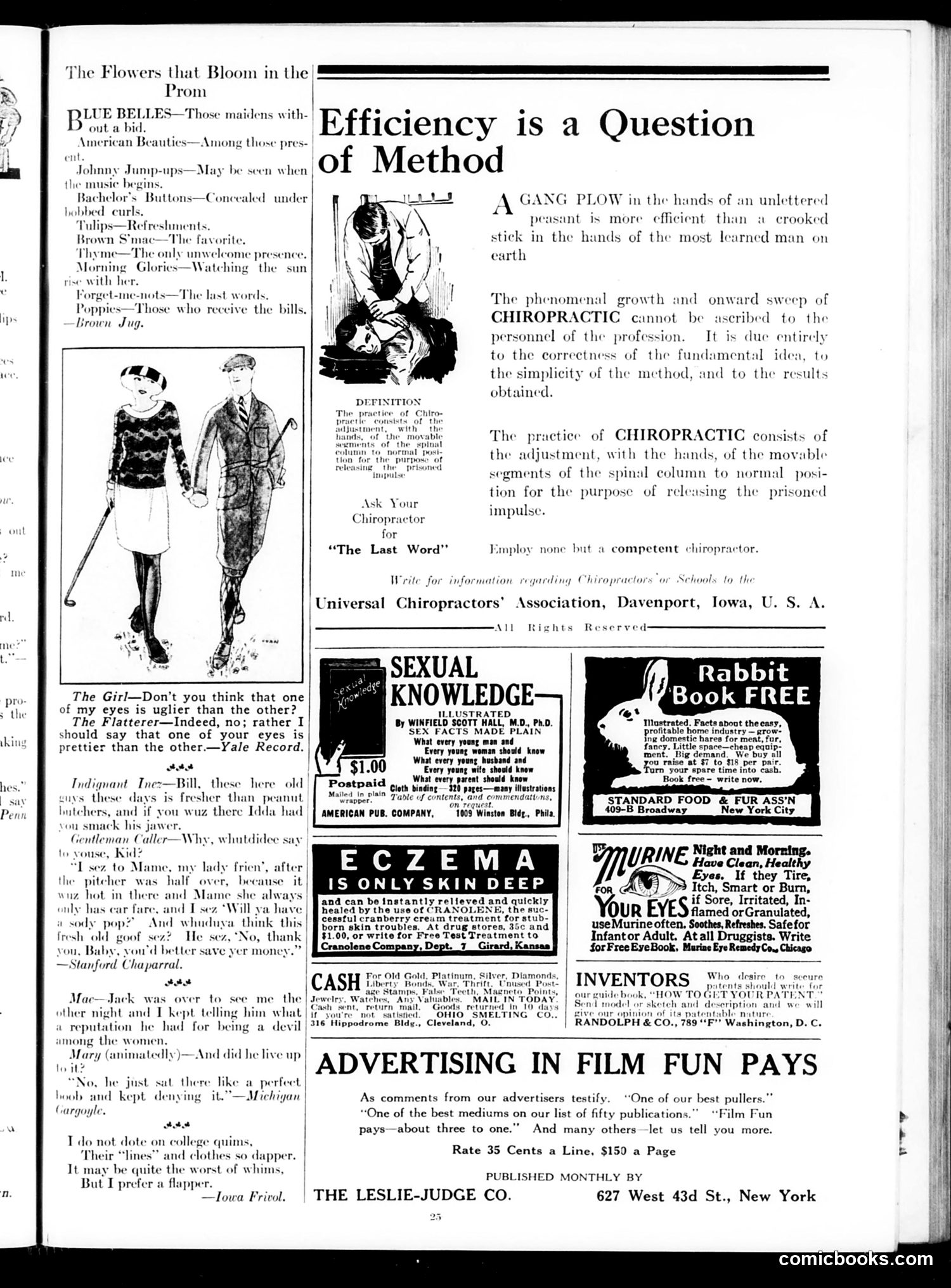
This is a mixed-content page from *Judge* magazine featuring humor columns, cartoons, and advertisements. ## The Humor Sections The left side contains witty observations about prom etiquette and flirtation—typical *Judge* fare mocking social conventions. The cartoon at top shows a young woman asking if one eye is uglier; the "flatterer" responds gallantly that one is simply "prettier." The brief anecdotes below mock class differences (the "indignant" working-class woman contrasts with the refined "gentleman caller") and male pretense ("Mac" claims his friend maintains his reputation as a ladies' man, but he merely denies everything). ## The Advertisements The right side is dominated by period advertisements for chiropractic services, sexual education booklets, rabbit-breeding ventures, eczema remedies, and eye medicine—typical of 1920s-era popular publications. These reflect genuine public concerns and emerging industries of the era. The page's humor is lighthearted social satire rather than political commentary, targeting dating customs and gender dynamics of the Jazz Age.
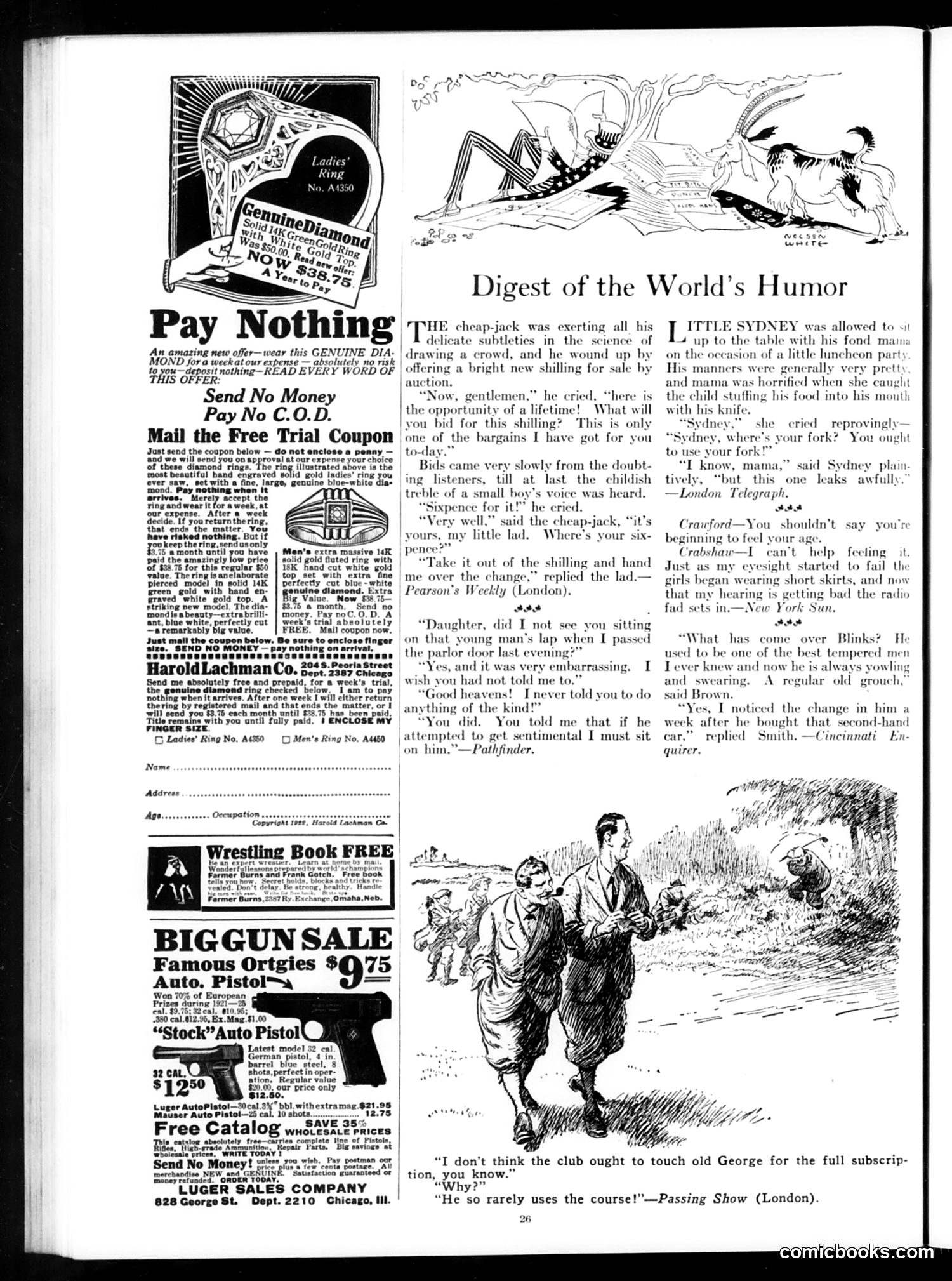
This page is primarily **advertising**, with small humor pieces interspersed. The main content includes: **Left side:** Multiple ads for mail-order items (diamond rings, pistols, wrestling books)—typical early 20th-century direct-mail marketing promising "free trials" and "pay nothing." **Right side:** "Digest of the World's Humor"—a collection of short jokes reprinted from various publications (Pearson's Weekly, Pathfinder, New York Sun, Cincinnati Enquirer, Passing Show, London Telegraph). The humor pieces are genteel domestic comedies: a mother embarrassed by her son's table manners, a father discovering his daughter sitting on a suitor's lap, a man's temperament declining with age. One joke involves an old-fashioned street vendor ("cheap-jack") selling a shilling—quaint even by 1920s standards. **What moderns miss:** These represent Judge's filler content—reprinted bits lacking contemporary political satire. The dated scenarios (strict parental propriety, manual labor vendors) reflect early-century social norms now largely vanished.
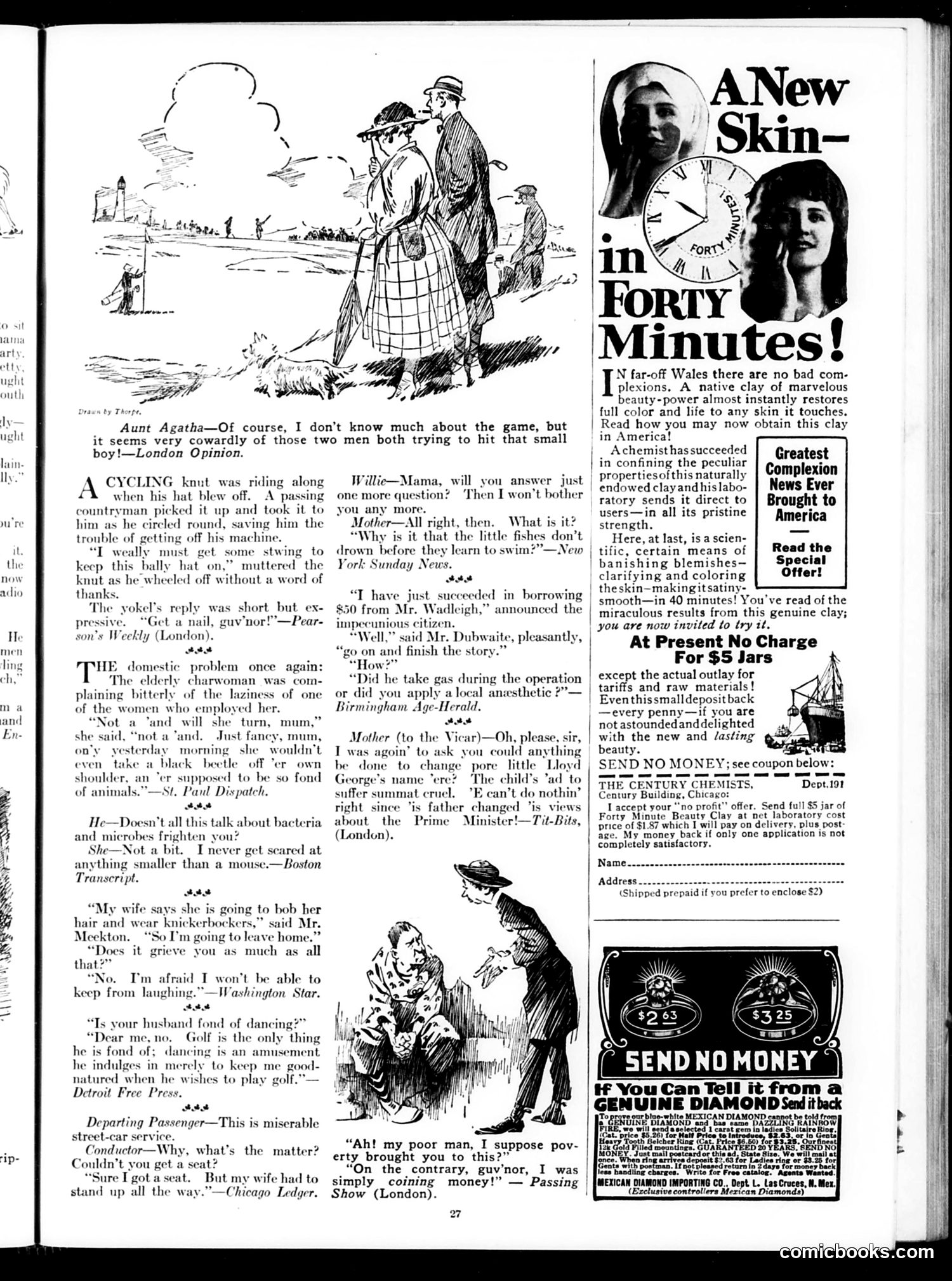
This page primarily contains humorous anecdotes and advertisements rather than political cartoons. The small illustration at the top depicts two men attempting to hit a golf ball while a boy stands nearby—captioned "Aunt Agatha" commenting on the cowardly behavior of grown men trying to hit a small boy, a joke playing on the double meaning of "boy" (the child vs. golf terminology). The remaining content comprises brief comedic stories from various newspapers, focusing on domestic life, class differences, and gender relations typical of early 20th-century humor. Notable themes include a working-class woman's laziness, marital discord over women's changing fashions (bobbed hair, knickerbockers), and a man prioritizing golf over his wife's comfort. The right side features advertisements, including one for "Forty Minute Beauty Clay" from Wales—a skincare product promising complexion improvement—and a "Send No Money" diamond ring offer. The page reflects period attitudes toward gender, class, and consumerism rather than explicit political satire.
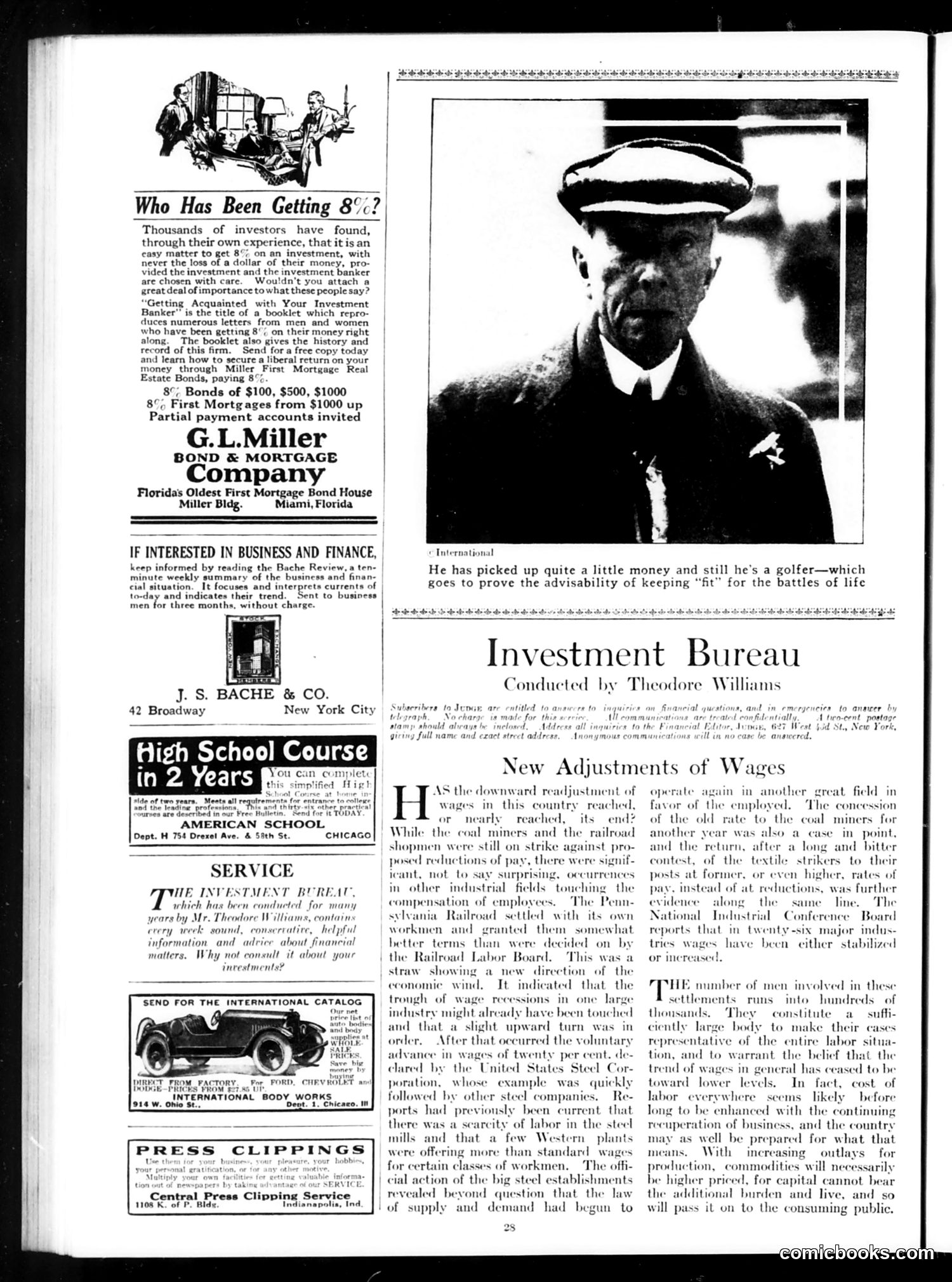
This page is primarily **advertising and financial content**, not political satire. The main elements are: **Top Left:** An advertisement for G.L. Miller Bond & Mortgage Company, promoting 8% returns on investment bonds in Miami, Florida. It targets investors seeking reliable income. **Top Right:** A photograph of a well-dressed man in a suit and captain's hat with the caption noting he's "picked up quite a little money" and remains a golfer—suggesting financial success allows leisure pursuits. **Bottom Half:** An "Investment Bureau" column by Theodore Williams discussing wage adjustments post-WWI. It reports that coal miners and railroad workers' strikes appear to be ending, and that the Pennsylvania Railroad and U.S. Steel have voluntarily increased wages rather than cutting them, suggesting the economy may be improving and labor scarcity is driving wages upward. The page reflects 1920s business optimism and investment culture, with no apparent satire or political commentary visible.
This page is primarily **financial advice and advertisements**, not political satire. The main article discusses how rising wages signal economic health and prosperity—a optimistic post-WWI economic commentary. The "Answers to Inquiries" section provides investment guidance on stocks like New Haven Railroad, Reo Motor Car Company, and oil ventures. The tone is cautiously bullish about American business recovery. The advertisements include a **Diamond Platinum Ring** offer ($5/month), **Cortez Cigars** ("made at Key West"), and the **Chalfonte-Haddon Hall** resort in Atlantic City. There is **no visible political cartoon** on this page. This appears to be a regular editorial/financial page from *Judge* magazine, likely from the early 1920s based on the investment references and post-war economic optimism. The satire *Judge* was known for is absent here—this is straightforward business journalism and advertising.
This page is primarily **advertising**, with a substantial editorial piece on golf interspersed. The main content is "The Germ of Golf," a humorous essay about golf's psychology. The author satirizes golfers' self-centered behavior—specifically how they obsess over recounting their own shots while ignoring others' stories at the 19th hole (the clubhouse bar). The satire suggests golfers are inherently egotistical because golf is an individual sport where you compete only against yourself, breeding narcissistic conversation. A secondary joke critiques Police Commissioner Enright's claim that New York traffic is better than European cities. The author mockingly juxtaposes this with an anecdote of a traffic cop rudely yelling at a citizen, undermining Enright's boast. The advertisements promote Bayer Aspirin (emphasizing brand authenticity), tailoring jobs, diamond rings, and various health products—typical 1920s magazine fare targeting middle-class readers.
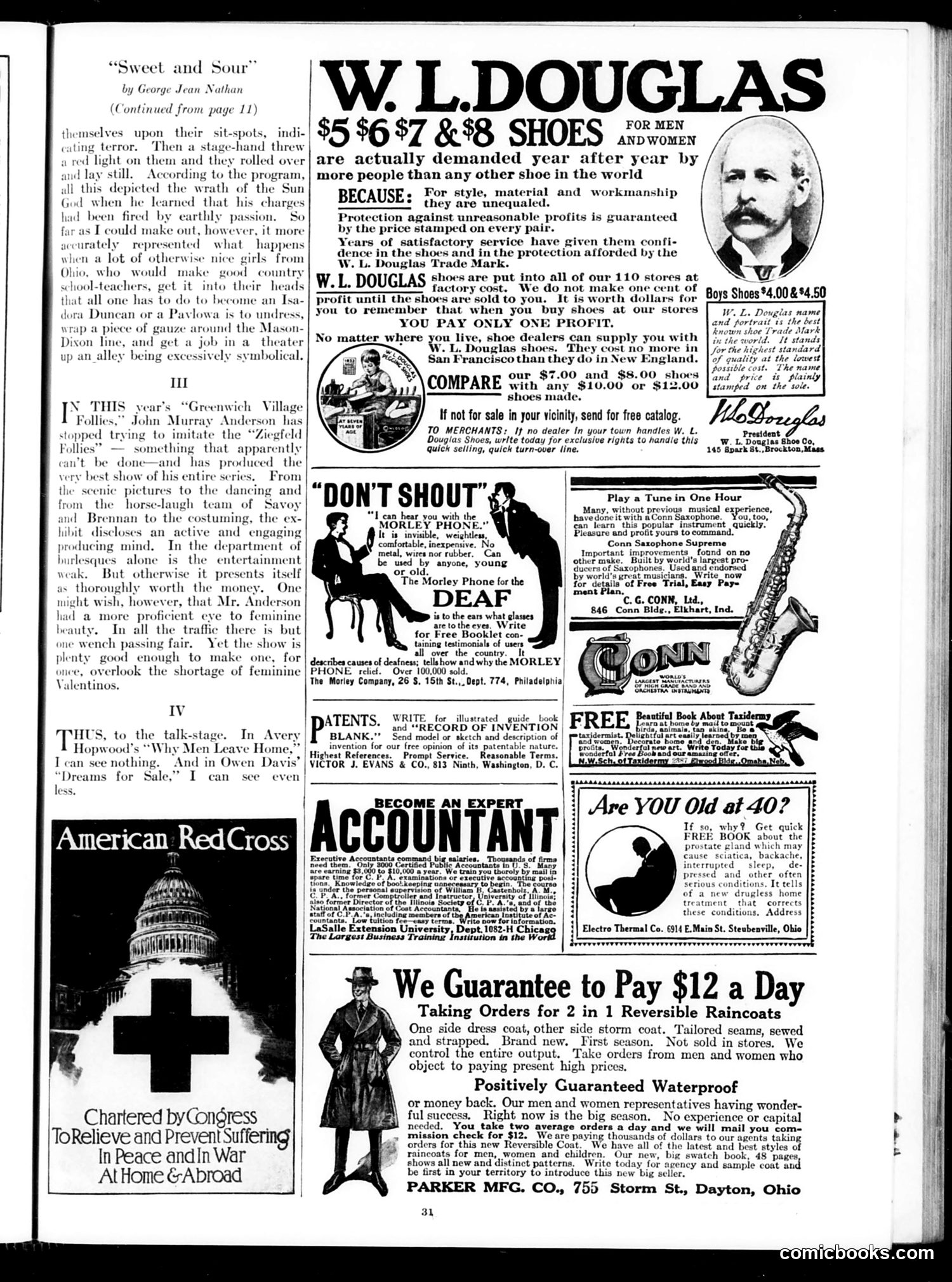
This page is primarily **advertisements and magazine content**, not political satire. The main elements: **Literary Content**: George Jean Nathan's theater review critiques Broadway productions—specifically praising John Murray Anderson's "Greenwich Village Follies" while dismissing Avery Hopwood's "Why Men Leave Home" and Owen Davis's "Dreams for Sale" as artistically empty. **Advertisements** dominate the page: - W.L. Douglas Shoes (emphasizing value and direct pricing) - Red Cross recruitment (patriotic appeal) - Morley Phone (invisible hearing device) - Conn Saxophone (musical instruction) - LaSalle Extension University (accountant training) - Various other products **Context for modern readers**: This appears to be from the 1920s (based on styling). The ads reflect era-specific concerns: shoe manufacturing transparency, wartime charitable giving, hearing aids as novelty items, and correspondence school education as social mobility. There is **no significant political cartoon or satire** on this page—it's a standard magazine layout mixing editorial content with commercial advertisements.
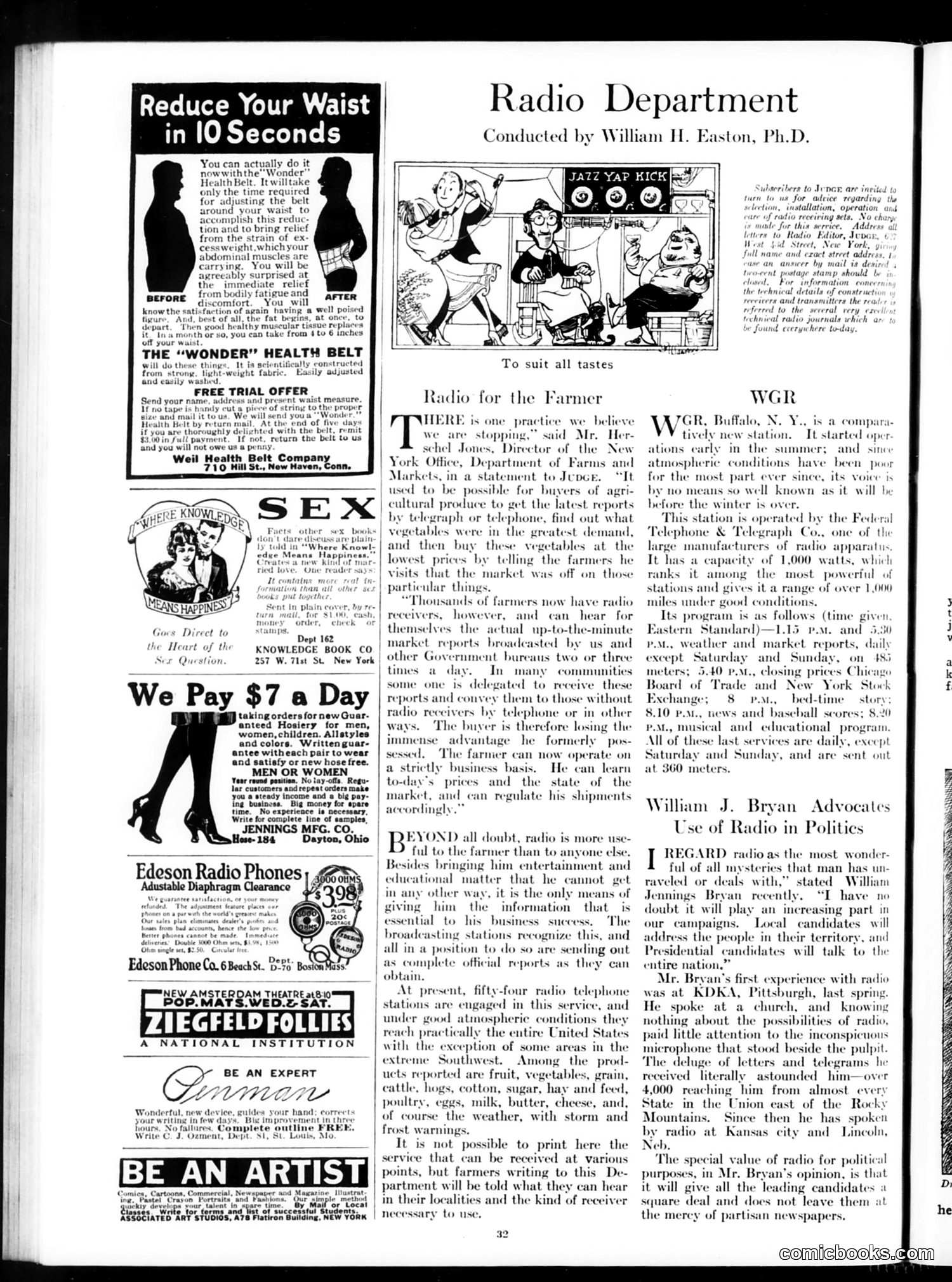
This page from *Judge* showcases a mix of advertising and radio content from the 1920s, with no significant political satire. The main article, "Radio for the Farmer," discusses how radio broadcasting—a relatively new technology—benefits agricultural markets. A Department of Farms and Markets official, Mr. Herschel Jones, explains how farmers previously had to rely on intermediaries for market prices, but can now receive up-to-the-minute reports directly via radio, allowing them to operate independently and fairly price their crops. The surrounding advertisements—for mail-order hosiery, the "Wonder" Health Belt, and Edeson Radio Phones—reflect typical 1920s consumer culture, pushing various remedies and new technologies to readers. The page exemplifies how radio was being promoted as a revolutionary technology with practical utility, especially for rural America. There is no apparent satire here; it's genuinely advocating radio's usefulness and advertising contemporary products.
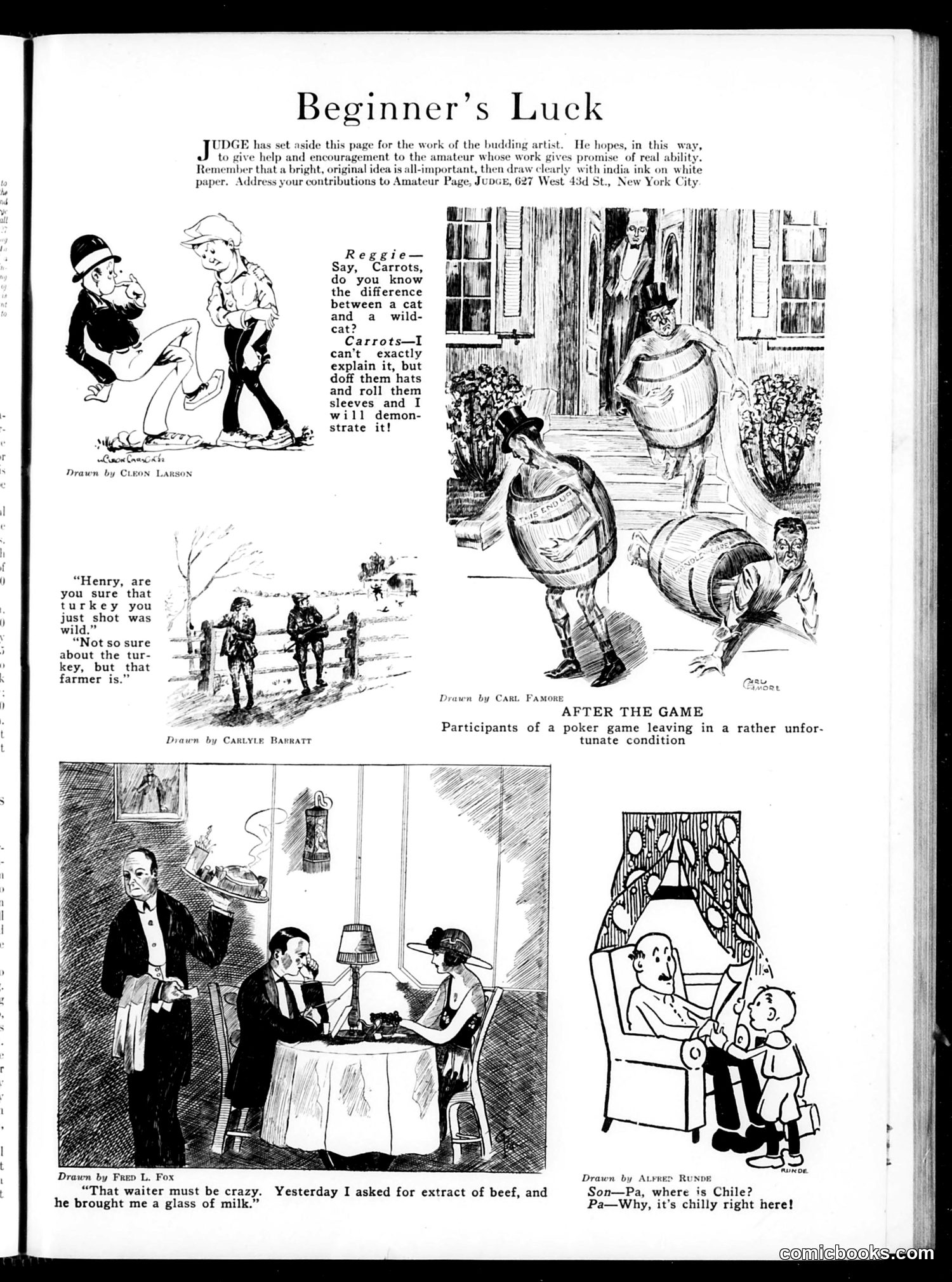
This page showcases amateur cartoonists' work, featuring several short comic gags typical of early 20th-century humor: **Top left**: Two boys discussing the difference between cats and wildcats—a setup for physical comedy, with "Carrots" threatening to demonstrate by fighting. **Middle left**: A hunter claims his shot turkey was wild; the farmer's angry reaction suggests the bird wasn't actually wild game—poking fun at hunting pretense. **Right side**: "After the Game" depicts poker players leaving in disheveled, drunk conditions—a straightforward joke about gambling's consequences. **Bottom left**: A waiter confusion joke—the diner asked for beef extract (a concentrated meat product) but received milk, implying the waiter is incompetent. **Bottom right**: A pun-based joke where a child asks "where is Chile?" and the father responds "it's chilly right here"—a groan-worthy homophone pun. These are lighthearted, domestic humor pieces with no political content—simply illustrating everyday mishaps and wordplay common to Judge's amateur submissions.
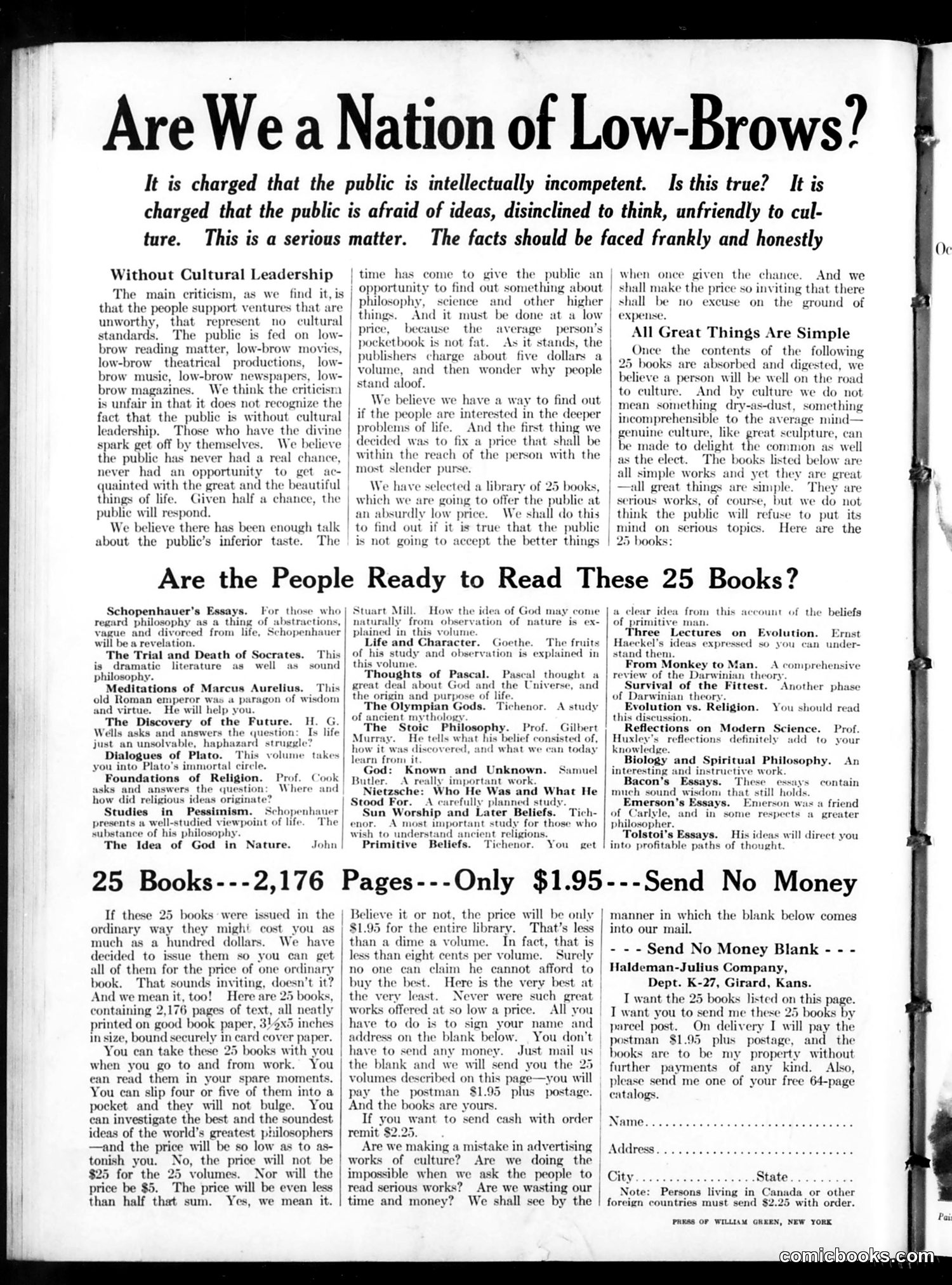
This is primarily a **book club advertisement**, not a political cartoon. The page presents a serious cultural argument wrapped in marketing. The piece responds to contemporary criticism that American public taste is "low-brow"—unsophisticated and culturally inferior. Rather than insulting the public, the author blames lack of "cultural leadership" and argues that ordinary people *will* appreciate serious philosophy and literature if given affordable access. The advertisement offers 25 classic philosophical and scientific works (Plato, Schopenhauer, Mill, Pascal, Darwin, etc.) for $1.95 total—positioning this as democratizing culture. The implicit social criticism is that high prices and cultural gatekeeping, not public stupidity, explain low-brow consumption. This reflects early 20th-century anxiety about mass culture, class divisions, and whether democratic societies could sustain intellectual standards. Judge here adopts an optimistic, populist stance: the public deserves respect and opportunity, not condescension.