
Judge, 1922-10-07 · page 8 of 36
Judge — October 7, 1922 — page 8: what you’re looking at
What you’re looking at
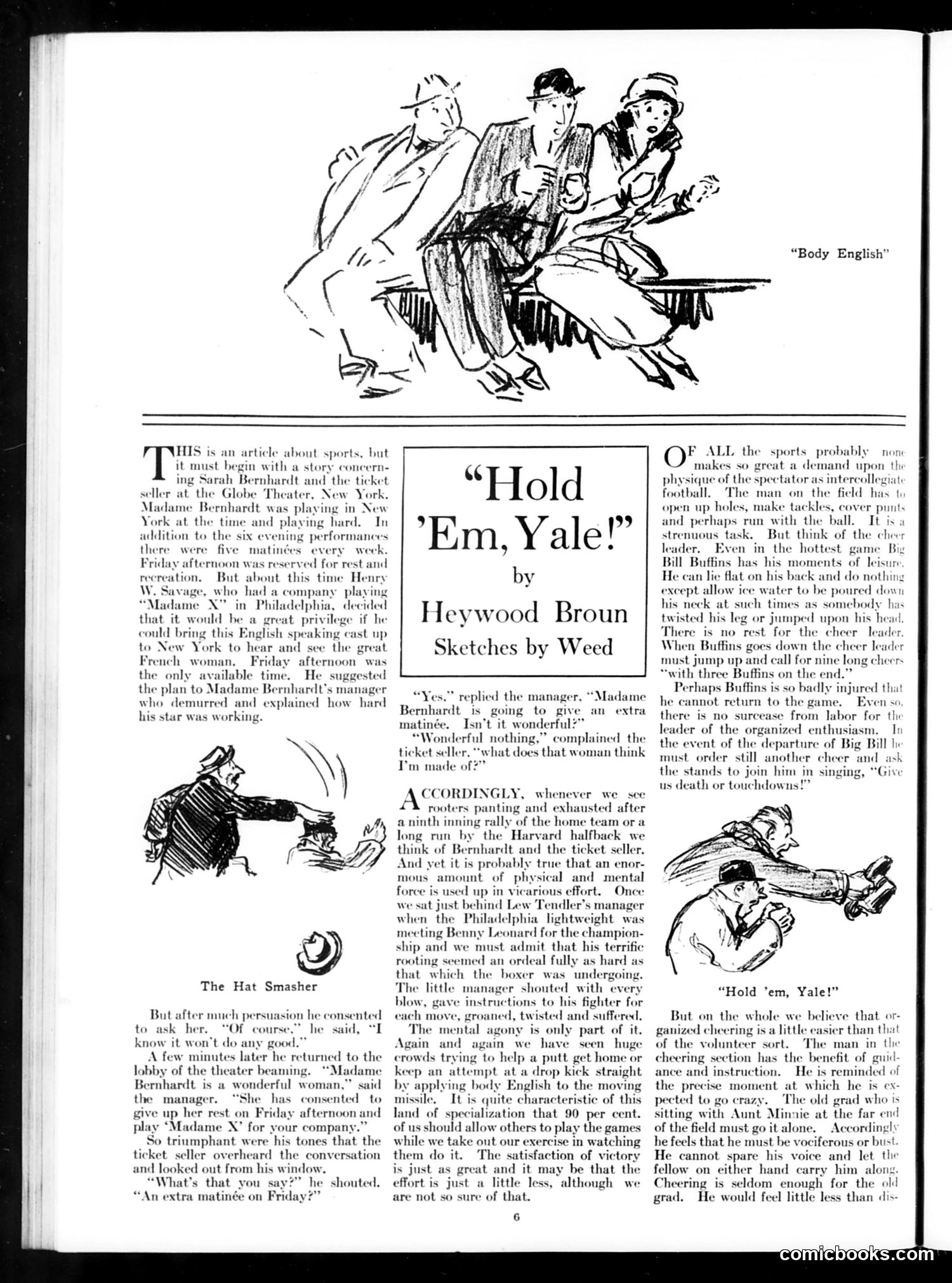
This Heywood Broun article satirizes the intense physical and emotional exertion fans expend while merely *watching* sports. The opening anecdote establishes the joke: a theater ticket seller complains that famous actress Sarah Bernhardt's demand for an extra matinee is unreasonable—she's already working so hard. The irony: spectators at games exert nearly comparable effort through emotional investment and what's called "body English" (unconscious physical mimicry). The article mocks how American sports culture has specialized labor so thoroughly that "90 per cent. of us allow others to play the games while we take out our exercise in watching them." The cartoon sketches illustrate examples: overzealous fans and cheerleaders like "Bill Buffins" who expend tremendous energy rooting, gesturing, and suffering vicariously. The satire critiques both spectator obsession and the odd contradiction that watching sports feels genuinely exhausting despite requiring no actual athletic participation.
📄 Transcribed text from this page (OCR, searchable)
Machine-transcribed from the original scan — historical spelling and the odd misread are preserved.
HIS is an article about sports, but it must begin with a story concern- ing Sarah Bernhardt and the ticket seller at the Globe Theater, New York. Madame Bernhardt was playing in New York at the time and playing hard. In addition to the six evening performances there we five every week. ternoon was reserved for rest and But about this time Henry who had a company playing ¢ X” in Philadelphia, decided that it would be a great privilege if he could bring this English speaking cast up to New York to hear and see the great French woman. Friday afternoon the only available time. He suggested the plan to Madame Bernhardt’s manager who demurred and explained how hard his star was working. The Hat Smasher But after much persuasion he consented to ask her. “Of course.” he said, “I know it won't do any good. A few minutes r he returned to the lobby of the the: beaming. * me Bernhardt is a wonderful won nid the manager. “She has conse to give up her rest on Friday afternoon and Madame X’ for your company.” So triumphant were his tones that the ticket seller overheard the conversation and looked out from his wi "Em, Yale!” by Heywood Broun Sketches by Weed * replied the manager, “Madame Bernhardt is going to give an extra matinée, Isn't it wonderful “Wonderful nothing,” complained the ticket sell what does that woman think I'm made of CCORDINGLY, whenever we see rooters panting and exhausted after aninth inning rally of the home team or a long run by the Harvard halfback we think of Bernhardt and the ticket seller. And yet it is probably true that an enor- mous amount of physical and mental force is used up in vicarious effort. Once we sat just behind Lew Tendler’s manager when the Philadelphia lightweight was meeting Benny Leonard for the champion- ship and we must admit that his terrific rooting seemed an ordeal fully as hard as that which the boxer was undergoing. The little manager shouted with every blow, gave instructions to his fighter for each move, groaned, twisted and suffered, The mental agony is ¢ part of it. Again and in we have seen huge crowds trying to help a putt get home or keep an attempt at a drop kick stra by applying body sh to the moving missile, It is quite characteristic of this land of specialization that 90 per cent. of us should allow others to play the games while we take out our exercise in watching them do it. The satisfaction of victory is just as great and it may be that the effort is just a little less, although we are not so sure of that. 6 “Body English” F ALL the sports probably non makes so great a demand upon thy physique of the spectator as intercolle football. The man on the field hi open up holes, make tackles, cover punts and perhaps run with the ball. It is a strenuous task. But think of the cheer leader. Even in the hottest game B Bill Buffins has his moments of He can lie flat on his back and do nothing except allow ice water to be poured down his neck at such times as somebody has twisted his leg or jumped upon his | There is no rest for the cheer When Buffins goes down the cheer leader must jump up and call for nine long cheers “with three Buffins on the end.” Perhaps Buffins is so badly injured that he cannot return to the game. Even so. there is no surcease from labor for the leader of the 1 ed enthusiasm. [1 the event of the departure of Big Bill lv must order still another cheer and ask the stands to join him in si us death or touchdowns!” “Hold ‘em, Yale!” But on the whole we believe that or- rering is a little easier than that unteer sort. The man in tl cheering section has the benefit of guid ance and instruction. He is reminded of the precise moment at which he is ex- pected to go crazy. The old grad who is sitting with Aunt Minnie at the far end of the field must go it alone. According! he feels that he must be ‘erous or bust He cannot spare his voice and let the fellow on either hand carry him along. Cheering is seldom enough for the old grad. He would feel little less than dis-