
Judge, 1922-10-07 · page 25 of 36
Judge — October 7, 1922 — page 25: what you’re looking at
What you’re looking at
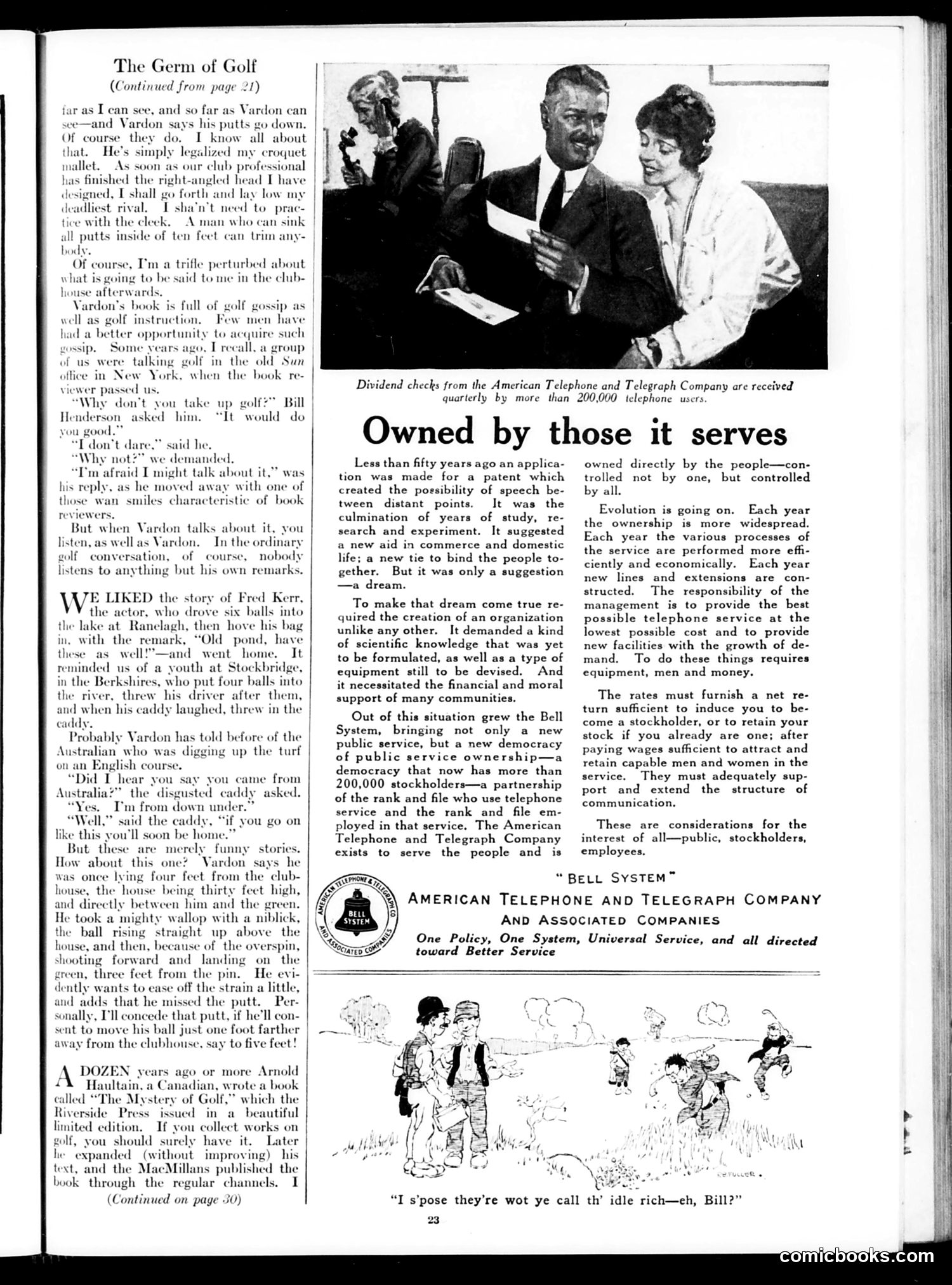
This Judge magazine page contains two distinct sections: **Left Side - Golf Humor Article**: A satirical piece about golf instruction and Harry Vardon (a famous golfer of the era). The humor mocks how people adopt golf pretentiously and how golfers exaggerate their exploits. Anecdotes about actors and caddies poke fun at wealthy Americans taking up the sport. **Right Side - Corporate Advertisement**: The Bell System presents itself as "owned by those it serves"—promoting the idea that 200,000 telephone stockholders democratically control the company. This appears to be early corporate public relations, positioning the telephone monopoly as a democratic, community-serving enterprise rather than a profit-driven monopoly. The language emphasizes scientific progress, widespread ownership, and public benefit to counter anti-monopoly sentiment of the era. The juxtaposition is typical of Judge: satirizing society's foibles while accepting advertising that reinforces establishment institutions.
📄 Transcribed text from this page (OCR, searchable)
Machine-transcribed from the original scan — historical spelling and the odd misread are preserved.
The Germ of Golf (Continued from page 21) s I can see, and so far as Vardon can see—and Vardon says his putts go down, Of course they do. I know all about that. He's simply legalized my eroquet mallet. As soon as our club pr has finished the r designed, [ shall go forth and lay low my deadliest rival. T sha’n’t need to prac- tice with the eleek. A man who can sink all putts inside of ten feet can trim any- irse, I'm a trifle perturbed about g to be said tome in the club- Vardon’s book is full of golf gossip as well If instruction. have had a better opportunity gossip. Some years of us were talkin ollice in New York, when the book re- acquire such viewer passed us. “Why don’t you take up golf?” Bill Henderson asked him. “It would do * said he. lemanded. ght talk about it,” was away with one of teristic of book “Why not “Tm afrai his reply, as he move those wan smiles ch: reviewers. But when Vardon talks about it, you listen, as well as Vardon. In the ordi golf conversation, of nobody listens to anything but his own remarks. course, \ E LIKED the story of Fred Kerr, the actor, who drove six balls into the lake at Ranelagh, then hove his bag in, with the remark, “Old pond, have these as well!’—and went home. It reminded us of a youth at Stockbridge, in the Berkshires, who put four balls into the river, threw his driver after them, and when his caddy laughed, threw in the caddy. Probably Vardon has told before of the Australian who was digging up the turf on an English course. “Did [ hear you say you came from Australia?” the disgusted caddy asked. “Yes. I'm from down under.” “Well,” said the caddy, “if you go on like this you'll soon be home.” But these are merely funny. stories. How about this one? Vardon says he was once lying four fect from the club- house, the house being thirty feet high, and directly between him and the green. He took a mighty wallop with a niblick, the ball risi straight up above the house, and then, because of the overspin, shooting forward and landing on the green, three feet from the pin. He evi- dently wants to ease off the strain a little, and adds that he missed the putt. Per- sonally, I'll concede that putt, if he'll con- sent to move his ball just one foot farther away from the clubhouse, say to five feet! A DOZEN years SY Haultain, a Canad called “The Mystery of Golf,” which the issued ina beautiful limited edition. If you collect works on | golf, you should surely have it, Later he expanded (without improving) his text, and the MacMillans published the go or more Arnold n, wrote a book Riverside ss angled head T have | Dividend checks from the American Telephone and Telegraph Company are received quarterly by more than 200,000 telephone users. Owned by those it serves Less than fifty years ago an applica- tion was made for a patent which created the possibility of speech be- tween distant points. It was the culmination of years of study, re- search and experiment. It suggested a new aid in commerce and domestic life; a new tie to bind the people to- gether. But it was only a suggestion —a dream. To make that dream come true re- quired the creation of an organization unlike any other. It demanded a kind of scientific knowledge that was yet to be formulated, as well as a type of equipment still to be devised. And it necessitated the financial and moral support of many communities. Out of this situation grew the Bell System, bringing not only a new public service, but a new democracy of public service ownership—a democracy that now has more than 200,000 stockholders—a partnership of the rank and file who use telephone service and the rank and file em- ployed in that service. The American Telephone and Telegraph Company exists to serve the people and is owned directly by the people—con- trolled not by one, but controlled by all. Evolution is going on. Each year the ownership is more widespread. Each year the various processes of the service are performed more efhi- ciently and economically. Each year new lines and extensions are con- structed. The responsibility of the management is to provide the best possible telephone service at the lowest possible cost and to provide new facilities with the growth of de- mand. To do these things requires equipment, men and money. The rates must furnish a net re- turn sufficient to induce you to be- come a stockholder, or to retain your stock if you already are one; after paying wages sufficient to attract and retain capable men and women in the They must adequately sup- the structure of service. port and extend communication. These are considerations for the interest of all—public, stockholders, employees. “BELL SYSTEM™ AMERICAN TELEPHONE AND TELEGRAPH COMPANY AND ASSOCIATED COMPANIES One Policy, One System, Universal Service, and all directed toward Better Service book through the regular channels. I (Continued on page 30) “I s'pose they’re wot ye call th’ idle rich—eh, Bill?” 23