
Judge, 1922-10-07 · page 21 of 36
Judge — October 7, 1922 — page 21: what you’re looking at
What you’re looking at
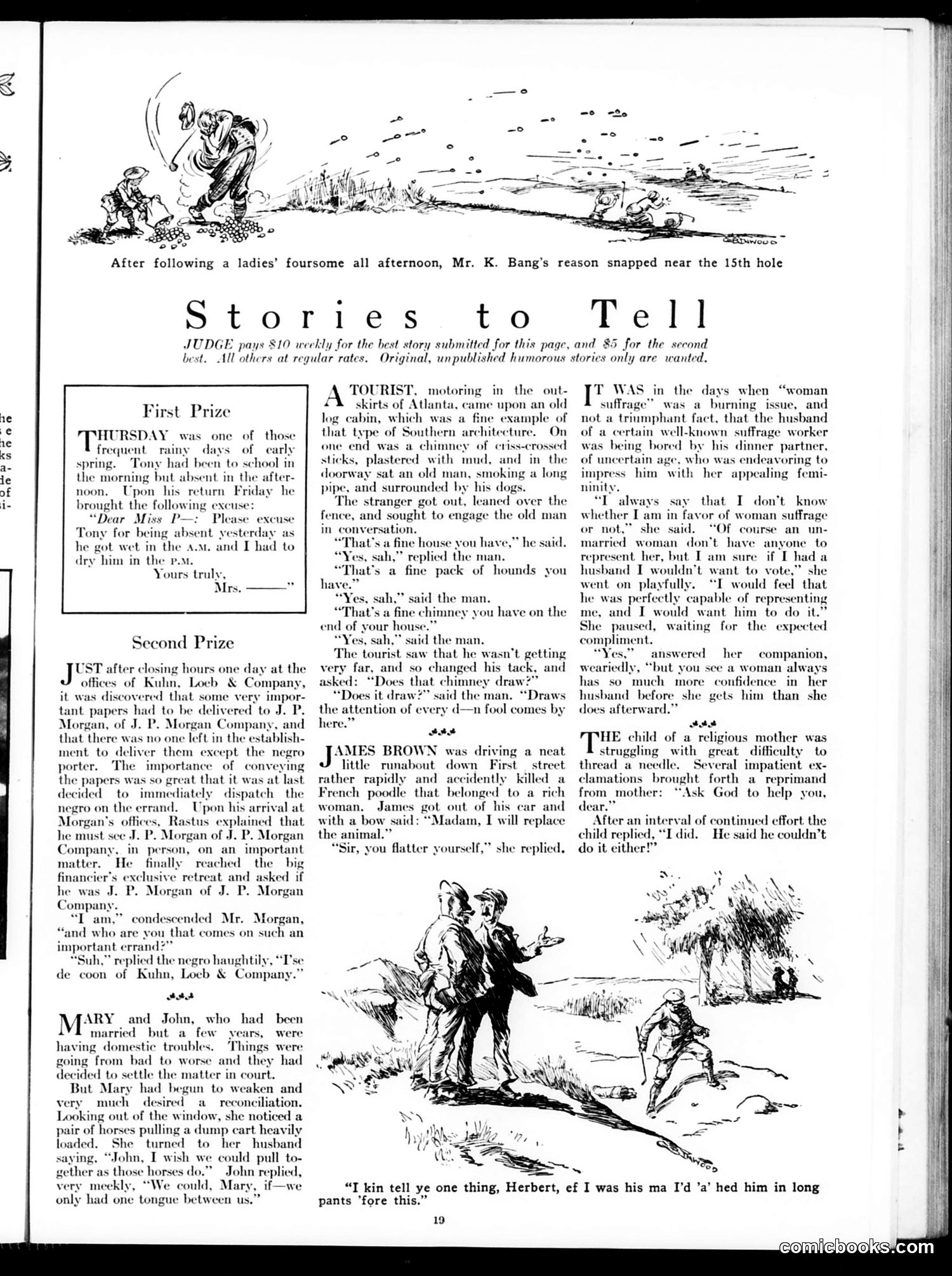
This page from Judge magazine features humorous short stories competing for prizes ($10 for first place, $5 for second). The content reflects early 20th-century American attitudes: **Key Stories:** - A school excuse note with risqué abbreviations ("a.a." and "p.m.") suggesting bathroom/toilet humor - A racial stereotype story: a Black porter from Kuhn, Loeb & Company proudly identifies himself as "de coon" to J.P. Morgan, playing on racist language and the assumption of servility - A marital dispute resolved through a pun about "one tongue between us" - A suffrage-era story where a woman argues against her own voting rights, preferring male representation **The Satire:** The page satirizes contemporary social issues—marital discord, racial hierarchies in business, and opposition to women's suffrage—through crude humor. The racism is particularly stark by modern standards, relying on dialect comedy and demeaning caricature. The suffrage story mocks anti-suffrage arguments through an ironically self-defeating female character.
📄 Transcribed text from this page (OCR, searchable)
Machine-transcribed from the original scan — historical spelling and the odd misread are preserved.
Stories to wooo After following a ladies’ foursome all afternoon, Mr. K. Bang’s reason snapped near the 15th hole Tell JUDGE pays $10 weekly for the best story submitted for this page, and $5 for the second best. AU others at regular rates. Original, unpublished humorous stories only are wanted. First Prize HURSDAY was one of those frequent rainy days of early spring. Tony had been to school in the morning but absent in the after- noon. Upon his return Friday he brought the following excuse “Dear Miss P—: Please excuse Tony for being absent yesterday as he got wet in the a.a. and I had to dry him in the p.m. Yours truly, Mrs. Second Prize just after closing hours one day at the offices of Kuhn, Loeb & Company, it was discovered that some very impor- tant papers had to be delivered to J. P. Morgan, of J. P. Morgan Company, and that there was no one left in the establish- ment to deliver them exc porter. The imports the papers was so gre decided to. immediately disp: negro on the errand. Upon his arrival at Morgan’s offices, Rastus explained that he must see J. P. Morgan of J. P. Morgan Company, in person, on an important matter. He fi reached the big financier’s exclusive retreat and asked if he was J. P. Morgan of J. P. Morgan Company. “I am,” condescended Mr. Morgan, “and who are you that comes on such an i rtant errand?” uh,” replied the negro haughtily, “ de coon of Kuhn, Locb & Company. wae had rs, ings v and they had ter in court. ARY and John, who married but a few having domestic trouble: going from bad to wors decided to settle the 1 But Mary had begun to weaken and very much desired a reconciliation. Looking out of the window, she noticed a pair of horses pulling a dump cart he loaded. She turned to her husband saying, “John, I wish we Id pull to- gether as those horses do.” John replied, - meekly, “We could, Mary, i had one tongue between us.” TOURIST, motoring in the out- irts of Atlanta, came upon an old log cabin, which was a fine example of that type of Southern architecture. On © end was a chimney of criss-crossec sticks, plastered with mud, and in the doorw: t an old man, smoking a long pipe, and surrounded by his dogs. The stranger got out, leaned over the fence, and sought to engage the old man in conversation t's a fine house you ha ah,” replied the man. a fine pack of hounds you i he said. have.” an. y you have on the end of your hi “Yes, sah,” said the man. ‘The tourist saw that he wasn’t getting very far, and so changed tack, and asked: “Does that chimney draw? “Does it draw aid the man. “Draws the attention of every d—n fool comes by here.” Rory AMES BROWN was driving a neat little runabout down First street rather rapidly and accidently killed a French poodle that belonged to a rich woman, James got out of his car and with a bow said: “Madam, I will replace the animal.” “Sir, you flatter yourself,” she replied. T WAS in the days when “woman suffrage” was a burning issue, and not a triumphant fact, that the husband of a certain well-known suffrage worker was being bored by his dinner partner, of uncertain age, who was endeavoring to impress him with her appealing femi- ninity. “I alway that I don’t know whether Iam in favor of woman suffrage or not.” she said. “Of course an un- married woman don’t have anyone to represent her, but I am sure if I had a husband I wouldn't want to vote,” she went on playfully. “I would feel that he was perfectly capable of representing me, and I would want him to do it.” She paused, waiting for the expected compliment. “Yes,” answered her — companion, weariedly, “but you see a woman always has so much more confidence in her husband before she gets him than she does afterward.” 2 HE child of a religious mother was struggling with great difficulty to thread a needle. Several impatient ex- clamations brought forth a reprimand from mother: “Ask God to help you, terval of continued effort the child replied, “I did. He said he couldn’t do it either! Se “I kin tell ye one thing, Herbert, ef I was his ma I’d ’a’ hed him in long pants "fore this.” 19