
Judge, 1922-10-07 · page 20 of 36
Judge — October 7, 1922 — page 20: what you’re looking at
What you’re looking at
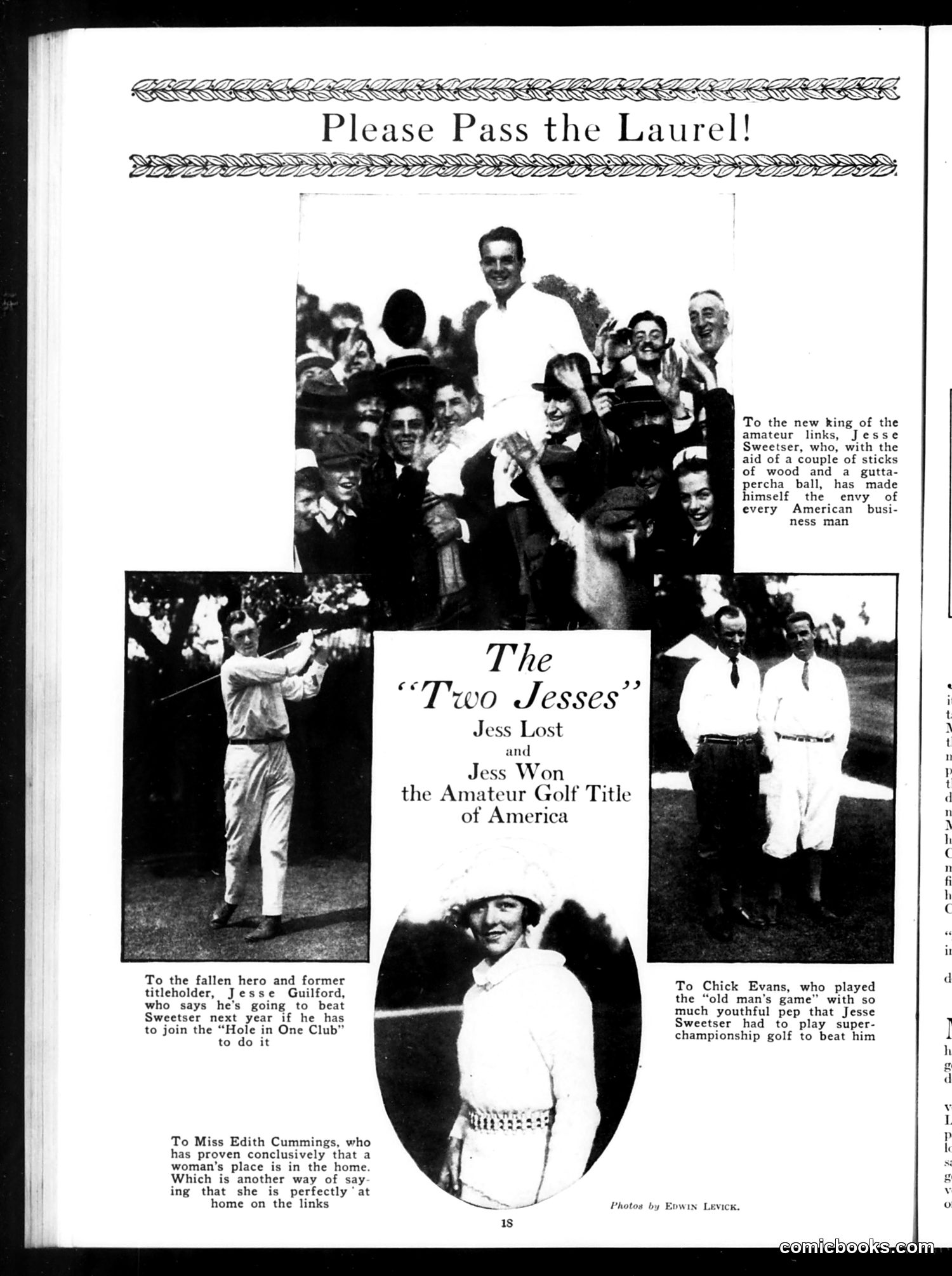
This page celebrates Jesse Sweetser's victory in the 1923 U.S. Amateur Golf Championship. The "Two Jesses" refers to Sweetser (winner) versus Jesse Guilford (former champion). The satire mocks American businessmen's obsession with golf—Sweetser has become "the envy of every American business man" simply by hitting a ball with sticks. The tributes are tongue-in-cheek: Guilford is portrayed as a "fallen hero," while Chick Evans is noted as needing youth to compete with Sweetser's superior skill. The final jab targets women's golf: Edith Cummings' excellence is sarcastically presented as "proof" that women belong at home—the implication being that if women excel at golf (traditionally a male domain), they're clearly "at home" doing it, thus reinforcing rather than challenging domestic stereotypes. This reveals era-typical sexism in amateur sports coverage.
📄 Transcribed text from this page (OCR, searchable)
Machine-transcribed from the original scan — historical spelling and the odd misread are preserved.
To the new king of the amateur links, Jesse Sweetser, who, with the aid of a couple of sticks of wood and a gutta- percha ball, has made himself the envy of every American busi- ness man The “Two Jesses” Jess Lost and Jess Won the Amateur Golf Title ot America € To the fallen hero and former = To Chick E ee titleholder, Jesse Guilford, the “old foie same withes who says he’s going to beat much youthful pep that Jesse Sweetser next year if he has Sweetser had to play super- to join the wale in One Club championship golf to beat him To Miss Edith Cummings, who has proven conclusively that a woman’s place is in the home Which is another way of say ing that she is perfectly ‘at , j home on the links ~— Photos by Epwin Levick.