
Judge, 1922-10-07 · page 15 of 36
Judge — October 7, 1922 — page 15: what you’re looking at
What you’re looking at
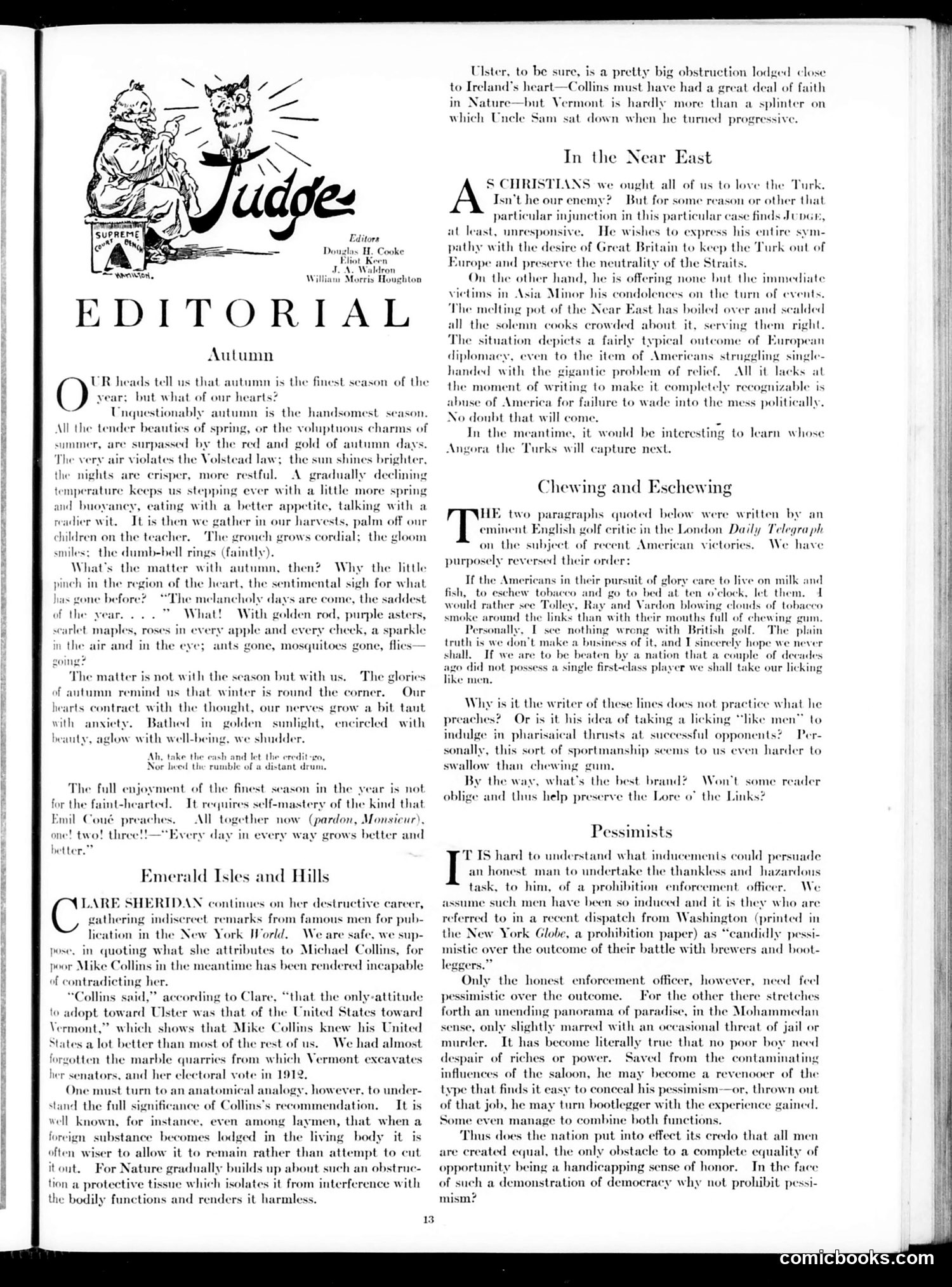
The cartoon at the top depicts **Judge himself** (the magazine's mascot—an elderly judicial figure) conversing with an owl, likely satirizing foolish or shortsighted commentary. The owl traditionally symbolizes wisdom, making the juxtaposition ironic. The editorials address contemporary 1920s issues: **"Emerald Isles and Hills"** discusses **Clare Sheridan**, a real journalist who published indiscreet remarks from famous figures in the New York World. The piece criticizes her for quoting **Michael Collins** (Irish revolutionary leader, recently deceased by 1922) without fear of contradiction. The Ulster analogy compares Ireland's political division to America's Vermont—suggesting Collins naively believed the U.S. handled its internal conflicts wisely. **"In the Near East"** tackles post-WWI geopolitics, criticizing both Christian hypocrisy toward Turkey and European diplomatic bungling in the collapsing Ottoman sphere. It mocks the failed interventionism of European powers ("solemn cooks"). **"Pessimists"** and **"Chewing and Eschewing"** critique American Prohibition enforcement and changing social mores respectively. The page showcases Judge's satirical treatment of contemporary politics, journalism ethics, and international affairs circa 1920-1922.
📄 Transcribed text from this page (OCR, searchable)
Machine-transcribed from the original scan — historical spelling and the odd misread are preserved.
i E ; n JOA. Waldron William Morris Houghton EDITORIAL Autumn ads tell us that autumn is the finest season of the but what of our hearts? Unquestionably autumn is the handsomest season. All the tender beauties of spring, or the voluptuous charms of summer, are surpassed by the red and gold of autumn days. The very air violates the Volstead law; the sun shines brighter, the nights are crisper, more restful. A’ gradually declining temperature keeps us stepping ever with a little more spring and buoyaney, eating with a better appetite, talking with a ther in our harvests, palm off our readier wit. It is then we ¢ children on the teacher. ‘The smiles: the dumb-bell rings (faintly). What's the matter with autumn, then? Why. the little pinch in the region of the heart, the sentimental sigh for what } “before? “The melancholy days are come, the saddest of the year... 27 Wh scarlet n wich grows cordial; the gloom n the ir and in the ey The matter is not with the season but with us. The glories of autumn remind us that winter is round the corner. Our hearts contract with the thought, our nerves grow a bit taut with any) Bathed in golden’ sunlight, encircled with beauty, aglow with well-being, we shudder, Ah, take the eash and let the eredit Nor In rumble of a distant ¢ The full enjoyment of the finest season in the year is not int-hearted. It requires self-mastery of the kind that her now (pardon, Monsieur). y way grows better and for the Emil Coué pre: one! two! three better.” Emerald Isles and Hills LARE SHERIDAN continues on her destructive career, C athering indiscreet remarks from famous men for pub- lication in the New York World. We are safe, we sup- pose. in quoting what she attributes to Michael Collins, for poor Mike € “ollins i in the meantime has been rendered incapable of contradicting her. “Collins according to Clare, “that the only-attitude to adopt toward Ulster was that of the United States toward Vermont,” which shows that Mike Collins knew his United States a lot better than most of the rest of us. We had almost nont excavates forgotten the marble quarries from which Ve her senators, and her electoral vote in 1912. One must turn to an anatomi lo; stand the full significance of Collins's rec well known, for inst foreign substance becomes kk often wiser to allow it to remain rather than attempt to cut itout. For Nature gradually builds up about such an obstruc- tion a protective tissue which isolates it from interference with the bodily functions and renders it harmless. . however, to under- mmendatior It is » that when a sd in the living body it is even amo Ulster, to be sure, is a pretty big obstruction lodged close to Ireland's heart—Collins must have had a great deal of faith in Nature—but Vermont is hardly more than a splinter on which Uncle Sam sat down when he turned progressive. In the Near East S CHRISTIANS we ought all of us to love the Turk. Isn't he our enemy? But for some reason or other that particular injunction in this particular case finds Jepcr, at pathy with the desire of G Europe and preserve the neutrali On the other hand, he is Vietims in Asia Minor his condolences on the turn of events. The melting pot of the Near East has boiled over and sealded all the solemn cooks crowded about it, serving them right. The situation depicts a fairly typical outcome of European ‘ast, unresponsive. He wishes to express his entire sym- sat Britain to keep the Turk out of of the Straits. ring none but the immer even to the item of Americans struggling. single- ntie problem of relief. AIL it 1 to make it completely re diplomacy handed with the gig: the moment of writi abuse of America for failure to wade into the mess politics No doubt that will come, . In the meantime, it would be interesting to learn whose Angora the Turks will capture next. Chewing and Eschewing HE two paragraphs quoted below were written by an minent English golf eritic in the London Daily Telegraph on the subject of recent: American victories. We have purposely reversed their order: If the Americans in their pursuit of glory care to live on milk and fish, to eschew tobac at ten o'clock, let them. 1 would rather see Tolley ardon blowing clouds of t smoke n with their mouths full of chewing gum. ly. [ sce nothing wrong with British golf. The truth is we don’t make a business of it, and I sincerely hope we n shall. If we are to be beaten by a nation that mple of di did not possess a si first-class player we shall take our like men. 1 go to b Why is it the write: preaches? Or is it his idea of taking a licking “like me indulge in pha sonally, this sort of sportmanship seems to us even harder to of these lines does not practice wha I thrusts at successful opponents? Per- swallow than chewing gum. y the way, what's th and Uhus help preserve the Lore 0” the Links? best brand? Won't some reader Pessimists TIS hard to understand what inducements could persuade I n honest: man to undertake the thankless and hazardous task, to him, of a prohibition enforcement. officer. We assume such men have been so induced and it is they who are referred to in a recent dispatch from Washington (printed in » New York Globe, a prohibition paper) as “candidly pessi- tic over the outcome of their battle with brewers and boot- leggers.” Only the honest enforcement. officer, however, need feel other there stretches pessimistic over the outcome. For th forth an unending panorama of paradise, in the Mohammedan sense, only slightly marred with an occasional threat of jail or It has become literally true that no poor boy need mg despair of riches or power. Saved from the contamin: influenc become a revenooer of the of the saloon, he m finds it easy to conceal his pessimism—or, thrown out of that job, he may turn hootlegger with the experience gained. Some even manage to combine both functions. ‘Thus does the nation put into effect its credo that all men are created equal, the only obstacle to a complete equality of opportunity being a handicapping sense of honor. In the face of such a demonstration of democracy why not prohibit pessi- mism?