
Judge, 1922-10-07 · page 17 of 36
Judge — October 7, 1922 — page 17: what you’re looking at
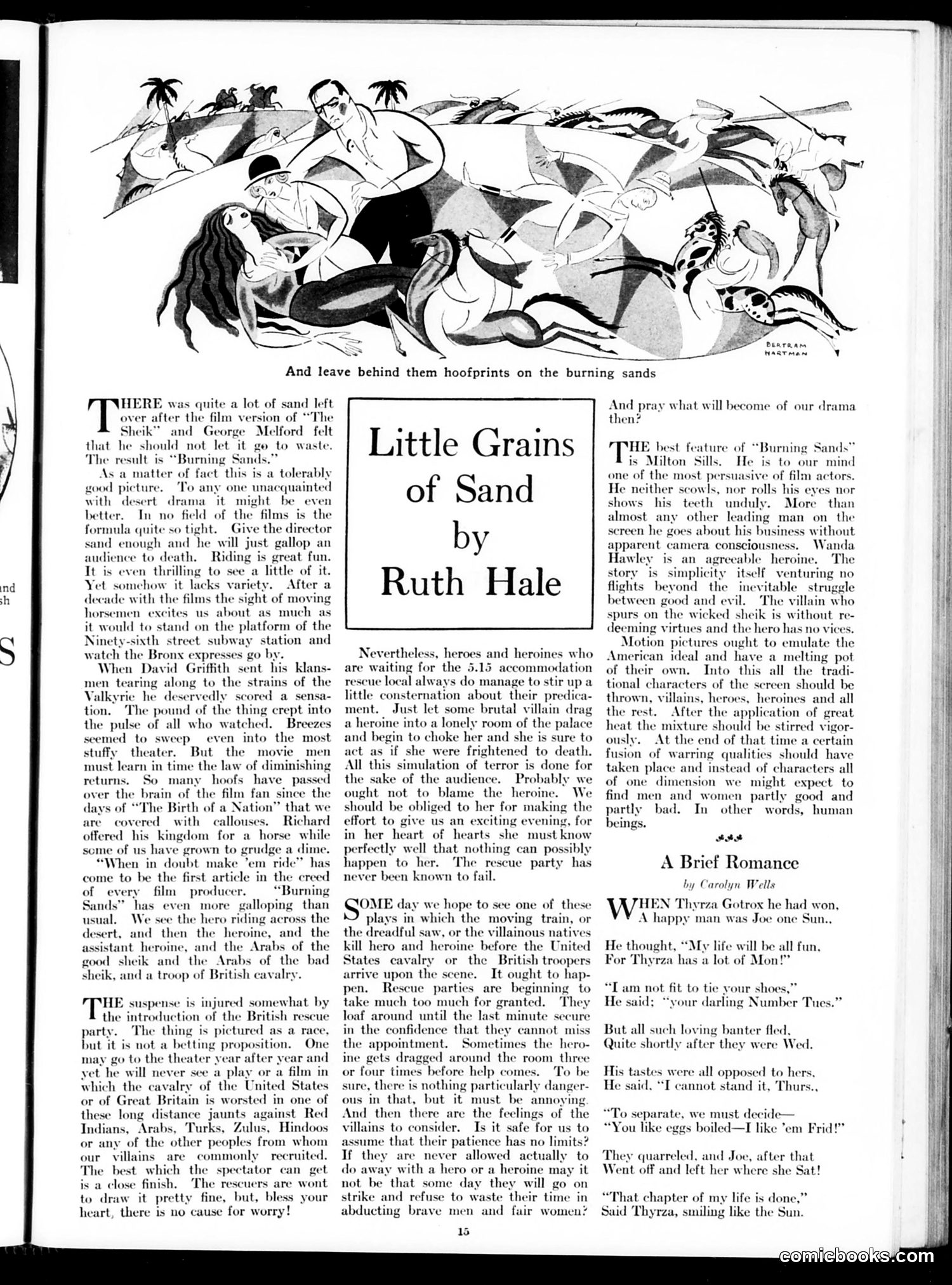
What you’re looking at
This page contains a film review by Ruth Hale critiquing the 1922 movie "Burning Sands," directed by George Melford. The accompanying cartoon illustrates the review's central complaint: that desert action films have become formulaic and repetitive. **The Satire:** Hale argues that filmmakers, following the success of D.W. Griffith's "Birth of a Nation" and the original "Sheik," have exhausted audiences by endlessly repeating the same scenes—heroes riding across deserts, heroines being dragged and threatened, and last-minute cavalry rescues. She notes that this "law of diminishing returns" means audiences have become desensitized to such spectacles. **The Cartoon's Point:** The illustration shows multiple identical scenes of desert horsemen, barely varying poses, emphasizing how interchangeable and tiresome these sequences have become across multiple films. Hale even proposes a satirical solution: what if the villain *actually succeeded* for once? The critique reflects early 1920s concerns about film industry standardization and audience fatigue.
📄 Transcribed text from this page (OCR, searchable)
Machine-transcribed from the original scan — historical spelling and the odd misread are preserved.
HERE was quite a lot of sand | over after the film version of “The Sheik” and George Melford felt that he should not let it oO waste. The result is “Burning Sands. As a matter of fact this is a tolerably good picture. To any one unacquainted with desert drama it might be even better. In no field of the films is the formula quite so tight. Give the director sand enough and he will just gallop an audience to death. Riding is great fun. It is even thrilling to see a little of it. Yet somehow it lacks variety. After a decade with the films the sight of moving horsemen excites us about as much as it would to stand on the platform of the Ninety-sixth street subway station and watch the Bronx expresses go by. When David ffith sent his klans- men tearing along to the strains of the Valkyrie he deservedly scored a sensa- tion. ‘The pound of the thing crept into the pulse of all who watched. Breezes seemed to sweep even into the most stuffy theater. But the movie men must learn in time the law of diminishing returns, So many hoofs have passed over the brain of the film fan since the days of “The Birth of a > are covered with — callouses. offered his kingdom for a horse while some of us have grown to grudge a dime, “When in doubt make ’em ride” has come to be the first article in the creed of every film produc Sands” has even more usual. We see the hero riding ac desert, and then the heroin M assistant heroine, and the Arabs of the good sheik and the Arabs of the bad sheik, and a troop of British cavalry. HE suspense is injured somewhat by the introduction of the British rescue thing is pictured as a race, a betting proposit me ar after year and play or a film in ulry of the United States re 1 is worsted in one of these long distar aunts against Red Indians, Arabs, Turks, Zulus, Hindoos or any of the other peoples from whom our villains are commonly recruited. The best which the spectator can get is a close finish, The rescuers are wont to draw it pretty fine, but, bless your heart, there is no cause for worry! Little Grains of Sand by Ruth Hale ertheless, heroes and heroines who ng for the 5.15 accommodation re: always do manage to stir up a little consternation about their predi ment. Just let some brutal villain drag a heroine into a lonely room of the palace and begin to choke her and she is sure to act as if she were frightened to death. All this simulation of terror is done for the sak udie Probably we ought not to blame the heroi We should be obliged to her for making the effort to give us an exciting evening, for in her heart of hearts she must know perfectly well that nothing can possibly happen to her. The rescue party never been known to fail. OME day we hope to see one of these plays in which the moving train, or the dreadful saw, or the villainous natives kill hero and heroine before the United States cavalry or the British troopers arrive upon the se It ought to hap- pen. Rescue parties are beginning to ke much too much for granted. They loaf around until the last minute secure in the confidence that they cannot miss the appointment. Sometimes the hero- ine gets dragged around the room three or four times before help comes. To be sure, there is nothing particul danger- ous in that, but must be annoying And then there are the feelings of the villains to consider. Is it safe for us to assume that their patience has no limits? If they are never allowed do away with a hero or a heroine not be that some day they will go on strike and refuse to waste their time in abducting brave men and fair women? 1b And pray what will become of our drama then? HE best feature of “Burning Sands” is Milton Sills. He is to our mind one of the most persuasive of film actors. He neither scowls, nor rolls his eyes nor shows his teeth unduly. More than almost any other leading man on_ the screen he goes about his business without apparent camera consciousness. Wanda Hawley is an agreeable heroine. The story ‘is simplicity. itself venturing no flights beyond the inevitable. struggle between good and evil. The villain who spurs on the wicked sheik is without re- deeming virtues and the hero has no vices. Motion pictures ought to emulate the American ideal and have a melting pot of their own. Into this all the tradi- tional characters of the screen should be thrown, villains, heroes, heroines and all the rest. After the application of great heat the mixture should be stirred vigor- ously. At the end of that time a certain fusion of warring qualities should have taken place and instead of characters all of one dimension we might expect. to find men and women partly good and bad. In other words, human se A Brief Romance by Carolyn Wells HEN Thyrza Gotrox he had won, A happy man was Joe one Sun., He thought, “My life will be all fun, For Thyrza has a lot of Mon!" “Tam not fit to tie your shoes,” He said; “your darling Number Tues.” But all such loving banter fled, Quite shortly after they were Wed. His tastes were all opposed to hers, He said. “I cannot stand it, Thurs., “To separate, we must decide— “You like eggs boiled—I like em Frid!” They quarreled, and Joe, after that Went off and left her where she Sat! “That chapter of my life is done,” Said Thyrza, smiling like the Sun.