
Judge, 1922-10-07 · page 9 of 36
Judge — October 7, 1922 — page 9: what you’re looking at
What you’re looking at
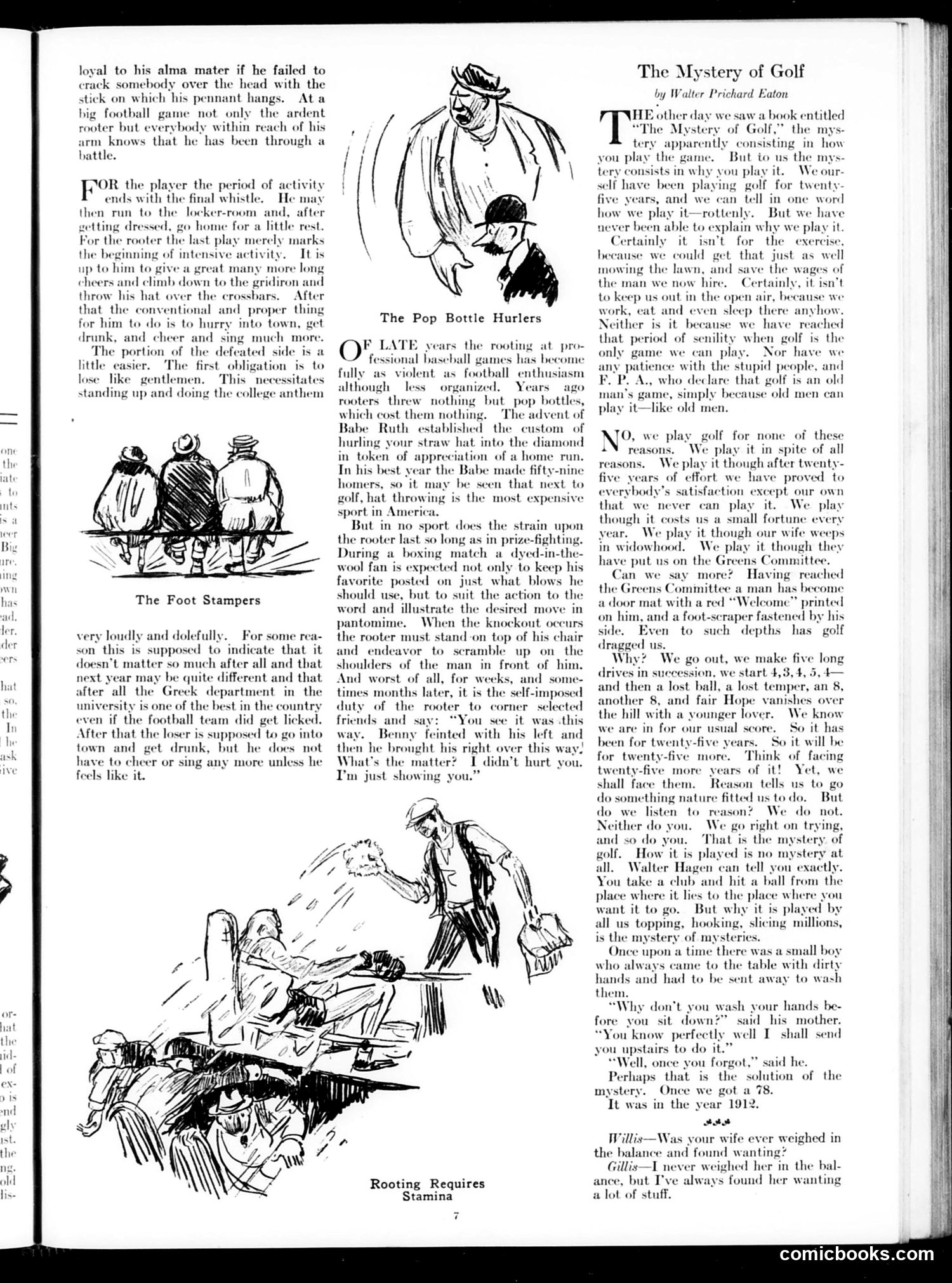
This page contains satirical commentary on American sports culture, specifically targeting enthusiastic sports fans ("rooters"). The three illustrations mock different fan behaviors: **"The Pop Bottle Hurlers"** and **"The Foot Stampers"** depict baseball fans whose excessive enthusiasm—throwing bottles and stamping feet—is presented as absurd overreaction. The text notes that fan behavior escalated when Babe Ruth inspired fans to throw straw hats into the diamond after home runs, making baseball rooting financially expensive. **"Rooting Requires Stamina"** shows boxing fans physically reenacting punches, standing on chairs, and later boring friends with detailed play-by-play pantomimes for weeks afterward. The main essay, **"The Mystery of Golf"** by Walter Pritchard Eaton, shifts tone to philosophical satire. Eaton admits playing golf poorly for twenty-five years while unable to explain *why* he plays—not for exercise, fresh air, or patience with "stupid people." The joke: golf's true appeal remains inexplicably irrational, despite its obvious futility. Together, these pieces mock American sports obsession as illogical mass behavior.
📄 Transcribed text from this page (OCR, searchable)
Machine-transcribed from the original scan — historical spelling and the odd misread are preserved.
loyal to his alma mater if he failed to crack somebody over the head with the stick on which his pennant hangs. Ata hig football game not only the ardent rooter but everybody within reach of his arm knows that he has been through a battle. TOR the player the period of « ends with the final whistle. He then run to the locker-room and, after getting dressed, go home for a little rest. For the rooter the last play merely marks the beginning of intensive activity. It is up to him to give a great many more long cheers and climb down to the gridiron and throw his hat over the crossbars. After that the conventional and proper thing for him to do is to hurry into town, get drunk, and cheer and sing much more. The portion of the defeated side is a little easier. The first obligation is to lose like gentlemen. This 1 standing up and doing the colle tivity The Foot Stampers very loudly and dolefully. For some son this is supposed to indicate that it doesn’t matter so much after all and that next year may be quite different and that after all the Greek departme nt in the university is one of the best in the country even if the football team did get licked. After that the loser is supposed to go into town and get drunk, but he does not have to cheer or sing any more unless he feels like it. LATE y has us violent less ars the rooting at pro- vall games has become as football enthusiasm organized, Years ago nothing but pop bottles, h cost them nothing. The advent of Babe Ruth established the custom of hurling your straw hat into the diamond in token of appreciation of a home run. In his best year the Babe made fifty-nine homers, so it may be seen that next to golf, hat throwing is the most expensive sport in America. But in no sport does the strain upon the rooter last so long as in prize-fighting. During a boxing match a dyed-in-the- wool fan is expected not only to keep his favorite posted on just what blows he should use, but to suit the action to the word and illustrate the desired move in pantomime. When the knockout occurs the rooter must stand-on top of his chair and endeavor to scramble up on the shoulders of the man in front of him. And worst of all, for weeks, and some- times months later, it is the self-imposed duty of the rooter to corner selected friends and sa » it was this way. Benny feinted with his left and then he brought his right over this wa What's the matte I didn’t hurt you. Tm just showin ‘a Rooting Requires Stamina The Mystery of Golf by Walter Prichard Eaton HE othe rday we saw a book entitled [* » Myst f,” the mys- tery apparently consisting in how you play the game. | But io us the mys- tery consists in why you play it. We our- self have been playing golf for twenty five rs, and we can tell in one word how we play it—rottenly. But we have never been able to explain why we play it. Certainly it isn’t for the exercise, because we could get that just as well mowing the lawn, and save the wages of the man we now hire. Ce ", it isn’t to keep us out in the open ai work, eat and even sleep the Neither is it because we have that period of senility when golf is the only game we can play. r have any patience with the stupid people, and F. P. A., who declare that golf is an old man’s game, simply because old men can play it —like old men. ), we play golf for none of these iN yeasons. We play it in spite of all reasons. We play it though after twenty- five years of effort we have proved to everybody's satisfaction except our own that we never can play it. We play though it costs us a small fortune every year. We play it though our wife weeps in widowhood. We play it though they put us on the Greens Committee. Can we say more? Having reached the Greens Committee a man has become a door mat with a red “Welcome” printed on him, and a foot-scraper fastened by his side. en to such depths has golf dragged us. Why? We go out, we make five long drives in succession, we start 4,3, 4, and then a lost ball, a lost temper, an 8, another 8, and fair Hope vanishes over the hill with a younger lover. We know we are in for our usual score. So it has been for twenty-five years. So it will be for twenty-five more. Think of facing » more years of it! Yet, we them. Reason tells us to go do something nature fitted us todo. But do we listen to reason? We do not. Neither do you. We go right on trying, and so do you. That is the mystery. of golf. How it is played is no mystery at all. Walter Hagen can tell you exactly. You take a club and hit a ball from the place where it lies to the place where you want it to go. But why it is played by all us topping, hooking, slicing millions, is the mystery of mysteries. Once upon a time there was a small boy whe ys came to the table with dir hands and had to be sent away to wash thei “m. “Why don’t you wash your hands be- fore you. sit down?” said his’ mother. *You know perfectly well I. shall send you upstairs to do it.” “Well, once you forgot,” said he. Perhaps that is the solution of the myste Once we got a 78. in the year 1912. sot —Was your wife ever weighed in ance and found wanting? ighed her in the bal- ance, lelaave found her wanting a lot of stuff. comicbooks.com