
A complete issue · 36 pages · 1922
Judge — August 12, 1922
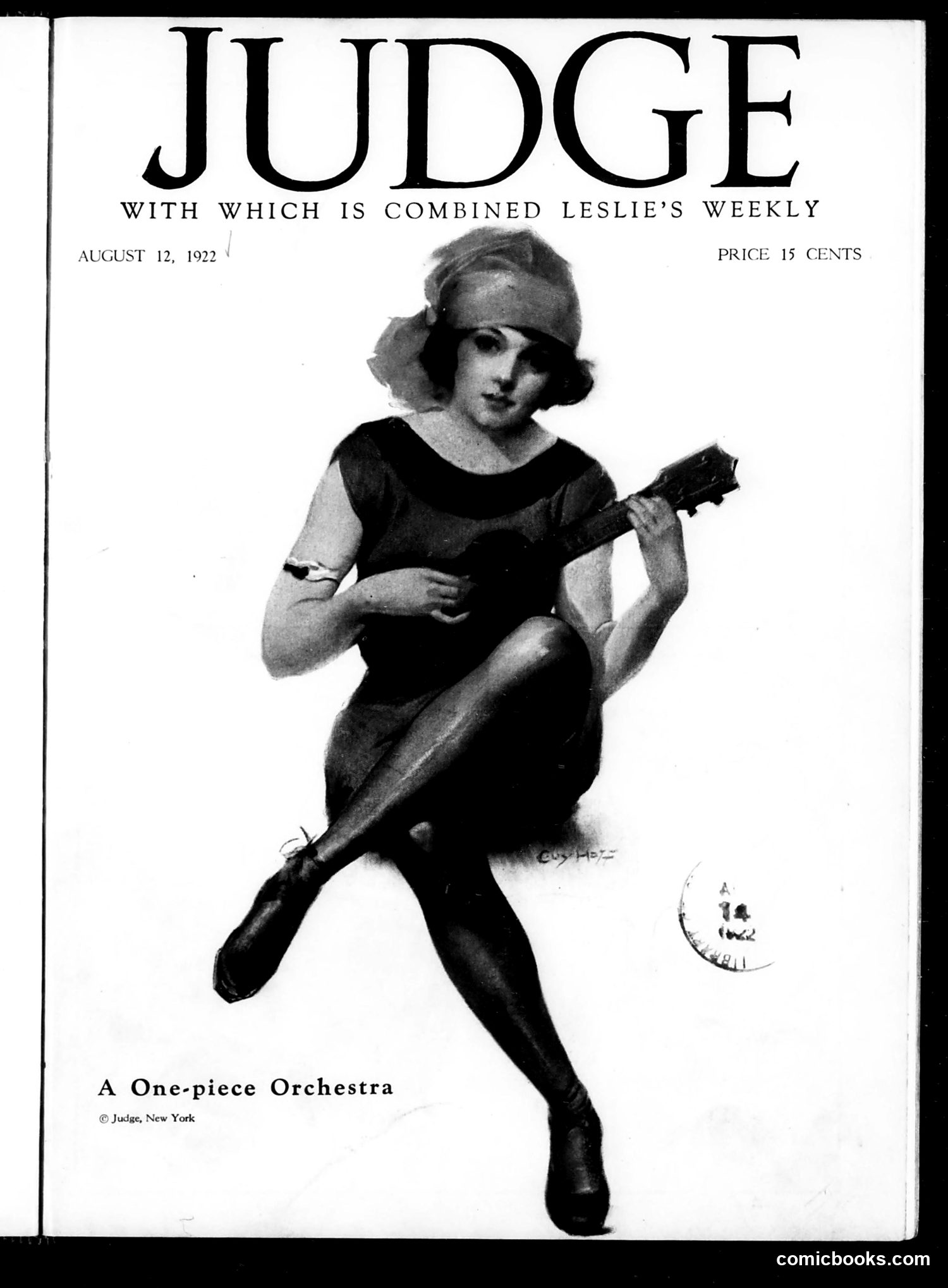
This cover features a woman in a cloche hat and flapper-style dress playing a ukulele while striking a theatrical pose. The caption "A One-Piece Orchestra" is a double entendre: it references both the single-piece bathing suits becoming fashionable in the 1920s and the humorous idea that this one performer constitutes an entire band. The image satirizes the Jazz Age trend of women adopting more casual, modern fashions and entertainments. The ukulele was a popular, accessible instrument among young women during this period. Judge is mocking the modern "flapper" culture—women's newfound social freedoms, shorter hemlines, and participation in previously male-dominated entertainment—through playful visual wit about how one fashionable woman could seemingly replace an entire orchestra.
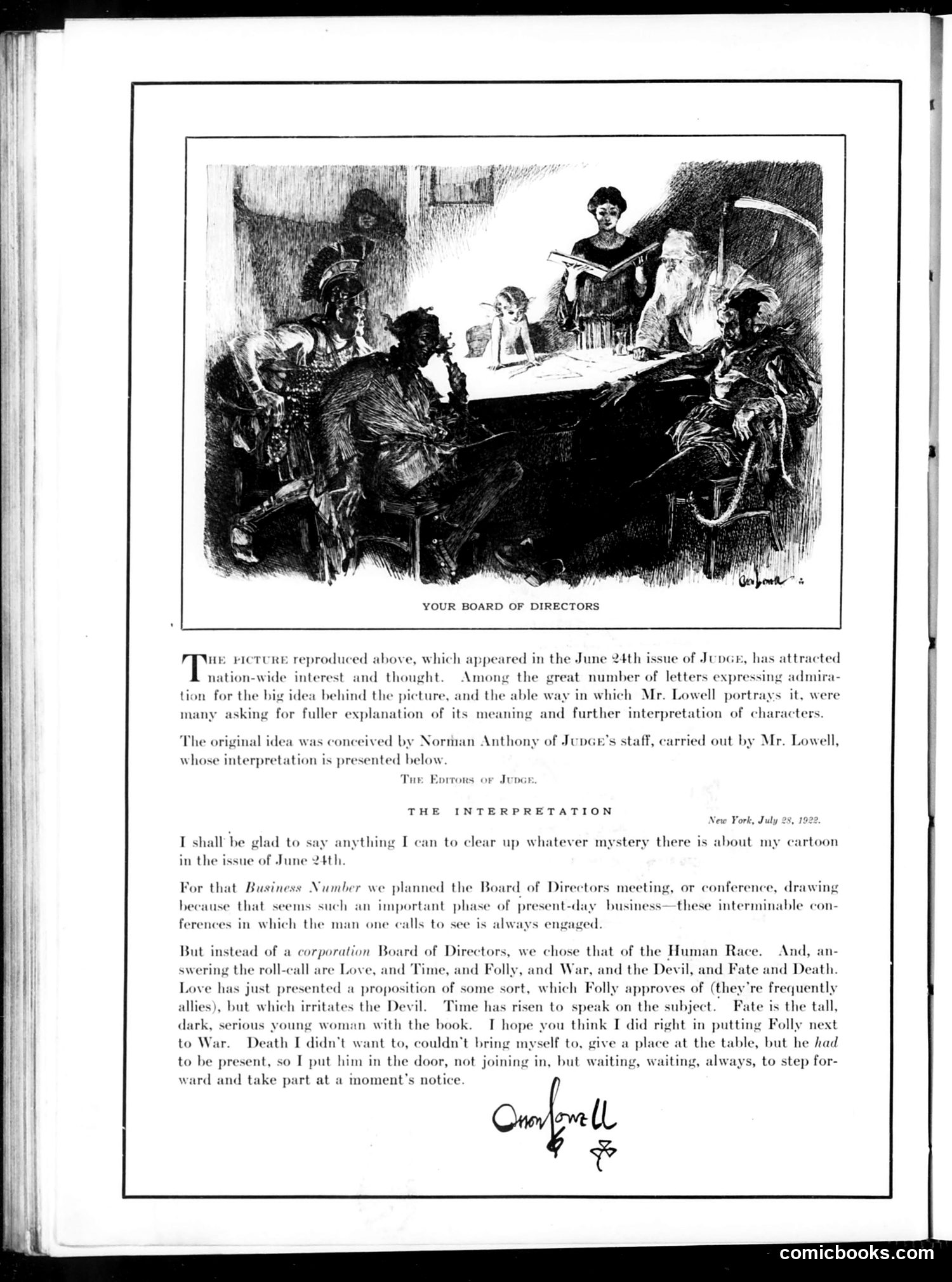
This cartoon satirizes abstract concepts as if they were corporate board members in a business meeting. The artist, Cormac Lowell, explains that instead of depicting an actual corporation's board, he personified human qualities: Love, Time, Money, Polly, War, the Devil, Fate, and Death. The satire works through this clever substitution—treating philosophical and moral forces as if they were mundane business directors in conference. The joke is that these cosmic/moral forces actually control human affairs more than any corporate board does. By rendering them as seated figures around a table, the cartoon suggests that abstract forces, not industrial captains, truly govern society and individual destiny. The piece appeared in Judge's June 24, 1922 issue.
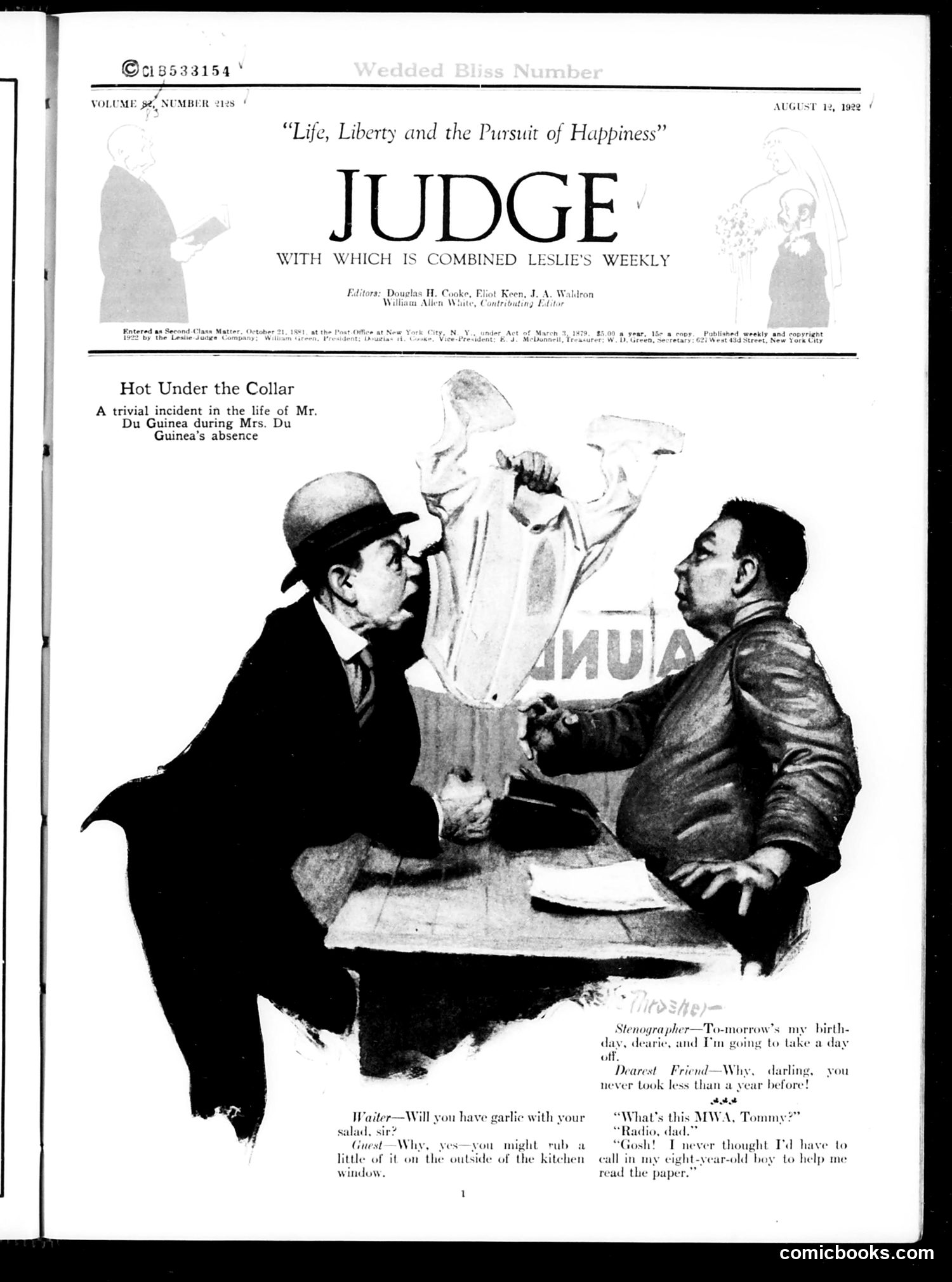
This cartoon depicts a domestic dispute between two men over a woman's housekeeping during her absence. The titled "Hot Under the Collar" refers to Mr. Du Guineau becoming angry while his wife is away. The humor relies on period domestic stereotypes: a waiter suggests adding garlic to the salad, while the stenographer comments that the husband "never looked less than a year before!" The final exchange about a radio broadcast for a child to "read the paper" suggests absurdist modern technology humor. The satire mocks both incompetent husbands managing households and the era's emerging consumer technologies. It reflects 1920s anxieties about gender roles, domestic management, and rapid technological change entering American homes.
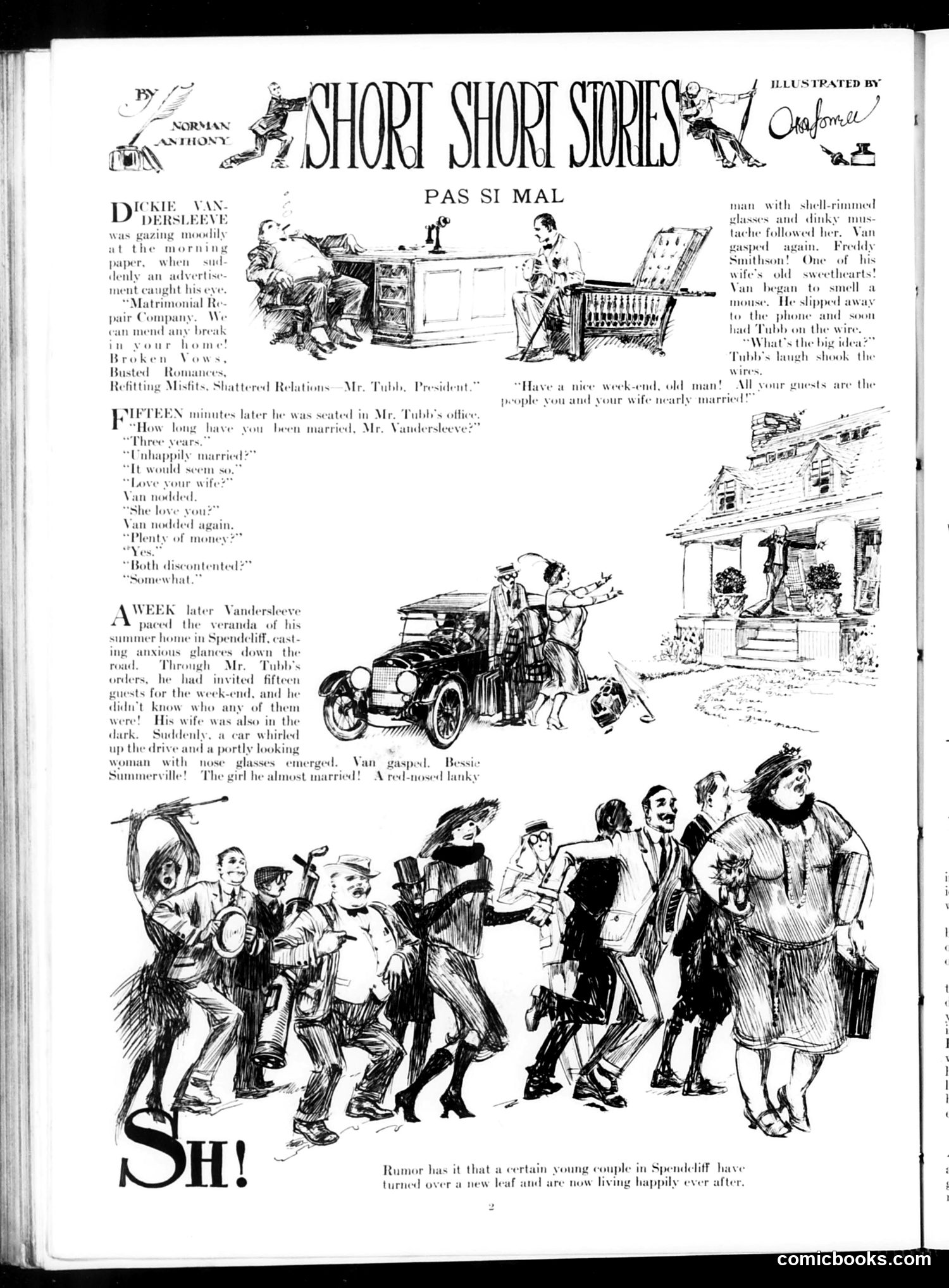
This page presents a humorous narrative about Dickie Van Dersleeve, a man whose marriage troubles prompt him to seek advice from Mr. Tubb, the company president. The story satirizes marriage dynamics of the era. Van Dersleeve complains of unhappiness despite having money and loving his wife. Tubb invites him and his wife to a weekend gathering at his summer home, where Van Dersleeve is shocked to encounter fifteen guests—none of whom he recognizes. The joke culminates when "a red-nosed hanky" (clearly a woman of questionable reputation) emerges from a car, and the narrative ends with "Sh!" The final caption notes the couple has "turned over a new leaf and are now living happily ever after"—implying the introduction of extramarital intrigue paradoxically saved their marriage. The satire mocks both marital dissatisfaction and the loose morality of the period's upper class.
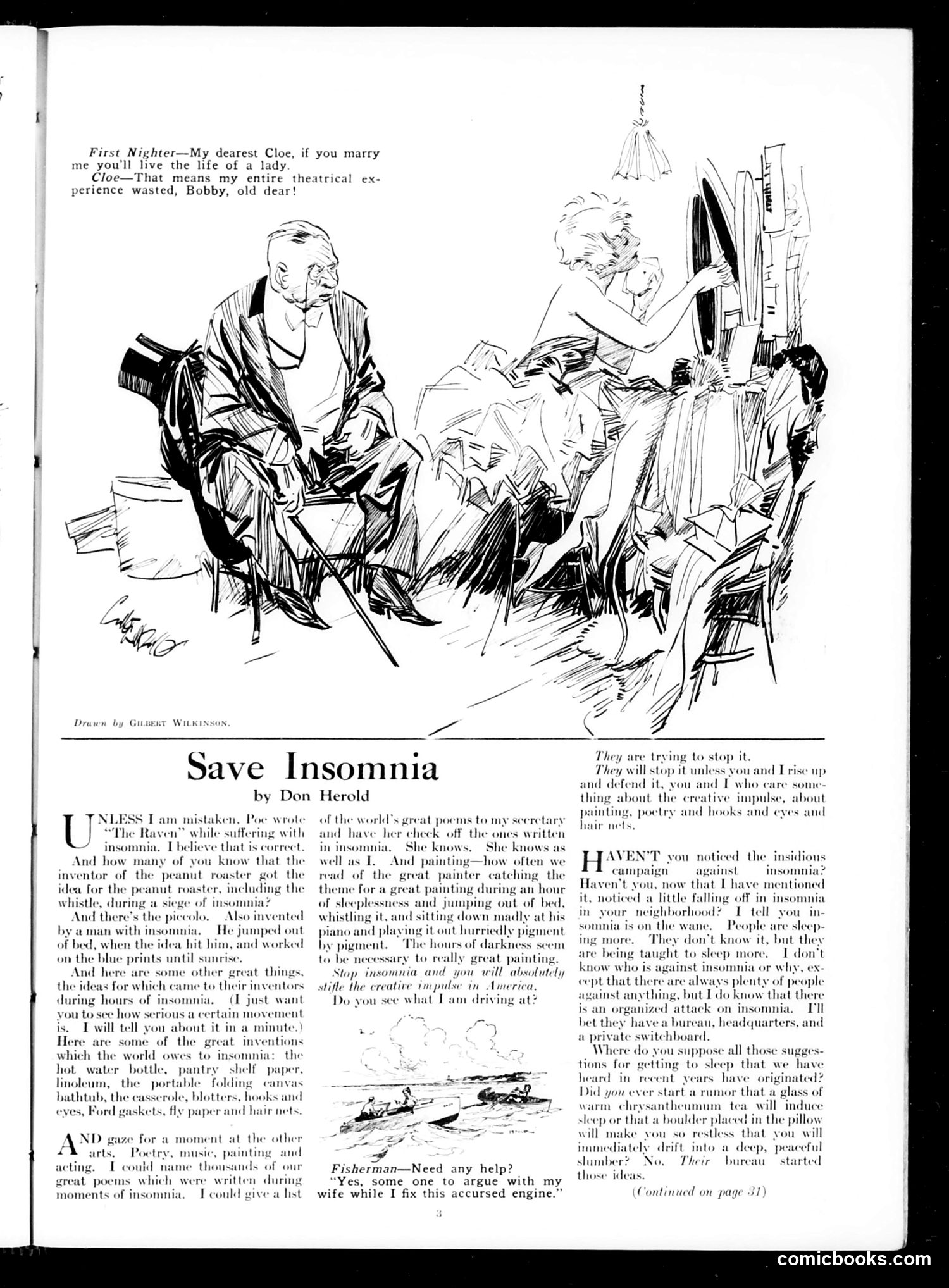
This satirical article critiques the "Stop Insomnia" movement—an apparent public campaign to help people sleep better. Herold argues ironically that insomnia should be *preserved* because sleeplessness enables creative achievement. The cartoon shows a man confronting a woman surrounded by sleep remedies and devices (hot water bottles, pillows, etc.), illustrating the commercial push to eliminate insomnia. Herold's point: society is organizing against insomnia, but this threatens creative impulse. He claims great poets, painters, and musicians produced their best work during sleepless nights. The satire mocks both the era's emerging commercialization of sleep-aids and what he sees as misguided anti-insomnia campaigns that would rob artists of productive restlessness. The article reflects 1920s debates about modernity, commerce, and artistic life.
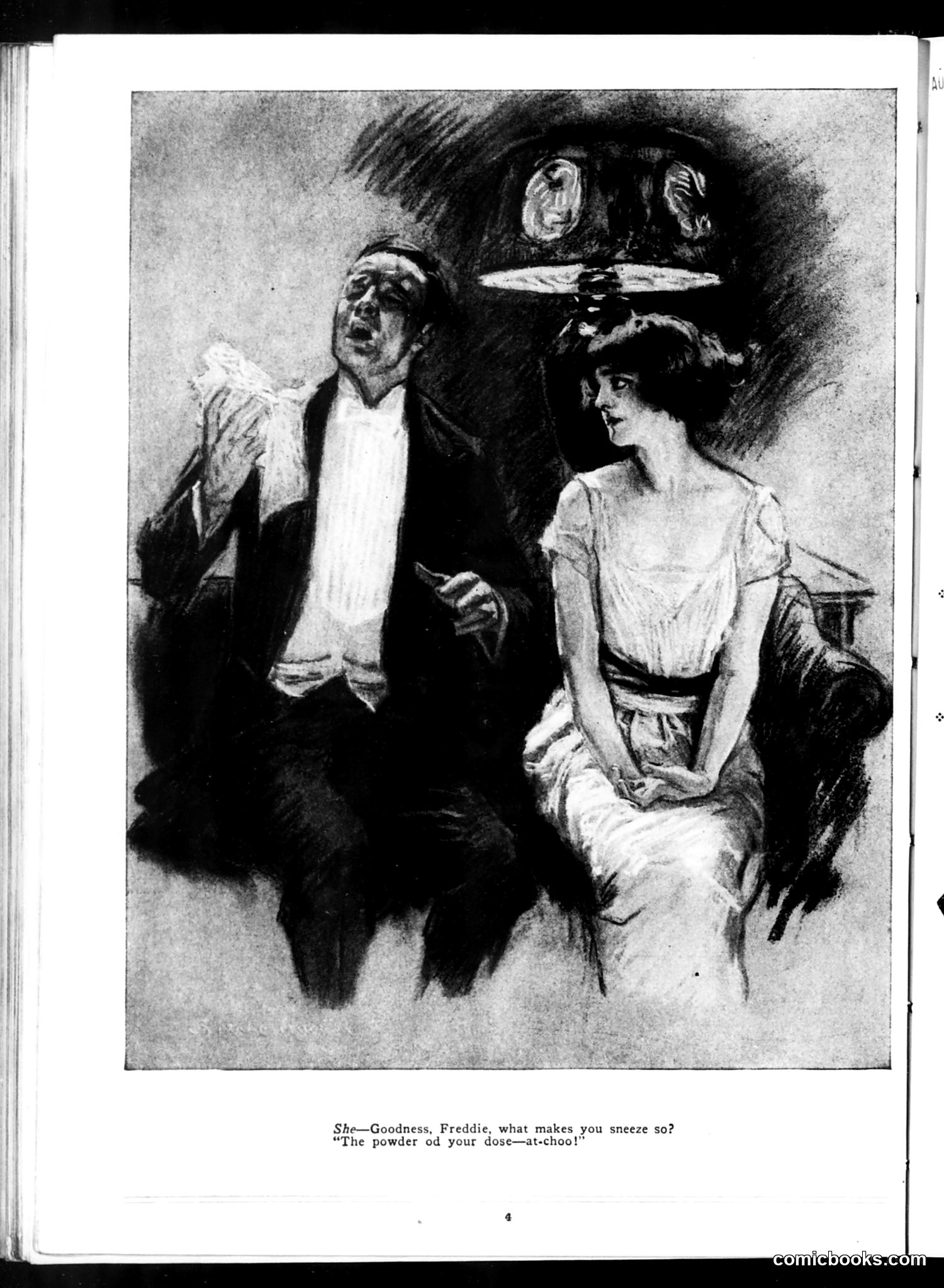
This illustration from *Judge* magazine depicts a domestic scene with social commentary. A man in formal attire (identified as "Freddie" in the caption) is sneezing, while a woman sits nearby. The caption reads: "She—Goodness, Freddie, what makes you sneeze so? 'The powder on your dose—atchoo!'" The joke appears to be a double entendre playing on the word "dose" (likely meant as "nose"). It satirizes the popular use of cosmetic face powder among women of the era, suggesting the woman has applied so much powder that it's causing the man to sneeze. This reflects early 20th-century anxieties about women's cosmetics and beauty practices, mocking both excessive makeup application and the social pretense surrounding feminine appearance.
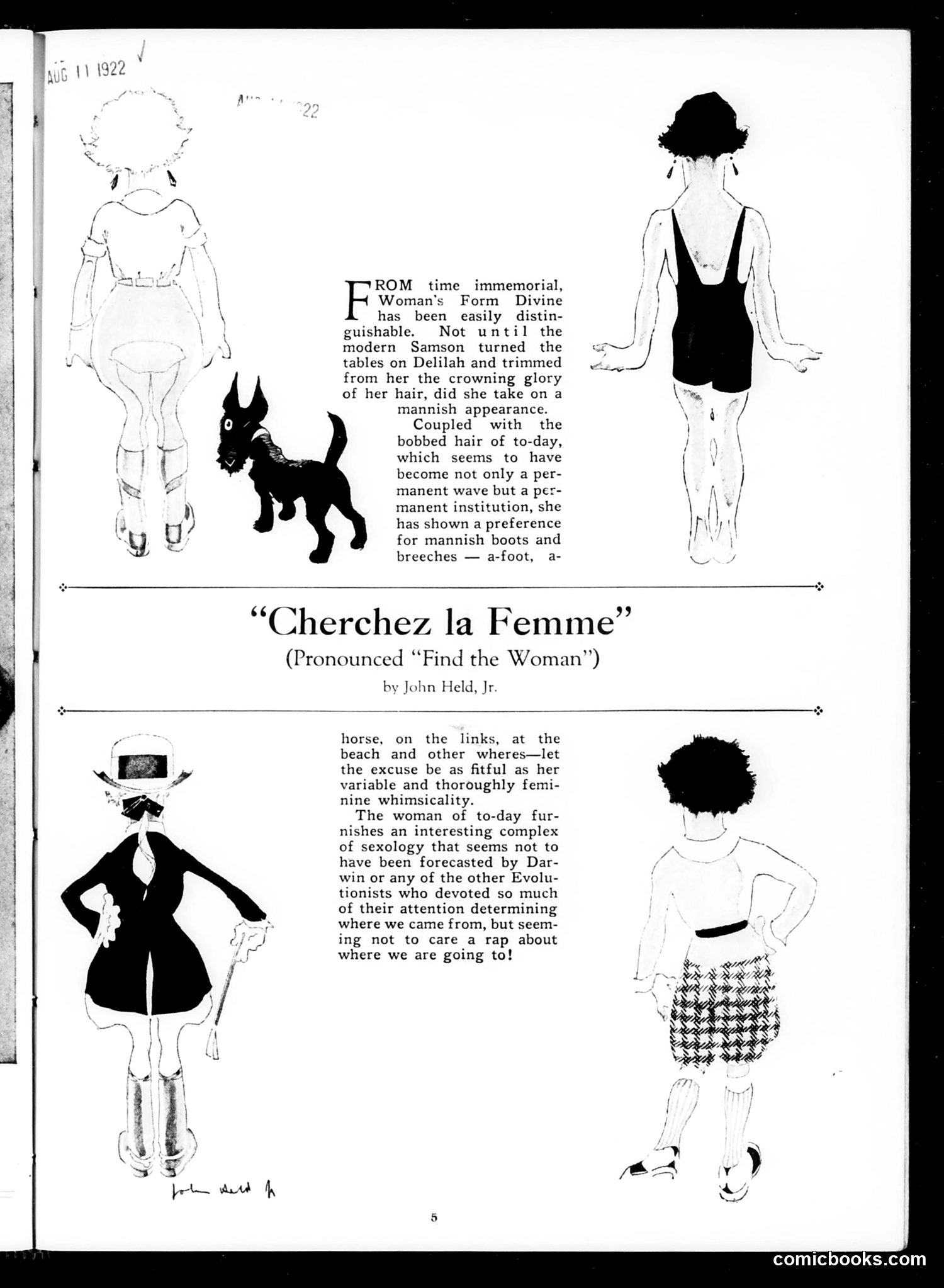
This 1922 satirical article by John Held Jr. mocks the "New Woman" of the Jazz Age—specifically the trend of bobbed hair and masculine fashion choices. The piece uses evolutionary language to ridicule women adopting short hairstyles, boots, and breeches as departures from traditional femininity. The cartoon pairs four illustrated female figures showing different degrees of "mannishness" with a small black dog, humorously suggesting women are becoming indistinguishable from males. The title, a French phrase meaning "find the woman," ironically suggests the modern woman is now *hidden* rather than visible. The satire criticizes both the fashion trend itself and intellectuals (Darwin, "Evolutionists") for failing to predict or understand women's changing social roles. The author presents this as bewildering sexual confusion rather than legitimate social progress—a common conservative reaction to 1920s feminism and women's increasing independence.
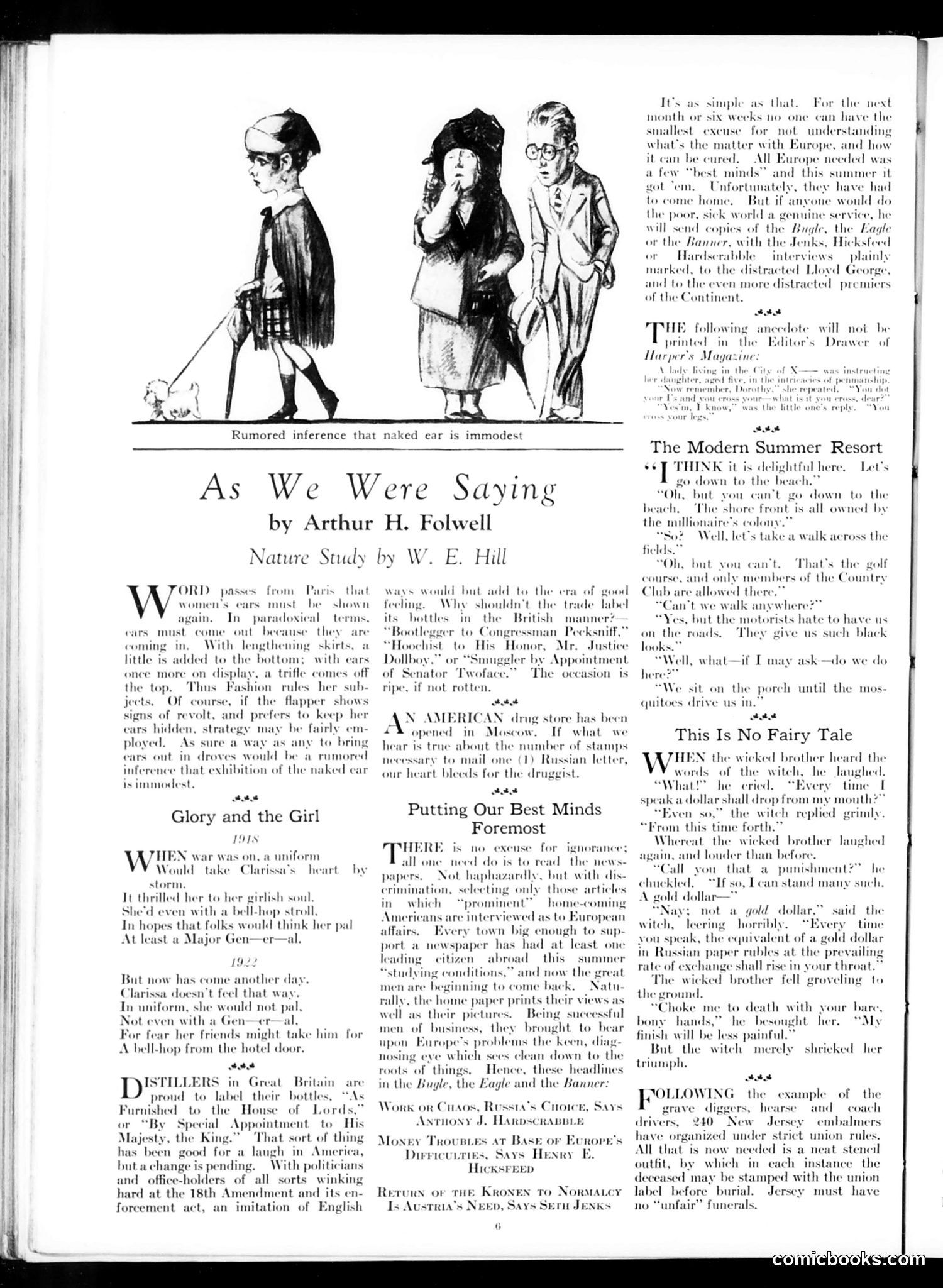
The main cartoon titled "As We Were Saying" satirizes fashion and social hypocrisy. It depicts three figures with prominent ears exposed, captioned "Rumored inference that naked ear is immodest." The joke targets the contradiction in 1920s fashion: as women's skirts lengthen (becoming more "modest"), their ears become visible through shorter hairstyles. The satire mocks society's arbitrary standards—it obsesses over hidden legs while now displaying ears, suggesting fashion "rules" are nonsensical and ever-changing. The accompanying text pieces mock American businessmen returning from Europe who now position themselves as experts on solving European problems through articles in popular magazines like the *Eagle* and *Banner*. Judge ridicules their self-importance: they're treated as "best minds" despite lacking genuine understanding, reflecting post-WWI American attitudes about foreign affairs and intellectual pretension.
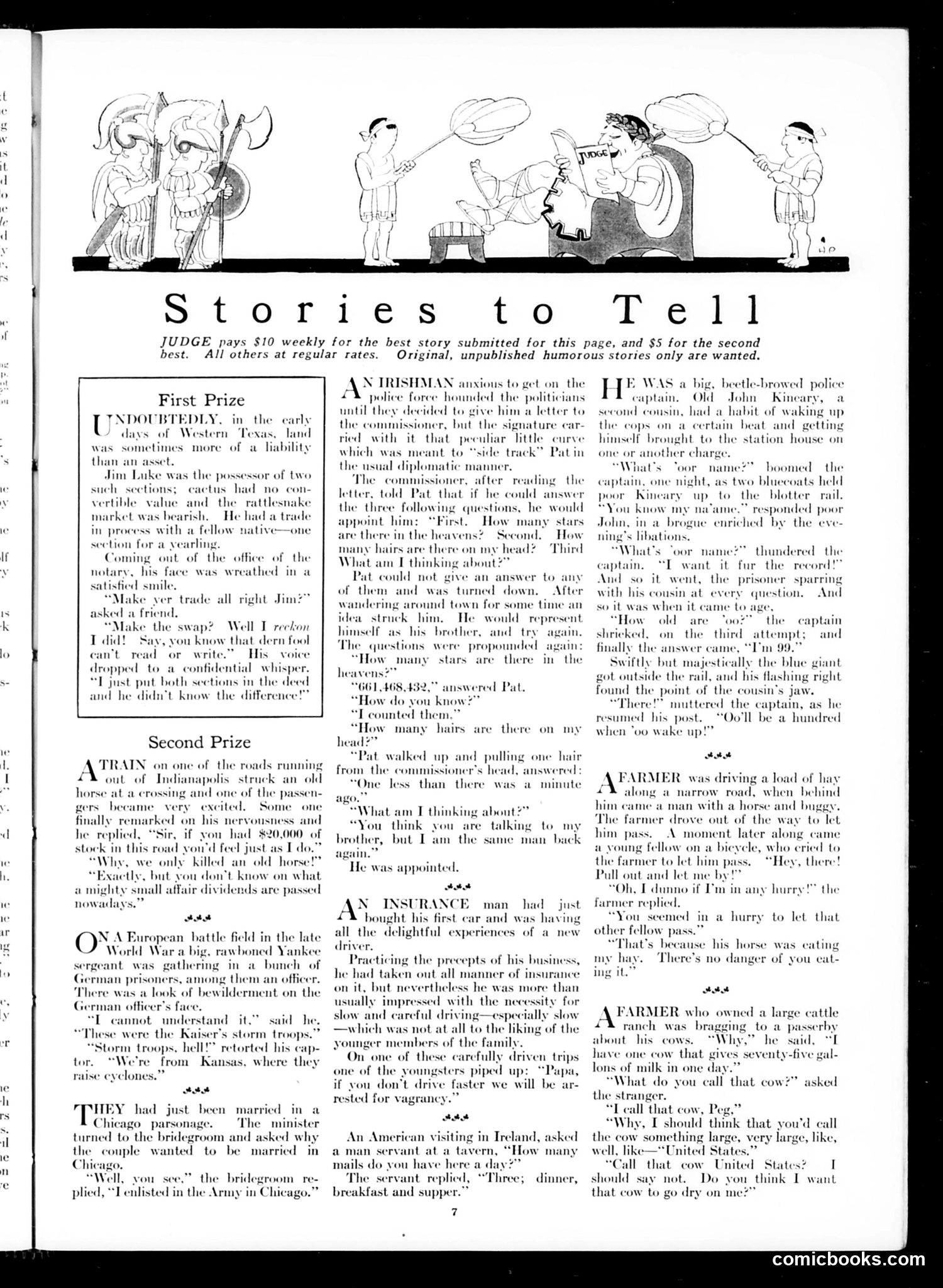
This is a **humor page featuring short stories** competing for cash prizes ($10 for first place, $5 for second). The cartoonish illustration at top depicts comedic scenes but functions mainly as decoration. The stories reflect early 20th-century American social humor: 1. **First Prize**: A Texas land-trader exploits an illiterate man's inability to read a deed—satirizing frontier dishonesty and illiteracy. 2. **Second Prize**: Railroad passengers debate an old horse's death; one reveals he owns company stock—mocking financial anxiety and capitalist anxiety. 3. **Other stories** include: German WWI prisoners intimidated by Kansas soldiers (American regional pride); an Irishman fooling a police commissioner by impersonating his brother (ethnic Irish humor); an insurance agent obsessively cautious with his new car; an American's surprise that Irish taverns serve three meals. The humor targets **immigrant communities** (Irish), **business ethics**, **class anxiety**, and **regional American character types**. Most jokes rely on wordplay, deception, or cultural stereotypes now considered offensive.
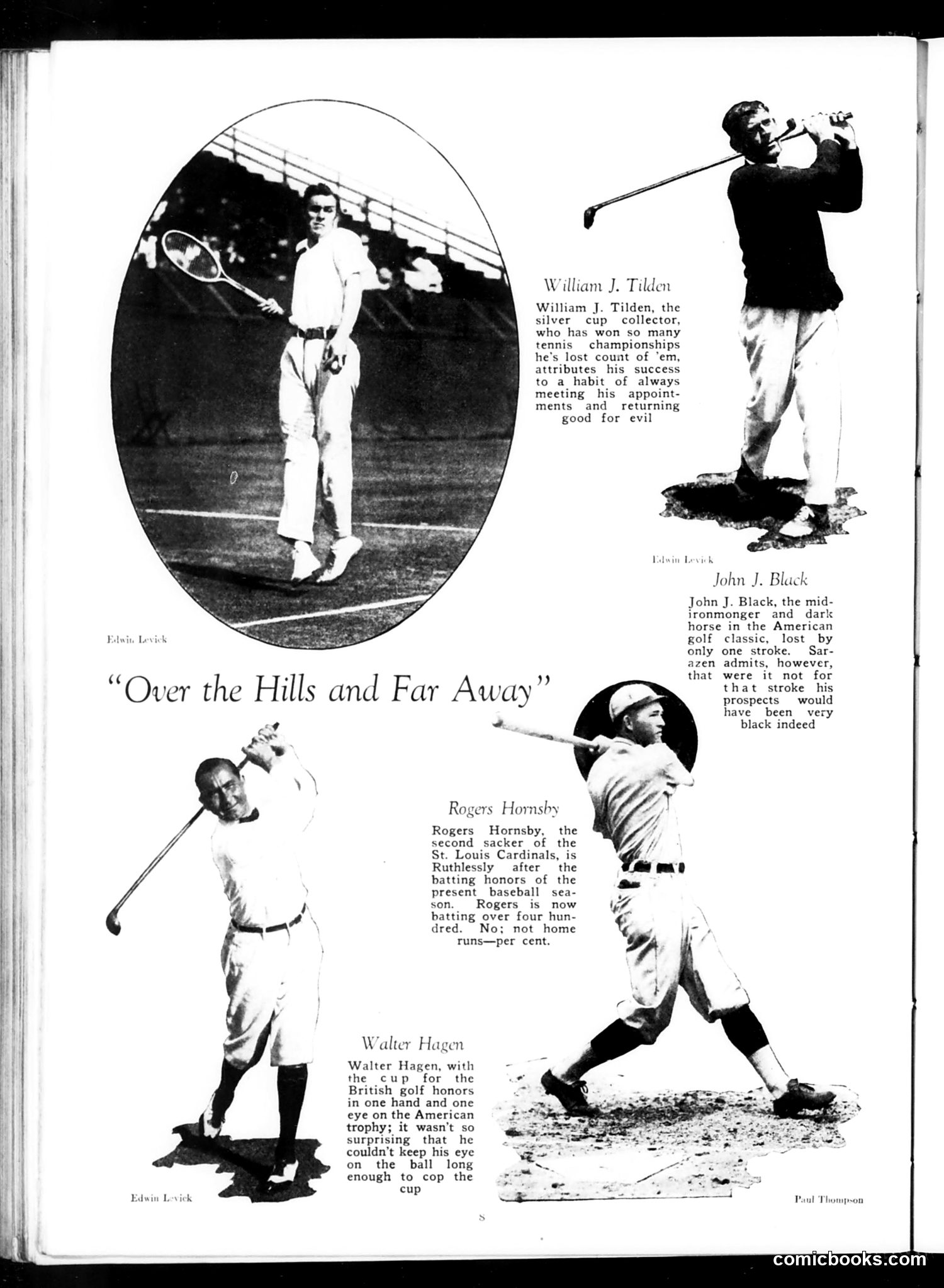
This page celebrates prominent American athletes from the 1920s with satirical biographical captions beneath their photographs. The title references a popular song, suggesting these sports figures are riding high on success. The satire is gentle: **Rogers Hornsby** (St. Louis Cardinals) is relentlessly chasing batting records. **William J. Tilden** (tennis champion) credits his success to punctuality and good sportsmanship. **Walter Hagen** (golfer) is so distracted pursuing both British and American trophies that he can't focus on either. **John J. Black** (golfer) lost a championship by one stroke—with a pun on his name ("prospects would have been very black"). The humor is primarily about sports obsession and the single-minded pursuit of victory. These are celebratory profiles of athletic excellence rendered slightly ridiculous through exaggeration—typical Judge magazine treatment of contemporary celebrities.
This is a sports commentary by Heywood Broun (not a cartoon) analyzing why certain baseball players capture public imagination while others don't, despite comparable talent. **The Main Figures:** - **Clarence "Tillie" Walker** - a real baseball player with excellent statistics but little fan appeal - **Babe Ruth** - the famous Yankees star with magnetic personality and perfect "brand name" - **Ping Bodie** - a historical player whose synthetic name succeeded through charm **The Satire's Point:** Broun argues that professional success depends less on actual ability than on *personality and marketability*. Walker hits home runs with technical skill but "without gusto"—he's forgettable. Ruth, by contrast, embodies raw vitality and "primitive force"; even his name carries drama. The article satirizes how mass psychology and personality cult override merit in American sports fandom. **Social Context:** This reflects 1920s concerns about celebrity culture, mass media's power, and whether substance or showmanship determines public success—issues remarkably similar to modern celebrity discourse.
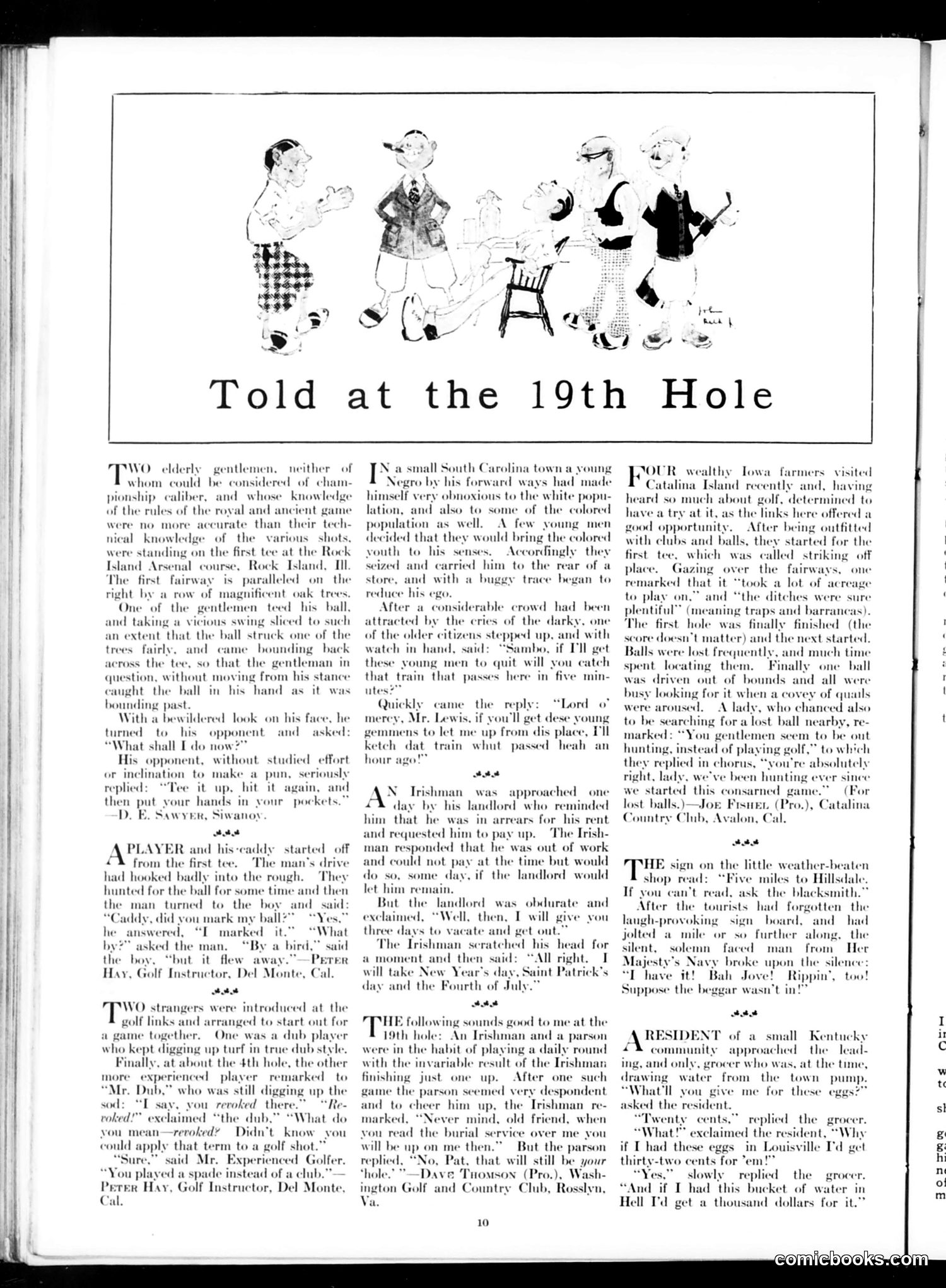
This page collects golf anecdotes—humorous stories traditionally shared at the 19th hole (the clubhouse bar). The cartoon header shows five caricatured gentlemen in period dress, establishing the leisurely, genteel context. The jokes employ gentle humor: one involves a gentleman catching his own ball mid-bounce and being told to simply "tee it up...and put your hands in your pockets"; another mocks an inexperienced golfer ("dub") who tears up turf instead of hitting properly. The final anecdote is racially charged by modern standards: it depicts a violent scene where white men beat a Black man to "reduce his ego" after he's deemed "obnoxious" through his "forward ways." An older white man negotiates the violence's duration, treating the assault as a commercial transaction timed to a passing train. This reflects Judge magazine's era (early 20th century) when such content reflected and reinforced racist attitudes among its educated, affluent readership. The story frames racial violence as corrective discipline, presented as humor within an ostensibly genteel sporting context.
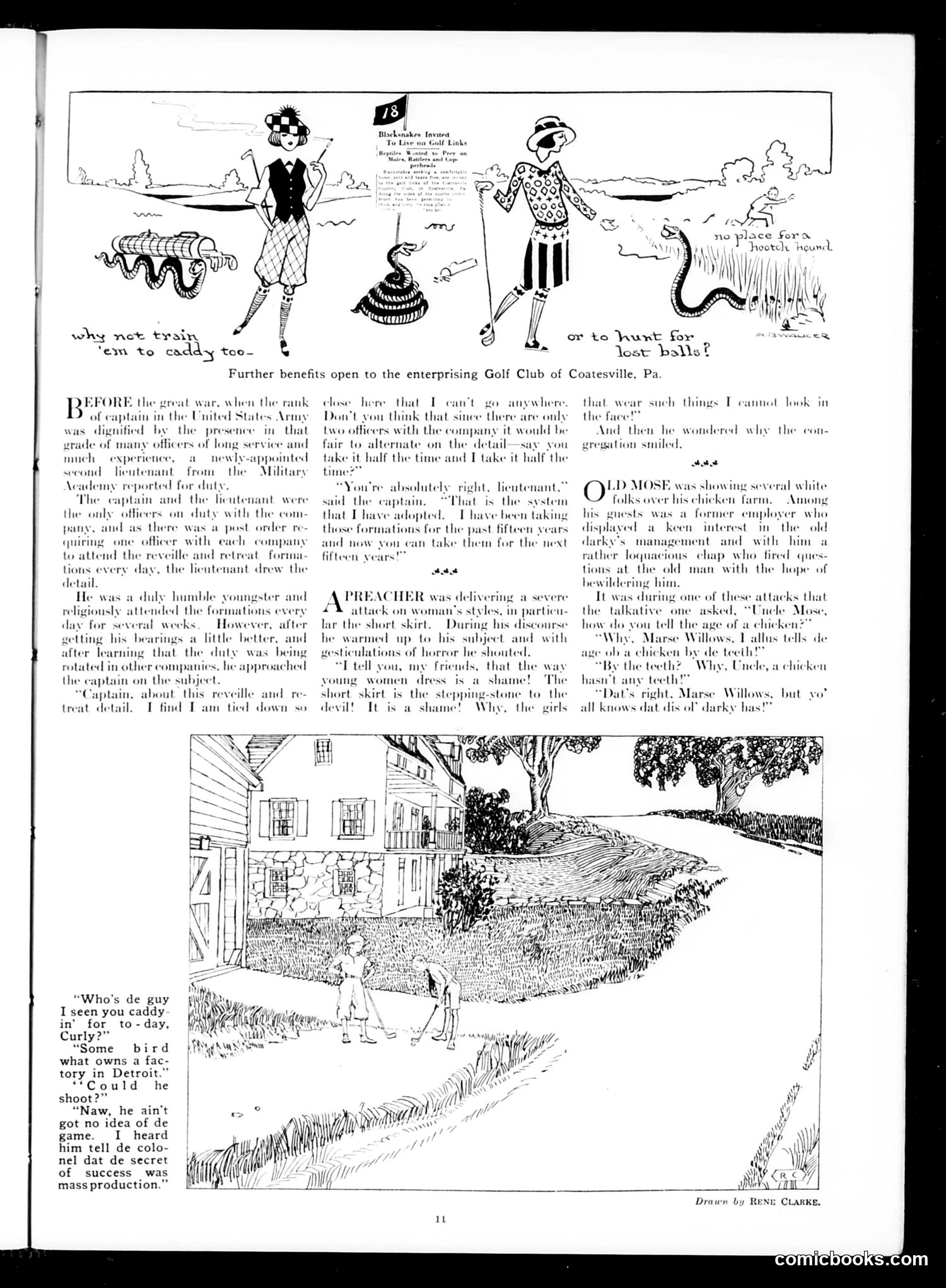
This page contains three distinct satirical pieces: **Top cartoon**: Mocks women's golf fashion by suggesting female golfers could serve alternative purposes—as caddies, hunting dogs, or "bootch hound" (bootleg alcohol runners, referencing Prohibition-era smuggling). The satire targets both women's athletic participation and prohibition enforcement. **Middle story**: A preacher condemns women's short skirts as moral corruption, yet his congregation smiles—satirizing hypocritical religious authority and generational anxiety about changing women's fashion and behavior in the 1920s. **Bottom anecdote**: A wealthy Detroit factory owner plays golf but lacks skill, attributing success to "mass production"—satirizing American industrial culture's mechanical thinking applied inappropriately to leisure activities, likely mocking nouveau riche industrialists' pretensions. The "Old Mose" dialect story appears unrelated racist stereotyping typical of period publications.
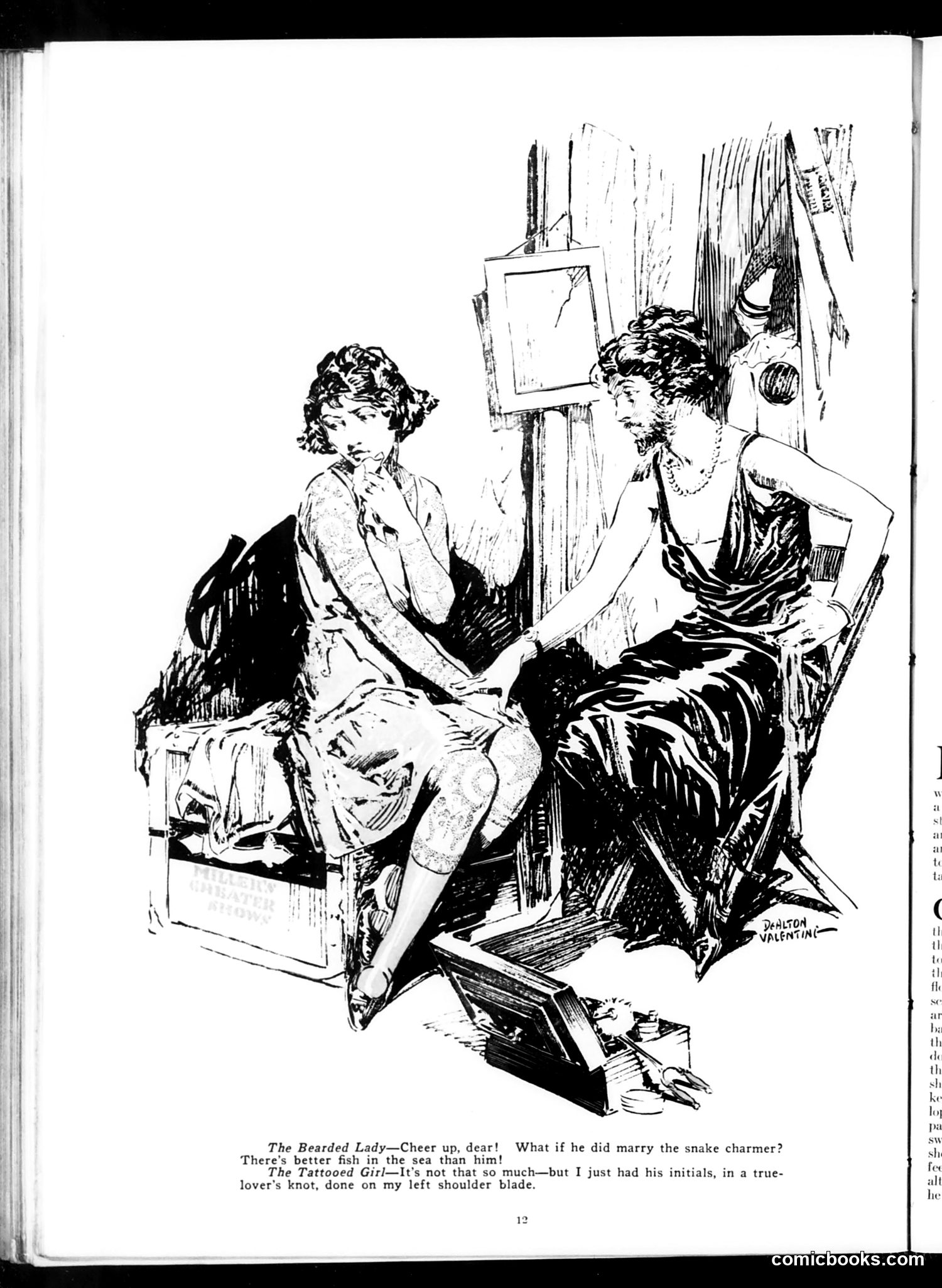
This is a humorous cartoon depicting two circus performers commiserating. The "Bearded Lady" consoles the "Tattooed Girl," whose boyfriend has just run off with a snake charmer. The joke's punchline involves the Tattooed Girl's practical dilemma: she's just had her unfaithful boyfriend's initials tattooed on her shoulder in a lover's knot design, making the betrayal particularly poorly timed and embarrassing. The satire mocks romantic impulsiveness and the permanence of tattoos—a commentary on hasty decisions in matters of love. The cartoon also plays on early 20th-century fascination with circus sideshow attractions and the melodramatic love lives attributed to performers. The humor relies on the audience's recognition that tattoo removal was impossible in that era.
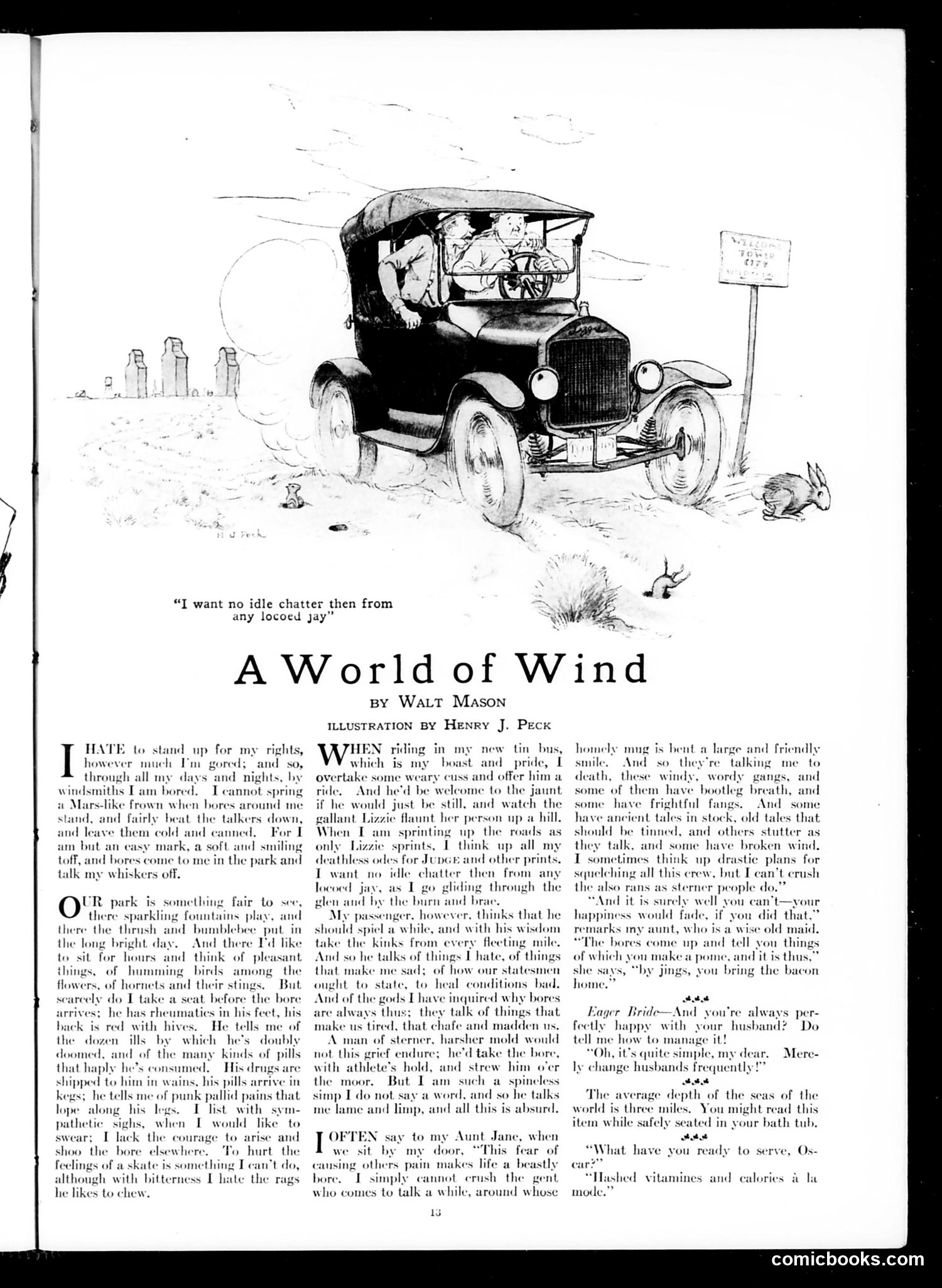
This is a humorous essay illustrated by Henry J. Peck about the narrator's inability to escape boring conversationalists. The piece satirizes a recognizable social type: the compulsive talker who monopolizes time with tedious complaints about ailments, old stories, and unwanted advice. The cartoon depicts a early-1920s automobile (labeled "Lizzie," slang for Model T Ford) where the driver wishes for quiet companionship but instead endures his passenger's constant chatter. The accompanying text explores how the narrator, despite being a "soft and smiling toff," lacks the spine to silence these bores—whether in parks, cars, or at home. The satire targets both the talkers themselves (obsessed with their rheumatics, pills, and grievances) and the social weakness that prevents people from enforcing boundaries. It's a gentle critique of early 20th-century social conventions that made rudeness worse than suffering boredom.
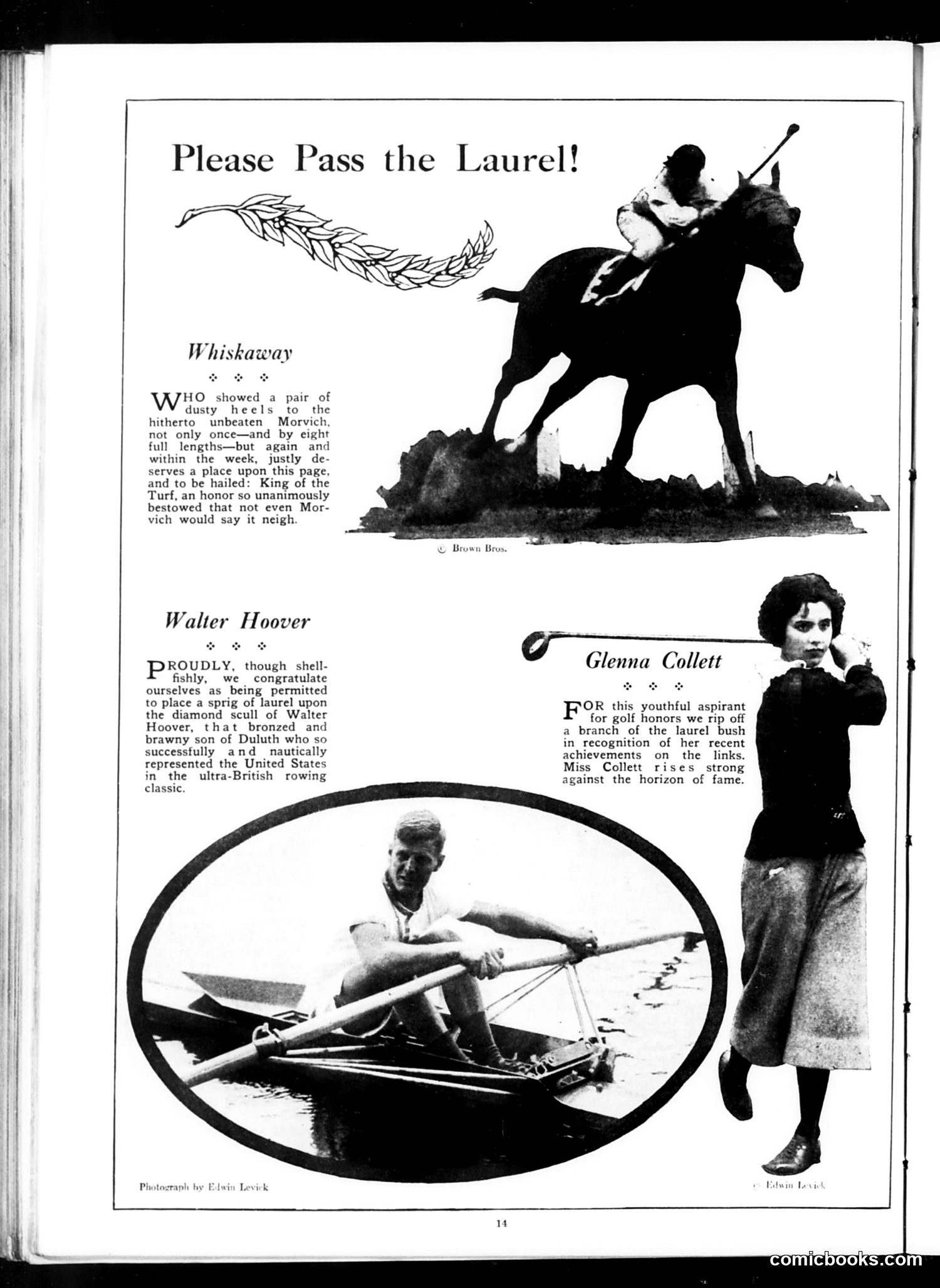
This page celebrates three recent American athletic achievements by awarding symbolic laurel branches to winners: 1. **Whiskaway** (horse racing): A racehorse that defeated the previously unbeaten champion Morvich twice within a week. The silhouette shows a jockey on horseback jumping over terrain. 2. **Walter Hoover** (rowing): Described as a "bronzed and brawny son of Duluth," Hoover won an international rowing competition representing the United States against British competitors in what's called "the ultra-British rowing classic." 3. **Glenna Collett** (golf): A young female golfer achieving recent success, described as "rising strong against the horizon of fame." The satire's premise: Judge playfully awards laurel wreaths—classical symbols of honor—to American sports champions. The tone is patriotic and congratulatory, celebrating American athletic dominance across different sports during what appears to be the 1920s.
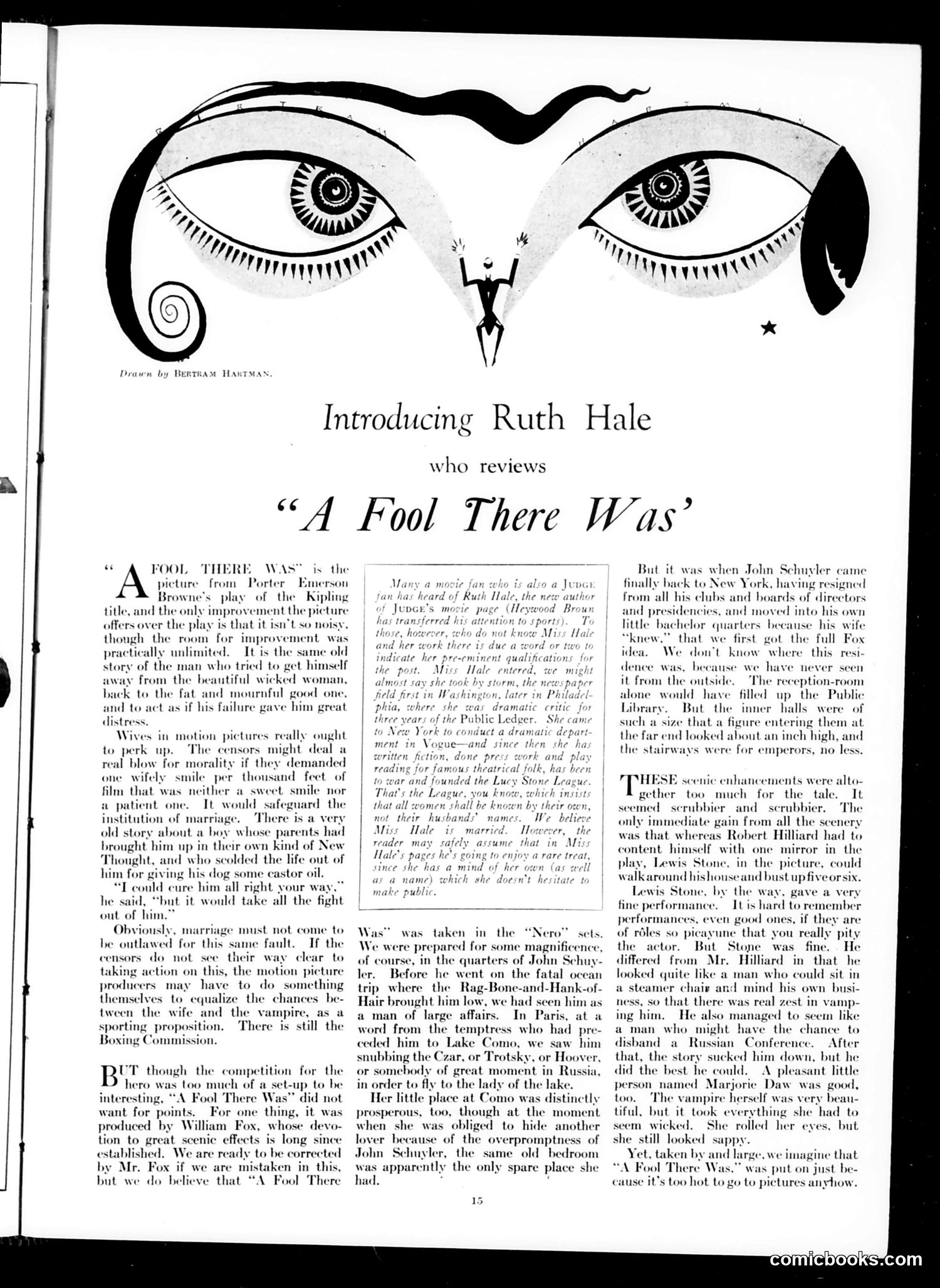
This page reviews a film adaptation of Porter Emerson Browne's play based on a Rudyard Kipling title. The decorative illustration at top—drawn by Bertram Hartman—shows a stylized owl's face, likely symbolizing wisdom or critical observation, befitting Judge's satirical purpose. The review critiques the film's tired moral premise: a man tempted away from his virtuous wife by a seductive woman. The critic argues motion pictures should show wives more favorably to defend marriage as an institution, suggesting otherwise the "Boxing Commission" might intervene—a humorous reference to regulatory bodies. The reviewer praises William Fox's lavish set design but argues the expensive staging overwhelms the flimsy plot. Lewis Stone's performance receives credit for competence despite the weak material. The underlying satire targets both the predictable "fallen man" narrative and Hollywood's tendency to prioritize spectacle over substance—critiques recognizable to modern audiences familiar with similar debates about form versus content.
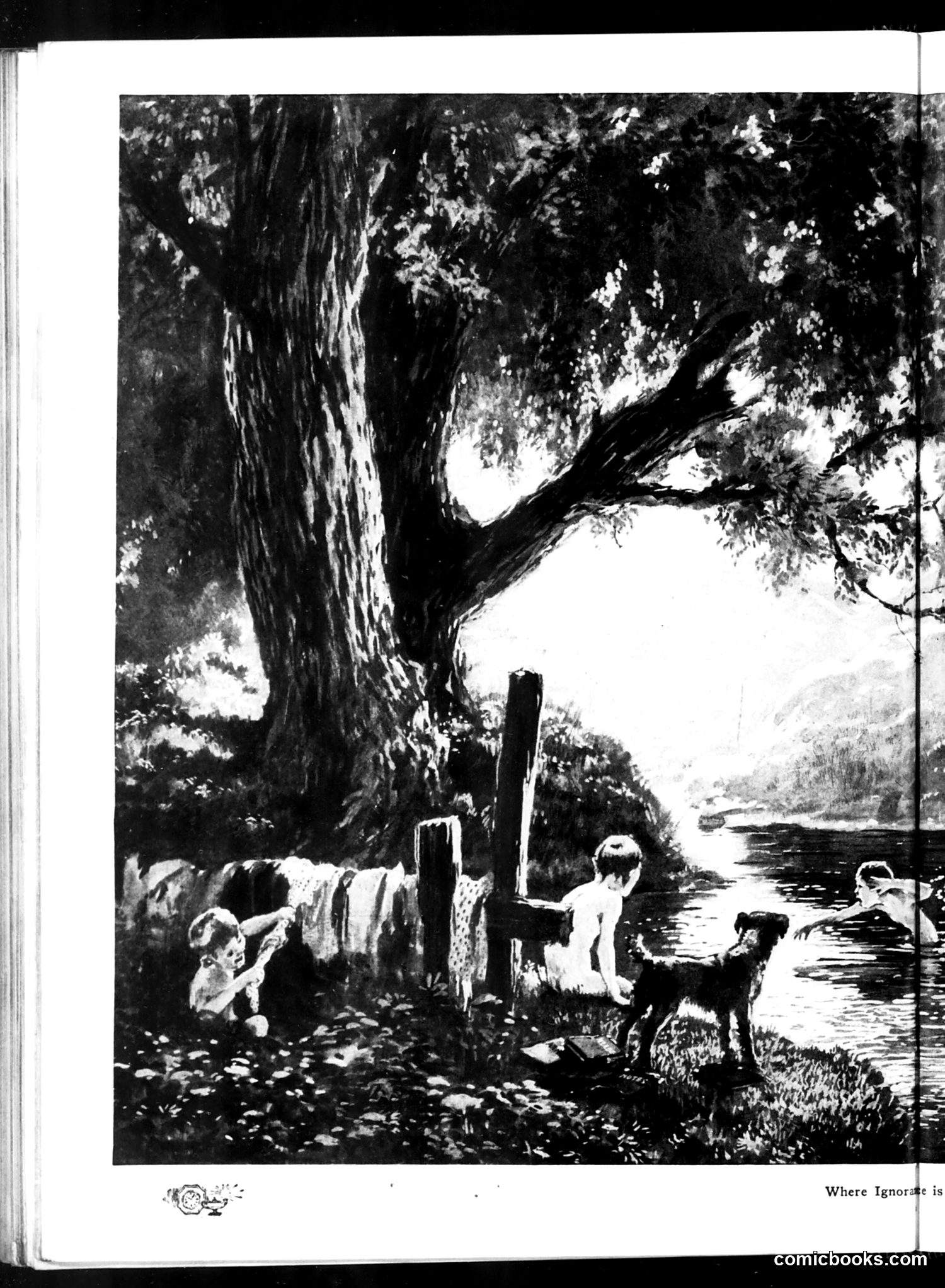
This appears to be an illustration rather than a political cartoon. The image shows a pastoral riverside scene with two children and a dog beneath a large, gnarled tree. The children appear to be at play or exploring near the water's edge, with laundry hanging on a line in the background. The partially visible caption reads "Where Ignorance is..." which suggests this may be an illustration accompanying text (likely a proverb or saying). The specific reference or satirical point is unclear without the complete caption or surrounding article text. The image itself is primarily a naturalistic scene without obvious caricature or political commentary visible.
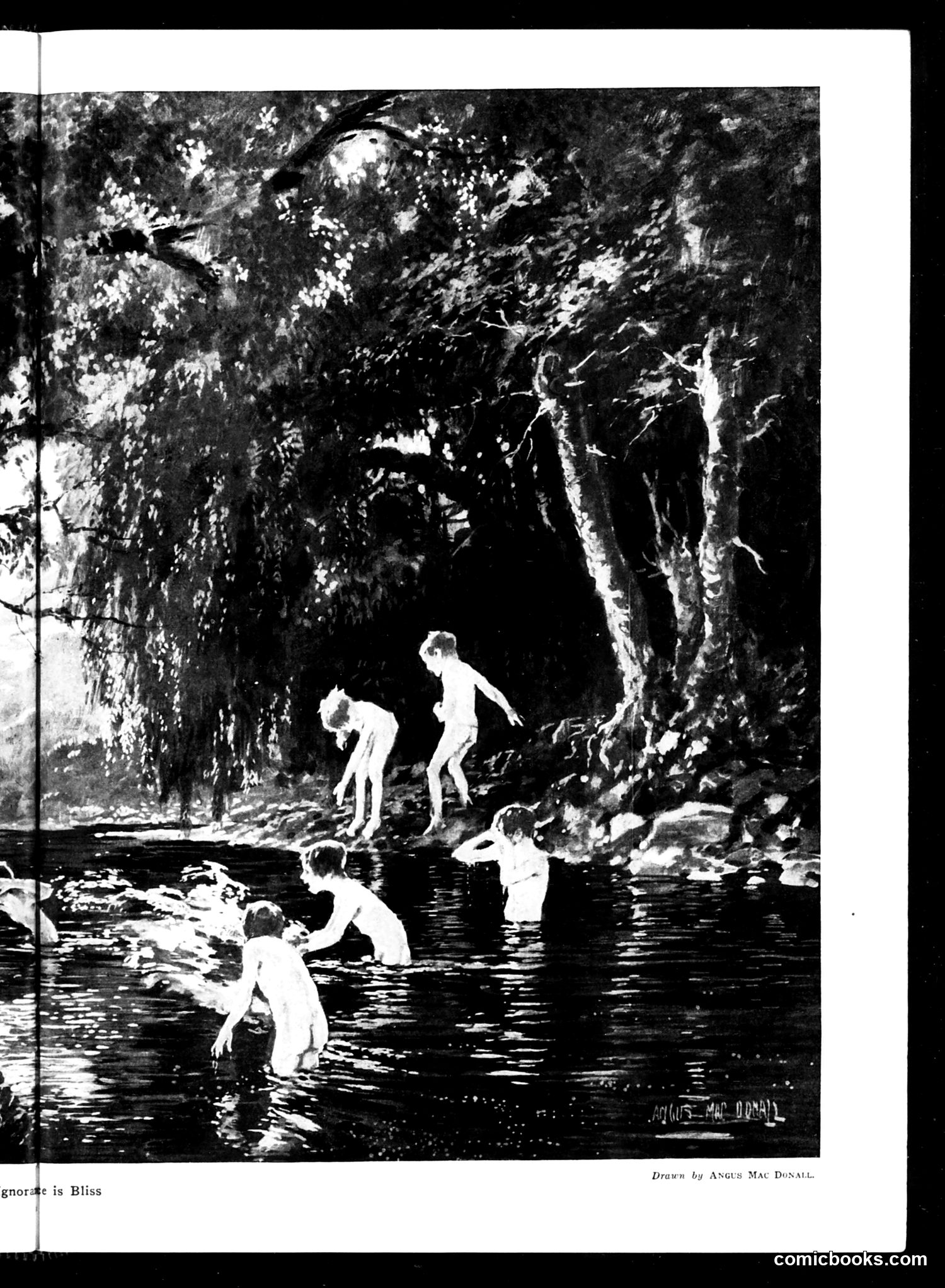
This illustration by Angus MacDonald depicts children playing innocently in a woodland stream beneath towering trees. The caption "Ignorance is Bliss" suggests social commentary on childhood naiveté or willful blindness. In the context of *Judge* magazine—a satirical publication—this likely critiques American attitudes toward serious issues by contrasting carefree youth with adult responsibilities or problems. The idyllic scene may ironically comment on how society ignores uncomfortable truths, or how ignorance allows temporary happiness. Without additional page context, the specific target remains unclear, but the juxtaposition of innocent play against the ominous, dark forest creates tension between blissful obliviousness and lurking dangers or realities society prefers not to acknowledge.
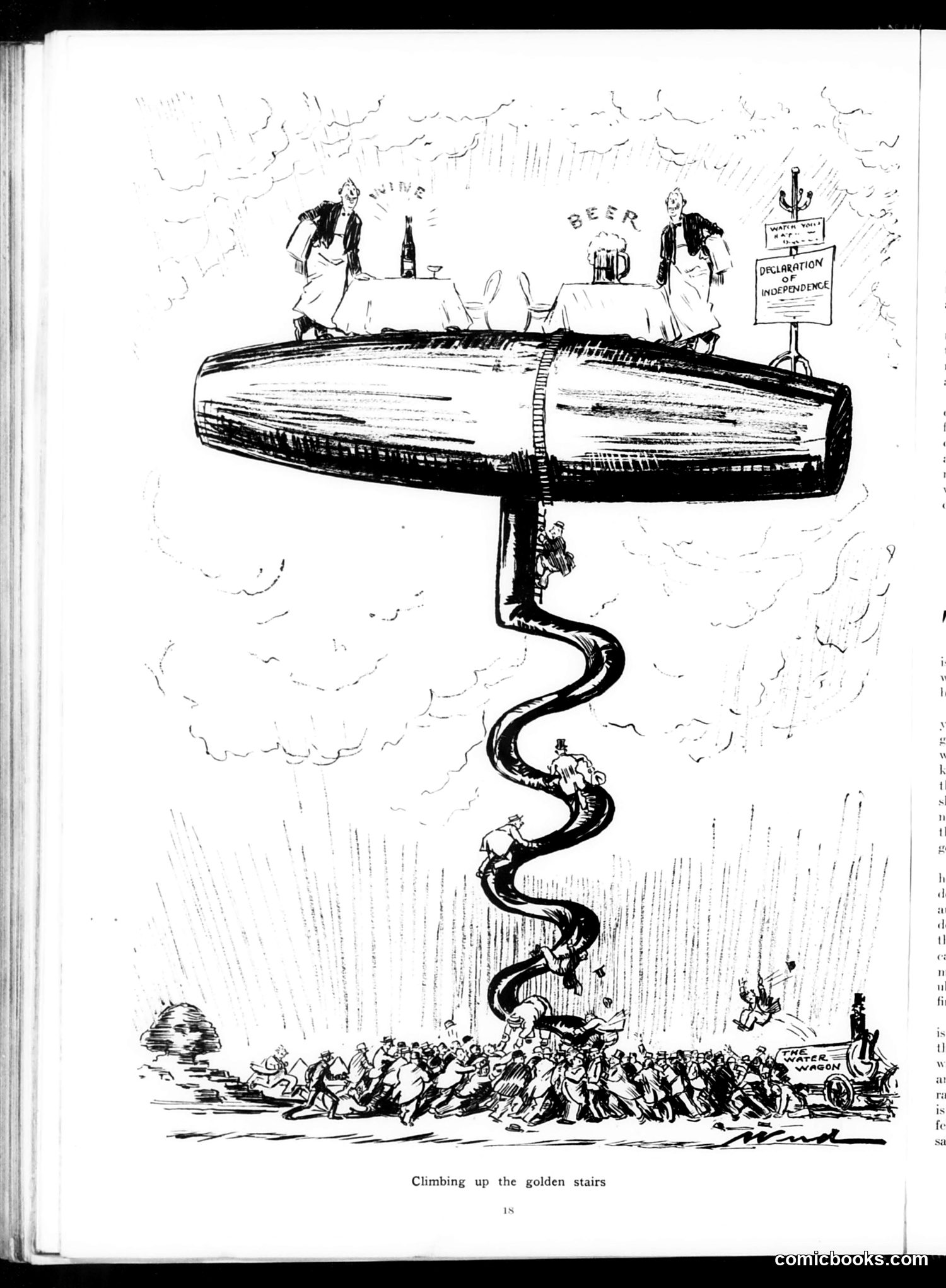
This cartoon depicts a coffin balanced atop a serpentine rope, with two figures dressed as servants attending a table on top of it. Below, a crowd of people and a "Cider Wagon" struggle upward along the winding path. A sign reading "Declaration of Independence" is visible, and beer mugs are shown. The satire appears to criticize American prosperity or nationalism being built upon or celebrated through death—possibly referencing Civil War casualties, or critiquing how the nation's ideals (Declaration of Independence) were being commercialized or misused. The "golden stairs" likely refer ironically to claims of American progress, while the coffin and struggling masses suggest the human cost beneath such aspirations. The beer and cider references may mock materialism. The specific historical moment remains unclear without additional context.
This is an editorial announcement page rather than a cartoon page. William Allen White, the editor, announces his resignation after eight months, citing the impossibility of editing a New York-based publication from 1,500 miles away. The page contains three brief editorial pieces: 1. **"In Which We Say Good-by"** — White's departure notice 2. **"Judge and the Home Fires"** — A commentary using marriage democracy versus autocracy as metaphor for social governance, suggesting Judge will publish guidance on domestic harmony 3. **"Kicking Cupid Out"** — Satirizing recent New York court rulings restricting public displays of affection in parks The final piece mocks romantic couples being policed in public spaces, with a joke about love relegated to ash heaps and double-seated buggies. A closing quip about Ford factories suggests manufacturing rather than sentiment now dominates American life. The page reflects early 20th-century satirical concerns with social regulation and modernity.
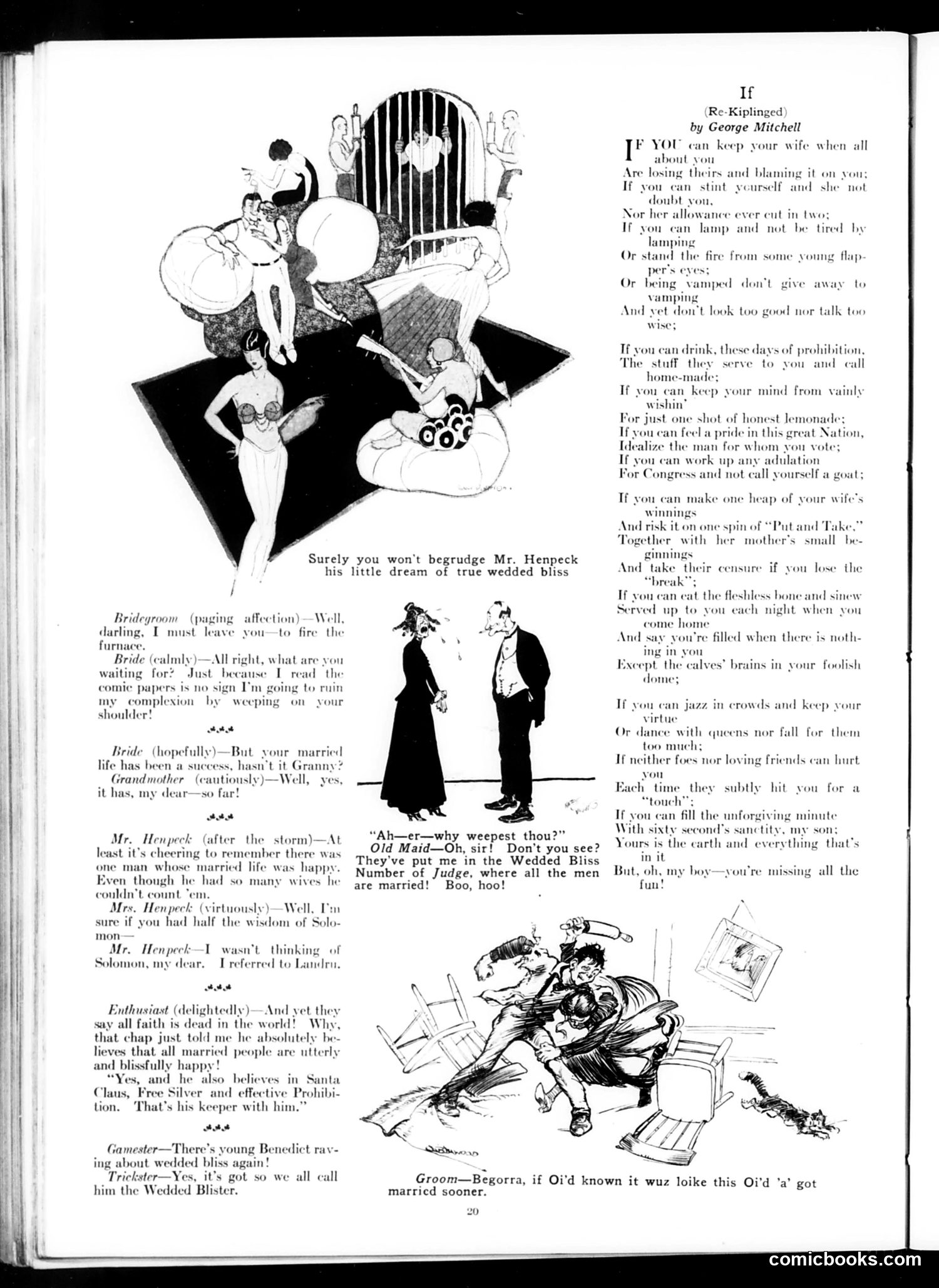
This 1920s *Judge* page satirizes marriage through multiple comic scenarios. The main theme: marriage is universally miserable, contrary to romantic ideals. **The cartoons mock:** - **Henpeck jokes**: Husbands dominated by wives (the "Henpeck" name recurs, referencing the stereotype of nagging spouses) - **The "Wedded Bliss" issue**: An old maid weeps because she's featured in a magazine issue celebrating marriage—she's unmarried and sees it as cruel irony - **Prohibition-era drinking**: References to illegal alcohol consumption by married couples - **Religious/historical allusions**: Solomon and Landru (a French serial killer of wealthy widows) are invoked to mock marriage **The parody poem** (titled "Re-Kiplinged," mocking Rudyard Kipling's "If—") offers impossible standards for marital success: keeping your wife happy while denying yourself everything, hiding infidelity temptations, accepting poor food and financial loss—concluding ironically that meeting all these demands means "you're missing all the fun!" The satire targets both marriage itself and the era's contradiction between publicly celebrating matrimony while privately acknowledging its disappointments.
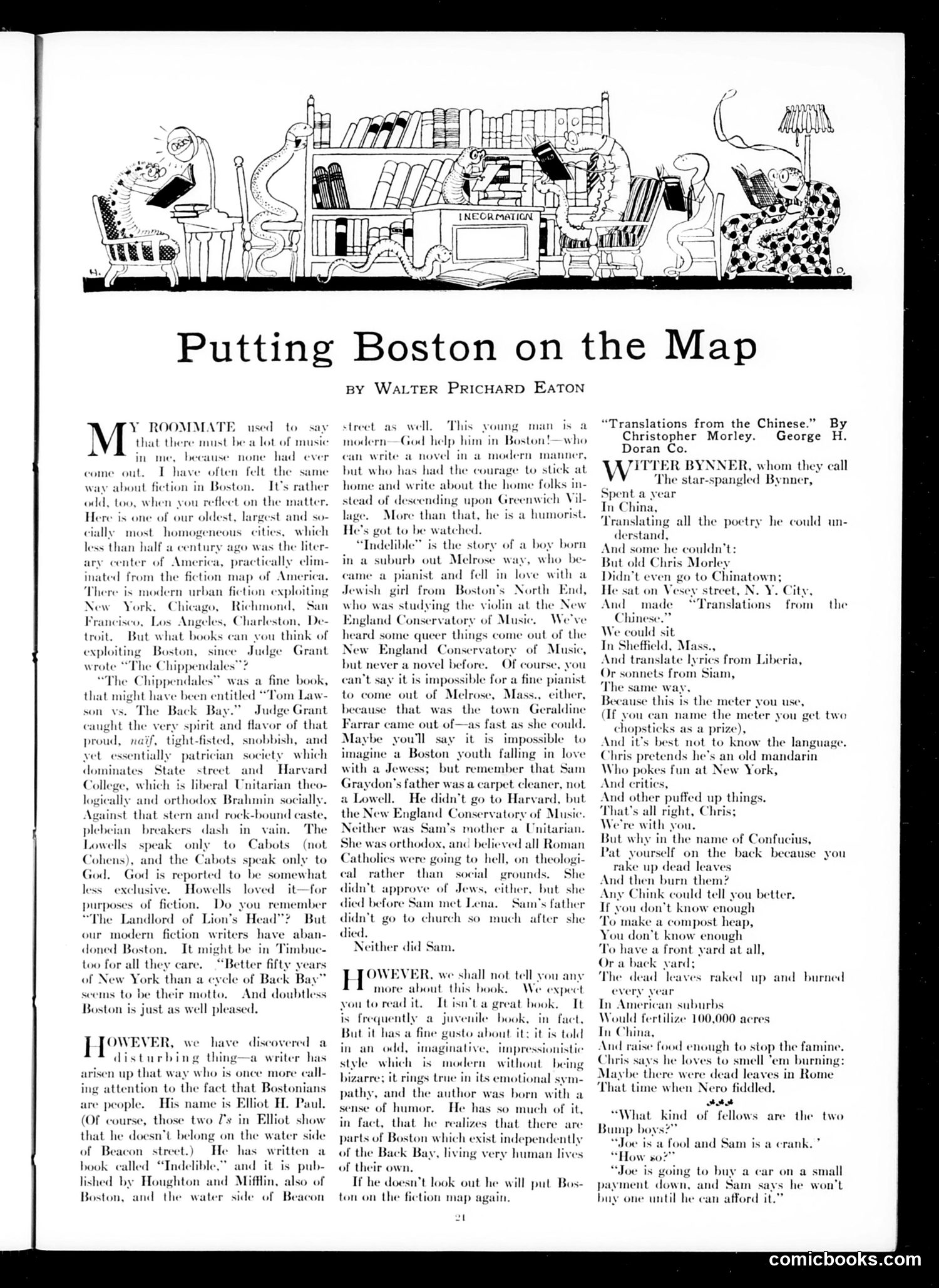
This is an editorial piece by Walter Prichard Eaton discussing a new novel called "Indelible" by Elliot H. Paul, published by Houghton and Mifflin (a Boston publisher). **The Point:** Eaton laments that Boston—despite being "one of our oldest, largest and socially most homogeneous cities"—has been absent from modern American fiction. Cities like New York, Chicago, and San Francisco dominate novels, but Boston remains unexploited literary territory. He celebrates Paul's "Indelible" as finally "putting Boston on the map" of fiction. **The Novel's Plot:** "Indelible" tells of a young pianist from suburban Melrose who falls in love with a Jewish girl from Boston's North End studying at the New England Conservatory of Music—a romance that challenges Boston's rigid Brahmin social hierarchy (the famous "Lowells speak only to Cabots" crowd). **The Satire:** The piece gently mocks Boston's exclusionary, old-money Protestant establishment while praising Paul for having the courage to set a contemporary novel there and write about ordinary "home folks" rather than exotic locales. The illustration shows a library scene with figures reading and lounging among books.
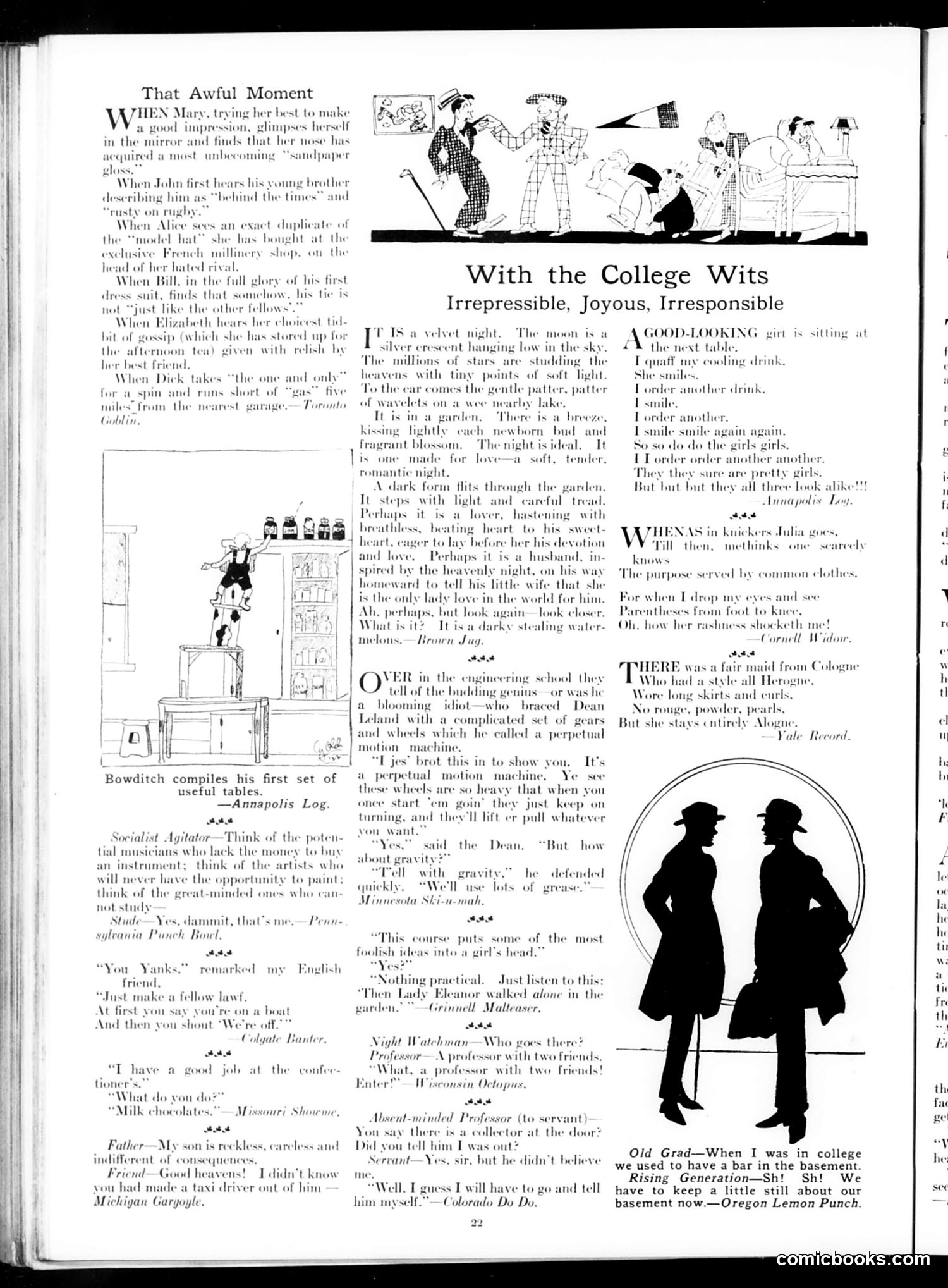
This page satirizes college life and young romance through interconnected sketches and poems. The main cartoon depicts three nearly identical young women at a table ordering drinks repeatedly—the joke being their indistinguishability and frivolous behavior ("They sure are pretty girls. / But but but they all three look alike!!!"). The accompanying verse and anecdotes mock college students as superficial and dim-witted. References include engineering students building a "perpetual motion machine," professors behaving foolishly, and a critique of women's education ("This course puts some of the most foolish ideas into a girl's head"). The silhouette illustration of two fashionably-dressed figures contrasts with accompanying verses mocking women who follow fashion trends uncritically ("Parentheses from foot to knee, / Oh, how her rashness shocketh me!"). Overall, the satire targets the perceived superficiality, conformity, and intellectual emptiness of college-age youth, particularly women—a common Judge magazine theme.
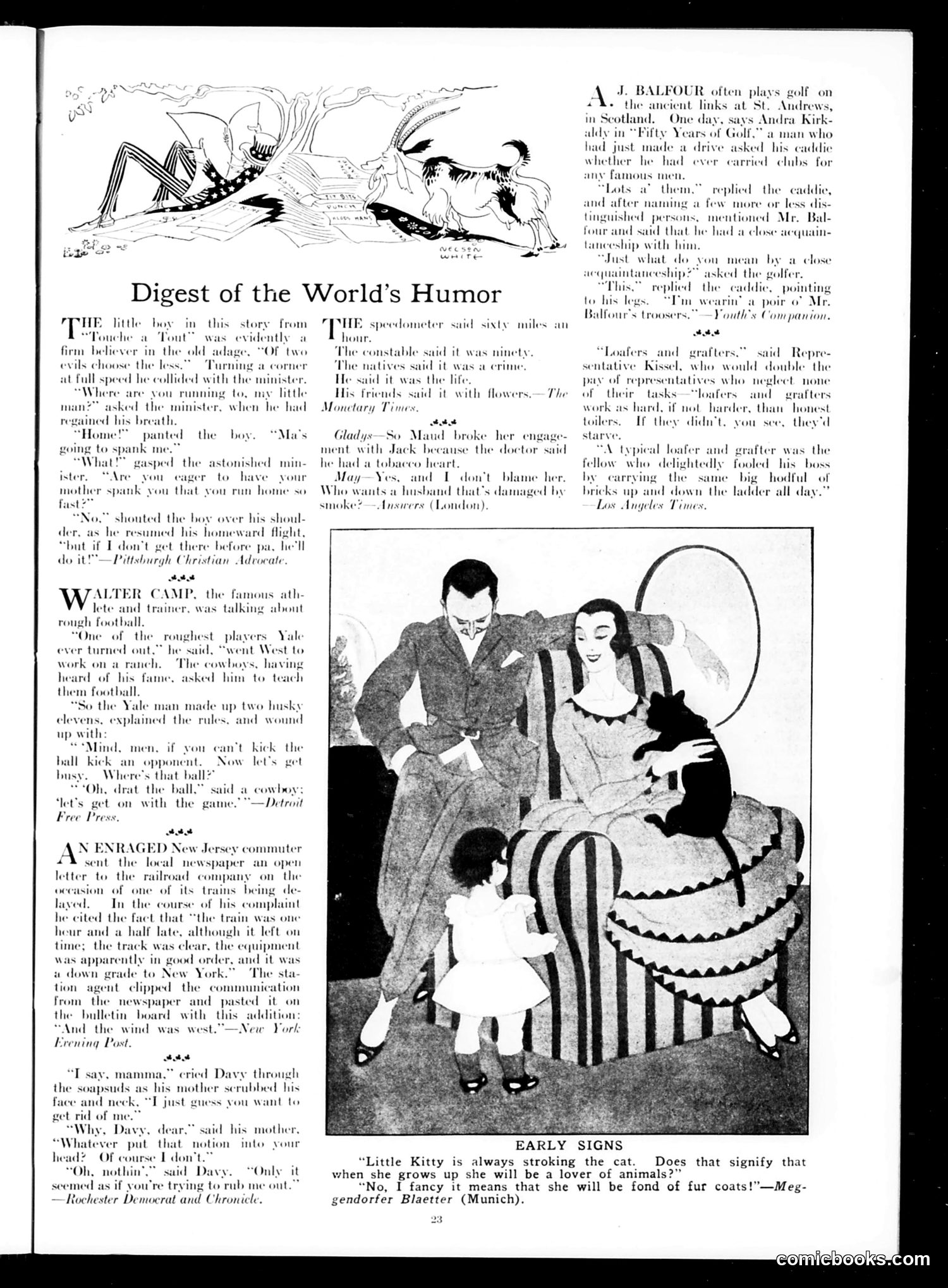
This page from *Judge* magazine contains several unrelated humorous anecdotes rather than unified political cartoons: **Main Illustration ("Early Signs"):** Shows a man and woman with a child stroking a cat. The joke plays on gender stereotypes: the child's affection for the cat is assumed to mean she'll love animals—but no, the caption suggests she merely wants fur coats (implying materialism and vanity in women). **Text Stories:** Include brief comedic vignettes: - A golfer's caddie claims familiarity with famous golfers by referencing their trousers - A speeding driver argues with a constable about his speed - A Yale football coach teaches cowboys football using violent terminology - A commuter's complaint about a delayed train is mocked by a station agent **Context:** These reflect early-20th-century American humor—casual sexism, class mockery, and observations about modern life (trains, automobiles). The satire targets human vanity, miscommunication, and social pretension rather than specific political issues.
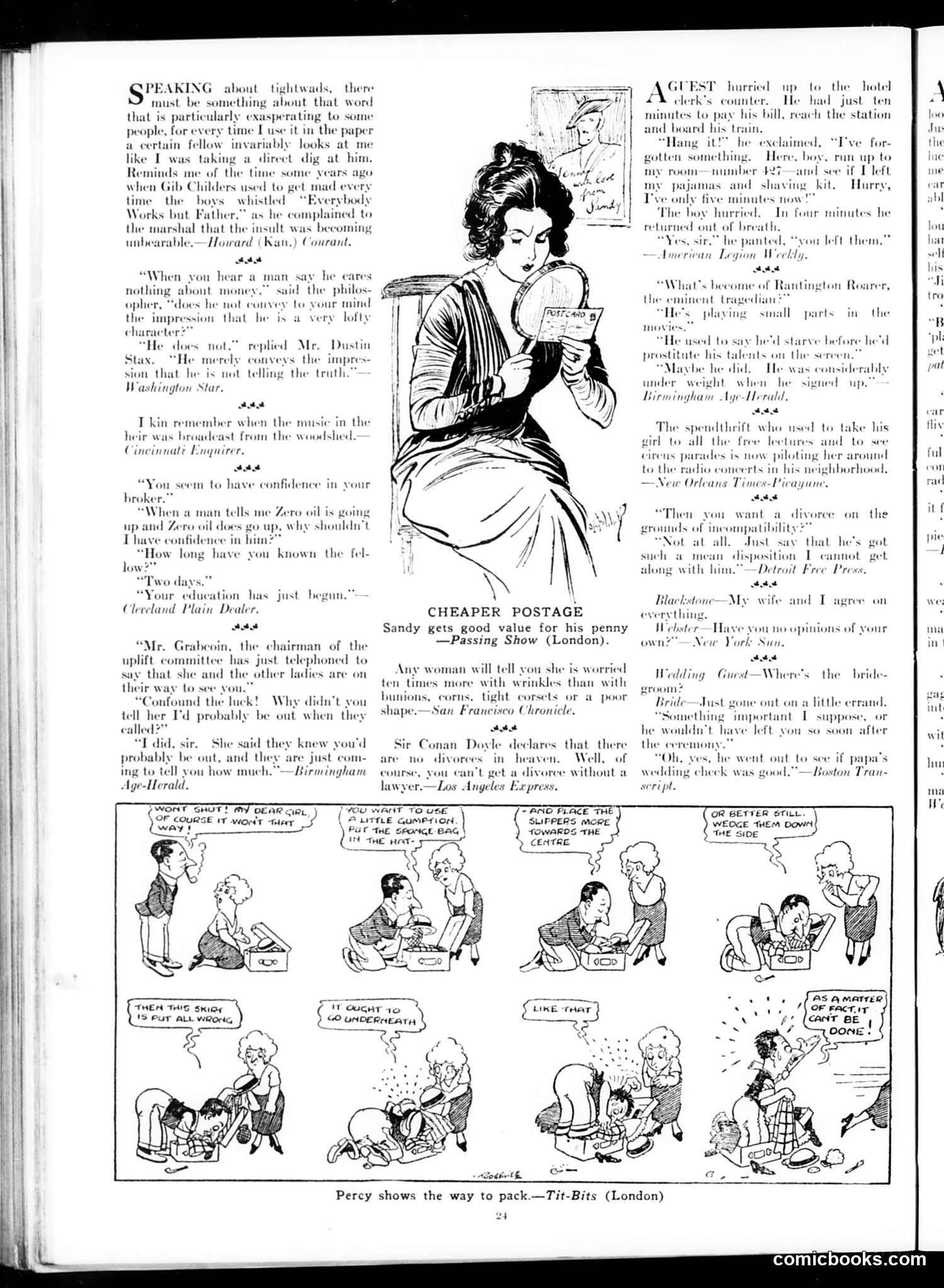
This page from *Judge* magazine contains several elements typical of early-20th-century American humor: **The Main Content:** Short anecdotes and jokes about money, relationships, and human nature—reflecting Depression-era anxieties about finances and social pretense. References to "tightwads," brokers, and divorce suggest economic instability and marital strain. **Notable References:** Sir Conan Doyle's statement about "no divorces in heaven" reflects public interest in celebrity opinions on contemporary social issues. **The Comic Strip ("Percy shows the way to pack"):** A domestic humor strip showing a woman trying to pack a suitcase, with increasingly absurd packing techniques. The humor lies in visual slapstick and the contrast between effort and chaos—common for British comics like *Tit-Bits*. **The Satire:** Gentle mockery of human foibles—vanity (women worried about wrinkles), hypocrisy (the "lofty character" who claims not to care about money), and marital discord. The page reflects early-20th-century magazine humor: accessible, family-oriented, focused on recognizable social situations rather than current events.
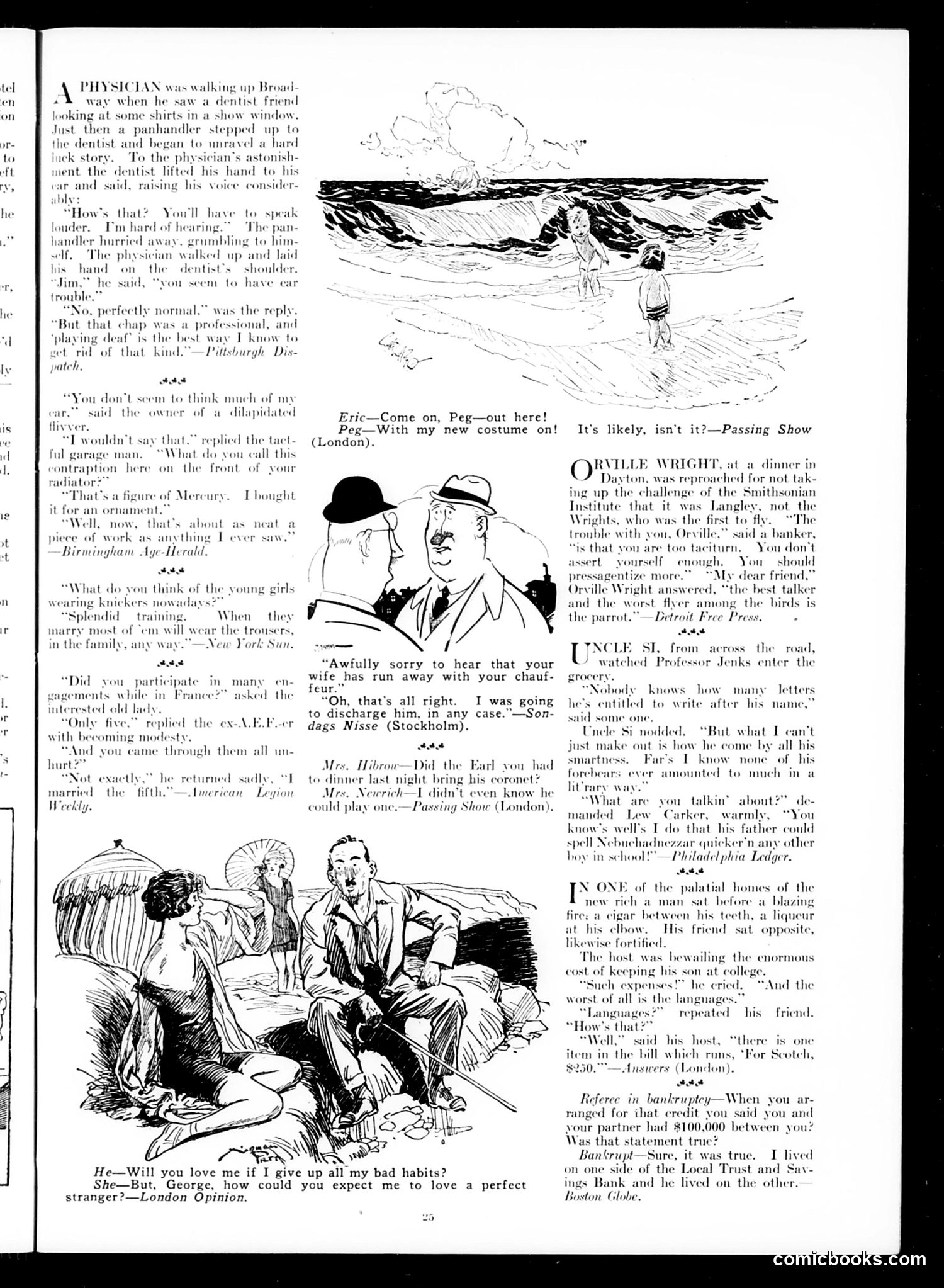
This page contains multiple short humorous anecdotes typical of early 20th-century American satire magazines. The jokes target various social types: **Main targets of satire:** - A dentist who feigns deafness to avoid panhandlers - Car owners with cheap "flivver" automobiles (poor-quality vehicles) - Young women wearing "knickers" (trousers), implying emasculation of men - A WWI soldier who survived multiple engagements but was "hurt" by marriage - Social climbers and the nouveau riche obsessing over status symbols (coronets, Mercury hood ornaments) - Orville Wright's taciturn personality versus Langley's self-promotion regarding flight invention - A wealthy man's shock at his son's college expenses, particularly "Scotch" whiskey costs **The satire's point:** These jokes mock social pretension, consumer culture, changing gender roles, and the gap between actual accomplishment and self-promotion. The humor relies on readers' familiarity with contemporary anxieties about modernity, wealth, and social status.
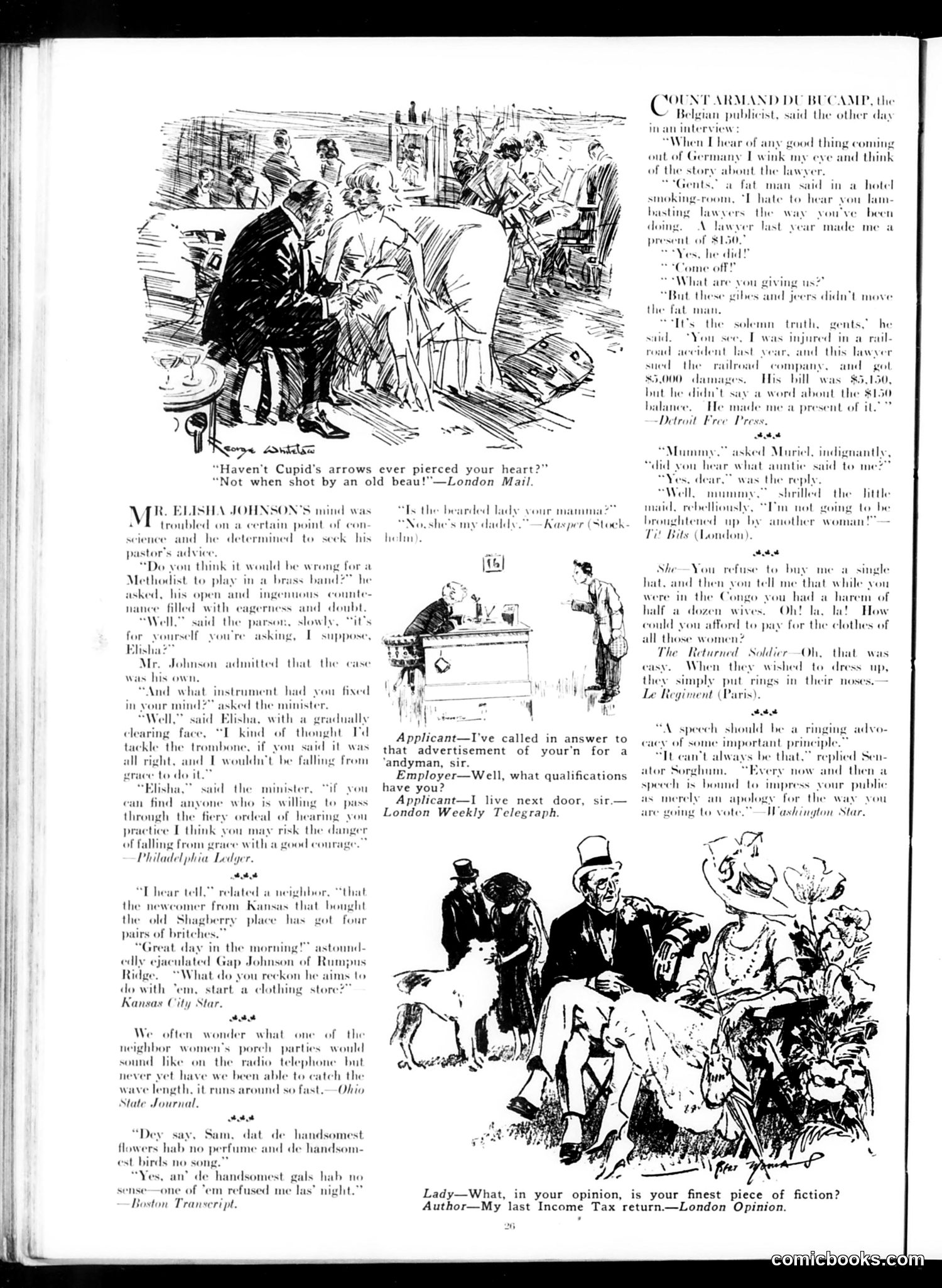
This page compiles brief humorous anecdotes and jokes reflecting early 20th-century American and British sensibilities. The cartoons mock: **Social pretension and hypocrisy**: The opening cartoon jokes about romantic rejection; another mocks a man's claim to African polygamy while criticizing his wife's hat expenses—exposing class anxieties about consumption and colonial boasting. **Professional incompetence**: A Methodist debates playing trombone in a brass band; a job applicant's only qualification is living nearby. These satirize working-class aspirations and labor market absurdities. **Gender and family dynamics**: A child confronts her aunt's rudeness; the lawyer anecdote presents the "honest professional" who refuses payment—contrasting idealized virtue against actual greed. **Political evasion**: The final cartoon criticizes politicians who use speeches as pretense before voting according to pressure, not principle. Overall, Judge targets complacency, class pretense, and institutional dishonesty through gentle ridicule rather than sharp political commentary—typical of American satirical magazines of this era.
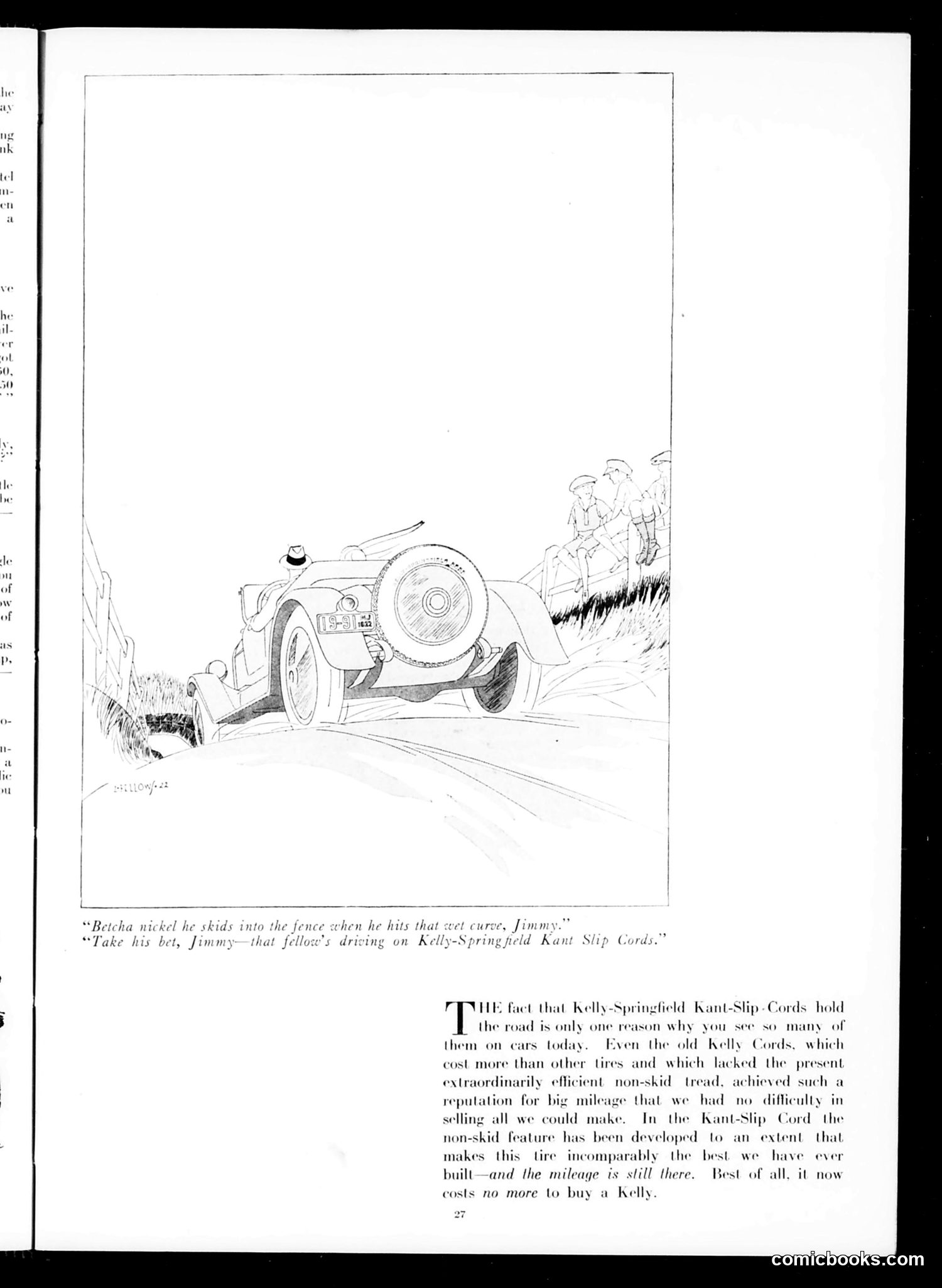
This is **advertising content**, not satire or political commentary. The page promotes Kelly-Springfield Kant-Slip Cord automobile tires through a combination of illustration and text. The cartoon depicts a racing or high-speed driving scene where a car navigates a curve on a hillside road. The humor is situational rather than satirical: the caption jokes that a driver ("Jimmy") risks skidding into a fence on curves unless he uses these particular tires. The accompanying text is a straightforward product pitch emphasizing that Kant-Slip Cords offer superior non-skid tread and excellent mileage at competitive pricing. There's no political or social satire present—this is purely commercial messaging typical of early-to-mid 20th century magazine advertising, using humor and dramatic scenarios to promote tire safety and performance.
This page is primarily **advertising and editorial content** rather than political cartoons. The main article, "Sane Settlement of Labor Troubles," praises the Pennsylvania Railroad's direct negotiation with 140,000 employees, avoiding strikes through worker representatives and "frank and friendly deliberation." The article argues this demonstrates that labor-capital disputes can be resolved peacefully without government intervention or union pressure—a conservative position emphasizing reasonable wage-adjustment over conflict. The single illustration shows a **man with binoculars**, likely symbolizing the "Investment Bureau" conducting by Theodore Williams, suggesting close financial observation and guidance. The surrounding advertisements (for partial payment securities, Dodge Brothers automobiles, William Green Inc., and J.S. Bache financial services) reflect the magazine's wealthy audience. The page reflects 1920s-era **business-friendly editorial stance**, celebrating private sector resolution of labor issues as superior to government wage-fixing or union activism—positioning capital and management as reasonable negotiators.
This page is **primarily financial advertising** with minimal editorial cartoon content. The main sections include: **Investment Advice Columns**: The bulk consists of responses to readers' questions about bond investments, discussing yields of 3.5%-7.5% from various utility companies (railroads, gas, electric, steam corporations). The tone is reassuring about "safe" investments for middle-class savers. **Central Advertisement**: G.L. Miller & Co. promotes bonds yielding 7-7.5%, positioned as superior to lower-rate alternatives—reflecting post-WWI investment culture where bonds were marketed as reliable wealth-building tools. **Dancing Instruction Advertisement**: A secondary feature promotes Arthur Murray's dance instruction course ($1.00 for a complete lesson), with the testimonial framing dancing as social/business success. The small silhouette illustration shows a dancing couple. **Context**: This reflects 1920s American financial optimism before the 1929 crash, when bonds and stock investments were heavily promoted to ordinary citizens as paths to prosperity. The page assumes readers are interested in modest but "safe" returns.
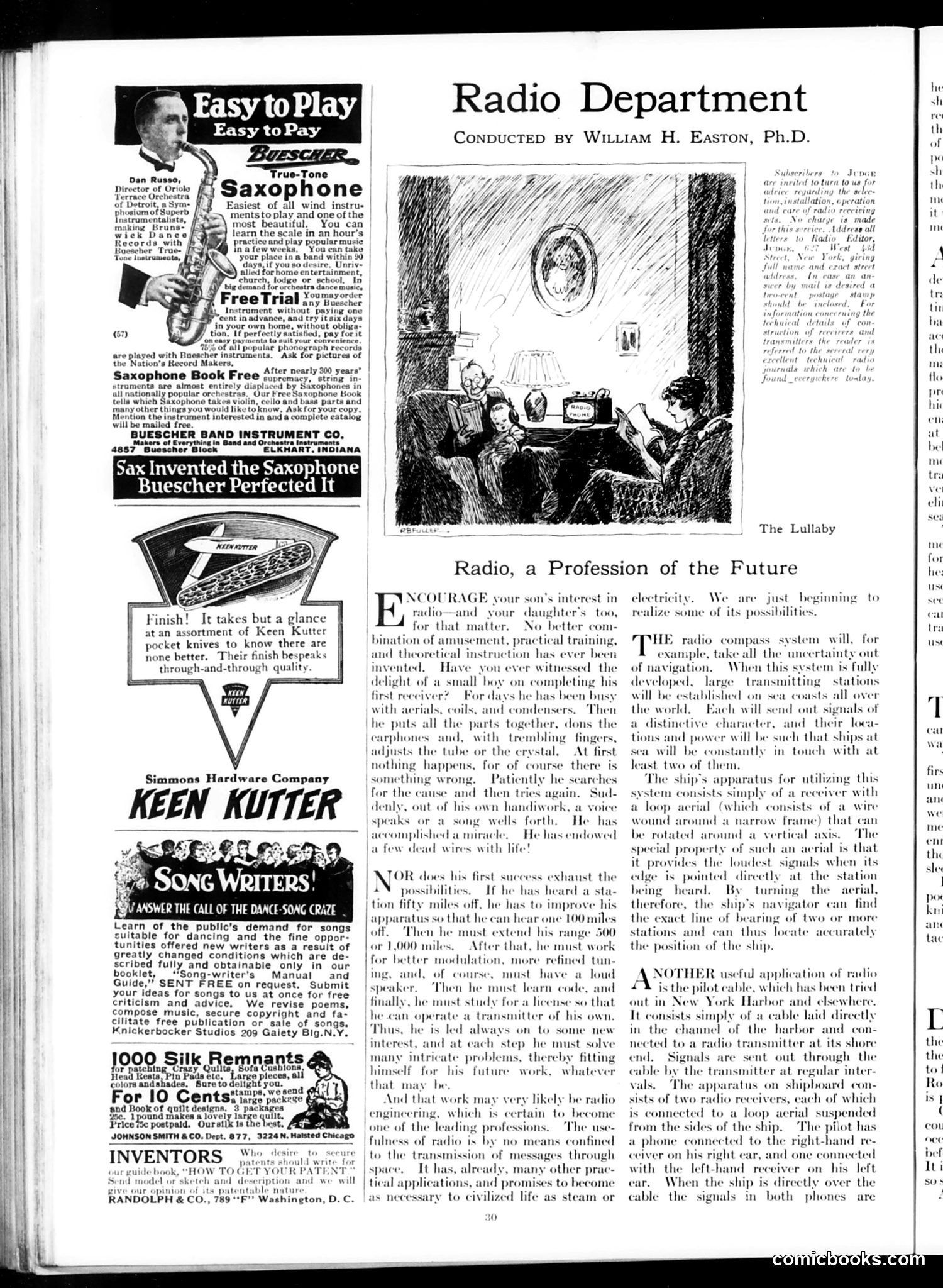
This page is primarily **educational/advisory content**, not satire. The "Radio Department" article by William H. Easton, Ph.D., encourages parents to foster their children's interest in radio as both a hobby and career path. **The illustrated cartoon** ("The Lullaby") depicts a child listening to a radio receiver—a domestic scene representing how radio is becoming integrated into family life. **The main article's argument**: Radio offers boys (and girls) practical training through hands-on experimentation—building receivers, troubleshooting problems, learning Morse code, obtaining licenses. The author frames radio not as mere entertainment but as rigorous technical education preparing youth for "one of the leading professions" of the future. **Historical context**: This reflects the 1920s radio boom, when amateur radio was genuinely a cutting-edge field attracting young enthusiasts. The piece is promotional rather than satirical, advocating radio as an intellectually legitimate pursuit for young people during a period when such emerging technologies needed cultural legitimization. The surrounding advertisements (saxophones, pocket knives, song-writing guides) are period commercial filler typical of *Judge* magazine.
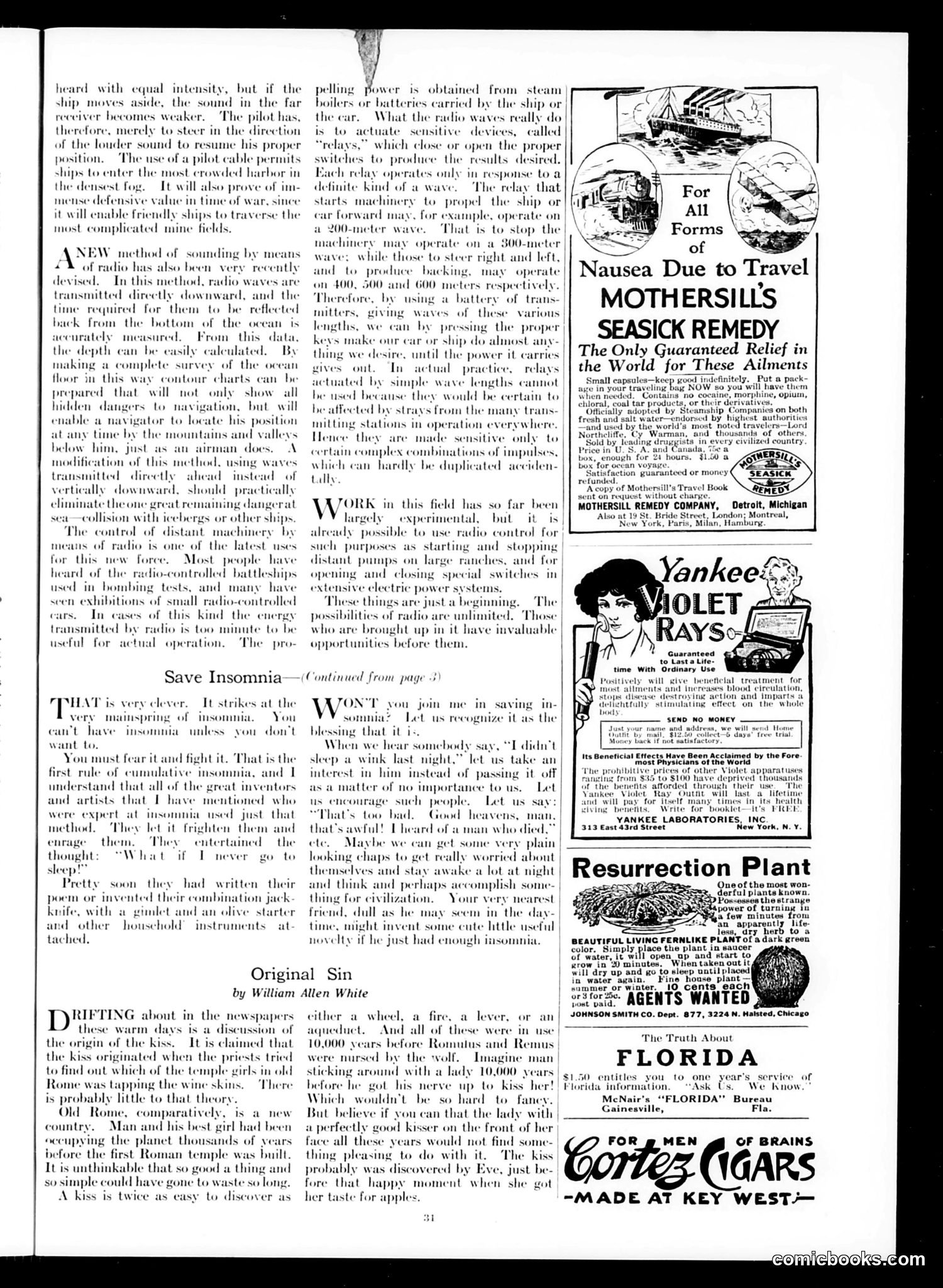
This page is primarily **educational/technical content rather than satire or political commentary**. It features: 1. **Main articles**: Discussions of radio technology applications—ocean depth-sounding, ship navigation in harbors/minefields, and remote machinery control via radio waves. This reflects early 20th-century fascination with wireless technology's practical possibilities. 2. **"Save Insomnia" column**: A humorous essay treating insomnia as something to embrace rather than fear, citing inventors and artists who allegedly used sleeplessness productively. The tone is tongue-in-cheek advice. 3. **"Original Sin" by William Allen White**: A brief essay about the historical origins of kissing. 4. **Advertisements**: For Mothersill's Seasickness Remedy, Yankee Violet Rays (medical device), Resurrection Plant, Cortez Cigars, and Florida tourism. The page demonstrates Judge's blend of serious technical journalism, light humor, and commercial advertising typical of 1920s American magazines—not political satire.
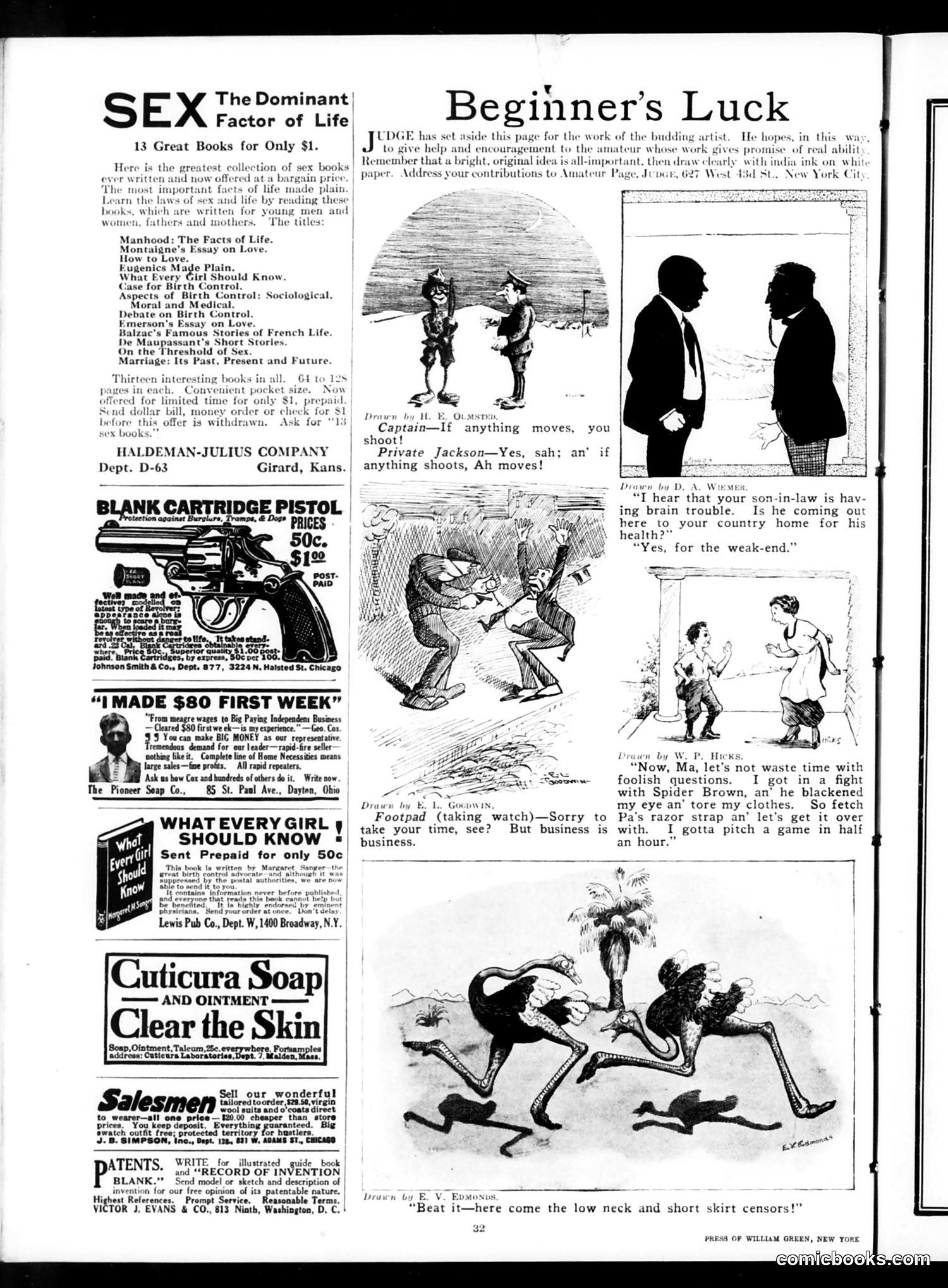
This page from *Judge* combines advertisements with cartoons illustrating common scenarios. The cartoons are brief gag strips with simple punchlines: 1. **"Beginner's Luck"** (top): A hunter and soldier stand ready to shoot. The joke hinges on military incompetence—the private accidentally moves while trying to stay still, making shooting impossible. 2. **"Footpad"** (middle-left): A mugger politely robs someone but acknowledges the inconvenience of "business." 3. **"Weak-end"** (middle-right): A pun about a son-in-law's mental health visit, playing on "weak" versus "weekend." 4. **Bottom cartoon**: Young boys anticipate censors approaching to enforce standards against revealing clothing ("low neck and short skirt"), suggesting 1920s moral anxiety about fashion and female modesty. The page primarily advertises mail-order books about sex education and self-improvement, common to this era's publishing market.
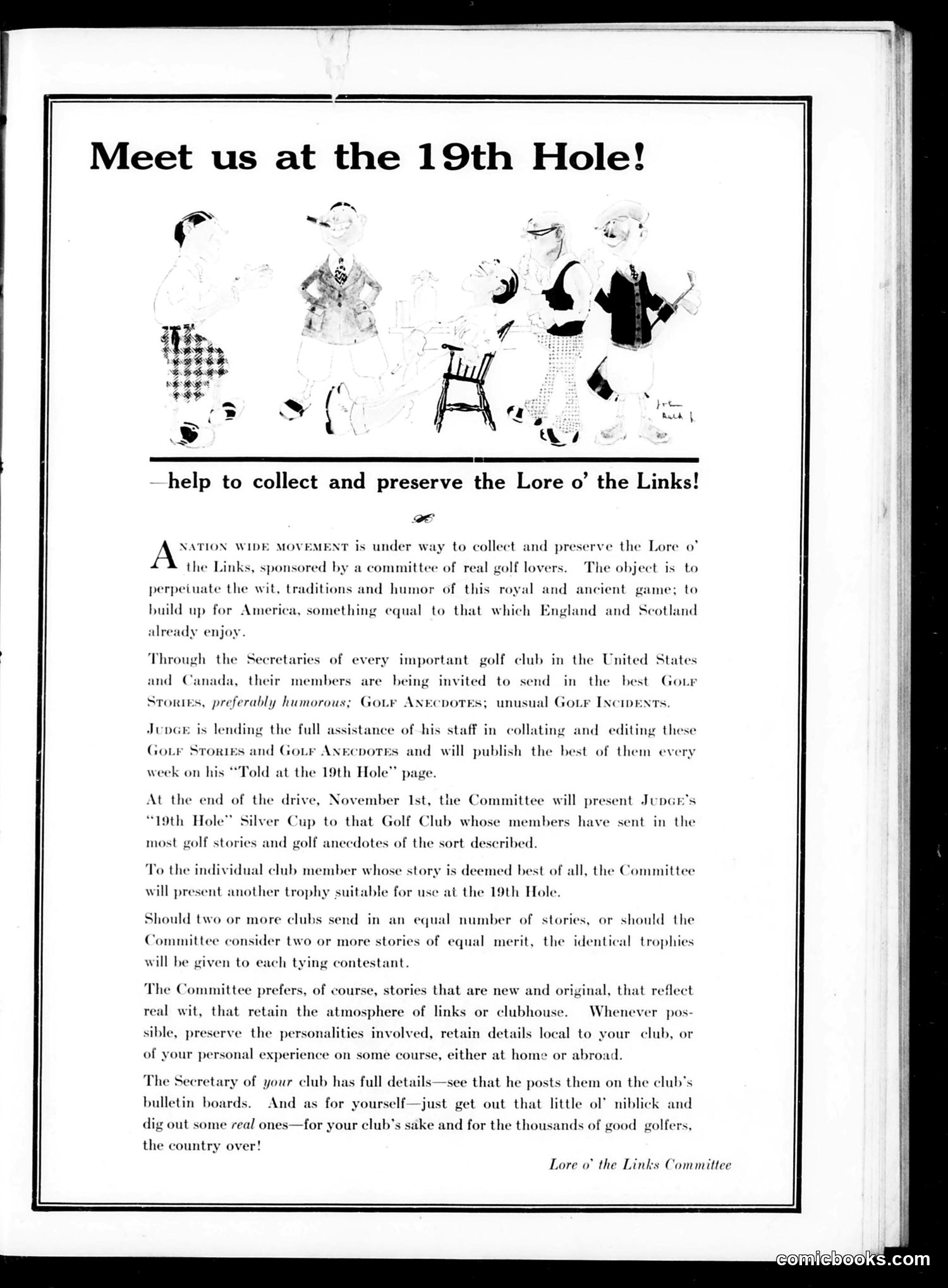
This is not a cartoon but a contest announcement by *Judge* magazine inviting golfers nationwide to submit humorous golf stories and anecdotes. The illustrated header shows stylized golfers in various poses and attire from the era. The "Lore o' the Links Committee" seeks to preserve American golf culture by collecting the best golf stories—preferably humorous, original, and reflecting real clubhouse atmosphere. *Judge* itself will publish winning submissions weekly in its "Told at the 19th Hole" page. Prizes include a silver cup for the golf club submitting the most stories and trophies for individual authors. The tone is lighthearted and encouraging, appealing to golfers' pride and competitive spirit while celebrating golf as an established American pastime worthy of cultural preservation—"something equal to that which England and Scotland already enjoy." The deadline is November 1st.
This page is **not a cartoon but an advertisement/contest announcement**. Judge magazine is soliciting reader suggestions for improvement by offering $25 per submission for the ten best ideas—substantial payment in 1922. The appeal emphasizes that Judge, while already featuring theater reviews, sports, editorials, humor columns, and artwork by leading American artists, still has "blind spots" and isn't perfect. The editors invite readers to propose new content or features rather than simply complain about existing material. The pitch is notably democratic for a satirical magazine of the era: Judge positions itself as collaborative, inviting ordinary readers into the editorial process. The deadline (August 15, 1922) and address (627 West 43rd Street, NYC) suggest active solicitation. The estimated six readers per copy means a good suggestion could reach 1.5 million people—framing contribution as culturally significant work.