
Judge, 1922-08-12 · page 13 of 36
Judge — August 12, 1922 — page 13: what you’re looking at
What you’re looking at
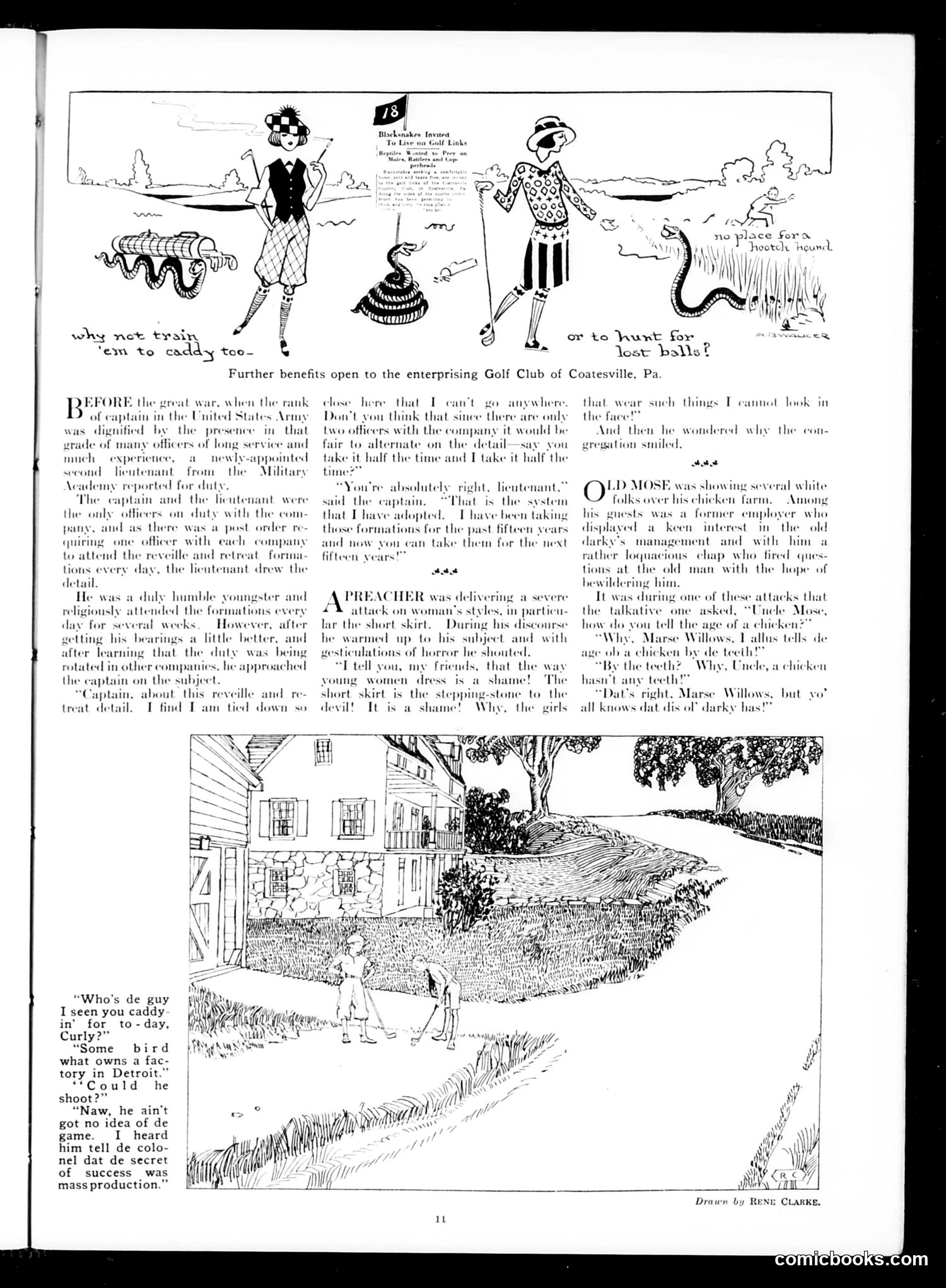
This page contains three distinct satirical pieces: **Top cartoon**: Mocks women's golf fashion by suggesting female golfers could serve alternative purposes—as caddies, hunting dogs, or "bootch hound" (bootleg alcohol runners, referencing Prohibition-era smuggling). The satire targets both women's athletic participation and prohibition enforcement. **Middle story**: A preacher condemns women's short skirts as moral corruption, yet his congregation smiles—satirizing hypocritical religious authority and generational anxiety about changing women's fashion and behavior in the 1920s. **Bottom anecdote**: A wealthy Detroit factory owner plays golf but lacks skill, attributing success to "mass production"—satirizing American industrial culture's mechanical thinking applied inappropriately to leisure activities, likely mocking nouveau riche industrialists' pretensions. The "Old Mose" dialect story appears unrelated racist stereotyping typical of period publications.
📄 Transcribed text from this page (OCR, searchable)
Machine-transcribed from the original scan — historical spelling and the odd misread are preserved.
te why net train HM ‘em to caddy too AN Sey GiiNenirs am o place fora wand hootch hounc. or to hunt for lost bells? Further benefits open to the enterprising Golf Club of Coatesville, Pa. i EFORE the great war, when the rank in in the United States Army by the that iy officers of long service and appointed Military presence in much experience, a ond lieutenant from lemy reported for duty. The captain and the lieutenant were the only off on duty with the com- pany, and as there was a post order re- quiring one officer with each company to attend the reveille and retreat) forma tions every day, the lieutenant drew the detail. He was a duly humble youngster and religiously attended the formations every for several weeks. However, after ting his bearings a little better, and learning that the duty was being Lin other companies. he approached s captain on the subject. about this reveille and re- I find Tam tied down so ywhere. © only close here that To can't Don’t vou think that since th two officers with the company: it would be fair to alternate on the detail—say you take it half the time and [take it half the time? “You're absolutely: right, lieutenant.” said the captain, “That is the system that T have adopted. T have been taking those formations for the past fifteen y and now you can take them for the next fifteen years!” rer) PREACHER was deliveri LY attack on woman’s styles, lar the short skirt. During his discourse he warmed up to his subject and with ticulations of horror he shouted. I tell you, my friends, that: the way young women dress is a shame! short skirt is the stepping-stone to. the devil! It Why, the g is a shame! “Who's de guy I seen you caddy in’ for to-day, Curly?” “Some bird what owns a fac- tory in Detroit.” “*Could he shoot?” “Naw, he ain't got no idea of de game. I heard him tell de colo- nel dat de secret of success was mass production.” that wear such things T cannot look in the face And then he wondered why gregation smiled. the con- ot as showing several white his chicken farm. Among his a former employer who displayed a keen interest. in’ the old darky's management. and with him. at rather loquacious chap who fired ques- LD MOSE folks ov ests was tions at the old man with the hope of bewildering him. It was during one of t talkative on do you tell th \ ttacks that “Uncle Mose, chicken? T allus tells de 3 re Unele, a chicken the how Willows, but) yo" darky has!