
Judge, 1922-08-12 · page 11 of 36
Judge — August 12, 1922 — page 11: what you’re looking at
What you’re looking at
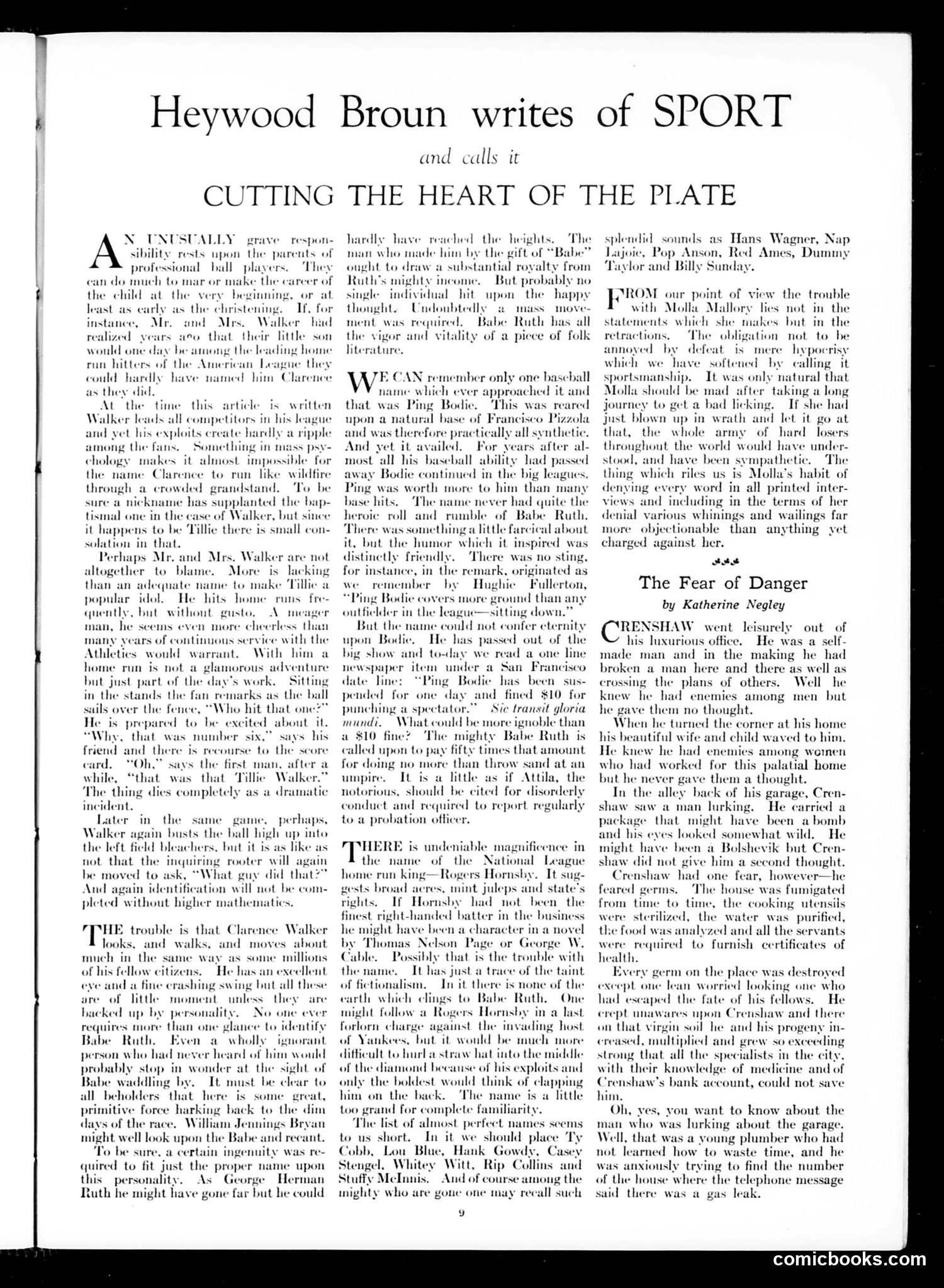
This is a sports commentary by Heywood Broun (not a cartoon) analyzing why certain baseball players capture public imagination while others don't, despite comparable talent. **The Main Figures:** - **Clarence "Tillie" Walker** - a real baseball player with excellent statistics but little fan appeal - **Babe Ruth** - the famous Yankees star with magnetic personality and perfect "brand name" - **Ping Bodie** - a historical player whose synthetic name succeeded through charm **The Satire's Point:** Broun argues that professional success depends less on actual ability than on *personality and marketability*. Walker hits home runs with technical skill but "without gusto"—he's forgettable. Ruth, by contrast, embodies raw vitality and "primitive force"; even his name carries drama. The article satirizes how mass psychology and personality cult override merit in American sports fandom. **Social Context:** This reflects 1920s concerns about celebrity culture, mass media's power, and whether substance or showmanship determines public success—issues remarkably similar to modern celebrity discourse.
📄 Transcribed text from this page (OCR, searchable)
Machine-transcribed from the original scan — historical spelling and the odd misread are preserved.
Heywood Broun writes of SPORT and calls it CUTTING THE HEART OF THE PLATE N UNUSUALLY grave respon- sibility rests upon the parents of professional ball players. ‘They ean do much to mar or ma ik the career of the child at the very be ing, least as carly as the christening instance Mr. and Mrs. Walker realized years 20 that their little would one day be among the leading home run hitters of the American League they could hardly have named him Clarence as they did. At the time this article is written Walker leads all competitors in his | and yet his exploits create hardly a ripple among the fans. Something in mass psy- chology makes it almost. impossible for the name Clarence to run like wildfire through a crowded grandstand. ‘To be sure a nickname has supplanted the bap- tismal one in the case of Walker, but since appens to be Tillie there is small con- tion in that. 9s Mr. and Mrs. Walke altogether to blame. More is than an adequate name to make Tillie a popular idol. He hits home runs fre- quently, but without gusto. AU me: man, he seems even more cheerless than many years of continuous service with the Athletics would warrant. With him a home run is not a glamorous adventure but just part of the day’s work. Sitting in the stands the fan remarks as the ball sails over the fence, “Who hit that one?” He is prepared to be excited about it. “Why, that was number uys his friend and there vurse to the score card, “Oh,” says the first man, after a while, “that was that ‘Tillie Walker.” The thing dies completely as a dramatic incident. Later in ad gue ager the game, perhaps, Walker in busts the ball high up into the left 1 bleachers, but it is as like « not that the inquiring rooter will ag sd to ask, “What guy did that?” nin identification will not be com- without higher mathematics. same pletec HE trouble is that Clarence Ws looks, and walks, and moves i much in the same way millions of his fellow citizens. He has an excellent eye and a fine crashing swing but all these are of lithe moment unless. they are backed up by personality. No one ever requires more than one glance to identify Babe Ruth. Even a wholly ignorant person who had 1 t heard of him would probably stop in wonder at the sight of Babe waddling by. Th must be eh all beholders that here primitive force harking days of the race. William Jennings Bryan might well look upon the Babe and recant. ‘To be sure, a certain ingenuity was re- quired to fit just the proper name upon this personality. As Herman Ruth he might have gone far but he could k to the dim reached the heights. ‘The Je him by the gift of “Babe” a substantial royalty from Ruth's mighty income. But probably no single individual hit upon the happy thought. Undoubtedly a mass move- ment was required. Babe Ruth has all the vigor and vitality of a piece of folk literature. have hardly WE CAN remember only one baseball name which ever yached it and that was Ping Bodie. ‘This was reare upon a natural base of Francisco Pizzola and was there! ally all synthetic. And yet it availed. For years after al- most all his base’ ity had passed away Bodie continued in the big leagues. Ping was worth more to him than many ‘The name never had quite the and rumble of B: Ruth. ‘There was somethin, ittle f: ul about it, but the humor which it inspired was distinctly friendly. There was no sting, for instance, in the remark, originated as we remember by Hughie Fullerton, “Ping Bodie covers more ground than any outfielder in the league—sitting down But the name could not confer lity upon Bodie. He has passed out of the big show and to-day we read a one line newspaper item under a San Francisco date line: “Ping Bodie has been sus- pended for one day and fined $10 for punching a spectator.” Sic transit gloria mundi. What could be more ignoble than a $10 fine? The mighty Babe Ruth is Hed upon to pay fifty times that amount for doing no more than throw sand at an umpire. It is a little as if Attila, the notorious, should be for disorderly conduct and required to report regularly to a probation officer, base hits. heroic roll gnificence in name of the National League Rogers Hornsby. It s gests broad s. mint juleps and state's rights. If Hornsby had not been the finest right-handed batter in the business he might have been a character in a novel by Thomas Nelson Page or George W. Cable. Possibly that is the trouble with the name. It has just a trace of the taint of fictionalism. In it there is none of the earth which clings to Babe Ruth. One ight follow a Rogers Hornsby in a last orn charge against the invading host of Yankees, but it, would be much more difficult to hurl a straw hat into the middle of the diamond because of his exploits and only the boldest would think of clapping him on the back. The name is a little too grand for complete familiarity. The list of almost perfect names seems to us short. In it we should place ‘Ty Cobb, Lou Blue, Hank Gowdy, ‘ Stengel, Whitey Witt, Rip Collins and Stuffy McInn And of course among the mighty who are gone « ay recall such THERE is undeniable m: the home run kin; 9 splendid sounds as Hans Wagner, Nap Lajoic, Pop Anson, Red Ames, Dummy Taylor and Billy Sunday. Frkom our point of view the trouble with Molla Mallory lies not in the statements which she makes but in the retractions. The obligation not to be annoyed by defeat is mere hypocrisy which we have softened by calling it sportsmanship. It was only natural that Molla should be ma ter taking a long journey to get a bad licking. If she had just blown up in wrath and let it go at that, the whole army of hard losers throughout the world would have under- stood, and have been sympathetic. The thing which riles us is Molla’s habit of denying every word in all printed inter- views and including in the terms of her denial various whinings and wailings far more objectionable than anything yet charged against her. ste The Fear of Danger by Katherine Negley RENSHAW. went his luxurious office. He was a self- made man and in the making he had broken a man here and there as well as crossing the plans of others. Well he knew he had enemies among men but he gave them no thought. When he turned the corner at his home his beautiful wife and child waved to him. He knew he had enemies among women who had worked for this palatial home but he never gave them a thought. In the alley back of his garage, Cren- shaw saw a man lurking. He carried a package that might have been a bomb and his eyes looked somewhat wild. He might have been a Bolshevik but Cren- shaw did not give him a second thought. Crenshaw had one fear, however—he feared germs. The house was fumigated from time to time, the cooking utensils were sterilized, the water was purified, the food was analyzed and all the servants were required to furnish certificates of health. leisurely out of germ on the place was destroyed lean worried looking one who ved the fate of his fellows. He crept unawares upon Crenshaw and there on that virgin soil he and his progeny in- creased, multiplied and grew so e xceeding strong that all the specialists in the city, with their knowledge of medicine and of Crenshaw’s bank account, could not save him. Oh, yes, you want to know about the man who Was lurking about the garage. Well, that was a young plumber who had not learned how to waste time, and he was anxiously trying to find the number of the house where the telephone message said there was a gas leak. comicbooks.com