
Judge, 1922-08-12 · page 23 of 36
Judge — August 12, 1922 — page 23: what you’re looking at
What you’re looking at
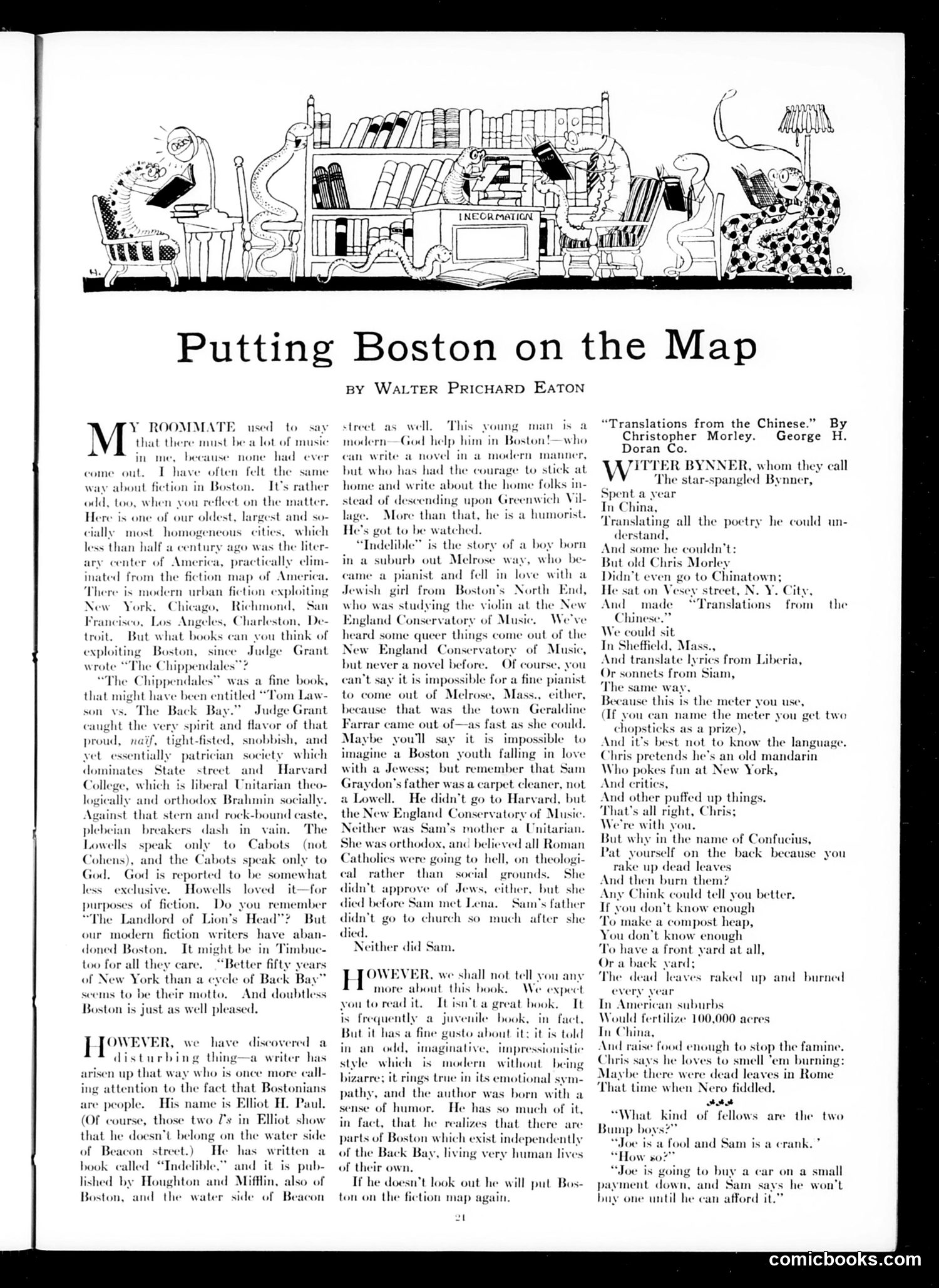
This is an editorial piece by Walter Prichard Eaton discussing a new novel called "Indelible" by Elliot H. Paul, published by Houghton and Mifflin (a Boston publisher). **The Point:** Eaton laments that Boston—despite being "one of our oldest, largest and socially most homogeneous cities"—has been absent from modern American fiction. Cities like New York, Chicago, and San Francisco dominate novels, but Boston remains unexploited literary territory. He celebrates Paul's "Indelible" as finally "putting Boston on the map" of fiction. **The Novel's Plot:** "Indelible" tells of a young pianist from suburban Melrose who falls in love with a Jewish girl from Boston's North End studying at the New England Conservatory of Music—a romance that challenges Boston's rigid Brahmin social hierarchy (the famous "Lowells speak only to Cabots" crowd). **The Satire:** The piece gently mocks Boston's exclusionary, old-money Protestant establishment while praising Paul for having the courage to set a contemporary novel there and write about ordinary "home folks" rather than exotic locales. The illustration shows a library scene with figures reading and lounging among books.
📄 Transcribed text from this page (OCR, searchable)
Machine-transcribed from the original scan — historical spelling and the odd misread are preserved.
Putting Boston on the Map Y ROOMMATE used to say M that there must be a lot of music in me, because none had ever come out. I have often felt the same way about fiction in Boston. It's rather odd, too, when you reflect on the matter. Here is one of our oldest, largest and so- cially most) homogeneous cities, which less than half a centur ary center of America, practically clim- inated from the fiction map of Am There is modern urban fiction exploiting New York, Chicago, Richmond, San Francisco, Los Angeles, Charleston, De- But what books can you think of exploiting Boston, udge Grant he Chippendales Chippendales” was 4 that might have been entitled “Tom Law- Back Bay.” Judge Grant spirit and flavor of that proud, 1 lit-fisted, snobbish, and yet essentially patrician society which dominates State street Harvard College, which is liberal Unitarian theo- gically and orthodox Brahmin socially. Against that stern and rock-bound caste, plebeian breakers dash in’ vain. ‘The Lowells speak only to Cabots (not Cohens), and the Cabots speak only to God. God is reported to be somewhat less exclusiv Howells loved —it—for purposes of fiction. Do you remember “The Landlord of Lion’s Head”? But our modern fiction writers ha aban- doned Boston, It might be in ‘Timbuc- too for all they care. “Better fifty year of New York than a cycle of Back Bay” seems to be their motto, And doubtless Boston is just as well pleased. go was the liter- since wrote “ fine book, son vs. The caught the and FOWEVER, we have discovered a disturbing thing—a writer has arisen up that way who is once more call- ing attention to the fact that Bostonians are people. His name is Elliot H. Paul. (Of course, those two I's in Elliot show that he doesn’t belong on the water side street.) He has written a Hed “Indelible.” and it is pub- lished by Houghton and Mifflin, also of Boston, and the water side of Beacon BY WALTER PRICHARD EATON well. This is a God help him in Boston! can write a novel in a modern manner, but who has had the courage to stick at home and write about the home folks in- stead of descending upon Greenwich Vil- More than that, he is a humorist. s got to be watched. “Indelible” is the story of in a suburb out Melrose way, who be- street as young man modern. who boy born came a pianist and fell in love with a Jewish girl from Boston’s North End, who was studying the violin at the New England Conservatory of Music. We've heard some queer things come out of the New England Conservatory of Music, but ney novel befc Of course, you can’t say it is impossible for a fine pianist to come out of Melrose, Mass., either, because that the town Geraldine Farrar came out of—as fast as she could. be you'll say it imagine a Boston youth falling in love with a Jewess; but remember that Sam Graydon’s father was a carpet cleaner, not a Lowell. He didn’t go to Harvard, but the New England Conservatory of Music. Neither was Sam's mother a Unitarian. She was orthodox, and believed all Roman Catholics were going to hell, on theolog cal rather She didu’'t approve of J died before Sam met Lena. didn’t go to church so much after she was is impossible to ands. but she than social Ws, Sam’s father died. Neither did Sam. I VEVER, we shall not tell you any bout this 1 We expect you to read it. Tt isn’t a great book. It is frequently a juvenile book, in fact. But it has a fine hout its it is told in an odd, in impressionistic style which is modern without bizarre; it rings true in its emotional sym- pathy, and the author was born with a sense of humor. He has so much of it, in fact, that he zes that there are parts of Boston which exist independently of the Back Bay, living very human lives of thei If he Wt look out he will put’ Bos- ton on the fiction map again. being “Translations from the Chinese.” By Christopher Morley. George H. Doran Co. WITTER BYN ‘The star-sps Spent a year In C Translating all the poetry he could un- derstand, And some he couldn't: But old Chris Morley Didn't even go to Chi He sat on Ve: And made Chinese. We could sit In Sheffield, Mass., And translate lyrics from Liberia, Or sonnets from Siam, ‘The same way, Because this is the meter you use, (If you can name the meter you get two chopsticks as a prize), And it’s best not to know the language. Chris pretends he’s an old mandarin Who pokes fun at New York, And critics, And other puffed up things. ‘That's all right, Chris; We're with you. But why in the name of Confucius, Pat yourself on the back because you rake up dead leaves And then burn them? Any Chink could tell you better. If you don’t know enough ‘To make a compost heap, You don’t know enough ‘To have a front yard at all, ER, whom they call led Bynner, vy. ¥. Translations from — the Tn China, And raise food enough to stop the famine, Chris says he loves to smell ’em burning: Maybe there were dead leaves in Rome That time when Nero fiddled, te “What kind of fellows are the two Bump boys?” x¢ is a fool and Sam is a crank.” How x07" “Joe is going to buy a car on a small payment down, and ays he won't buy one until he ean afford it.” comicbooks.com