
A complete issue · 36 pages · 1922
Judge — January 14, 1922
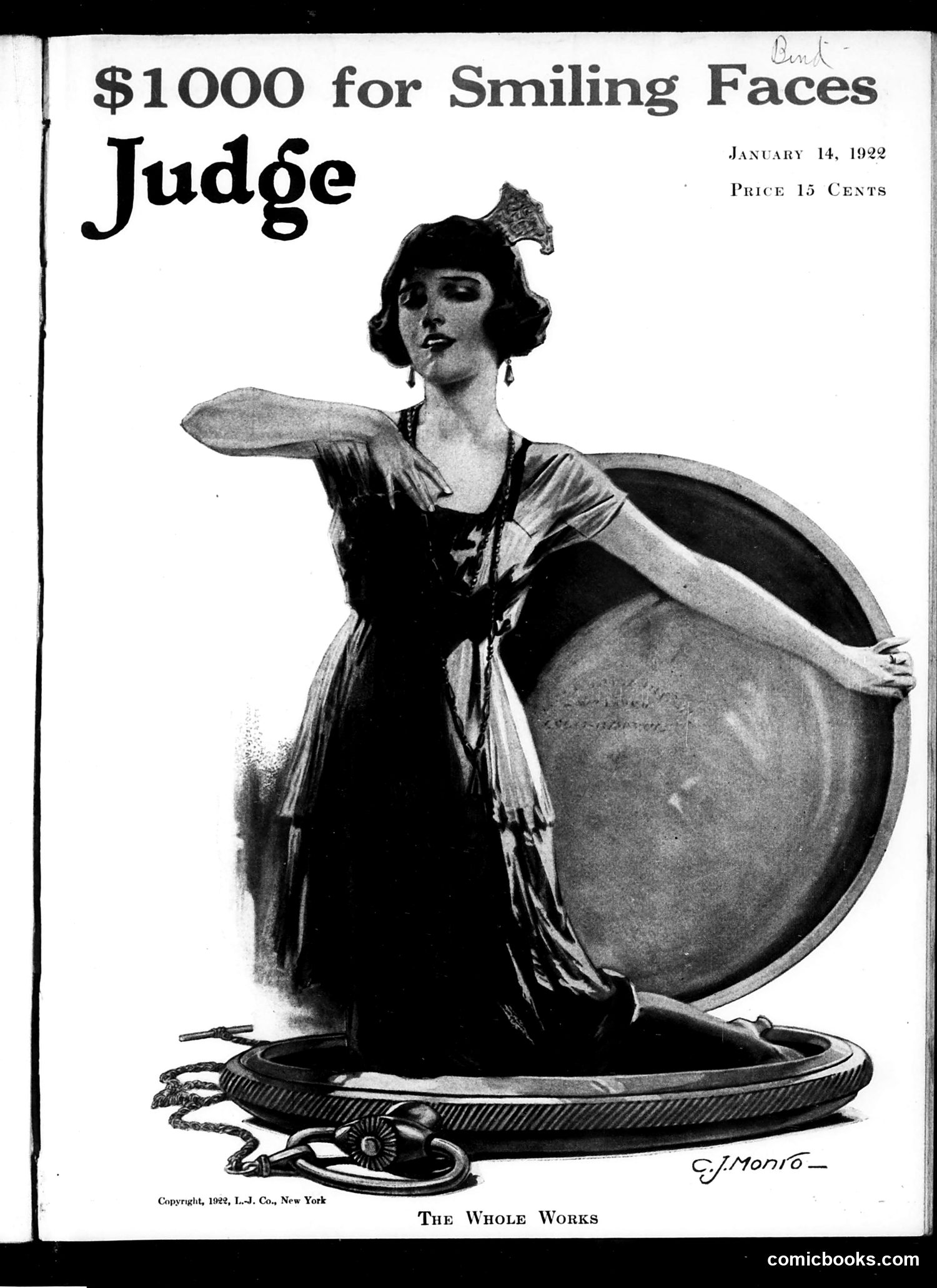
This January 14, 1922 *Judge* magazine cover features an Art Deco-styled illustration of a woman posing with large decorative plates or discs. The headline "$1000 for Smiling Faces" suggests this is advertising or promoting a contest or competition—likely related to beauty, entertainment, or modeling, which were emerging commercial industries in the 1920s. The figure's fashionable bob haircut, elegant draped clothing, and confident posture exemplify the "modern woman" ideal of the Jazz Age. The prominent display of decorative objects and the substantial prize amount ($1000 was significant in 1922) indicate this celebrates consumer culture and commercialized beauty standards gaining prominence during this era. The artwork is credited to G. J. Monro.
This page is primarily **advertising for Leslie's Weekly magazine** rather than political satire or comics. The headline "Is It Chiropractic?" appears to be a rhetorical question promoting an investigative article by Severance Johnson about the chiropractic medical movement—which the text characterizes critically as a "modern-day cult" claiming to cure all human ailments while dismissing conventional medicine and surgery. The ad then pivots to promoting Leslie's Weekly's January 14th issue, listing various feature articles and noting the magazine costs 10 cents. The tone is promotional rather than satirical. While the chiropractic critique reflects early 20th-century skepticism toward alternative medicine, this is straightforward magazine advertising rather than political cartoon commentary.
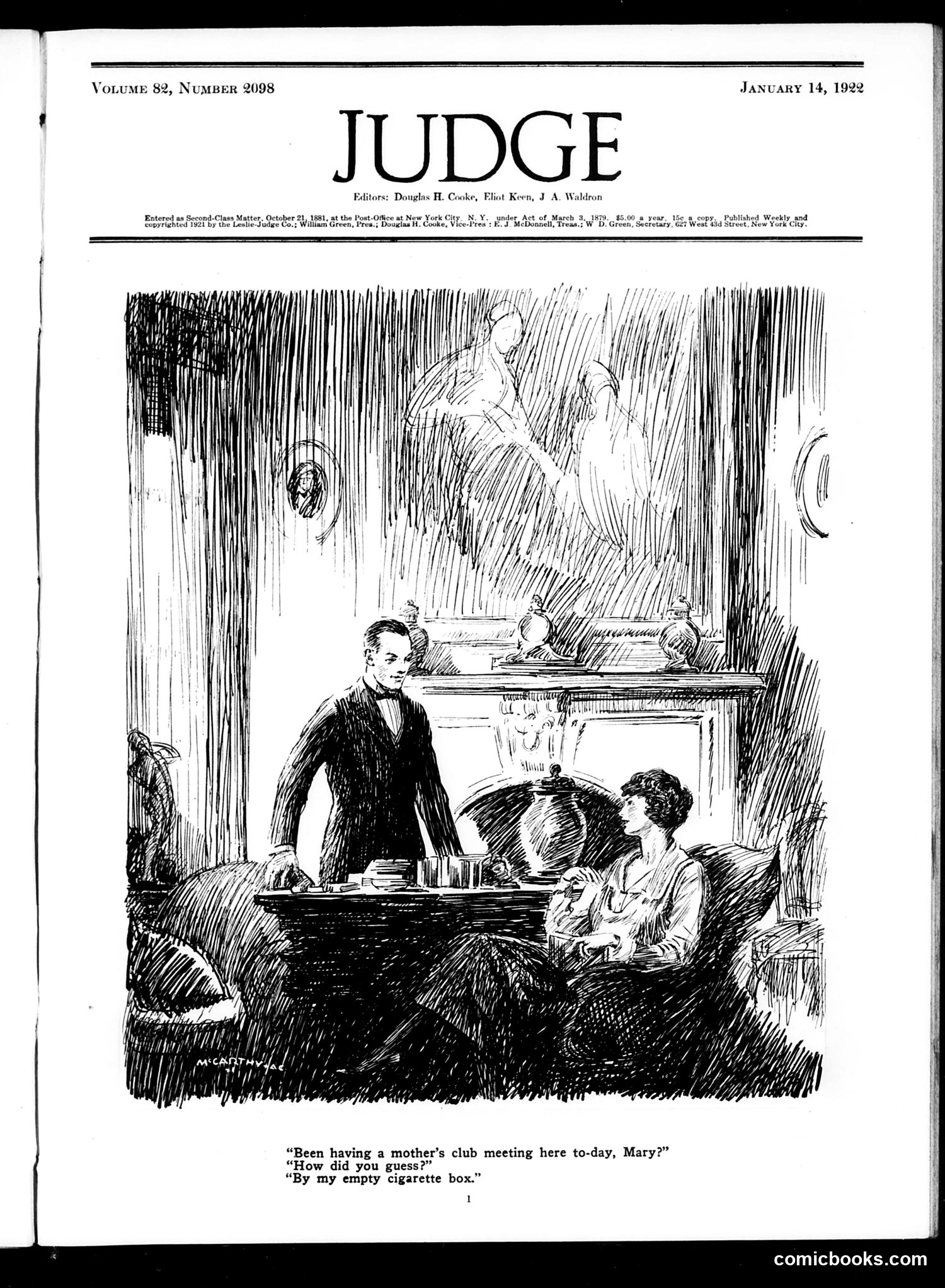
This 1922 *Judge* cartoon depicts a domestic scene satirizing gender relations and social conventions of the era. A man confronts a woman about her whereabouts, asking if she attended a "mother's club meeting." She replies, "By my empty cigarette box"—implying she smoked through her supply while out, revealing her alibi through this evidence. The satire targets the growing independence of women in the 1920s (the "Flapper" era) and male suspicion of female autonomy. The joke assumes women's increasing freedom to leave home, smoke publicly, and participate in social activities challenged traditional domestic expectations. The man's skeptical interrogation reflects anxieties about changing gender roles during this transitional period.
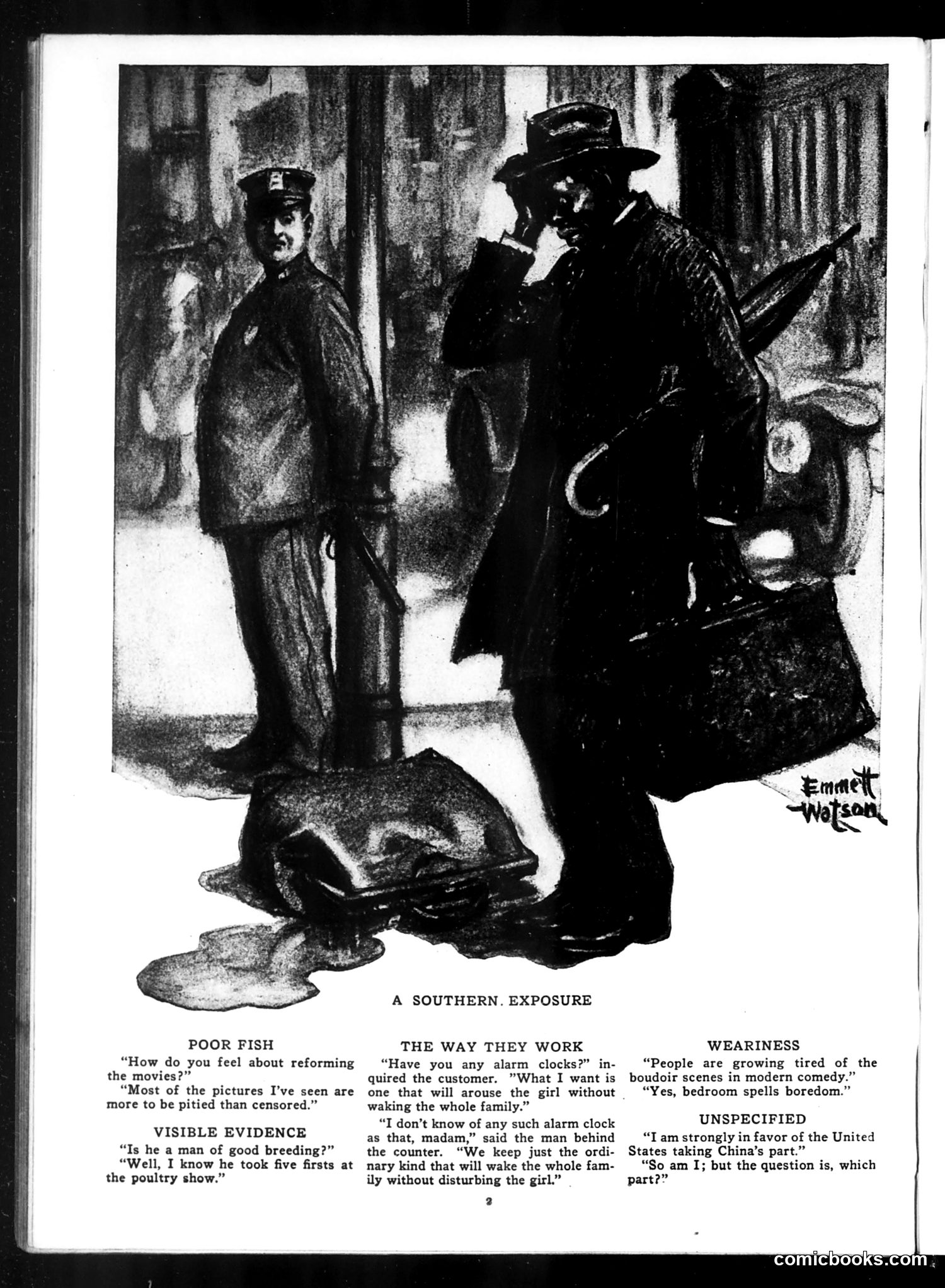
This satirical cartoon by Emmett Watson depicts a street scene with two uniformed officers discovering a dead body. The title and accompanying jokes satirize Southern racial violence and censorship of film content. The dialogue snippets mock: 1. **Film censorship**: Studios claiming to remove "immoral" content while ignoring depictions of lynching 2. **Southern violence**: The dead body represents victims of racial terror, presented as something routine to "expose" 3. **Hypocrisy**: The contrast between censoring bedroom scenes versus tolerating "Southern" (racial) violence The cartoon critiques how American institutions—both entertainment and law enforcement—tolerated or obscured racial murders while policing other "moral" content. The dead body is the dark joke: what reformers truly overlook.
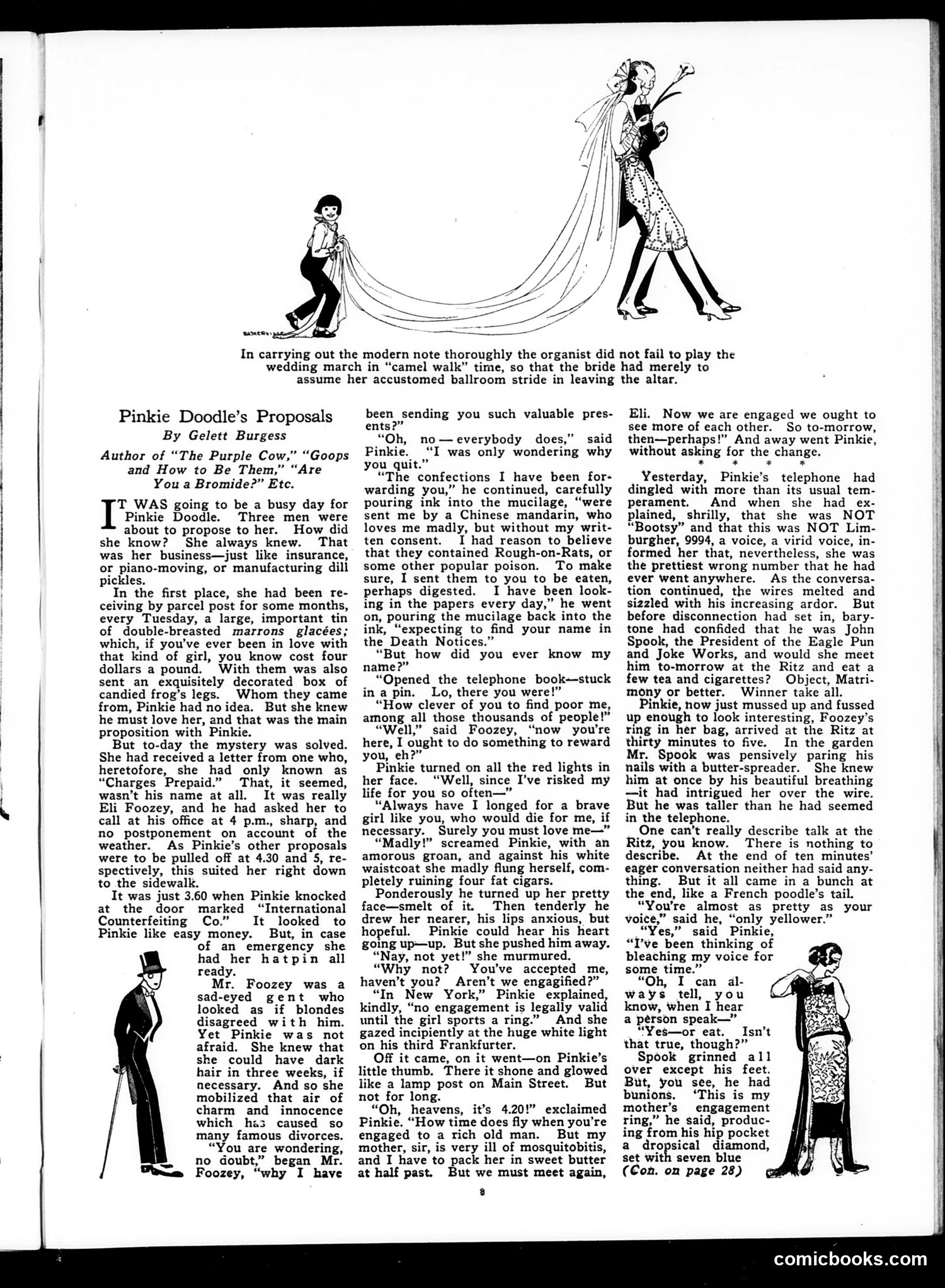
This page features a humorous short story by Gelett Burgess titled "Pinkie Doodle's Proposals." The illustration at the top shows a bride in an exaggerated wedding dress with an extremely long train being carried by a small boy, satirizing modern wedding fashion excess. The story itself is a comedic narrative about Pinkie Doodle receiving multiple marriage proposals—from a Chinese mandarin, a wealthy man named Poozey, and others—while already engaged. The humor derives from Pinkie's romantic complications and the absurd suitors vying for her attention. The text mocks both the frivolousness of engagements in the era and the melodramatic courtship customs of the time, presenting Pinkie as a character navigating ridiculous romantic entanglements with deadpan wit.
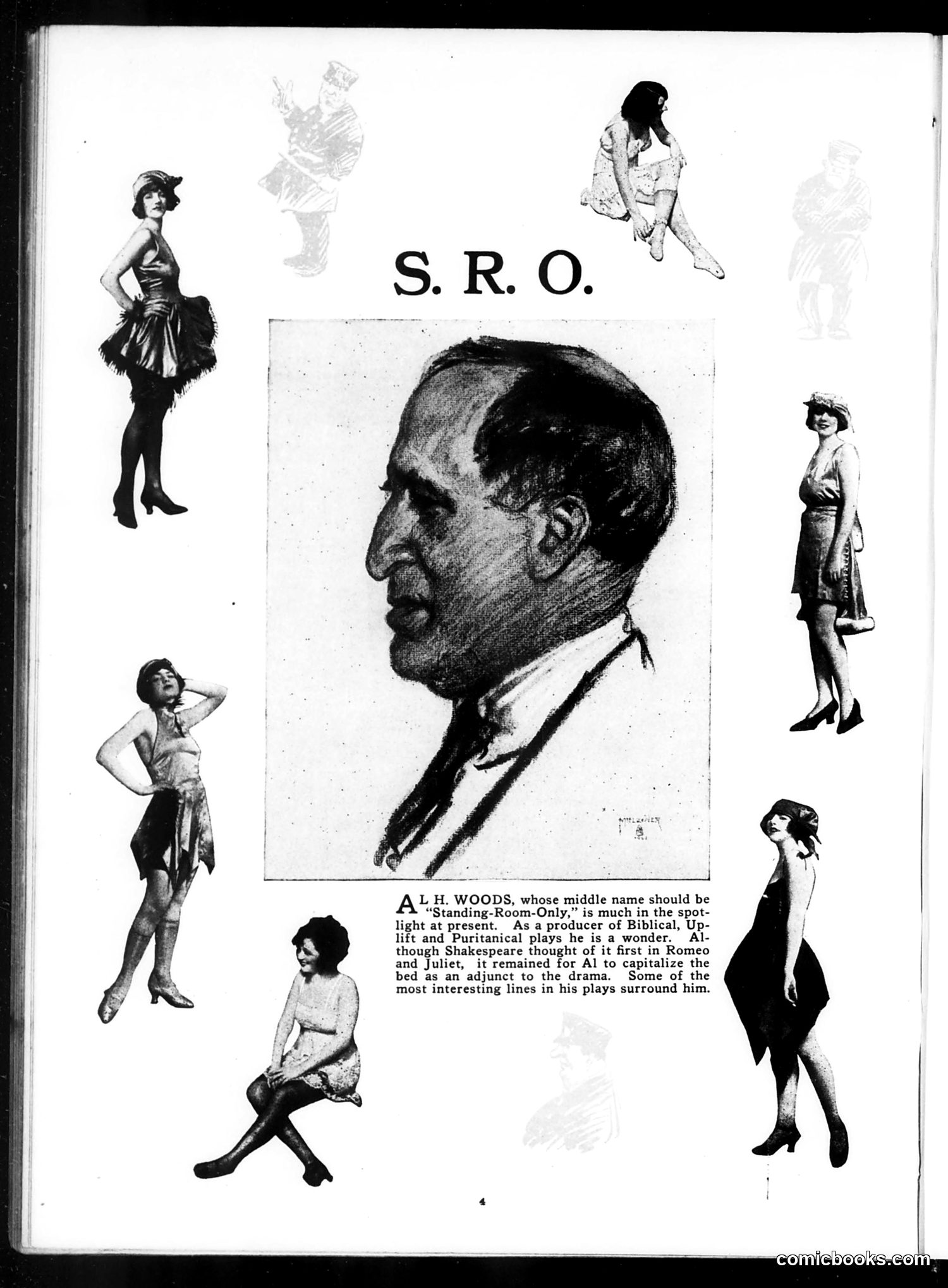
This page features **Al H. Woods**, a theatrical producer whose initials form "S.R.O." (Standing Room Only—theater slang for a sold-out show). The central portrait shows Woods in profile. The caption describes Woods as a producer of "Biblical, Uplift and Puritanical plays," noting that while Shakespeare first used Romeo and Juliet, Woods "remained for Al to capitalize the idea as an adjunct to the drama." The surrounding illustrations appear to be actresses or theatrical performers in various poses and costumes. The satire likely mocks Woods' commercial success with moralistic theatrical productions and his exploitation of classic material for profit—a common target of Judge's theatrical criticism during this era.
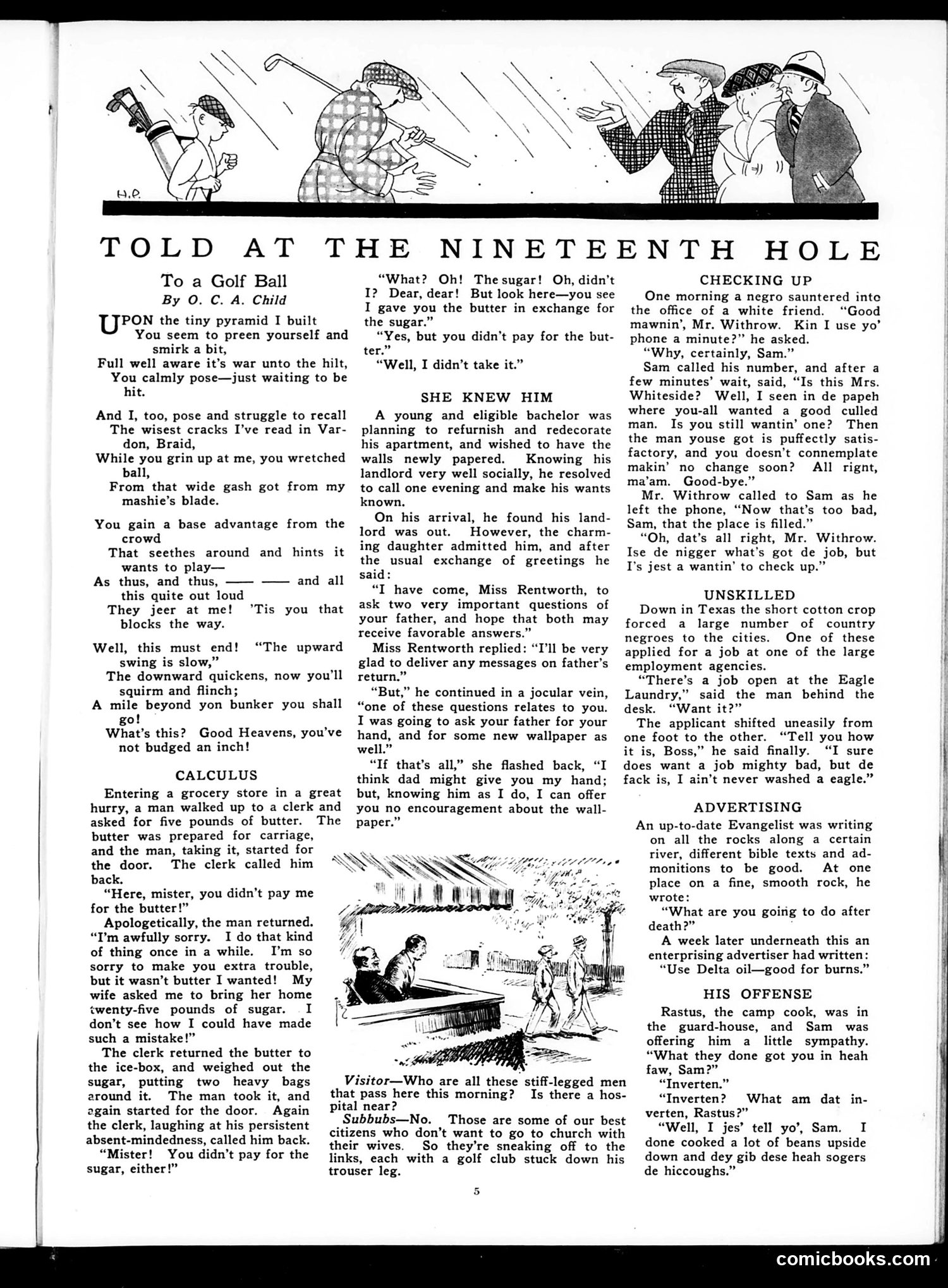
This page collects humorous anecdotes centered on golf culture. The main content includes: **"To a Golf Ball"**: A poem about a frustrated golfer's failed swing, personifying the ball as a smug antagonist. **"Calculus"**: A comedy sketch about an absent-minded man who confuses butter and sugar purchases, repeatedly forgetting to pay—a joke about mental distraction. **"She Knew Him"**: A bachelor proposes marriage to his landlord's daughter while also requesting wallpaper, expecting refusal on both counts; she accepts marriage but jokes the father won't approve the wallpaper improvements. **"Visitor/Suburbs"**: A visual gag depicting men concealing golf clubs down their trouser legs to sneak away to golf courses instead of attending church—mocking both golfers' devotion to the sport and their dishonesty with families. The page satirizes early 20th-century golf obsession among middle-class men, portraying it as consuming, distracting, and worth considerable deception. The tone is lighthearted rather than harsh.
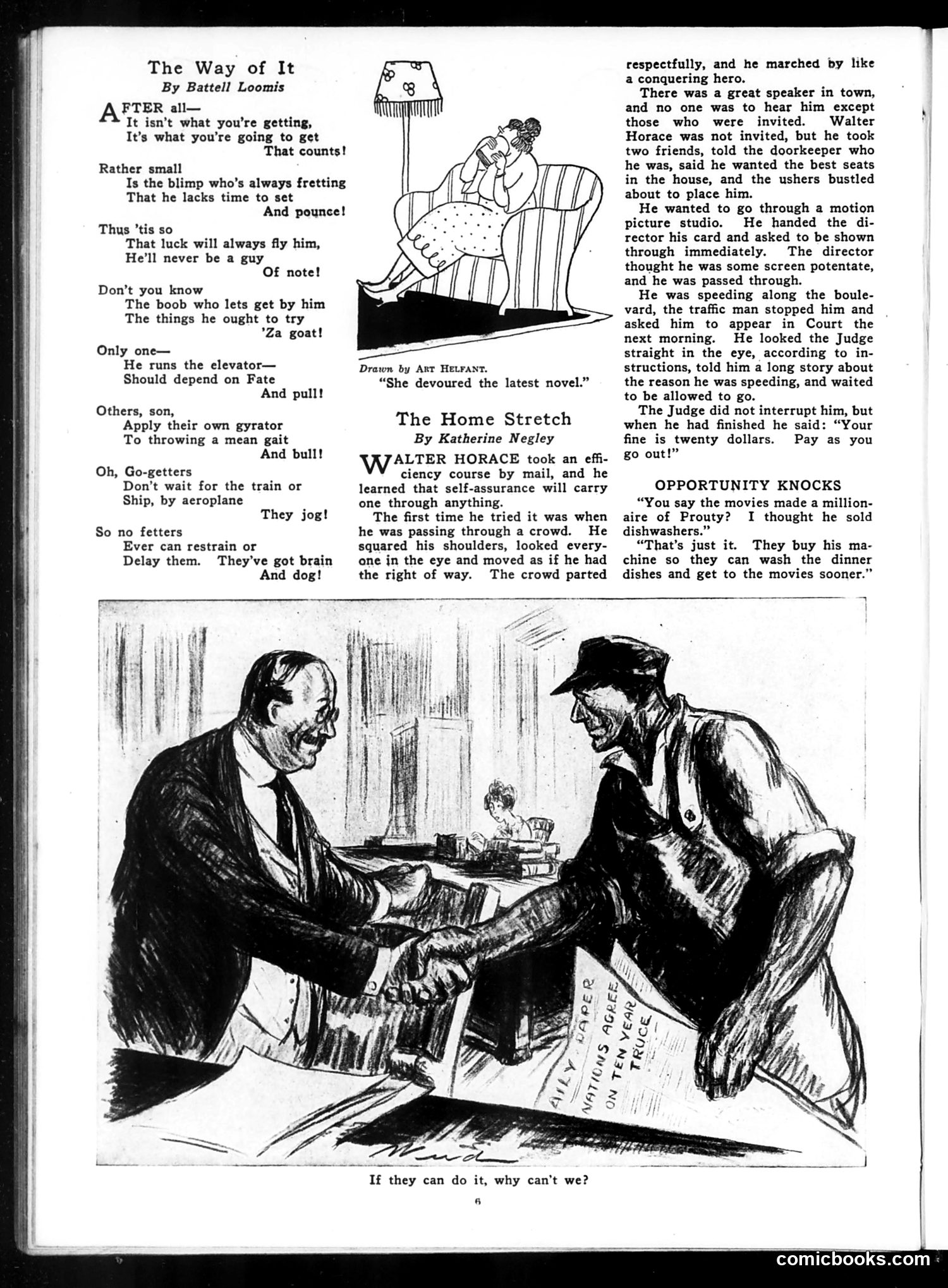
This page from *Judge* magazine contains two satirical pieces: **"The Way of It"** (poem by Battell Loomis): A commentary on American success culture, mocking passivity and promoting aggressive self-promotion. It celebrates "go-getters" who seize opportunities without waiting, using dismissive terms ("blimp," "boob") for hesitant people. The satire appears to target both excessive ambition and timid inaction. **"The Home Stretch"** (story by Katherine Negley): Satirizes the popular "self-help" movement of the early 20th century. Walter Horace takes a mail-order efficiency course teaching that confidence alone conquers obstacles. The story shows this working absurdly well—until he's caught speeding and fined anyway, deflating the self-help promise. **"Opportunity Knocks"**: A brief joke about movies' cultural dominance, showing how even wealthy people (movie millionaires) buy labor-saving devices primarily to free time for cinema—satirizing cinema's grip on American leisure time. The cartoons mock both earnest self-improvement culture and American hustle mentality.
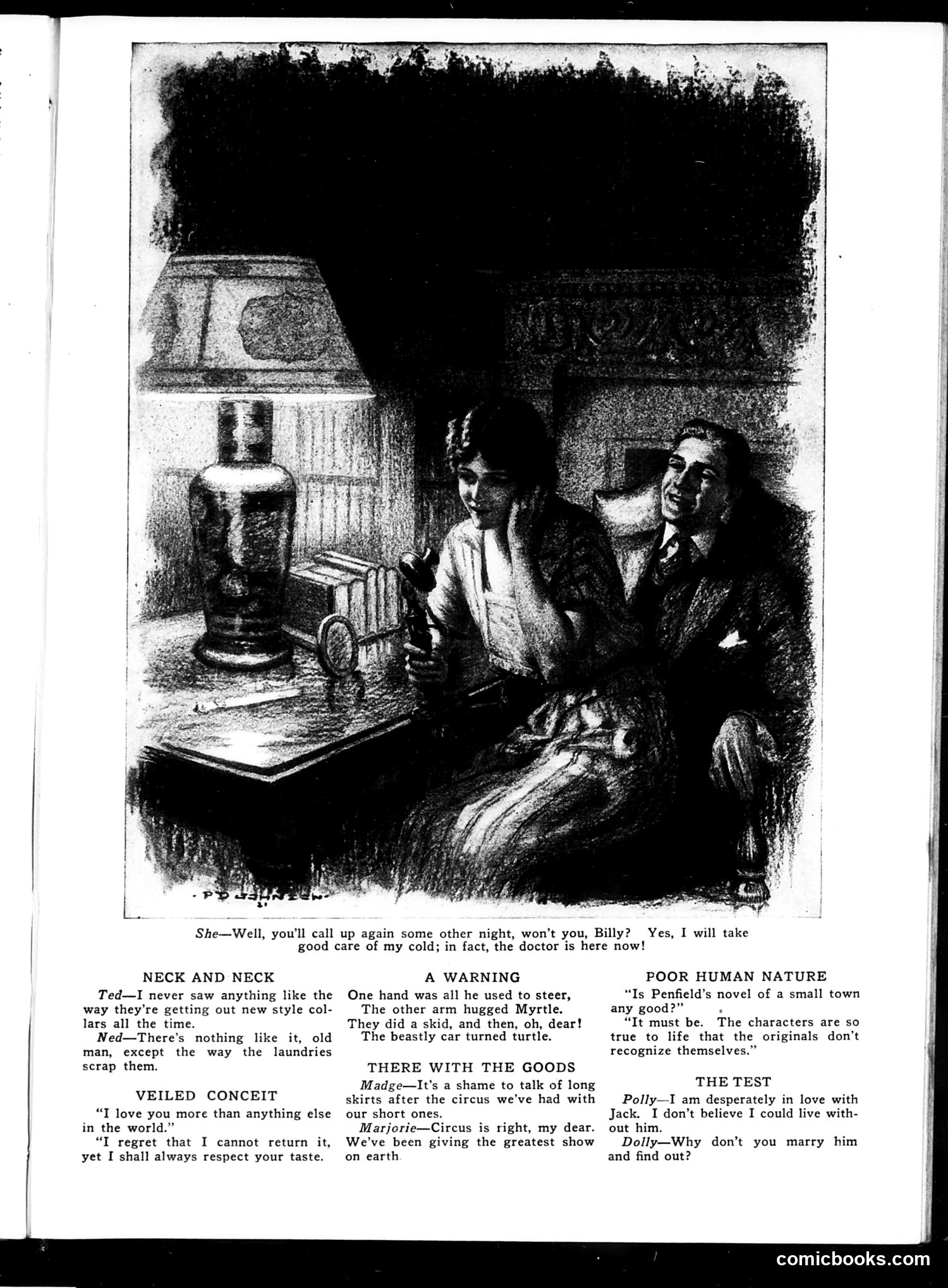
This page contains multiple short humorous pieces typical of early 20th-century satirical magazines: **Main cartoon** (top): Shows a woman with a male visitor while a doctor is present, suggesting she's using a cold as a pretext to entertain a gentleman caller—satirizing courtship pretexts and social proprieties. **Text pieces below** mock contemporary social trends and attitudes: - **"Neck and Neck"**: Jokes about rapidly changing shirt collar fashions versus laundry's tendency to destroy clothes - **"A Warning"**: Satirizes dangerous automobile driving behavior (one-handed steering while embracing a passenger) - **"There with the Goods"**: References changing hemline fashions, particularly shorter skirts becoming acceptable - **"The Test"** and **"Veiled Conceit"**: Mock romantic sentimentality and insincere declarations of love The humor relies on recognizing contemporary fashion anxieties, early automobile culture hazards, and dating/courtship social conventions. No specific political figures appear identifiable in the illustration.
This page reviews travel books, using them to comment on contemporary attitudes. The header cartoon shows seven figures reading various books about different regions and modes of travel. The main satire targets casual, non-confrontational travel writing. Author Walter Prichard Eaton praises Lewis Freeman's *Down the Columbia* and Julian Street's *Mysterious Japan* for being honest accounts without preaching hate—a pointed reference to contemporary anti-Japanese sentiment among American "patriots" who were agitating for war with Japan. The secondary feature celebrates actor Allan Pollock's theatrical "comeback" after WWI service left him severely wounded. Eaton presents this as genuinely impressive but notes Pollock finds the fuss boring—a gentle jab at performative patriotism. Overall, the page advocates for thoughtful, unprejudiced observation of the world over inflammatory nationalism, using book reviews as its vehicle.
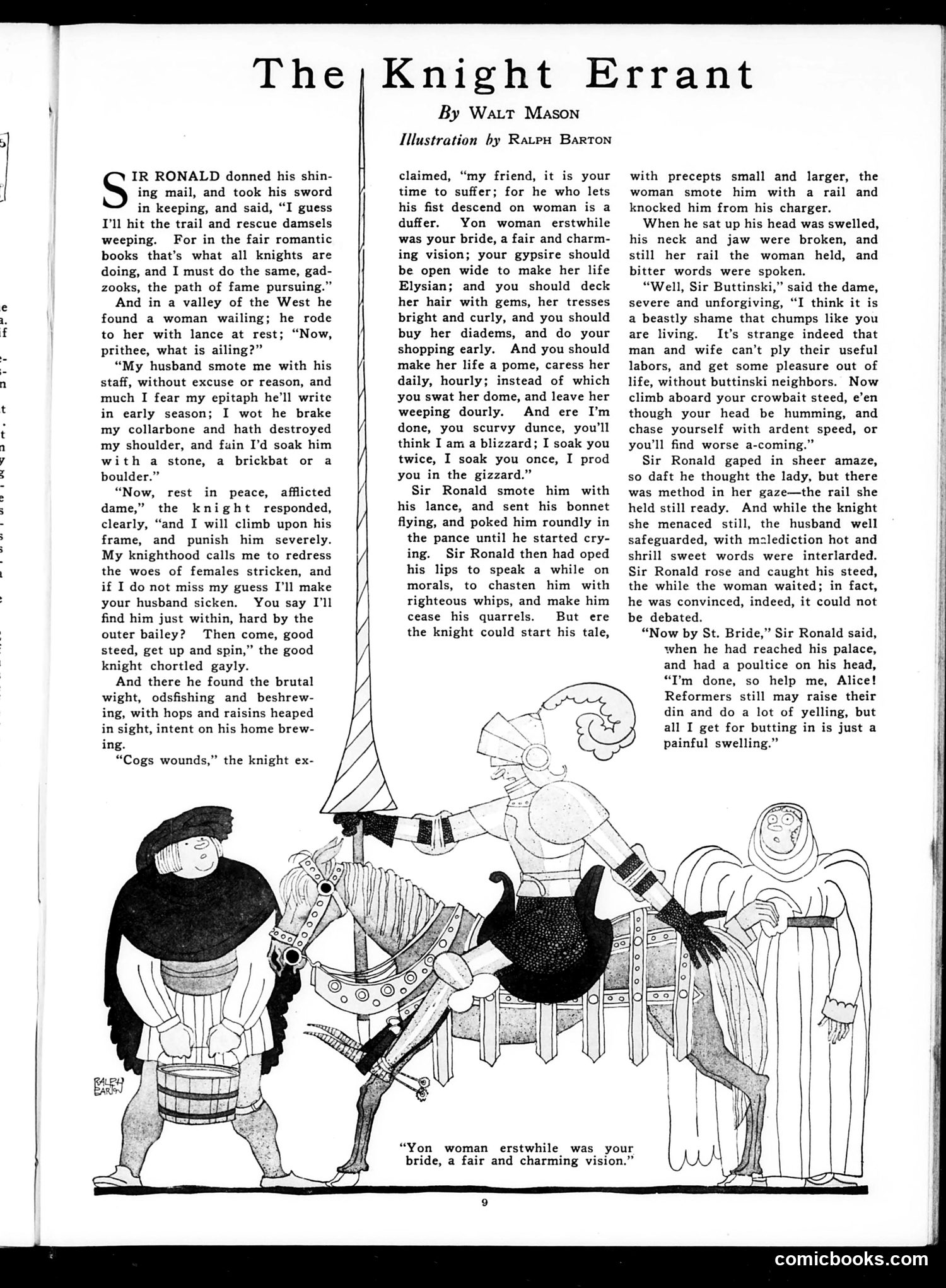
This is a humorous story illustrated in Judge magazine satirizing the "knight errant" archetype—the romantic medieval hero who rescues damsels in distress. Sir Ronald, equipped for chivalry, encounters a woman beaten by her husband. Following storybook logic, he intervenes to punish the abusive man. However, the joke subverts the romance narrative: the woman herself is violent and ungrateful. She attacks Ronald with a rail, criticizes him as a "chump," and drives him off. When Ronald finally reaches home battered and bruised, he concludes the whole rescue enterprise was pointless—he's learned that meddling in domestic disputes brings only pain. The satire targets both naive idealism (believing in chivalric romance) and perhaps early progressive "do-gooders" who interfere in matters beyond their understanding. The illustration's exaggerated, grotesque style emphasizes the absurdity of the situation.
This is a theater/film criticism article by Heywood Broun critiquing a popular dramatic formula. The essay attacks the cliché "happy ending" where shabby small-town characters are magically transformed into prosperity by act four—complete with renovated hotels, fine dining, and ceremonial silver cups. Broun specifically criticizes how George M. Cohan's stage play "Get-Rich-Quick Wallingford" established this tired formula, which film producers then slavishly copied. He argues that motion pictures, with access to actual outdoor locations (mountains, deserts, oceans), should develop their own aesthetic rather than imitating theater's artificiality—like using coconut shells for horse hoofbeats or toy trolley cars. The satirical point: Hollywood's laziness in recycling stage tricks undermines cinema's unique potential. The article mocks both playwrights and filmmakers for confusing superficial material "swell-ness" (fancy décor) with genuine storytelling. The decorative header shows dancing figures in evening wear—visualizing the article's theme of hollow prosperity spectacle.
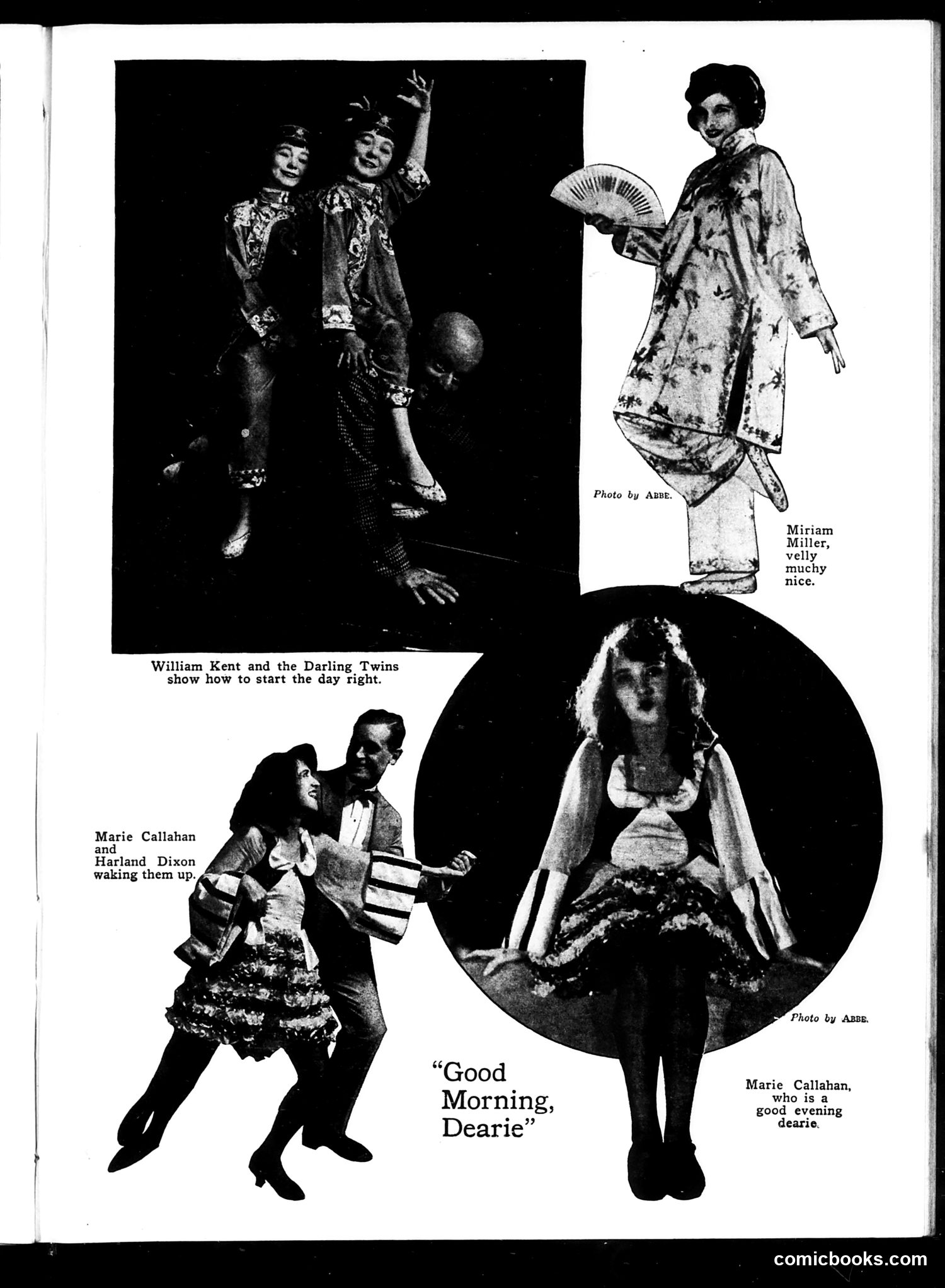
This page from Judge magazine features photographs of theatrical performers from what appears to be an early 20th-century stage production titled "Good Morning, Dearie." The images showcase William Kent with the Darling Twins, Marie Callahan with Harland Dixon, and a solo shot of Marie Callahan in various costumes and poses. The captions use playful, flirtatious language typical of the era ("dearie," "waking them up"). Rather than political satire, this appears to be entertainment coverage—essentially theatrical promotion or gossip disguised as magazine content. The page celebrates Broadway performers and their show through candid photographs, reflecting Judge's practice of mixing satire with celebrity culture and stage publicity.
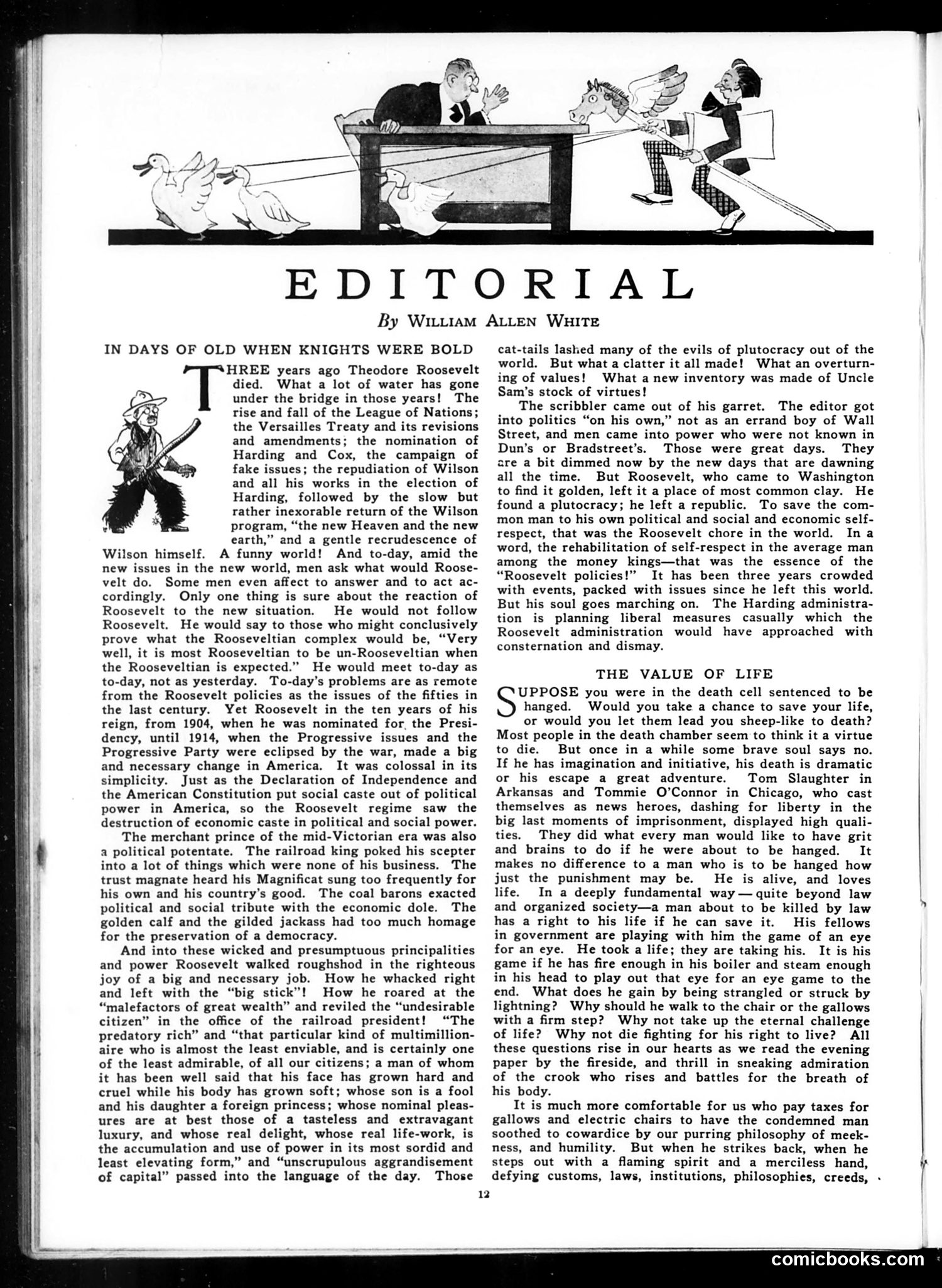
This is William Allen White's editorial tribute to Theodore Roosevelt, who died three years prior (1919). The cartoon header depicts a seesaw/lever scene: angels on the left pull down while a demonic figure on the right is lifted up—a visual metaphor for Roosevelt's disruptive reformist impact. White argues Roosevelt fundamentally transformed America by destroying "economic caste in political and social power." He attacked corrupt industrialists—railroad kings, coal barons, trust magnates—whom White sarcastically calls "malefactors of great wealth." Roosevelt's famous "big stick" wielded against these plutocrats brought ordinary people (scribblers, editors) into public influence, replacing Wall Street's traditional gatekeepers. White contrasts Roosevelt's decisive Progressive era (1904-1914) with post-WWI confusion under Wilson and Harding. The editorial suggests modern leaders should adapt Roosevelt's *spirit* of reform to current problems, not simply imitate his past policies—a meditation on how to preserve his legacy amid changed circumstances.
This page critiques American economic policy through two main articles. **"THIS VAST ECONOMIC BOOBYHATCH"** attacks laissez-faire capitalism. It uses Robert Harris—a Wyoming sheep rancher who received only eleven cents per sheep after expenses—as a case study. The author argues that the meat industry's collapse wasn't due to sudden market shifts but to systemic neglect. Despite knowing disaster was coming, government, Congress, the President, and bankers did nothing, instead hiding behind the principle of "Hands Off." The satire mocks the hypocrisy: Americans laugh at farmers leaving equipment in weather, yet the nation abandoned an entire industry to market forces. The title "boobyhatch" (asylum) suggests the economic system itself is insane. **"THE JIMREEDS"** attacks Senator Jim Reed of Missouri as an opponent of disarmament. The author portrays "Jimreed" not as political disagreement but as a psychological disease—a spiritual infection of hatred and suspicion that corrupts those afflicted. The reference to "Tomwatsons" (likely Tom Watson, a populist politician) suggests this affliction recurs across political figures.
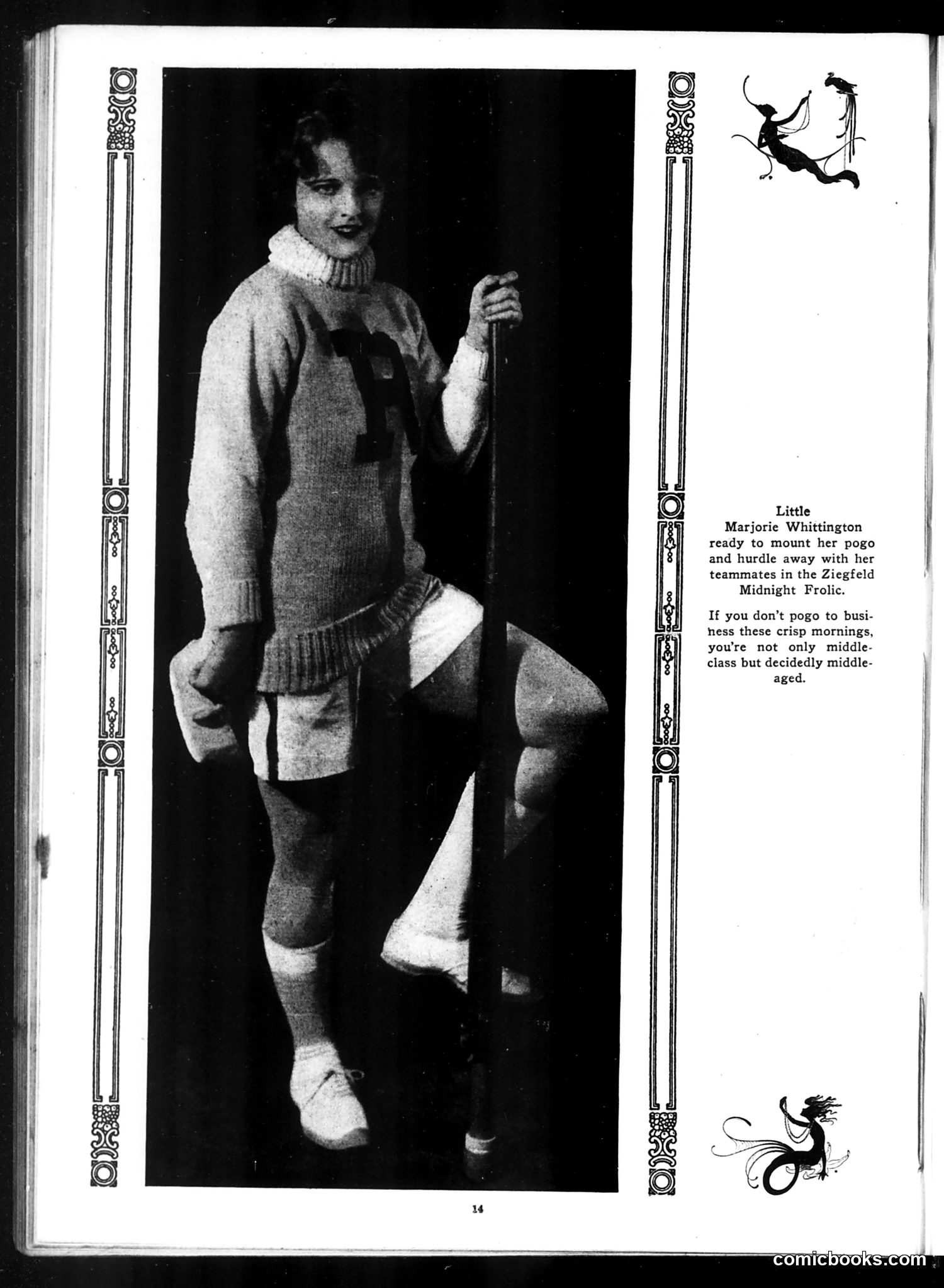
This page features a photograph of "Little Marjorie Whittington" posed with a pogo stick, dressed in 1920s attire including a sweater and knee-high socks. The accompanying text is satirical social commentary about the pogo stick craze. The joke targets middle-class respectability: the text suggests that failure to "pogo to business" on crisp mornings marks one as not only middle-class but "decidedly middle-aged"—a humorous reversal implying that pogo-sticking is fashionable and youthful. The reference to the "Ziegfeld Midnight Frolic" (a famous Broadway revue) adds theatrical glamour. The satire mocks both the faddish adoption of pogo sticks by those seeking trendiness and the anxiety about appearing outdated. Judge is poking fun at how quickly new crazes become status markers.
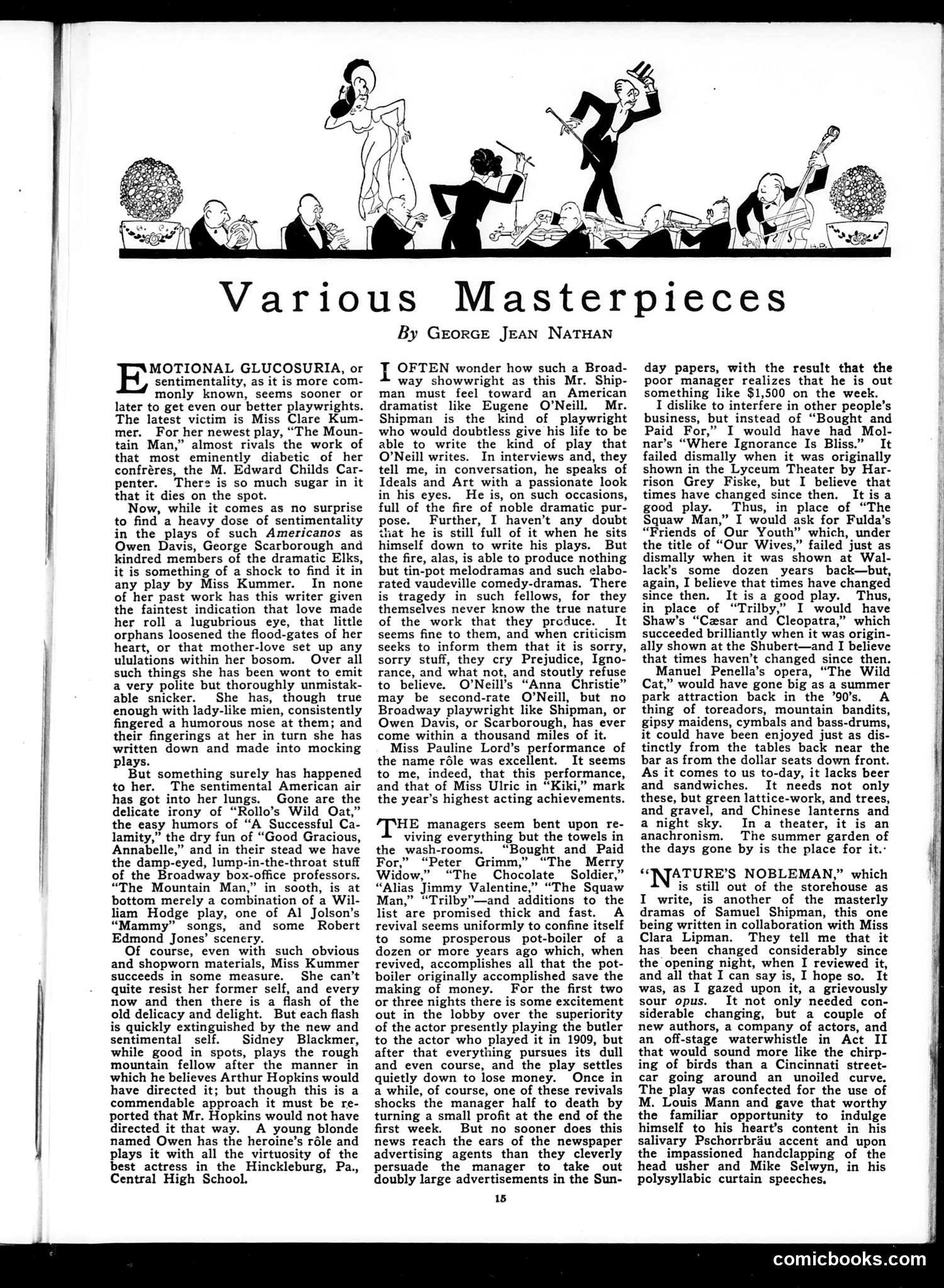
This page from Judge magazine features drama criticism by George Jean Nathan, a prominent theater critic of the era. The illustration at the top shows silhouettes of various theatrical figures and performers in comedic poses—reflecting the page's focus on Broadway plays and playwrights. Nathan critiques several contemporary American dramatists: 1. **Clare Kummer** is mocked for abandoning her signature dry wit and irony in favor of maudlin sentimentality in "The Mountain Man," which Nathan compares unfavorably to formula Broadway fare. 2. **Mr. Shipman** is portrayed as an aspiring artist who claims to value ideals and serious drama but produces only "tin-pot melodramas and vaudeville comedy-dramas." Nathan contrasts him with Eugene O'Neill, whose work represents genuine theatrical achievement. The satire targets the gap between Broadway's commercial pressures and serious artistic ambition—playwrights compromise their talents for box-office success while pretending to artistic integrity.
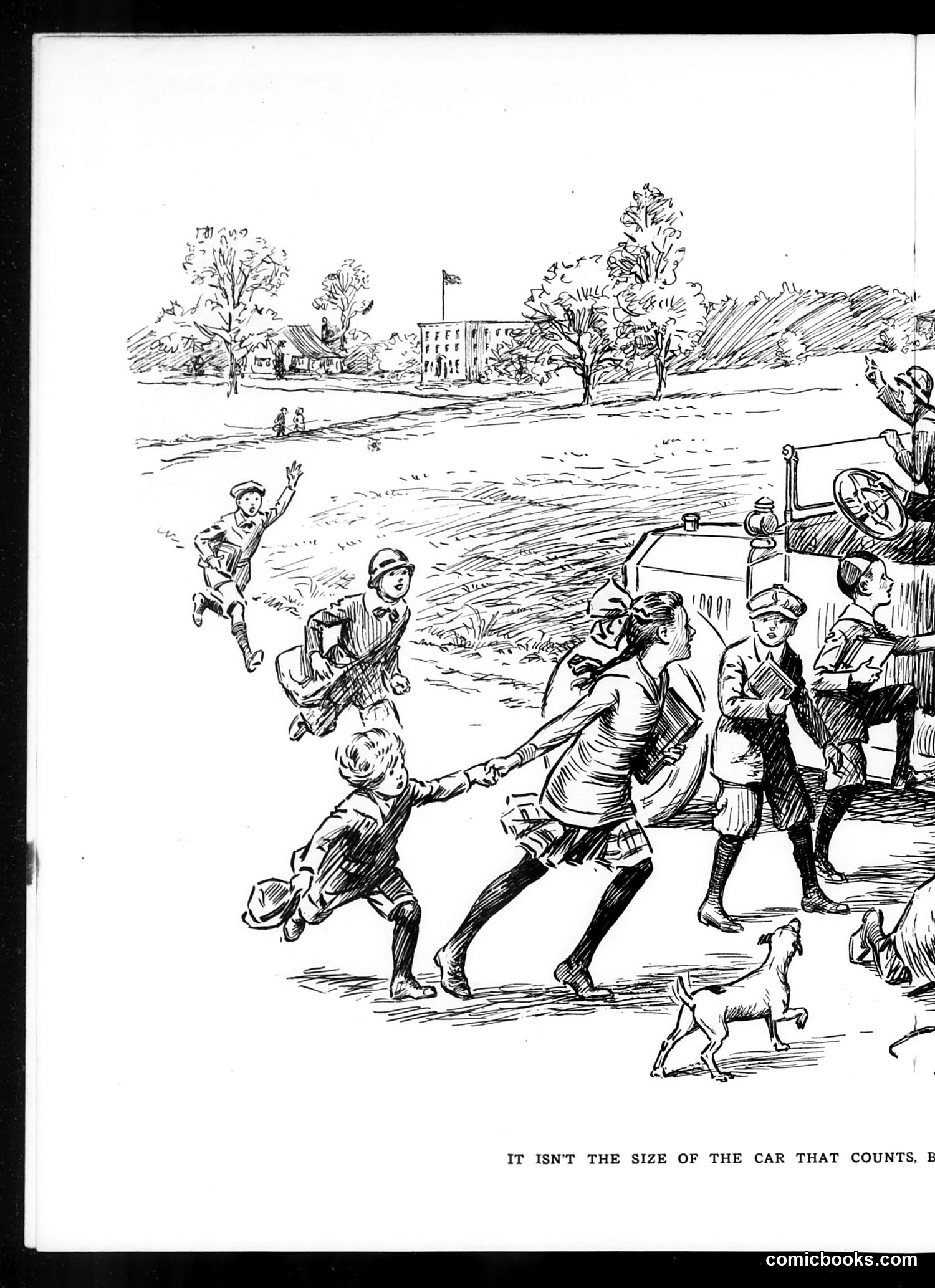
This is a satirical illustration from *Judge* magazine depicting a tug-of-war scene. Adults and children are literally pulling on what appears to be a small automobile, while additional figures operate or stand nearby. A dog participates in the contest. The caption reads: "IT ISN'T THE SIZE OF THE CAR THAT COUNTS, B[...]" (text cuts off). The cartoon satirizes early automotive culture and likely critiques either: (1) the obsession with car ownership regardless of practicality, or (2) the emerging class distinctions based on vehicle size and expense. By showing numerous people struggling to move even a modest car, the artist mocks the disproportionate social importance placed on automobile possession during the automobile boom era. The specific satirical target remains unclear without the complete caption.
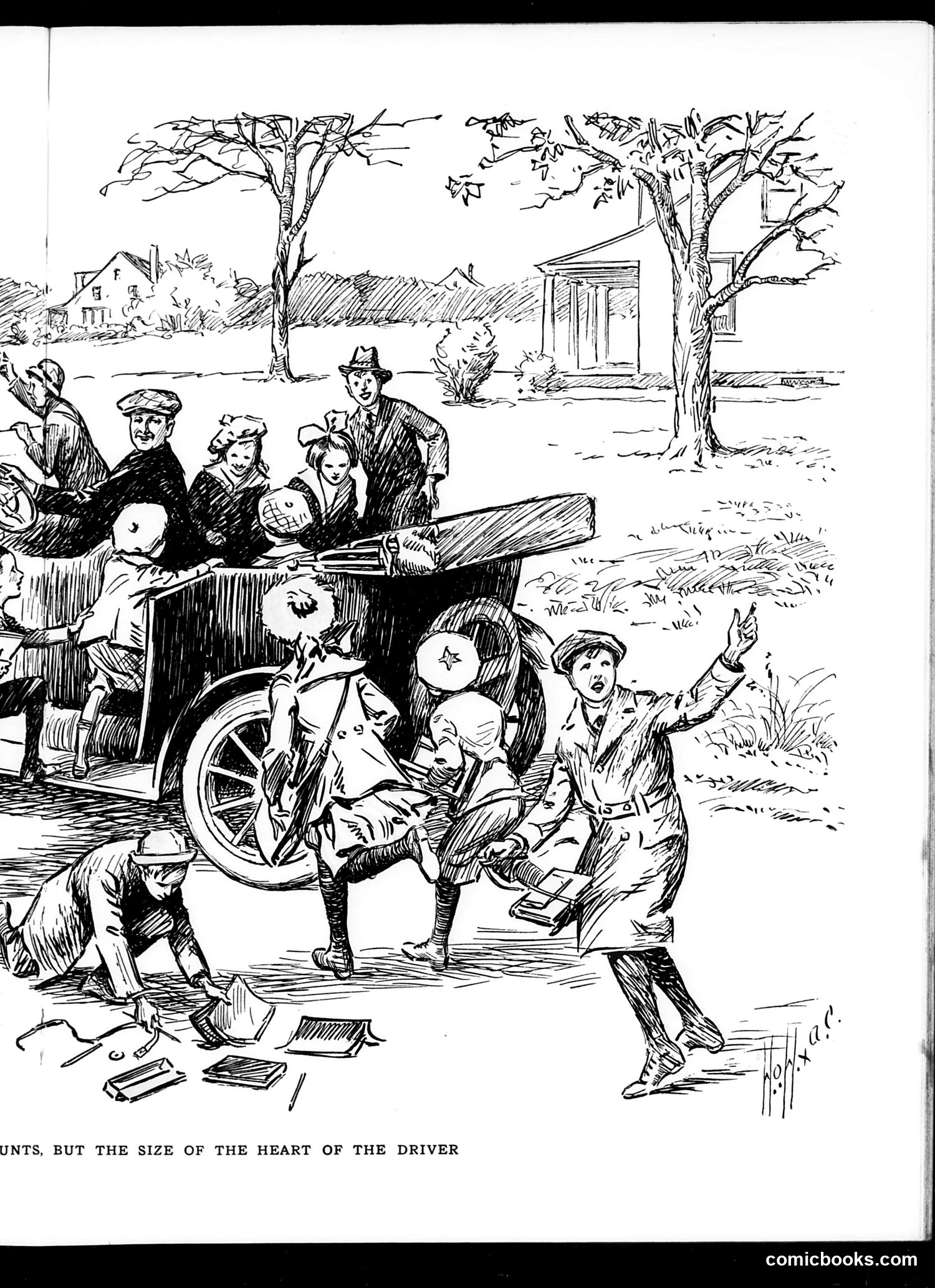
This cartoon depicts a charitable scene involving a wealthy driver and automobile. The visible caption reads "...UNTS, BUT THE SIZE OF THE HEART OF THE DRIVER," suggesting the satirical point concerns a person of means demonstrating generosity or kindness. The scene shows children gathered around an automobile, with adults observing from a carriage in the background. The composition appears to celebrate the driver's benevolent act—likely distributing gifts or assistance to poor children in a rural setting. The satire likely praises the driver's character generosity ("size of the heart") despite perhaps modest material circumstances, or conversely, mocks ostentatious philanthropy by the wealthy. Without the complete caption, the exact satirical target remains unclear, though the overall theme involves wealth, charity, and moral character—common Judge magazine subjects.
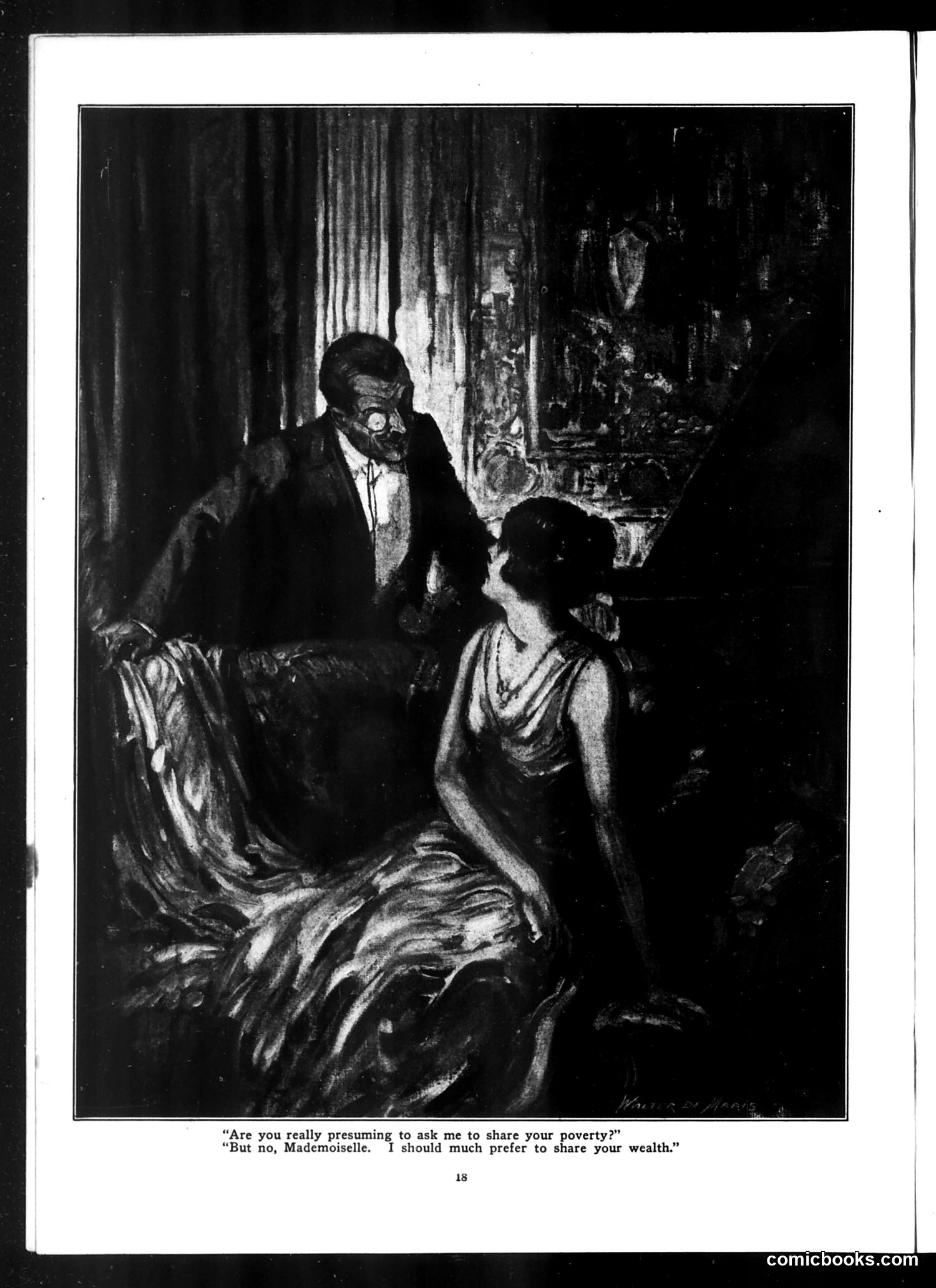
This illustration depicts a flirtation scene between a man and a woman in what appears to be an elegant interior setting. The dialogue reveals a satirical commentary on courtship and class dynamics: the woman accuses the man of presuming to ask her to share his poverty, but he cleverly responds that he'd prefer to share *her* wealth instead. The satire targets fortune-hunting in romantic relationships—specifically, men pursuing wealthy women for financial gain rather than genuine affection. The formal French address "Mademoiselle" suggests this critiques the European aristocracy or wealthy social circles. The cartoon mocks both the transparent mercenary nature of such courtships and perhaps the naïveté or vanity of wealthy women who might fall for such flattery. It's a cynical commentary on marriage as a financial transaction among the upper classes.
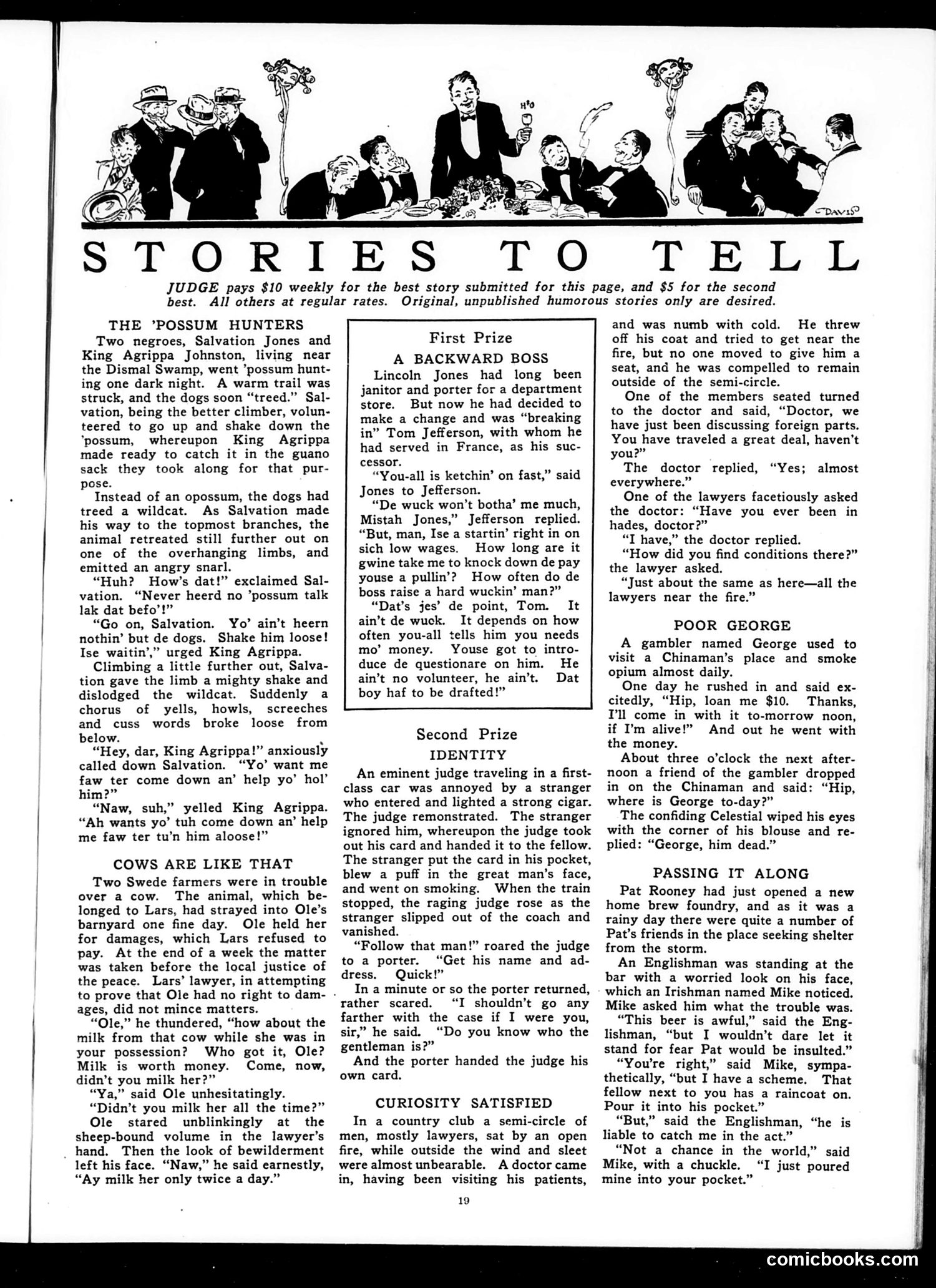
This is a humor submission page from *Judge*, where readers sent in comedic stories for prizes. The page contains three winning stories that exemplify early 20th-century American comedy tropes: **"The Possum Hunters"** uses heavy dialect humor featuring two Black characters in a slapstick scenario where a misidentified wildcat causes chaos—typical of the era's minstrelsy-influenced entertainment. **"Cows Are Like That"** features Swedish immigrant characters ("Lars" and "Ole") with thick accents in a legal dispute, playing on ethnic stereotype humor common to the period. **"A Backward Boss"** again uses Black dialect characters, here discussing workplace dynamics and wage negotiation. All three stories rely on ethnic/racial caricature, dialect exaggeration, and physical comedy—entertainment conventions considered acceptable in this era but reflecting problematic racial attitudes. The humor depends on readers finding these stereotyped characters amusing rather than recognizing them as people.
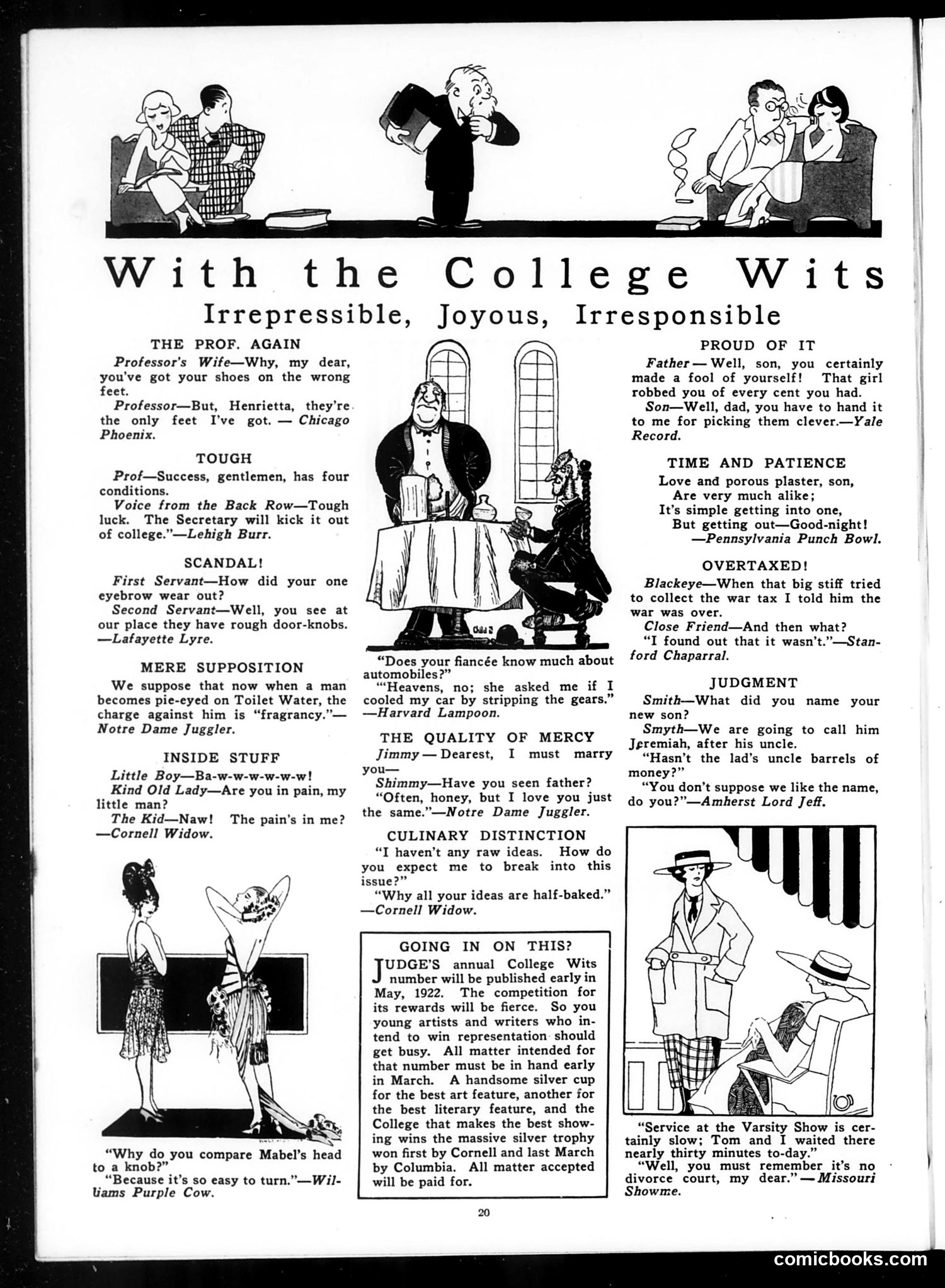
This page collects humorous one-liners and jokes from various college humor magazines (Cornell Widow, Yale Record, Harvard Lampoon, etc.), a format Judge regularly published. The jokes target college life and romantic entanglements typical of early 1920s undergraduate culture: absent-minded professors, foolish romantic choices, automobile ignorance (women depicted as mechanically incompetent), hasty engagements, and social mishaps. References to "pie-eyed" behavior and "war tax" suggest Prohibition-era drinking and post-WWI economic concerns. The satire is gentle—poking fun at student pretensions, dating follies, and generational attitudes rather than serious social critique. A competition announcement promotes Judge's upcoming "College Wits" issue, inviting student submissions for silver cup prizes, positioning the magazine as arbiter of campus humor standards. The appeal relies on readers recognizing collegiate experiences and in-group college publication references.
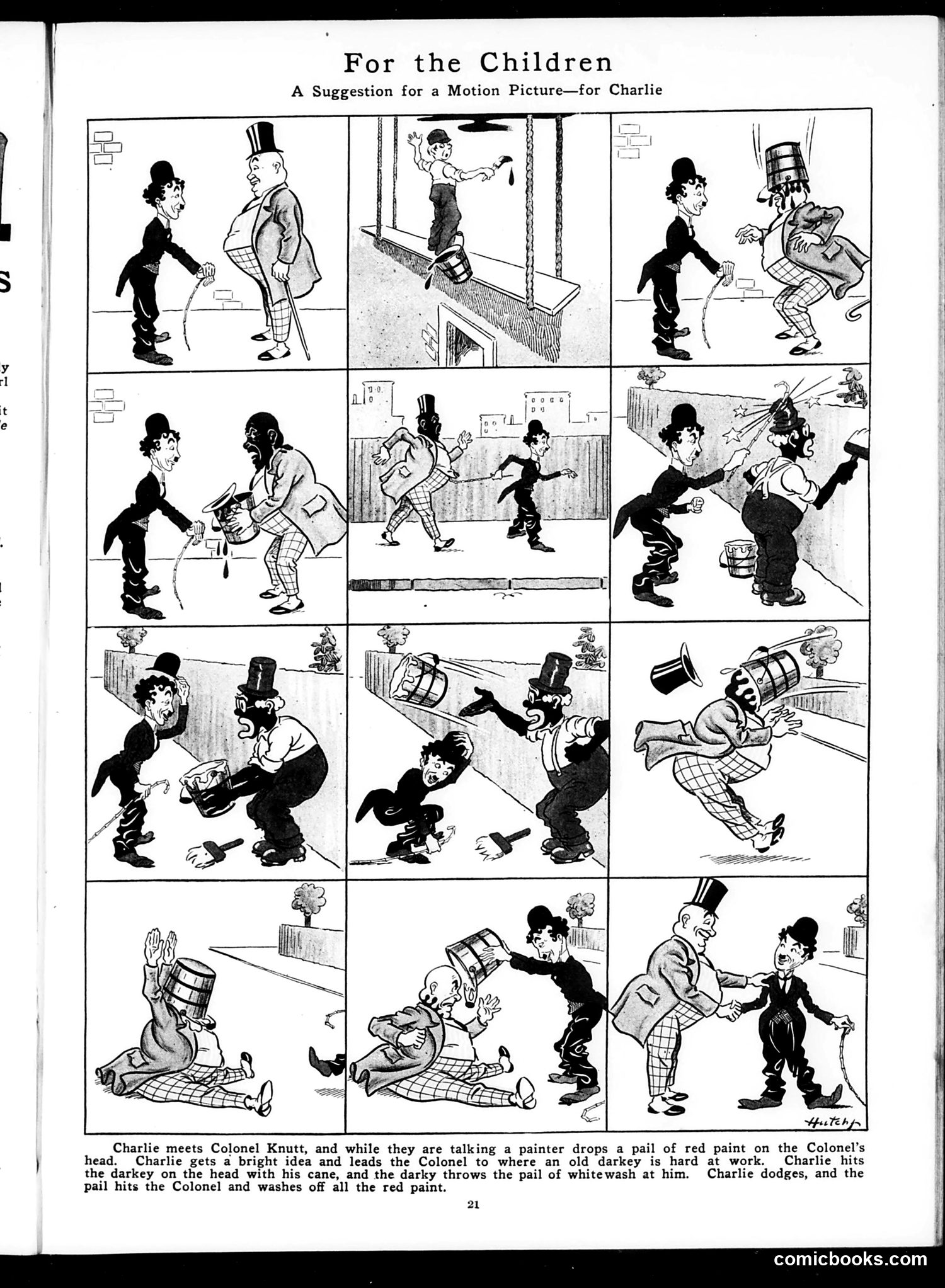
This is a Charlie Chaplin slapstick comedy scenario proposed for film. The narrative involves Chaplin's character orchestrating a series of mishaps: a painter drops red paint on Colonel Knutt's head, Chaplin then leads the Colonel to a Black worker and strikes that worker with his cane, prompting the worker to throw whitewash that hits the Colonel instead, removing the paint. The humor relies on classic silent-film physical comedy and mistaken consequences. However, the text's casual reference to striking a Black character reflects the casual racial caricature and violence common in early 20th-century entertainment ("an old darkey"). The scenario treats the Black worker's reaction as comic retaliation rather than addressing the violence itself. Modern readers would recognize this as reflecting deeply problematic racial attitudes embedded in that era's supposedly innocent "children's" entertainment.
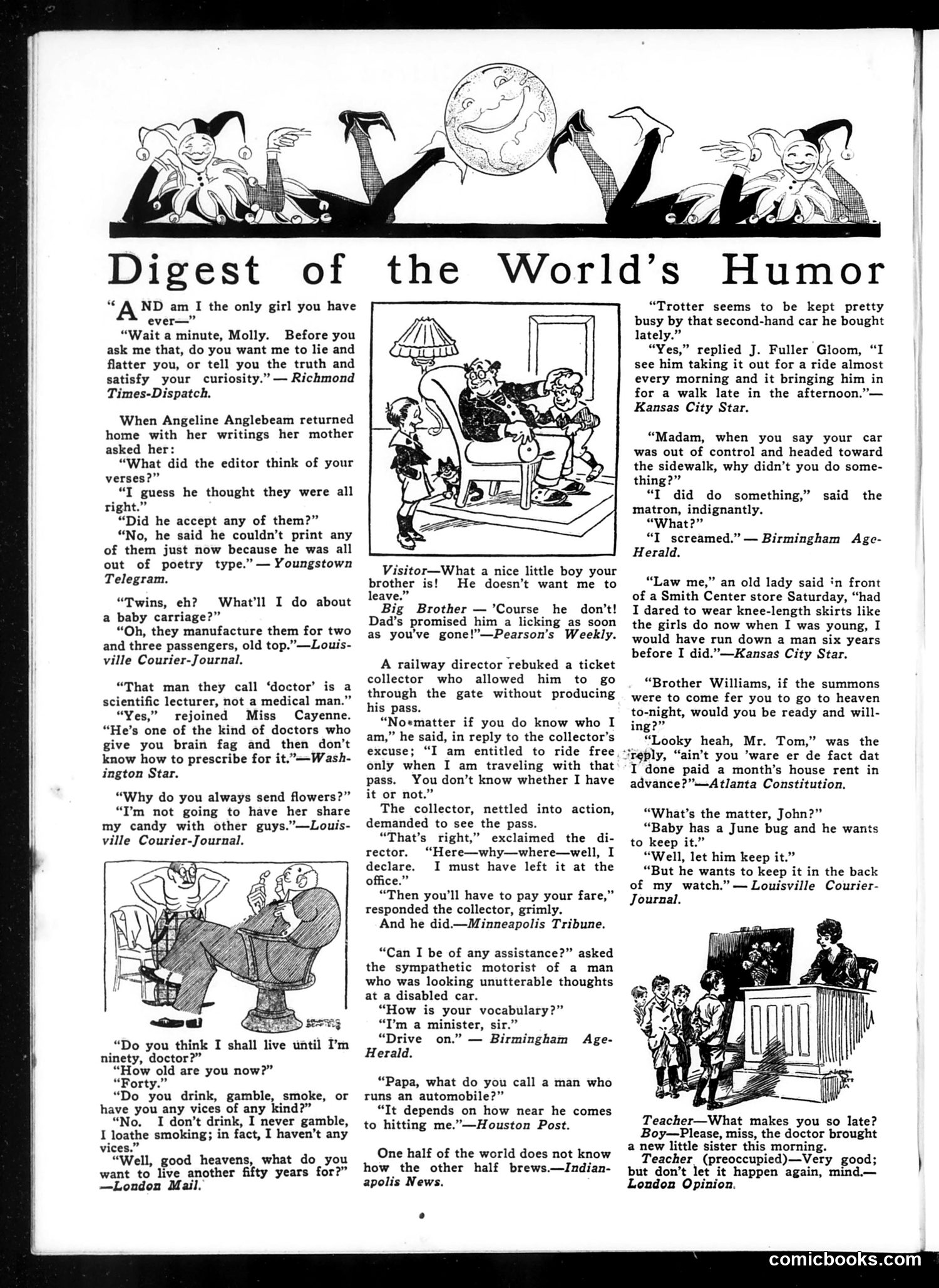
This page collects brief humorous anecdotes from newspapers nationwide, representing early 20th-century American joke culture. The cartoons and jokes satirize contemporary social anxieties: **Automobiles** dominate the humor—a still-novel technology. Jokes mock their unreliability ("second-hand car"), dangerous unpredictability (women screaming rather than acting), and their effect on courtship and family life. **Class and authority** appear in the railway director story, where a superior officer is humbled by enforcing rules equally—satirizing hypocrisy among the privileged. **Gender roles** surface in the knee-length skirt joke, reflecting moral panic over women's changing fashion and independence. **Religion and materialism** clash in the African American dialect joke about Brother Williams prioritizing rent over heaven. The two cartoons show men relaxing (top) and a scolding scene (bottom), illustrating domestic and public discomfort. Overall, the page reflects anxieties about modernity, changing social hierarchies, and new technologies disrupting traditional life.
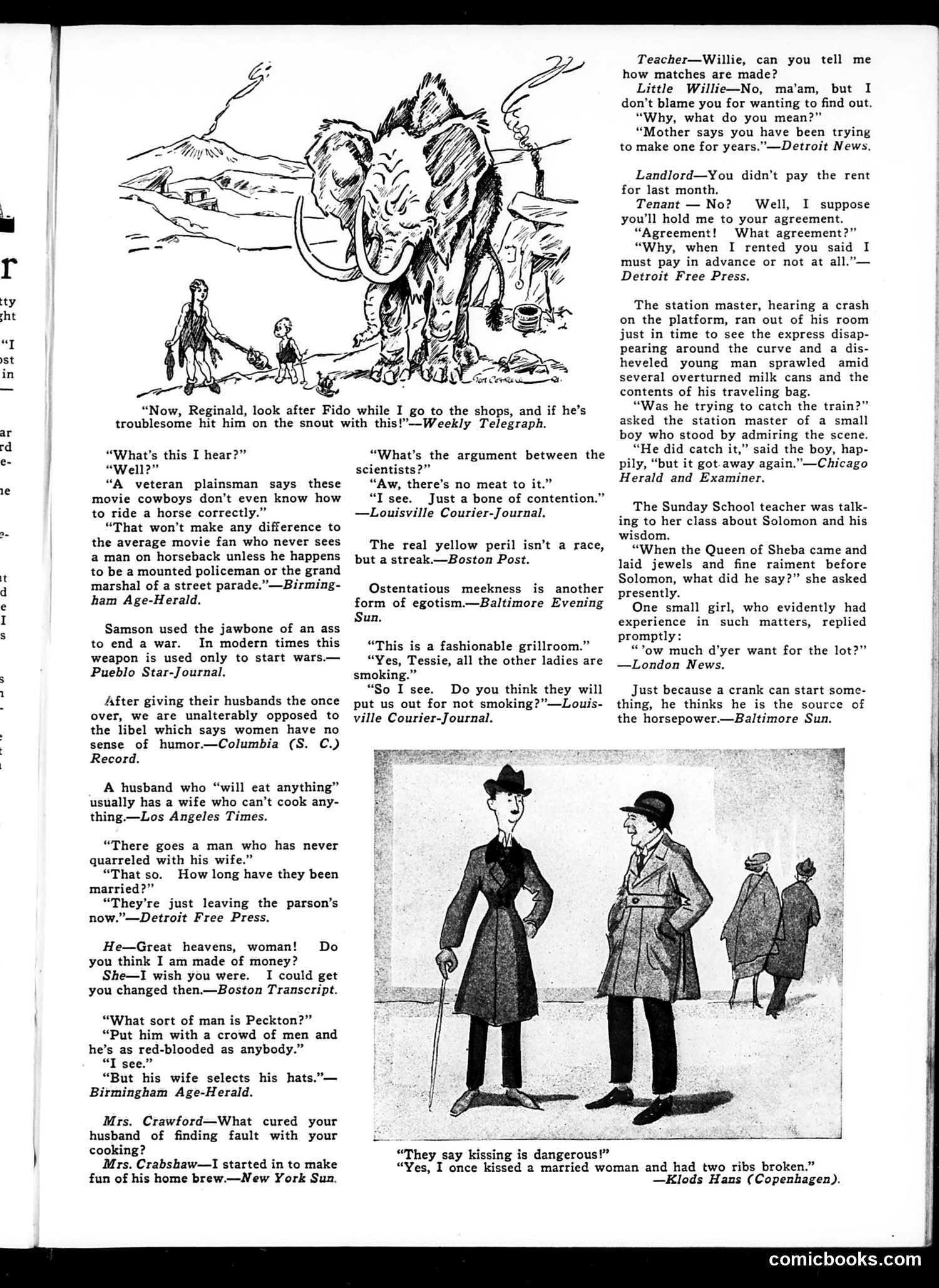
This page from the satirical magazine *Judge* collects brief humor items and jokes typical of early 20th-century American periodicals. The content reflects contemporary social anxieties and gender dynamics: **Main themes:** - **Gender and marriage satire** dominates: jokes about wives controlling husbands' appearance ("selects his hats"), wives' poor cooking, and men obsessing over money reveal period anxieties about shifting domestic power. - **Class commentary**: References to "fashionable grillrooms" and servants suggest mockery of affectation and social pretension. - **Movie industry critique**: One joke dismisses movie cowboys' authenticity, reflecting early cinema's growing cultural impact. - **The bottom cartoon** (illustration of adults and children) captioned about a dangerous kiss resulting in broken ribs appears to be slapstick humor, though the exact reference is unclear. The humor is consistently conservative, mocking modern conveniences, women's independence, and social change while celebrating "traditional" values—typical of *Judge's* satirical approach during this era.
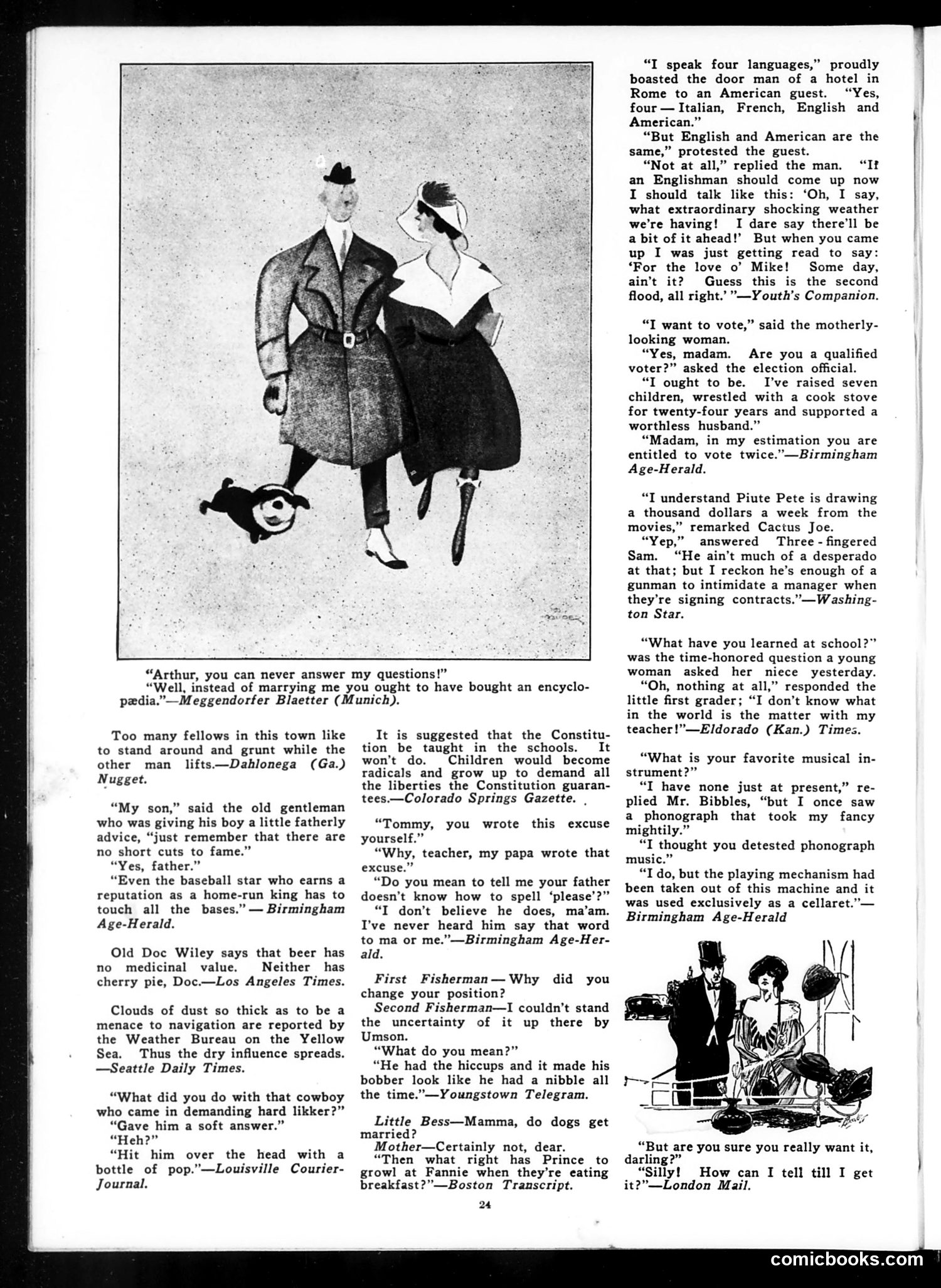
The main cartoon depicts two fashionably dressed women walking together, likely illustrating one of the accompanying jokes about marital disputes or gender relations—a common Judge theme. The page is primarily a collection of short satirical quips from various newspapers, typical of Judge's format. Key themes include: **Social/Political Satire:** - A joke about women's voting rights mocking a woman's qualification to vote based on domestic hardship rather than citizenship - A remark suggesting teaching the Constitution would make children "radicals" demanding their guaranteed liberties—satirizing conservative opposition to civic education **Domestic Humor:** - Multiple jokes about marriage, women's intelligence, and spousal dynamics reflecting early 20th-century gender attitudes - A child's excuse for homework revealing parental inadequacy **Americana:** - Western/frontier references (Piute Pete, desperados) - Small-town newspaper reprints, giving Judge a national, populist voice The page captures Judge's role as a humor magazine republishing wit from American newspapers while offering commentary on contemporary social issues through comedy.
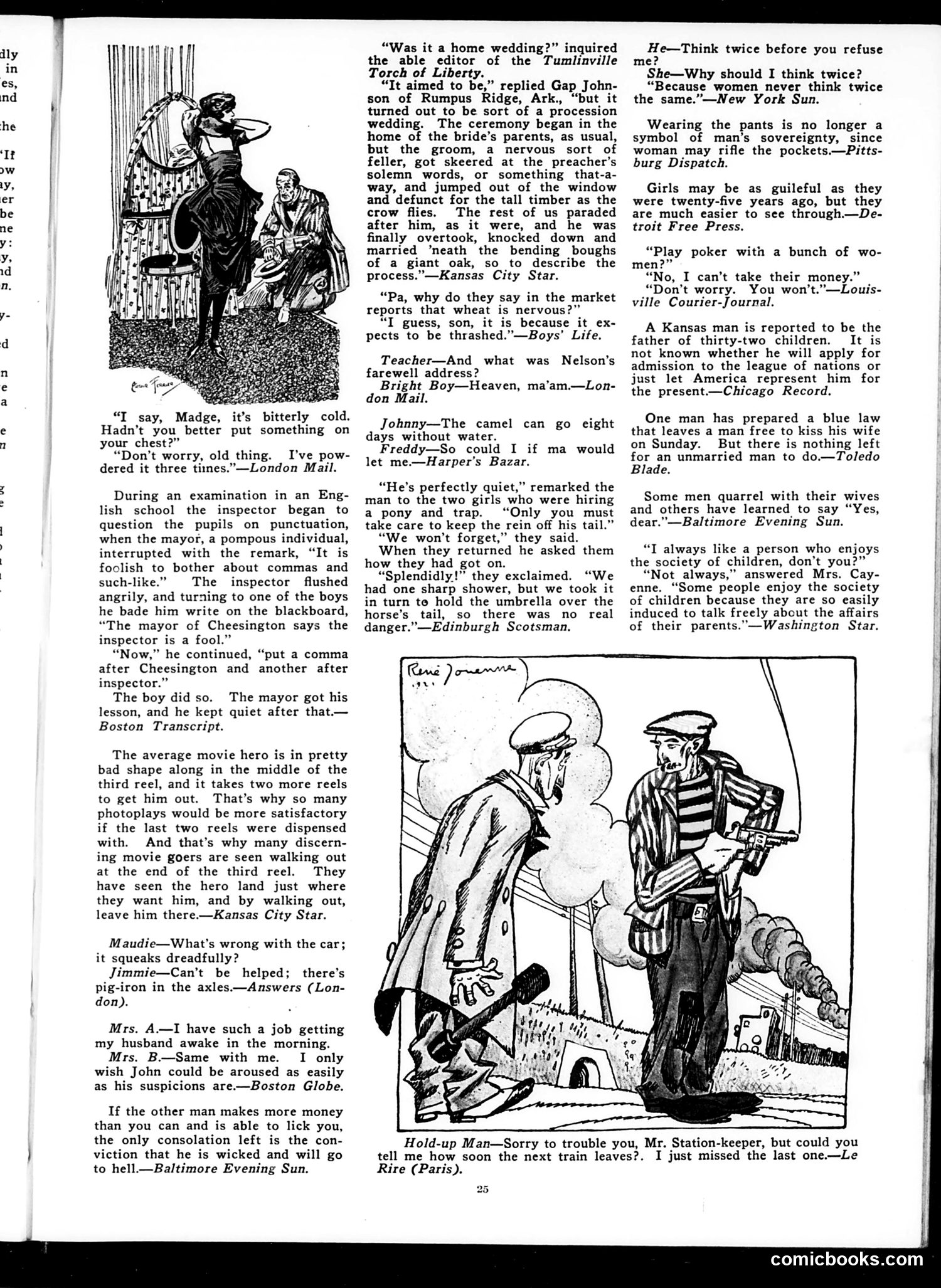
This page from Judge magazine contains primarily **humorous anecdotes and jokes** rather than political cartoons. The single cartoon depicts a hold-up scene with a robber asking a station-keeper about train schedules—a straightforward robbery joke. The text consists of short, satirical quips on **gender relations and social customs** typical of early-20th-century American humor: - Jokes about wives waking husbands and marital dynamics - A classroom anecdote where a mayor is humbled by a punctuation lesson (punctuation joke demonstrating his foolishness) - Commentary on women gaining economic/social independence ("wearing the pants," rifling pockets, easier to deceive) - Observations on movie endings and audience behavior - A rural courtship story involving an eloping groom The **satirical targets** are modest: pompous authority figures, marital friction, and evolving gender roles where women are depicted as increasingly independent but still portrayed through traditional stereotypes. The humor reflects period anxieties about women's changing social position while maintaining conventional gender assumptions.
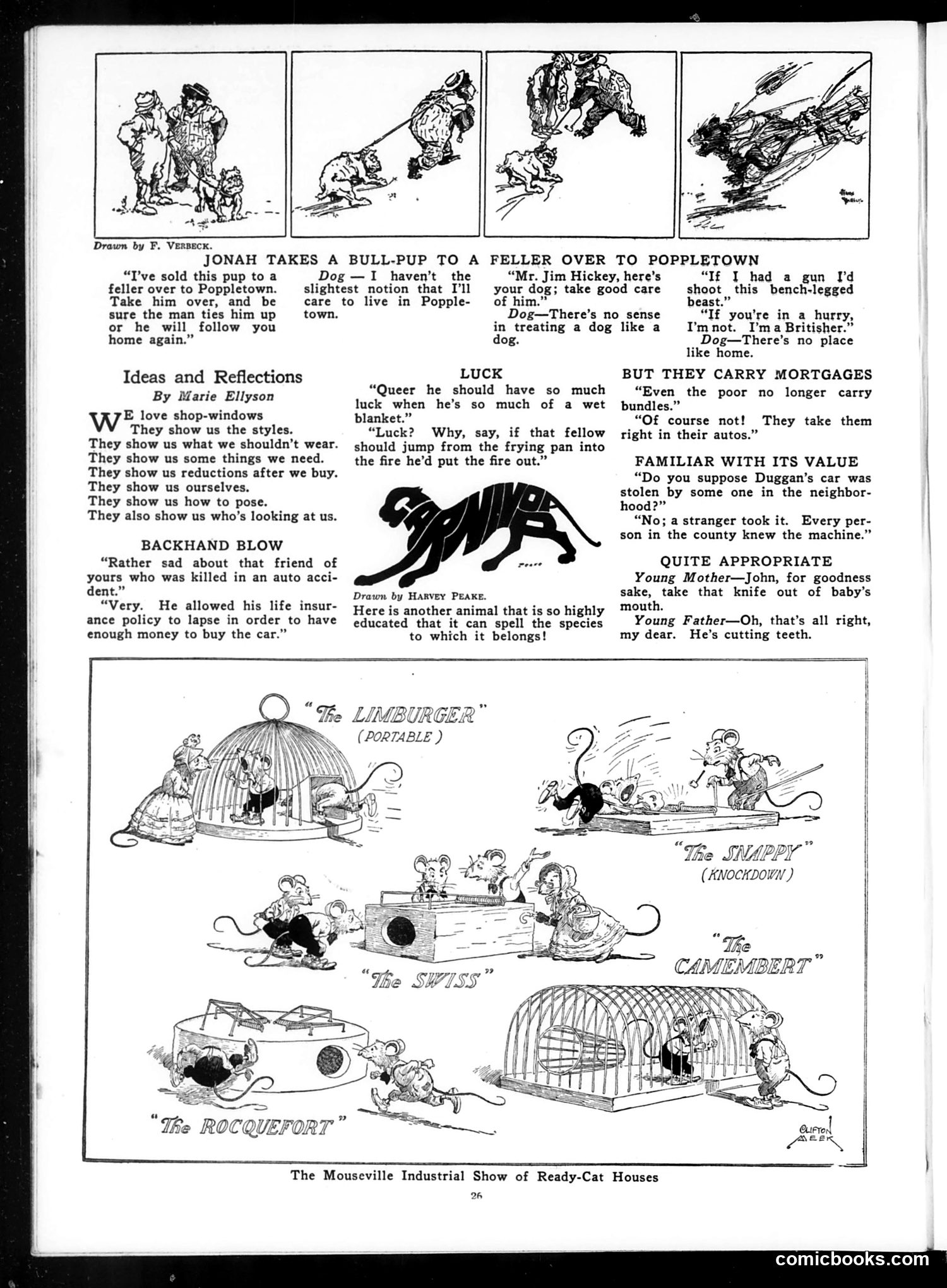
This page contains **satirical humor pieces and cartoons** reflecting early 20th-century American social anxieties: **Top section**: A comic narrative about selling an unwanted dog—the joke being the dog's inevitable return home, mocking both the seller's optimism and the dog's loyalty. **"Ideas and Reflections"**: Light social commentary on shop windows and human behavior—how they reveal fashion, needs, vanity, and social performance. **"Backhand Blow"**: Dark satire about an auto-accident victim whose life insurance lapsed so he could afford the car that killed him—critiquing the emerging automobile culture and financial irresponsibility. **"Luck"**: A quip about pessimism being so powerful it reverses fortune itself. **Bottom section titled "Mouseville Industrial Show"**: Anthropomorphic mice in inventive portable houses (the "Limburger," "Snappy," "Swiss," "Rocquefort," "Camembert")—a playful parody of the contemporary housing industry's marketing of prefabricated "ready-made" homes, using cheese names as puns on mouse culture. The overall theme satirizes modern consumer culture, automobile adoption, and industrial mass production.
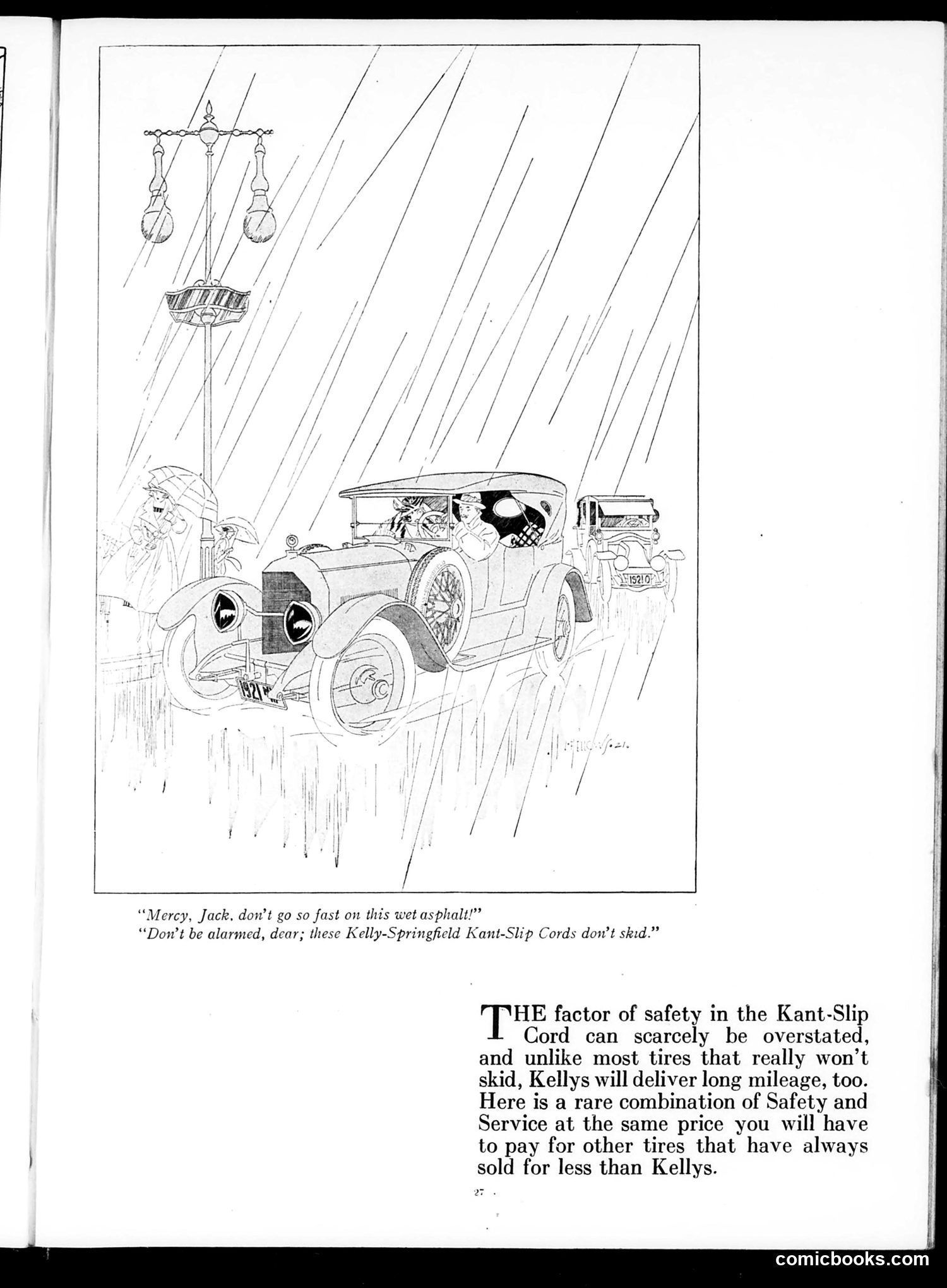
This is primarily an **advertisement for Kelly-Springfield tires**, not political satire. The page depicts a couple in an early automobile driving in heavy rain. The woman expresses concern about slipping on wet pavement; the man reassures her that their Kelly-Springfield "Kant-Slip Cord" tires provide safety. The accompanying text promotes the tire's non-skid properties and durability as a competitive advantage. The humor is gentle—playing on the couple's domestic dynamic rather than satirizing politics or society. This reflects early 20th-century automobile marketing, when tire safety was a genuine selling point and advertisements often used conversational scenarios to demonstrate product benefits. The "Judge" magazine platform allowed companies to present ads with illustrative narratives rather than simple product copy.
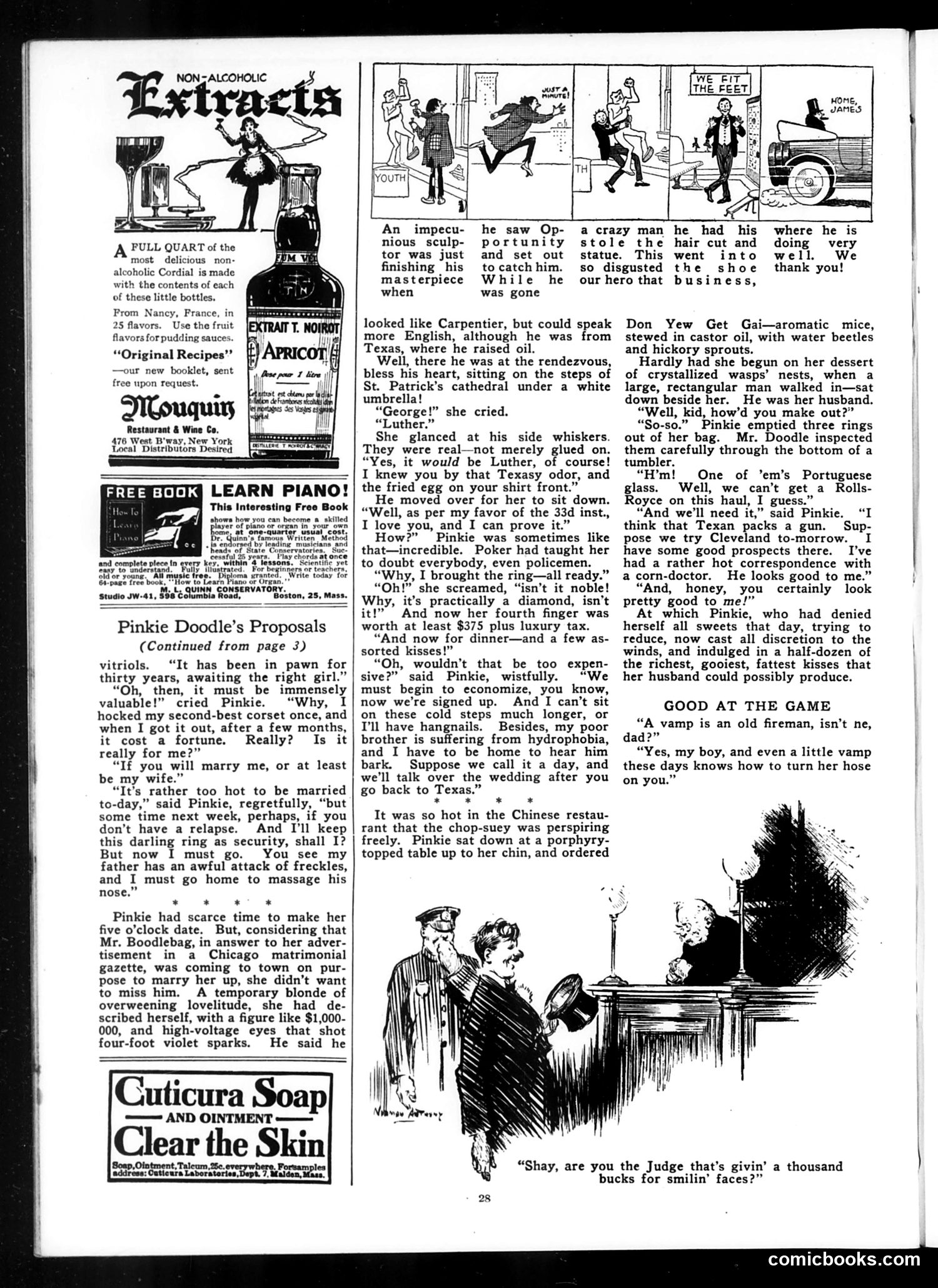
This page contains the continuation of "Pinkie Doodle's Proposals," a satirical humor story about a scheming woman named Pinkie who advertises for marriage in a matrimonial gazette. The satire targets early 20th-century dating customs and gold-digging behavior. **The joke**: Pinkie deliberately misrepresents herself (calling herself a "temporary blonde" with exaggerated physical attributes) to attract wealthy men. She meets "Luther" (who claims to be from Texas and wealthy from oil), accepts his proposal and diamond ring, then immediately begins economizing and making excuses to avoid actual marriage expenses—feigning concern about her brother's hydrophobia and needing to get home. **The satire**: The piece mocks both romantic fraud through matrimonial advertisements and mercenary attitudes toward marriage. Pinkie's casual acceptance and rejection of proposals, combined with her focus on extracting valuables, portrays her as manipulative and dishonest. The bottom illustration's caption—a judge offering money for "smilin' faces"—likely references contemporary beauty or talent contests, reinforcing themes of artifice and commercialized appearance.
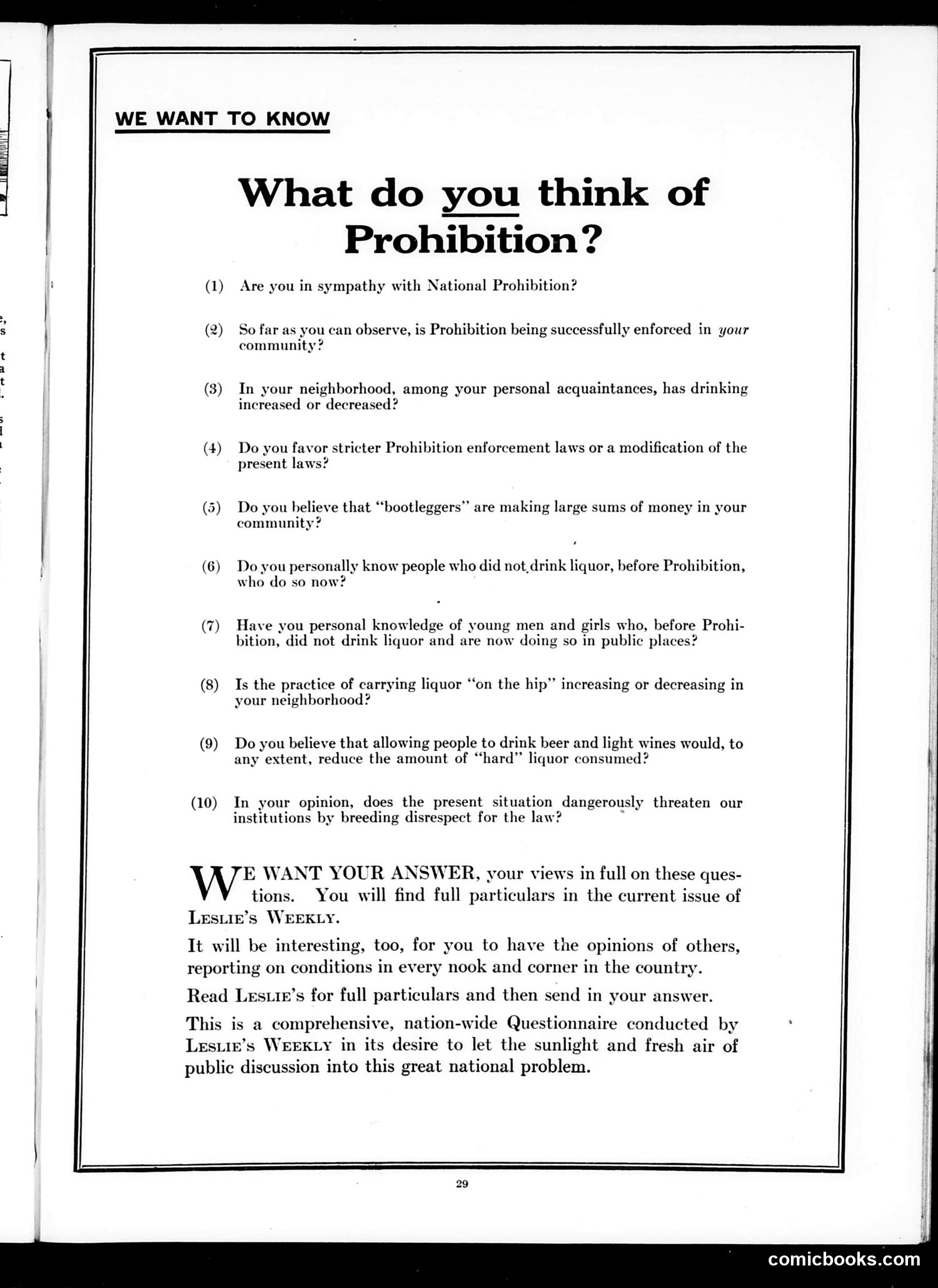
This page is not a cartoon but rather a **questionnaire advertisement** from Leslie's Weekly magazine, published during the Prohibition era (1920-1933). The content solicits reader opinions on National Prohibition's effectiveness and social impact. The ten questions probe whether Prohibition is being enforced, whether drinking has increased or decreased, whether bootleggers are profiting, and whether it's creating disrespect for law itself. **Historical context**: This represents the intense public debate surrounding Prohibition. The questions suggest skepticism about the policy's success—asking about bootleggers, hidden drinking, and whether young people now drink who didn't before. Leslie's frames this as promoting "public discussion" of a "great national problem," implying Prohibition's failures were already apparent and worthy of investigation. For modern readers: this documents contemporary concerns that Prohibition was counterproductive, creating criminal enterprise while failing to eliminate alcohol consumption.
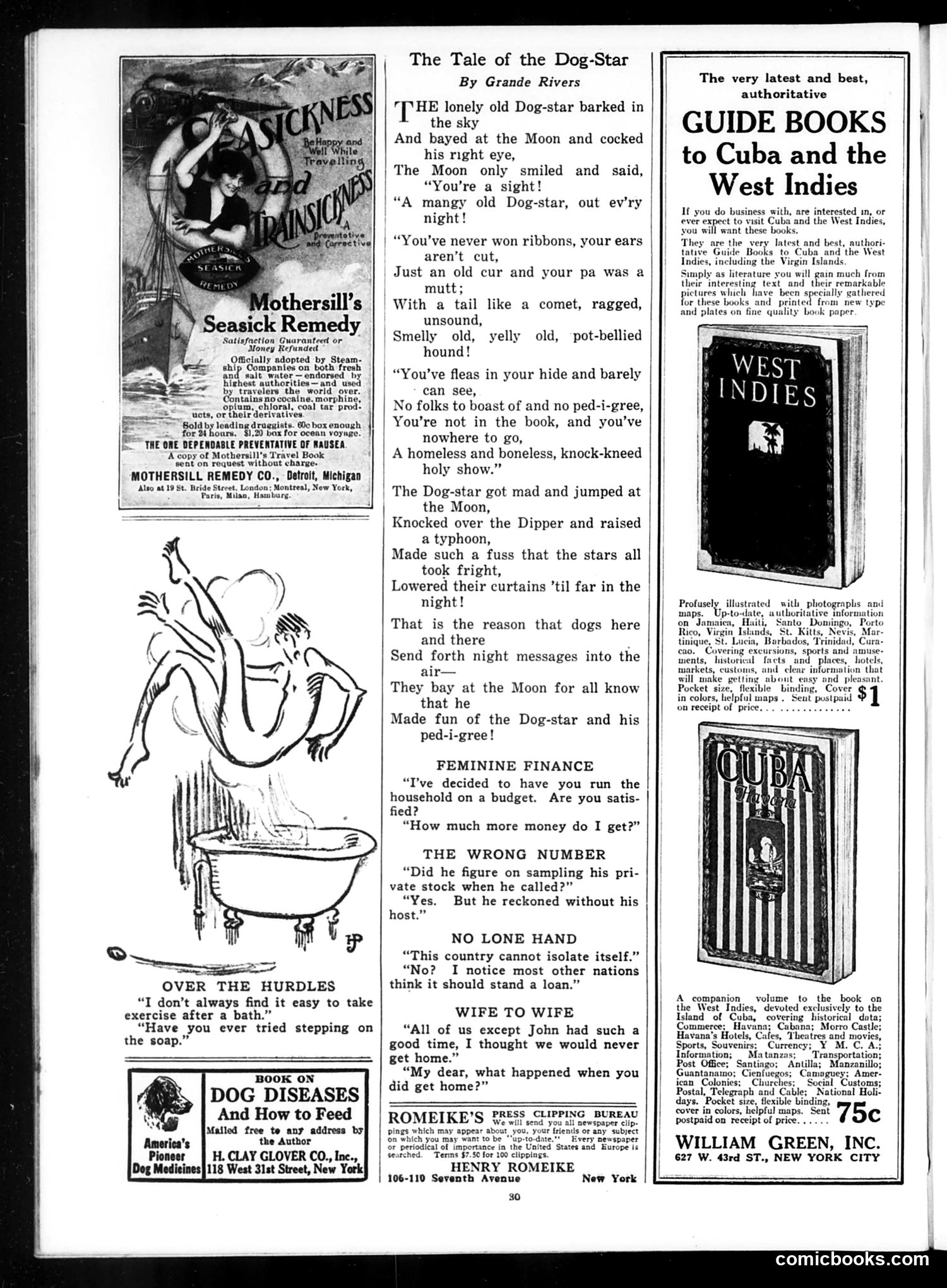
This page is primarily **advertising and light humor**, not political satire. The main content includes: 1. **"The Tale of the Dog-Star"** — a whimsical poem by Grande Rivers about a mangy dog-star mocked by the Moon for having no pedigree or social standing. The poem explains why dogs bay at the moon (seeking revenge for the insult). This is pure fantasy/folklore humor, not political commentary. 2. **Brief joke sections** ("Feminine Finance," "The Wrong Number," etc.) — These are domestic humor gags about budgets, marital misunderstandings, and business mishaps. No political content. 3. **Advertisements** — For Mothersill's seasickness remedy, dog medicine, and travel guidebooks to Cuba and the West Indies. The page contains **no identifiable political figures, caricatures, or social commentary**. It's a typical Judge magazine page mixing light verse, domestic humor, and period advertisements. The content reflects early-20th-century consumer culture and family-oriented comedy rather than satire of political or social issues.
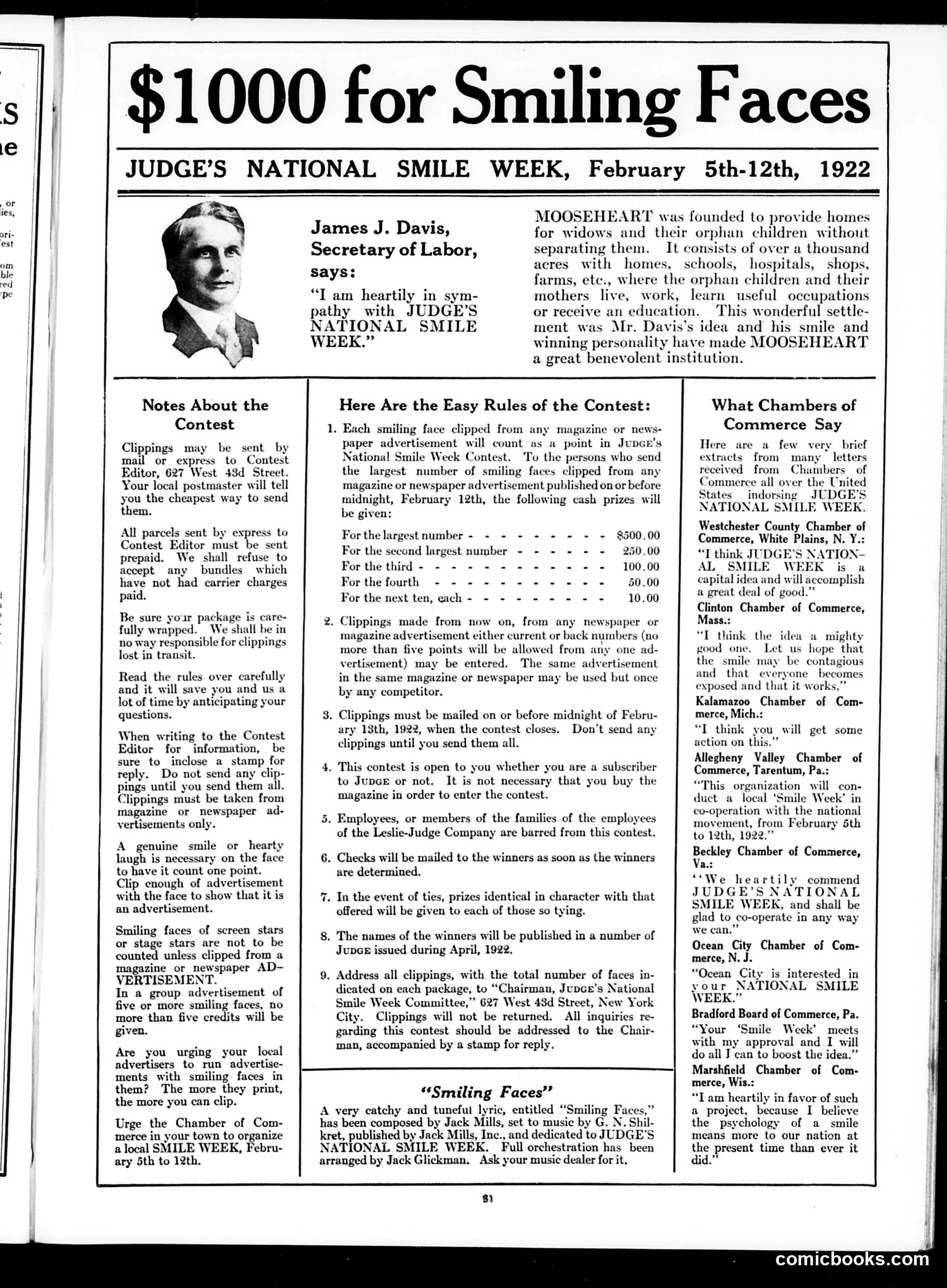
This page announces a cheerful but telling promotional contest: readers compete to clip smiling faces from advertisements in magazines and newspapers, earning points and cash prizes (up to $300) based on volume. The endorsement from James J. Davis, Secretary of Labor, lends official credibility. The satirical angle—though subtle—lies in the contest's underlying message: it celebrates and monetizes optimism during the post-WWI period. By 1922, America was adjusting to peacetime after severe economic and social upheaval. The page also functions as advertising itself, encouraging local businesses and Chambers of Commerce to participate by running more ads with smiling faces. It's essentially Judge magazine promoting consumer culture and advertising through the guise of a feel-good national initiative, while simultaneously poking gentle fun at American commercial enthusiasm and the commodification of happiness.
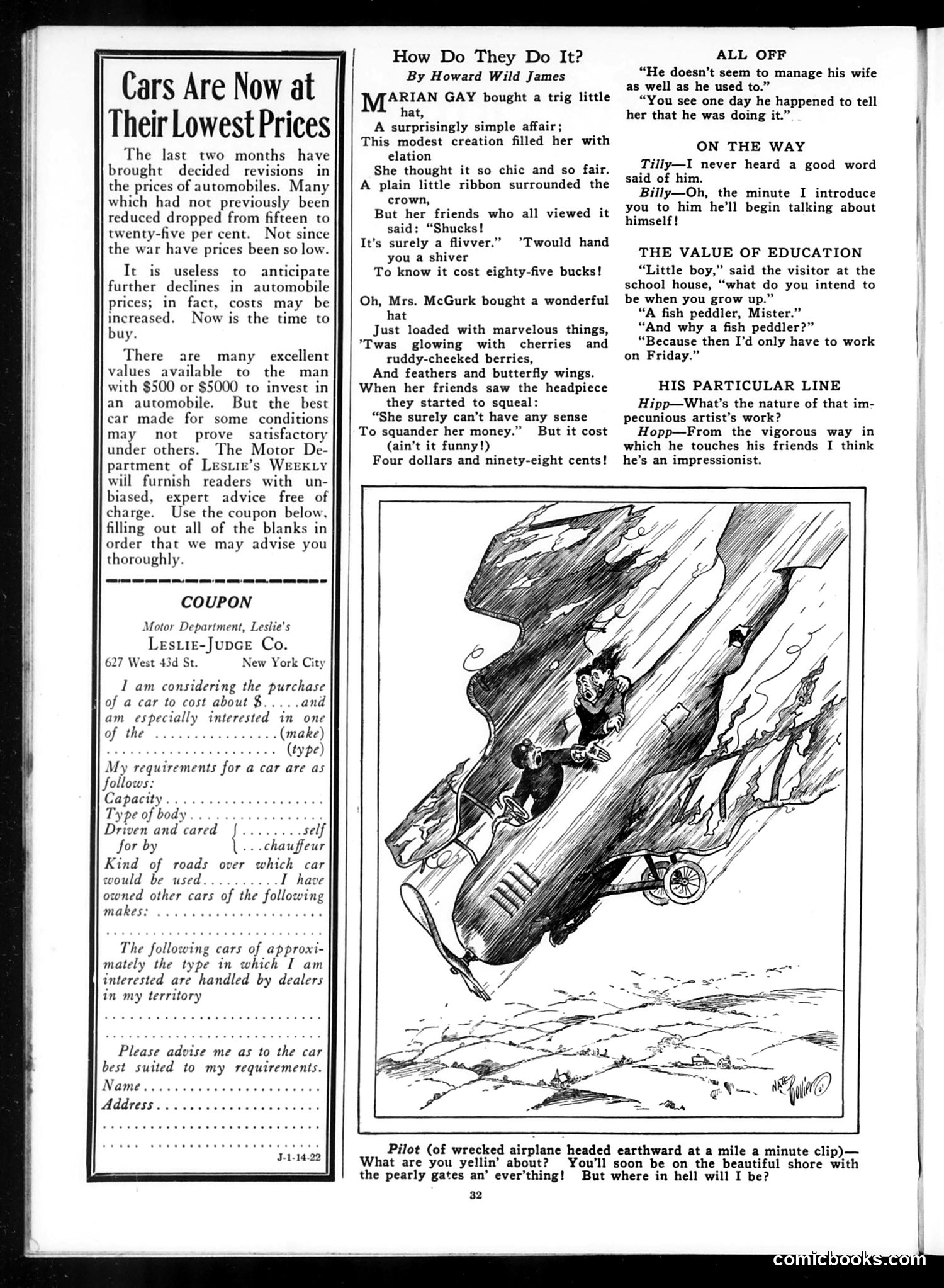
This page contains period humor pieces and advertising from Judge magazine (dates unclear from image, but likely 1920s based on references to post-war automobile prices). **Main content:** - "Cars Are Now at Their Lowest Prices": An advertisement encouraging automobile purchases during a price decline, offering free expert advice via coupon - "How Do They Do It?" by Howard Wild James: A satirical poem contrasting two women's hats—Marian Gay's simple ribbon hat costing $85 versus Mrs. McGurk's elaborate decorated hat costing $4.98. The joke satirizes consumer foolishness: expensive simplicity versus cheap excess **Cartoon:** Shows an airplane plummeting earthward with two occupants. The pilot asks a passenger why he's yelling; the passenger responds they're headed toward "beautiful shore" and "pearly gates"—the pilot responds with dark humor about his own uncertain fate. This is gallows humor about aviation danger. **Side jokes** mock marital dynamics, self-absorbed men, and a child's career aspiration (fish peddler who only works Fridays—observing the Jewish Sabbath). The page reflects 1920s consumer culture anxieties and period humor conventions.
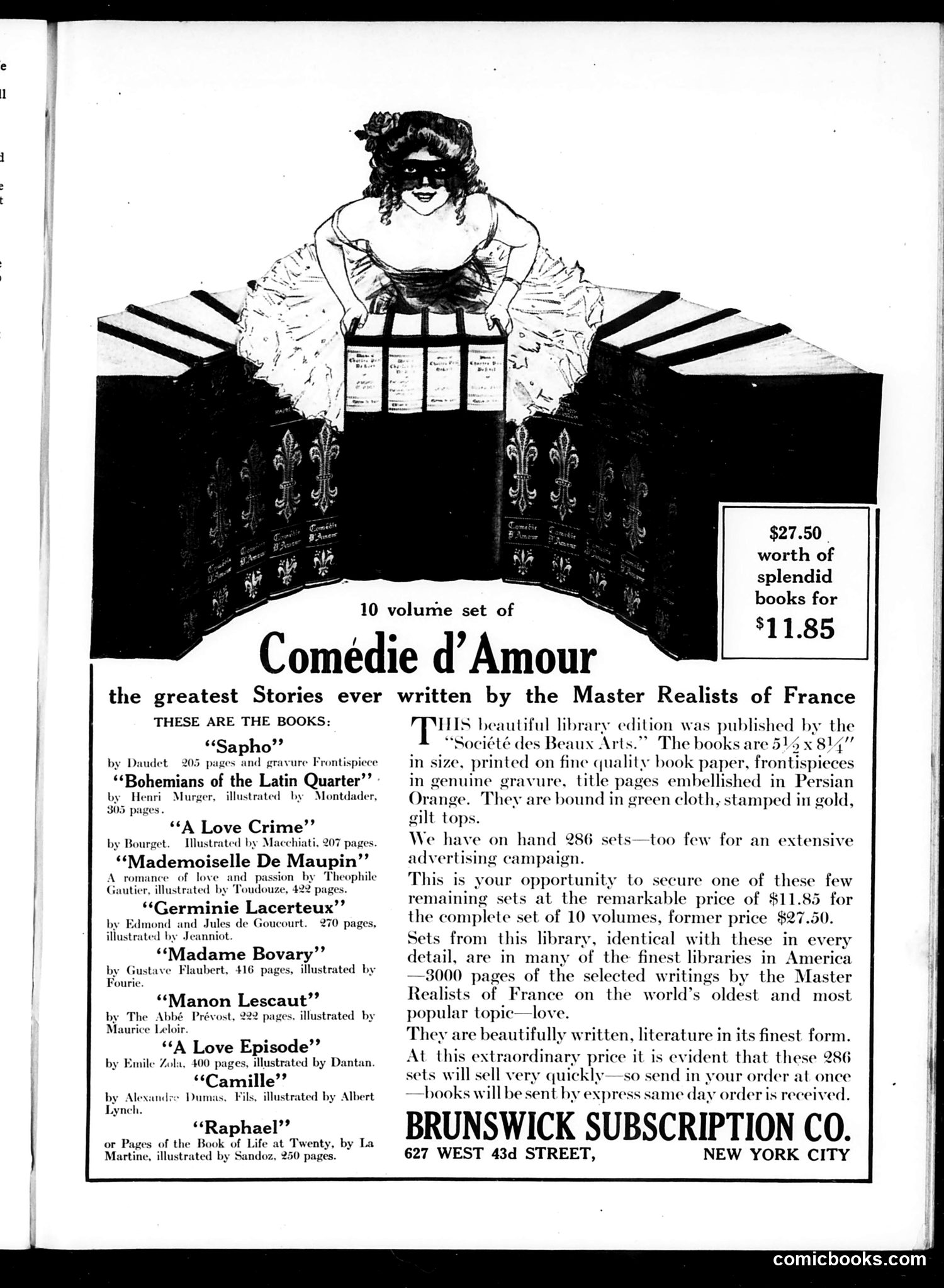
This page is **primarily an advertisement**, not a political cartoon. It promotes a 10-volume set of French literature called "Comédie d'Amour"—works by 19th-century French Realist authors (Daudet, Flaubert, Zola, Dumas, etc.)—offered at a steep discount ($11.85 instead of $27.50). The illustration shows a woman in period dress opening an ornate book cabinet, likely meant to evoke luxury and refinement. The marketing pitch emphasizes the books' quality (fine paper, gravure illustrations, green cloth binding, gold stamping) and their presence in "finest libraries in America." The gentle humor lies in the sales language: claiming only 286 sets remain (creating artificial scarcity), emphasizing the books' focus on "love" (the "world's oldest and most popular topic"), and urging immediate purchase. This represents early 20th-century direct-mail marketing tactics—appeals to sophistication, urgency, and savings. There is no identifiable political satire or social commentary visible in the image or text.
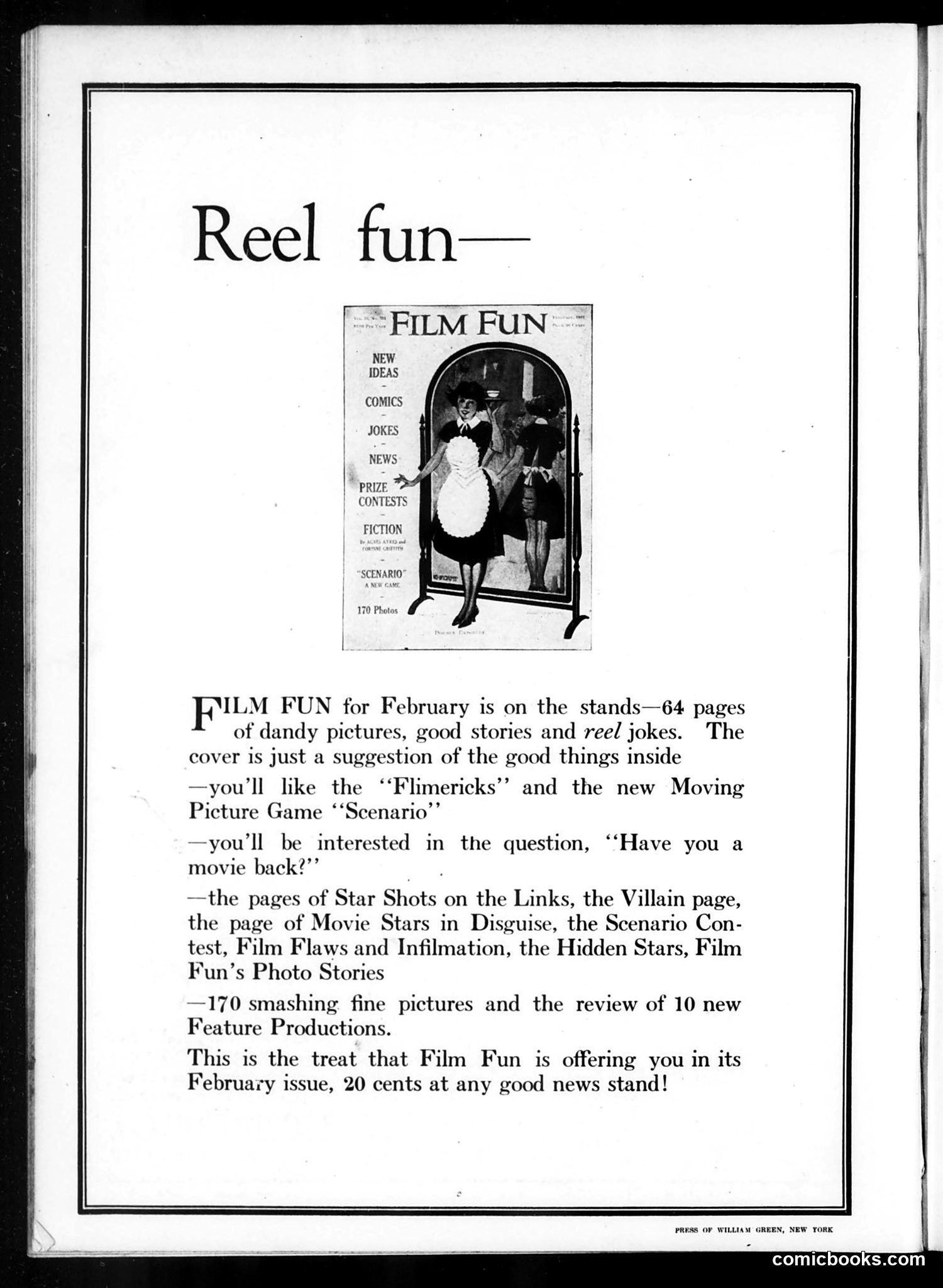
This is **advertising copy**, not political satire. Judge magazine is promoting "Film Fun," a companion publication dedicated to cinema entertainment. The page advertises Film Fun's February issue (64 pages, 20 cents) featuring: - **"Flimericks"** — puns combining "film" with limericks - **"Scenario"** — a new moving-picture guessing game - Content about movie stars, including "Movie Stars in Disguise" and "Hidden Stars" - 170 photographs and reviews of 10 new feature films The illustration shows a figure in silhouette viewing a mirror or screen — a visual metaphor for cinema itself. The humor is gentle wordplay ("reel jokes" punning on "real"; "Have you a movie back?" — unclear reference, possibly "movie back" as a joke type). This reflects the early 1900s film industry's novelty and the enthusiastic fan culture developing around cinema during this period.