
Judge, 1922-01-14 · page 14 of 36
Judge — January 14, 1922 — page 14: what you’re looking at
What you’re looking at
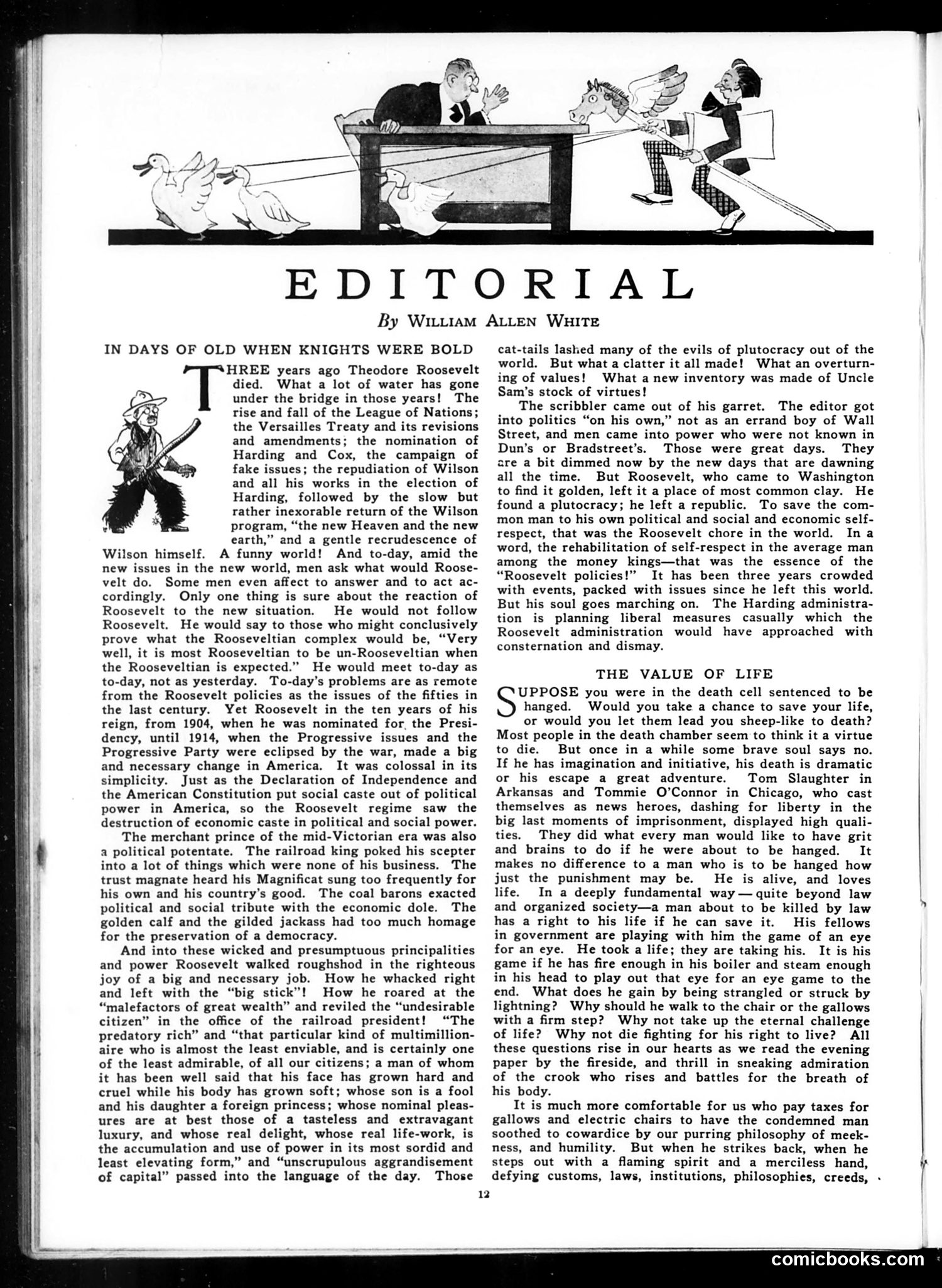
This is William Allen White's editorial tribute to Theodore Roosevelt, who died three years prior (1919). The cartoon header depicts a seesaw/lever scene: angels on the left pull down while a demonic figure on the right is lifted up—a visual metaphor for Roosevelt's disruptive reformist impact. White argues Roosevelt fundamentally transformed America by destroying "economic caste in political and social power." He attacked corrupt industrialists—railroad kings, coal barons, trust magnates—whom White sarcastically calls "malefactors of great wealth." Roosevelt's famous "big stick" wielded against these plutocrats brought ordinary people (scribblers, editors) into public influence, replacing Wall Street's traditional gatekeepers. White contrasts Roosevelt's decisive Progressive era (1904-1914) with post-WWI confusion under Wilson and Harding. The editorial suggests modern leaders should adapt Roosevelt's *spirit* of reform to current problems, not simply imitate his past policies—a meditation on how to preserve his legacy amid changed circumstances.
📄 Transcribed text from this page (OCR, searchable)
Machine-transcribed from the original scan — historical spelling and the odd misread are preserved.
EDITORIAL By WituraMm ALLEN WHITE IN DAYS OF OLD WHEN KNIGHTS WERE BOLD HREE years ago Theodore Roosevelt died. What a lot of water has gone under the bridge in those years! The rise and fall of the League of Nations; the Versailles Treaty and its revisions and amendments; the nomination of Harding and Cox, the campaign of fake issues; the repudiation of Wilson and all his works in the election of Harding, followed by the slow but rather inexorable return of the Wilson program, “the new Heaven and the new earth,” and a gentle recrudescence of A funny world! And to-day, amid the Wilson himself. new issues in the new world, men ask what would Roose- velt do. Some men even affect to answer and to act ac- cordingly. Only one thing is sure about the reaction of Roosevelt to the new situation. He would not follow Roosevelt. He would say to those who might conclusively prove what the Rooseveltian complex would be, “Very well, it is most Rooseveltian to be un-Rooseveltian when the Rooseveltian is expected.” He would meet to-day as to-day, not as yesterday. To-day’s problems are as remote from the Roosevelt policies as the issues of the fifties in the last century. Yet Roosevelt in the ten years of his reign, from 1904, when he was nominated for, the Presi- dency, until 1914, when the Progressive issues and the Progressive Party were eclipsed by the war, made a big and necessary change in America. It was colossal in its simplicity. Just as the Declaration of Independence and the American Constitution put social caste out of political power in America, so the Roosevelt regime saw the destruction of economic caste in political and social power. The merchant prince of the mid-Victorian era was also a political potentate. The railroad king poked his scepter into a lot of things which were none of his business. The trust magnate heard his Magnificat sung too frequently for his own and his country’s good. The coal barons exacted political and social tribute with the economic dole. The golden calf and the gilded jackass had too much homage for the preservation of a democracy. And into these wicked and presumptuous principalities and power Roosevelt walked roughshod in the righteous joy of a big and necessary job. How he whacked right and left with the “big stick”! How he roared at the “malefactors of great wealth” and reviled the “undesirable citizen” in the office of the railroad president! “The predatory rich” and “that particular kind of multimillion- aire who is almost the least enviable, and is certainly one of the least admirable, of all our citizens; a man of whom it has been well said that his face has grown hard and cruel while his body has grown soft; whose son is a fool and his daughter a foreign princess; whose nominal pleas- ures are at best those of a tasteless and extravagant luxury, and whose real delight, whose real life-work, is the accumulation and use of power in its most sordid and least elevating form,” and “unscrupulous aggrandisement of capital” passed into the language of the day. Those 12 cat-tails lashed many of the evils of plutocracy out of the world. But what a clatter it all made! What an overturn- ing of values! What a new inventory was made of Uncle Sam’s stock of virtues! The scribbler came out of his garret. The editor got into politics “on his own,” not as an errand boy of Wall Street, and men came into power who were not known in Dun’s or Bradstreet’s. Those were great days. They are a bit dimmed now by the new days that are dawning all the time. But Roosevelt, who came to Washington to find it golden, left it a place of most common clay. He found a plutocracy; he left a republic. To save the com- mon man to his own political and social and economic self- respect, that was the Roosevelt chore in the world. Ina word, the rehabilitation of self-respect in the average man among the money kings—that was the essence of the “Roosevelt policies!” It has been three years crowded with events, packed with issues since he left this world. But his soul goes marching on. The Harding administra- tion is planning liberal measures casually which the Roosevelt administration would have approached with consternation and dismay. THE VALUE OF LIFE UPPOSE you were in the death cell sentenced to be S hanged. Would you take a chance to save your life, or would you let them lead you sheep-like to death? Most people in the death chamber seem to think it a virtue to die. But once in a while some brave soul says no. If he has imagination and initiative, his death is dramatic or his escape a great adventure. Tom Slaughter in Arkansas and Tommie O’Connor in Chicago, who cast themselves as news heroes, dashing for liberty in the big last moments of imprisonment, displayed high quali- ties. They did what every man would like to have grit and brains to do if he were about to be hanged. It makes no difference to a man who is to be hanged how just the punishment may be. He is alive, and loves life. In a deeply fundamental way — quite beyond law and organized society—a man about to be killed by law has a right to his life if he can save it. His fellows in government are playing with him the game of an eye for an eye. He took a life; they are taking his. It is his game if he has fire enough in his boiler and steam enough in his head to play out that eye for an eye game to the end. What does he gain by being strangled or struck by lightning? Why should he walk to the chair or the gallows with a firm step? Why not take up the eternal challenge of life? Why not die fighting for his right to live? All these questions rise in our hearts as we read the evening paper by the fireside, and thrill in sneaking admiration of the crook who rises and battles for the breath of his body. It is much more comfortable for us who pay taxes for gallows and electric chairs to have the condemned man soothed to cowardice by our purring philosophy of meek- ness, and humility. But when he strikes back, when he steps out with a flaming spirit and a merciless hand, defying customs, laws, institutions, philosophies, creeds, - comicbooks.com