
Judge, 1922-01-14 · page 5 of 36
Judge — January 14, 1922 — page 5: what you’re looking at
What you’re looking at
This page features a humorous short story by Gelett Burgess titled "Pinkie Doodle's Proposals." The illustration at the top shows a bride in an exaggerated wedding dress with an extremely long train being carried by a small boy, satirizing modern wedding fashion excess. The story itself is a comedic narrative about Pinkie Doodle receiving multiple marriage proposals—from a Chinese mandarin, a wealthy man named Poozey, and others—while already engaged. The humor derives from Pinkie's romantic complications and the absurd suitors vying for her attention. The text mocks both the frivolousness of engagements in the era and the melodramatic courtship customs of the time, presenting Pinkie as a character navigating ridiculous romantic entanglements with deadpan wit.
📄 Transcribed text from this page (OCR, searchable)
Machine-transcribed from the original scan — historical spelling and the odd misread are preserved.
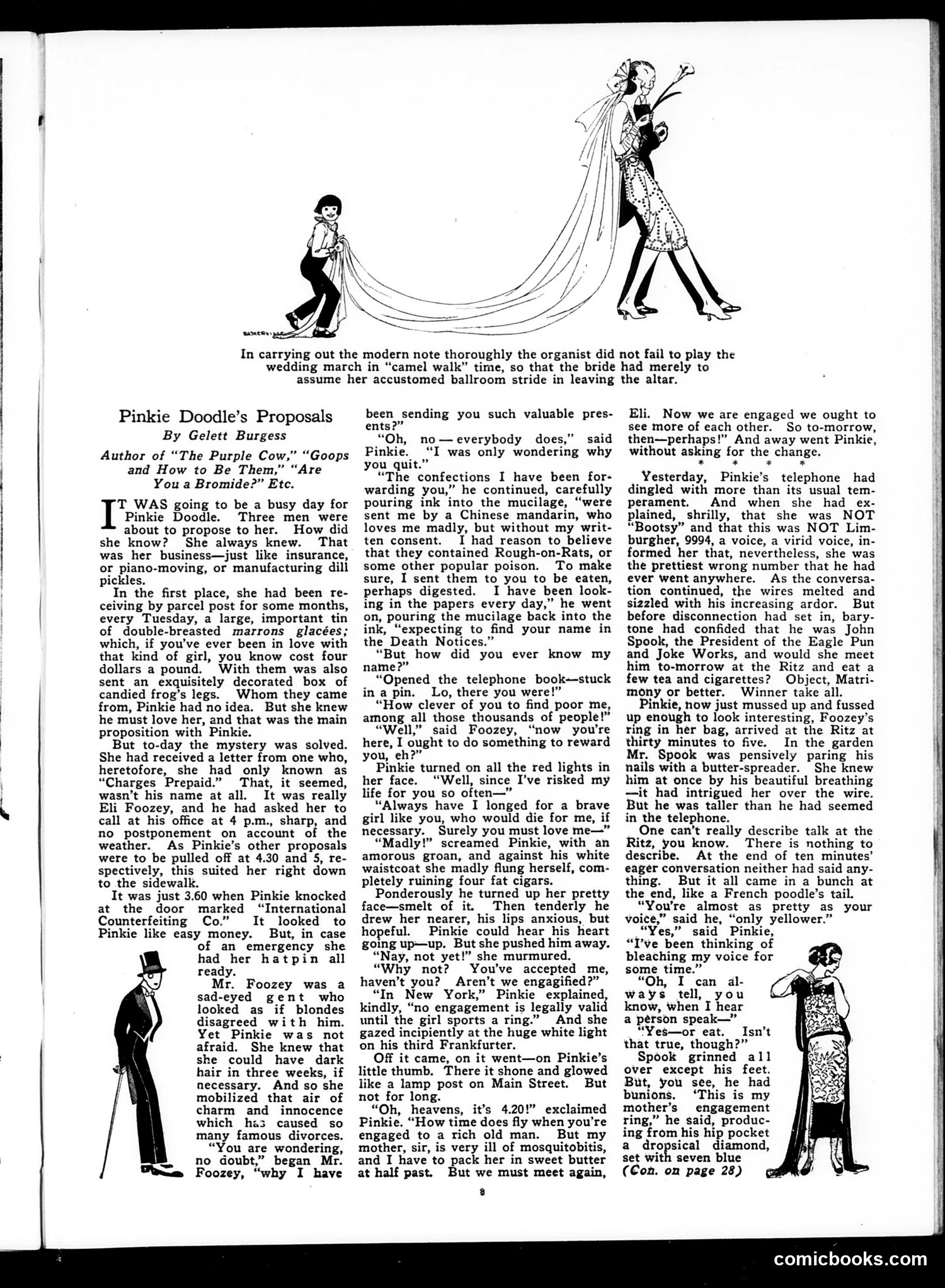
£*~ In carrying out the modern note thoroughly the organist did not fail to play the wedding march in “camel walk” time, so that the bride had merely to assume her accustomed ballroom stride in leaving the altar. Pinkie Doodle’s Proposals By Gelett Burgess Author of “The Purple Cow,” “Goops and How to Be Them,” “Are You a Bromide?” Etc. 'T WAS going to be a busy day for Pinkie Doodle. Three men were about to propose to her. How did she know? She always knew. That was her business—just like insurance, or piano-moving, or manufacturing dill pickles. In the first place, she had been re- ceiving by parcel post for some months, every Tuesday, a large, important tin of double-breasted marrons glacées; which, if you’ve ever been in love with that kind of girl, you know cost four dollars a pound. With them was also sent an exquisitely decorated box of candied frog’s legs. Whom they came from, Pinkie had no idea. But she knew he must love her, and that was the main proposition with Pinkie. But to-day the mystery was solved. She had received a letter from one who, heretofore, she had only known as “Charges Prepaid.” That, it seemed, wasn’t his name at all. It was really Eli Foozey, and he had asked her to call at his office at 4 p.m., sharp, and no postponement on account of the weather. As Pinkie’s other proposals were to be pulled off at 4.30 and 5, re- spectively, this suited her right down to the sidewalk. It was just 3.60 when Pinkie knocked at the door marked “International Counterfeiting Co.” It looked to Pinkie like easy money. But, in case of an emergency she had her hatpin all ready. Mr. Foozey was a sad-eyed gent who looked as if blondes disagreed with him. Yet Pinkie was not afraid. She knew that she could have dark hair in three weeks, if necessary. And so she mobilized that air of charm and innocence which ha3 caused so many famous divorces. ones wondering, = no doubt,” began Mr. Teme Foozey, “why I have been sending you such valuable pres- ents?” “Oh, no—everybody does,” said Pinkie. tT was only wondering why you quit. “The confections I have been for- warding you,” he continued, carefully pouring ink into the mucilage, “were sent me by a Chinese mandarin, who loves me madly, but without my writ- ten consent. I had reason to believe that they contained Rough-on-Rats, or some other popular poison. To make sure, I sent them to you to be eaten, perhaps digested. I have been look- ing in the papers every day,” he went on, pouring the mucilage back into the ink, “expecting to find your name in the Death Notices.” “But how did you ever know my name?” “Opened the telephone book—stuck ina pin. Lo, there you were!” “How clever of you to find poor me, among all those thousands of people!” “Well,” said Foozey, “now you're here, I ought to do something to reward you, eh?” Pinkie turned on all the red lights in her face. ‘Well, since I’ve risked my life for you so often—” “Always have I longed for a brave girl like you, who would die for me, if necessary. Surely you must love me—” “Madly!” screamed Pinkie, with an amorous groan, and against his white waistcoat she madly flung herself, com- pletely ruining four fat cigars. Ponderously he turned up her pretty face—smelt of it. Then tenderly he drew her nearer, his lips anxious, but hopeful. Pinkie could hear his heart going up—up. But she pushed him away. “Nay, not yet!” she murmured. “Why not? You've accepted me, haven’t you? Aren’t we engagified?” “In New York,” Pinkie explained, kindly, “no engagement is legally valid until the girl sports a ring.” And she gazed incipiently at the huge white light on his third Frankfurter. Off it came, on it went—on Pinkie’s little thumb. There it shone and glowed like a lamp post on Main Street. But not for long. “Oh, heavens, it’s 4.20!” exclaimed Pinkie. “How time does fly when you're engaged to a rich old man. But my mother, sir, is very ill of mosquitobitis, and I have to pack her in sweet butter at half past. But we must meet again, Eli. Now we are engaged we ought to see more of each other. So to-morrow, then—perhaps!” And away went Pinkie, without asking for the change. * * * * Yesterday, Pinkie’s telephone had dingled with more than its usual tem- perament. And when she had ex- plained, shrilly, that she was NOT “Bootsy” and that this was NOT Lim- burgher, 9994, a voice, a virid voice, in- formed her that, nevertheless, she was the prettiest wrong number that he had ever went anywhere. As the conversa- tion continued, the wires melted and sizzled with his increasing ardor. But before disconnection had set in, bary- tone had confided that he was John Spook, the President of the Eagle Pun and Joke Works, and would she meet him to-morrow at the Ritz and eat a few tea and cigarettes? Object, Matri- mony or better. Winner take all. Pinkie, now just mussed up and fussed up enough to look interesting, Foozey’s ring in her bag, arrived at the Ritz at thirty minutes to five. In the garden Mr. Spook was pensively paring his nails with a butter-spreader. She knew him at once by his beautiful breathing —it had intrigued her over the wire. But he was taller than he had seemed in the telephone. One can’t really describe talk at the Ritz, you know. There is nothing to describe. At the end of ten minutes’ eager conversation neither had said any- thing. But it all came in a bunch at the end, like a French poodle’s tail. “You're almost as pretty as your voice,” said he, “only yellower.” “Yes,” said Pinkie, “T’ve been thinking of bleaching my voice for some time.” “Oh, I can al- ways tell, you know, when I hear a pérson speak—” “Yes—or eat. Isn’t that true, though?” Spook grinned all over except his feet. But, you see, he had bunions. ‘This is my mother’s engagement ring,” he said, produc- ing from his hip pocket a dropsical diamond, set with seven blue (Con. on page 28) comicbooks.com