
Judge, 1922-01-14 · page 17 of 36
Judge — January 14, 1922 — page 17: what you’re looking at
What you’re looking at
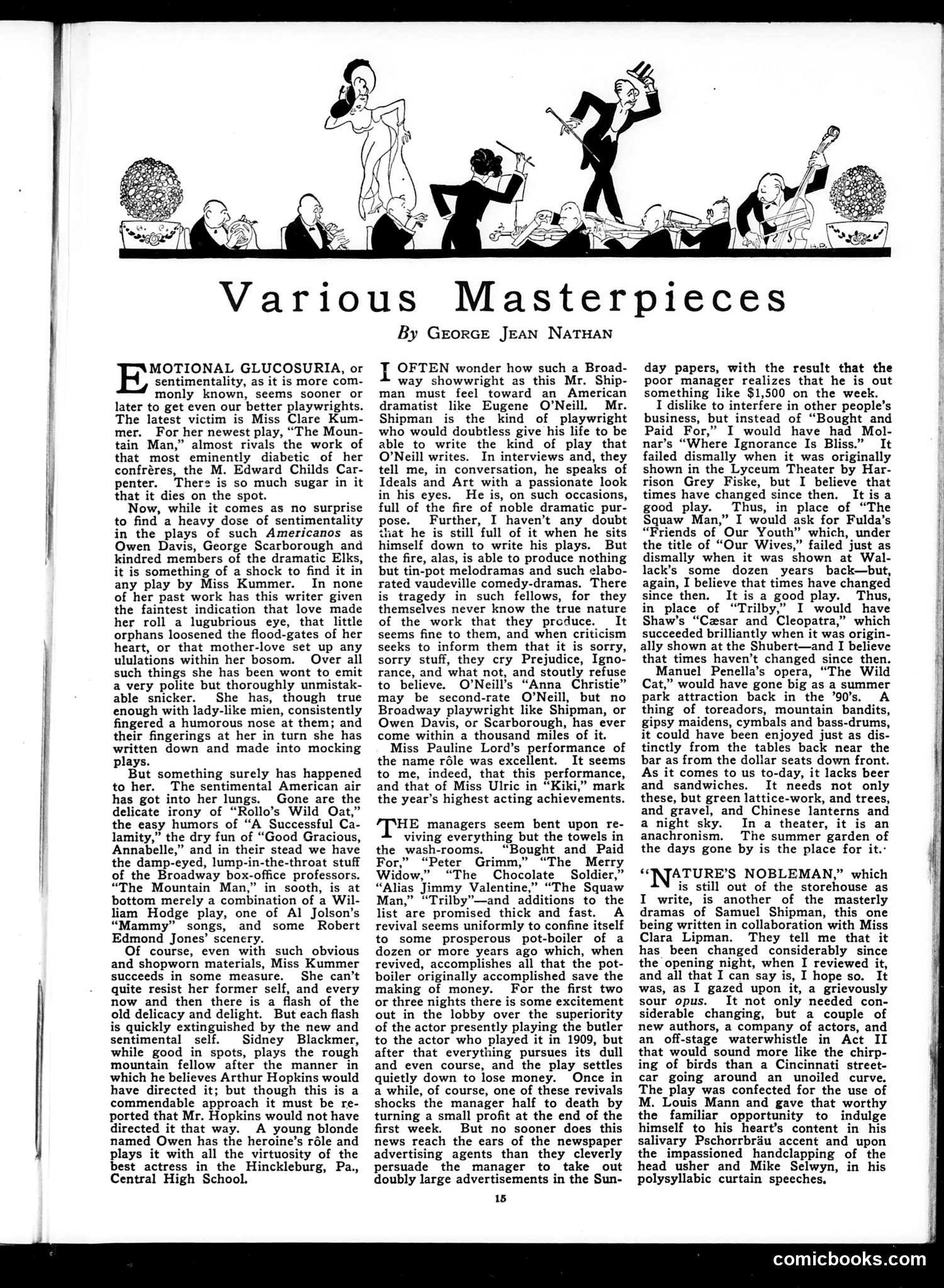
This page from Judge magazine features drama criticism by George Jean Nathan, a prominent theater critic of the era. The illustration at the top shows silhouettes of various theatrical figures and performers in comedic poses—reflecting the page's focus on Broadway plays and playwrights. Nathan critiques several contemporary American dramatists: 1. **Clare Kummer** is mocked for abandoning her signature dry wit and irony in favor of maudlin sentimentality in "The Mountain Man," which Nathan compares unfavorably to formula Broadway fare. 2. **Mr. Shipman** is portrayed as an aspiring artist who claims to value ideals and serious drama but produces only "tin-pot melodramas and vaudeville comedy-dramas." Nathan contrasts him with Eugene O'Neill, whose work represents genuine theatrical achievement. The satire targets the gap between Broadway's commercial pressures and serious artistic ambition—playwrights compromise their talents for box-office success while pretending to artistic integrity.
📄 Transcribed text from this page (OCR, searchable)
Machine-transcribed from the original scan — historical spelling and the odd misread are preserved.
Various Masterpieces By Grorce JEAN NaTHAN MOTIONAL GLUCOSURIA, or sentimentality, as it is more com- monly known, seems sooner or later to get even our better playwrights. The latest victim is Miss Clare Kum- mer. For her newest play, “The Moun- tain Man,” almost rivals the work of that most eminently diabetic of her confréres, the M. Edward Childs Car- penter. There is so much sugar in it that it dies on the spot. Now, while it comes as no surprise to find a heavy dose of sentimentality in the plays of such Americanos as Owen Davis, George Scarborough and kindred members of the dramatic Elks, it is something of a shock to find it in any play by Miss Kummer. In none of her past work has this writer given the faintest indication that love made her roll a lugubrious eye, that little orphans loosened the flood-gates of her heart, or that mother-love set up any ululations within her bosom. Over all such things she has been wont to emit a very polite but thoroughly unmistak- able snicker. She has, though true enough with lady-like mien, consistently fingered a humorous nose at them; and their fingerings at her in turn she has written down and made into mocking plays. But something surely has happened to her. The sentimental American air has got into her lungs. Gone are the delicate irony of “Rollo’s Wild Oat,” the easy humors of “A Successful Ca- lamity,” the dry fun of “Good Gracious, Annabelle,” and in their stead we have the damp-eyed, lump-in-the-throat stuff of the Broadway box-office professors. “The Mountain Man,” in sooth, is at bottom merely a combination of a Wil- liam Hodge play, one of Al Jolson’s “Mammy” songs, and some Robert Edmond Jones’ scenery. Of course, even with such obvious and shopworn materials, Miss Kummer succeeds in some measure. She can’t quite resist her former self, and every now and then there is a flash of the old delicacy and delight. But each flash is quickly extinguished by the new and sentimental self. Sidney Blackmer, while good in spots, plays the rough mountain fellow after the manner in which he believes Arthur Hopkins would have directed it; but though this is a commendable approach it must be re- ported that Mr. Hopkins would not have directed it that way. A young blonde named Owen has the heroine’s réle and plays it with all the virtuosity of the best actress in the Hinckleburg, Pa., Central High School. OFTEN wonder how such a Broad- way showwright as this Mr. Ship- man must feel toward an American dramatist like Eugene O’Neill. Mr. Shipman is the kind of playwright who would doubtless give his life to be able to write the kind of play that O’Neill writes. In interviews and, they tell me, in conversation, he speaks of Ideals and Art with a passionate look in his eyes. He is, on such occasions, full of the fire of noble dramatic pur- pose. Further, I haven’t any doubt that he is still full of it when he sits himself down to write his plays. But the fire, alas, is able to produce nothing but tin-pot melodramas and such elabo- rated vaudeville comedy-dramas. There is tragedy in such fellows, for they themselves never know the true nature of the work that they produce. It seems fine to them, and when criticism seeks to inform them that it is sorry, sorry stuff, they cry Prejudice, Igno- rance, and what not, and stoutly refuse to believe. O’Neill’s “Anna Christie” may be second-rate O’Neill, but no Broadway playwright like Shipman, or Owen Davis, or Scarborough, has ever come within a thousand miles of it. Miss Pauline Lord’s performance of the name réle was excellent. It seems to me, indeed, that this performance, and that of Miss Ulric in “Kiki,” mark the year’s highest acting achievements. ‘THE managers seem bent upon re- viving everything but the towels in the wash-rooms. “Bought and Paid For,” “Peter Grimm,” “The Merry Widow,” “The Chocolate Soldier,” “Alias Jimmy Valentine,” “The Squaw Man,” “Trilby”—and additions to the list are promised thick and fast. A revival seems uniformly to confine itself to some prosperous pot-boiler of a dozen or more years ago which, when revived, accomplishes all that the pot- boiler originally accomplished save the making of money. For the first two or three nights there is some excitement out in the lobby over the superiority of the actor presently playing the butler to the actor who played it in 1909, but after that everything pursues its dull and even course, and the play settles quietly down to lose money. Once in a while, of course, one of these revivals shocks the manager half to death by turning a small profit at the end of the first week. But no sooner does this news reach the ears of the newspaper advertising agents than they cleverly persuade the manager to take out doubly large advertisements in the Sun- 15 day papers, with the result that the poor manager realizes that he is out something like $1,500 on the week. I dislike to interfere in other people’s business, but instead of “Bought and Paid For,” I would have had Mol- nar’s “Where Ignorance Is Bliss.” It failed dismally when it was originally shown in the Lyceum Theater by Har- rison Grey Fiske, but I believe that times have changed since then. It is a good play. Thus, in place of “The Squaw Man,” I would ask for Fulda’s “Friends of Our Youth” which, under the title of “Our Wives,” failed just as dismally when it was shown at Wal- lack’s some dozen years back—but, again, I believe that times have changed since then. It is a good play. Thus, in place of “Trilby,” I would have Shaw’s “Czsar and Cleopatra,” which succeeded brilliantly when it was origin- ally shown at the Shubert—and I believe that times haven’t changed since then. Manuel Penella’s opera, “The Wild Cat,” would have gone big as a summer park attraction back in the ’90’s. A thing of toreadors, mountain bandits, gipsy maidens, cymbals and bass-drums, it could have been enjoyed just as dis- tinctly from the tables back near the bar as from the dollar seats down front. As it comes to us to-day, it lacks beer and sandwiches. It needs not only these, but green lattice-work, and trees, and gravel, and Chinese lanterns and a night sky. In a theater, it is an anachronism. The summer garden of the days gone by is the place for it.: ATURE’S NOBLEMAN,” which is still out of the storehouse as I write, is another of the masterly dramas of Samuel Shipman, this one being written in collaboration with Miss Clara Lipman. They tell me that it has been changed considerably since the opening night, when I reviewed it, and all that I can say is, I hope so. It was, as I gazed upon it, a grievously sour opus. It not only needed con- siderable changing, but a couple of new authors, a company of actors, and an off-stage waterwhistle in Act II that would sound more like the chirp- ing of birds than a Cincinnati street- car going around an unoiled curve. The play was confected for the use of M. Louis Mann and gave that worthy the familiar opportunity to indulge himself to his heart’s content in his salivary Pschorrbrau accent and upon the impassioned handclapping of the head usher and Mike Selwyn, in his polysyllabic curtain speeches, comicbooks.com