
Judge, 1922-01-14 · page 10 of 36
Judge — January 14, 1922 — page 10: what you’re looking at
What you’re looking at
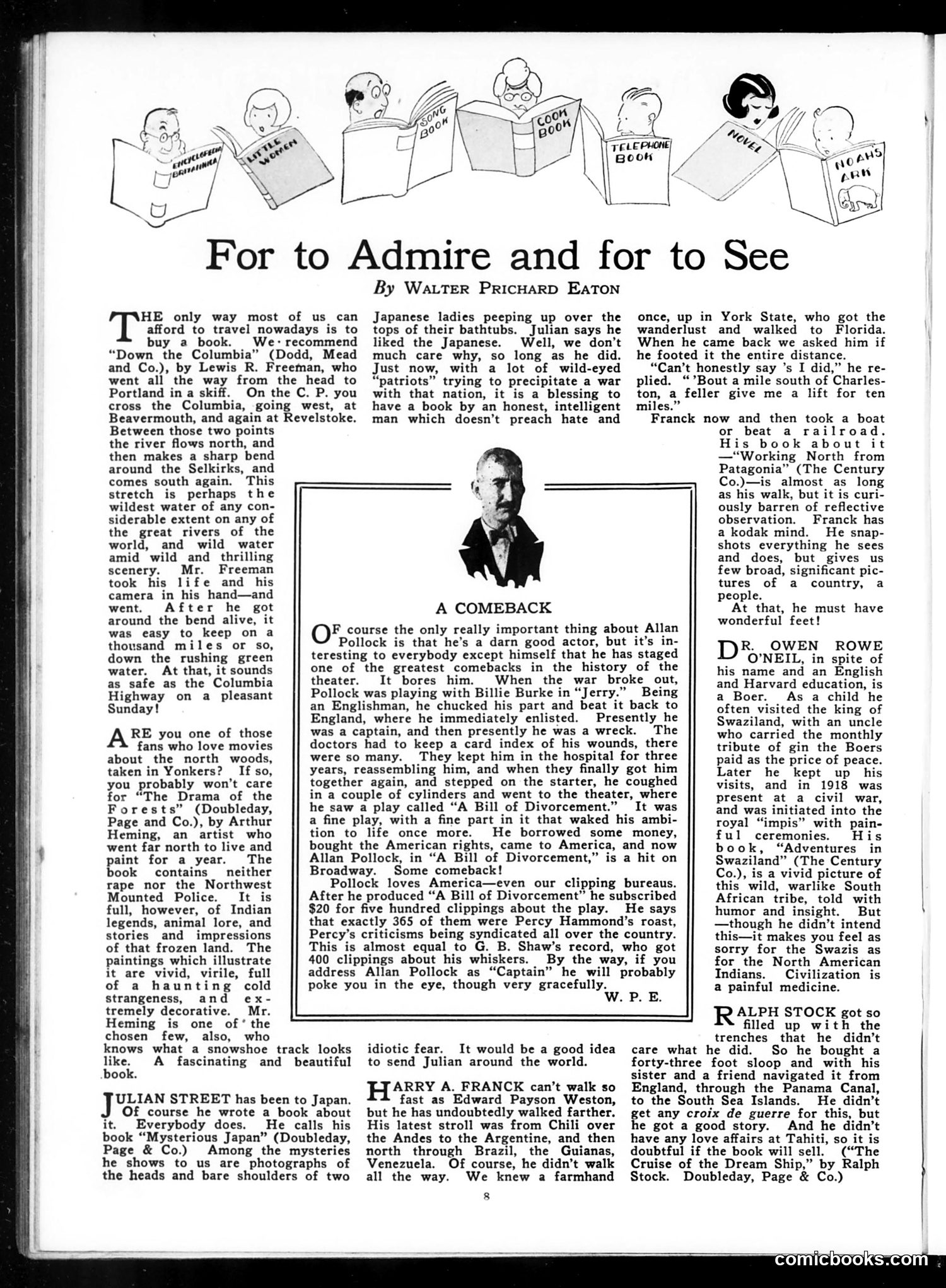
This page reviews travel books, using them to comment on contemporary attitudes. The header cartoon shows seven figures reading various books about different regions and modes of travel. The main satire targets casual, non-confrontational travel writing. Author Walter Prichard Eaton praises Lewis Freeman's *Down the Columbia* and Julian Street's *Mysterious Japan* for being honest accounts without preaching hate—a pointed reference to contemporary anti-Japanese sentiment among American "patriots" who were agitating for war with Japan. The secondary feature celebrates actor Allan Pollock's theatrical "comeback" after WWI service left him severely wounded. Eaton presents this as genuinely impressive but notes Pollock finds the fuss boring—a gentle jab at performative patriotism. Overall, the page advocates for thoughtful, unprejudiced observation of the world over inflammatory nationalism, using book reviews as its vehicle.
📄 Transcribed text from this page (OCR, searchable)
Machine-transcribed from the original scan — historical spelling and the odd misread are preserved.
HE only way most of us can afford to travel nowadays is to buy a book. We- recommend “Down the Columbia” (Dodd, Mead and Co.), by Lewis R. Freeman, who went all the way from the head to Portland in a skiff. On the C. P. you cross the Columbia, going west, at Beavermouth, and again at Revelstoke. For to Admire and for to See By Wa.TEeR PRICHARD EATON Japanese ladies peeping up over the tops of their bathtubs. Julian says he liked the Japanese. Well, we don’t much care why, so long as he did. Just now, with a lot of wild-eyed “patriots” trying to precipitate a war with that nation, it is a blessing to have a book by an honest, intelligent man which doesn’t preach hate and once, up in York State, who got the wanderlust and walked to Florida. When he came back we asked him if he footed it the entire distance. “Can’t honestly say ’s I did,” he re- plied. “’Bout a mile south of Charles- ton, a feller give me a lift for ten miles.” Franck now and then took a boat Between those two points the river flows north, and then makes a sharp bend around the Selkirks, and comes south again. This stretch is perhaps the wildest water of any con- siderable extent on any of the great rivers of the world, and wild water amid wild and thrilling scenery. Mr. Freeman took his life and his camera in his hand—and went. After he got around the bend alive, it was easy to keep on a thousand miles or so, down the rushing green water. At that, it sounds as safe as the Columbia Highway on a pleasant Sunday! A®E you one of those fans who love movies about the north woods, taken in Yonkers? If so, you probably won't care for “The Drama of the Forests” (Doubleday, Page and Co.), by Arthur Heming, an artist who went far north to live and paint for a year. The book contains neither rape nor the Northwest Mounted Police. It is full, however, of Indian legends, animal lore, and stories and impressions of that frozen land. The paintings which illustrate it are vivid, virile, full of a haunting cold strangeness, and ex- tremely decorative. Mr. Heming is one of’ the chosen few, also, who knows what a snowshoe track looks idiotic fear. It would be a good idea care what he did. like. A fascinating and beautiful to send Julian around the world. A COMEBACK OF course the only really important thing about Allan Pollock is that he’s a darn good actor, but it’s in- teresting to everybody except himself that he has staged one of the greatest comebacks in the history of the theater. It bores him. When the war broke out, Pollock was playing with Billie Burke in “Jerry.” Being an Englishman, he chucked his part and beat it back to England, where he immediately enlisted. Presently he was a captain, and then presently he was a wreck. The doctors had to keep a card index of his wounds, there were so many. They kept him in the hospital for three years, reassembling him, and when they finally got him together again, and stepped on the starter, he coughed in a couple of cylinders and went to the theater, where he saw a play called “A Bill of Divorcement.” It was a fine play, with a fine part in it that waked his ambi- tion to life once more. He borrowed some money, bought the American rights, came to America, and now Allan Pollock, in “A Bill of Divorcement,” is a hit on Broadway. Some comeback! Pollock loves America—even our clipping bureaus. After he produced “A Bill of Divorcement” he subscribed $20 for five hundred clippings about the play. He says that exactly 365 of them were Percy Hammond’s roast, Percy’s criticisms being syndicated all over the country. This is almost equal to G. B. Shaw’s record, who got 400 clippings about his whiskers. By the way, if you address Allan Pollock as “Captain” he will probably poke you in the eye, though very eracetally.., Bz or beat a railroad. His book about it —‘“‘Working North from Patagonia” (The Century Co.)—is almost as long as his walk, but it is curi- ously barren of reflective observation. Franck has a kodak mind. He snap- shots everything he sees and does, but gives us few broad, significant pic- tures of a country, a people. At that, he must have wonderful feet! R. OWEN ROWE O’NEIL, in spite of his name and an English and Harvard education, is a Boer. As a child he often visited the king of Swaziland, with an uncle who carried the monthly tribute of gin the Boers paid as the price of peace. Later he kept up _ his visits, and in 1918 was present at a civil war, and was initiated into the royal “impis” with pain- ful ceremonies. His book, “Adventures in Swaziland” (The Century Co.), is a vivid picture of this wild, warlike South African tribe, told with humor and insight. But —though he didn’t intend this—it makes you feel as sorry for the Swazis as for the North American Indians. Civilization is a painful medicine. RALPH STOCK got so filled up with the trenches that he didn’t So he bought a forty-three foot sloop and with his book. bees STREET has been to Japan. Of course he wrote a book about it. Everybody does. He calls his book “Mysterious Japan” (Doubleday, Page & Co.) Among the mysteries he shows to us are photographs of the heads and bare shoulders of two ARRY A. FRANCK can’t walk so fast as Edward Payson Weston, but he has undoubtedly walked farther. His latest stroll was from Chili over the Andes to the Argentine, and then north through Brazil, the Guianas, Venezuela. Of course, he didn’t walk all the way. We knew a farmhand sister and a friend navigated it from England, through the Panama Canal, to the South Sea Islands. He didn’t get any croix de guerre for this, but got a good story. And he didn’t have any love affairs at Tahiti, so it is doubtful if the book will sell. (“The Cruise of the Dream Ship,” by Ralph Stock. Doubleday, Page & Co.)