
A complete issue · 36 pages · 1921
Judge — November 19, 1921
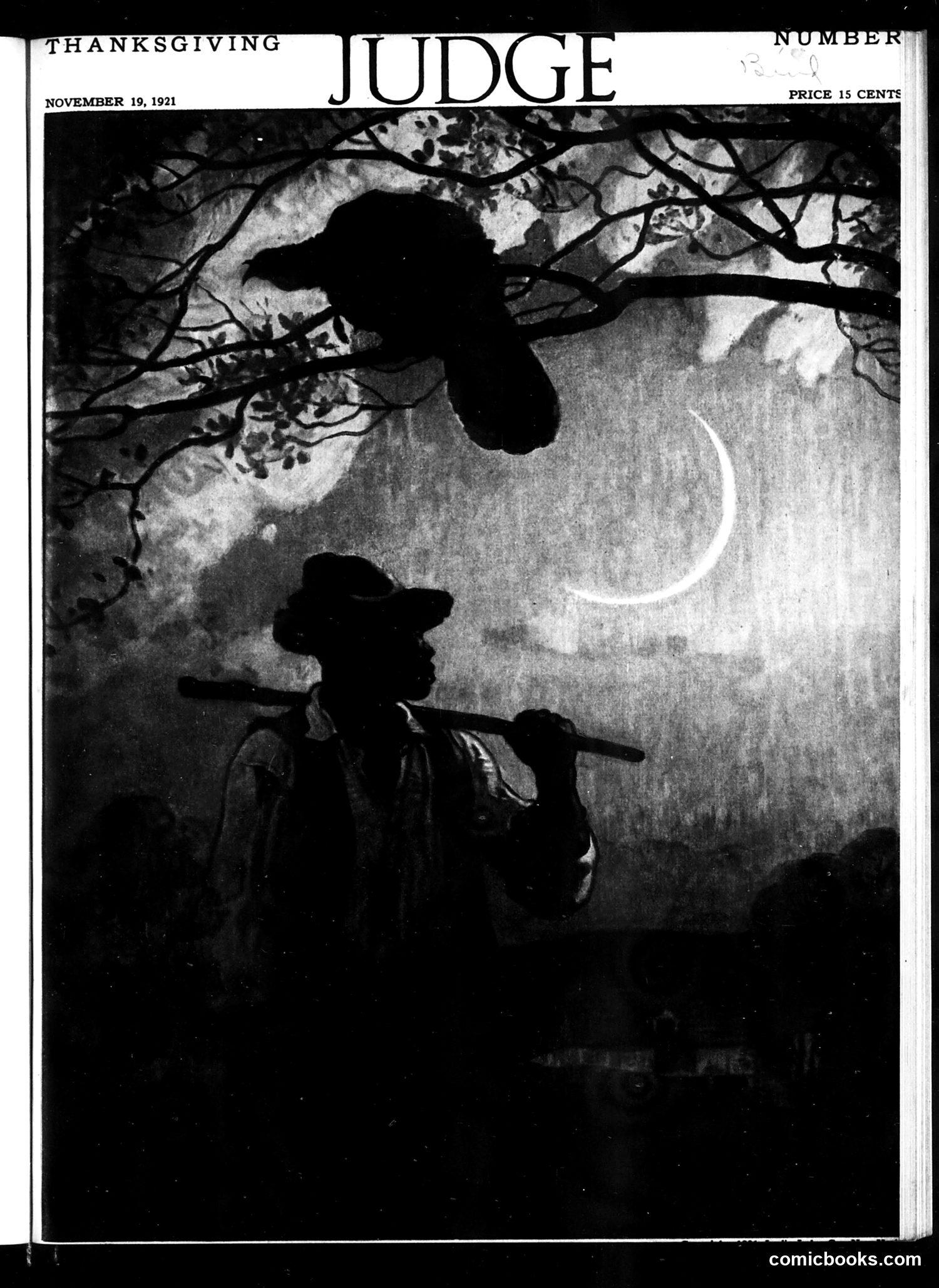
This is the cover of *Judge* magazine's Thanksgiving issue from November 19, 1921. The image shows a silhouetted figure in a hat carrying a rifle, standing beneath bare branches under a crescent moon—a classic hunting scene composition. The satire likely plays on Thanksgiving's traditional association with hunting and harvest, presenting a romantic or satirical vision of the holiday's origins. The silhouette technique was popular for cover art of this era. Without additional text visible on the page, the specific political or social commentary remains unclear, though the mood suggests either nostalgic Americana or subtle critique of holiday commercialization. The 15-cent price reflects early 1920s publishing costs.
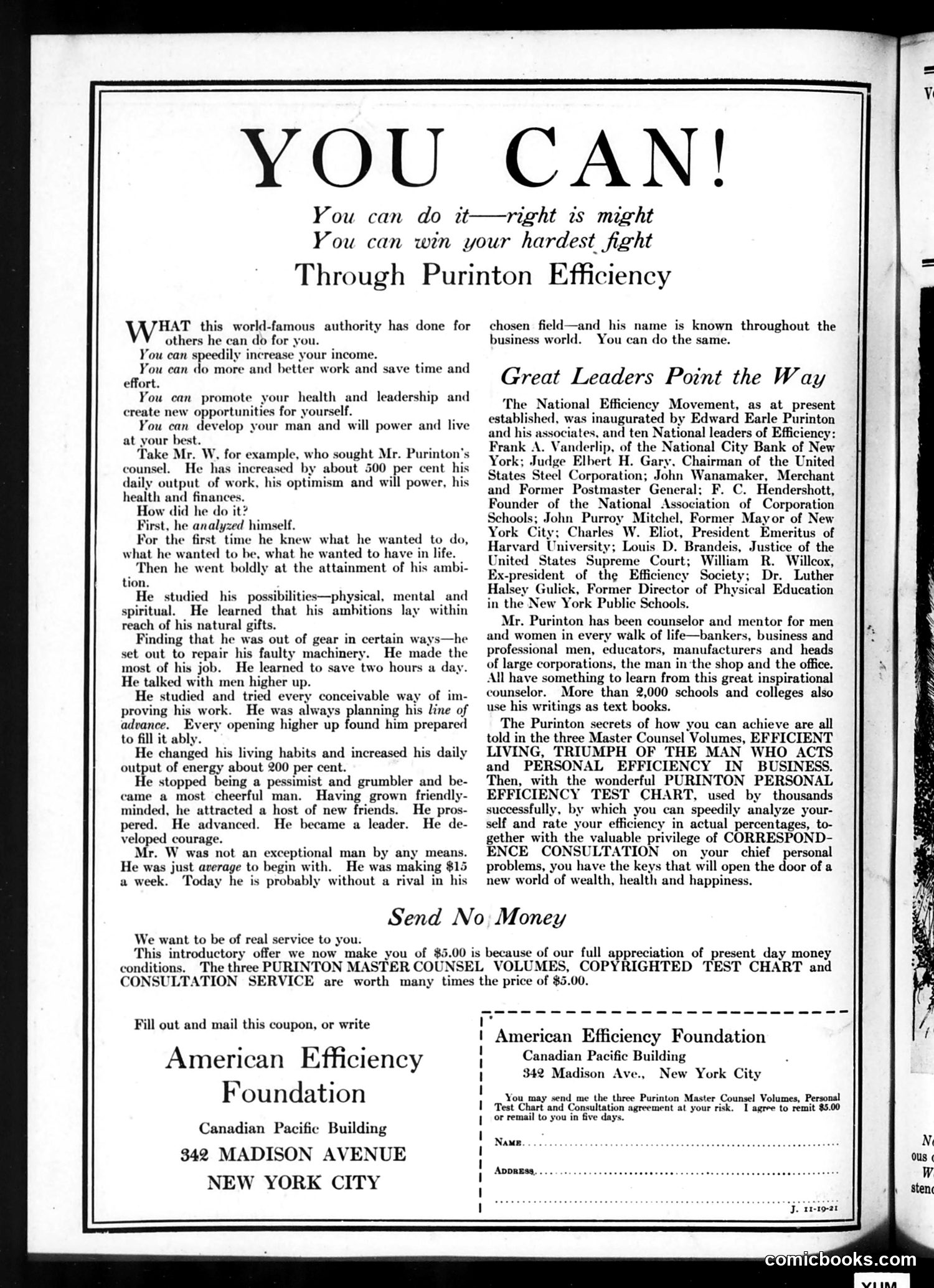
This page is primarily **advertising, not satire or political cartoon content**. It's a full-page ad for the American Efficiency Foundation promoting "Purinton Efficiency"—a self-help/business improvement system created by Edward Earle Purinton. The ad uses motivational copy ("YOU CAN!") and testimonials from prominent figures (judges, business leaders, educators) to tout Purinton's three Master Counsel Volumes and personal efficiency test chart. The narrative describes an unnamed man ("Mr. W.") who analyzed himself, improved his work output by 300%, and achieved success. This reflects early 20th-century American enthusiasm for **scientific management and self-improvement systems**—a period when efficiency gurus marketed promise-filled programs to ambitious businessmen. The tone is earnest promotional material rather than satirical commentary.
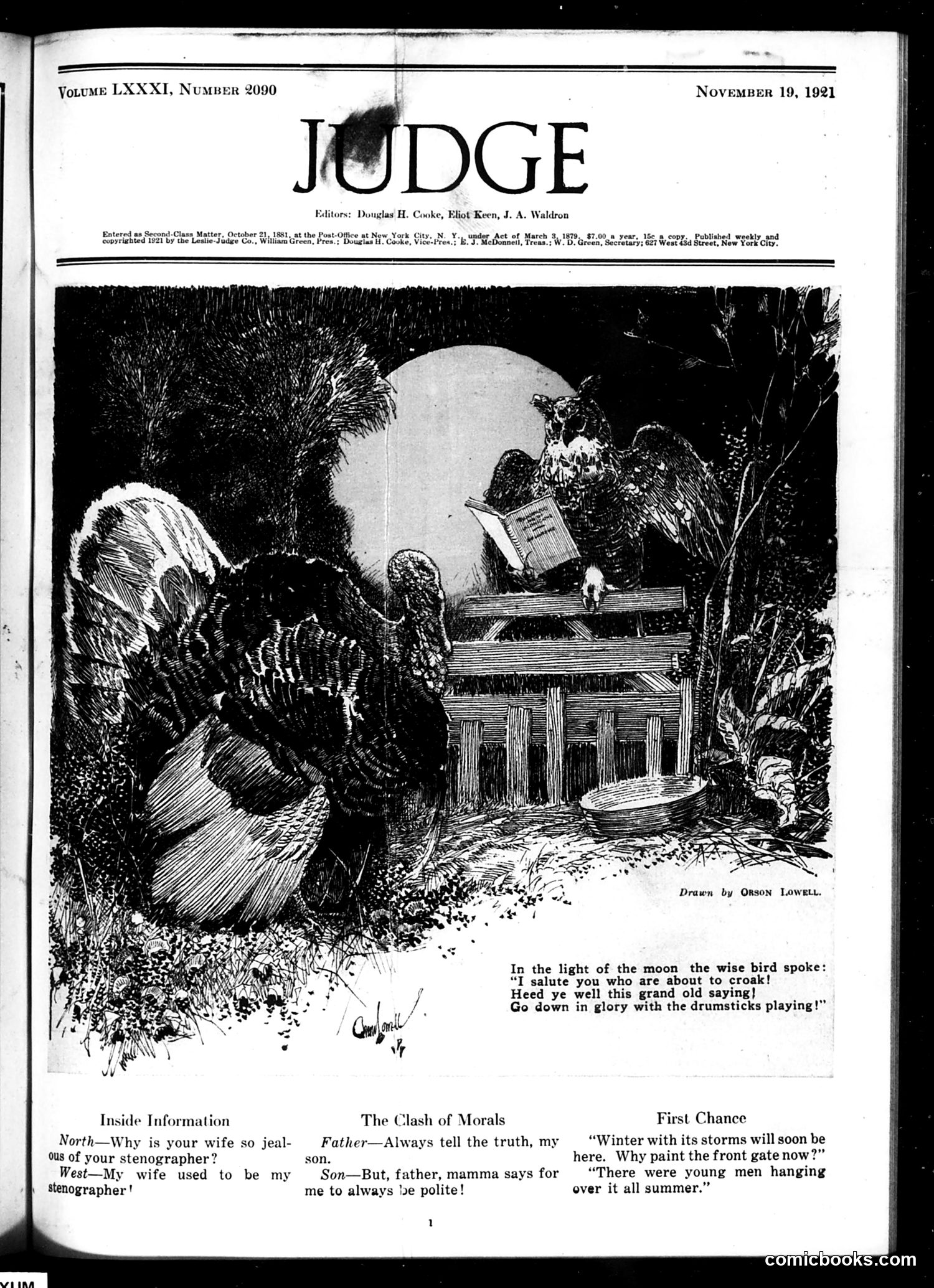
This is the cover illustration by Orson Lowell, featuring an anthropomorphic eagle (representing America) reading a newspaper by moonlight, addressing two frogs about to croak. The accompanying verse warns them to "go down in glory with the dramatics playing!" The cartoon appears to satirize American isolationism or reluctance regarding international involvement post-World War I. The "wise bird" (eagle/America) seems to mock the smaller nations (frogs) facing their demise, suggesting American indifference to or detachment from global affairs. The three brief jokes below reference stenographers, wives' roles, and house painting—typical light humor of the era unrelated to the main illustration's political commentary about America's stance toward world events.
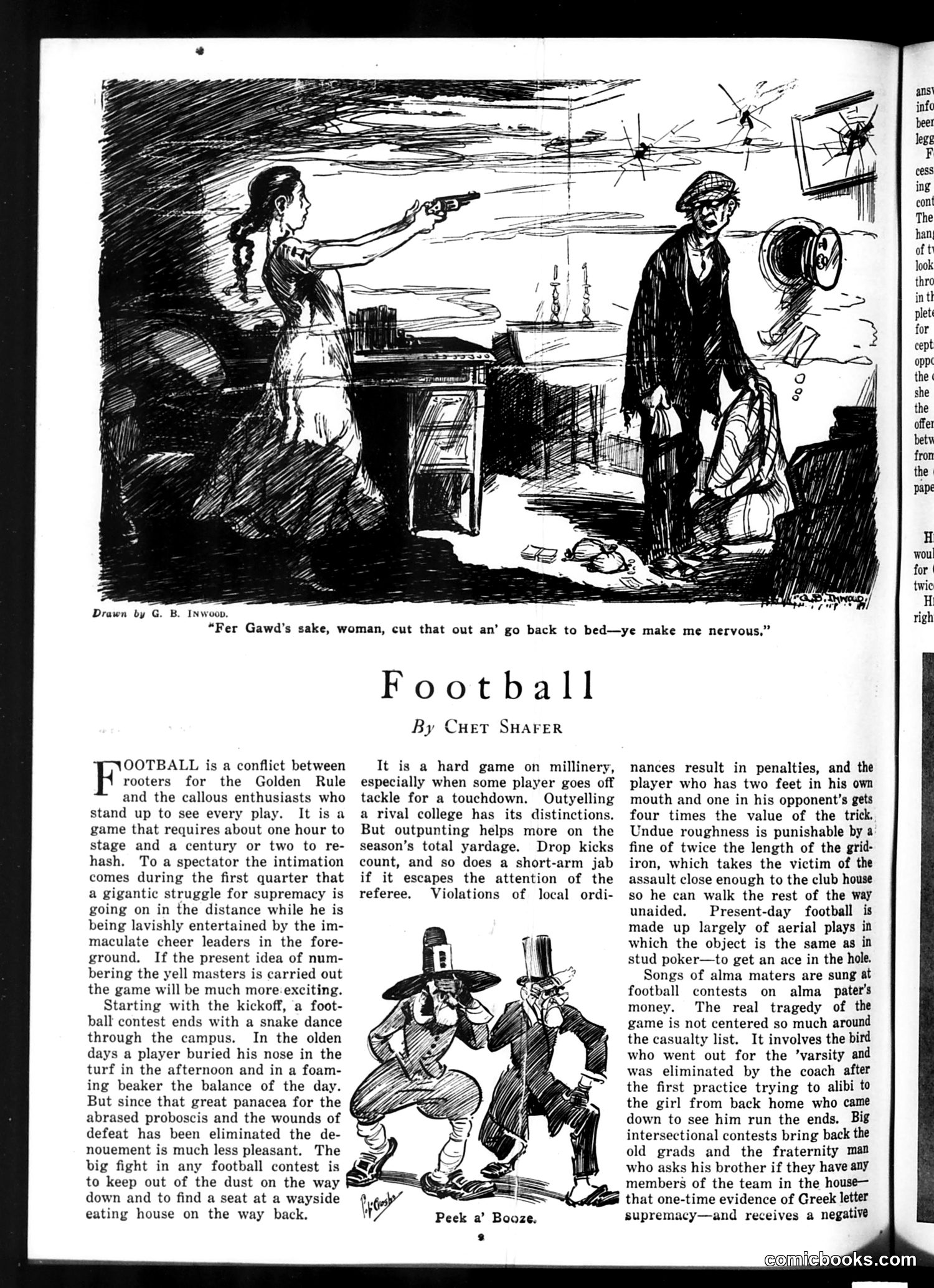
This page contains Chet Shafer's humorous essay on American college football, illustrated with two cartoons by G.B. Inwood. The top cartoon depicts a domestic scene where a woman aims a pistol at a man, with the caption "For Gawd's sake, woman, cut that out an' go back to bed—ye make me nervous." The joke suggests football season makes men so anxious about games that even gunfire seems less stressful than their wives' antics. The lower cartoon, labeled "Peek a' Booze," shows two anthropomorphized figures (appearing to be football players or mascots) in playful interaction. Shafer's essay satirizes football's intensity—its violent collisions, obsessive fan culture, and social consequences. He notes the sport eliminates players through injury and eliminates girls "from back home," suggesting football's all-consuming nature damages both bodies and relationships. The satire critiques the era's football mania.
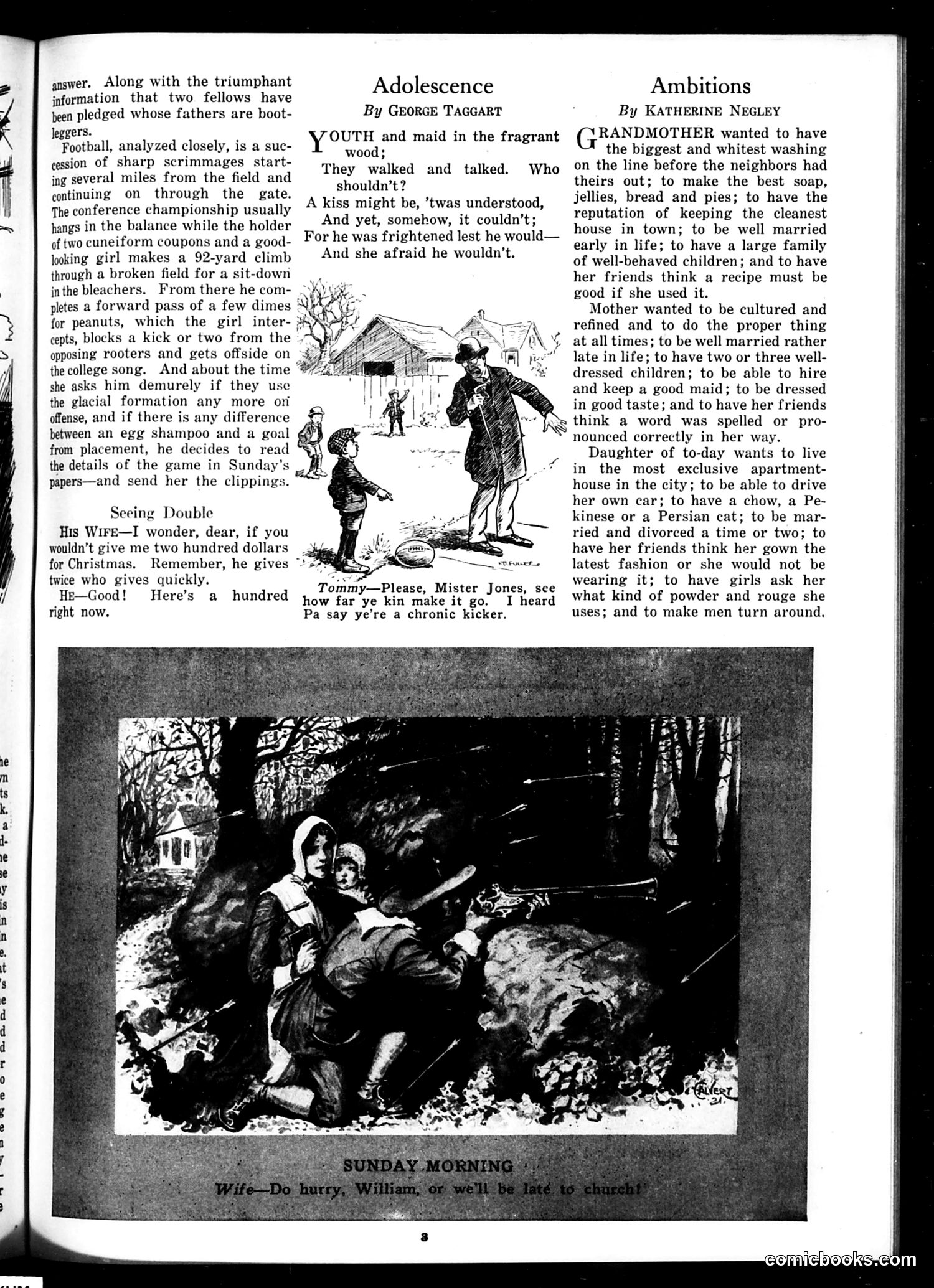
This page contains three distinct pieces: 1. **"Adolescence"** (poem by George Taggart): A sentimental poem about youth romance, accompanied by an illustration of two young people in a rural setting. 2. **"Ambitions"** (by Katherine Neeley): A humorous list cataloging the materialistic and social aspirations of women across generations—from grandmothers wanting domestic perfection to modern daughters desiring independence, fashion, cosmetics, and romantic variety. It satirizes evolving female ambitions. 3. **"Seeing Double" / "Sunday Morning"**: A brief comic dialogue and illustration about a husband requesting money for Christmas, followed by a domestic scene of a wife rushing her husband to church. The page reflects early 20th-century American attitudes toward gender roles, consumerism, and family dynamics, using humor to comment on women's changing social positions.
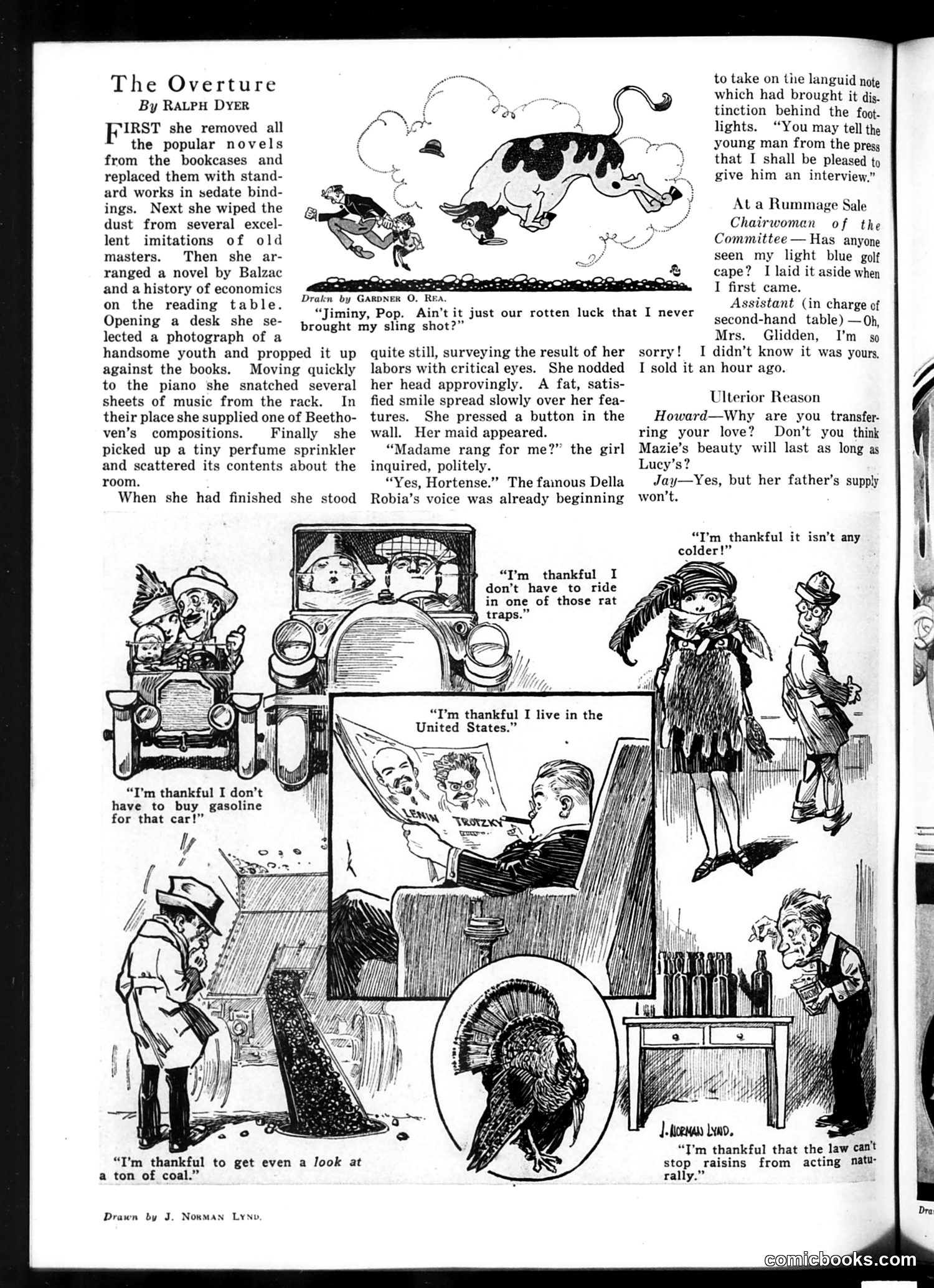
This satirical piece mocks a woman's self-improvement efforts through cultural refinement—replacing popular novels with serious literature, adding classical music and perfume to her home. The cartoon then shifts to political satire, showing various figures expressing gratitude for different circumstances: avoiding gasoline costs, not riding in "rat traps" (automobiles), living in the United States, getting coal deliveries, and crucially, "that the law can't stop raising from acting naturally" (the final figure appears to be a caricature, likely referencing immigration or labor restrictions). The overall joke satirizes both social climbing and contemporary political anxieties, suggesting that despite pretensions to refinement, certain "natural" behaviors remain unchanged—possibly critiquing nativist sentiment or labor disputes of the era.
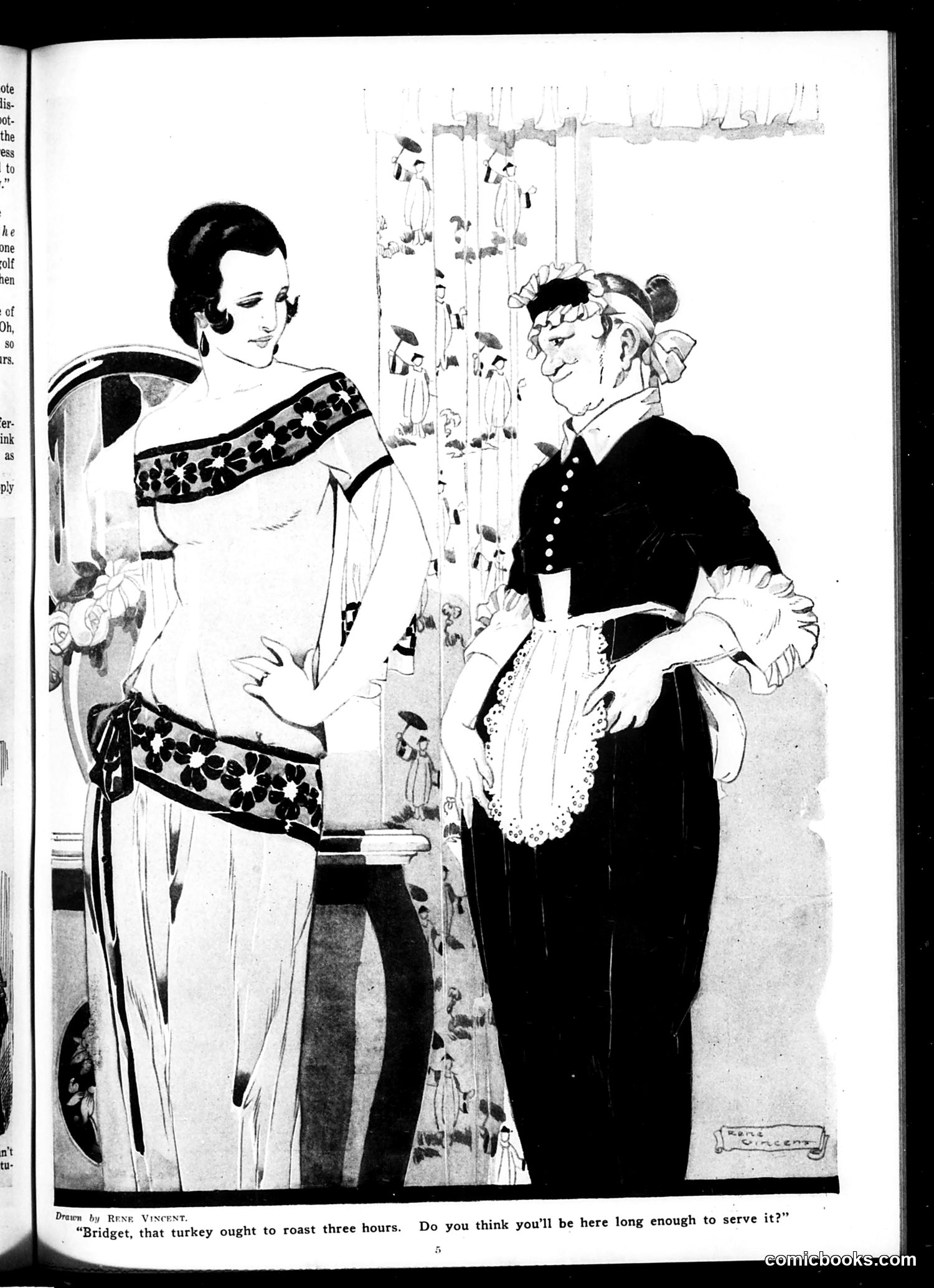
This illustration by René Vincent appears to be a domestic humor cartoon, likely from the early 20th century. It depicts an interaction between two women—presumably a wealthy lady of the house (left, in elegant dress with patterned sash) and her servant or cook, Bridget (right, in black dress with white apron and cap). The joke plays on class dynamics and servant reliability. The lady sarcastically asks if Bridget will still be employed long enough to serve the turkey after its three-hour roasting time—implying that servants commonly quit or were dismissed abruptly. This reflects period anxieties about domestic staff turnover and the precarious nature of service employment. The cartoon satirizes both the dismissive attitude of employers toward their workers' tenure and the unstable working conditions servants faced.
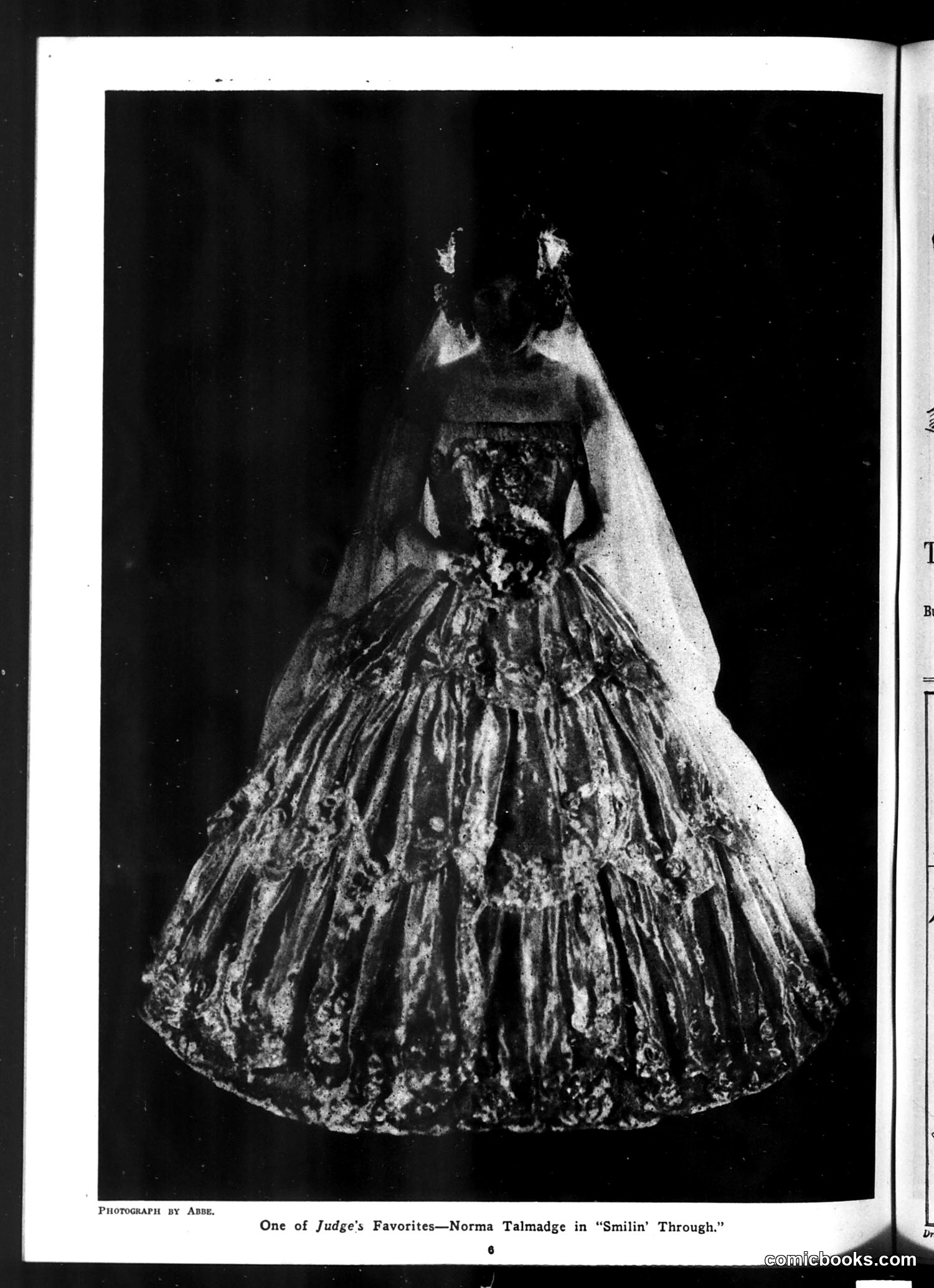
This page features a photograph (credited to "Abbe") showing an actress named Norma Talmadge in an ornate ball gown from the film "Smilin' Through." The caption identifies her as "One of Judge's Favorites." This appears to be a fashion or entertainment feature rather than political satire. Judge magazine occasionally showcased glamorous theatrical and film costumes alongside its satirical content. The elaborate gown—with its full skirt, detailed embroidery, and dramatic cape—represents 1920s theatrical costume design. The inclusion suggests Judge's readership included interest in entertainment and high society fashion, not just political commentary. This is essentially a celebrity photograph rather than satirical content requiring historical context beyond appreciating the era's costume aesthetics.
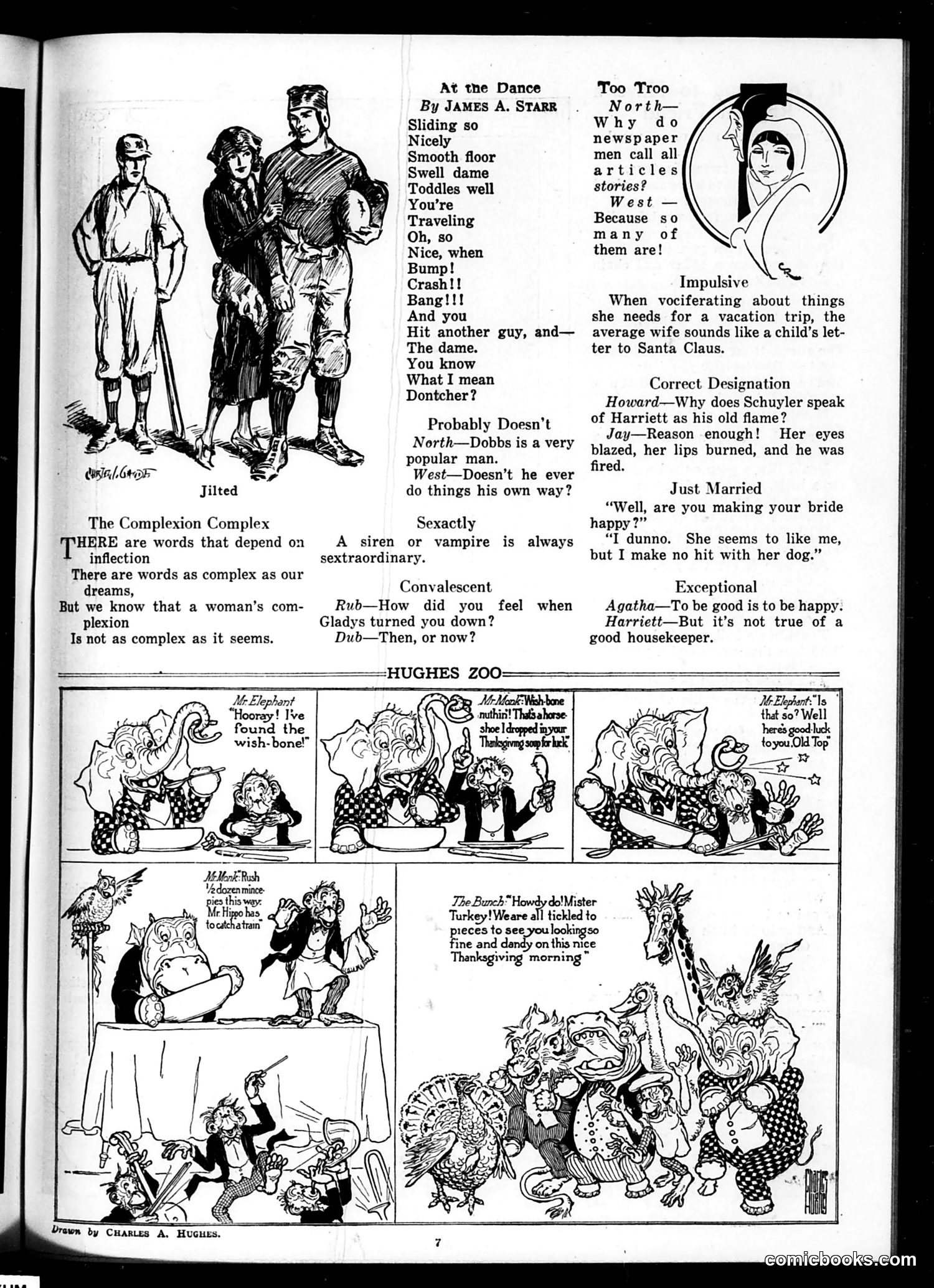
This page contains several short humor pieces and a comic strip ("Hughes Zoo") typical of early 20th-century satirical magazines. **Upper content:** Brief joke columns with puns and observational humor about dating, dancing mishaps, newspaper terminology, and marriage. These are lightweight social commentary—"At the Dance" satirizes clumsy male behavior on dance floors; "Too Troo" jokes that newspaper stories are often fabricated; marital humor pokes fun at newlyweds and wives' demands. **"Hughes Zoo" comic strip:** A whimsical animal comic depicting anthropomorphized creatures (elephant, ostrich, turkey, etc.) in domestic situations. The humor is slapstick and absurdist—animals discussing a wishbone and complimenting Turkey on his Thanksgiving appearance. This appears to be pure entertainment rather than political satire. **Overall tone:** Lighthearted, gender-stereotyping humor aimed at urban middle-class readers. No apparent political commentary or references to specific contemporary events are visible. The page prioritizes comedy over social critique.
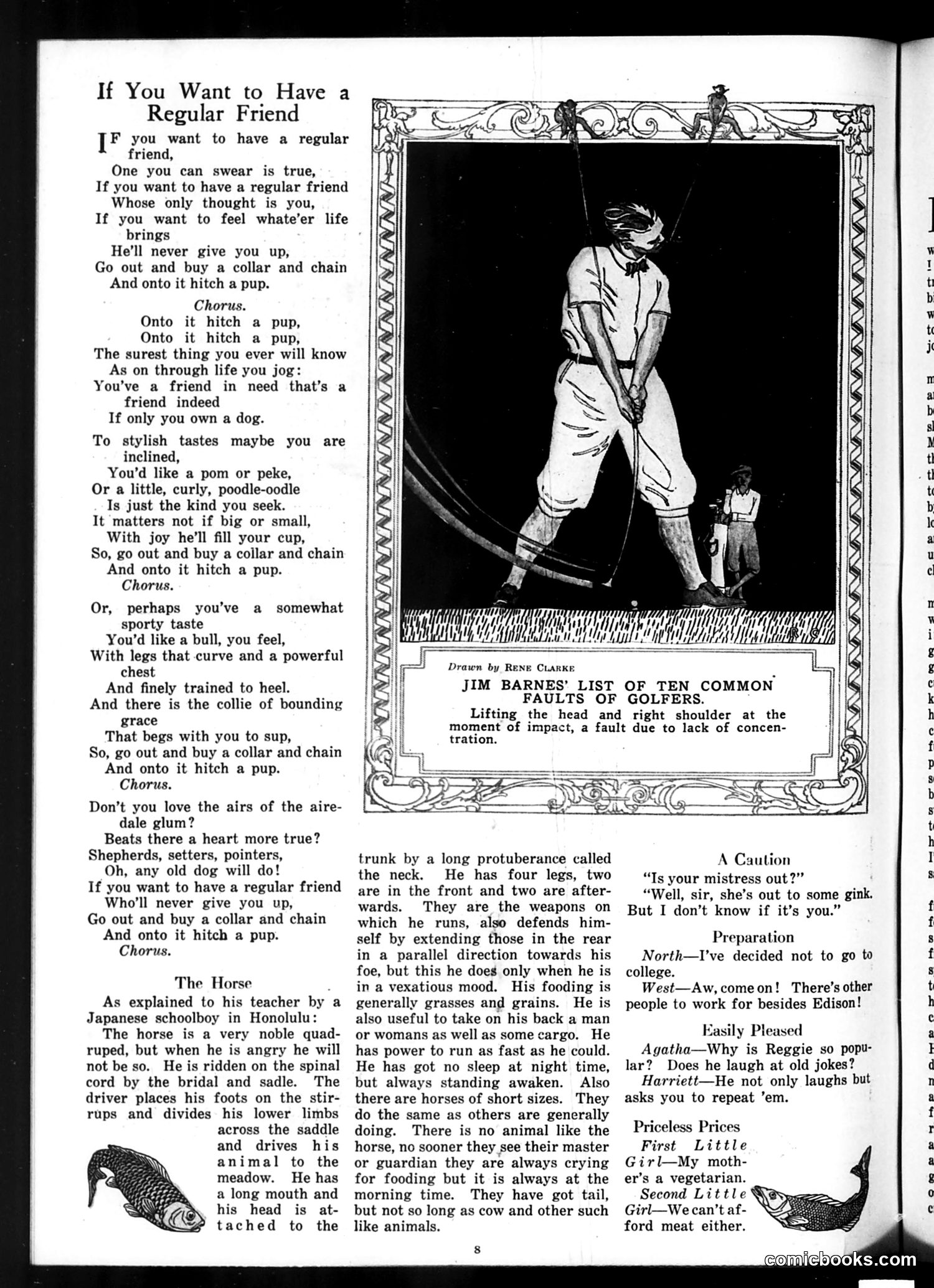
This page from *Judge* magazine contains several humorous pieces: **Main Feature**: A satirical song encouraging dog ownership as a path to unconditional friendship. The joke plays on dogs' famous loyalty—suggesting a dog is more reliable than human friends. It humorously catalogs breed preferences (pomeranians, collies, bulldogs) for different personality types, all ending with the refrain to "hitch a pup." **"The Horse" Section**: A comedic piece presenting a Japanese schoolboy's hilariously garbled English description of horses. The humor derives from malapropisms and confused anatomical terminology ("spinal cord" for saddle, "foots" for feet, "afterwards" for hind legs)—a common early-20th-century joke format mocking non-native English speakers. **Golf Instruction**: Jim Barnes (likely the famous golfer) offers genuine golfing advice about concentration. **Short Jokes**: Miscellaneous one-liners about domestic life and class differences, typical of the era's humor magazine format.
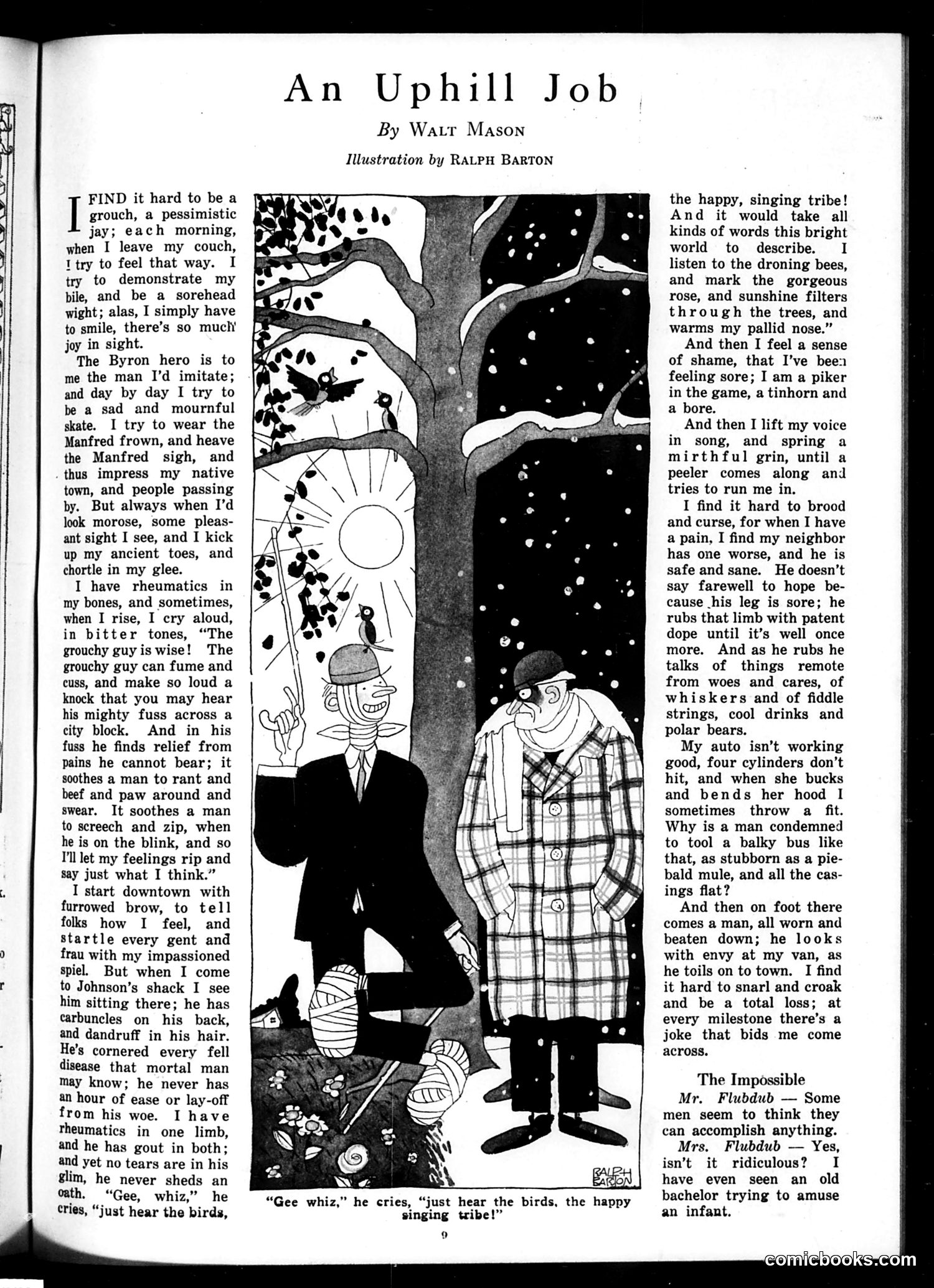
This is a humorous essay-poem about the narrator's failed attempt to be a grouch. He tries daily to adopt a pessimistic, complaining attitude—inspired by Byronic literary heroes like Manfred (references to Lord Byron's tragic, brooding characters popular in the 19th century). However, he's constantly undermined by genuine human decency and perspective. Each time he prepares to grouse about his problems, he encounters someone worse off—Johnson with multiple ailments who remains cheerful, or a man on foot envying his broken car. The irony: complaining requires a kind of misanthropy the narrator simply cannot muster when confronted with others' suffering and their good humor. The small sidebar joke at bottom mocks men who overestimate their abilities—even an old bachelor trying to entertain a baby. The satire gently mocks both pessimism and the human tendency toward comparative suffering.
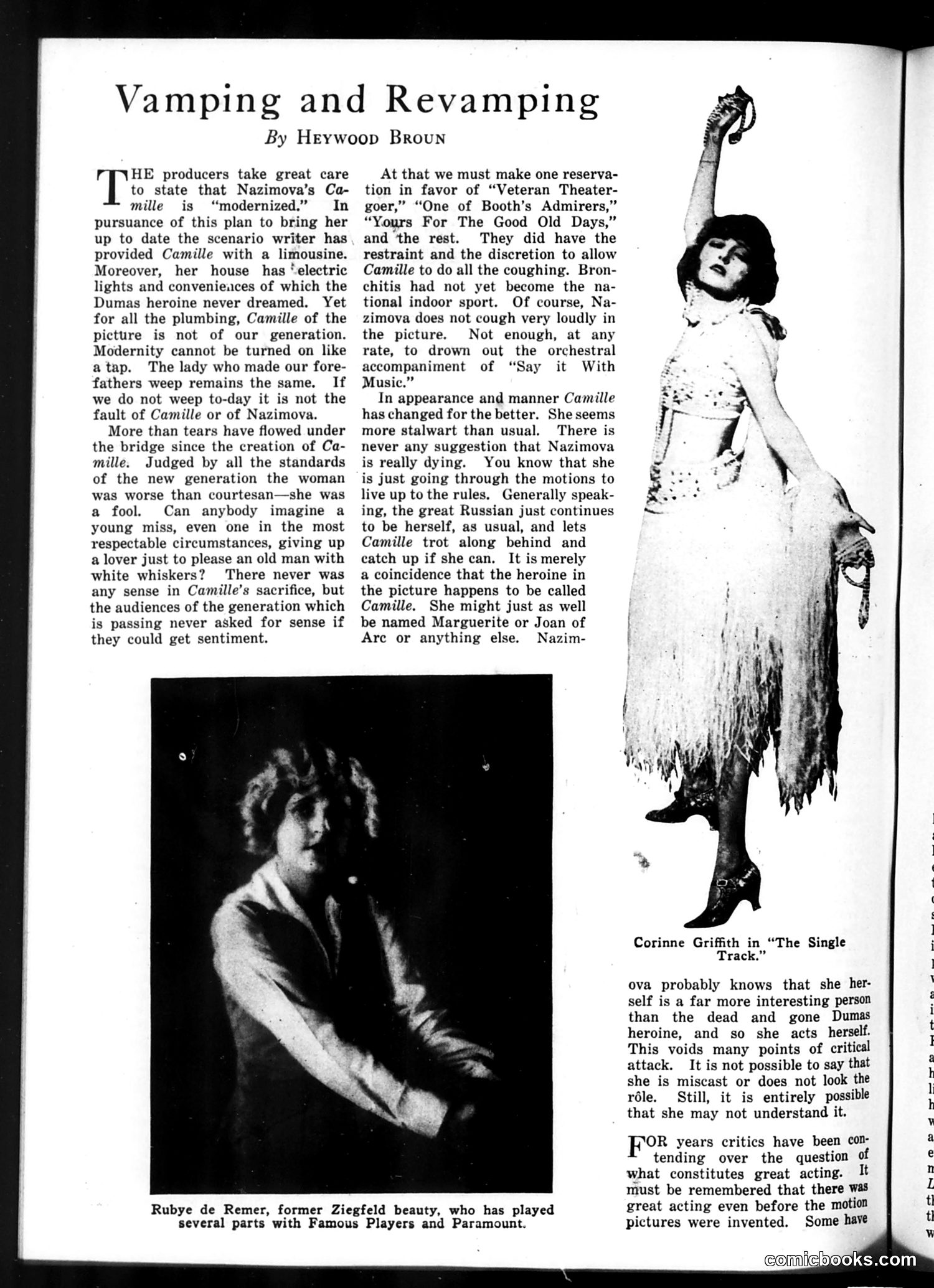
This is a theater review by Heywood Broun critiquing actress Alla Nazimova's performance in a modernized film adaptation of *Camille*. The satire targets the contradiction of "updating" classic literature: the producers add contemporary conveniences (limousines, electric lights) to appear modern, yet the material remains fundamentally sentimental and outdated. Broun argues that modern audiences find the self-sacrificing heroine's logic foolish—no respectable woman would abandon a lover for an elderly man. More pointedly, Broun criticizes Nazimova herself for playing the character as merely *herself* rather than embodying Camille. She performs the role perfunctorily ("going through the motions"), failing to convince viewers she's actually dying. The actress appears indifferent to the character's substance, treating *Camille* as interchangeable with any other role. This undermines any genuine dramatic interpretation or emotional connection audiences might achieve.
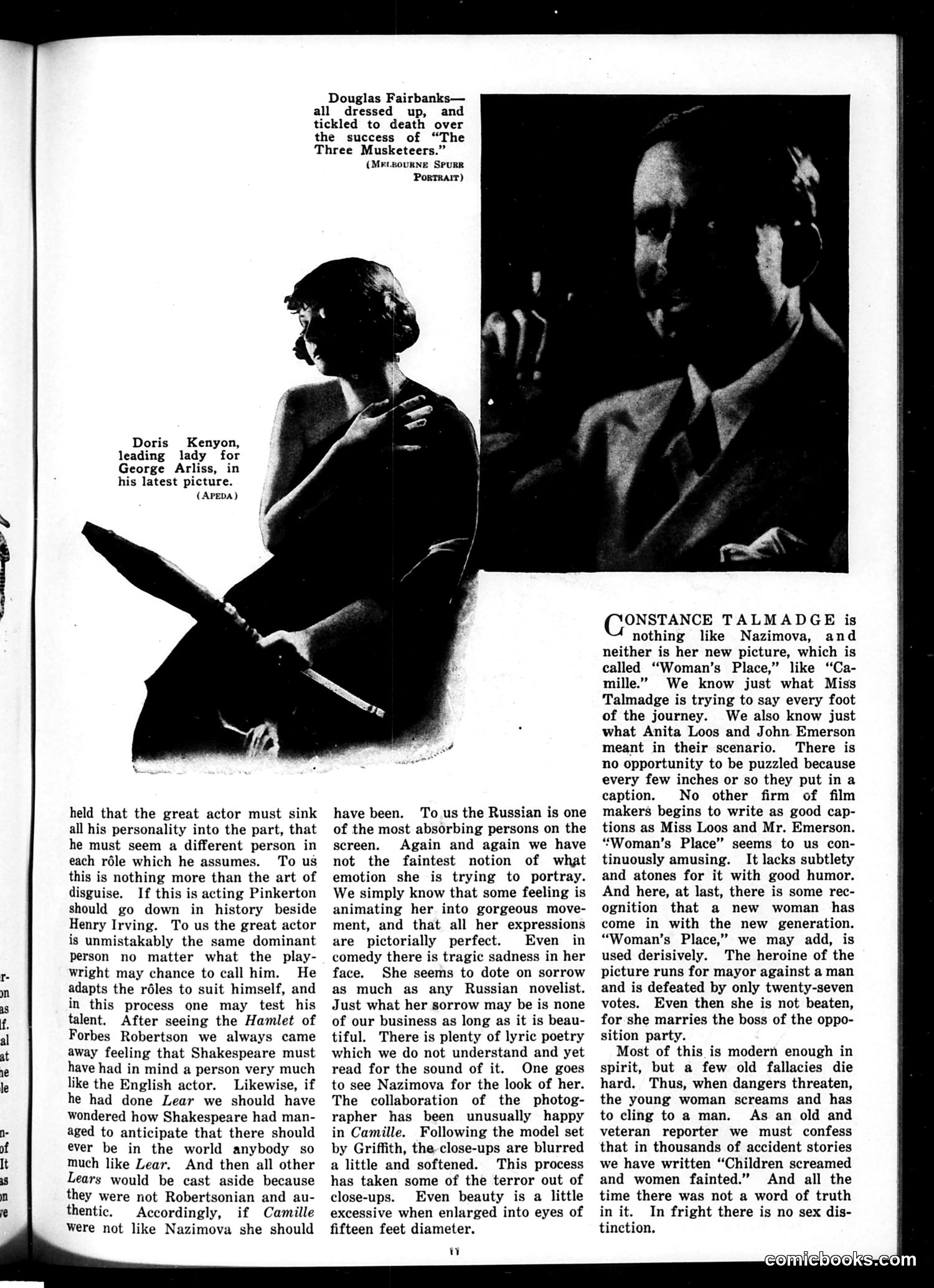
This page from *Judge* magazine reviews three contemporary silent films, using them to discuss acting styles and modern cinema. **The Reviews:** The text compares three actresses' approaches: **Nazimova** (in *Camille*), praised for her mysterious, pictorially perfect emotionalism that viewers don't fully understand but find beautiful; **Doris Kenyon** (with George Arliss); and **Constance Talmadge** (in *Woman's Place*), criticized for being overly explicit—her films include constant captions explaining every plot point, leaving nothing to interpretation. **The Satire:** The critic argues that great acting requires maintaining a dominant personality across roles, not disappearing into characters. Talmadge's film is deemed amusingly modern (its heroine runs for mayor), yet still relies on old clichés—namely, that women scream and faint in danger. The author, claiming experience as a "veteran reporter," notes this gendered trope is factually untrue. **For Modern Readers:** This reflects 1920s debates about acting realism versus stylization, and early feminist critiques of how cinema portrayed women's responses to crisis.
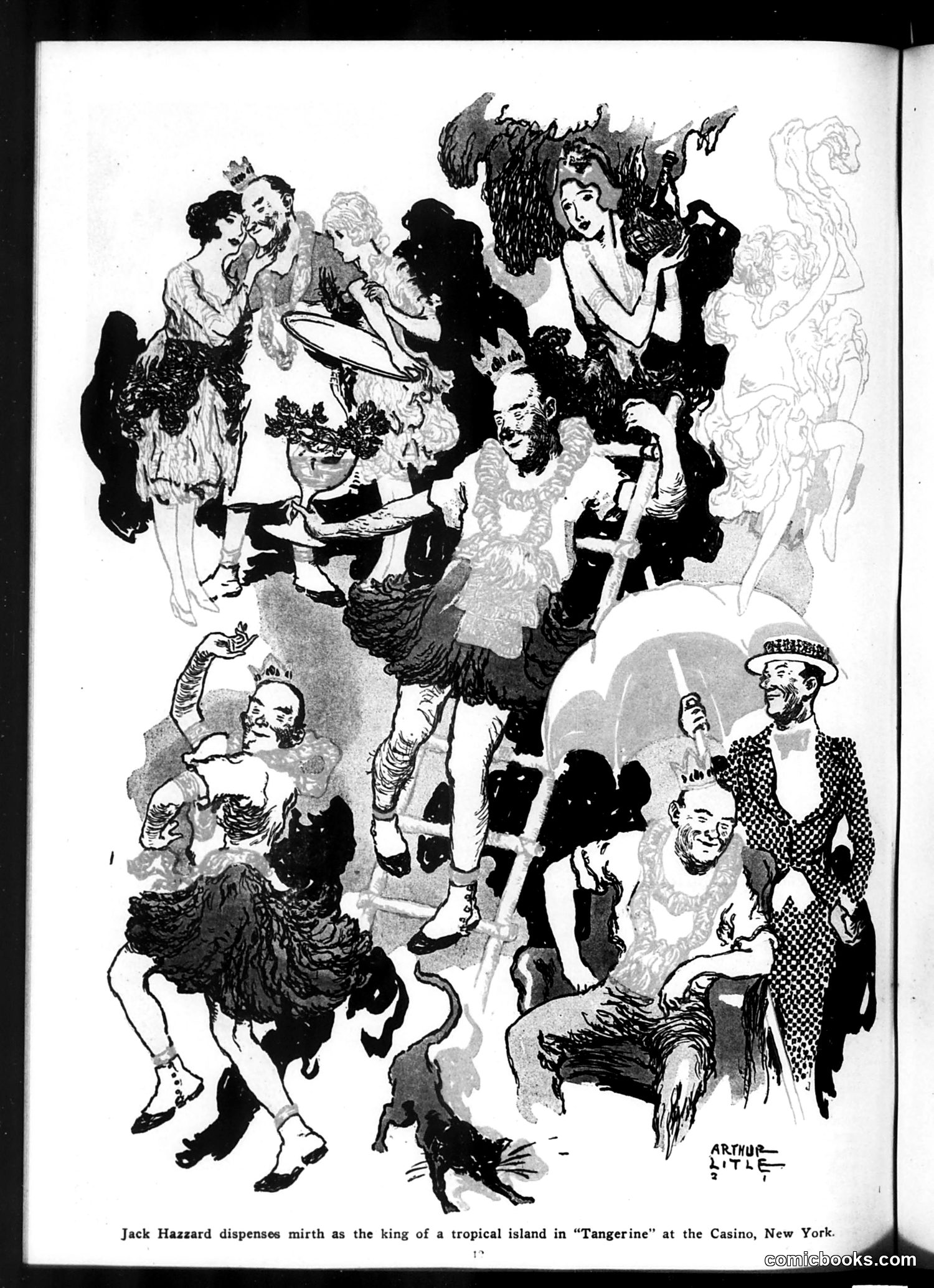
This illustration by Arthur Little depicts **Jack Hazard** as "the king of a tropical island" in the theatrical production "Tangerine" at the Casino in New York. The cartoon satirizes the show's plot through exaggerated caricature: Hazard sits enthroned amid a chaotic scene of dancing, flirting performers in various states of undress and theatrical costume. The style is typical of early 20th-century theatrical satire in *Judge* magazine—mocking both the show's exotic "island" setting and its loose moral atmosphere. The humor relies on the contrast between Hazard's dignified "king" pose and the absurdity surrounding him, suggesting the production prioritized spectacle and suggestive entertainment over serious dramaturgy. The elaborate costumes and exaggerated body language emphasize the theatrical excess being ridiculed.
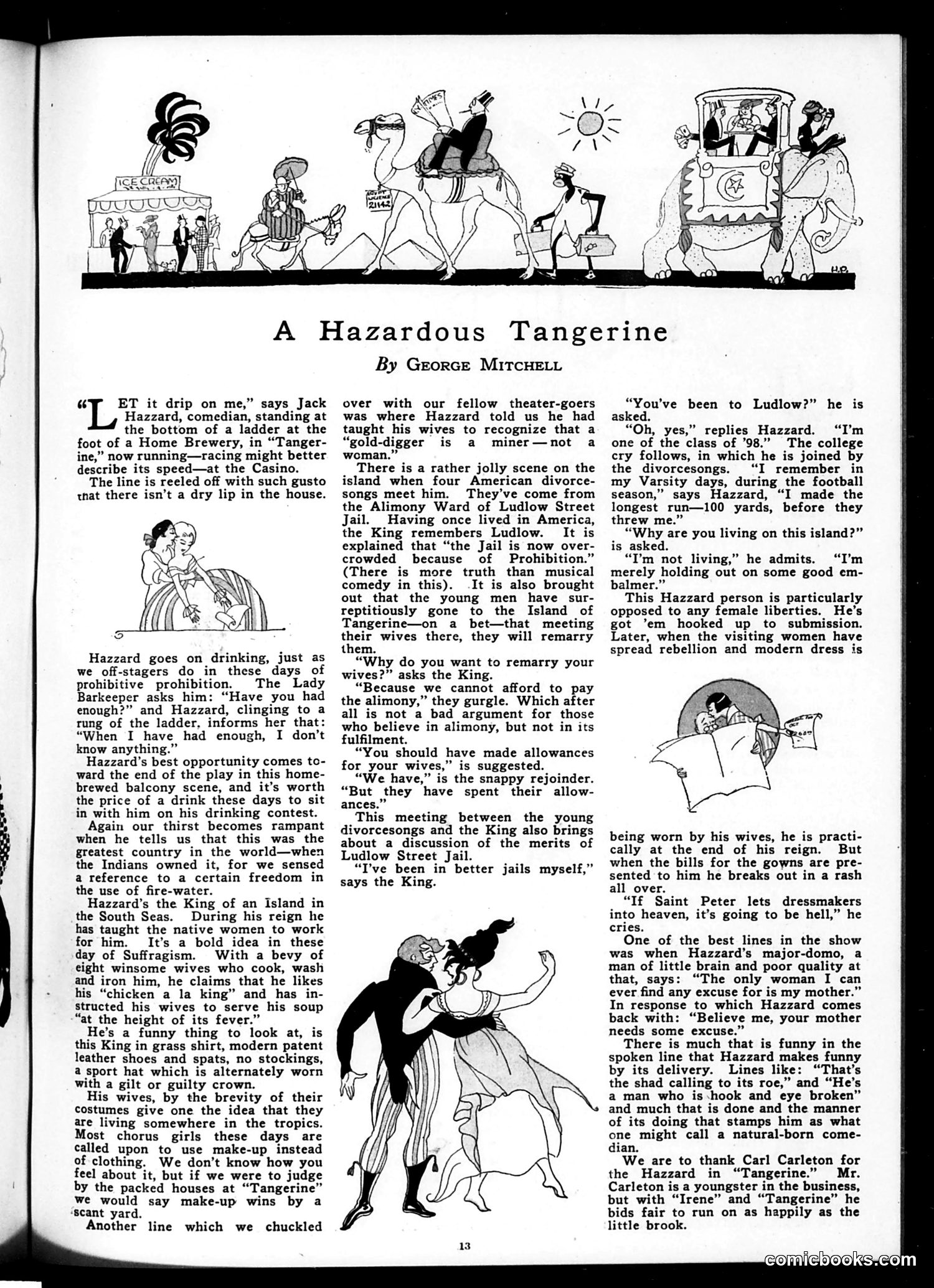
This is a theater review of a comedy play starring Jack Hazzard, performing at the Casino. The satire targets Prohibition-era attitudes and social hypocrisy. The review highlights comedic lines mocking Prohibition (characters drinking openly despite the law), divorce culture (four American divorcées meeting on a tropical island), and alimony disputes. One joke references Ludlow Street Jail being "overcrowded because of Prohibition"—suggesting the law's ineffectiveness. Hazzard plays a South Seas island king with eight wives, allowing satirical commentary on women's roles and suffragism. The reviewer notes the joke about "gold-diggers" being "miners—not women" and finds humor in the costumes' brevity, typical of 1920s chorus girls relying on "make-up" instead of clothing. The review is generally favorable, praising Hazzard's comedic delivery, particularly his "drinking contest" scene and his claim of making a "100-yard" football run before being thrown out.
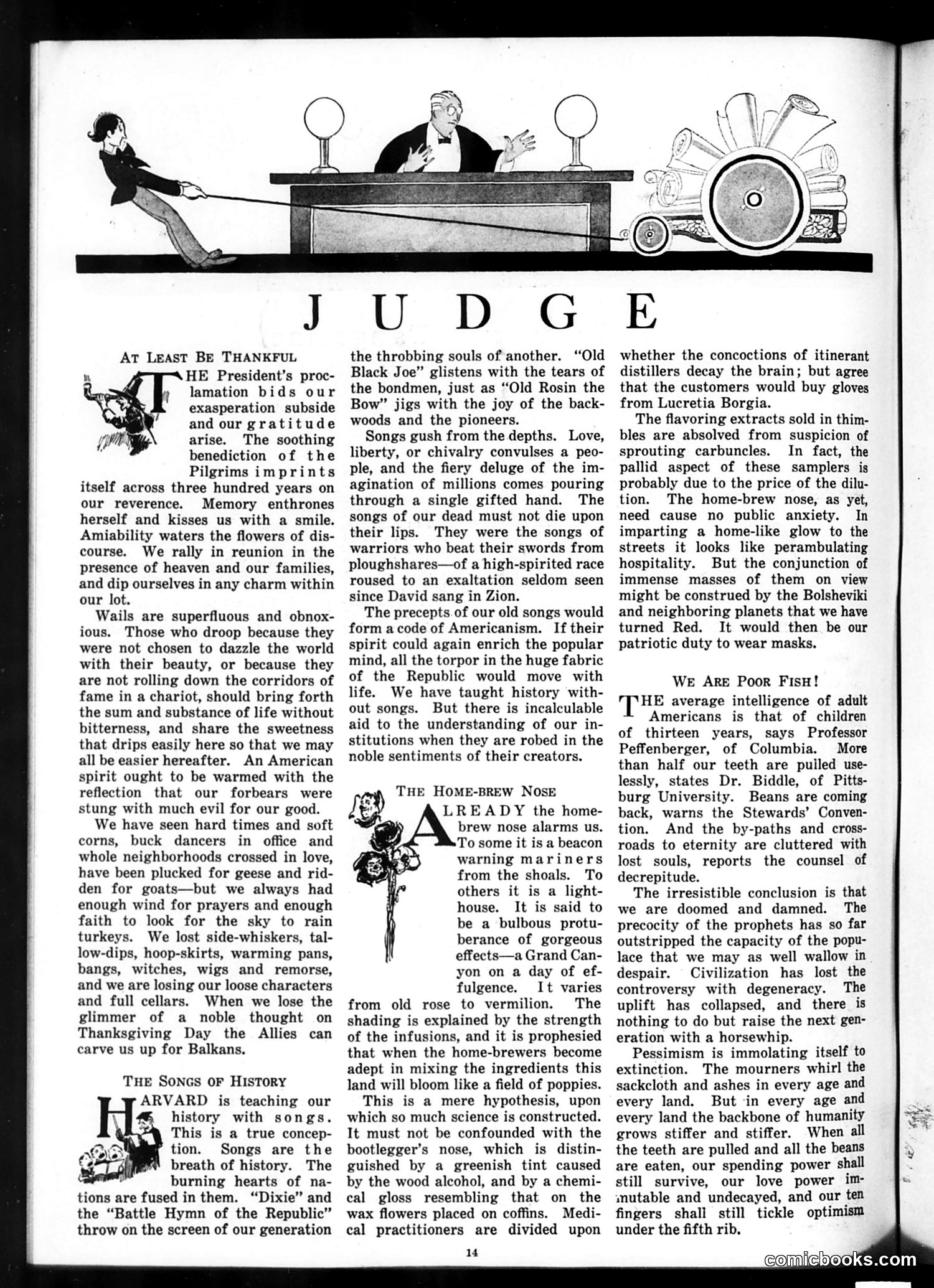
This page from Judge magazine contains three editorial commentaries on American life, likely from the Prohibition era (1920s-early 1930s). **"At Least Be Thankful"** urges Americans to appreciate their blessings despite hardships and social changes ("side-whiskers, hoop-skirts" lost to modernity). It subtly warns that losing "noble thought" could invite foreign powers to "carve us up for Balkans"—referencing European colonial divisions. **"The Songs of History"** praises Harvard's teaching history through patriotic songs ("Dixie," "Battle Hymn of the Republic," "Old Black Joe"). It argues songs capture national spirit better than dry facts, advocating for emotional connection to American identity. **"The Home-Brew Nose"** satirizes Prohibition's failure by mocking home-distilling's visible effects—the enlarged, reddened nose of amateur bootleggers. It distinguishes between the "home-brew nose" and the bootlegger's nose (greenish from toxic wood alcohol), sardonically suggesting home-brewers will perfect their craft, "blooming like a field of poppies." All three pieces critique American decline while defending traditional values.
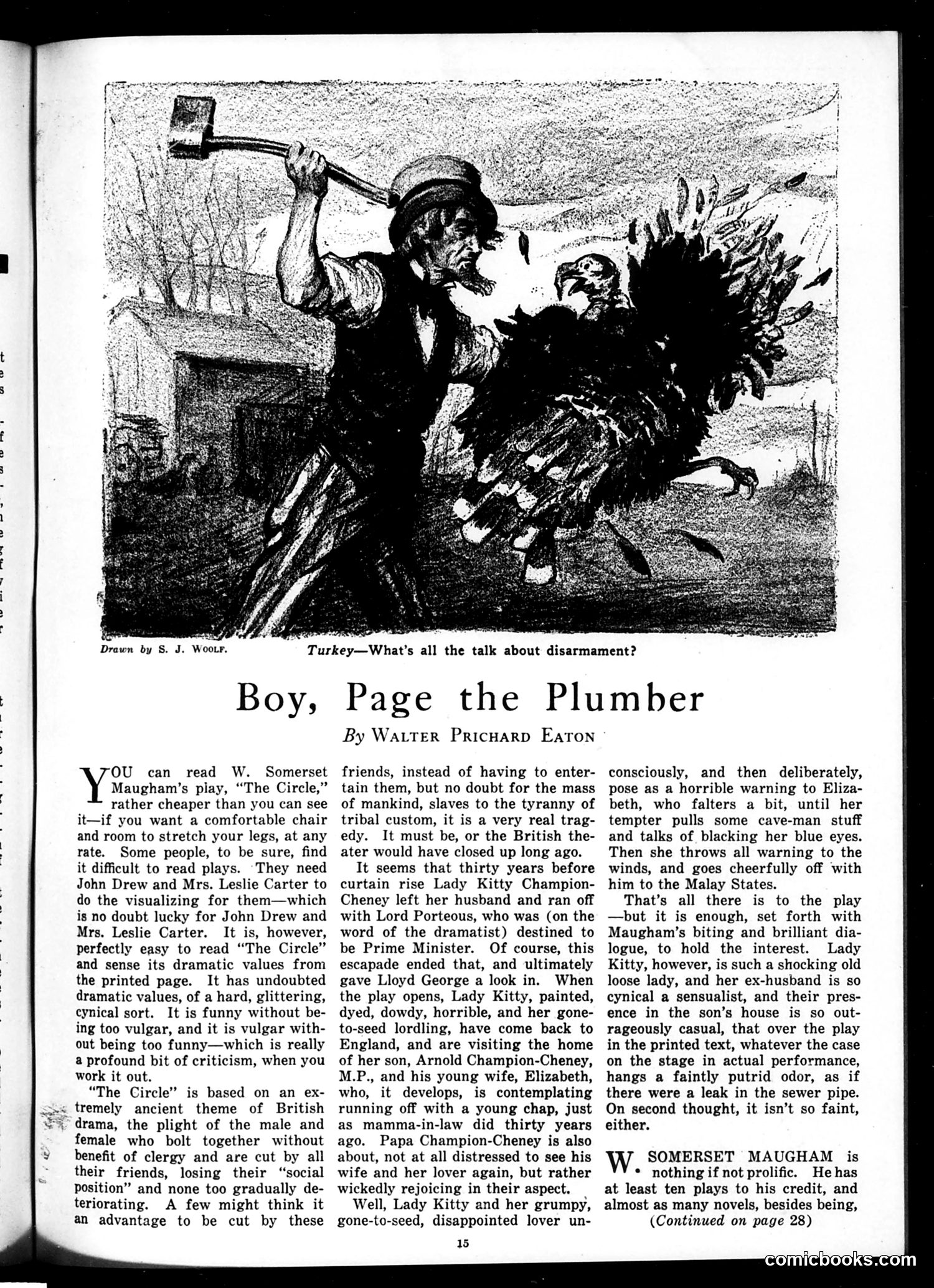
The cartoon at top, captioned "Turkey—What's all the talk about disarmament?", depicts a figure wielding an axe against what appears to be a bird or creature labeled as Turkey. The joke plays on the double meaning of "disarmament"—the political concept of reducing weapons versus literally disarming (removing limbs). Turkey, likely representing the Ottoman Empire or modern Turkey, is shown being violently attacked, satirizing post-World War I geopolitical tensions and the "Eastern Question" in European politics. The cartoon reflects anxiety about Turkish military power and territorial disputes following WWI's aftermath, when Turkey's role in the Middle East and Mediterranean remained contentious among Western powers. The page's main content is a theater review of W. Somerset Maugham's play "The Circle," unrelated to the political cartoon above it.
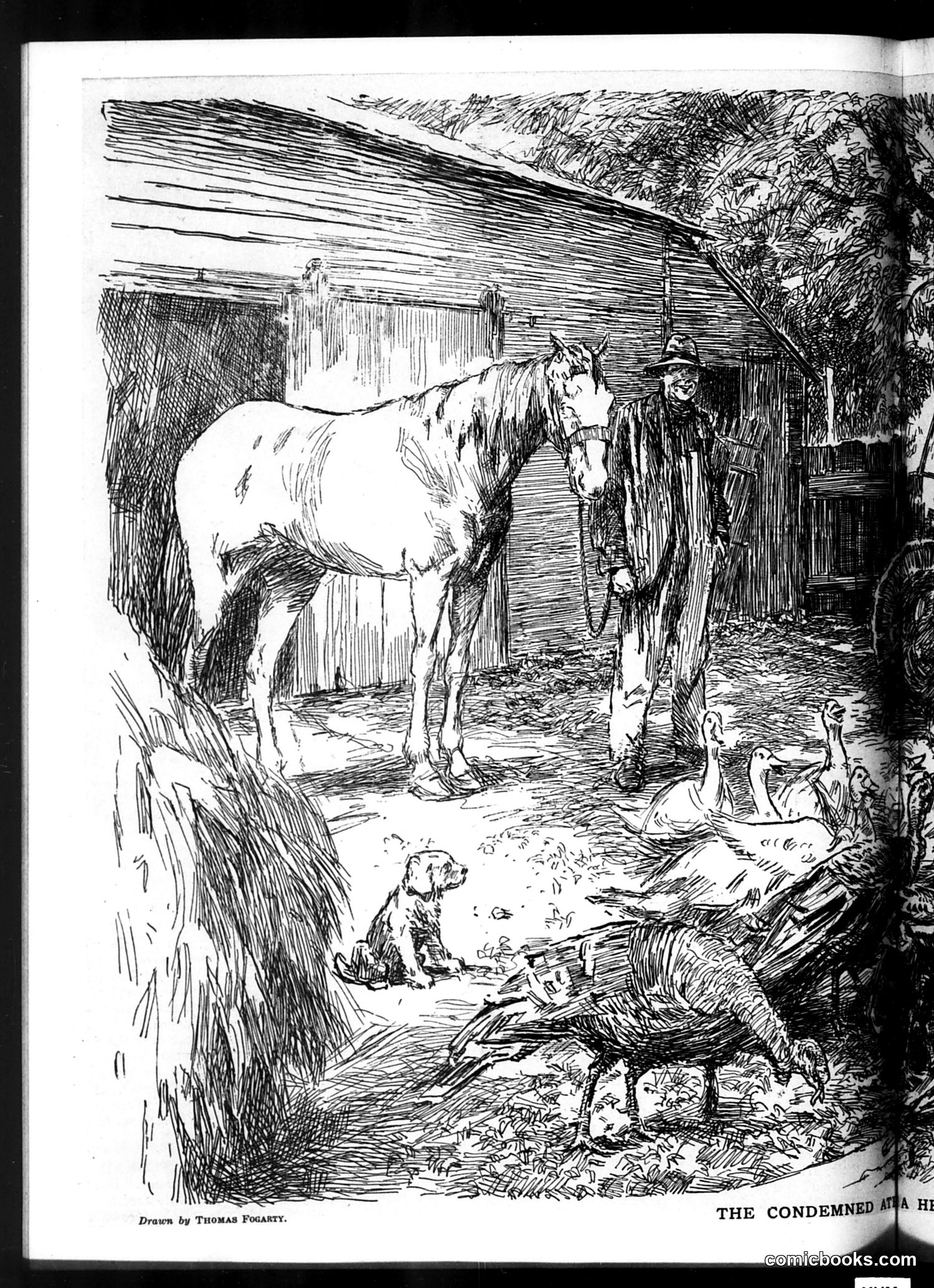
This pen-and-ink illustration by Thomas Fogarty depicts a stable scene with a man, horse, and several dogs. The title "THE CONDEMNED MAN'S HI[...]" (text cut off) suggests a narrative about execution or capital punishment, likely using the horse as a metaphor or symbolic element. The condemned figure appears to be the man in the center observing the animals. The specific satirical or political commentary is unclear without the complete title and accompanying text. This appears to be from Judge magazine's illustrated fiction or serial story section rather than a political cartoon, though the dark subject matter suggests social commentary typical of late 19th or early 20th-century publications.
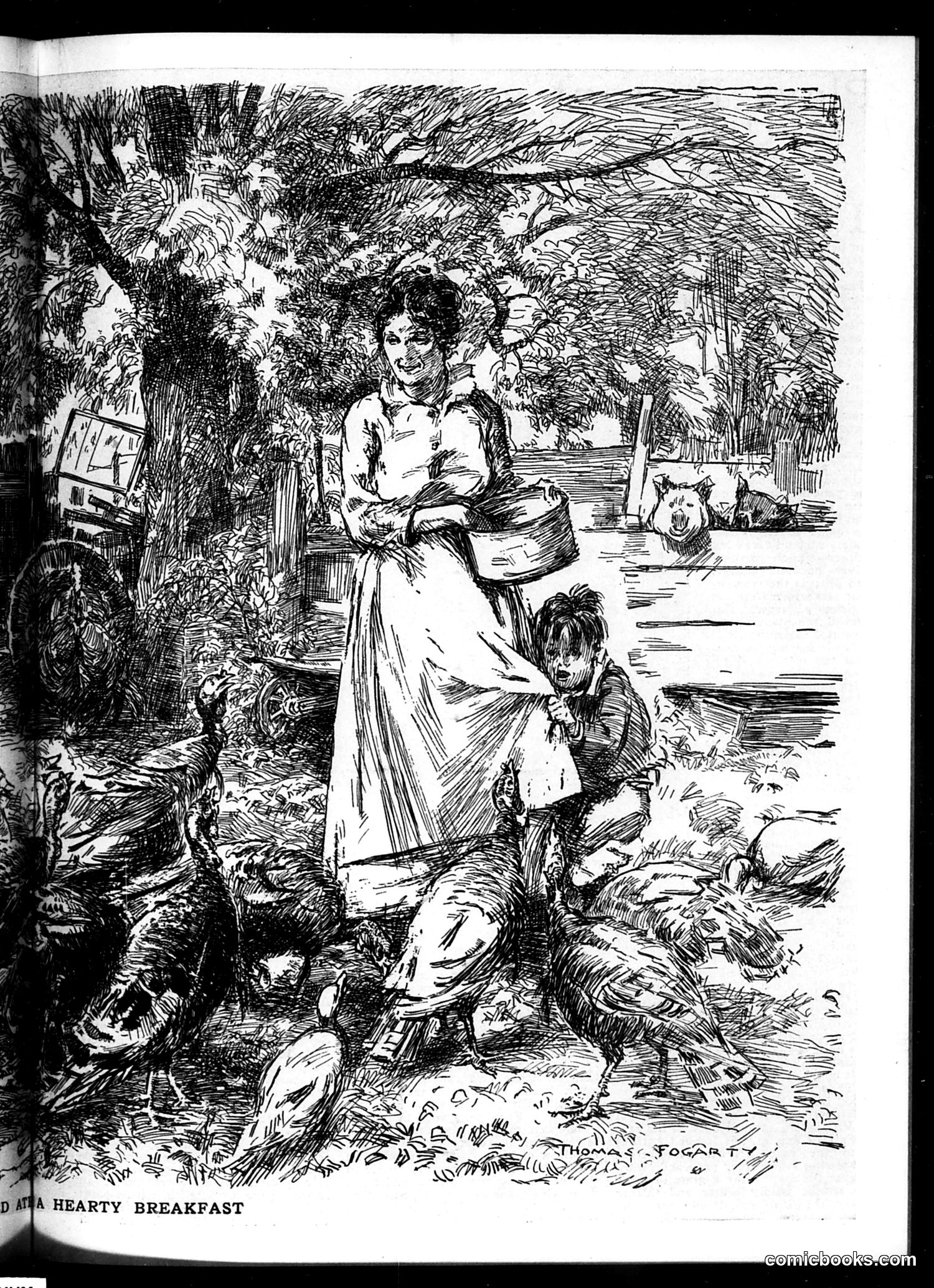
This is an ink sketch titled "A Hearty Breakfast" signed by Thomas Fogarty. The image depicts a woman in Victorian-era dress serving food to several children in what appears to be a rustic or poor household setting. The scene includes animals (dogs and a cat) around a simple domestic space with trees visible in the background. Without additional context or visible political references in the composition itself, this appears to be an illustration of a domestic or social scene rather than explicit political satire. The title "A Hearty Breakfast" and the humble setting suggest commentary on working-class or rural family life, possibly touching on themes of domestic care, poverty, or rural existence—common subjects in Judge magazine's social commentary. However, the specific satirical target remains unclear from the image alone.
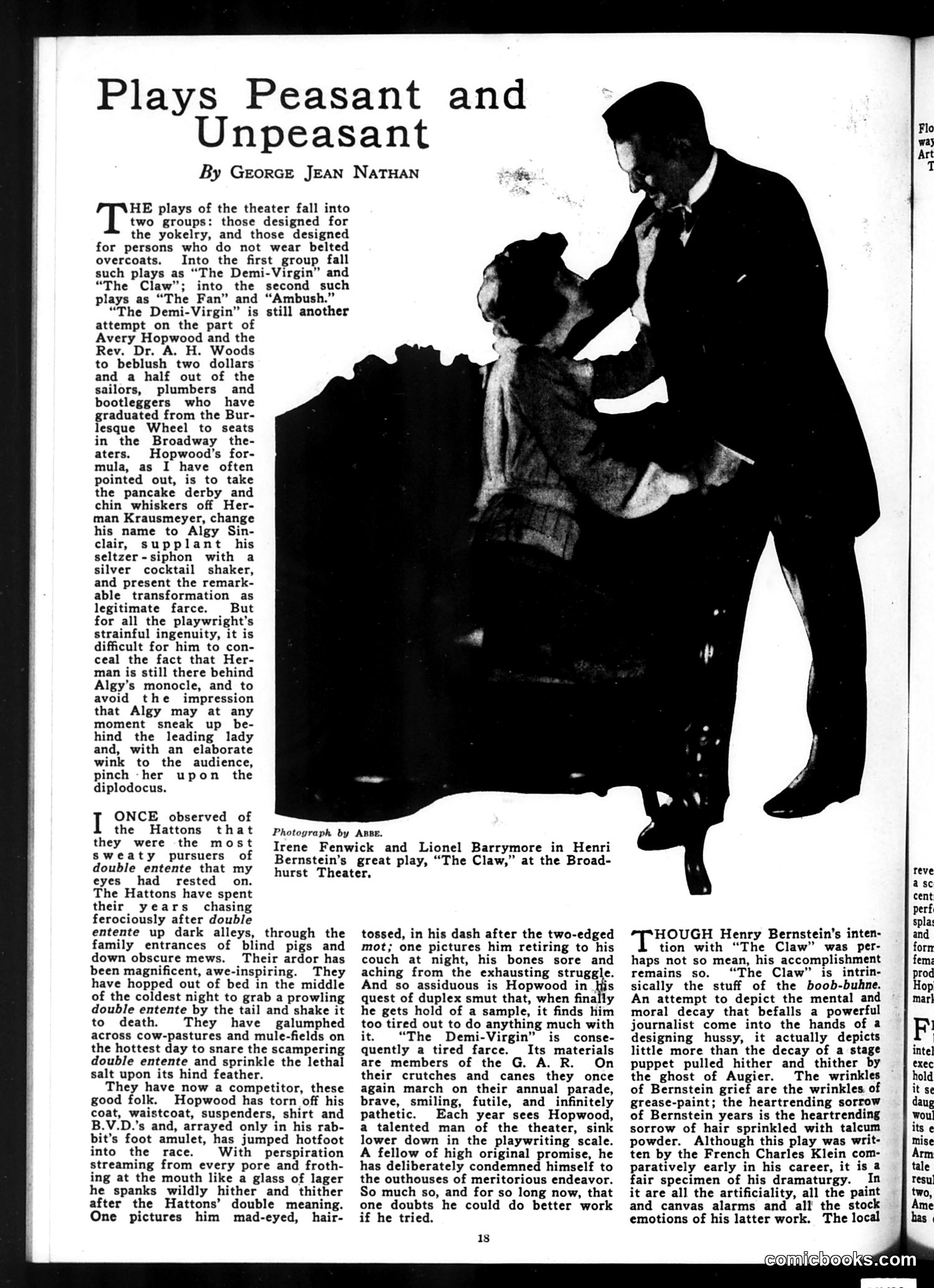
This is George Jean Nathan's theater review column critiquing Broadway plays. Nathan divides theatrical productions into two categories: those for "yokelry" (working-class audiences) and those for educated patrons. Nathan savagely attacks playwright Avery Hopwood's "The Demi-Virgin," claiming Hopwood merely dresses up lowbrow burlesque characters (like "Herman Krausmeyer") in fancy names and settings to sell tickets to sailors and plumbers seeking double entendres. He sarcastically describes Hopwood obsessively chasing after sexual innuendo like a desperate competitor. The photograph shows Irene Fenwick and Lionel Barrymore in "The Claw" by Henri Bernstein. Nathan similarly dismisses this play, arguing that despite pretensions of depicting moral decay in a journalist, it merely amounts to lowbrow material with theatrical veneer. Nathan's satire targets the gap between Broadway's artistic pretensions and its actual commercialism—selling smut to unsophisticated audiences under respectable guises.
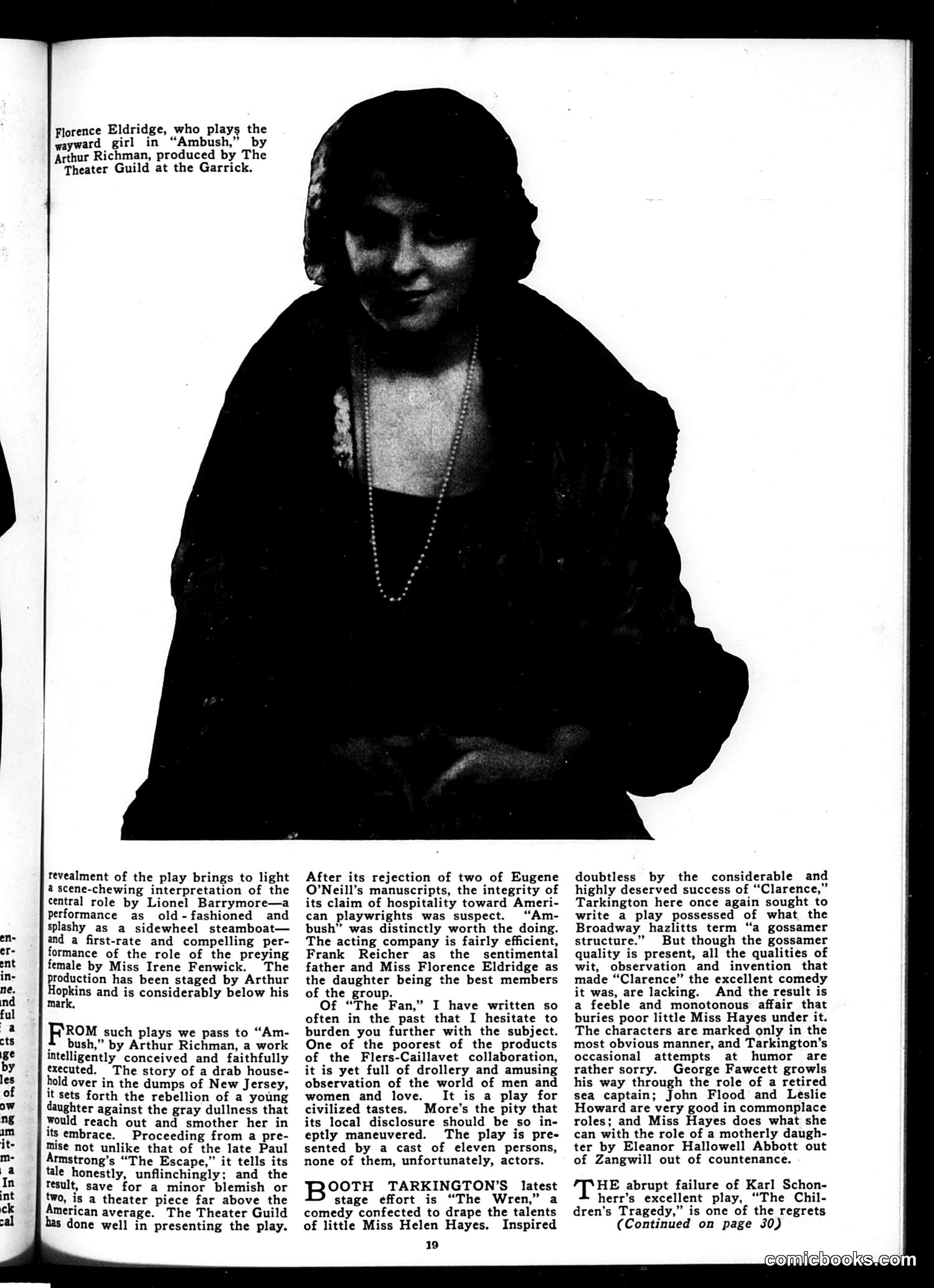
This is a theater criticism page from Judge magazine reviewing several Broadway productions. The central photograph shows **Florence Eldridge**, an actress in Arthur Richman's play "Ambush," produced by the Theater Guild. The reviews discuss: - **"Ambush"**: Praised as intelligently conceived, dealing with a New Jersey family's rebellion against drab domesticity. Eldridge and Frank Reicher are commended, though Lionel Barrymore's performance in another production is criticized as old-fashioned and overwrought. - **"The Fan"**: A Flers-Caillavet collaboration deemed poorly executed despite witty source material. - **"The Wren"**: Booth Tarkington's new comedy starring Helen Hayes. The critic finds it lacks the wit and observation of Tarkington's earlier success "Clarence," calling it "feeble and monotonous" that undermines Hayes's talent. The page represents typical 1920s theater criticism, evaluating scripts, direction, and individual performances by major actors of the era.
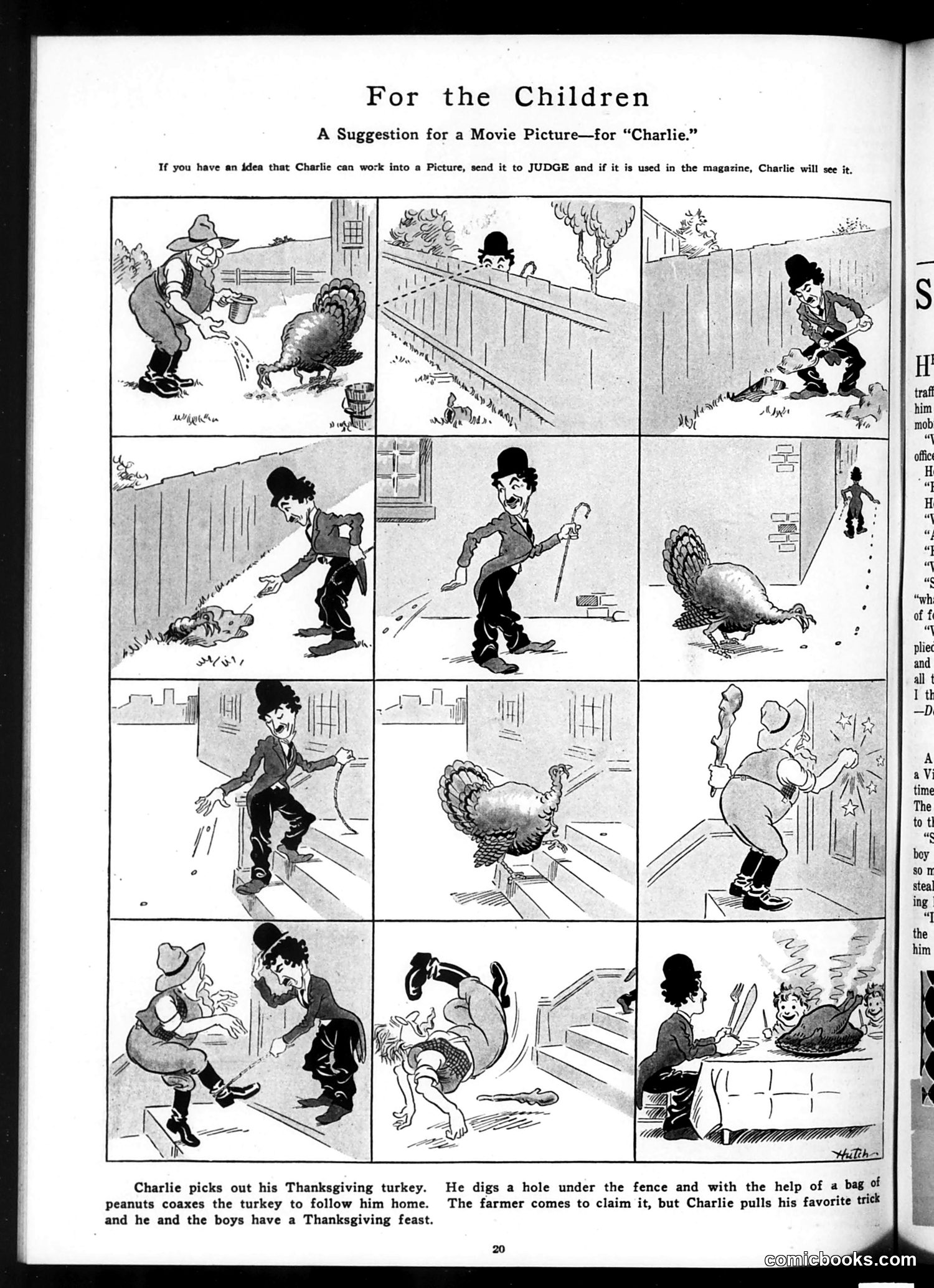
This is a comic strip proposal submitted to *Judge* magazine for film adaptation featuring "Charlie"—likely referring to Charlie Chaplin, whose "Tramp" character was hugely popular in silent films of the 1910s-20s. The strip depicts a slapstick scenario: Charlie steals a farmer's turkey by luring it under a fence with peanuts, then outwits the farmer's attempt to reclaim it (his "favorite trick" appears to be physical comedy), allowing Charlie and street boys to share a Thanksgiving meal. The page invites readers to submit movie ideas to *Judge*, which would share profitable concepts with Chaplin's production company. This reflects the era's burgeoning film industry and *Judge's* engagement with popular entertainment. The humor relies on Charlie's archetypal mischievous-underdog persona—stealing food for impoverished children resonates as sympathetic rather than criminal, a common Chaplin trope.
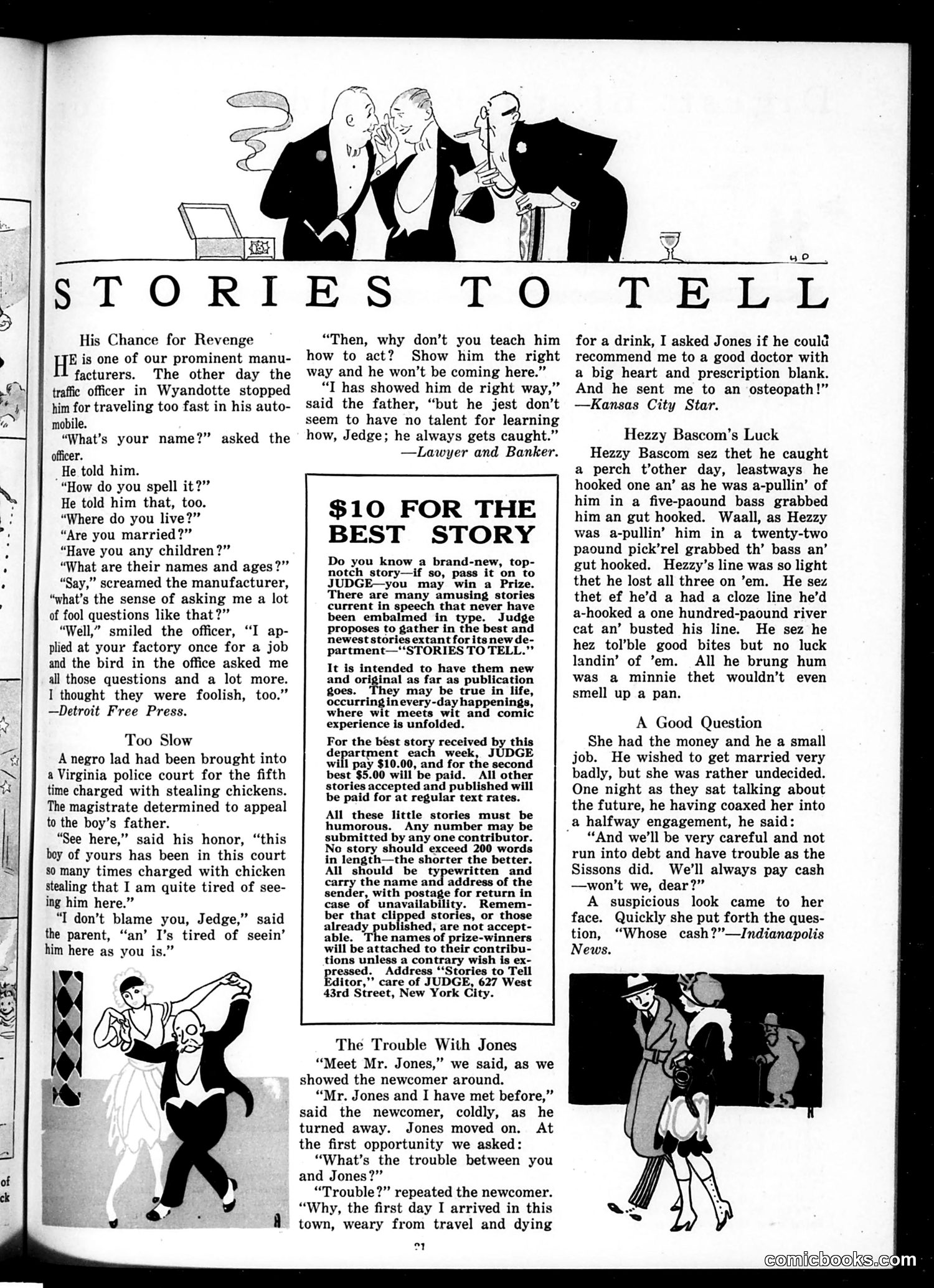
This page from *Judge* (a satirical weekly) contains several brief humorous anecdotes mocking everyday absurdities: **"His Chance for Revenge"** satirizes bureaucratic rudeness: a factory owner stopped for speeding is peppered with intrusive questions by a traffic officer—who reveals he's taking revenge for the manufacturer's hiring office asking him similarly pointless questions years earlier. The joke targets industrial-era hiring practices as needlessly invasive. **"Too Slow"** uses racist dialect humor (common in period publications) to joke about a Black youth repeatedly arrested for chicken theft. The magistrate's exasperation is deflated when the boy's father admits teaching him "right" but the boy lacks aptitude for *not* getting caught—darkly comic resignation. **"The Trouble With Jones"** plays on misunderstanding: a newcomer coldly rebuffs Jones because Jones once directed him to an osteopath instead of a medical doctor—a mild social insult treated as lasting enmity. The page also advertises *Judge*'s "$10 for the Best Story" contest, soliciting humorous anecdotes from readers.
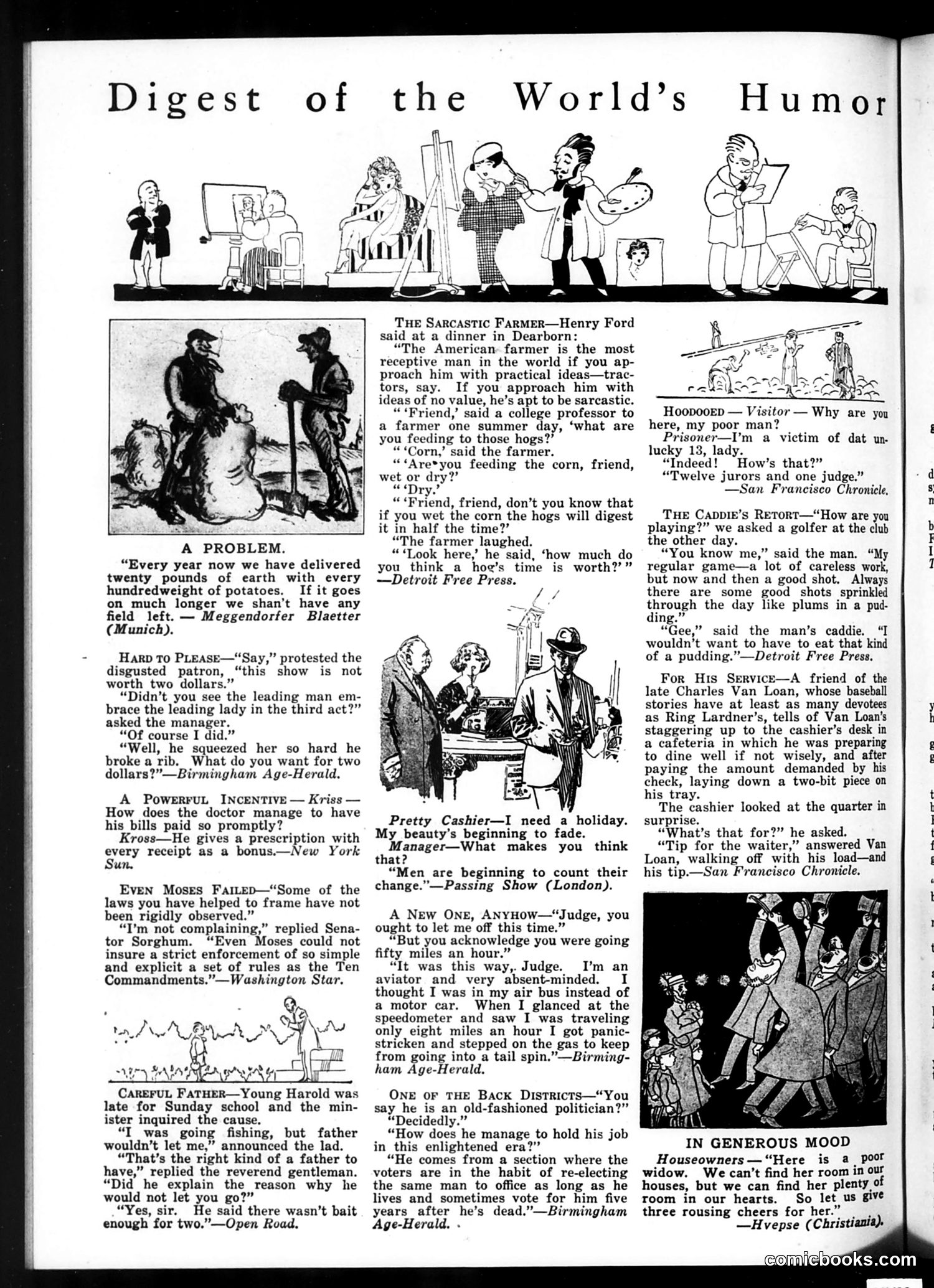
This page from *Judge* magazine collects brief humorous anecdotes translated from international sources, arranged as a "Digest of the World's Humor." **Key satire includes:** - **"The Sarcastic Farmer"**: A Henry Ford quote about American farmers being practical but sarcastic. The anecdote ridicules a college professor offering supposedly scientific advice (wetting corn speeds hog digestion) to a farmer who sarcastically questions the professor's understanding of actual farm economics. - **"Pretty Cashier"**: A joke about a young woman's fading beauty measured by men no longer carefully checking their change—implying her attractiveness was her only value. - **"One of the Back Districts"**: Satirizes rural voter loyalty, where constituents re-elect the same politician for life, even voting for him years after death—mocking backward political practices. - **"The Caddie's Retort"**: Golf humor where a caddie sarcastically critiques a golfer's inconsistent play (good shots mixed with bad, like "plums in pudding"). The overall tone mocks pretension, foolishness, and social hypocrisy through everyday scenarios.
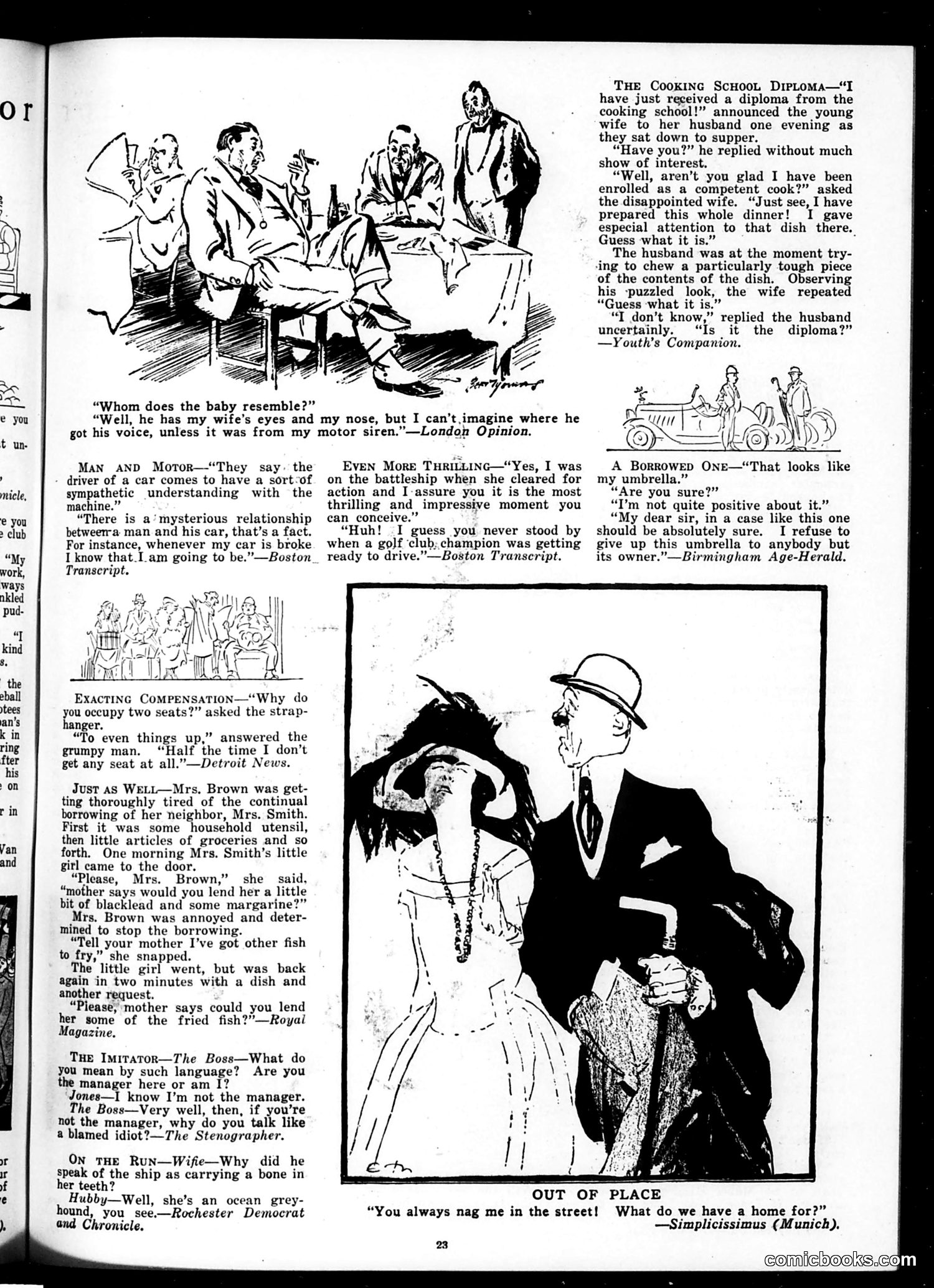
This page collects brief humor items typical of early-20th-century satirical magazines. The jokes mock everyday domestic and social frustrations: **"The Cooking School Diploma"** satirizes a newly credentialed wife whose cooking remains inedible—her husband, unable to identify what he's eating, sarcastically asks if it's the diploma itself. The joke targets both false credentialism and wives' domestic incompetence (a common period stereotype). **Other vignettes** include: a man claiming his car and he share a "sympathetic understanding" (anthropomorphizing automobiles, then novel); a grumpy transit rider claiming two seats to "even things up"; and a neighbor persistently borrowing household items until asked about "fried fish"—a deadpan punchline. **"Out of Place"** (bottom right) depicts a henpecked husband criticized for nagging in public, asking what home is for—inverting typical gender roles for comedic effect. The humor relies on marital discord, class anxiety, and urban irritations—recognizable to Judge's middle-class readership. Most jokes are gentle observations rather than pointed satire, typical of the magazine's lighthearted approach.
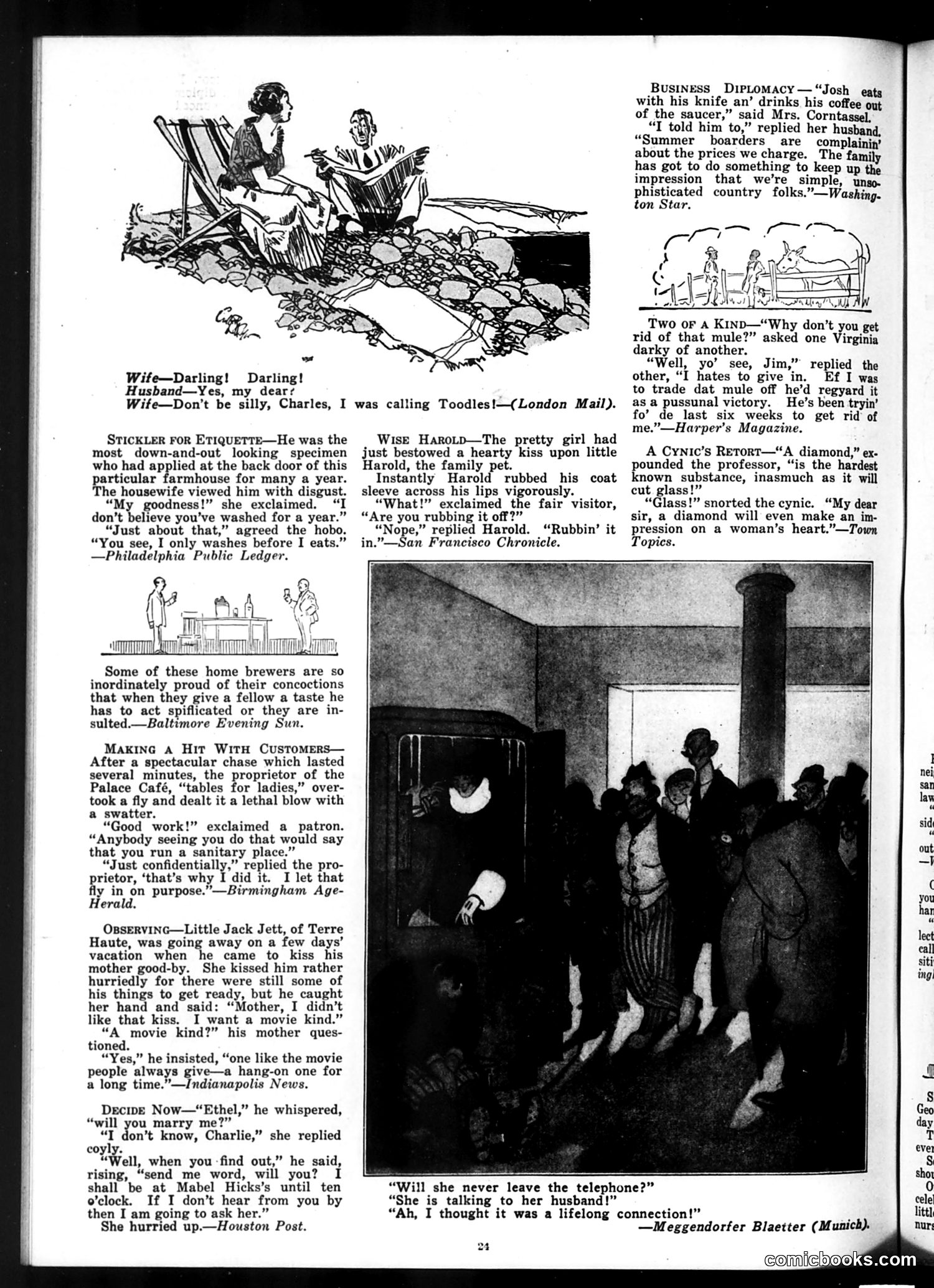
This page contains humorous anecdotes rather than political cartoons. The jokes reflect early 20th-century American domestic life and social attitudes: **Key themes:** - **Marital dynamics**: Multiple jokes about wives, husbands, and romantic relationships—often portraying wives as demanding or husbands as reluctant suitors - **Class commentary**: A hobo's poor hygiene, "home brewers" during Prohibition, and rural/Southern dialect humor depicting working-class characters - **Gender roles**: Women depicted as frivolous (obsessed with movie-style kisses, telephone calls) and manipulative in romance - **Sanitation/modern concerns**: Jokes about restaurant hygiene and cleanliness anxiety - **Rural life**: Southern dialect humor and farm settings The final cartoon (with photograph) references telephone culture and marriage as a "lifelong connection"—a pun on telephone terminology. The humor is gentle, domestic satire typical of Judge's era—reflecting anxieties about modernity, social class, and changing gender relations rather than explicit political commentary.
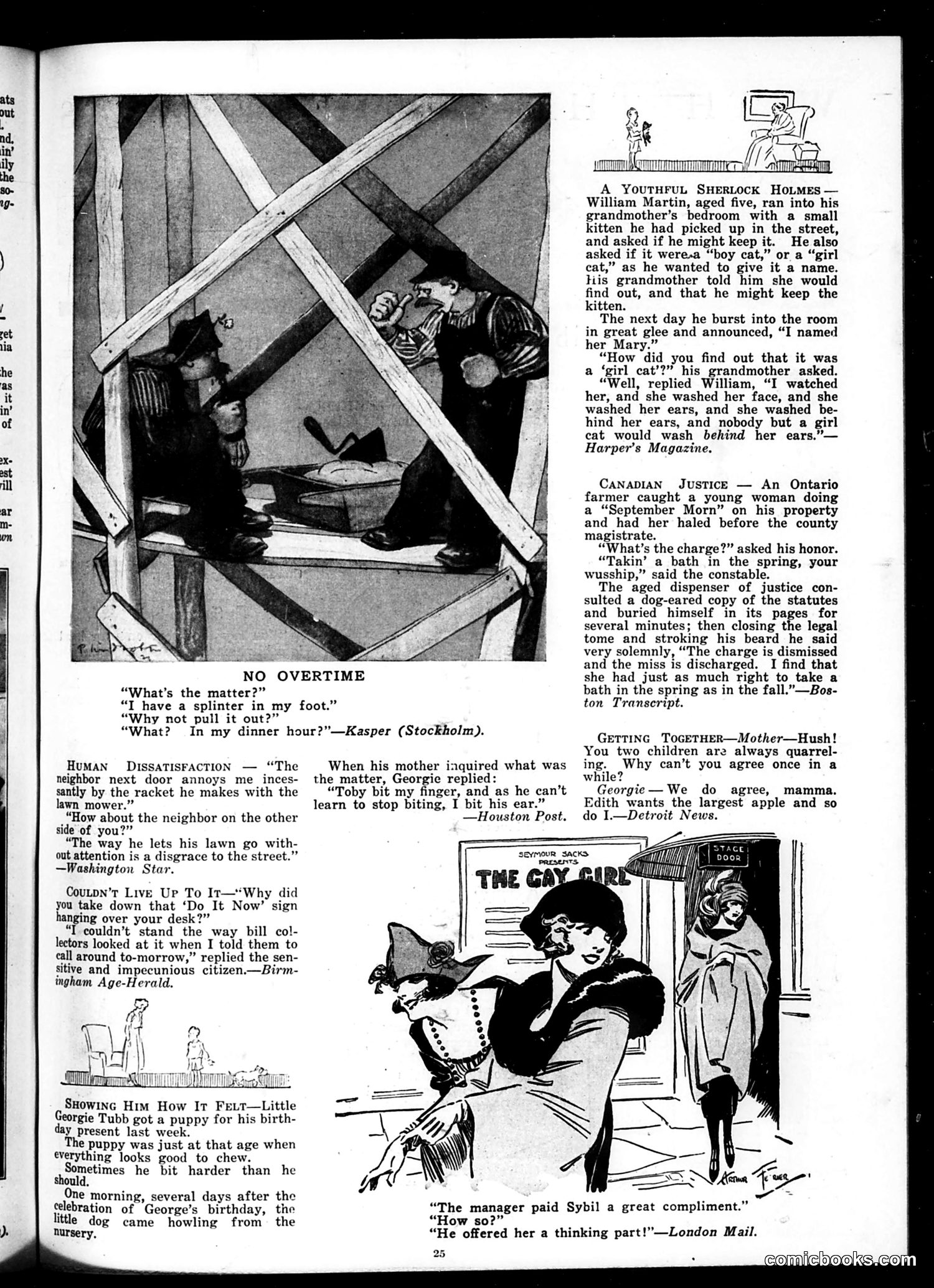
This page collects humorous short anecdotes rather than political cartoons. The main items: **"A Youthful Sherlock Holmes"**: A five-year-old boy deduces a kitten's sex by observing it wash "behind her ears"—implying only girls do thorough grooming. The "Sherlock Holmes" reference invokes the famous detective's deductive methods applied comically to childish logic. **"Canadian Justice"**: Satirizes judicial incompetence. A magistrate solemnly dismisses indecent exposure charges after consulting law books, reasoning a woman has equal right to bathe in spring as in fall—missing the actual offense entirely. **Other brief items** mock workplace laziness, neighborly annoyances, and a child's literal retaliation (biting back a puppy that bit him). The cartoons at bottom show domestic comedy: a woman with a cat offered a theatre role, and a child-rearing disagreement resolved through agreement on wanting the largest apple. The humor is gentle, family-oriented satire typical of early 20th-century *Judge* magazine.
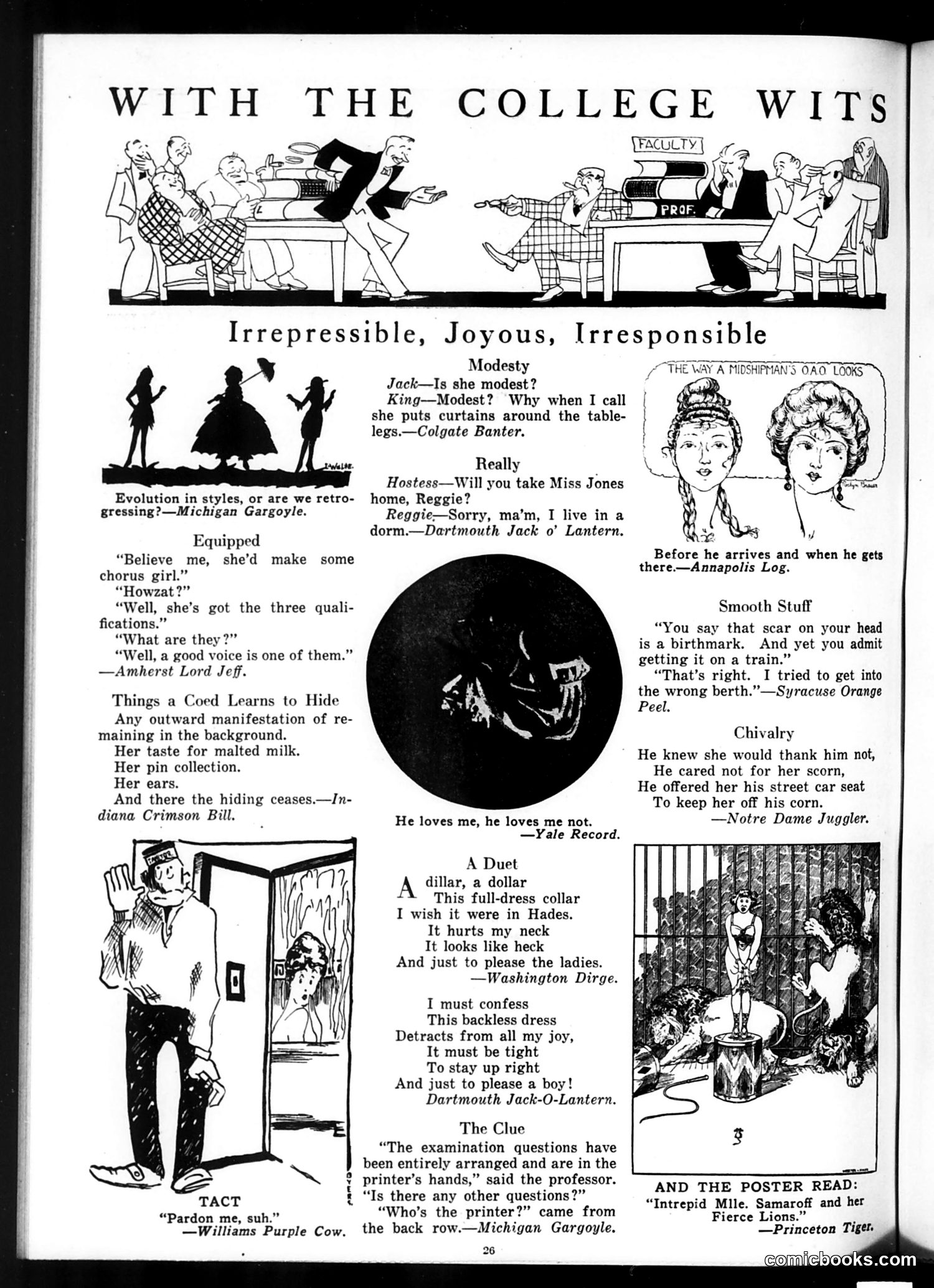
This page collects humorous quips and cartoons from various college newspapers, satirizing undergraduate life and social conventions of the era (likely 1920s-30s, based on style). **Main themes:** **Fashion/Gender**: Jokes mock women's fashion constraints—uncomfortable collars, backless dresses that must be cinched tight "to please the ladies/a boy," suggesting women endure physical discomfort for male approval. **Courtship rituals**: Multiple jokes play on romantic uncertainty and awkward social interactions (the "loves me, loves me not" circular image). **Academic life**: One joke mocks professors' authority—when an exam professor asks for questions, a student asks who the printer is, implying the professor has lost control. **Modesty ironies**: Coeds are portrayed as modest yet vain (hiding ears but displaying pin collections). The satire targets both student pretension and the rigid social expectations imposed on young men and women navigating college social hierarchies. The humor is gentle, collegiate mockery rather than sharp political commentary.
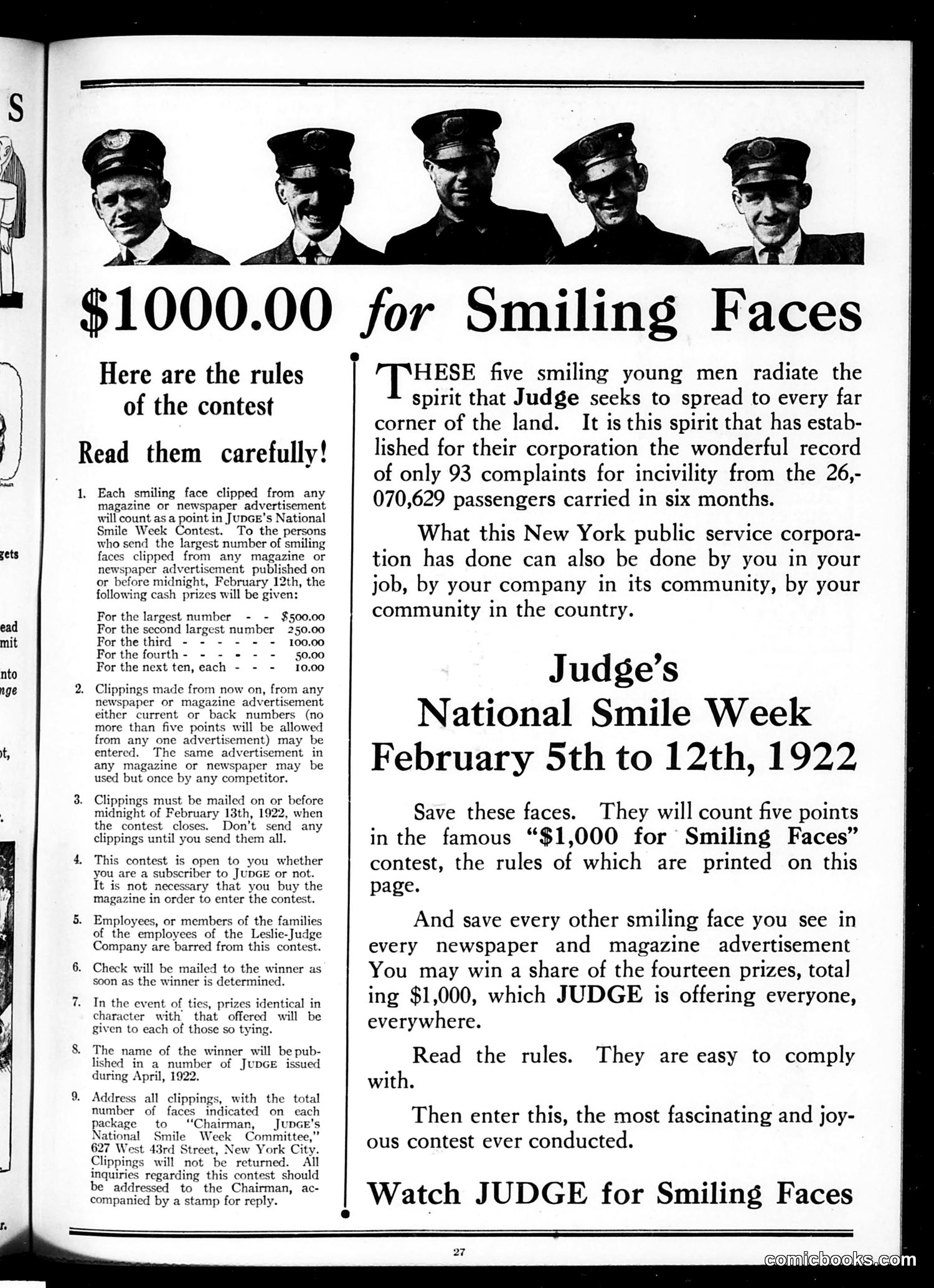
This is primarily a **contest advertisement**, not political satire. Judge magazine is running a "$1,000 for Smiling Faces" contest during February 5-12, 1922, encouraging readers to clip smiling faces from advertisements and mail them in for prizes. The five men pictured at top appear to be **employees of a New York public transit corporation** (likely the subway system), presented as exemplars of service-industry politeness. The text notes their company received only 93 incivility complaints from over 26 million passengers in six months—positioning "smiling faces" as a corporate virtue worth emulating. The contest reflects **1920s progressive-era optimism** about spreading positivity through commercial culture. Readers could enter clippings from any ads; largest submissions won up to $500. For modern readers: this reveals how advertising, employee branding, and mass-participation contests functioned in early 20th-century American magazines as both entertainment and moral instruction.
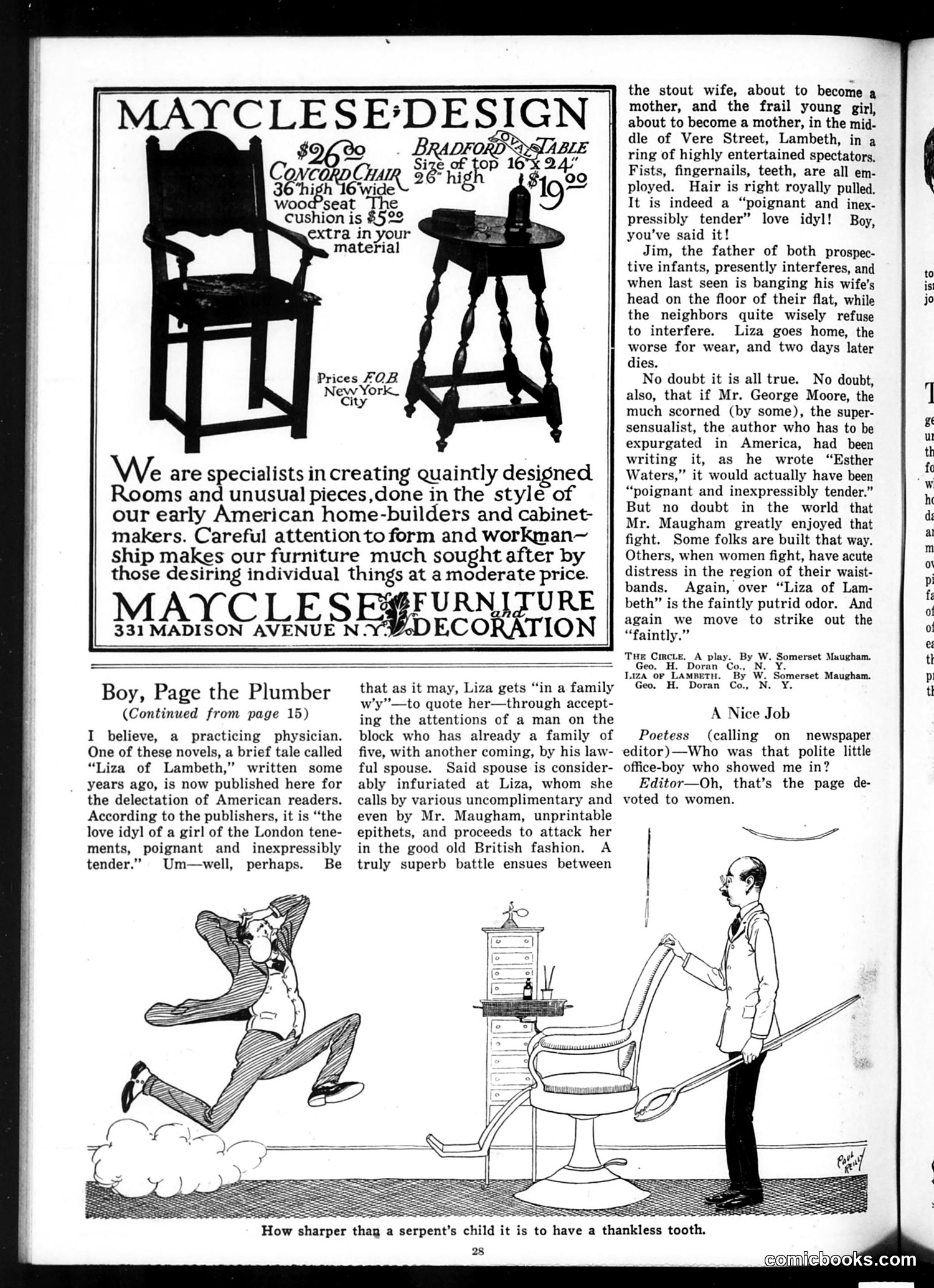
This page contains a furniture advertisement and two satirical pieces. The main cartoon at bottom, captioned "How sharper than a serpent's child it is to have a thankless tooth," shows a plumber being chased from a bathroom by an angry man wielding a plunger—a visual pun on the plumber's trade. The joke plays on Shakespeare's famous line about ingratitude. Above it, "A Nice Job" is a brief comedic exchange: a female poet visits a newspaper editor asking about a polite office boy. The editor replies he's "the page devoted to women"—a cutting joke suggesting the women's section employs only inexperienced or disposable staff. The longer article reviews W. Somerset Maugham's novel "Liza of Lambeth," describing its plot of a pregnant working-class woman fighting another pregnant woman in the street, with domestic violence and the protagonist's death. The reviewer notes Maugham appears to have enjoyed writing the brutality, contrasting his approach with that of more censored author George Moore. The Mayclese furniture advertisement occupies the upper portion.
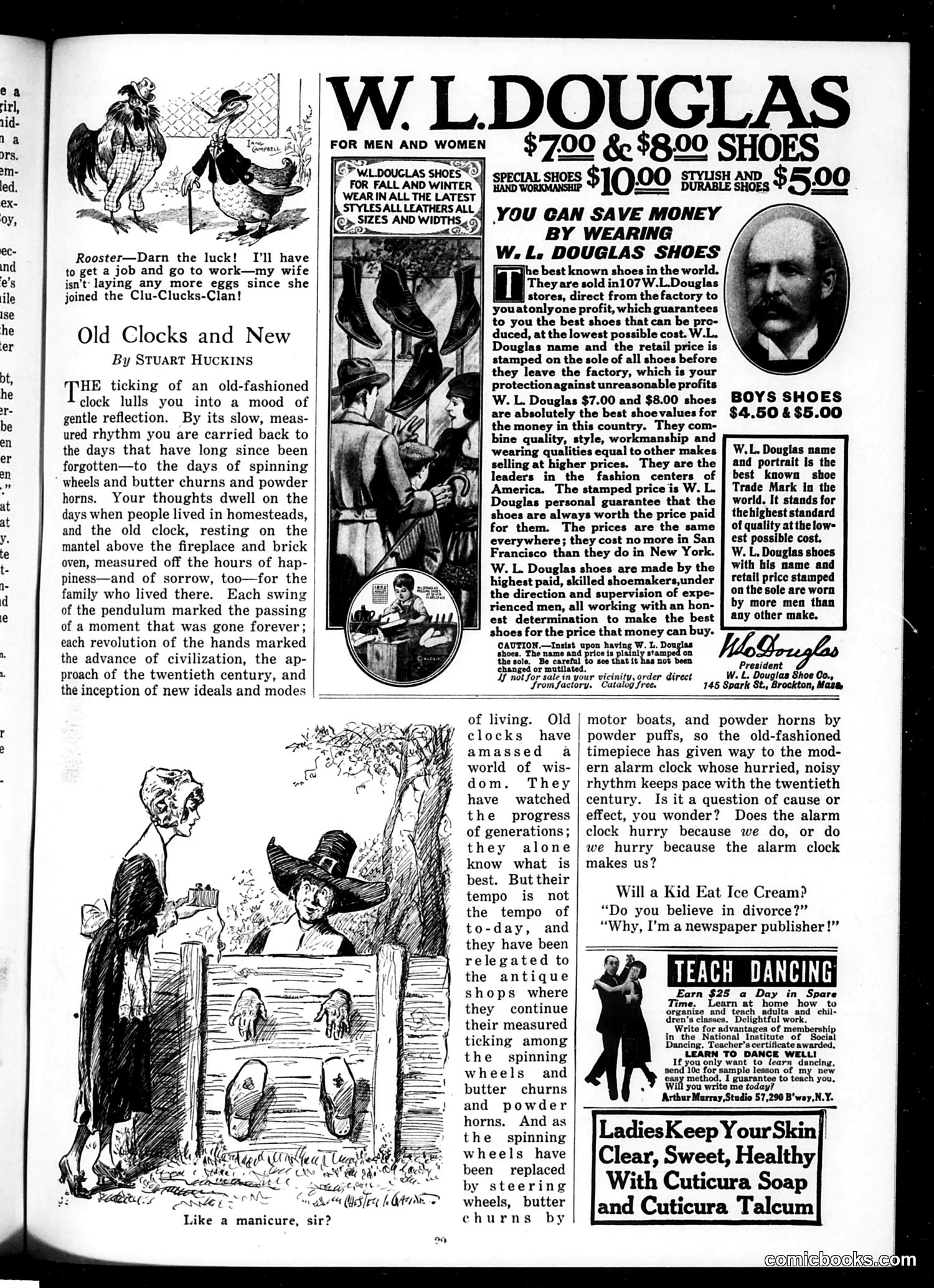
The top-left cartoon satirizes the **Ku Klux Klan** through a visual pun. A rooster complains he must get a job because his wife has stopped laying eggs since joining the "Clu-Clucks-Clan"—a play on words mocking the KKK. The joke targets the organization's absurdity and suggests it distracted members (here, the hen) from productive work. This reflects Judge's contemporary satirical criticism of the Klan during its 1920s resurgence. The main article, "Old Clocks and New" by Stuart Huckins, is a nostalgic essay contrasting old-fashioned mechanical clocks with modern alarm clocks. It reflects period anxieties about industrialization and the accelerated pace of modern life—old clocks represented a slower, more measured past, while alarm clocks symbolize the rush of the twentieth century. The remaining content is primarily **advertising**: W.L. Douglas shoe advertisements dominate the right side, along with ads for dancing lessons and Cuticura soap. The page is essentially a vehicle for commercial promotions typical of Judge's revenue model.
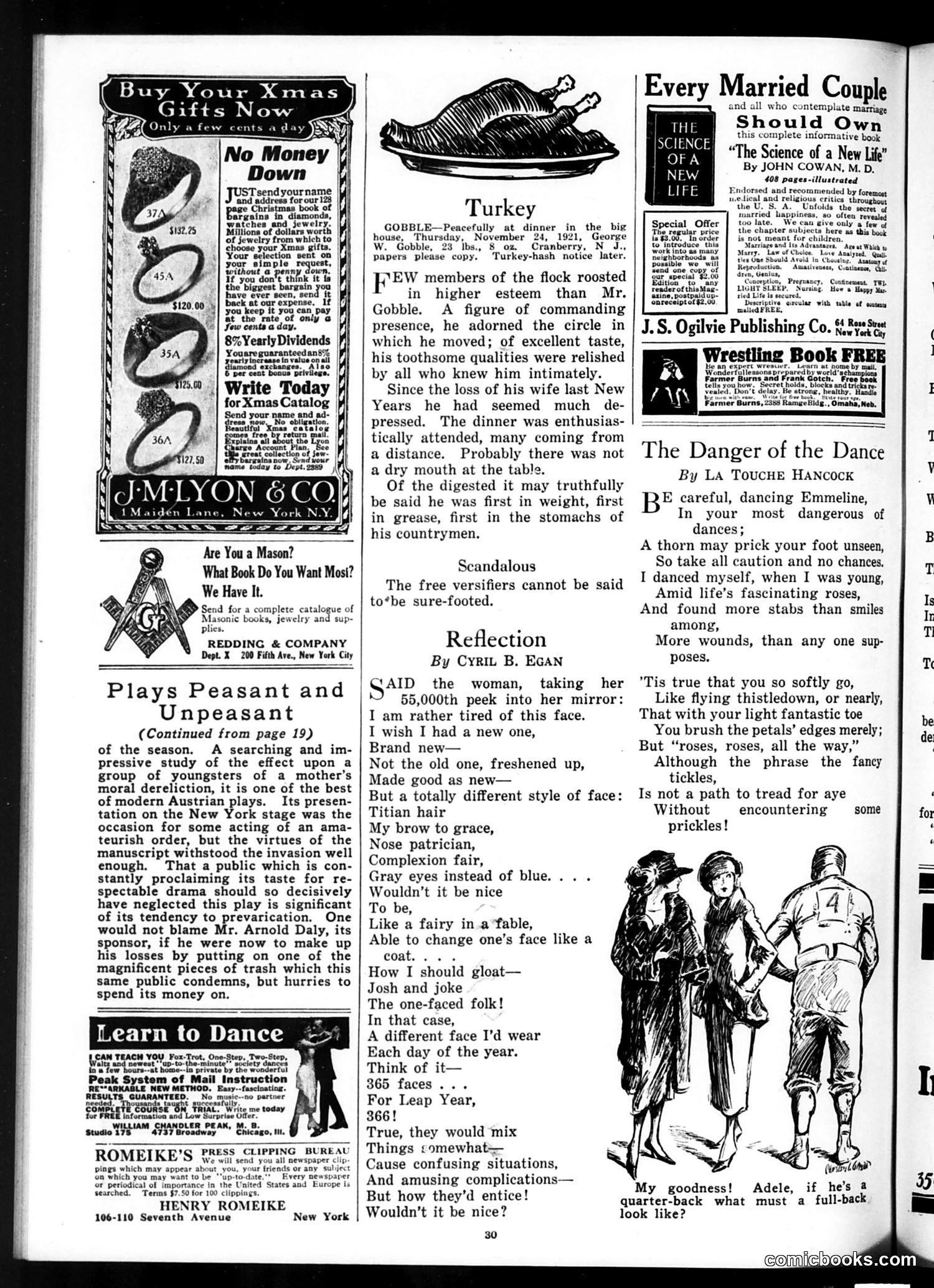
**"Turkey" (satirical obituary):** This is mock-serious death notice for "George W. Gobble"—a anthropomorphized turkey killed for Thanksgiving dinner (November 24, 1921). The joke plays on the bird's name and human qualities: he's eulogized as respected and dignified ("commanding presence"), yet the cruel punchline emphasizes his ultimate fate as food in "the stomachs of his countrymen." It's darkly humorous satire about holiday consumption. **"Reflection" (poem by Cyril B. Egan):** A lighthearted poem about female vanity, capturing 1920s attitudes toward women's appearance obsession. The speaker fantasizes about changing her face daily like changing clothes—365 different faces yearly. The satire gently mocks women's supposed preoccupation with looks while acknowledging the chaotic confusion such freedom would create. It's mild social commentary disguised as whimsy, typical of era attitudes toward gender and beauty. Both pieces are typical Judge content: satirical commentary on contemporary life through humor and irony.
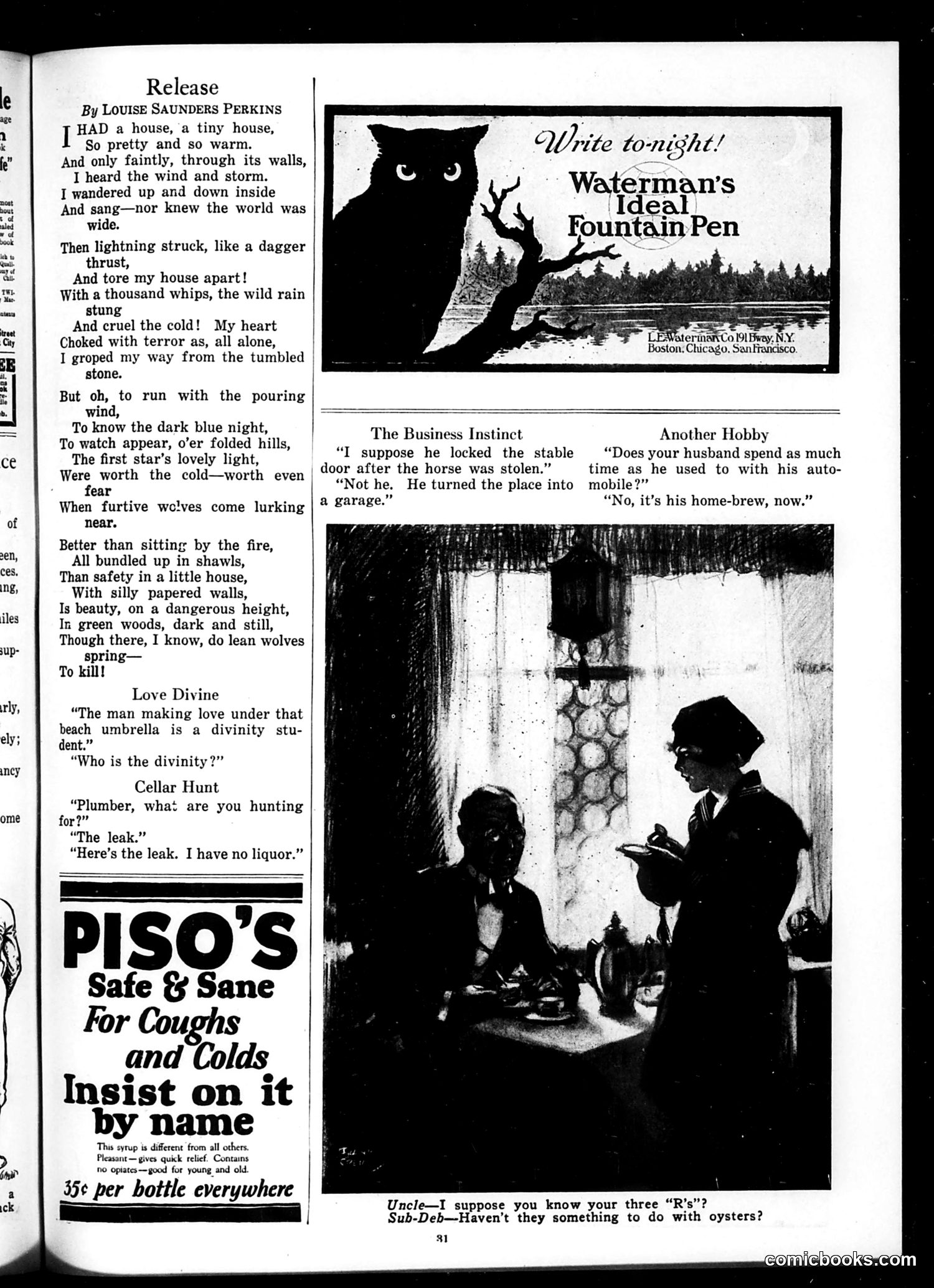
This page contains poetry, short humorous quips, and advertisements typical of early 20th-century Judge magazine. **"Release"** by Louise Saunders Perkins is a Romantic poem contrasting safe confinement with dangerous freedom—the speaker's house is destroyed, yet she celebrates the liberation of experiencing nature's wild elements and starlight, accepting the attendant perils (wolves). The brief jokes satirize contemporary social attitudes: "Love Divine" plays on the irony of theology students; "Cellar Hunt" is a pun about plumbers seeking leaks (with wordplay on alcohol prohibition); "The Business Instinct" mocks automotive conversion of horse stables into garages as practical modernization; "Another Hobby" suggests a husband's interest has shifted from automobiles to home-brewed alcohol (likely referencing Prohibition era). The final cartoon shows an uncle testing a "sub-deb" (young debutante) on the three R's (reading, 'riting, 'rithmetic). Her answer conflates "R's" with oysters—suggesting ignorance or flirtatiousness. Advertisements for Waterman fountain pens and Piso's cough syrup occupy significant space.
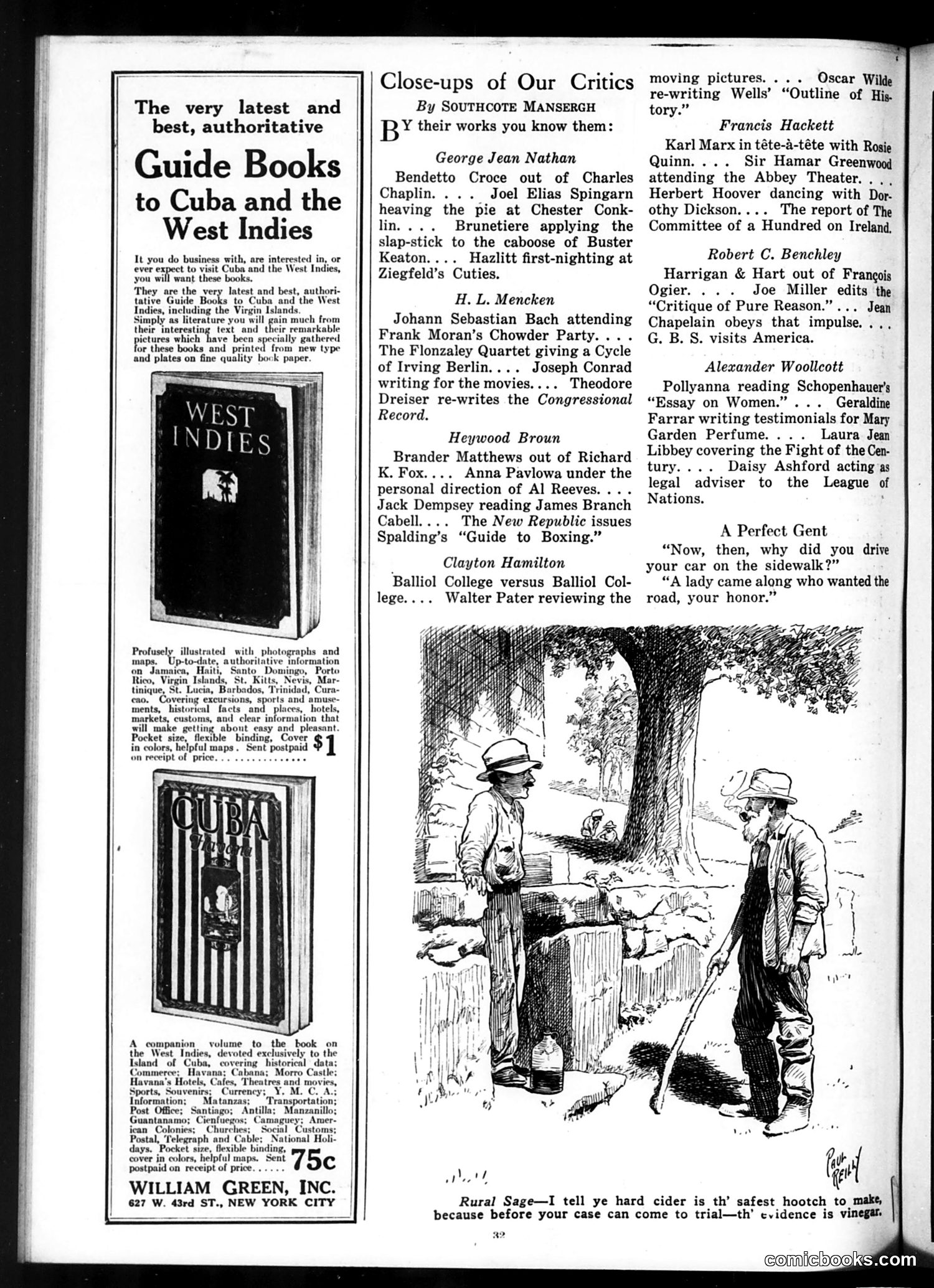
This page mocks prominent literary and cultural critics of the era (likely 1920s) by pairing their names with absurd, incongruous juxtapositions. The satire works by imagining these serious intellectuals in ridiculous scenarios. For example, H.L. Mencken is imagined as "Johann Sebastian Bach attending Frank Moran's Chowder Party"—combining high culture with lowbrow vulgarity. Theodore Dreiser "rewrites the Congressional Record" (treating politics as fiction). Alexander Woollcott becomes "Pollyanna reading Schopenhauer"—pairing saccharine sentimentality with dense philosophy. The cartoon below depicts two rural men discussing bootleg cider during Prohibition, joking that hard cider becomes vinegar before legal prosecution occurs—a commentary on the era's alcohol enforcement. The page also advertises travel guides to Cuba and the West Indies, suggesting American interest in Caribbean tourism and commerce at this period.
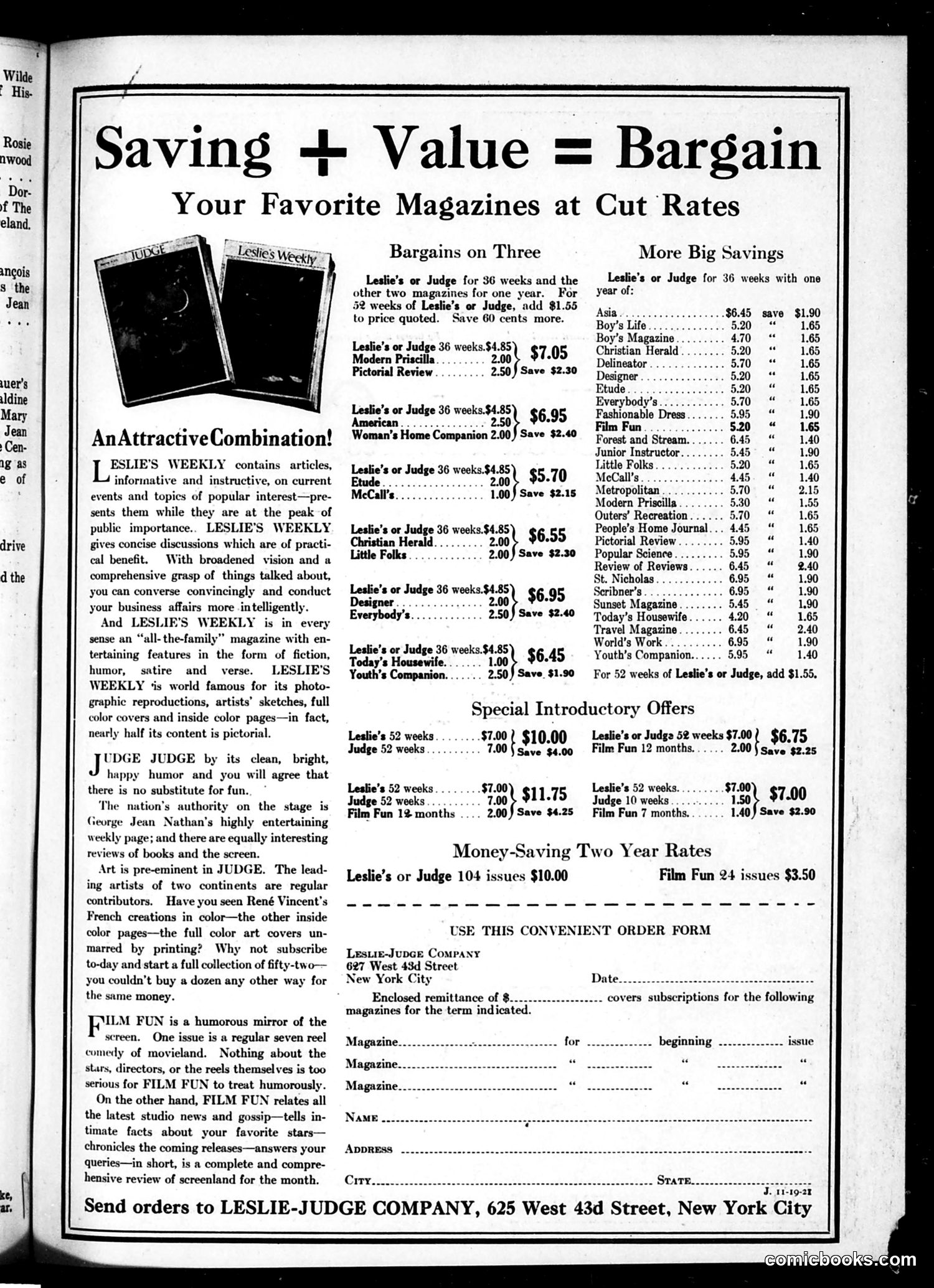
This is **not a cartoon or satirical content page**, but rather a **full-page advertisement** for subscription deals from the Leslie-Judge Company (dated around 1918, based on the address format). The page promotes three magazines: - **Leslie's Weekly**: described as containing current events coverage, practical discussions, fiction, humor, and pictorial content - **Judge**: presented as a humor and arts magazine featuring theater reviews by George Jean Nathan and work by renowned illustrators like René Vincent - **Film Fun**: positioned as entertainment coverage of movieland, gossip, and upcoming releases The "Saving + Value = Bargain" formula at the top is a straightforward marketing pitch offering discounted subscription bundles—combining multiple magazines or longer subscription terms to achieve savings. There are no political cartoons, caricatures, or satirical commentary visible on this page. It is essentially a commercial offer designed to encourage magazine subscriptions through attractive pricing.
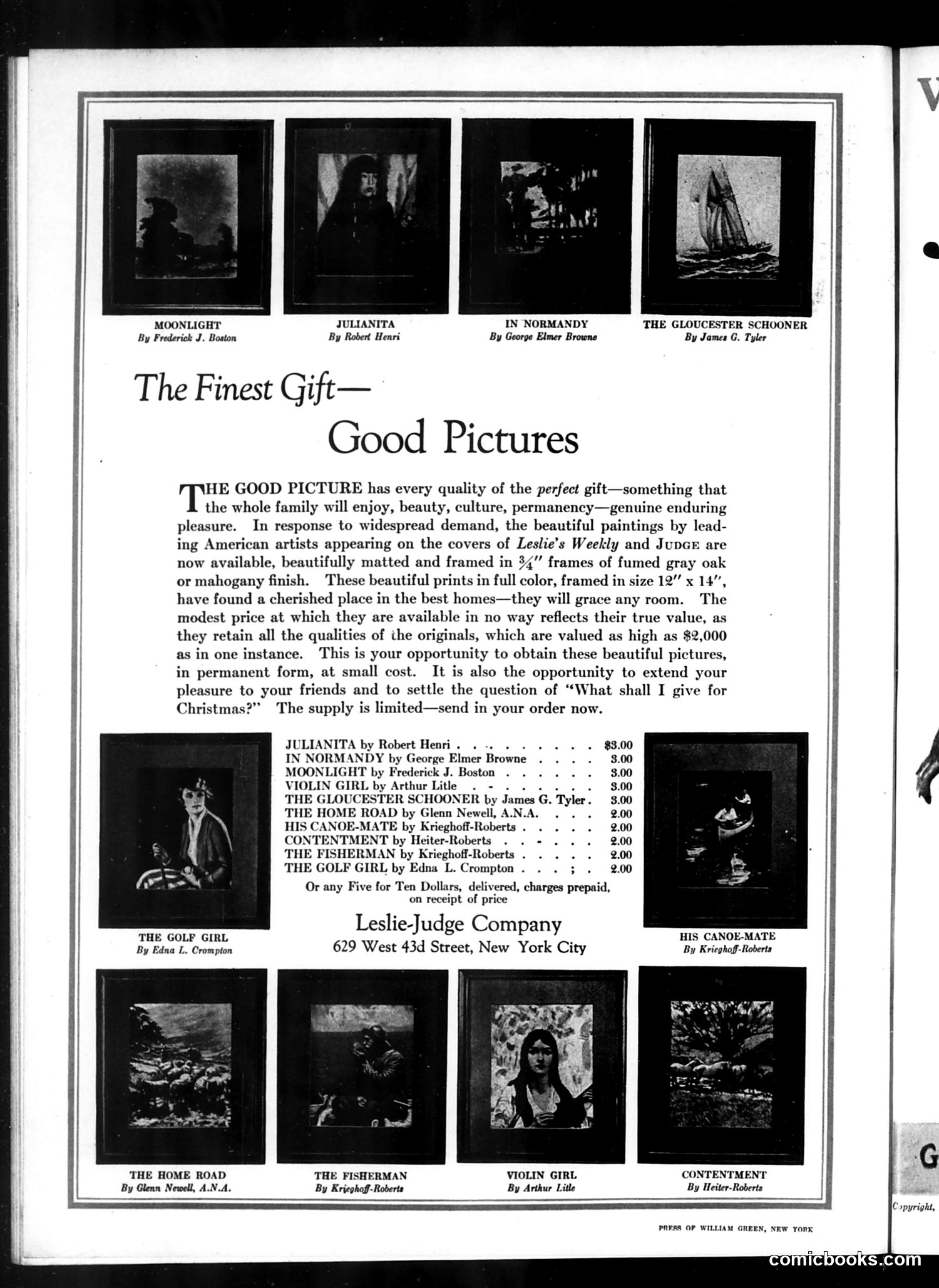
This is **not a cartoon or satire page** but rather a **full-page advertisement** for framed art prints. Judge magazine, known for satire, is here promoting reproductions of paintings by leading American artists that previously appeared on magazine covers. The pitch emphasizes that these artworks—originally valued up to $2,000—are now available as affordable, matted and framed prints ($2-3 each, or five for $10) suitable as Christmas gifts for "the whole family." The advertisement lists ten paintings with artists' names (Robert Henri, George Elmer Browne, James G. Tyler, etc.), featuring landscapes, portraits, and genre scenes. The "satire" here is implicit: Judge is monetizing its own editorial content by selling reproductions to readers, presenting mass-produced art as democratically accessible culture. There is **no political commentary or caricature**—this is purely commercial, marketing "good pictures" as the "finest gift" for middle-class homes.