
Judge, 1921-11-19 · page 12 of 36
Judge — November 19, 1921 — page 12: what you’re looking at
What you’re looking at
This is a theater review by Heywood Broun critiquing actress Alla Nazimova's performance in a modernized film adaptation of *Camille*. The satire targets the contradiction of "updating" classic literature: the producers add contemporary conveniences (limousines, electric lights) to appear modern, yet the material remains fundamentally sentimental and outdated. Broun argues that modern audiences find the self-sacrificing heroine's logic foolish—no respectable woman would abandon a lover for an elderly man. More pointedly, Broun criticizes Nazimova herself for playing the character as merely *herself* rather than embodying Camille. She performs the role perfunctorily ("going through the motions"), failing to convince viewers she's actually dying. The actress appears indifferent to the character's substance, treating *Camille* as interchangeable with any other role. This undermines any genuine dramatic interpretation or emotional connection audiences might achieve.
📄 Transcribed text from this page (OCR, searchable)
Machine-transcribed from the original scan — historical spelling and the odd misread are preserved.
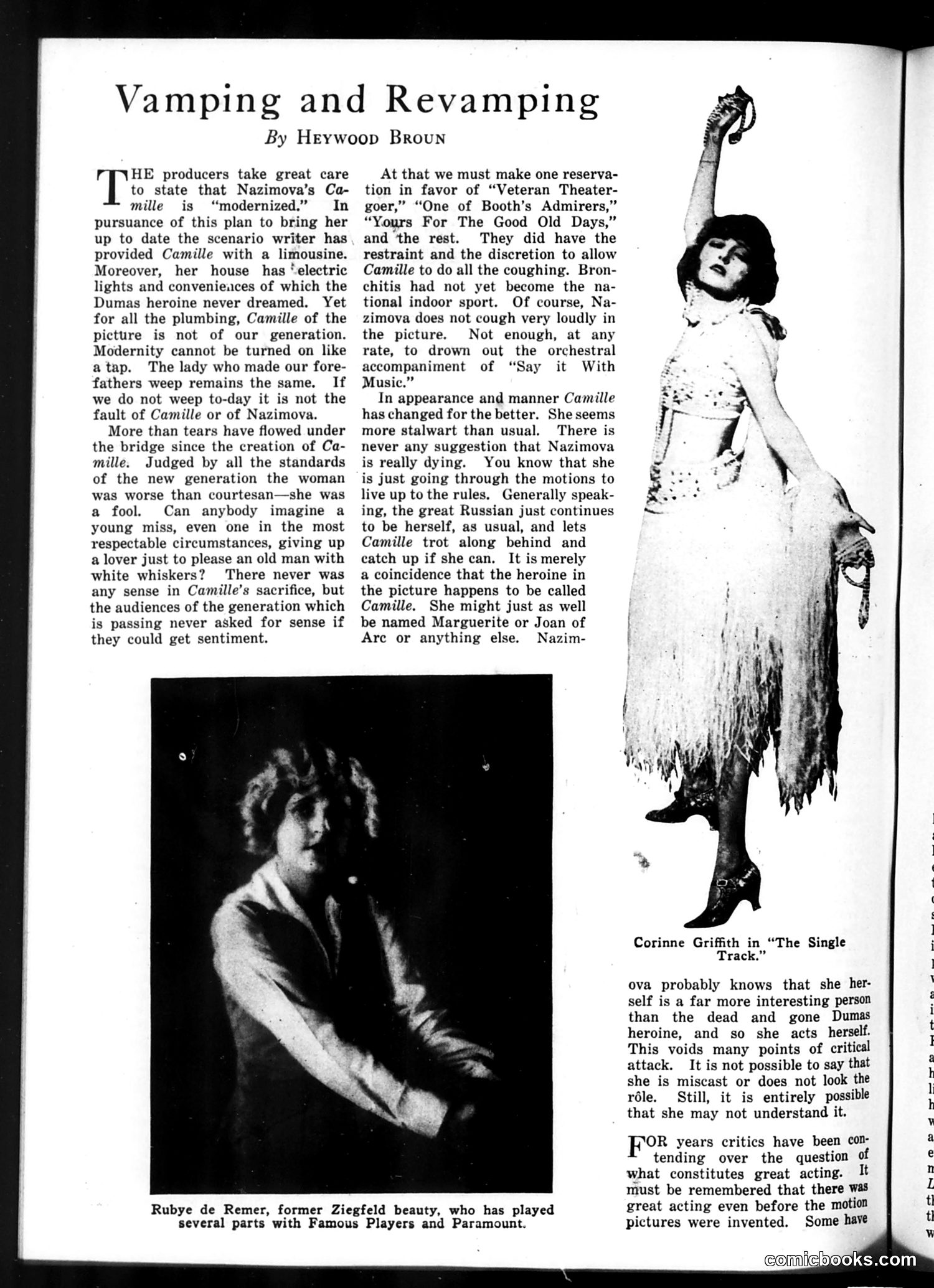
Vamping and Revamping By Heywoop Broun HE producers take great care Te state that Nazimova’s Ca- mille is “modernized.” In pursuance of this plan to bring her up to date the scenario writer has provided Camille with a limousine. Moreover, her house has ‘electric lights and conveniences of which the Dumas heroine never dreamed. Yet for all the plumbing, Camille of the picture is not of our generation. Modernity cannot be turned on like atap. The lady who made our fore- fathers weep remains the same. If we do not weep to-day it is not the fault of Camille or of Nazimova. More than tears have flowed under the bridge since the creation of Ca- mille. Judged by all the standards of the new generation the woman was worse than courtesan—she was a fool. Can anybody imagine a young miss, even one in the most respectable circumstances, giving up a lover just to please an old man with white whiskers? There never was any sense in Camille’s sacrifice, but the audiences of the generation which is passing never asked for sense if they could get sentiment. At that we must make one reserva- tion in favor of “Veteran Theater- goer,” “One of Booth’s Admirers,” “Yours For The Good Old Days,” and the rest. They did have the restraint and the discretion to allow Camille to do all the coughing. Bron- chitis had not yet become the na- tional indoor sport. Of course, Na- zimova does not cough very loudly in the picture. Not enough, at any rate, to drown out the orchestral accompaniment of “Say it With Music.” In appearance and manner Camille has changed for the better. She seems more stalwart than usual. There is never any suggestion that Nazimova is really dying. You know that she is just going through the motions to live up to the rules. Generally speak- ing, the great Russian just continues to be herself, as usual, and lets Camille trot along behind and catch up if she can. It is merely a coincidence that the heroine in the picture happens to be called Camille. She might just as well be named Marguerite or Joan of Are or anything else. Nazim- Rubye de Remer, former Ziegfeld beauty, who has played several parts with Famous Players and Paramount. Corinne Griffith in “The Single Track.” ova probably knows that she her- self is a far more interesting person than the dead and gone Dumas heroine, and so she acts herself. This voids many points of critical attack. It is not possible to say that she is miscast or does not look the réle. Still, it is entirely possible that she may not understand it. FoR years critics have been con- tending over the question of what constitutes great acting. It must be remembered that there was great acting even before the motion pictures were invented. Some have